A Wheelchair-Using Child’s Barcelona Waterfront Day: Maritime Museum, Aquarium and Seafront Transitions

Updated
Can the Maritime Museum and Aquarium work as one shared family day?
Yes, provided the waterfront transition is planned as carefully as the two attractions. The workable sequence is the Museu Marítim in the Drassanes, a deliberately paced crossing from the old shipyards to Port Vell, and then Barcelona Aquarium on Moll d’Espanya. What makes the day succeed is not simply that both venues describe themselves as accessible. It is knowing which entrance is in use, where the next toilet and genuine rest point are, how much exposed movement the child can comfortably tolerate, and exactly where the family can shorten the route without making the child feel responsible for everyone else losing the day.
The Maritime Museum gives the family the more controlled opening: an indoor cultural visit in a large historic building, with the option to keep interpretation selective. Its official planning page identifies accessible entrances at Carrer de Josep Carner and Portal de Santa Madrona, says the building is wheelchair accessible, notes a lift to Espai Mirador, and states that wheelchairs and lightweight portable stools can be requested. Those are useful access facts, but they do not answer every child-specific question. Check the museum’s official visit-planning page close to the date, then confirm which entrance is operating, the location of an accessible toilet, lift status, and the availability of seating or stools when you arrive.
The Aquarium is a larger energy commitment. Its own guidance recommends allowing at least two hours, and the family must still reach it across a busy piece of waterfront rather than through a protected internal connection. For a child who uses a wheelchair, that middle section can determine whether the Aquarium feels like the rewarding second half of the day or one commitment too many. Treat the route as three separate environments—museum, waterfront, Aquarium—and authorize a decision at the end of each. That is more reliable than promising the family in advance that all three will happen.
A child’s wheelchair changes the planning question
“Wheelchair accessible” is a building-level description. A family day depends on the child, the chair, the accompanying adults, and the way the child wants to participate. An adult traveler who self-propels, a child in a manual chair pushed by a parent, and a child using a powered chair with postural supports may all encounter the same step-free entrance differently. Small front casters react more strongly to joints and uneven paving. A low seated eye line can make an Aquarium window exciting in one gallery and obstructed in another. A child who can transfer briefly may value a conventional bench; a child who remains in the chair may need space beside the bench so the family can rest together.
Before choosing the long or short route, establish the child’s own access profile rather than assuming that an adult wheelchair itinerary can simply be shortened. Useful questions include these:
- Does the child self-propel, use powered mobility, or depend on an adult to push? The answer changes how gradients, camber, wind, and crowd density are felt.
- How often does the child need a position change, pressure-relief pause, medication, food, or a toilet? Build those needs around known indoor anchors rather than hoping the waterfront supplies them at the right moment.
- Can the child see displays comfortably from the usual seated height, or does the family need to rotate positions and seek lower viewing points?
- Is the child comfortable with dim galleries, tunnel-like spaces, echo, moving images, or tightly clustered visitors? Physical access and sensory ease are separate questions.
- What kind of assistance does the child accept in public? A route that preserves independence may be preferable to a nominally shorter line that requires constant pushing or lifting.
- What does the child most want from the day: ships, sea animals, a treasure hunt, open-air movement, or time with siblings? That preference should shape the sequence.
There is also a family dynamic to protect. A wheelchair-using child should not be cast as the reason the group cannot continue, while siblings should not be expected to suppress all of their own interests. The practical answer is to give every person a role and to pre-agree the branch points. One adult can be responsible for access and tickets, another for sibling engagement, and the child can choose among two or three meaningful options. This is a day about Barcelona’s relationship with the sea, not a medical logistics exercise conducted in public.
Families planning a wider stay may also find Barcelona wheelchair-access planning beyond the waterfront useful. That guide addresses a different urban problem—Gaudí interiors, pavements, and hills—but the same principle applies: access quality is created by transitions as much as by entrances.
Think in three zones, not one flat waterfront
Zone one: the Drassanes and the museum interior
The Museu Marítim occupies the former royal shipyards at the lower end of La Rambla. For route planning, its chief advantage is containment. Once the correct step-free entrance is found, the family can settle into a weather-protected environment, establish the child’s energy level, and choose a selective path through maritime history. The building is large enough that “seeing the museum” is not a useful target. A better target is one coherent story—how ships were built, how Barcelona’s port connected the city to the Mediterranean, or how navigation changed movement and trade—supported by a handful of objects or spaces.
Zone two: the Drassanes-to-Port Vell transition
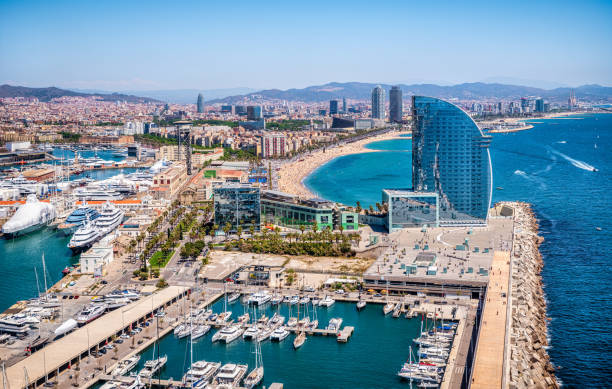
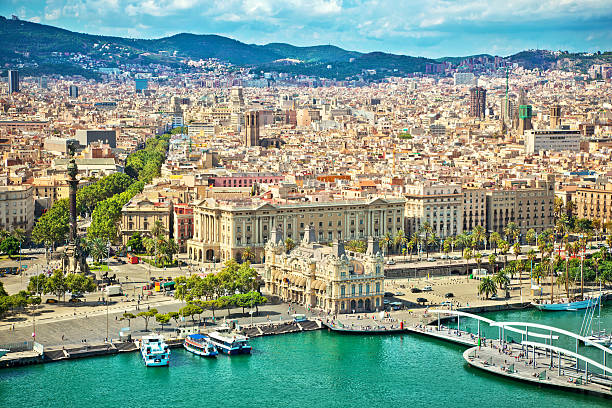
This is the segment most likely to be underestimated. On a map, the Maritime Museum and Aquarium appear to belong to the same waterfront cluster. On the ground, the family must leave a controlled interior, orient toward Portal de la Pau and the Columbus Monument area, negotiate broad road space and pedestrian flows, and then continue onto the Port Vell side toward Moll d’Espanya. The planning objective is a continuous step-free line, but the public-realm segment is not guaranteed by either venue and should be checked against current works. Even where no stair is involved, the route is not uniformly smooth, shaded, quiet, or free of detours. Paving joints, kerb transitions, bridge approaches, drainage channels, crowd compression, cyclists, sun, and wind can accumulate into real effort.
Zone three: Moll d’Espanya and the Aquarium
Arrival at the Aquarium does not end the access work. The family still has an admission threshold, possible queues, internal vertical movement, toilets to locate, and a long sequence of displays. The Aquarium may be the child’s high-interest anchor and the sibling favorite, but it is also the part least suited to an improvised “we will just see how it goes” approach. Its recommended minimum visit is already two hours. Once the group enters, the adults need to know whether they are following a compact priority route, a full family route, or a split route in which one adult is prepared to leave with the child.
This three-zone view is also more truthful to the geography than treating “the waterfront” as one attraction. For the broader historical choice between Drassanes, Port Vell, and Barceloneta, see the wider maritime-quarter context. For this family route, however, Barceloneta should normally remain an optional extension, not a promised fourth act.
How to use the Maritime Museum without exhausting the first half
The official access information gives the family a sound starting point: two named accessible entrances, wheelchair access within the building, a lift to Espai Mirador, and mobility aids or portable stools on request. The planning consequence is that the museum can function as more than a place to “fill time” before the Aquarium. It can be the part of the day where the child has the most control. Staff can direct the family to the active entrance and lift, the group can establish a comfortable pace, and adults can observe how the chair handles the building before committing to the outdoor crossing.
Do not equate a large museum with a requirement to cover every gallery. A specialist family route should have a defined interpretive arc and a stop rule. Choose three anchors before entering: one that explains the Drassanes as a working shipbuilding place, one that makes the scale or construction of vessels legible, and one that connects maritime movement to the present-day port outside. The exact objects on display can change, so the method is more durable than an object-by-object script. Ask staff which current spaces best support those three questions and which can be reached with the least backtracking.
For a younger child, interpretation should be concrete and visible. Look for size, material, movement, sound, or a before-and-after comparison. “How would this heavy piece have been moved?” is more child-scaled than a long explanation of maritime administration. A primary-school child can keep a simple visual record: three shapes used in ships, two tools, and one clue about life on board. A teenager may respond better to engineering, labor, trade, empire, or the changing relationship between the old shipyards and the modern port. These are family prompts, not claims about a specific museum activity, and they can be adjusted to the child’s communication style.
Siblings need a task that does not turn them into assistants. One can choose the family’s “most surprising object,” another can photograph or sketch a structural detail where permitted, and the wheelchair-using child can decide which of the three anchors deserves more time. The point is shared authorship. When the family later reaches the waterfront, those museum choices become a lens for reading cranes, boats, water, and harbor movement rather than a disconnected indoor lesson.
Use the museum’s portable stools or existing seating as a group resource, not as a special accommodation for one person. If the child stays in the chair, adults and siblings should still sit when the family pauses; otherwise the stop can feel like everyone is waiting for the child to recover. Ask where the nearest accessible toilet is early in the visit, not at the moment it becomes urgent. If a larger changing surface or particular transfer space is required, contact the museum directly because a generic accessible-toilet label does not confirm those details.
A sensible museum dwell time for this combined day is often around 75 to 105 minutes, but that is an editorial planning range rather than an official recommendation. A child with a strong maritime interest may want longer; a child saving energy for the Aquarium may need only one major hall or storyline. The exit decision should be made while the family is still comfortable, not after signs of fatigue have become obvious.
The waterfront transition is the real test
When the museum visit ends, the next move is not simply “walk to the Aquarium.” First ask staff which accessible exit is operating and which gives the cleanest current line toward Port Vell. Construction, temporary barriers, events, and crowd controls can change the most convenient route. The family should leave with a first pause point in mind, not with the Aquarium as the only acceptable destination.
The geography can be understood as a sequence of manageable pieces:
- Museum exit to the Portal de la Pau area. This is the orientation phase. Confirm that everyone has used the toilet, adjusted clothing, secured loose items, and agreed whether the Aquarium remains the plan.
- The major road and pedestrian crossing near the Columbus Monument. Treat the signal cycle as a constraint. Do not begin hurriedly at the end of a green phase. One adult should watch the full group and traffic environment rather than walking ahead to scout while another adult manages every person.
- The approach to Rambla de Mar. This is where open sun, wind, busier pedestrian flow, and mixed directions become more apparent. Keep siblings on an agreed side of the wheelchair, especially if the chair has a wider turning radius or a powered control.
- The bridge and Moll d’Espanya approach. Expect changes in gradient and surface feel even when there is no stair. Small casters, anti-tip wheels, footplates, and low ground clearance can make minor transitions more consequential than they appear to a walking adult.
- The Aquarium threshold. Stop before joining any admission flow. Decide whether the child is ready for at least the priority route inside, and identify the first toilet or rest location after entry.
For a family moving at a child-led pace, allow roughly 30 to 45 minutes from the museum exit to the Aquarium threshold, including one pause and an unhurried crossing. This is not an official journey time and may be shorter in calm conditions. Its purpose is to stop the schedule from treating outdoor movement as empty time. A ten-minute adult walk on a map can become a much longer family transition when a signal is missed, the child needs a position change, a sibling wants water, or the group waits for a less crowded path across the bridge.
Surface quality should be judged dynamically. Look several metres ahead for ridges, damaged paving, drainage gaps, temporary cables, and abrupt camber. A parent pushing a manual chair may need to approach a joint squarely rather than at an angle. A child using powered mobility may prefer to control speed independently, while an adult monitors the surrounding flow. Never grab the chair without permission unless there is an immediate safety issue. The child may know exactly how the chair handles a slope or threshold.
Moll de la Fusta can function as a waterfront breathing space or a separate short-route destination, but it is not automatically the shortest line to the Aquarium. Barcelona City Council’s listing identifies a reduced-mobility reserved space beside the control tower and a public toilet bank that includes an adapted unit. See the official Moll de la Fusta listing. That information is useful for contingency planning, yet the family should still verify current opening, access, and exact location rather than relying on the toilet as the only option. Diverting toward it can add distance, and an “adapted” unit may not meet every child’s transfer or changing needs.
Weather alters the same route in different ways. In heat, the exposed transition can consume energy before the Aquarium. In wind, pushing effort and temperature comfort change. In rain, smooth paving can become slippery and umbrellas can reduce visibility in crowds. The two indoor venues do not make the day weather-proof because the connection remains outdoors. If the forecast is difficult, either reduce the museum visit, use a prearranged accessible vehicle between anchors where legal stopping can be confirmed, or split the attractions across different days.
What the Aquarium’s accessibility statement does—and does not—settle
Barcelona Aquarium’s official FAQ states that its facilities are completely accessible to people with disabilities. It recommends at least two hours for the visit and says visitors may remain as long as they wish during the day. It also indicates that leaving and returning requires a new admission, so the family should treat the exit as final unless staff confirms a different arrangement. These points are set out on the Aquarium’s official FAQ.
That accessibility statement is important, but it is not a promise that every child will have the same viewing experience. Aquarium environments often concentrate visitors at popular windows, narrow attention toward a single focal point, and move people through dark or highly stimulating spaces. A wheelchair can reach a gallery while the child still struggles to see through standing adults. The practical response is not to rush ahead of the crowd; it is to let one wave pass, position at the side of a viewing area where possible, and decide which displays matter enough to wait for.
Ask at entry where the lifts, accessible toilets, and quieter or more open areas are located. Also ask whether any lift is temporarily unavailable and how the step-free visitor route changes if so. “Completely accessible” gives confidence about the overall facility, but only current staff can explain a temporary diversion. If the child’s chair is long, has extended footplates, or requires a larger turning circle, mention that rather than asking only whether a wheelchair fits.
The Aquarium’s two-hour recommendation should be treated as a baseline for a conventional visit, not a requirement to complete every part. For this combined day, define a priority route before the child enters. It might consist of three marine environments, one major immersive sequence, and one activity chosen by the children. If energy remains, continue. If not, leave without describing the visit as incomplete. The child’s successful experience is a better measure than the percentage of exhibits covered.
Re-entry policy matters to family splitting. If one adult takes the child outside for a quiet pause, the group should assume that adult and child will not simply return on the same admission. A better internal strategy is to create short waiting points inside the accessible route: one adult and a sibling can look at a nearby display while the child pauses with another adult, then the group rejoins without crossing the exit line. If the child needs to leave altogether, the remaining family members can finish and meet later at a pre-agreed external pickup point.
When private coordination changes the outcome
Private coordination matters when one route has to preserve wheelchair access, sibling interest, and a credible early-exit plan at the same time. A guide or planner can hold the interpretive thread while another adult manages the child, verify the active entrances and lifts, keep siblings involved, and maintain a vehicle or shortened-route contingency. The value is not ceremonial service; it is reducing the number of decisions parents must make while moving. Families seeking that level of tailor-made support can review private Barcelona touring options with flexible pacing and Inquire now.
Use family activities as engagement tools, not obligations
The Aquarium lists several family activities: an all-day treasure hunt collected at the entrance, “Journey into the Depths” beginning in the exhibition area, and second-floor Aqua Protectors and interactive games. The official family-activities page describes them as suitable for all ages. These can give siblings a constructive role and help the wheelchair-using child make choices, but availability and the exact format should be checked for the visit date.
A treasure hunt is useful when it helps the family notice rather than hurry. Give each child only a small part of the task, or allow them to work together. If the activity turns the galleries into a race, it will work against wheelchair pacing and crowd management. “Journey into the Depths” can be treated as a shared narrative thread rather than another item to complete. Interactive games may be especially useful for siblings while the child takes a physical pause, provided the family confirms that the controls and sightlines suit the child too.
Age matters, but interest and fatigue matter more. Preschool-age children may benefit from a repeated visual question—find something that hides, something that glides, and something with an unexpected shape. Children in primary school can compare movement, habitat, or defense. Teenagers may prefer conservation, animal behavior, photography, or the design of the Aquarium itself. A child who communicates nonverbally can still direct the visit by choosing between images, pointing, using a device, or signaling “more” and “finished.”
Siblings should receive planned moments of independence that do not compromise supervision. One adult can accompany them to an interactive station while the child and another adult remain at a nearby viewing point. The group should reunite by time and place, not by vague instruction. Five or ten minutes at a named display is manageable; “meet us somewhere upstairs” is not. The family’s route should make rejoining easy even when mobile reception is poor or the interior is noisy.
Three workable route branches
The short route: Maritime Museum and one waterfront threshold
Choose the short route when the child’s best energy is limited, the chair requires frequent adjustment, the weather makes the exposed connection costly, or the family wants culture without committing to a second long interior. Spend about 60 to 90 minutes in the Museu Marítim, using one interpretive storyline and a planned toilet stop. Then move only as far as the family can comfortably reach toward Portal de la Pau or a verified Port Vell pause point. The waterfront finish can be visual: connect the shipyard history to the working harbor, watch boats, identify the old-to-new transition, and stop while the child is still engaged.
This is not a failed Aquarium day. It is a complete maritime route with an indoor core and an outdoor conclusion. Siblings can each choose one harbor observation or photograph. The family can reserve the Aquarium for another morning, when the child arrives with fresh energy and the two-hour recommendation is easier to honor. This branch is especially sensible if the family has already scheduled another major interior later in the day.
The full route: museum, transition, and a priority Aquarium visit
The full route works best when the child is interested in both ships and marine life, the adults can share responsibilities, and the family has no fixed appointment immediately afterward. Use approximately 75 to 105 minutes in the museum, 30 to 45 minutes for the waterfront transition, and at least two hours at the Aquarium. Add time for toilets, food, ticketing, and one pause, and the plan becomes a substantial day block of roughly five to six hours rather than a quick double attraction.
Keep the interpretive logic simple. The museum answers how people built, navigated, and organized movement by sea; the waterfront reveals the modern harbor as urban space; the Aquarium shifts attention below the waterline. That gives the day coherence without requiring a lecture. It also lets each child have a different favorite while still sharing one subject.
Do not automatically add Barceloneta, a long seafront promenade, or another museum. The family has already completed two interiors and an exposed transition. A further walk may be physically possible but can make the final hour feel like endurance. For a broader city plan that distributes child-focused attractions more intelligently, use a broader first-trip plan for Barcelona with children.
The early-exit branch: make the decision before the crisis
The most useful early-exit plan has three gates. Gate one is inside the Maritime Museum, before the family commits to the waterfront. Gate two is at the Port Vell threshold, before crossing onto Moll d’Espanya. Gate three is immediately before Aquarium admission. At each gate, ask the same questions: Is the child comfortable? Is the chair functioning well? Has the next toilet been identified? Are siblings still regulated and engaged? Does the family have enough reserve for the next environment?
If the answer changes after Aquarium entry, one adult should be authorized to leave with the child while the others finish a defined route. Because same-day return after exit should not be assumed, do not frame leaving as a brief outside break. Agree in advance who keeps essential medication, charging equipment, documents, and transport details. The child should not have to wait while adults redistribute critical items in a crowded lobby.
Design bailout points that preserve dignity
A bailout is not simply a taxi summoned when everyone is exhausted. It is a pre-agreed place where the family can stop, separate, or change mode without blame. The most effective points are before a new commitment: at the museum exit, before the major waterfront crossing, before Rambla de Mar, and before Aquarium admission. Each has a different consequence.
At the museum exit, the family can end the cultural visit and return by the transport mode already checked. This is the cleanest exit because no one has crossed the exposed middle segment. The child can still finish with a view toward the port if desired.
Before the bridge toward Moll d’Espanya, the family can keep a short Port Vell experience while avoiding the Aquarium commitment. This works when the child enjoys being outside but the group recognizes that another long interior is too much. The adults need a verified pickup or transit plan; they should not assume a vehicle can stop exactly where the family decides to end.
At Aquarium admission, the group can split. One adult and the child may leave, while siblings enter with another adult. This is emotionally easier when the split was discussed before the day and when the child has a preferred alternative rather than simply “going back.” That alternative might be a quiet drive, time at the accommodation, or a shorter waterfront observation, depending on the family.
Inside the Aquarium, the only true bailout may be final exit. Use internal pauses first if they are comfortable and safe. Once exit is necessary, treat it as a completed visit, even if only the priority displays were seen. The remaining adults should know whether they are leaving too or finishing a short route. Avoid asking the child to wait near the exit while siblings continue for an undefined period.
Rejoining points need to be explicit. Choose a named entrance, a staffed desk, or a prearranged vehicle pickup rather than a broad plaza. State the time, who is responsible for each child, and what happens if the parties are delayed. A family traveling across three generations may need even more deliberate rejoining rules; this three-generation Barcelona framework shows how shared anchors can coexist with different mobility and interest levels.
Arrival, public transport, and the role of a vehicle
Barcelona’s public-transport network is broadly accessible, but network-wide accessibility is not the same as a guaranteed route on a particular morning. TMB reports lifts at 156 of 165 metro stations and directs passengers to individual station pages for current lift status. It also states that the bus network is adapted for reduced mobility and that buses provide access ramps. Consult the official TMB accessibility page, then check the exact station and line needed on the day.
For the Maritime Museum, do not rely only on the fact that a nearby station appears on a map. Confirm that every lift in the required chain is operating, that the accessible entrance is on the useful side of the junction, and that the child’s chair dimensions suit the planned route. A single unavailable lift can turn a simple arrival into a long detour. Bus access may be easier for some families, but crowding, waiting space, and the child’s comfort with ramps and vehicle movement still matter.
An accessible private vehicle can be valuable when it changes a real outcome: reducing exposure in heat or rain, providing an early exit, carrying medical or mobility equipment, or keeping a multigenerational group together. It is not automatically the best way to move between two close waterfront sites. Loading, securement, traffic, and legal stopping can take longer than expected, and the family still needs step-free access between the vehicle and each entrance. Confirm ramp or lift dimensions, wheelchair securement, child restraint requirements, and the exact pickup process in advance.
A useful compromise is to arrive at the museum by the most reliable accessible mode, complete the museum and waterfront decision points on foot or wheel, and hold the vehicle only as a contingency after a pre-agreed time. That avoids turning the day into repeated loading while preserving an exit. For a fuller comparison of walking and chauffeured movement in the city, Barcelona’s walking-versus-vehicle planning principles offers a relevant parallel, even though the terrain and attractions differ.
A practical verification checklist
The source details used here were verified on 18 October 2026. The overall route is evergreen, but entrances, lifts, activities, toilets, transport status, works, and ticket conditions can change. The family should verify operational details close to travel and again on the day when a failed lift or closed access point would materially alter the plan.
- Maritime Museum entrance: ask which of the accessible entrances at Carrer de Josep Carner or Portal de Santa Madrona is open and best for the route toward Port Vell.
- Museum vertical access: confirm lift operation, including access to Espai Mirador if that space is part of the visit.
- Museum rest and toilet provision: locate the accessible toilet, ask about portable stools or loan wheelchairs, and verify any child-specific transfer or changing requirement directly.
- Waterfront works and surfaces: check for temporary barriers, events, bridge restrictions, or construction that could lengthen the step-free line. Observe paving and weather rather than assuming the entire seafront is smooth and calm.
- Moll de la Fusta contingency: confirm whether the adapted public toilet is open and whether using it adds acceptable distance to the family’s route.
- Aquarium admission and access: verify lift routes, accessible toilets, current queue procedure, and any temporary closure that changes the normal visitor sequence.
- Aquarium timing and re-entry: plan for at least two hours if attempting the main visit, and assume that leaving ends the admission unless staff says otherwise.
- Family activities: confirm the treasure hunt, Journey into the Depths, Aqua Protectors, and interactive games offered on the chosen date; do not build the child’s entire motivation around an activity that may change.
- Transit: check the exact metro-station lift status or bus route, not only the network accessibility statement.
- Vehicle contingency: confirm chair dimensions, ramp or lift, securement, child restraint, legal stopping, and the named pickup point.
- Family branch plan: write down who leaves with whom at each decision gate, where the group reunites, and who carries medication, chargers, documents, and contact details.
This checklist should be shared among the adults rather than held in one person’s head. A family member who is interpreting exhibits cannot simultaneously watch crossing signals, manage tickets, monitor siblings, and troubleshoot a chair. Clear division of responsibility is part of access.
When to split the attractions across two days
Combining the Museu Marítim and Aquarium is attractive because the subject and geography connect. Splitting them is often the better choice when the child uses significant energy in transfers, needs a long midday rest, finds crowded interiors tiring, or has a chair that is uncomfortable on extended outdoor surfaces. It is also sensible when siblings are young enough that the Aquarium will dominate their attention and make the museum feel like an obstacle.
A two-day version gives each place a clearer role. On the museum day, the family can use the Drassanes as an architectural and historical anchor, then finish with a short harbor observation. On the Aquarium day, the group can arrive fresh, use the family activities selectively, and leave when the child has had a complete experience. The waterfront transition can still be included in one direction, but it no longer carries the burden of connecting two timed commitments.
Aquarium-first can also work within one day when marine life is the child’s strongest interest or when siblings need an immediate high-engagement start. The tradeoff is that the museum becomes the optional second stop, and the family may reach the Drassanes after the child has already spent two or more hours in a stimulating interior. This reversal is best when adults are genuinely willing to drop the museum rather than pushing to preserve the original plan.
If the family wants a mixed-mobility day with more urban history and fewer enclosed visitor sequences, another Barcelona route may fit better. Montjuïc planning for a mixed-mobility group explains a more topographically demanding alternative built around shared anchors and rejoining points. It is not an easier substitute, but it shows how the same family logic can be applied to a different district.
The standard for a successful waterfront day
The best version of this route is not the one in which the family completes the most. It is the one in which the wheelchair-using child has a real subject to explore, siblings have defined moments of interest, and adults make branch decisions before fatigue becomes public and urgent. The museum, Port Vell, and Aquarium can form a coherent story about ships, harbor space, and marine life, but only when the outdoor transition is recognized as a substantial part of the day.
Begin with verified access at the Drassanes, keep the museum selective, and leave through the entrance that best serves the current step-free route. Cross the waterfront with time for signals, surfaces, wind, crowds, and one pause. Enter the Aquarium only when the family is ready for its two-hour scale and its no-assumed-re-entry consequence. Keep an early exit that preserves dignity, and let splitting the group count as good planning rather than failure.
That is how the waterfront becomes genuinely shared: the child’s wheelchair is neither ignored nor made the day’s sole subject. It is one of the practical conditions around which Barcelona’s maritime story is interpreted, paced, and enjoyed together.
If you’re interested in any private tours of Barcelona, please reach out to us.

















 So if you are looking for the absolute best in Barcelona & surroundings with authentic local fully-licensed native guides whose English you can actually understand and with an exclusive and amazingly fun itinerary













