Montjuïc for a Mixed-Mobility Barcelona Group: Shared Anchors, Steep Transitions and Rejoining Points

Updated
Montjuïc is neither fully accessible nor a hill to dismiss
The common planning mistake is to make one of two absolute claims. The optimistic version says that the funicular, cable car, lifts and venue ramps remove the hill. The pessimistic version says that Montjuïc is too steep for any group containing a wheelchair user, a traveler with limited standing tolerance or an older relative who walks slowly. Neither description is useful. Montjuïc works best when it is treated as a collection of shared destinations separated by transitions of very different difficulty.
That distinction changes the day. A mixed-mobility group does not need every person to cover the same pavement in order to share the same art, architecture and views. It does need a route that identifies which parts are genuinely shared, which transitions should be split, where everyone will meet again and what happens if a lift, funicular or vehicle connection is unavailable. The key question is not “Can we do Montjuïc?” It is “Which Montjuïc moments can we share without requiring the least mobile traveler to absorb every gradient between them?”
For most private groups combining a wheelchair user with stronger walkers, the most dependable cultural anchors are the Museu Nacional d’Art de Catalunya, usually shortened to MNAC, and the Mies van der Rohe Pavilion. Both publish meaningful accessibility information. They are also close enough on a city map to look like one continuous visit, yet their entrances and the terrain between them demand different decisions. That apparent closeness is exactly where poor plans begin.
The strongest structure is usually a shared arrival, a deliberately split transition and a named indoor rejoining point. At MNAC, that point can be the lobby by the information area, where the museum publishes the availability of seating, adapted circulation and accessible facilities. At the Mies Pavilion, the group can enter by different sides and reunite inside, but it is a weaker place for a long wait because the pavilion states that it has no restrooms. These are not minor details. They determine whether a ten-minute delay is inconsequential or exhausting.
This guide therefore treats accessibility as an operating plan rather than a label. It separates verified venue facts from route judgment, uses current transport information only with a date attached, and avoids presenting any untested pavement sequence as universally suitable. For the wider strategic choice between art, views and gardens, see how to decide what Montjuïc is meant to contribute to your Barcelona stay.
Read the hill as three mobility zones
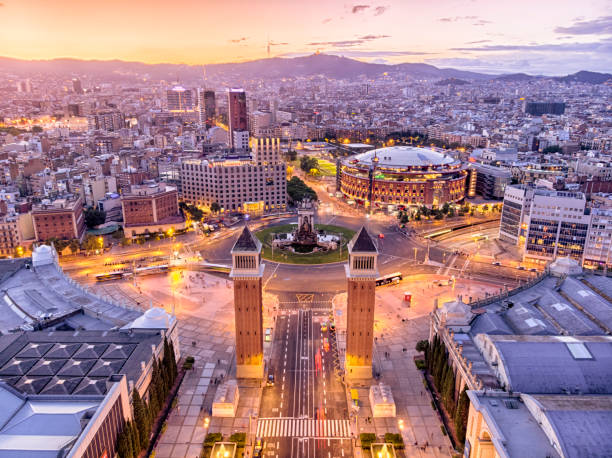
Montjuïc is often described as one destination because the hill has a recognizable name and a dense cluster of attractions. On the ground, however, it behaves more like three overlapping zones: the lower monumental approach around Plaça d’Espanya and the 1929 exhibition axis; the middle cultural shelf around the Mies Pavilion, Palau Nacional and MNAC; and the upper hill, where gardens, Olympic sites, the cable car and Montjuïc Castle pull the day farther from the city grid.
These are planning zones, not formal accessibility categories. They expose the cost between attractions: a step-free interior may have a difficult approach, and an adapted transport installation may still leave outdoor distance, uneven surfaces or unsupported waiting before the next entrance.
Lower approach: Plaça d’Espanya is the obvious visual gateway, but it should not be mistaken for a frictionless starting point. The monumental axis rises toward Palau Nacional. The broad setting can make distances look shorter than they feel, and a map does not communicate repeated level changes, exposed waiting or the effort of crossing a large interchange. For a wheelchair user or someone who needs frequent seats, “start at Plaça d’Espanya and walk up” is not a complete instruction.
Middle cultural shelf: this is where a mixed group can extract the greatest shared value. The Mies Pavilion and MNAC offer distinct but complementary experiences: a compact architectural work whose circulation can be brief, and a large museum where time, seating and gallery choice can be adjusted. Yet the transition between them should be planned as its own segment rather than hidden inside the phrase “then walk to MNAC.” Strong walkers may welcome the monumental climb. The mobility-priority party may need a vehicle or adapted bus connection to the correct entrance level.
Upper hill: this is best treated as an optional module, not the inevitable continuation of the middle zone. A group can decide to add a cable-car ride, an Olympic-area stop or a garden only after confirming the day’s transport status, the exact drop-off and pickup points, the amount of outdoor movement and the return plan. The upper hill is where a loose itinerary most easily turns into multiple small burdens: waiting for a connection, crossing to an entrance, discovering that the next path is steeper than expected and then retracing the same ground.
Barcelona’s Resilience Atlas offers useful context without pretending to certify tourist routes. Its walking-mobility analysis treats a street-section gradient above 6 percent as a conditioning factor and identifies concentrations of highly conditioned sections around the boundaries of Montjuïc. The official methodology is available through the Barcelona Resilience Atlas on everyday mobility. That 6 percent threshold is not a pass-fail rule for an individual traveler. It is evidence that topography is a recognized mobility constraint at street-section level, and it supports planning transitions instead of assuming that one lift or funicular neutralizes the entire hill.
MNAC is a strong shared anchor, but the entrance level matters
The Museu Nacional d’Art de Catalunya occupies the Palau Nacional, the monumental building above the fountains and terraces. Its visual drama encourages people to approach from below. For a mixed-mobility group, however, the iconic frontal ascent and the accessible museum visit should be treated as separate experiences. Strong walkers may choose the monumental approach for the views and architecture. A wheelchair user or traveler conserving energy can arrive nearer the museum’s accessible entrance and meet the walkers inside.
Verified access: Barcelona’s official tourism accessibility entry says that MNAC has two ramps, one on each side of the main entrance. It describes adapted internal routes, lifts and stairlifts that staff activate, benches in the lobby, Oval Hall, Dome Hall and some collection or temporary-exhibition rooms, and a loan service for wheelchairs and folding chairs. It also lists adapted restrooms in the lobby, Oval Hall and Library. The full venue entry is published at the official Barcelona tourism page for MNAC.
Those facts make MNAC valuable for more than step-free entry. The building offers ways to manage fatigue after arrival. A traveler who can walk short distances but cannot stand through a long explanation may benefit more from known benches and a folding-chair loan than from a route described merely as “accessible.” A wheelchair user who transfers occasionally may care about adapted restrooms and lift continuity. A family handling both a stroller and an older adult may need a spacious indoor pause before deciding whether to continue to another gallery.
Vehicle access: the same official entry states that vehicles carrying passengers who require special attention may use a reserved office-access area at the rear after advance notification by telephone. That option should be verified directly with the museum before the visit, because access control, contact details and operational procedures can change. Its importance is strategic: a prearranged rear approach can prevent the group from turning the monumental forecourt into a compulsory mobility test.
Route judgment: use the museum lobby, not an outdoor terrace, as the principal rejoining point. The lobby has staff, published seating resources nearby, adapted facilities and protection from sun or rain. “Meet at the top of the steps” is picturesque but weak operationally: one party may arrive at a different level, outdoor events can alter circulation, and a delayed traveler may have nowhere suitable to sit. A rejoining point should reduce uncertainty, not merely be visually memorable.
The museum’s scale also calls for a content plan. A mixed group should not measure success by the number of rooms crossed. MNAC’s Romanesque collection can sustain a focused visit because the murals, apses and church interiors reveal how works were transferred from Pyrenean sites into a museum setting. A second cluster might cover Gothic art or the modern collection, but adding another wing should depend on actual energy, not on the size of the admission. The building’s adapted circulation makes choice possible; it does not make every gallery equally necessary.
For a wheelchair-using architecture traveler whose Barcelona plans extend beyond Montjuïc, this wider guide to entrances, pavements and hill transfers provides the supporting city context. The useful connection is that accessible interiors and accessible urban transitions must be assessed separately in every district, not only on Montjuïc.
The Mies Pavilion is compact inside and specific at the threshold
The Mies van der Rohe Pavilion is an unusually good shared intellectual anchor for a group with different walking capacities. The architectural experience is concentrated: open plan, precise materials, reflected water, slender columns and the relationship between interior and garden can be understood without covering the distance of a large museum. Yet its accessible entrance is not the ceremonial one, and the threshold facts need to be communicated before arrival.
Verified access: the main entrance has eight steps. The official Barcelona tourism accessibility page says that wheelchair users can notify staff, who open a rear gate. The alternative approach begins from Avinguda de Francesc Ferrer i Guàrdia along a dirt path 110 centimetres wide, with a short gentle slope at the beginning; after that, the route is level through the garden into the pavilion. The interior itself is described as one level and free of architectural barriers, and the shop-bookstore is accessible. The same source states that the pavilion has no restrooms. See the published accessibility details for the Mies Pavilion.
These facts create a very different access profile from MNAC. At MNAC, the principal concern is reaching the right level and pacing a large interior. At Mies, the interior is compact, but the alternative entrance depends on staff coordination and includes a narrow dirt approach. A power-wheelchair user may evaluate a 110-centimetre path differently from someone using a manual chair with assistance. Rain can also change how a dirt surface feels, even when the gradient is gentle. The official page does not promise that every mobility device will find the approach equally easy, so the group should describe chair width, turning needs and assistance requirements when contacting the venue.
Shared-entry plan: let stronger walkers use the eight-step main entrance only if the group has already agreed to reunite inside. The wheelchair user and one companion should go directly to the arranged rear gate rather than waiting at the base of the steps while another person searches for staff. The rejoining point should be the staffed interior entry area or accessible shop-bookstore, not the front platform. The point is to make the split short, predictable and supervised.
Standing plan: compact does not automatically mean restful. The pavilion is an architectural space rather than a conventional museum with a published network of benches. A traveler who can walk but struggles to stand still may need a portable seating solution that the venue has approved, a shorter interpretive sequence or immediate onward transfer. Because there are no restrooms, the pavilion should not serve as the group’s long holding point before a delayed vehicle or distant reservation.
Interpretive payoff: this is one place where a split entrance does not have to produce a split experience. Once inside, everyone can share the same architectural argument: how walls define space without enclosing it, how marble and glass redirect sightlines, and how Lilly Reich’s contribution belongs in the account alongside Mies van der Rohe. The route should preserve that common interpretation. Accessibility planning is not only about avoiding discomfort; it protects the part of the visit the group came to share.
Gradient, surface and standing are three different workloads
“Walking difficulty” is too broad to plan from. One traveler may tolerate a gentle slope but not rough ground; another may manage a ramp yet struggle with stationary listening. Wheelchair dimensions, stroller turning space and quick toilet access add different constraints. Discuss gradient, surface and standing separately.
Gradient is cumulative, not just dramatic
The obvious steep sections draw attention, but repeated small rises can be more tiring than one short slope followed by a proper rest. Montjuïc’s difficulty is often cumulative: approach to transport, boarding, exit, crossing to a venue, entrance procedure, indoor circulation and return. A plan that records only the largest hill misses this sequence. The city’s use of gradients above 6 percent as a walking-mobility conditioning factor is a useful warning, but individual tolerance depends on distance, camber, weather, propulsion method and whether the traveler can pause safely.
For a manual wheelchair, the question is not only whether an ascent is technically possible. It is whether the user wants to expend the effort before a museum visit, whether assistance is comfortable and safe, and whether the same route must be descended later. For an ambulatory older traveler, a downhill section can be more destabilizing than the climb because of braking effort and balance. The correct route may therefore use a vehicle uphill and let stronger walkers descend, or reverse the order according to the group’s capacities.
Surface can override a favorable slope
The Mies Pavilion’s alternative entrance illustrates why surface belongs in the brief. The published description says the initial section is gently sloped, but it is a dirt path only 110 centimetres wide. “Gentle” answers one question; “dirt” and “110 centimetres” answer two others. A group using a wider power chair, a mobility scooter or a chair with limited traction should not treat the word “accessible” as the end of the inquiry.
Elsewhere on the hill, paving changes should be anticipated even when exact route conditions have not been verified. Monumental plazas, garden paths, kerbs, drainage channels and temporary barriers can alter the usable line. This guide does not certify a specific outdoor path. The practical response is to give each transition a transport alternative and to avoid making a time-critical reservation dependent on an unverified shortcut.
Standing tolerance often decides the museum experience
People who describe themselves as “fine with walking” may still need a seat during explanations, security waits or gallery bottlenecks. MNAC’s published benches and loan folding chairs are therefore high-value facts. The group should ask not only how far someone can walk, but how long they can remain upright without support, whether they can queue, and whether a seated explanation preserves attention better than moving continuously.
Standing demand also affects rejoining. A meeting point beside an entrance may be step-free yet unsuitable if it has no seating. A ten-minute discrepancy between routes becomes a physical burden for the person who arrives first. The most reliable meeting points have staff, shelter, seating or a nearby adapted restroom. By that standard, MNAC’s lobby is more robust than the outdoor staircase, and Mies is better for a brief reunion than for an open-ended wait.
A shared-and-split route that keeps the cultural story intact
The following sequence is a planning framework, not a tested path certification. It is designed around the verified thresholds at Mies and MNAC, the possibility of vehicle or adapted-bus movement, and the need for a precise rejoining point. It works best when the group’s principal goal is architecture plus Catalan art, not an attempt to collect every Montjuïc attraction.
Stage one: arrive at the Mies Pavilion with the rear gate already understood
Confirm the pavilion’s current opening information, accessible-gate procedure and suitability for the group’s specific mobility device. Arrange the party so that the wheelchair user is not separated from all decision-makers: one informed companion should accompany the accessible approach, while the rest use the main entrance. Everyone reunites at the staffed interior entry area. Keep the visit focused. The building rewards close looking, but it does not require a long dwell to establish its architectural significance.
Before leaving, use the restroom situation as a go-or-stop check. Because the pavilion publishes that it has no restrooms, anyone needing facilities should not be asked to wait there while transport is located. The next movement should already be active. This is a small operational discipline with a large effect on comfort.
Stage two: split the ascent instead of debating it on the pavement
Strong walkers who value the monumental approach can continue toward Palau Nacional by the agreed pedestrian route. The mobility-priority party takes the prearranged vehicle or a verified adapted-bus connection to the appropriate MNAC entrance level. Do not require the two parties to maintain visual contact. Their routes serve different purposes: one experiences the ascent and urban composition; the other preserves energy and reaches the museum without turning the transition into the main event.
Each party should know the rejoining time, the exact indoor point and the contingency. “At MNAC” is insufficient. “Inside the main lobby by the information area, with the mobility-priority party entering first if it arrives first” is operational. Add a time window rather than a single minute, because boarding, traffic and entrance procedures are variable. A strong-walking party that is late should continue to the indoor point rather than asking the other party to come back outside.
Stage three: share one museum argument, then branch by stamina
Begin with a collection cluster that matters to everyone. MNAC’s Romanesque rooms are a strong choice because they make the museum’s identity clear quickly: monumental church painting, transported apses and the relationship between art, architecture and Catalan geography. A guide can interpret from seated positions where available and avoid long standing introductions in the lobby.
After the common core, create an optional branch. Travelers with more energy can add a second wing or terrace experience. Anyone nearing their limit can use a bench, folding chair or adapted restroom and then meet at the lobby. This is a better split than sending the less mobile traveler away entirely. The person remains inside the shared institution, retains autonomy and can rejoin without another outdoor transfer.
Stage four: decide on the upper hill only after the shared anchor is complete
The group should not commit emotionally to the cable car, castle or gardens before seeing how the first two anchors have gone. If energy, weather and transport status are favorable, an upper-hill module can be added. If not, Montjuïc has already delivered a coherent architecture-and-art day. The upper hill should be a bonus with its own return plan, not the price of considering the outing complete.
This is also the point at which a coordinated private service becomes materially useful. When one party wants the upper-hill extension while another needs a direct return, the challenge is not simply having a car. It is synchronizing museum timing, the accessible pickup, the walkers’ endpoint and a rejoining or final-destination plan without moving the wheelchair user to solve other people’s delay. A group considering that level of coordination can review private Barcelona touring options designed around tailored pacing and Inquire now once the required entrances, mobility devices and shared priorities are known.
Choose the split by traveler need, not by a single “accessible” label
Two groups may contain a wheelchair user and still need opposite plans. One traveler may use a lightweight manual chair only for distance and be able to manage a transfer. Another may use a heavy power chair, require continuous seated access and avoid narrow surfaces. An ambulatory grandparent may walk farther than either but need frequent rest and avoid stairs. The route should be built from functional needs, not from broad identity labels.
For a full-time power-wheelchair user
Prioritize verified entrance width, surface, turning space, lift continuity, restroom access and vehicle loading. At Mies, the 110-centimetre dirt path deserves direct confirmation against the chair’s dimensions and traction. At MNAC, confirm the current entrance procedure and whether any planned gallery depends on a staff-operated stairlift. A staff-operated platform can be accessible while still introducing waiting and dependence on personnel, so the itinerary should have slack.
Avoid any split that leaves the wheelchair user waiting at an uncertain curb. Use a known sheltered point, prefer indoor rejoining, and add the upper hill only when both ends of the transport movement are defined.
For a manual-wheelchair user who sometimes self-propels
Ask which gradients the traveler wants to propel independently and where assistance is welcome. Do not assume that a visually attractive descent is easier; sustained braking can be tiring and can reduce control. A vehicle transfer uphill followed by selected level or gentle sections may preserve autonomy better than requiring assistance on the monumental climb.
At Mies, narrowness and surface may matter more than slope. At MNAC, seating and loan equipment can support a hybrid plan, but any loan should be confirmed rather than presumed available.
For an ambulatory traveler with limited standing tolerance
This profile is easy to under-plan because the traveler may not request a wheelchair and may look comfortable while moving. Build the visit around known seats, short interpretive segments and low-wait entrances. The MNAC facts are particularly useful: benches in several principal spaces and loan folding chairs offer options that a step-free map alone cannot show.
The Mies Pavilion may be physically compact yet demanding if the traveler must stand throughout. Keep the interpretation concise, avoid using the pavilion as a transport waiting room, and move to a seated environment promptly. In the museum, explain major works from a bench where possible rather than asking the person to stand through a long chronological introduction.
For families combining a stroller, young children and grandparents
The slowest person can change from minute to minute. A grandparent may manage the first ascent but tire after the museum; a preschooler may refuse the stroller just when the terrain steepens; an adult may be occupied with bags while another handles mobility equipment. The route needs fewer handoffs and a clear toilet plan. Mies’s lack of restrooms is therefore more consequential for this group than its compact size suggests.
At MNAC, use the shared lobby as the control point. One adult can take a child to facilities while the rest remain seated. The museum’s published stroller, wheelchair and folding-chair loans may provide resilience, but availability should be confirmed. For a broader multi-generational sequence that includes a preplanned Montjuïc exit, see the Montjuïc bailout logic for preschoolers and grandparents.
For strong walkers who do not want the day flattened
Accessibility planning should not erase the interests of the more mobile travelers. Montjuïc’s monumental ascent, terraces and urban views can be meaningful. The solution is not to forbid those experiences; it is to place them in transitions where the group can split without losing the shared cultural anchor. Strong walkers can take the scenic ascent while the mobility-priority party transfers, then everyone meets in MNAC’s lobby and shares the museum.
This structure avoids resentment in both directions. The wheelchair user is not forced onto a punishing route to keep the group together, and the walkers are not told that every gradient must be removed from their day. The itinerary treats different movement choices as parallel routes to the same shared experience.
Transport helps only when the complete chain is accessible
Montjuïc’s transport names are easy to blur. The funicular and the cable car are different systems with different functions. The Montjuïc Funicular connects Paral·lel with Parc de Montjuïc. The Montjuïc Cable Car continues aerially toward the upper hill. Neither should be described as a magic device that removes every gradient before, between and after attractions.
Current funicular hours: TMB’s operating-hours page, checked on 17 August 2026, lists the funicular from 30 March through 25 October 2026 as operating 07:30–22:00 on weekdays and 09:00–22:00 on Saturdays, Sundays and public holidays. From 26 October 2026 through 28 March 2027, the listed closing time moves to 20:00. These are volatile operational details, so verify the date and any service alerts on TMB’s official operating-hours page before publication and again on the day of travel.
A timetable does not establish that the whole journey is step-free for a particular passenger. The group must check access to the origin station, lift status, boarding procedure, the exit route and the next segment. If one lift failure breaks the chain, the itinerary needs a road alternative that is ready before departure.
Cable-car accessibility: TMB states that the Montjuïc Cable Car is fully wheelchair adapted. That is meaningful evidence about the installation itself. It does not answer how far the traveler must move to reach the cabin, what the queue will be, whether every intended upper-hill path is suitable or how the group returns if service changes. Use the official TMB accessibility page to check the current network position and elevator status, then verify the precise journey rather than extrapolating from the cable car alone.
Bus network: TMB says its entire bus network is adapted for passengers with reduced mobility, with access ramps and reserved spaces. This makes a bus a credible contingency or primary link. It is not a guarantee that the first arriving vehicle will have free wheelchair space, that a stop is perfectly level or that a crowd will not slow boarding. Build time around the possibility of waiting for a later bus, especially when the next venue has a timed reservation.
Espanya station caution: the same TMB accessibility page lists the L1 platforms at Espanya among stations still due to be adapted as of 17 August 2026. That detail matters because “take the metro to Espanya” can sound universally step-free when the exact line and interchange path determine the reality. Do not use the station name as shorthand for accessible arrival. Check the line, lift route and current elevator status, or choose an adapted bus or road transfer that avoids uncertainty.
Vehicle links: a private vehicle is most valuable when it connects exact entrance levels and absorbs a split transition. It is less useful when it simply deposits everyone at a generic Montjuïc address. The driver needs the accessible entrance, any advance-call requirement, the walker party’s endpoint, the waiting rule and the fallback if stopping is restricted. This is transport as coordination, not as a brochure promise.
The lower-hill fallback should still feel like a deliberate day
A bailout is a preselected shorter day, not an improvised retreat. Here, the lower-hill fallback keeps Mies as the compact architecture anchor, then uses either a confirmed accessible transfer to MNAC or a return to a previously chosen city-level interior. Never substitute an unplanned steep ascent for failed transport.
Use objective bailout triggers: an elevator outage on the required station path, a funicular interruption, an unconfirmed Mies rear gate, a delay that would rush MNAC, rain affecting confidence on the dirt approach or the loss of an accessible pickup. When one occurs, execute the shorter version without reopening the debate outside.
If the funicular is disrupted before departure
Do not reroute automatically through Plaça d’Espanya and assume the group can climb from there. Use an adapted bus or prearranged road approach to the chosen venue, checking the exact stop or entrance level. If that connection cannot be confirmed, keep the day to a lower-hill anchor or move to a city-level interior already identified in the wider itinerary.
If the Mies accessible gate cannot be confirmed
Do not ask the wheelchair user to wait at the eight steps while others visit. Either delay entry briefly while the guide contacts staff, or remove the pavilion and proceed to the next verified shared anchor. A compact building is not worth beginning the day with unequal access and uncertainty. The architecture can remain in the narrative from the exterior context, but the group’s shared experience should not depend on an unverified threshold.
If transport fails between Mies and MNAC
The group should remain together at the lower level unless there is a verified alternative. Sending strong walkers uphill while the mobility-priority party searches for a ride creates a bad split because there is no stable time or destination for rejoining. The correct response may be to finish the Mies visit, move to an accessible city-level plan and preserve MNAC for another day with a direct entrance approach.
If fatigue appears inside MNAC
Use the museum’s strengths. Move to a bench, request a folding chair if available, use adapted facilities and reduce the collection plan to one meaningful cluster. The rest of the group can add a nearby gallery and return to the lobby. This is a successful internal split because the less mobile traveler remains in a supported environment and no additional transport is required.
If the upper-hill extension becomes uncertain
End the Montjuïc portion after MNAC. Do not substitute an unverified garden path or long downhill walk merely to preserve the word “Montjuïc” in the afternoon. A clean exit protects the quality of the shared visit. For a three-generation day that deliberately moves from one major interior to Montjuïc and then the sea, this wider sequence shows how Montjuïc can remain one chapter rather than consume the whole day.
Three workable versions by available energy
The right duration depends less on the number of attractions than on the group’s transfer and standing capacity. These versions assume that venue procedures and transport are reconfirmed. They are not fixed schedules; they show where to preserve shared time and where to shorten.
The focused museum version
Go directly to MNAC at the appropriate accessible entrance level. Reunite in the lobby, use facilities, and choose one collection cluster. Build in a seated explanation near the beginning rather than saving rest for the end. Stronger walkers may add a terrace or a brief exterior viewpoint only after the shared visit, returning to the lobby for departure. This version is best when the group has another major reservation the same day, when standing tolerance is uncertain or when transport reliability is reduced.
The value of this plan is concentration. It avoids spending the traveler’s energy on the approach and gives the museum enough time to mean something. It also creates the cleanest bailout: the group can leave from one established pickup point without another venue threshold.
The architecture-and-art version
Begin at the Mies Pavilion with the rear-gate procedure confirmed. Rejoin inside, keep the architectural interpretation concise, then split the ascent. Strong walkers take the monumental route; the mobility-priority party uses the verified road or bus connection. Reunite in MNAC’s lobby, share one major collection cluster and decide whether a second gallery is desirable.
This is the most balanced mixed-mobility Montjuïc plan because the split occurs in a transition rather than in the cultural content. Everyone sees Mies and shares MNAC. Different travelers simply reach the museum in different ways. The route also makes the contrast between 1929 exhibition modernity and the Palau Nacional’s historicizing monumentality part of the day’s interpretation.
The half-day with an optional upper module
Follow the architecture-and-art version, then pause in MNAC before deciding on the upper hill. The extension should have one clear purpose: an aerial ride, a specific garden, Olympic urbanism or the castle. Do not combine several merely because they are nearby on the hill. Verify the accessible transport chain to and from that single objective, including the endpoint and return pickup.
If part of the group wants the extension and another part does not, define whether the day ends in two places or includes a later rejoining. A final split is often simpler than forcing a second reunion on the hill. For example, the mobility-priority party may return directly to the city while strong walkers continue, provided each party has an informed companion, confirmed transport and the same understanding of the next shared commitment.
How to define a rejoining point that survives delays
A good rejoining point has five characteristics: an unambiguous name, a step-free approach for every party, staff or a recognizable fixed feature, somewhere suitable to wait, and a fallback instruction. “Near the museum” has none of these. “Inside MNAC’s lobby by the information area; if entry is delayed, call and remain at your assigned entrance” has all five.
- Use indoor points after difficult transitions. They reduce weather exposure and let the mobility-priority party wait with access to staff and facilities.
- Avoid points beyond the next security or admission check. One party may be unable to cross without the other person’s booking details.
- Give the earlier party permission to sit. Nobody should remain standing to appear easy to find.
- Use a time window. A range acknowledges variable boarding, traffic and staff-assisted access without making either party feel late immediately.
- Write the failure rule. After the window, each party follows a pre-agreed action rather than wandering to search.
Mies and MNAC illustrate the hierarchy. At Mies, reunite inside at the staffed entry or accessible shop-bookstore, but keep the wait short because there are no restrooms. At MNAC, the lobby is a stronger control point because the published access resources include seating, adapted toilets, staff assistance and loan mobility equipment. For an upper-hill module, use the exact named station exit or venue entrance only after confirming that it is step-free; otherwise let the parties finish separately.
The advance verification call should be specific
“Is the venue accessible?” usually produces an answer too broad for a mixed-mobility route. The useful call describes the traveler and asks about the exact chain from arrival to departure. It also distinguishes permanent features from procedures that depend on staff, construction or the day’s operations.
- At Mies: confirm how staff will open the rear gate, where the vehicle or party should arrive, whether the 110-centimetre dirt path suits the actual chair or scooter, whether temporary works affect it, and where the group should reunite inside.
- At MNAC: confirm the correct accessible entrance, any advance requirement for rear vehicle access, the current operation of lifts or stairlifts on the intended gallery route, availability of loan wheelchairs or folding chairs, and the best staffed lobby meeting point.
- With TMB: check the exact line and station path, elevator status, funicular service notice, bus-stop location and cable-car operation. Do not ask only whether the network is accessible.
- With a driver or guide: provide the mobility-device dimensions, transfer ability, walking and standing tolerance, who travels with whom during a split, the named rejoining point and the no-show rule.
The distinction between “step-free,” “wheelchair adapted,” “assistance available” and “comfortable for this traveler” should remain visible. A rear gate opened by staff is not the same operating condition as an always-open main entrance. A level interior does not eliminate a dirt threshold. A fully adapted cable car does not certify the path to the next garden. Accurate language prevents the group from overestimating what one verified fact proves.
A practical handoff for the day
Before leaving the hotel or first venue, every adult responsible for the group should have the same short brief. State the shared anchors, the split segment, the rejoining point, the transport fallback and the condition that cancels the upper-hill extension. The brief should be simple enough to read aloud in one minute.
Shared anchor one: Mies Pavilion, with the accessible rear gate confirmed and one companion assigned to that approach.
Rejoin: inside at the staffed entry area; no prolonged waiting because the pavilion has no restrooms.
Split transition: strong walkers take the agreed monumental ascent; the mobility-priority party uses the verified vehicle or adapted-bus link.
Shared anchor two: MNAC, meeting inside the lobby by the information area.
Shared content: one agreed collection cluster before anyone adds a terrace, second wing or upper-hill module.
Bailout: if the accessible connection fails, remain lower or go directly to the city-level fallback; do not improvise the climb.
Upper hill: optional and confirmed only after the museum pause, with a complete return chain.
This handoff turns Montjuïc from a binary accessibility question into a controlled set of choices. The hill’s cultural value does not depend on everyone tracing the same line across it. What matters is that the group shares the places worth sharing, spends effort intentionally and never leaves the person with the greatest mobility constraints waiting at the least supported point.
Recheck funicular hours, station lifts, service notices and staff procedures before travel; they change faster than the hill’s geography. With that discipline, Montjuïc can remain ambitious without becoming coercive: shared architecture at Mies, shared art at MNAC, split movement where necessary and a lower-hill exit planned before anyone needs it.
If you’re interested in any private tours of Barcelona, please reach out to us.







 So if you are looking for the absolute best in Barcelona & surroundings with authentic local fully-licensed native guides whose English you can actually understand and with an exclusive and amazingly fun itinerary