Barcelona’s Maritime Quarter Decision: Drassanes, Port Vell or Barceloneta When the Sea Belongs in the Story

Updated
Verdict: choose Drassanes first when the sea needs to carry history, use Port Vell as the breathing transition, and let Barceloneta come last only when the day genuinely wants beach-edge air or a meal. This works in real Barcelona conditions because Drassanes to Port Vell is a true route hinge: the Royal Shipyards sit by Drassanes metro at the foot of La Rambla, then the walk opens through Portal de la Pau, Moll de la Fusta and Rambla de Mar without a forced transfer. The clearest exception is a traveler who wants sand, seafood and open horizon more than maritime context; in that case, Barceloneta should be saved for a separate meal or evening rather than folded into a history route.
The thesis is simple but important: in Barcelona, the sea belongs in the story when it explains how the medieval city made ships, moved goods and widened its imagination, not when it is added as a pretty edge after Gaudí. Drassanes gives the route its spine, Port Vell gives it air, and Barceloneta gives it mood only when the timing is honest. If your first day is already built around the Gothic Quarter, El Born or Santa Maria del Mar, this maritime layer can deepen the city instead of turning into an afterthought; see the related old-town logic in Gothic Quarter & Old Town private touring if you are deciding how much medieval context belongs before the harbor.
The route decision in one view
The best maritime quarter depends on whether you need depth, transition, or release. Drassanes is the best choice when the sea needs to mean something; Port Vell is the runner-up when you need the route to breathe; Barceloneta is the right ending only when the group wants a coastal mood more than a denser historical argument.
Use these scenarios before you add anything to the day. They prevent the most common mistake: assuming that every sea-facing place in Barcelona performs the same job.
Choose Drassanes when: your route starts in the Gothic Quarter, La Rambla, El Raval or El Born and you want Barcelona’s maritime power to feel connected to stone, trade and medieval ambition rather than detached from the old city.
Choose Port Vell when: the day already has enough interiors and needs a transition from old streets to open water, especially between Portal de la Pau, Moll de la Fusta and Rambla de Mar.
Choose Barceloneta when: the group wants a sea-air finish, a family-friendly release after museums, or a meal that deserves its own timing rather than a rushed add-on.
Cut the sea when: the route is already overloaded with Sagrada Família, Park Güell, Passeig de Gràcia and the Gothic Quarter in one day. In that version, the waterfront usually becomes filler, not clarity.
The comparison criteria are not simply beauty or popularity. Judge the choice by narrative payoff, walking load, transfer drag, exposure to sun and wind, and whether the next commitment is dinner, cruise boarding, a museum entry, or a hotel return. A family with older parents may need Port Vell’s level promenade more than Barceloneta’s longer out-and-back. A history-focused couple may get more from the Royal Shipyards than from another photo of the beach. A cruise traveler may need the waterfront because it lies naturally near the port, but still needs a guide to decide where the port belongs in the story rather than letting the day drift; see Barcelona cruise layover private touring if the ship schedule is shaping the day.
When Drassanes gives depth instead of another old-town stop
Drassanes gives depth when you want the sea to feel like an engine of Barcelona’s history rather than a scenic border. The Reials Drassanes are not simply near the harbor; they are the physical reminder that ships, Mediterranean trade and royal ambition once sat at the edge of the walled city.
The strongest route begins before the water appears. Come down from the Gothic Quarter through Carrer Ample or the lower Rambla, pause around Plaça del Duc de Medinaceli or Passeig de Colom if the group needs orientation, then land at the shipyards instead of walking straight to the marina. That order changes the consequence of the stop. The visitor has just felt the compressed lanes of the old city, so the scale of Drassanes reads as civic infrastructure, not merely a large historic building.
The Maritime Museum of Barcelona (https://www.mmb.cat/en/) is the most useful direct source for the site because it anchors the shipyards in maritime heritage rather than turning them into a vague monument. For a private route, the point is not to overload the morning with every maritime object. The point is to let the building explain why Barcelona’s sea story is inseparable from medieval logistics, royal policy and the movement of people and goods.
This is where Drassanes beats a generic waterfront stroll. A guide can make the city legible: Roman Barcino behind you, medieval lanes above you, the shipyard beside you, the harbor ahead. Without that sequence, visitors often experience the waterfront as a sudden change of scenery. With it, the sea becomes the next chapter of the city rather than a pause between attractions.
Drassanes is also the best choice for travelers who dislike itinerary sprawl. It keeps the old-town day compact. You can move from the Cathedral or Santa Maria del Mar toward Drassanes without changing vehicles, then open into Port Vell when the group is ready for air. That matters for couples who want continuity, families who do not want repeated transfer resets, and visitors who are already carrying a morning of Gaudí or museum concentration.
When Port Vell is a transition, not the destination
Port Vell is most useful when it helps the day change tempo. It should usually be treated as a transition from Drassanes or the Gothic Quarter to sea air, not as the main reason for the morning.
This is the counterintuitive correction: Port Vell looks like the obvious waterfront destination, but it often works better as connective tissue than as a standalone stop. The route from Portal de la Pau toward Moll de la Fusta and Rambla de Mar gives visitors the release they wanted from the sea without asking them to turn the whole day into a marina visit. The official Port de Barcelona Port Vell public-space information (https://www.portdebarcelona.cat/en/port-vell/public-space) is useful for understanding the docks as public waterfront rather than as one single attraction.
In practice, Port Vell solves a very specific problem. Old Barcelona can become visually dense: narrow lanes, shaded squares, church façades, Roman fragments, stone walls, market edges. Port Vell gives the eye distance. It lets a family reassemble after a museum or church visit. It lets a couple slow the pace before lunch. It lets a small group shift from guide-led interpretation to a looser walking rhythm without abandoning the route.
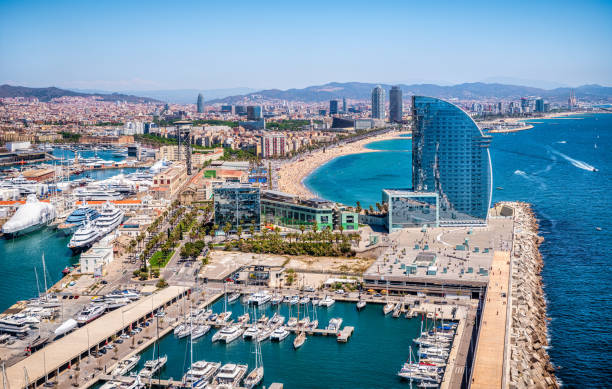
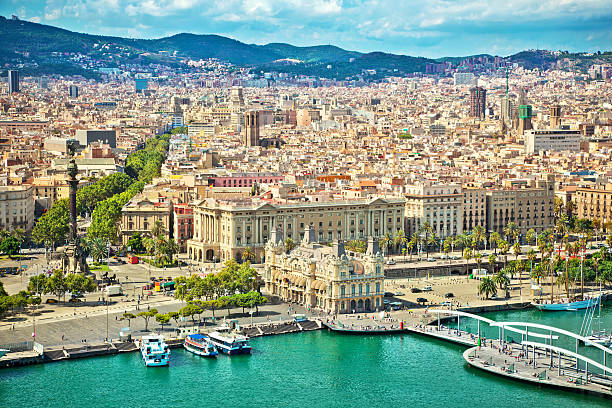
The best Port Vell segment is usually short and deliberate. From the Columbus Monument at Portal de la Pau, use the harbor edge to explain why this part of the city faces outward, then decide whether the group needs the bridge and marina view or only a controlled breath along Moll de la Fusta. Rambla de Mar is useful because it turns the harbor into a movement moment; it is less useful if the day is already late and everyone is hungry.
Do not confuse open space with low effort. Port Vell feels easy because it is flatter and wider than the Gothic Quarter, but it can still stretch the day. A walk that looked like a small waterfront loop can become a slow, exposed detour if you continue toward Moll d’Espanya, double back, and then still expect Barceloneta to carry lunch. The better edit is to let Port Vell do one job: move the route from history to air.
When Barceloneta belongs in the day
Barceloneta belongs when the day needs a coastal finish, a meal with its own place in the schedule, or a relaxed second-day mood after the major interiors are already handled. It does not belong automatically just because the neighborhood is famous or close to the water.
The key distinction is between a sea-air ending and a beach errand. Barceloneta is strong when you approach it from Port Vell, cross into the neighborhood with the old harbor behind you, and let the grid of narrow streets, Passeig de Joan de Borbó, the beach edge and the Mediterranean widen the emotional temperature of the day. It is weak when the group is dragged there between Sagrada Família and dinner because someone felt that a Barcelona trip must include a beach.
Barceloneta should be saved for a separate meal or evening when the travelers care about the meal more than the historical arc. That is not a downgrade. It is the honest version of the neighborhood. A food-and-wine traveler may enjoy Barceloneta more when it is not competing with shipyard context, Gothic Quarter lanes, museum time and a timed Gaudí entry. A family may enjoy it more after rest, when children can handle the beach edge without turning the rest of the route into negotiation.
For first-time visitors, Barceloneta is often better as an answer to mood than as an answer to history. It can make a second day feel lighter after a first day of Sagrada Família, Passeig de Gràcia and old-town context. It can also give celebration travelers the sense that Barcelona is not only architecture and stone. But if the route is meant to explain maritime Barcelona, Drassanes and Port Vell should come first, with Barceloneta acting as release, not proof.
There is also a practical hotel consequence. Visitors based in Eixample often underestimate the return. Barceloneta may feel close on a map, but a late afternoon drift toward the beach can make the return to Passeig de Gràcia or the upper Eixample feel longer than expected, especially after a morning of interiors. If the evening is formal or dinner is north of the old city, a clean Port Vell pause may be more valuable than a full Barceloneta extension. For the broader first-stay question, the neighboring guide on where Barceloneta belongs in a first stay handles the Gaudí-and-sea balance more directly.
When the sea weakens the route
The sea weakens the route when it is added to prove the itinerary is complete rather than to solve a real pacing or storytelling problem. In Barcelona, the water is powerful when it clarifies the city; it becomes expensive filler when it only adds another zone to an already full day.
The most fragile version is the all-in first day: Sagrada Família, Park Güell, Passeig de Gràcia, Gothic Quarter, Drassanes, Port Vell and Barceloneta. It looks efficient on paper because everything is in one city. It feels scattered in the body because the day changes scale too many times: basilica interior, hill logistics, Eixample boulevards, medieval lanes, shipyard history, marina openness and beach edge. By late afternoon, the group may still be moving, but the memory has started to blur.
Premium spend does not help when the waterfront is added as a detached scenic add-on after everyone is already tired. A chauffeur cannot create meaning if the waterfront is added without narrative purpose. A driver can reduce heat exposure, shorten cross-city transfers and make a hotel return easier; a driver cannot make Port Vell matter if the route has not earned the transition from old city to harbor.
Cut Barceloneta first when time is tight and the day is already strong. That is the plainest mistake-prevention rule. Do not cut Drassanes if the sea story is the point, and do not cut Port Vell if the group needs air after the Gothic Quarter. Cut the beach extension, the extra marina loop, or the idea that the route needs both a waterfront stroll and a long seaside meal in the same half day.
The wrong fit is a traveler who wants a pure beach afternoon, a nightlife plan, or a waterfront bar crawl. That is not this route. This article is about when maritime Barcelona adds story, air and pacing to a first or second stay. If the desired outcome is leisure-only, give Barceloneta its own slot and stop asking Drassanes to do the work of a beach plan.
How to sequence a sea-led route from the Gothic Quarter
The cleanest sequence is Gothic Quarter or El Born context first, Drassanes for depth, Port Vell for the release, and Barceloneta only if the next two hours can genuinely absorb it. That order keeps the route from feeling like a collection of waterfront places.
A strong half-day can begin around the Roman and medieval core: Cathedral area, Plaça del Rei, the lower Gothic Quarter, Santa Maria del Mar or the edge of El Born. From there, the guide should choose a southward line that does not force backtracking. Carrer Ample, Plaça de la Mercè, Passeig de Colom and Avinguda de les Drassanes each create a different angle of arrival. What matters is not the prettiest street; it is whether the route makes the shipyards feel like the city’s working threshold to the Mediterranean.
After Drassanes, resist the urge to explain everything again. Let Port Vell do what old-town streets cannot. Walk toward Portal de la Pau, let the Columbus Monument mark the shift from city fabric to harbor edge, then decide how much of Moll de la Fusta is necessary. A short harbor segment can be enough for older parents, cruise guests, or travelers with a late lunch. A fuller loop toward Rambla de Mar works better for guests who want the physical sensation of moving over water.
Barceloneta then becomes a conscious extension, not an obligation. Cross toward the neighborhood if the group has energy, the weather is kind, and the next commitment is nearby or flexible. Skip it if dinner is in Eixample, if the day already included a long Gaudí morning, or if the group is managing children, mobility limits or heat. In a more history-forward version, the better extension may be El Born and La Ribera rather than the beach; the related guide to Roman and medieval Barcelona in one focused day helps when the old-city layer should stay dominant.
This is also where a private route earns its cost. The value is not only avoiding crowds. It is knowing when to stop interpreting, when to let the harbor breathe, and when to turn back before the day becomes longer than it feels on paper. A public checklist rarely makes that decision for your specific group.
Which maritime quarter in Barcelona should you choose for history, sea air and pacing?
Choose Drassanes for history, Port Vell for sea air, and Barceloneta for mood. The mistake is asking one place to do all three jobs equally.
For serious history travelers, Drassanes is the default. It turns the waterfront from a pleasant walk into an argument about power, craft, trade and Mediterranean reach. It also connects well with the Gothic Quarter because the visitor can feel the old city closing behind them and the sea opening ahead. That physical contrast is more persuasive than a long lecture.
For comfort-first travelers, Port Vell may matter more than it seems. It is the place where the pace can loosen without abandoning the route. The promenades near Moll de la Fusta and the harbor edge are easier to process than another cluster of narrow streets. This does not mean Port Vell should consume the day. It means it can be used as a controlled pressure release after dense sightseeing.
For families, Barceloneta is tempting because it sounds like the obvious reward. It can be, but only if the reward is not scheduled too late. Children who have already handled a church, a museum and a long lunch may not experience Barceloneta as charming; they may experience it as the final forced walk. If Barceloneta is the promise, put it where it can succeed: as a clear finish, a meal plan, or a separate lighter block.
For food-and-wine travelers, do not turn the maritime quarter into a snack crawl by accident. A serious lunch or dinner near the sea can be a wonderful part of a Barcelona stay, but it deserves its own rhythm. If the route’s purpose is heritage, keep the food stop simple. If the purpose is a seaside meal, let Drassanes become optional and keep the old-town history tighter. For less touristic neighborhood texture beyond the obvious waterfront, Barcelona like a Local private routing may be a better next step than another harbor loop.
What this choice does to the body
The body notices this decision before the mind does. Barcelona’s maritime route can feel light because it is flatter than Park Güell or Montjuïc, but the wrong sequence still creates heat load, glare, slow crossings and late-return fatigue.
The old city asks for attention at close range. The Gothic Quarter and El Born compress the body into narrow lanes, uneven paving, doorway pauses and frequent turns. Drassanes changes the scale but still asks for standing, looking up and absorbing context. Port Vell then exposes the body to open light and wind. Barceloneta adds distance. None of this is extreme, but the accumulation matters for older parents, children, post-cruise travelers and anyone planning a polished evening.
The practical consequence is that a sea-led route should not be measured only in minutes. A short map distance from Drassanes to Port Vell may feel easy; the additional drift to Barceloneta, a beach look, and a return to an Eixample hotel can become the part of the day everyone remembers as one walk too many. This is why the best private itineraries build a decision point at Port Vell. If the group is bright, continue. If the group has gone quiet, turn the sea into a graceful ending and leave Barceloneta for later.
Heat and glare change the value of the route as well. The shipyards and old-town lanes offer shade and structure; the harbor opens the day but also exposes it. In mild weather, that openness can be the exact thing the group needed. In high summer or after a long museum morning, it can flatten attention. The difference is not whether Port Vell is good. The difference is whether the route reaches it while the group still has enough energy to enjoy space rather than endure it.
What this choice does to the mood of the day
The right maritime choice makes the day feel calmer, shorter and more complete; the wrong one makes Barcelona feel scattered. Mood is not decorative here. It changes what travelers remember.
Drassanes gives the day a serious mood without making it heavy. The visitor senses that Barcelona’s relationship with the sea is not only beach, leisure or cruise infrastructure. It is labor, shipbuilding, defense, commerce and projection. That weight helps history travelers and second-day visitors feel that they are seeing a less obvious city, not simply taking a break from Gaudí.
Port Vell changes the mood by widening the day. After stone streets and interpretive stops, the harbor can make the itinerary feel less crowded than it is. This is especially valuable before a late lunch, after a museum, or between a morning old-town walk and an evening plan. Used well, it prevents the day from ending in the mental clutter that old-city routes can produce.
Barceloneta changes the mood most sharply, which is why it needs respect. It can turn a cultural day into a sea-air memory. It can also make the day feel less coherent if the group was expecting heritage and suddenly finds itself walking toward the beach. The best Barceloneta placements feel chosen: a family release, a couple’s coastal finish, a second-day stroll, or a meal that belongs to the evening. The weakest placements feel like someone added the word “sea” because the itinerary needed one more Barcelona image.
For celebration travelers, this distinction is crucial. A private day should not build toward fatigue before a special dinner. If the evening matters, Port Vell may be enough. If the sea is the emotional center of the celebration, give Barceloneta its own space and do not make it fight Drassanes for attention.
Where a private guide changes the waterfront
A private guide changes the waterfront when the route needs to become a Roman-medieval-maritime arc rather than a pleasant walk by the water. The guide’s value is judgment: what to connect, what to leave out, when to move, and when to stop.
In Barcelona, context can be lost at the exact moment the view improves. Visitors leave the Gothic Quarter, reach the harbor, relax, and the story dissolves. A good guide prevents that without overtalking the sea. They can make the shift from Barcino to medieval port power to the Royal Shipyards feel natural, then allow Port Vell to change the pace. The result is more elegant than a checklist because the group understands why the route moved in that direction.
This is especially useful for short stays. If you have two or three days in Barcelona, the maritime quarter has to earn its place against Gaudí interiors, old-town history, Montjuïc, food, shopping and rest. The guide’s role is not to add more. It is to edit the day so the waterfront either deepens the story or is postponed honestly. For a tailor-made route that turns the sea from filler into a coherent city chapter, Inquire now.
Private touring also helps mixed groups. One traveler may want history, another may want sea air, another may be watching walking distance, and another may be thinking about dinner. A fixed route often splits those needs badly. A private route can set Drassanes as the intellectual anchor, Port Vell as the shared breather, and Barceloneta as an optional finish rather than a forced democratic compromise.
The upgrade that earns its cost is not simply a nicer vehicle or a longer tour. It is a guide who can say, in the moment, “This is enough harbor for today,” or “Now the beach edge will actually improve the mood.” That kind of editing is what makes the maritime quarter feel bespoke rather than bolted on.
How to connect this with Gaudí, Sagrada Família official tickets and cruise timing
The maritime quarter pairs best with Gaudí when it is not competing for the same mental energy. If Sagrada Família is the day’s timed centerpiece, check Sagrada Família official tickets (https://sagradafamilia.org/en/tickets-individuals) and build the waterfront around the actual entry time rather than around a wishful map route.
A morning Sagrada Família visit can pair with Drassanes and Port Vell later only if the middle of the day is kept disciplined. The basilica asks for attention, vertical looking, symbolic interpretation and crowd navigation. Following it immediately with Park Güell, the Gothic Quarter and the entire waterfront is rarely elegant. A better plan is to choose one old-city arc after lunch, then decide whether the sea gives relief or only adds distance.
If Park Güell is in the same day, be even stricter. The hill logistics and timed entry make it a different kind of effort from the waterfront. In that version, Drassanes may be cut unless maritime history is a core interest. Port Vell can still work as a short late-day breath, but Barceloneta should usually move to a separate evening or another day. Trying to make hill, basilica, old town and beach all feel meaningful is how otherwise polished itineraries become blurred.
Cruise timing flips the question. For cruise arrivals or boarding days, the port is not decorative; it shapes luggage, pickup, drop-off and the emotional start or finish of the trip. Drassanes and Port Vell can be excellent because they keep the day near the sea without turning it into dead time before boarding. Barceloneta may work if the schedule is generous, but it is not the default. Boarding-day comfort usually favors a shorter, cleaner waterfront chapter over an ambitious beach extension.
For travelers staying in Eixample, the question is return logic. A chauffeured pickup can make a late waterfront finish more comfortable, especially after dinner or for older parents. But the car should support a good route, not excuse a bad one. If the day has no narrative reason to descend to the sea, spend the time on a stronger interior, a hotel pause, or a focused old-town walk instead.
The cut-first rule for short stays
On a short Barcelona stay, cut the weakest sea extension before cutting the route’s argument. That usually means keeping Drassanes to Port Vell and dropping Barceloneta unless the beach-edge finish is the emotional purpose of the day.
This rule protects the trip from a common form of overplanning. Visitors want Gaudí, the Gothic Quarter, food, sea air and a feeling of ease. The easiest way to promise all five is to write them into one day. The easiest way to damage all five is to keep them there after the real timing becomes visible. When something has to go, cut the add-on that does the least narrative work.
For a first stay, the sea can still belong. Pairing a Gothic Quarter or El Born morning with Drassanes and a controlled Port Vell finish gives visitors an excellent sense of maritime Barcelona without sacrificing the evening. For a second stay, the route can go deeper: more time in the Maritime Museum, a slower old-harbor walk, and Barceloneta as a mood-led finish. For a cruise day, the sea may be unavoidable, but the route still needs discipline.
The strongest plans are not the fullest plans. They are the plans where each place knows its job. Drassanes explains. Port Vell releases. Barceloneta changes the mood. If a stop cannot perform one of those jobs on the day you are actually planning, leave it out without regret.
First day, second day or arrival day: where the sea earns its place
The maritime quarter earns its place differently depending on when it appears in the trip. On a first day, it should calm the route and give the city a broader edge; on a second day, it can carry more interpretation; on an arrival or cruise day, it should simplify movement rather than add ambition.
On a first day after an overnight flight, Drassanes and Port Vell can be excellent because they keep the plan grounded and legible. The route does not ask travelers to climb, cross the city repeatedly or absorb another major interior after concentration has started to fade. The danger is Barceloneta. It sounds relaxing, but if it pushes the walk too far from the hotel return or turns lunch into a late search, the sea stops helping.
On a second day, the maritime quarter can become more serious. Travelers have already seen the Gaudí headline and have a better sense of Barcelona’s shape. That is when the Royal Shipyards, Santa Maria del Mar, El Born, Pla de Palau and the harbor can sit together as a more layered story about the city facing the Mediterranean. The sea feels less like a postcard and more like a clue.
On a cruise day, keep the maritime idea clean. A route that begins or ends near the port should not use proximity as an excuse to wander. Drassanes and Port Vell can make the day feel connected to the ship without making every hour about the port. Barceloneta belongs only if the boarding time, luggage plan and group energy leave genuine space for it.
Hotel geography should also shape the choice. From a Gothic Quarter or lower Rambla hotel, Drassanes and Port Vell can be almost seamless, which makes the maritime layer an efficient way to end a morning. From Eixample, the same route needs a cleaner return plan because the emotional finish at the harbor is not the same as being back near Passeig de Gràcia, Rambla de Catalunya or a dinner north of Plaça de Catalunya.
Visitors staying near the beach should be especially careful not to overvalue convenience. Barceloneta may be the easiest place to reach at the end of the day, but that does not make it the best interpretive choice. If your hotel is already near the water, use Drassanes and Port Vell to give the sea context before returning to the coast on your own rhythm.
FAQ
Is Drassanes, Port Vell or Barceloneta best for a first-time Barcelona visitor?
Drassanes to Port Vell is usually best for a first-time visitor who wants the sea to add history and pacing without turning the day into a beach plan. Barceloneta is best saved for a separate meal, evening or lighter second-day finish.
Is Drassanes worth visiting if I am not a maritime-history specialist?
Yes, Drassanes is worth it when it connects the Gothic Quarter to the harbor and makes Barcelona’s sea power visible. It is less worthwhile if you only want a quick waterfront photo or if the day already has too many major interiors.
How long should a Drassanes to Port Vell walk take?
Plan it as a controlled route segment rather than a fixed number of minutes. The shipyards, Portal de la Pau, Moll de la Fusta and Rambla de Mar can be shaped into a short transition or a deeper heritage chapter depending on energy, weather and the next booking.
Should Barceloneta be part of a private history tour?
Barceloneta can be part of a private history tour when it is used as a coastal finish after Drassanes and Port Vell. It should not be forced into the route if the group wants medieval context, has a tight dinner schedule, or is already tired.
Can I combine Sagrada Família, the Gothic Quarter and the maritime quarter in one day?
Yes, but the maritime part should usually be edited down to Drassanes and Port Vell. Adding Barceloneta as well can make the day feel scattered unless the group has excellent energy and the sea is a clear priority.
Is Port Vell a destination or just a transition?
For most tailored touring, Port Vell works best as a transition. It gives the route air between old-town density and the sea, but it rarely needs to become the main destination unless the schedule is intentionally light.
When should I skip the maritime quarter entirely?
Skip it when the day already includes multiple timed Gaudí sites, a serious museum visit, a formal evening plan, or travelers who need a shorter walking load. In that case, the sea will likely weaken the route rather than improve it.
Is a chauffeur useful for Drassanes, Port Vell or Barceloneta?
A chauffeur is useful for hotel returns, heat management, older parents, cruise logistics and late-day comfort. A chauffeur is not useful as a substitute for route logic; the waterfront still needs a clear narrative or pacing purpose.
If you’re interested in any private tours of Barcelona, please reach out to us.












 So if you are looking for the absolute best in Barcelona & surroundings with authentic local fully-licensed native guides whose English you can actually understand and with an exclusive and amazingly fun itinerary













