Barcelona With Balance Impairment: Gaudí Interiors, Uneven Surfaces and Shared Routes

Updated
Barcelona can support a rewarding Gaudí architecture day for a traveler with balance impairment, but the useful plan is not simply the city’s wheelchair-accessible route. The most dependable shared sequence usually gives Sagrada Família’s nave priority, uses Casa Milà’s lifts and ramps while treating its rooftop as optional, and makes Park Güell a conditional choice rather than an automatic third stop. At every site, verify stairs, ramps, lifts, surface transitions, crowd flow and a fixed rejoining point. Keep a ground-level alternative ready before the day begins.
This distinction matters because a route can be step-free and still feel difficult. Patterned paving, sloping floors, repeated curves, moving crowds, dramatic light, wide open volumes and the need to look upward may affect orientation or confidence even when no wheelchair barrier is present. The reverse is also true: a traveler may manage ordinary steps with a handrail yet struggle on an irregular ramp, an exposed terrace or a floor that offers few stable visual references. No article can predict an individual response, and “accessible” should never be read as a universal safety assurance.
The practical objective is therefore not to remove Gaudí from the day. It is to decide where the architecture can be experienced from stable, legible positions; where companions can take a short optional branch; and where the group can reunite without ambiguity. That approach preserves the shared story instead of reducing one traveler’s visit to exterior photographs while everyone else goes inside.
Balance limitations require a different access question
Wheelchair access is primarily about step-free circulation, doorway width, lift provision, gradients, surfaces and usable facilities. Balance impairment may overlap with those concerns, but it can also introduce a separate set of questions: Is there a handrail where the floor changes? Does a lift eliminate only the stairs, or does the visitor still emerge onto an uneven terrace? Does the route require repeated head turns, prolonged upward viewing or rapid adaptation from bright exterior light to a visually dense interior? Can the traveler pause without blocking a moving visitor stream?
That is why a “fully accessible” label is not enough for this day. A family should ask about the actual sequence from entrance to exit, including the final metres after a lift, the texture of ramps, whether a route is one-way, and where an optional section begins. A person who uses no mobility device may still benefit from the same lift or reduced-gradient route offered to visitors with reduced mobility. Conversely, a technically step-free path may be the less comfortable choice if it is long, steep, crowded or visually disorienting.
For the separate question of step-free architecture touring, use wheelchair-specific Barcelona architecture guidance. It is a useful comparison precisely because it should not be treated as interchangeable with this balance-focused plan.
Build the day around five verifications, not three famous names
Before committing to Sagrada Família, Casa Milà and Park Güell in one sweep, check five forms of friction. These are more predictive than a generic distance estimate.
- Approach: Confirm the side of the site that offers the simplest arrival, the shortest exposed walk and the clearest entrance. A taxi or private vehicle can reduce the approach but cannot remove internal terrain.
- Vertical movement: Ask which stairs can be bypassed by lift or ramp, where the lift delivers visitors, and whether an optional upper level has a separate return route.
- Surface: Distinguish level flooring from cobbles, sloped paving, irregular stone, open-air ramps and architecturally sculpted roofs. Rain can change the answer.
- Visual environment: Consider moving crowds, patterned surfaces, changing colored light, mirrors or glass, repeated curves and long upward viewing. These are not barriers for everyone, but they are relevant planning variables.
- Exit and rejoining: Name one exterior point that every companion can find without retracing a controlled route. “By the entrance” is too vague when a monument has several façades, gates or one-way flows.
Record the answers in plain language. “Lift available” is weaker than “lift reaches the Gaudí Space; rooftop remains uneven; traveler will wait at the exit-side courtyard.” “Park entrance confirmed” is weaker than “arrive from Carretera del Carmel; avoid Vallcarca; companions rejoin at the same named gate.” This level of specificity is what turns access information into a workable family plan.
Sagrada Família: make the nave the shared architectural anchor
For most groups managing balance limitations, Sagrada Família offers the strongest combination of major architectural value and a controllable shared route. The official FAQ states that the basilica is accessible except for the towers and directs visitors with reduced mobility to Entrance B on Carrer de la Marina. Those are useful operational facts, not a guarantee of comfort for every balance condition. Check the current wording on the Sagrada Família official FAQ before the visit.
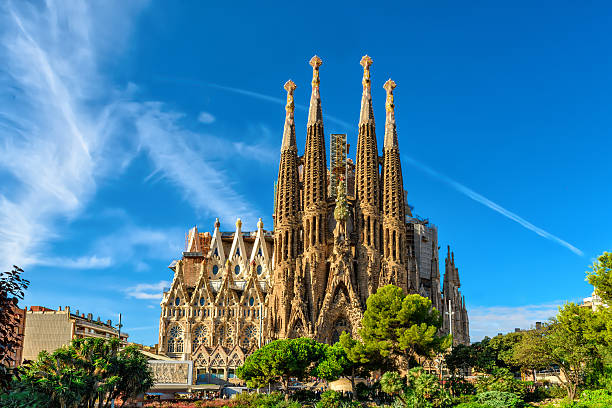
The decisive choice is nave first, towers separate. The nave contains the building’s central architectural argument: branching columns, a forest-like structural rhythm, changing light through stained glass, the relationship between vertical load and spatial lift, and the long axis toward the apse. A traveler does not need tower access to understand why this building matters. In fact, removing the tower branch can produce a more coherent visit because the group spends its energy on the interior rather than on a vertical excursion with different access rules.
What may be balance-relevant inside
The nave is not visually neutral. Its scale invites prolonged upward viewing. Columns multiply into branching forms, colored light changes across the floor and walls, and visitors move in several directions while many people stop suddenly for photographs. For someone sensitive to visual motion or spatial ambiguity, the combination can be more demanding than the level floor alone suggests.
A useful strategy is to enter with one stable visual task rather than trying to absorb the whole volume immediately. Begin by reading a single column from base to branching point, or by looking along the central axis before turning toward the stained glass. Use the building’s fixed verticals as reference points. The group can then move in short arcs, pausing near the perimeter rather than repeatedly crossing the busiest central flow. This is editorial route judgment, not a medical prescription; the traveler’s own preferred coping methods should lead.
The Vestibular Disorders Association’s travel guidance recommends planning for weather, activities, fatigue and clear communication with companions, and notes that uneven or visually stimulating environments can be relevant for some travelers. Its travel strategies guidance is useful context for deciding how much stimulation to place before and after the basilica.
How companions can branch without splitting the day
If companions want tower access, treat it as an optional branch rather than the shared climax. Agree in advance that the balance-limited traveler will complete the nave and museum-level material at a comfortable pace, then meet the others at a fixed exterior location after the tower branch. Avoid an interior rejoining point that depends on retracing a one-way visitor route or on mobile reception inside a dense building.
Carrer de la Marina is the most logical side to discuss because the official access information names Entrance B there, but the exact meeting spot should be confirmed against the current entry and exit configuration. Choose a visible street-level landmark or a specific corner, not “outside Sagrada Família.” Allow a time window rather than a single minute, because tower access and exit flow can vary.
For a deeper architectural comparison of the tower branch and the nave-only experience, see a nave-only or tower decision at Sagrada Família. For this audience, the important point is that nave-only is not a diminished visit. It is the most complete shared version of the building’s architecture.
The immediate bailout
If the interior becomes visually tiring, the group does not need to abandon the entire morning. Move toward the perimeter, reduce upward viewing, shorten the interpretive sequence and exit to the Eixample grid. Avinguda de Gaudí provides an obvious urban connection toward the Hospital de Sant Pau area, although it still involves ordinary city walking and should not be described as uniformly level. A short exterior discussion of façades, construction chronology and the relationship between Sagrada Família and the surrounding blocks can preserve meaning without extending interior exposure.
Casa Milà: use the lift-connected interior and make the roof optional
Casa Milà, also known as La Pedrera, is the best second Gaudí interior when the group wants domestic architecture, applied design and structural experimentation without committing to a hill. Its location on Passeig de Gràcia also makes it easier to substitute an exterior Eixample study if energy changes.
The building’s official accessibility page states that lifts and ramps connect its floors and that the courtyards, Tenants’ Apartment and Gaudí Space have no mobility obstacles. It separately describes the rooftop as very uneven and says a lift reaches a platform with a partial rooftop view. Read the current details on La Pedrera’s official accessibility page. This is one of the most useful distinctions in Barcelona: the lift-supported interior and the sculpted roof should be treated as two different access decisions.
Why the interior can still demand careful pacing
Casa Milà is an architecture of curves, shifting sightlines and transitions between open courtyards, domestic rooms and the attic’s repeated arches. The circulation is more intimate than Sagrada Família, but it can also feel less directionally obvious. Curved walls reduce long straight reference lines. Furnished rooms invite lateral head turns. The attic’s rhythmic sequence of brick arches can create a repeated visual pattern, and visitor flow may tighten at thresholds.
The answer is not necessarily to move faster. A slower route with fewer interpretive stops may be easier than a long stop-and-start visit in which the traveler repeatedly turns between guide, object, ceiling and crowd. Keep explanations anchored to stable points: the courtyard as a source of light and ventilation, the apartment plan as a response to bourgeois domestic life, the attic as a structural and service zone, and the roof as a separate sculptural landscape. Four clear ideas are more useful than trying to inspect every room.
The rooftop decision
The roof is visually unforgettable, but it combines exactly the elements that deserve separate verification: uneven levels, steps, sculptural forms, changing horizons, open sky and frequent upward or sideways viewing. Lift access to a platform with a partial view is materially different from full circulation across the roof. For some travelers, the platform is the right compromise. For others, even the transition onto that level may not be worthwhile. Ask staff where the lift ends, what remains between the lift and viewing position, and whether weather has changed access.
Companions who want the full roof should branch only after agreeing on an exit-side meeting point. Do not plan for the traveler to wait halfway along a route if the building’s visitor flow does not allow easy backtracking. The cleanest model is shared courtyard, apartment and Gaudí Space; optional rooftop for those who choose it; reunion after the controlled route at a named exterior point near the building exit. Confirm the exact exit side on arrival.
That structure keeps the architecture shared. The traveler who skips the rooftop has still seen the building’s urban façade, courtyards, domestic interior and structural exhibition. The companion’s roof visit adds one layer; it does not contain the whole meaning of Casa Milà.
The exterior substitute
If a second interior is too much after Sagrada Família, Passeig de Gràcia can carry the architectural story at street level. Casa Milà’s stone façade, iron balconies and corner massing are legible from outside. Farther south, the facades of the Illa de la Discòrdia allow a comparison of Casa Batlló, Casa Amatller and Casa Lleó Morera without another controlled interior route.
Street level is not automatically frictionless. Passeig de Gràcia is busy, its paving patterns can be visually active, curb crossings interrupt the rhythm, and stopping in the centre of pedestrian flow can be uncomfortable. Use a small number of predetermined viewing positions and let the vehicle or a short taxi transfer absorb unnecessary distance. The purpose is a coherent exterior study, not a forced promenade.
Park Güell: treat terrain as the main architectural condition
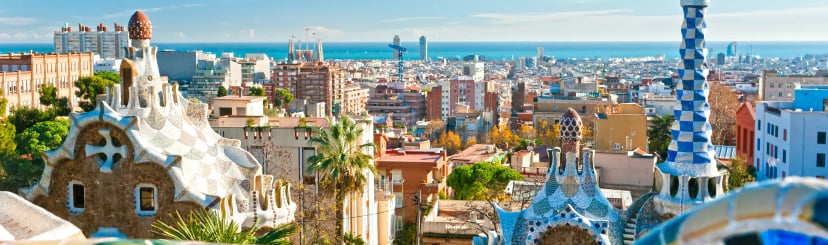
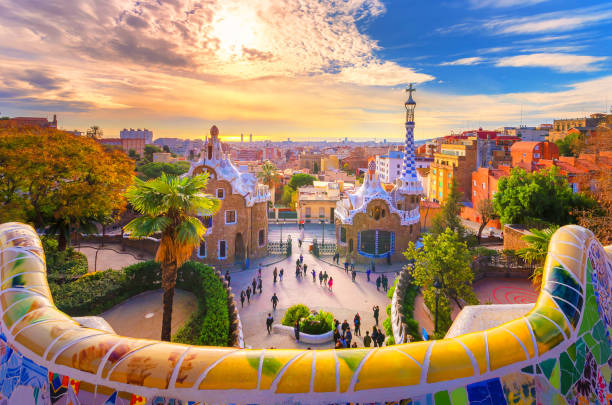
Park Güell is the most difficult of the three major stops to generalize for a traveler with balance limitations. The issue is not simply whether a route is technically accessible. The park sits on a hillside, and its architecture is inseparable from gradients, irregular paths, ramps, stairs, open views and transitions between monumental elements and landscape.
The current official FAQ warns that irregular paths and steep ramps can impede visitors with reduced mobility. It recommends arriving via Carretera del Carmel and currently advises against the Vallcarca approach. Verify the latest guidance on the Park Güell official FAQ. Because this is operational information, it matters more than a generic map or an old blog description.
Why step-free does not settle the question
A ramp can avoid stairs and still be difficult if it is steep, long, exposed, crowded or surfaced unevenly. At Park Güell, the traveler may also be adapting to changing horizons, textured stonework, patterned trencadís mosaic, lateral movement by other visitors and the visual openness of terraces. The park’s famous forms do not sit in a neutral gallery; they are embedded in topography.
For a person whose balance is more affected by surface irregularity than by visual stimulation, the main issue may be footing and gradient. For someone whose symptoms are triggered by large moving scenes, the open terrace and busy viewing areas may matter more. For another traveler, heat and fatigue may be decisive. These profiles can lead to different choices even when the same official access route is available.
When Park Güell belongs in the day
Include Park Güell when the traveler values the park specifically, current conditions are favorable, the approach from Carretera del Carmel is confirmed, and the day has not already used most of the traveler’s concentration and physical reserve. It is usually stronger as the first major stop of a lighter day than as the final obligation after two interiors. Morning placement may reduce accumulated fatigue, but crowd levels, weather and entry arrangements should be checked for the actual date.
Do not attach the park merely because it is a famous Gaudí name. Sagrada Família plus Casa Milà already provides sacred, domestic and structural dimensions of Gaudí’s work. Park Güell adds landscape urbanism, civic ambition, craft and topography, but those gains should justify the terrain.
A shared route and a clean rejoin
The group should enter from the same confirmed side. Once inside, decide whether everyone will follow the shortest mutually comfortable route or whether companions will continue to a more demanding section. The balance-limited traveler should not be left at an improvised internal junction that is hard to describe or that depends on retracing slopes. A safer planning model is to keep the shared portion short and agree on an exterior rejoining point at the Carretera del Carmel side, subject to the current exit rules.
If the traveler decides not to enter, companions can complete a limited park visit while the traveler waits at a prearranged ground-level location elsewhere, but this is a weaker shared experience than the Sagrada Família or Casa Milà branch model. It also creates more logistical risk because the park’s duration can vary. For many families, the better answer is to substitute a lower-friction architecture stop rather than engineer a long separation.
The immediate bailout
If the approach already feels unstable, turn the park into an exterior or contextual stop and leave before fatigue compounds. A driver or taxi can take the group back toward the Eixample, where the rest of the day can continue with a seated architectural discussion, a short façade sequence or a single interior selected for controlled circulation. The sunk-cost instinct is particularly unhelpful here. The park’s hill does not become easier because an entry time was reserved.
Use shared anchors, not parallel itineraries
The best family plan does not create one “full” day for companions and a separate reduced day for the traveler with balance limitations. It uses shared anchors with optional branches. At Sagrada Família, the nave is shared and the towers are optional. At Casa Milà, the courtyard, apartment and Gaudí Space are shared and the full rooftop is optional. At Park Güell, the shortest confirmed route may be shared and a more demanding continuation optional, although the park permits less elegant branching than the two interiors.
A good rejoining point has four qualities: it is outside the controlled visitor flow, reachable without reversing the route, specific enough to describe, and tolerable if one party arrives early. It should also have a backup. For example, “the Carrer de la Marina side at the agreed corner; backup by text once both parties are outside” is better than “meet at the basilica.” At Casa Milà, use the named street corner or exit side confirmed by staff. At Park Güell, use the agreed Carretera del Carmel-side point rather than an internal monument.
Keep the interpretation shared as well. Before companions take an optional branch, explain what that branch adds and what the traveler has already experienced. After rejoining, spend two minutes connecting the branch back to the common story. This prevents the day from becoming a sequence of absences.
When the route must change in real time, private pacing adds value because the guide can preserve the architectural narrative while shortening a room sequence, moving interpretation outside or coordinating a companion branch. For tailor-made support, see private Barcelona tour planning or Inquire now.
Three workable day shapes
There is no single correct itinerary because balance impairment is not one fixed access profile. These three day shapes make the tradeoffs explicit.
Most shared architecture, least terrain uncertainty
Sagrada Família nave, a calm lunch or seated pause, then Casa Milà interior without committing to the full rooftop.
This is usually the most dependable shape for a traveler who can manage city transfers but wants to minimize hills and unpredictable outdoor surfaces. Begin at Sagrada Família while attention is fresh. Use the nave as the main shared experience, omit towers, and keep the museum or additional interior material proportional to stamina. Transfer rather than forcing the full walk to Passeig de Gràcia. After a real pause, enter Casa Milà for its lift-connected interior. Decide on the rooftop only after assessing energy and weather.
The architectural return is high: sacred space, structure, light, domestic planning, courtyards and Gaudí’s mature urban language. The day also has clean bailout points. After Sagrada Família, the group can stop. At Casa Milà, the roof can be omitted without losing the interior. After either site, the Eixample offers exterior interpretation at street level.
One interior plus a lower-stimulation city reading
Sagrada Família nave, then a short Eixample façade study or another Modernisme site chosen for current access conditions.
This version suits a traveler for whom visual density and accumulated indoor stimulation are more significant than walking distance alone. Give the basilica the morning and avoid stacking another highly patterned, curved interior immediately afterward. Use a vehicle to reach one or two exterior viewing positions on Passeig de Gràcia, or select a quieter architectural alternative after confirming its current route.
A photosensitivity issue is not identical to balance impairment, but light and visual motion can overlap as planning concerns. The supporting guide to a photosensitivity-focused Barcelona plan can help families separate glare, colored light and shade questions from surface and gradient questions.
This day avoids treating “more interiors” as automatically better. The traveler receives one major interior in depth and a second chapter through the city itself: chamfered Eixample blocks, bourgeois façades, wrought iron, stone, ceramic and the competitive display of Modernisme along Passeig de Gràcia.
Park Güell by deliberate choice
Park Güell first, followed by one controlled interior or a ground-level Eixample fallback.
Use this version only when the park is personally important and the current approach has been verified. Arrive from the recommended side, keep the shared route concise and leave enough reserve to abandon the second interior. After the park, Sagrada Família can still work if the traveler recovers well and the entry is timed with a generous transfer. Casa Milà can work if the group wants a smaller-scale interior and is prepared to skip the roof.
What usually does not work well is Park Güell plus Sagrada Família plus Casa Milà as a compulsory checklist. The problem is not only distance. It is the cumulative sequence of hill terrain, crowd adaptation, visual complexity, timed entries, vehicle transitions and long periods of attentive standing. A three-name day may look efficient on a map while being poor in actual comprehension.
Families trying to decide where to concentrate limited stamina can also use choosing one Gaudí interior when stamina is limited. The relevant measure is not how many landmarks fit before dinner; it is how much architecture remains understandable and enjoyable.
Visual and spatial triggers are site-specific
“Visually busy” is too broad to guide a route. The three sites create different kinds of spatial demand.
- Sagrada Família: monumental vertical scale, upward gaze, colored light, repeated columns and a large moving crowd. Stable reference points exist, but the whole room can feel in motion if the eye continually shifts between floor, glass and vaults.
- Casa Milà: curved circulation, changing room geometry, repeated attic arches and an uneven sculptural roof. The interior can be broken into smaller interpretive units; the roof is a separate decision.
- Park Güell: gradients, irregular paths, open horizons, patterned mosaic, landscape transitions and lateral crowd movement. Physical and visual demands are intertwined.
Companions should ask the traveler which type of challenge is most relevant. Some people prefer a wide space with a clear distant axis and dislike narrow curving rooms. Others prefer enclosed rooms with nearby reference points and find open terraces difficult. Some are affected mainly by surfaces underfoot. Others can tolerate uneven paving but not repeated upward viewing. The itinerary should branch from that answer rather than from a generic “mobility level.”
A guide can reduce unnecessary head movement by describing details before asking the traveler to look, grouping several observations from one stable position and avoiding rapid pointing in multiple directions. Companions can do the same. “Look up there, then behind you, then across the room” is a poor interpretive rhythm for this audience. A calmer method is to establish one orientation, explain what matters, then invite a single deliberate shift.
Weather, fatigue and transport change the route
Weather is not a decorative detail. Rain can make smooth or irregular surfaces feel less predictable. Heat can increase fatigue and reduce tolerance for a long exposed approach. Strong sun creates glare and hard visual contrast. Wind can make an open terrace feel more demanding even when the path itself is unchanged. None of these effects is universal, but each can change the sensible choice between Park Güell, a rooftop and an interior.
Use the forecast to decide which optional branch to remove, not merely what to wear. In rain, Casa Milà’s roof and Park Güell deserve renewed scrutiny. In heat, shorten the park and avoid a long midday approach. On a day of fluctuating symptoms, place the most valued shared interior first and leave the second half structurally open.
Transport should reduce transitions, not become a separate luxury performance. A car or taxi between Sagrada Família, Passeig de Gràcia and the Carretera del Carmel side of Park Güell can remove long approaches, but curb access and legal stopping points must be confirmed. The vehicle cannot follow visitors through a monument and should not encourage an overfilled schedule.
Public transport may still be appropriate. TMB states that its app can filter journeys for reduced-mobility accessibility, show real-time metro-elevator status and identify suitable station entrances and exits. Consult the TMB app help information close to travel. The reduced-mobility filter is useful even for a traveler who does not use a wheelchair, because a lift-based route may reduce stair and escalator exposure. It does not assess visual complexity, crowding or the balance effect of a moving bus or train.
Fatigue should be measured by transitions as well as steps. Entering a vehicle, orienting at a new curb, finding the correct door, passing security, adapting to a new interior, standing for interpretation and locating the exit all consume attention. Two substantial sites with one well-managed transfer can be easier than three “nearby” stops linked by repeated short movements.
A ground-level fallback should still feel like Barcelona
A bailout plan should not be “return to the room and lose the day” unless rest is genuinely needed. Barcelona offers architecture that can be read from stable street positions and short, selective interior visits. The fallback should be decided in advance so that changing course feels intentional rather than disappointing.
Fallback one: Sagrada Família exterior and Avinguda de Gaudí
If the basilica interior is not workable, study the Nativity and Passion façades from selected exterior positions, discuss how their sculptural language differs, and follow only as much of Avinguda de Gaudí as feels comfortable. The avenue connects the basilica’s modern sacred project with the Hospital de Sant Pau’s Modernisme complex. It is not a promise of perfectly level ground, but it offers a clear urban axis and multiple points at which to stop.
Fallback two: Casa Milà courtyard or façade only
If the full visitor route is too long, ask whether the currently permitted access allows a shortened experience. If not, read the building from outside: the continuous stone skin, the relationship between corner and block, and the iron balconies. Pair that with one or two nearby façades rather than a long avenue walk.
Fallback three: a non-Gaudí Modernisme sequence
When Gaudí’s curves, crowds or symbolic density become tiring, another Modernisme chapter may be more useful than forcing one more icon. Consider a Modernisme day without Gaudí overload as an alternative framework. Current access, interior lighting and surface conditions still need verification, but the change of architectural language can make the day feel broader rather than reduced.
A useful fallback preserves one meaningful idea from the planned stop. If Park Güell is dropped, keep Gaudí’s relationship with landscape in the explanation and compare it with the Eixample’s urban grid. If the Casa Milà roof is omitted, use the attic model or façade to explain how structure and sculpture meet. If the Sagrada towers are skipped, keep the nave’s structural ascent as the shared focus.
Companion planning: make the support specific and discreet
Companions help most when they agree on roles before reaching a busy entrance. One person can handle documents and speak with staff. Another can remain beside the traveler during surface transitions. In a family group, avoid having several people give simultaneous directions. “Step here,” “watch that person,” and “look at the ceiling” arriving at once increases cognitive load.
Use short, factual language. Name the change before it happens: “The floor slopes for the next few metres,” “We are turning left toward the lift,” or “The group will stop at the wall before looking up.” Ask before offering an arm, and do not assume that continuous physical support is helpful. The traveler should define the preferred kind of assistance.
For children or teenagers in the group, explain the branch in neutral terms. One companion may take the roof while another remains in the courtyard; both are valid ways to visit the building. This prevents the balance-limited traveler from becoming the reason everyone “missed” something. The architecture is already being experienced together, with one optional extension.
Carry only what reduces friction: water within site rules, any personally used aid, a charged phone, the exact meeting point written down, and the current booking or access information. Do not overload the traveler with bags that shift weight or occupy a hand needed for a rail. If a folding seat or other aid is important, confirm that it is permitted rather than assuming.
A concise verification checklist for each site
Use this checklist when contacting the site, reviewing official pages or speaking with staff on arrival. It avoids the vague question “Is it accessible?”
- Which entrance is recommended for a visitor who wants to minimize stairs, steep ramps and long approaches?
- Are lifts operating today, and exactly which levels do they connect?
- After the lift, are there steps, slopes or irregular surfaces before the main viewing area?
- Is the route one-way, and can a visitor shorten it without retracing against the flow?
- Where does the optional branch begin, such as towers or rooftop?
- What is the clearest exterior rejoining point after that branch?
- Are any outdoor areas restricted because of rain, wind, maintenance or crowd management?
- Where can the traveler pause without obstructing circulation?
- Which exit will the group use, and is it on the same side as the planned pickup?
At Sagrada Família, prioritize the current Entrance B procedure, tower separation and exterior rejoin. At Casa Milà, verify the lift path, the platform with partial roof view, the full rooftop’s unevenness and the exit side. At Park Güell, verify the Carretera del Carmel approach, current advice about Vallcarca, route gradients and the external meeting point.
The best Barcelona Gaudí day is the one that remains shared
For families arranging a private, tailored day around a balance limitation, the strongest architecture plan is neither an exterior-only compromise nor a three-icon endurance test. It is a carefully sequenced shared visit: Sagrada Família’s nave as the major interior, Casa Milà’s lift-supported rooms as the second chapter, and Park Güell only when its terrain is specifically desired and current conditions support the choice.
The essential distinction is between access provision and lived route difficulty. Lifts, ramps and designated entrances matter, but so do uneven surfaces, visual motion, upward viewing, fatigue, weather and the clarity of an exit. A plan becomes reliable when each optional section has a named branch, a named reunion point and a meaningful fallback.
The source review for this guide was completed on 6 November 2026 under an annual recheck policy, with earlier review triggered by a substantive page update or source correction. Operational details such as access routes, lift operation, entry sides and transport status can still change, so confirm the Sagrada Família, La Pedrera, Park Güell and TMB pages shortly before travel and again when conditions are weather-sensitive. The final decision should follow the traveler’s own experience and current needs, not a universal label.
If you’re interested in any private tours of Barcelona, please reach out to us.








 So if you are looking for the absolute best in Barcelona & surroundings with authentic local fully-licensed native guides whose English you can actually understand and with an exclusive and amazingly fun itinerary













