Barcelona for a Wheelchair-Using Architecture Traveler: Gaudí Interiors, Pavements and Hill Transfers

Updated
Barcelona is often described as an easy city for wheelchair users because many major attractions publish accessibility information, the Eixample has broad avenues, and adapted public transport is widely available. That description is encouraging, but it can produce the wrong architecture day. A venue may be step-free once you reach the correct door, yet the route can still fail through a steep approach, a distant accessible entrance, a lift sequence that separates companions, a long exposed crossing, or a hill transfer that leaves too little energy for the building itself.
For a wheelchair-using architecture enthusiast, those distinctions matter more than a generic list of accessible sights. The point is not merely to enter Sagrada Família, Casa Batlló or Park Güell. It is to experience the spatial sequence, light, structure, materials and urban setting without repeatedly being diverted onto a secondary path or asked to wait while the rest of the party continues. The best day is therefore built from the access path inward: arrival point, entrance, security, lift, internal circulation, viewing position, toilet, exit, pickup and fallback.
The most useful correction is this: step-free does not mean effortless, and a famous site is not automatically the strongest choice for a shared wheelchair-accessible day. Sagrada Família has a clearly identified accessible entrance and excludes the towers from accessible visiting. Casa Batlló publishes unusually direct information about its lifts and wheelchair circulation. Park Güell offers designated reduced-mobility itineraries, but it remains a hillside landscape whose entrance choice shapes the entire visit. The Eixample can look simple on a map while accumulating friction at every curb ramp and crossing.
This guide compares those places by what the party must actually do, not by landmark status. It also distinguishes verified operational facts from editorial route judgment. The official pages cited below were verified for this brief on August 1, 2026; because entrance procedures, lift availability and transport status can change, they should be checked again for the dates of travel.
Plan the access chain before choosing the architecture
A good route begins with the wheelchair user’s own priorities and equipment, not with a preselected list of monuments. Two travelers who both use wheelchairs may need entirely different days. A self-propelled manual-chair user may be comfortable with distance but dislike repeated transverse slopes. A power-chair user may manage gradual gradients well but need certainty about lift dimensions, weight limits and charging margin. A traveler who can transfer briefly may have options that are inappropriate for someone who remains in the chair. None of those differences should be guessed from age or appearance.
Before reservations are fixed, establish the practical profile in plain terms:
- Whether the traveler remains in the wheelchair throughout each visit or can transfer by choice.
- The chair’s width, length, weight, turning needs and whether it folds.
- Comfort with ramps, cross-slopes, cobbles, tactile paving and sustained gradients.
- Preferred maximum time between seated rest, toilet access and climate-controlled space.
- Whether one companion needs to stay beside the wheelchair user at all times.
- Whether the architectural priority is interior space, exterior façades, urban planning, decorative detail or panoramic context.
Those answers change the value of every stop. A compact vertical interior with verified lifts may be a better architectural experience than a celebrated landscape requiring a difficult approach. Conversely, a traveler who particularly wants Gaudí’s relationship between architecture and terrain may accept a shorter, carefully selected Park Güell itinerary and omit another interior.
The party should then evaluate each candidate through six linked questions. Where does the adapted vehicle, bus or taxi actually stop? Is the accessible entrance the same as the general entrance? Can companions enter together? Which lifts or ramps are essential to the visit? How demanding is the public-realm segment between drop-off and door? What is the credible substitute if a lift, booking or route condition changes?
This method prevents a common planning error: treating the venue’s accessibility label as a complete answer. An official statement can verify a doorway, lift or designated route. It usually cannot guarantee that a temporary works barrier will not narrow the pavement, that a lift will be operating at the exact moment of arrival, or that a large party will move through vertical circulation without splitting. Those are coordination questions, and they become more important as the day adds reservations and hill transfers.
Sagrada Família: a strong interior anchor with a distinct arrival procedure
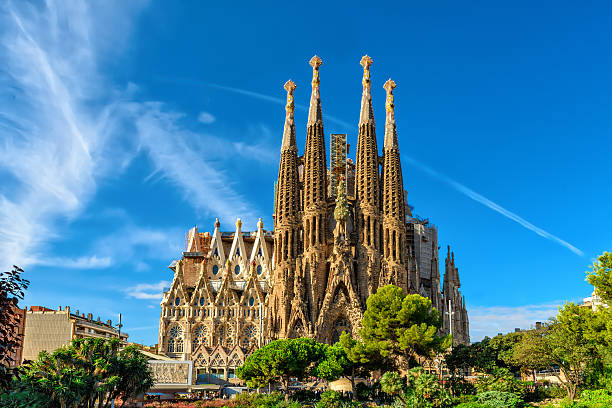
Sagrada Família is usually the most consequential booking because the interior is central to many architecture-focused visits and because its access procedure is specific. The official Sagrada Família FAQ states that the Basilica is accessible except for the towers, that visitors with disabilities or reduced mobility should use entrance B on Carrer de la Marina, and that proof of disability is required for the disability-access procedure.
That is valuable information, but it does not reduce the visit to “wheelchair accessible.” It creates a planning sequence. The reservation name, required proof, entrance letter and street name should all appear on the day sheet. The party should confirm whether everyone may accompany the wheelchair user through entrance B or whether staff will direct some companions differently. If there is any possibility of separation, choose a named regrouping point after security before the guide begins interpretation. “Meet inside” is not precise enough in a building with multiple façades, entrances and dense visitor flows.
The exclusion of the towers should be treated as part of the architectural plan, not as a disappointing surprise. A tower add-on is not an appropriate shared component for a wheelchair-using group when the official accessibility information excludes it. Companions who strongly want a tower visit can schedule it separately on another day, or the entire party can keep the visit focused on the nave, structural system, light, façade narratives and the building’s long construction history. That choice preserves a common experience rather than creating a waiting period at the center of the day.
Route judgment: make Sagrada Família the first major interior unless a timed reservation dictates otherwise. The reason is not that mornings are universally easier; it is that the building deserves the traveler’s best concentration and physical reserve. Arriving after a hill visit or a long pavement sequence risks spending more energy on access than on architecture. A direct transfer to the verified entrance area, followed by a generous interior dwell, is usually more coherent than treating the Basilica as one stop in a rapid Gaudí circuit.
The handoff should be designed around Carrer de la Marina without assuming that a vehicle can stop at any desired point. Legal stopping space, security controls, road works and crowd management can alter the practical drop-off. The useful instruction is therefore not “drop at Sagrada Família,” but “confirm the nearest lawful handoff for entrance B on Carrer de la Marina, then verify the remaining pavement segment.” The driver or dispatcher needs the entrance, not only the attraction name.
Inside, the architecture enthusiast may want more stationary viewing time than a standard sightseeing group. Build that into the reservation sequence. The nave’s branching columns, changing color, sightlines toward the altar and contrast between the Nativity and Passion sides reward pauses from more than one position. Companions should not interpret slower movement as lost time. In an architecture day, the viewing interval is the purpose of the stop.
If the accessible entry cannot be used because documentation, booking or an operational change is unresolved, an exterior interpretation can still be meaningful, but it is not an equivalent substitute for the interior. The fallback should be explicit: either retain a short façade study and move to a verified interior elsewhere, or abandon the stop cleanly rather than circling the perimeter in search of another entrance. For travelers deciding whether this should be their only Gaudí interior, the supporting guide on choosing a single Gaudí interior when time is tight helps frame the architectural tradeoff.
Casa Batlló: the clearest supplied evidence for a compact vertical visit
Casa Batlló offers a different access proposition. Its official visitor page states that the house has two elevators with priority use for people with disabilities and reduced mobility, and that wheelchair users may visit all areas of the house. Within the evidence supplied for this guide, that is unusually strong and direct interior-circulation information.
The practical advantage is concentration. Casa Batlló delivers façade, entrance sequence, stair design, light well, domestic rooms, attic and roof-level ideas within one building rather than across a hillside campus. That can reduce outdoor distance and make the architectural content feel substantial even when the day needs to remain compact. It is especially persuasive for a traveler whose priority is material detail and spatial invention rather than panoramic landscape.
Yet a lift-supported visit still needs choreography. The whole party may not fit into a lift movement at once. Some companions may be tempted to continue via the principal stairs while the wheelchair user follows another vertical path. That can turn a shared interpretation into two partially overlapping visits. The remedy is simple but must be agreed in advance: everyone regroups at a named point on each level before the guide explains the next spatial sequence. The stairs can be discussed visually without making stair use the organizing principle of the tour.
Verified fact and editorial boundary: the official page supports wheelchair access to all areas and the presence of two priority lifts. It does not, in the supplied evidence, guarantee a particular lift wait, group capacity or absence of temporary disruption. Those remain day-of operational variables. A planner should therefore confirm current conditions and avoid placing another tightly timed reservation immediately after the visit.
Casa Batlló also works well as the Eixample anchor because a group can study the block, the neighboring Modernisme façades and the logic of Passeig de Gràcia without committing to a long continuous roll. The urban sequence should be selective: one or two strong observation points, minimal unnecessary crossings, and a direct pickup rather than a vague instruction to “wander the Eixample.” For deeper context beyond Gaudí alone, a Modernisme day beyond the headline Gaudí interiors provides a useful supporting direction.
Park Güell: choose the entrance and itinerary before deciding that it fits
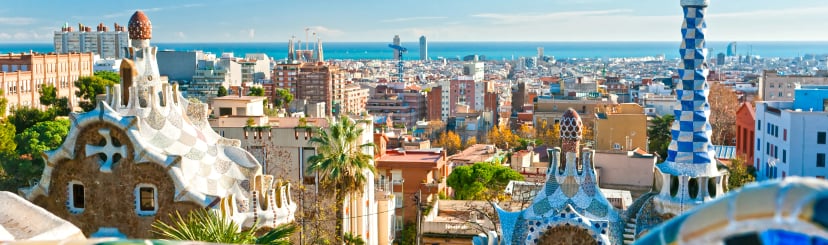
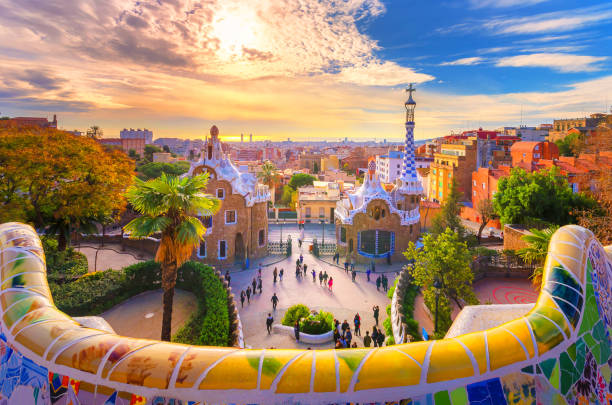
Park Güell is where Barcelona’s accessibility reputation is most likely to be oversimplified. A vehicle can remove part of the climb, but it cannot flatten the site. The architectural experience is distributed across terrain, paths, viewpoints and structures, so the access route is inseparable from what the visitor will actually see.
The official Park Güell accessibility page recommends the Carretera del Carmel entrance for visitors with reduced mobility, also permits access from Carrer Marianao, and identifies two easier itineraries of approximately 50 minutes and 20 minutes. Those details should control the reservation and transport plan. Arriving at a familiar lower gate or asking a driver simply for “Park Güell” can place the group on the wrong side of the access logic.
The words “easier itinerary” also require careful reading. They indicate an official attempt to identify more manageable routes; they do not mean that the entire monumental zone is level, that every desired viewpoint lies on the route, or that the experience will feel easy for every manual-chair user. The traveler’s tolerance for sustained gradient, surface variation and outdoor exposure still decides whether the park is a good inclusion.
Route judgment: Park Güell should be treated as an elective architecture landscape, not a compulsory badge. Include it when the relationship between Gaudí, topography, gardens and city views is a primary interest and when the specific wheelchair profile suits the chosen official itinerary. Omit it when the day’s real priority is uninterrupted interior study, when heat or rain makes outdoor surfaces more demanding, or when the group would have to split for much of the visit.
A strong Park Güell handoff uses a single entrance for the entire party. The wheelchair user should not be delivered to Carretera del Carmel while companions enter elsewhere because their tickets, taxi or walking approach happened to lead them to another gate. Confirm the exact entrance name on every booking note and message. Agree where the guide will meet the group, where a delayed companion should go, and where everyone will regroup if a short optional branch separates them.
The official 20-minute and 50-minute itineraries are useful planning frames, but the booked dwell should be longer than the route label. Time is needed for entry, orientation, stopping to interpret the viaducts and landscape design, photography, and returning to the pickup point. A 20-minute route is not a 20-minute vehicle stop. Likewise, the longer itinerary should not be added after two major interiors merely because it appears manageable on paper.
For a manual-chair user, the relevant question is not only average gradient. Repeated push effort, cross-slope and braking on descent can be more fatiguing than one obvious ramp. For a power-chair user, battery margin, turning space and the consequences of a mechanical problem on a hillside deserve more attention than raw distance. For a companion who assists, the day must account for that person’s physical load as well. Assistance should never be treated as an unlimited substitute for route design.
The most credible fallback is an interior or urbanism sequence that preserves the architecture theme without trying to imitate the park. Casa Batlló offers the strongest supplied evidence for comprehensive wheelchair circulation. A shorter Eixample study can examine chamfers, façade composition, light wells and the social ambition of the grid. A later Montjuïc architecture stop can be considered only after its own current access path is confirmed. Readers committed to the park can use a Park Güell-led day built around the hill and timed entry as the sibling plan; the central principle is to let the hill set the day rather than squeeze it into an already full route.
Montjuïc: a hill transfer is useful only when the final door also works
Montjuïc presents a different problem from Park Güell. It is not one enclosed attraction with one accessibility page; it is a large hill containing museums, gardens, Olympic-era spaces, viewpoints and the Mies van der Rohe Pavilion. A vehicle can connect elevations efficiently, but the term “Montjuïc transfer” hides the final operational questions: which venue, which entrance, which drop-off, which internal lift or ramp, and which pickup after the visit?
For a wheelchair-using architecture traveler, the hill should therefore be planned around one named anchor rather than a scenic sweep. The Mies Pavilion may be the priority for twentieth-century architecture. The Olympic landscape may matter for urban design. The Museu Nacional d’Art de Catalunya may be selected for its building and collection. Each choice requires its own current accessibility confirmation; this brief does not supply verified entrance and internal-circulation details for those venues, so they should not be presented as guaranteed substitutes.
The vehicle’s role is contextual. It can remove a long uphill connection, preserve energy between sites and return the party to a convenient exit. It cannot resolve an inaccessible threshold, an out-of-service lift or a long internal route. This is why “use a driver for Montjuïc” is incomplete advice. The actionable version is: choose one architectural objective, verify its accessible entrance, map the last pavement segment, select a lawful handoff, and hold a lower-friction alternative elsewhere in the city.
Companion regrouping matters on Montjuïc because the hill encourages people to drift toward viewpoints, stairways and gardens. Before anyone leaves the vehicle, the group should know the next indoor or sheltered meeting point and the pickup side of the road. A guide or trip leader should hold the wheelchair user’s route as the common route. Optional branches should be short, clearly timed and designed to return companions to the shared experience rather than leaving the wheelchair user waiting beside the vehicle.
Montjuïc fits best after a single interior, not after an exhausting chain. A Sagrada Família morning followed by one carefully verified Montjuïc architecture stop can work when the traveler values contrast between Catalan Modernisme and twentieth-century design. Adding Park Güell as well usually turns the day into a study of transfers rather than architecture. The related guide on Barcelona architecture beyond repeated Gaudí interiors is the stronger next step for travelers whose interest extends to Mies, civic planning and the hill’s cultural institutions.
The Eixample is legible, but every crossing adds friction
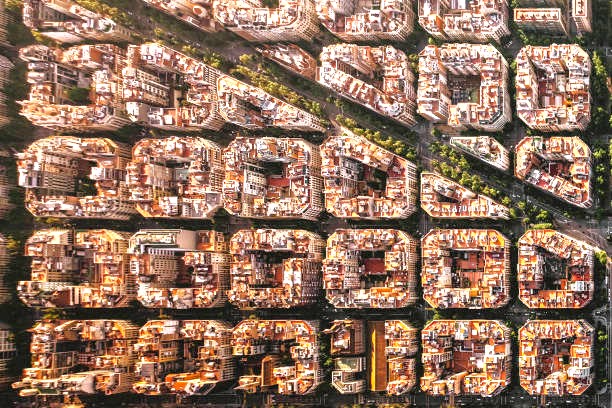
Barcelona’s Eixample grid is often assumed to be the easy part of the day. Its straight streets, broad avenues and chamfered corners make orientation clear. For wheelchair routing, however, legibility and effort are different questions. A sequence that looks like a pleasant twenty-minute walk can include several curb ramps, transverse slopes, changes of paving, crowded corners and long waits at traffic lights. The burden is cumulative.
Barcelona City Hall’s geolocated street-accessibility dataset records variables including pavement, longitudinal and transverse slopes, level changes, curb ramps, tactile paving, reserved parking, clear passage width and obstacles. The significance is not that the dataset certifies one ideal route forever. It is that the city itself treats accessibility as a set of block-level conditions rather than a yes-or-no neighborhood label.
Editorial interpretation: use those variables to reduce the number of transitions, not merely the number of meters. A route with one slightly longer same-side pavement segment may be preferable to a shorter line that crosses back and forth for individual façades. The chamfered corners, known locally as xamfrans, provide broad visual fields but also create complex intersections. Choose observation points that allow several buildings to be discussed from one position.
Passeig de Gràcia is architecturally rich enough to tempt over-programming. Casa Batlló, La Pedrera and multiple façades can appear close together, but visiting them as a checklist produces repeated entrances, queues, crossings and vertical circulation. For a wheelchair-using specialist, one verified interior plus a short, carefully positioned exterior study usually produces more insight. The guide can explain neighboring buildings from a stable viewing point and use images or plans to clarify details that are difficult to see from pavement level.
Temporary conditions deserve their own check. Construction barriers, maintenance, deliveries and movable street furniture can alter clear passage even where the permanent curb design is good. The municipal dataset is a strong planning layer, not a promise about every moment of the travel day. A same-day route review should focus on the final two or three blocks around each stop, where a small detour can disrupt the handoff or force the group into an unnecessary crossing.
Public transport can be part of the solution, but it should be selected by route rather than reputation. The TMB accessibility page states that the bus network is fully adapted for passengers with reduced mobility, using boarding ramps, kneeling systems and wheelchair spaces. At the August 1, 2026 verification point, TMB reported lifts at 156 of 165 metro stations and directed travelers to check each station’s accessibility information.
That evidence supports two useful conclusions. First, an adapted bus may sometimes avoid the vertical descent and lift dependence of a metro journey, especially for a short transfer across the Eixample. Second, “the metro is accessible” is not specific enough: the exact origin, interchange and destination stations must all be checked, along with any current lift notice. A single inaccessible interchange can invalidate an otherwise sensible line.
A private vehicle may be better when the group needs direct handoffs, carries medical or mobility equipment, or cannot risk a full wheelchair space on the next bus. Yet the vehicle should not be asked to crawl from façade to façade. That substitutes traffic and repeated boarding for a coherent street experience. The stronger pattern is a small number of purposeful transfers, each connecting a verified entrance or a selected low-friction observation segment.
Use a five-address handoff, not an attraction name
Wheelchair-aware transport coordination improves when every major stop is described through five addresses or locations, even if some ultimately coincide. This prevents the driver, guide and companions from using the same venue name while imagining different doors.
- Venue address: the public identity used for the reservation.
- Accessible entrance: the exact street, gate, letter or door named by the venue.
- Lawful handoff point: the closest place where the chosen vehicle can safely and legally load or unload.
- Indoor regrouping point: a named location after entry where interpretation begins.
- Exit and pickup point: the door and curb used after the visit, which may differ from arrival.
At Sagrada Família, the accessible entrance is explicitly entrance B on Carrer de la Marina. At Park Güell, the official accessibility guidance makes Carretera del Carmel the principal reduced-mobility entrance and also identifies Carrer Marianao. At Casa Batlló, the entrance is simpler, but lift-supported circulation still calls for level-by-level regrouping. On Montjuïc, every selected venue needs its own version of the five-address note.
The lawful handoff is the most volatile element. A planner should not invent a curb position months in advance. Barcelona’s traffic management, works and event controls can change access to a block. The route file should therefore contain the intended handoff and a nearby alternative, with a final confirmation close to the visit. The driver should know the wheelchair dimensions and whether the traveler remains seated in transit, because the correct vehicle type and loading space depend on that information.
Companion routing belongs in the same document. One person should be responsible for keeping the party together, communicating with venue staff and deciding when to activate the fallback. That is especially important in affluent multigenerational groups, where different walking speeds and interests can create accidental separation. The wheelchair user should not become the fixed meeting point while everyone else explores.
A bespoke private route earns its value here through coordination rather than display. When entrance letters, timed admissions, lift paths and hill handoffs differ, a guide and transport team can protect the group’s common experience by sequencing arrivals, holding interpretation until everyone regroups, and changing the next stop when conditions deteriorate. The service is material only if it does those things; a comfortable vehicle without an access brief is not enough.
Choose the day by the traveler’s actual friction profile
There is no single “wheelchair-friendly Gaudí day.” The right combination depends on which type of friction is most consequential for the traveler. The following branches are route judgments, not medical categories, and should be confirmed with the wheelchair user.
For a traveler who remains in a power chair
Prioritize verified lifts, direct entrances and battery margin. Sagrada Família plus Casa Batlló creates a strong two-interior architecture day with comparatively little hill exposure. Confirm vehicle loading, chair weight, lift dimensions where relevant and a charging contingency. Park Güell may still fit, but only when the selected official itinerary, chair performance and weather all align. Do not make the hill the final test after the battery and traveler have already absorbed a full day.
For a self-propelled manual-chair user
Cross-slope and repeated curb transitions may matter more than total distance. Keep the Eixample study compact, use same-side observation points and reduce unnecessary crossings. A short official Park Güell itinerary can be considered when the traveler actively wants the landscape and is comfortable with the surface and gradient profile. Assistance should be discussed as an option chosen by the traveler, not assumed as the plan.
For a traveler using a manual chair with companion assistance
Account for the companion’s workload as part of the access calculation. Braking on descent, pushing on sustained slopes and managing crowded thresholds can make a route unsafe or exhausting even when the chair user is comfortable. A vehicle transfer to the correct Park Güell entrance may remove the approach climb, but it does not eliminate effort within the park. The party should be willing to turn back at the planned limit rather than converting assistance into an endurance exercise.
For a family spanning children, older relatives and a wheelchair user
The shared-day problem becomes more complex because standing tolerance, attention span and toilet timing differ across the group. One major interior, one compact exterior sequence and one optional low-friction stop usually work better than three headline admissions. Sagrada Família can provide the common architectural centerpiece; Casa Batlló or a short Eixample study can add detail without another cross-city expedition. The supporting guide on a gentler Barcelona plan for older parents is useful when the wheelchair user is not the only person whose stamina shapes the route.
For an architecture specialist who wants depth rather than coverage
Use fewer buildings and lengthen the interpretation. At Sagrada Família, study structural logic, liturgical space and façade programs. At Casa Batlló, focus on the relationship among façade, light well, ventilation, joinery and roof forms. In the Eixample, add Cerdà’s block geometry, chamfers and the social ambition of Modernisme. This traveler gains little from rushing to Park Güell for a photograph if the accessible itinerary leaves insufficient time to understand the landscape system.
For a group that accepts short optional branches
Optional separation can be respectful when the wheelchair user explicitly prefers it and the shared core remains substantial. A companion might take a brief stair route or viewpoint branch while the wheelchair user and guide continue another interpretation. The branch needs a fixed duration and a named regrouping point. It should never be a default arrangement imposed because the main route was poorly planned.
These distinctions also help with ticket choices. Do not buy every add-on simply because it is available. A tower element excluded by the Sagrada Família accessibility guidance, a long hillside extension, or a second vertical interior may add cost and complexity without adding shared architectural value. The better purchase is the one that matches the access path the group can actually use together.
Build alternatives that preserve the architectural question
A credible fallback is not merely another nearby attraction. It should retain the intellectual purpose of the day. If the traveler came to understand Gaudí’s interior space, replacing a failed admission with a random viewpoint is not enough. If the priority was architecture in landscape, a compact urban interior may be comfortable but should be presented as a change of theme.
When Sagrada Família entry fails
First determine whether the problem is temporary and resolvable: wrong entrance, missing proof, timing confusion or a venue instruction that has changed. If it cannot be corrected promptly, do not consume the day circling the perimeter. Use a concise exterior interpretation from freshly checked pavement positions, then transfer to Casa Batlló if its admission and lift route are confirmed. The architectural thread shifts from basilica structure and sacred light to domestic Modernisme, but the replacement remains substantive.
When Park Güell is too demanding
Move the day toward the Eixample rather than seeking another hill. Casa Batlló gives the strongest verified wheelchair-circulation evidence in this source pack. A guided street sequence can then explain chamfers, façade competition, materials and urban expansion from a small number of stable viewing points. This is not a lesser day; it is a different inquiry into how Modernisme shaped metropolitan life.
When an interior lift is unavailable
Do not assume a staff workaround will suit the chair or the traveler. Ask what areas remain accessible, whether the interruption is expected to be brief, and whether re-entry is possible later. If the visit would become fragmentary, activate the exterior or urbanism plan. The group should leave with a coherent architectural narrative rather than a series of apologies and waits.
When weather changes the surface calculation
Rain can increase braking demands on slopes and make surface transitions less comfortable. Heat can turn an exposed hill itinerary into a fatigue problem even when the gradients remain technically manageable. In either case, favor the verified interior with the simplest transfer and shorten outdoor observation. Weather is not an argument to cancel architecture; it is a reason to change the medium through which the architecture is experienced.
When the whole party is tiring
Remove the next transfer before compressing every remaining visit. A shortened Casa Batlló or Sagrada Família experience is rarely improved by rushing through it to preserve a later hill. If the architecture enthusiast still has energy but companions do not, agree whether a small group continues and where the others will rest. The wheelchair user’s preference should control whether separation feels liberating or exclusionary.
The strongest alternative plans are prepared before the first booking. They include a confirmed admission path, a realistic transfer and a reason the substitute belongs in the story. A useful supporting read is what to choose after Barcelona’s best-known Gaudí icons, which helps distinguish another interior from an urban-detail day.
Three workable route shapes
Exact times must follow the current reservation inventory, but the shape of the day can be chosen in advance. These versions deliberately limit the number of access chains.
A compact interior morning
Best for: a first Barcelona visit, limited stamina, a non-transfer chair user, or a group with an afternoon commitment.
- Direct handoff for entrance B on Carrer de la Marina.
- Sagrada Família interior with no tower component.
- One agreed regrouping point after security and one at exit.
- Transfer to a nearby rest point or return to the hotel, depending on the traveler’s plan.
This version protects depth. It avoids the temptation to treat the Basilica as an hour-long preface to another attraction. It also leaves room for an exterior façade study if the interior circulation takes longer than expected. The fallback is Casa Batlló only if a same-day reservation, current lift operation and transport window are already confirmed; otherwise, save it for another day.
A two-interior Eixample day
Best for: an architecture enthusiast who values spatial experience and wants to minimize hills.
- Sagrada Família as the first major interior.
- Purposeful transfer rather than a long roll between neighborhoods.
- Casa Batlló with level-by-level companion regrouping.
- A short Passeig de Gràcia façade study from one or two selected positions.
- Direct pickup from the final confirmed exit.
This is often the most reliable shared architecture day because both anchor buildings have specific official accessibility information in the supplied evidence. The route still requires pavement checks and lift confirmation, but it does not depend on a hillside itinerary. Allow a meaningful interval between timed entries so the first visit can expand without turning the second into a race.
An interior plus Park Güell
Best for: a traveler who considers Gaudí’s landscape design essential and whose wheelchair profile suits the official reduced-mobility route.
- Choose either Sagrada Família or Casa Batlló as the interior anchor.
- Transfer directly to the Carretera del Carmel entrance unless the official guidance for the date directs otherwise.
- Select the approximately 20-minute or 50-minute easier itinerary before arrival.
- Keep the whole party on the same route, with only short optional branches.
- Return to the same planned pickup zone or another explicitly confirmed exit.
The omission is as important as the inclusion: do not add a second major interior and Montjuïc merely because the vehicle makes the map look possible. The park’s value comes from stopping, reading the terrain and understanding the architecture-landscape relationship. A hurried circuit defeats that purpose.
Sagrada Família plus one Montjuïc architecture anchor
Best for: a specialist interested in the contrast between Modernisme and twentieth-century civic or museum architecture.
- Sagrada Família first, using the verified accessible entrance procedure.
- Direct hill transfer to one named Montjuïc venue.
- Current confirmation of that venue’s entrance, lift or ramp route.
- No assumption that a panoramic stop or neighboring museum can be added without another access check.
- A lower-city fallback if the hill venue changes operations.
This route can be intellectually rich because the two stops differ sharply. It should remain a two-anchor day. Montjuïc distances and elevation make spontaneous additions more expensive in time and energy than they appear from a map.
What to recheck before the travel date
The source pack for this guide was verified on August 1, 2026. The Sagrada Família, Park Güell, Casa Batlló and TMB pages were treated as high-volatility operational sources, with verification current through August 31, 2026 in the supplied review. The municipal street-accessibility dataset was treated as medium-volatility. For later travel, or after a substantive official-page update or correction, confirm the facts again rather than relying on this article alone.
Use a final access check that records answers, not merely links:
- Sagrada Família: current entrance for reduced mobility, accepted disability proof, companion-entry procedure, tower exclusion and any changed security instruction.
- Casa Batlló: current lift operation, wheelchair circulation, chair-size considerations and whether any area is temporarily unavailable.
- Park Güell: recommended entrance, current status of the easier itineraries, reservation conditions and the precise pickup plan.
- Montjuïc: venue-specific entrance, internal lifts or ramps, accessible toilet, exit and lower-friction substitute.
- Street route: curb ramps, slopes, temporary works, clear passage and the final block from handoff to door.
- Public transport: station-by-station lift status or the suitability of the adapted bus route for the exact journey.
- Vehicle: wheelchair dimensions, transfer method, loading needs, legal drop-off and where the driver will return.
- Companions: who enters with the wheelchair user, who holds the tickets, and the named regrouping points.
- Time: a buffer after every lift-dependent or hill stop, with no fragile chain of back-to-back admissions.
- Fallback: one alternative interior and one no-hill architecture sequence that can be activated without fresh research.
The final route sheet should fit on one page and be shared with the traveler, companions, guide and transport provider. It should use exact entrance names and plain instructions. It should also state what will be dropped first if conditions change. That handoff is more useful than a long sightseeing list because it allows the group to make one calm decision rather than renegotiate the day at every doorway.
A shared architecture day is the real standard
Barcelona can deliver an exceptional wheelchair-aware architecture day, but the quality comes from selection and coordination. Sagrada Família offers a defined accessible entrance and a major interior, with the towers excluded. Casa Batlló provides the clearest supplied evidence for lift-supported access throughout the house. Park Güell can work when the correct entrance and official easier itinerary match the traveler’s mobility profile. The Eixample rewards close study, but its crossings and pavement variables must be counted as real effort. Montjuïc becomes viable only when a named venue’s final access path is verified.
The practical handoff is to choose two anchors, write the five-address note for each, keep one architecture-preserving fallback, and let the wheelchair user decide which kinds of effort are worthwhile. When several celebrated sites offer materially different access paths and the whole party wants one shared day, route coordination becomes part of the cultural experience rather than an administrative extra. Orange Donut Tours can shape that work through tailor-made Barcelona private touring, aligning current entrance procedures, realistic dwell, companion movement and a credible alternative around the traveler’s architectural priorities. Inquire now
If you’re interested in any private tours of Barcelona, please reach out to us.








 So if you are looking for the absolute best in Barcelona & surroundings with authentic local fully-licensed native guides whose English you can actually understand and with an exclusive and amazingly fun itinerary













