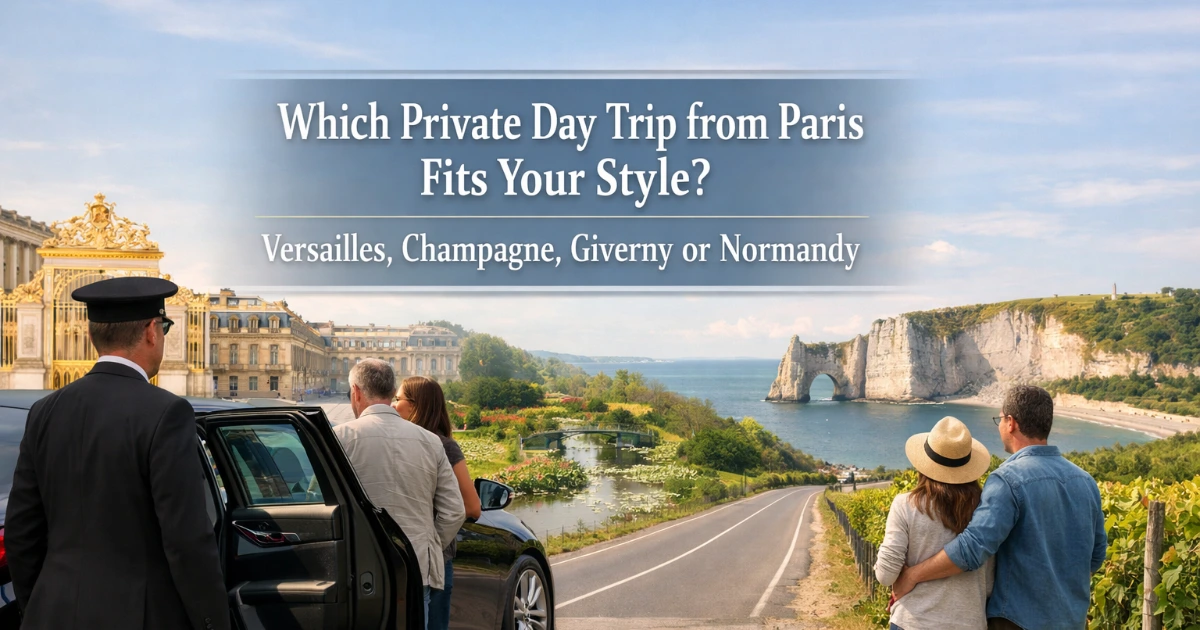
Which Private Day Trip from Paris Fits Your Style? Versailles, Champagne, Giverny or Normandy
Updated
Versailles is usually the best private day trip from Paris when you have one open day and you want the highest return for the least disruption. From a western Paris hotel base near Avenue Kléber, that answer becomes even stronger, because the route west is cleaner from the start and the morning does not disappear into a cross-city slog before the outing has even begun. A pickup near Avenue Kléber can be moving toward Porte Maillot and the western exits quickly, and that small local fact changes what is actually sensible from a Paris base. The important exception is just as clear: if what you mainly want is scenery, air, and a relaxed pace, Versailles is the wrong choice. In that case, Giverny is calmer, and Champagne is the better fit when tasting is the day’s real point.
The useful way to choose is not by fame. It is by asking what this day will cost the wider trip in energy, timing, and evening mood. That is why the best answer is often the route that leaves Paris feeling intact rather than the route with the grandest brochure. A day trip from Paris should work like a hinge in the stay, not a separate campaign. When readers browse private day trips from Paris, the smartest move is to rank the options by transit penalty, cultural or tasting payoff, how much a guide changes the visit, and whether you still want to be a functioning human being at dinner.
That framework produces a firmer verdict than most comparisons do. Versailles is the default winner for first-time visitors and for anyone who wants one major out-of-city experience without sacrificing the rest of Paris. Champagne is the runner-up when the trip is adult, celebratory, and food-and-wine led. Giverny is the gentlest option and the best answer for travelers protecting their mood or energy. Normandy is the most meaningful choice only when history is the reason, not when you simply want a pretty day out.
A Paris-base route ladder, before you fall for the postcard
The four options look comparable in photos; from a Paris hotel, they behave very differently.
Default winner: Versailles. It delivers the biggest cultural hit for the lightest transit burden, and from western Paris it keeps the rest of the trip in proportion. If that is already your instinct, start with Versailles private tour.
Runner-up: Champagne. It wins when the day should feel adult, celebratory, and tasting-led rather than monument-led.
Softest scenic answer: Giverny. Choose it when you care more about atmosphere, gardens, and a breathable rhythm than about checking off a famous royal site.
Wrong fit for scenery-first travelers: Versailles. It is rewarding, but it is not the easy green day many people imagine.
Meaningful but heavy: Normandy. Choose it for D-Day history, reflection, and context; skip it as a generic “best countryside day.”
First cut on a short stay: Normandy. Paris already asks for enough timed entries, crossings, and late nights. The longest day should survive only if it is the reason you came.
Best private day trip from Paris for first-time visitors
For most first-time visitors, Versailles wins because it spends the smallest amount of Paris energy for the largest amount of historical and visual reward.
Versailles: the best use of one open day when Paris is still the main event
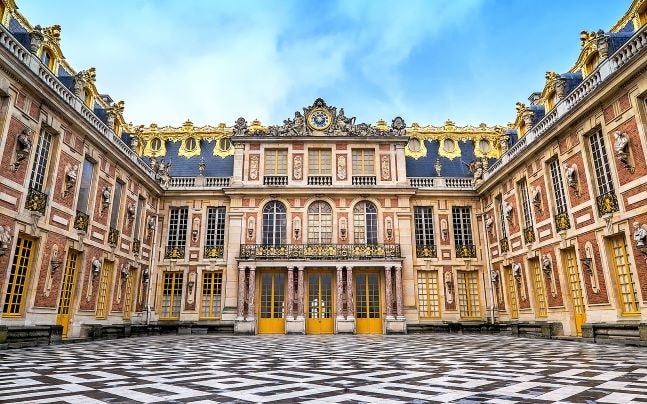
Versailles is the safest strong recommendation because it feels proportionate to a Paris stay. The palace is close enough that the day still belongs to Paris, but substantial enough that it does not feel like a half-measure. For couples on a first visit, it offers the most coherent “one big thing outside the city” without requiring the emotional reset of a much longer regional outing. For families with older children, it also gives clear story lines: monarchy, court ritual, power, gardens, and scale. The point is not merely that Versailles is famous. The point is that it is the rare day trip whose fame, distance, and payoff actually line up.
Who should choose it? Travelers who want one major royal or historical site, anyone who likes strong visual drama with context, and visitors whose Paris stay is still full of first-time priorities. Who should skip it? Anyone already tired of palaces, anyone who wants open countryside rather than interiors, and anyone whose ideal day is slow, green, and lightly structured. Versailles is the wrong choice when the traveler mainly wants scenery and a relaxed pace. It is also less rewarding for people who prefer food-and-wine discovery to political or court history; for them, the emotional return tends to sit lower than the effort.
The timing tradeoff is favorable but still real. From a western Paris hotel base near Avenue Kléber, the drive can feel straightforward compared with starting deep on the Left Bank, where the car may burn more morning time before it even points west. That difference sounds small until you realize it shapes the whole day. Versailles is often manageable as a true full day without destroying the evening, but only if you resist the very common mistake of trying to do every layer of the estate. Palace plus a meaningful look at the grounds is already a serious outing. Palace, gardens, Grand Trianon, Petit Trianon, Queen’s Hamlet, shopping, and a polished Paris dinner is where the day stops feeling elegant and starts feeling dutiful. The official Versailles planning page is still the cleanest place to confirm the visit mechanics before you lock the shape of the day.
This is also the first place where private spend should be calibrated, not romanticized. At Versailles, the guide often matters more than the fanciest vehicle. That is the counterintuitive correction many travelers need. A palace visit without interpretation can flatten into a sequence of gilded rooms, while a good guide turns it into a readable story about etiquette, power, architecture, and why each space mattered. Private transport still helps, especially if you want hotel pickup, a direct return, and fewer station decisions, but the more meaningful upgrade is a guide who can help you cut intelligently. It is also the one outing here where an independent rail plan can be perfectly reasonable if budget discipline matters, which is another reason to spend on interpretation and timing before you spend on symbolism. If you are already leaning toward Versailles, spend first on understanding the site, not on a more theatrical ride to it.
Champagne: the adult celebration day and the best tasting payoff
Champagne is the strongest alternative when the day should feel grown-up, festive, and anchored by tasting rather than by one monumental site.
This is the day for anniversaries, birthdays, small groups of adults, and travelers whose happiest memory will come from a cellar conversation and a long lunch rather than from state apartments. It also works especially well for people on a second Paris trip, or for first-timers who have already decided that central Paris will supply enough grand cultural material on its own. If your wider stay already includes museum days, classic neighborhoods, and one memorable dinner, Champagne creates contrast. The day becomes more social, more sensory, and often more relaxed in tone than Versailles, even though it can ask more of the route.
Who should skip it? Families with young children unless the adults are happy to downplay the tasting focus, travelers who want one undeniable headline monument, and anyone trying to pretend that Champagne is a short, casual hop. The region is close enough to do well from Paris, but not so close that you can be vague. The first decision is whether the day is fundamentally about Reims and its cellars or about Épernay and the villages. Trying to hit both in an ambitious, trophy-hunting way is how a tasting day turns into windshield time. From a western Paris hotel base near Avenue Kléber, the eastbound departure also tends to remind you that not all Paris hotels are equal for all routes. The morning can involve more city positioning or périphérique time than a westbound Versailles or Giverny departure, and that matters to the tone of the day.
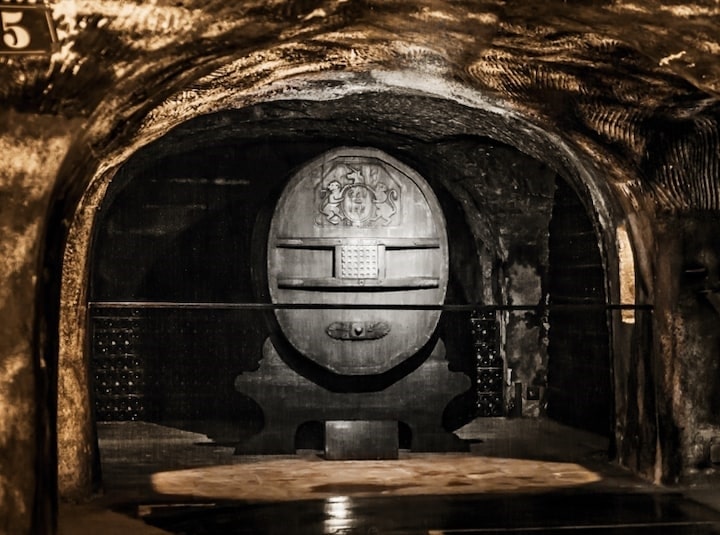
The case for private transport is clearest here: tasting and driving should never be in competition, and the good parts of the day are dispersed. A Champagne day is not one walkable site. It is appointments, villages, lunch, and the right sequence. Private planning earns its keep by curating style as much as logistics: large house versus smaller producer, polished lunch versus casual cellar-town meal, more architecture in Reims versus more vineyard atmosphere around Épernay. Guiding matters, but the bigger gain is coherent routing. The right private Champagne day feels edited. The wrong one feels like a transfer plan with bubbles poured into it.
The other reason Champagne ranks so highly is mood. For couples, it gives conversation instead of queue psychology. It gives a celebratory middle rather than a crescendo built entirely around arrival. It also tends to leave a cleaner emotional aftertaste than a palace day if the trip is meant to feel easy rather than instructive. That is why, when people are really debating a culture-heavy outing versus a tasting-heavy outing, the answer often comes down to how they want to feel at lunch, not only what they want to have seen by sunset.
Giverny: the right answer when you want beauty without a hard day
Giverny is the best choice for travelers who want a genuine escape from Paris without turning the outing into an operation.
Of the four, Giverny is the least aggressive on the body and often the kindest to the mood. It suits couples who want something beautiful and breathable, mixed-age families who do not want to spend the day inside formal interiors, and travelers who already know Paris will give them enough density. It is also the strongest answer for readers who hear “private day trip from Paris” and really mean “I want one day that feels lighter than the city.” That is a legitimate goal, and it is where Giverny beats Versailles. The whole point is that the day can feel composed without feeling full.
Who should skip it? Travelers who need a high historical yield, people for whom the outing must feel unmistakably major, and serious food-and-wine travelers hoping the day itself will revolve around lunch and tasting. Giverny is not thin, but it is softer. The reward is atmosphere, color, air, and an Impressionist frame, not the density of story you get in Versailles or Normandy. It is also the most season-sensitive of the four, which is another reason not to oversell it as a universal winner. If the emotional pull of Monet and the gardens is central, the official Monet Foundation page is worth checking before you commit, because this is one choice where your dates matter more than your ambition.
From Paris, the route usually feels moderate rather than trivial. From a western Paris hotel base near Avenue Kléber, it can be a particularly attractive use of one day because you are again aligned with a westbound start. By rail, the Saint-Lazare to Vernon logic is workable, but the Vernon transfer is exactly the kind of small choreography that changes the emotional texture of the day. It does not ruin anything. It simply makes Giverny feel more like a task and less like a release. That is why private door-to-door transport helps here, even if it is not as transformative as it is in Champagne or Normandy. The value is not access; it is protecting the softness of the day.
Guiding is also different here. A private guide inside Giverny is less critical than at Versailles or on a WWII route, because the site can communicate itself more directly. The stronger reason to book privately is the clean hotel start, the ability to shape lunch sensibly, and the freedom to make Giverny the centerpiece of a gentle countryside outing rather than an isolated stop bracketed by transfers. If that sounds like the right tone for your trip, the next practical step is usually Giverny private tour.
Normandy: the meaningful long day that only works when the history matters
Normandy is worth it from Paris when D-Day history is the reason for going, and much easier to regret when that is not the case.
This is not the generic best day trip that roundups sometimes make it sound like. Normandy from Paris is a serious commitment, and it asks to be chosen on purpose. It suits travelers with real WWII interest, families with older teens or adult children who will engage with the subject, and visitors willing to give one day to a more reflective, more demanding narrative. It can be one of the most memorable excursions available from Paris. It can also be the wrong call for celebration travelers, for people guarding energy, and for anyone hoping a long coastal drive will somehow double as a languid scenery day. If your true goal is a beautiful countryside outing with gentle tempo, choose Giverny instead.
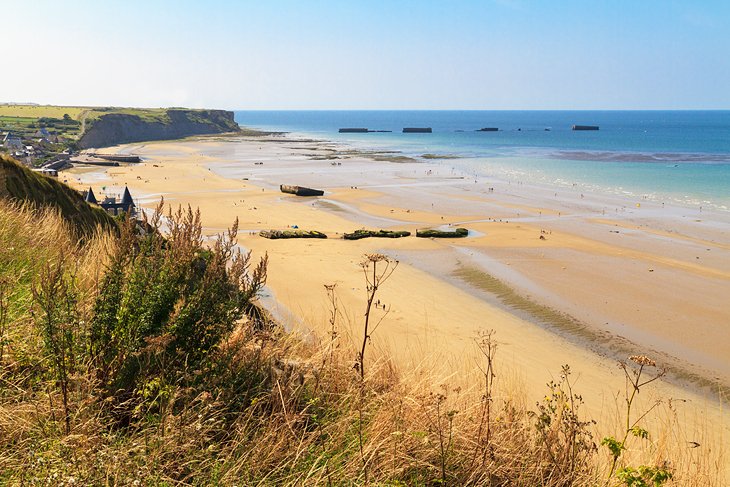
The core planning reality is that Normandy is not one place. Bayeux, Arromanches, Omaha Beach, and the American Cemetery do not collapse into one compact, walkable cluster. Even after the long drive out of Paris, there is still real movement between sites. That spread is why the door-to-door shape matters more than the map suggests. From a western Paris hotel base near Avenue Kléber, the early departure is at least aligned with the westbound route, but the alignment does not erase the scale of the day. You are still committing to a long run out, coastal transfers, standing time, weather exposure, and a late return. This is the option most likely to make Paris feel far away by the time you get back.
Private transport and expert guiding do help here, and not just in a cosmetic way. This is the day on which a strong guide can turn a list of site names into a coherent human story. The beaches, memorials, and museums become much more meaningful when the sequence is intentional and the context is carried from stop to stop. But there is also a crucial limit to what private spend can do. Paying for the longest chauffeured day does not materially improve the experience if your real goal is simply a beautiful countryside outing. The distance is still the distance, the coast is still spread out, and the emotional weight is still the point. If the history is the reason, a well-designed Normandy private tour can be excellent. If history is not the reason, the car does not magically turn Normandy into a soft scenic detour.
Normandy also has the biggest opportunity cost on a short Paris stay. It usually consumes the whole day and part of the next one in energy terms. That does not make it a bad choice. It makes it a deliberate one. The people happiest with Normandy are rarely the people trying to add “one more nice outing” to an already packed Paris schedule. They are the people who knew, before they landed, that this would be a cornerstone day with its own emotional gravity.
The fork that actually changes the answer: Champagne cellar day versus Versailles icon day
Many travelers think they are comparing four destinations. In practice, the real decision often narrows to a Champagne cellar day versus Versailles icon day.
That fork matters because it reveals what you are buying with your one open day. Versailles gives you density: architecture, power, court ritual, formal gardens, and one of France’s most legible historical stories in a single destination. Champagne gives you rhythm: cellar visits, a less didactic kind of pleasure, a celebratory lunch, and a day that is experienced through conversation and taste rather than through a grand narrative. Neither is inherently better. The better one is the one that matches the shape of the wider trip.
If Paris itself is already delivering your romance, your restaurants, and your neighborhoods, then Versailles may be the better contrast because it adds one major historical counterweight. If Paris is already giving you enough monuments and museums, then the more intelligent contrast is often Champagne private tour. That is especially true for couples and food-and-wine travelers. The day then becomes less about ticking off one more “must-see” and more about choosing what kind of pleasure belongs in the itinerary. Travelers who want to arrive home saying they understood something about French royal history should take Versailles. Travelers who want to remember a cellar, a lunch, and the pace of the day should take Champagne.
Private guiding also matters differently in each. In Versailles, the guide earns value inside the site by selecting, editing, and interpreting. The palace is the challenge; the road is not. In Champagne, the road and the curation are the challenge. A guide can deepen the tastings, but the larger value comes from not having to choreograph a region where the good parts of the day are separated from each other. That is why Champagne is often the better private-tour argument, even when Versailles remains the safer overall answer. One is a site that needs storytelling. The other is a region that needs shaping.
There is a mood question here too, and it matters more than many planners admit. Versailles can feel grand, instructive, and satisfying. It can also feel formal. Champagne can feel easy, adult, and celebratory, but it may leave first-time visitors wondering whether they skipped the more culturally obvious answer. Your own regret risk tells you which one to choose. If you will always wish you had seen the palace, do not outsmart yourself. If you will resent spending your only free day inside court spaces when what you wanted was a glass in hand and time to talk, do not let Versailles win by prestige alone.
What the route does to your body, and what the return does to the evening
The hidden cost of a day trip from Paris is usually paid after 6 p.m., not at noon.
This is where real route planning beats glossy comparison copy. A long day out of Paris is rarely just the drive itself. It is the early pickup, the standing time once you arrive, the little resets between stops, the late run back, and then the final city re-entry when everyone else is also heading home. The body feels that accumulation. Normandy is the clearest example: long seated stretches, weather on the coast, memorial walking, museum standing, more vehicle time, then the final approach back into Paris when your legs are already done. But Champagne can do a version of the same if you overschedule cellars across too wide a geography, and Versailles can do it if you insist on making the estate exhaustive instead of intentional.
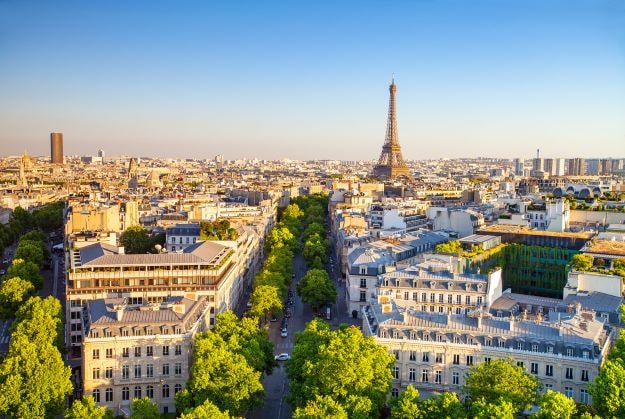
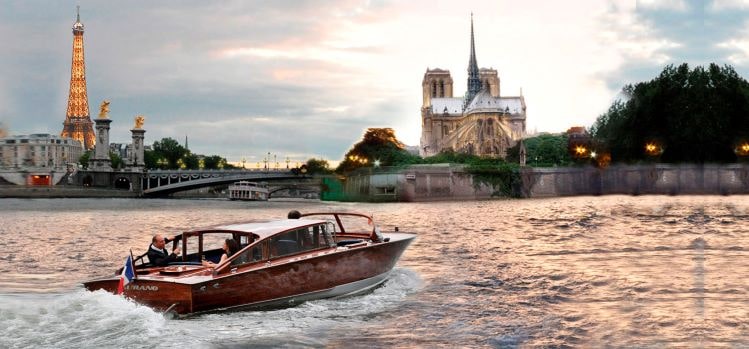
Paris adds its own final tax. Returning to a hotel near Avenue Kléber is one thing. Returning from a long excursion, then crossing the Seine to a Left Bank dinner, or trying to reach a river cruise departure near Pont de l’Alma, is another. Travelers often misread the pain point because the glamorous part of the day happened earlier. The fatigue arrives later, when you are deciding whether you still want to dress for dinner, whether the 9 p.m. reservation was a bad idea, and whether the next morning now needs to start slower. One of the most useful planning habits is to choose the out-of-city day partly by the evening you want afterward.
For couples, that evening effect can be decisive. Giverny is the most likely to leave you in a good mood with energy left for Paris. Champagne can do the same if the tastings are edited and lunch is sensible rather than sprawling. Versailles often still allows a fine dinner, especially from a western Paris base, but only when the estate is not treated like a conquest. Normandy usually takes the whole emotional day, and that is not a flaw; it is simply the nature of the subject and the route. The mood-preserving decision is to match the excursion to the kind of evening you want. The mood-killing mistake is to force a high-stakes dinner, late museum slot, or dress-up celebration on top of the heaviest possible outing and then wonder why Paris feels flat.
That is also why a “more” mindset often backfires on short Paris trips. More distance is not necessarily more romance. More stops are not necessarily more sophistication. The city already gives you enough density. The smarter day trip is often the one that gives you contrast without emptying the rest of the stay.
What to cut first when Paris is already full
On a short first trip, cut Normandy first and stop trying to make the farthest day the most valuable by default.
This is the sharpest planning judgment in the whole comparison. If you have three or four nights in Paris, you do not need your one open day to prove how ambitious you are. Paris already comes with its own timed-entry pressure, city crossings, and late-return temptation. If you are also trying to fit the tower, a museum priority, and a celebratory dinner, the right out-of-city choice is the one that leaves breathing room. That is why Versailles usually beats Champagne for first-timers, and why Giverny beats both when energy and mood are the actual brief. Before you overbuild the schedule, check the official Eiffel Tower site and notice how quickly a short Paris stay can accumulate fixed points before you even add a day trip.
The second useful cut-first rule is this: do not force a double headline day. Versailles plus a major Paris sight afterward is usually a mistake. Champagne plus a tasting-menu dinner is sometimes lovely, but only if the day was intentionally light. Normandy plus anything else is almost always the wrong frame. If you want the out-of-city day to feel like a highlight rather than a burden, give it one clear identity. Palace day. Cellar day. Garden day. D-Day day. That single decision prevents most overplanning.
It also helps to judge the outing against the rest of the stay rather than in isolation. A Paris trip heavy on museums and interiors often benefits from Champagne or Giverny. A trip built more around neighborhoods, dining, and lighter city exploration can absorb Versailles beautifully. A trip that already includes an emotionally serious historical site in Paris may not need Normandy unless the D-Day story is central for you. If the whole framework of the stay is still moving, it helps to compare the excursion against your city days in the 3-day Paris itinerary before you lock the one day that sits outside it.
Spend where the road is the problem, not where the brochure is
Private spend changes different days in different ways, and the cleanest choices come from knowing exactly what you are paying to fix.
- Versailles: Spend first on a strong guide and on a route that cuts intelligently. A more glamorous car is secondary to interpretation and a realistic scope.
- Champagne: Spend on chauffeur-led routing and appointment design. This is the day where private logistics most clearly change comfort, safety, and overall coherence.
- Giverny: Spend only if you care about preserving the softness of the day, avoiding transfer choreography, or pairing the outing with lunch in a controlled way.
- Normandy: Spend when history is the point and you want context carried across multiple sites. Do not spend simply because the distance is long and the idea sounds impressive.
The plainest way to say it is this: premium spend does not always earn its cost. It earns its cost in Champagne because the region is dispersed and tasting should never be tied to driving. It earns its cost in Normandy when expert context is the reason to go. It earns less in Versailles if all you are buying is a more glamorous ride to a site that mostly needs better interpretation once you arrive. And it does not earn its cost in the longest Normandy run when your real brief is just scenery and ease.
The right question, then, is not which day trip sounds most special in the abstract. It is which day you can still enjoy inside the trip you are actually taking. When the stay is short, the best route can preserve a Paris evening and the wrong one can flatten two days instead of one. If you want that decision built around your hotel location, walking tolerance, meal plans, and whether the priority is royal history, cellar time, gardens, or D-Day context, Inquire now.
FAQ
Which private day trip from Paris is best for first-time visitors?
Versailles is usually the best first-time choice because it offers the highest cultural payoff for the smallest transit burden, especially if Paris itself is still the main reason for the trip.
Is Versailles or Champagne better for couples?
Versailles is better for couples who want one major historical and visual hit. Champagne is better for couples who want the day to feel celebratory, conversational, and centered on tasting rather than on a palace narrative.
Which day trip from Paris is best if I want scenery and a relaxed pace?
Giverny is the strongest fit. Versailles is the wrong choice when your real priority is scenery and a relaxed pace, because even a well-planned palace day carries more structure and density than it first appears to.
Is Giverny worth it if I only have a few days in Paris?
Yes, when your short stay already includes enough museums, reservations, or city intensity and you want one lighter day. It is often a better emotional fit than a heavier excursion when the wider trip is already full.
Is Normandy too much for a day trip from Paris?
Normandy is too much for a casual add-on, but not too much for travelers who care deeply about D-Day history. The key is choosing it as a deliberate cornerstone day rather than as a generic countryside outing.
Where does private transport make the biggest difference?
Champagne benefits the most from private transport because tastings, lunch, and cellar appointments are spread out and should not be tied to driving decisions. Normandy is the next strongest case because the sites are dispersed and the day is long.
Does a private guide matter more in Versailles or Normandy?
A private guide matters more inside Versailles than many travelers expect because the palace needs interpretation to feel coherent. In Normandy, guiding is just as valuable, but for a different reason: it connects multiple sites into one meaningful historical story.
Which day trip works best from a western Paris hotel base near Avenue Kléber?
Versailles usually works best because the westbound route starts cleanly and keeps the day proportional to the city stay. Giverny also benefits from that western position, while Champagne asks more of the morning because the route points the other way.
If you’re interested in any private tours of Paris, please reach out to us.

 So if you are looking for the absolute best in Paris & surroundings with authentic local fully-licensed native guides whose English you can actually understand and with an exclusive and amazingly fun itinerary