Barcelona With Preschoolers and Grandparents: Gaudí Time Slots, Stroller Friction and a Montjuïc Bailout Plan

Updated
Slower is not the same as workable
The usual advice for visiting Barcelona with a preschooler and grandparents is to slow down. That sounds sensible, but it does not solve the central problem. A multigenerational day can be slow and still fail because the child, the older adults and the ticketed monuments are running on different clocks. A preschooler may be cheerful while moving and unravel during a stationary wait. A grandparent may enjoy an interior but lose confidence after a steep approach or a long descent. Sagrada Família and Park Güell, meanwhile, operate around selected entry times rather than the moment when everyone happens to feel ready.
The practical task is therefore synchronization, not simply reduced speed. You need one shared architectural experience, a route that does not spend stamina on avoidable gradients, and an agreed point at which the group may divide without turning the split into a family disappointment. Montjuïc belongs in the plan as a flexible alternative to a second demanding Gaudí anchor, not as an extra attraction added after both generations are tired.
This guide assumes a family with at least one preschool-age child, a stroller that may still be useful for distance or naps, and one or more older adults whose walking ability is real but finite. It does not assume wheelchair use, perfect lift availability, or that every older traveler has the same balance, heat tolerance or stair confidence. For more detailed mobility questions, the supporting guide to Barcelona architecture planning for a wheelchair user addresses a different and more specific access brief.
The most reliable promise to make the family is modest: everyone shares the best part of one major site, nobody is forced through an unsuitable branch, and the afternoon remains adjustable. Once that promise is explicit, the day becomes easier to design. The group can stop treating every deviation as a loss and start treating planned separation as a tool.
Plan around three stamina curves and two hard edges
Preschool energy is rarely a smooth downward line. It rises after food, drops sharply around a missed nap or prolonged queue, and may recover in open space. Older-adult stamina is often more predictable but less recoverable within the same day: standing, uneven footing, heat and repeated vehicle entries can matter more than the total distance shown on a map. The third curve belongs to the accompanying adults, who are carrying the coordination load and may be managing a stroller, snacks, admission documents and two sets of expectations.
The hard edges are the timed entries. A late child-care transition can threaten an entry window; a delayed exit from one monument can make the next booking oppressive. That is why two fixed Gaudí admissions on the same mixed-mobility day are materially different from two untimed neighborhood stops. The second reservation does not merely add culture. It removes your ability to wait for the child to sleep, let a grandparent sit longer, or change direction when the group is fading.
Before buying anything, define capability in operational language rather than age labels. Ask how long the older adults are comfortable standing without a guaranteed seat; whether a stair descent is harder than an ascent; whether uneven paving changes balance; whether heat or crowds shorten their usable window; and whether entering and leaving vehicles repeatedly is tiring. For the preschooler, identify the usual meal and sleep windows, whether the stroller is for transport or a necessary nap environment, and how the child handles security lines and enclosed interiors.
- Shared promise: choose one experience that all generations will complete together.
- Optional branch: identify one element that more mobile adults may do without the whole family.
- Exit rule: agree that leaving a site ends that person’s visit unless re-entry is explicitly permitted.
- Reunion rule: name a precise, street-level meeting point and a clock time rather than “near the entrance.”
A family that wants broader first-trip context can compare this specialist route with a wider Barcelona plan with children. The distinction here is narrower: the child and grandparents are not simply fellow travelers at a gentler pace. Their constraints interact with the city’s hills and reservation system in different ways.
The verified operational facts that should shape the day
The official-source review supplied for this guide was completed on 11 August 2026. The facts below are operational and should be checked again after a substantive official-page change or source correction. They are not interchangeable with route judgment: a site can be technically accessible in one respect and still be a poor fit for a particular group’s stamina on a particular afternoon.
Sagrada Família fixes the clock and removes the tower as a shared preschool option
Sagrada Família’s official conditions require the purchaser to select a specific date and time. They also state that a tower visit ascends by lift and descends on foot, and that tower access is not available to children under six, visitors with baby strollers, people with reduced mobility and people described by the site as elderly. Those conditions are set out in Sagrada Família’s official rules and conditions of sale.
For this family profile, the consequence is stronger than “check the fine print.” Most preschoolers fall within the under-six restriction, and an older relative may be excluded or simply unsuited to the descent even without identifying as mobility-impaired. A tower add-on creates a compulsory split inside the day. If the primary goal is a shared family experience, the nave and ground-level interpretation should be the booked core.
Park Güell combines timed admission with gradient and surface friction
Park Güell’s official FAQ says online booking allows selection of a date and time up to three months ahead, warns that availability is limited, identifies irregular paths and steep ramps, and recommends the Carretera del Carmel access for visitors with reduced mobility. The current details are on the official Park Güell planning FAQ.
The park’s official reduced-mobility map marks an architectural route of approximately fifty minutes and another visitable-places route of approximately twenty minutes, with access mapped around Carmel Road, Marianao Street and Olot Street. Those durations are map labels, not promises that a preschooler, stroller and older adult will maintain the same speed. They are useful because they prove that route choice inside the park is consequential; there is no single neutral circuit.
Barcelona transport is broadly adapted, but lift dependency remains a planning variable
TMB states that the bus network is adapted for reduced mobility and uses access ramps; newer buses include reserved spaces for wheelchairs, authorized scooters and strollers. The same official page reported lifts at 156 of 165 metro stations and advises travelers to check lift status. See TMB’s accessibility and reduced-mobility information.
This makes public transport viable, but not frictionless. A stroller and an older adult can both depend on the same lift, and a failed lift can convert a simple metro plan into extra walking or a station change. A bus avoids stairs but introduces traffic variability and the possibility that designated space is already occupied. The correct choice is not ideological; it depends on which uncertainty the family can absorb without threatening a timed entry.
Sagrada Família: make the nave the family’s common achievement
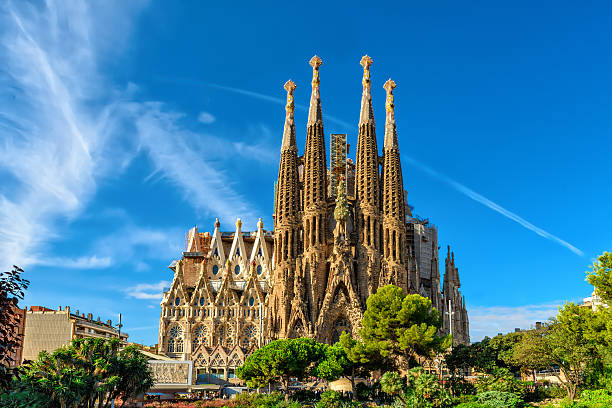
Sagrada Família is the stronger morning anchor because its interior delivers a complete architectural experience without requiring a hill approach or tower descent. It also gives the day a clear success condition: everyone enters together, experiences the nave and leaves before the child’s or grandparents’ patience has been spent on secondary details. Families deciding between access and architectural payoff can also read the detailed comparison of Sagrada Família towers and a nave-only visit.
Book for the group you actually have
Do not buy the tower because one energetic adult fears missing out, then attempt to solve the split on site. Buy the shared visit first. A more mobile adult who considers the tower essential should treat it as a separate commitment, with its own ticket logic and a named companion responsible for the preschooler. The family should decide in advance whether the tower subgroup reunites inside only if the rules permit, or outside after everyone’s visit has ended. Ambiguity at the monument is harder than disappointment during planning.
The entry time should sit inside the older adults’ reliable window and before the preschooler’s usual late-morning deterioration, not at the earliest hour merely because it appears efficient. A very early booking can be fragile after jet lag, a slow breakfast or a difficult night. A late booking can turn the entire morning into waiting. The best slot is one the family can reach with a calm buffer while still leaving appetite and attention for the interior.
Use interpretation to reduce movement, not to prolong it
A specialist guide can make a shorter visit feel complete by selecting a few ideas that work for both generations. For a preschooler, the changing colored light, tree-like columns, animals and geometric forms are concrete entry points. For grandparents, the same features can be connected to structure, liturgy and Gaudí’s long construction history without requiring a full perimeter circuit. The shared narrative is not childish for one generation or overtechnical for the other; it uses the same visible object at two levels.
The route judgment is to favor a compact sequence over exhaustive coverage. Start with the spatial effect of the nave, establish one or two visual themes, then decide whether the façades are approached as a short exterior continuation or viewed more selectively. Do not assume that walking slowly around every available area is gentler. More stops can mean more standing, more crowd negotiation and a later meal.
Create a final-exit branch before anyone needs it
A preschooler may finish before the older adults, or a grandparent may prefer to sit while the child needs movement. The cleanest split is usually one adult leaving with the person who is finished and accepting that the exit may be final. The remaining subgroup completes one agreed segment and meets at a precise exterior point at a set time. The meeting point should be described by street side or façade, not by a landmark that looks different from different corners.
Carry admission details on more than one adult’s device and make sure the person leaving has what the child needs. Avoid placing the stroller, medicines, outerwear or all family documents under the control of the subgroup that may stay longer. This is not a packing checklist; it is a division-of-responsibility issue created by the planned split.
Older adults deserve an exit choice that does not sound like failure. “You can leave whenever you need to” still places the burden on them to interrupt the family. A better plan states the branch in advance: after the shared nave sequence, one adult can accompany anyone who is finished outside, while the others spend a limited additional period on the façades or museum area, subject to current access. The permission is built into the design rather than requested under pressure.
The interval between monuments is part of the visit
The most expensive mistake in stamina is treating the transfer and meal as blank space. Between Sagrada Família and Park Güell, the group must exit a crowded monument, locate transport, secure the child, manage the stroller, travel across the Eixample-to-Gràcia edge, eat and approach a hillside site. Even when the map distance looks modest, the sequence contains many transitions. Each transition asks the older adults to stand, turn, step, wait or climb in and out.
Lunch should therefore be operationally easy and early enough that the preschooler does not enter Park Güell hungry. The exact venue matters less than predictable seating, a menu the child can use, toilets, and a location that does not require an unnecessary loop away from the next route decision. A long destination meal is poorly matched to a second timed admission because it converts hospitality into clock pressure.
Use the meal as a decision gate. Before leaving the table, ask four concrete questions: Is the child likely to nap in the stroller or resist it? Can the grandparents comfortably manage an irregular, sloping environment now? Is the weather making exposed walking more demanding? Is everyone willing to accept the shortened Park Güell route rather than chase every famous viewpoint?
If any answer is no, the family should pivot before traveling to the park. Montjuïc is useful only at this stage, while the group still has control over direction. It is not an efficient rescue after arriving at the wrong Park Güell gate, discovering the gradient and then crossing the city again.
Park Güell: choose an entrance, an exit and a maximum route before arrival
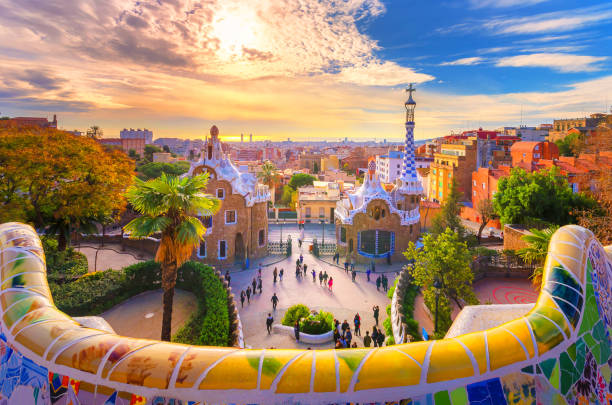
Park Güell creates a different kind of difficulty from Sagrada Família. The basilica’s main risk is the clock; the park’s risk is cumulative terrain. Irregular paths, steep ramps, sun exposure, route-finding and an exit that may not be where the family expects can turn a beautiful open-air visit into the point where both generations run out of capacity at once.
Treat Carretera del Carmel as a route decision, not a footnote
The official recommendation of Carretera del Carmel for reduced-mobility access matters even when nobody uses a wheelchair. A grandparent with limited hill tolerance and a stroller pushed by an adult are both affected by gradient, although their formal access needs are not identical. Arriving at a more convenient vehicle drop point is not the same as having a flat visit, but it avoids spending a large share of the group’s energy before the architectural experience begins.
The family should match drop-off and pickup to the same planned route whenever current traffic and site rules allow. An itinerary that enters from the mobility-friendlier side but requires the whole group to cross the park to reach an unrelated pickup recreates the hill problem at the end, when balance and patience are lower. Confirm the current approach, entrance instructions and vehicle access rather than relying on a pin saved from an earlier trip.
Use the official route lengths as boundaries, not targets
The mapped approximate fifty-minute architectural route and twenty-minute other-places route provide a useful planning frame. For a family with a preschooler and grandparents, the shorter route is not merely a reduced version of the real visit. It can be the correct shared core, with one or two Gaudí elements interpreted well and the broader park left to a more mobile subgroup.
Do not combine both mapped routes by default. The published durations exclude the family’s own pauses, child negotiations, photography, crowd flow and any wrong turn. A stroller can help on smoother stretches and become physical work on awkward surfaces. An older adult who is comfortable walking for fifty minutes on level paving may not be comfortable with fifty minutes of ramps and irregular footing. The labels describe route content, not personal effort.
Build the age-specific branches around what each person values
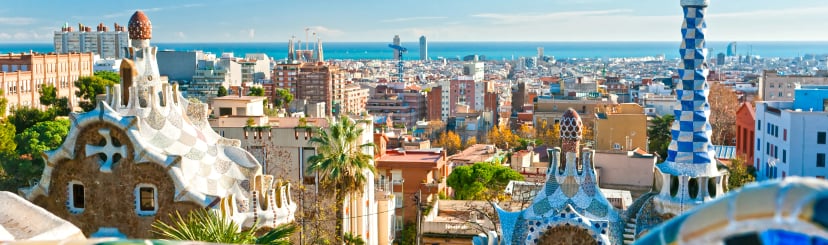
For the preschooler, Park Güell’s strength is visual variety and outdoor movement. The child does not need a complete architectural chronology. A parent can turn mosaics, animal forms, columns and framed city views into a short sequence, then stop before interest becomes resistance. The stroller should be treated as a tool with limits: useful for a tired child, but not proof that every path is easy to push.
For older adults, the value may come from context rather than coverage. One well-chosen viewpoint or architectural zone, explained without a forced circuit, can be more satisfying than reaching every photogenic area. Seating availability and shade should be confirmed for the intended route rather than assumed. When standing tolerance is the limiting factor, the guide’s role is to place explanation where the family can pause, not to add more stops.
For the more mobile adults, the optional branch may be a longer path or additional viewpoint. That branch should begin only after the shared core is complete. It should have a time cap and return to a pickup point everyone can identify. A grandparent should not be left as the sole supervisor of a tired preschooler unless that arrangement is genuinely comfortable for both; the split must redistribute effort, not transfer it to the person with the least reserve.
Make reunion independent of mobile signal and mood
Choose a reunion point that appears on the current official map and can be reached without repeating the demanding part of the route. Record the name in every adult’s phone and also say it aloud. Set both a meeting time and a latest departure time. If the longer-route subgroup is late, the waiting subgroup should be authorized to leave for the pickup rather than remain standing.
This is where a private guide or a two-person adult coordination plan changes the quality of the day. One person can remain with the shorter-route subgroup and preserve the cultural narrative, while another accompanies the child or more mobile adults. Without that structure, the family often keeps everyone together to avoid confusion, even when togetherness has become the source of exhaustion.
Montjuïc is a bailout only when the family changes the objective
Montjuïc is also a hill, so it should not be sold as a universally easy substitute for Park Güell. Its advantage is different: the family can use mechanized access to the lower hill, choose among several kinds of experience, and leave without being bound to a second Gaudí admission. The objective shifts from “complete another major monument” to “share a flexible Barcelona afternoon with a clean exit.”
TMB’s official page says the Montjuïc funicular links Paral·lel, connected to metro lines L2 and L3, with Parc de Montjuïc in approximately two minutes; Parc de Montjuïc also connects with the cable car toward the summit. Operational details are on the official Montjuïc funicular page. Check current service status before relying on it, because a mechanized link is only useful when operating as planned.
The bailout begins before the hill
After lunch, the family chooses between Park Güell and Montjuïc. If the preschooler needs sleep, the grandparents have limited reserve, or weather makes exposed irregular paths unattractive, do not travel toward Park Güell merely to see whether it feels manageable. Move instead toward Paral·lel for the funicular or use a prearranged vehicle to a confirmed lower-hill point. The gain is optionality, not a shorter cross-city transfer from every origin.
The lower hill should be planned as one modest experience plus open time, not as a chain of museums, gardens and summit views. Candidate focuses include an art visit, a garden-and-view sequence, or an urban-design explanation around the Olympic and exhibition landscape, but opening hours, access routes and admissions must be checked for the chosen date. The companion guide to choosing art, views or gardens on Montjuïc can help define that single focus.
Give each generation a branch that can end independently
A preschooler who has slept may benefit from a short open-air walk with one parent. A grandparent may prefer a seated pause or one indoor collection rather than another panoramic circuit. The two branches can reunite at Parc de Montjuïc station or at a confirmed vehicle pickup point. Avoid using the summit as the automatic meeting place; reaching it may add another mode, queue and exposure that defeats the purpose of the pivot.
If the child does not recover or an older adult’s capacity falls, the early exit is clear: return by the funicular if operating, or use the arranged pickup. The family does not need to justify leaving because no second high-stakes monument remains unfinished. That emotional difference is important. A flexible afternoon feels complete when it was framed as flexible from the beginning.
Know what Montjuïc does not solve
Montjuïc does not remove all gradients, guarantee seating, eliminate the need to verify lifts, or make a tired child interested in art. It can also be geographically inconvenient after Sagrada Família unless transport is coordinated. It is the better alternative when the second timed hill visit is the problem and the family still wants a shared Barcelona chapter. It is not the better alternative when everyone simply needs to stop.
Ending the program after Sagrada Família and lunch is a legitimate option. One parent may later take the child on a light neighborhood outing while the grandparents rest, or the family may reunite for an early evening close to the accommodation. The wider guide to a three-generation Barcelona day with one Gaudí interior offers another structure when the family wants to distribute the city over a less compressed arc.
Three day designs that preserve a shared memory
Design one: Sagrada Família together, abbreviated Park Güell together
This is the most ambitious version that still respects the brief. Book a nave-focused Sagrada Família visit inside the family’s reliable morning window. Build the arrival buffer specified by the current admission instructions, complete a compact shared interpretation, and accept a final-exit split if either generation finishes early. Eat before the child becomes hungry, then hold the Park Güell go-or-no-go conversation at the table.
Proceed only if the child can tolerate the transfer and the grandparents remain comfortable with sloping, irregular terrain. Approach through the mobility-recommended side, use the shorter official route as the shared core, and cap any longer branch. Arrange pickup so the group does not have to cross the park after the visit. The day ends after Park Güell; adding a third cultural anchor would convert a successful plan into endurance.
This design suits a family whose preschooler naps reliably in the stroller, whose grandparents can manage moderate irregular walking, and whose accompanying adults are willing to leave parts of both monuments unseen. It is a poor fit when the adults equate value with full coverage. The plan succeeds by editing.
Design two: Sagrada Família together, Montjuïc after the lunch decision
This version preserves the strongest shared Gaudí experience and trades the second reservation for flexibility. After Sagrada Família, have an early, easy meal and assess the family honestly. If energy is mixed rather than absent, continue to the lower Montjuïc area by the most reliable route available that day. Use the funicular only after checking service and lift conditions relevant to the journey.
Choose one focus. A family interested in Catalan art might select a single institution; a child-led group might prioritize open space and views; architecture-minded grandparents may enjoy the exhibition and Olympic landscape without another Gaudí interior. Keep the plan reversible. The moment the child or older adults are finished, return to Paral·lel or the confirmed pickup.
This is often the better design when the family values being together more than checking off Park Güell. It also works when Park Güell availability forces an awkward slot. The tradeoff is geographic: Montjuïc is not adjacent to Sagrada Família, so the transfer must be treated as a real part of the day. A direct vehicle can be justified when it replaces multiple lift-dependent transitions and protects the group’s usable afternoon, not merely because private transport sounds more comfortable.
Design three: one shared morning, two afternoon branches, one easy reunion
Some families should stop trying to make the afternoon identical. After the shared Sagrada Família visit and meal, one branch can take the preschooler for sleep, open space or a child-paced outing, while the other takes interested adults to Park Güell or a focused Eixample site. The branches reunite near the accommodation or at a simple evening location rather than inside another attraction.
This design is strongest when the grandparents genuinely want more culture but not child logistics, or when the child’s nap cannot be moved without consequences. It requires at least two capable adults, duplicate access to essentials, and a clear transport plan. It should not leave one older adult carrying the stroller or managing an overtired child through a hill site.
The reunion needs less ambition than the sightseeing. Choose a place with simple access and no timed admission. The family can share photographs and one story from each branch, which often produces a better multigenerational memory than a forced afternoon in which everyone experienced the same route badly.
Transport should remove transitions, not become another itinerary
Barcelona’s adapted network gives families genuine choices, but the best mode changes by leg. For a direct journey with a workable bus route, low-floor access can be useful for a stroller and an older traveler. For metro travel, verify the specific stations and lift status rather than assuming that a generally accessible system makes every interchange easy. For Park Güell, the arrival gate and final pickup matter more than the abstract mode. For Montjuïc, the funicular can replace the climb to the lower hill when operating.
A taxi or prearranged private vehicle is most valuable on the cross-city, hill-facing leg, especially when the group must arrive at a specific entrance with enough reserve for the visit. It is less useful when it deposits the family far from the correct access or when traffic uncertainty threatens the slot. Send the driver or dispatcher the exact official entrance name, not only “Park Güell,” and reconfirm the pickup side before the group enters.
Strollers create their own transfer tax. Folding one for a vehicle, carrying it around a failed lift or negotiating a crowded bus may be harder than walking a short distance with the child. Conversely, leaving it behind can remove the child’s only reliable nap environment. Decide by route segment: the stroller may be essential for the Sagrada-to-lunch interval but burdensome on parts of Park Güell. The family should not discover that conflict after paying for two fixed admissions.
Older-adult comfort also depends on vehicle sequencing. Repeated short rides can involve more standing, stepping and waiting than one longer ride followed by a seated visit. A mobility-aware plan reduces the number of transitions and places the longest walking segment before lunch. This is why the question is not “public transport or chauffeur?” but “which mode removes the most consequential friction on this leg?”
A verification checklist for the booking week and the morning itself
Before purchasing
- Confirm the preschooler’s exact age on the visit date and apply the current Sagrada Família tower rules.
- Choose whether the family’s common goal is Sagrada Família alone or Sagrada Família plus a second anchor.
- For Park Güell, review the official FAQ and current reduced-mobility map before selecting the entry and route.
- Reject any booking sequence that requires the family to cross a hill site merely to reach its pickup.
- Decide who accompanies the child and who accompanies an older adult if the group divides.
During the booking week
- Recheck official admission conditions, entry instructions and any notices affecting access.
- Verify the intended Park Güell entrance, the maximum route and the final meeting point against the current map.
- Check TMB accessibility information for the stations and modes actually planned, including lift status close to travel.
- Check Montjuïc funicular service before treating it as the afternoon fallback.
- Give every adult the admission documents, addresses and contact numbers needed to operate independently.
On the morning
- Assess sleep, appetite, heat and balance honestly; do not let sunk costs decide the afternoon.
- Confirm who carries child essentials, medicines and shared documents if one subgroup exits early.
- State the Sagrada Família reunion point and time before entering.
- At lunch, make the Park Güell decision before beginning the transfer.
- If choosing Montjuïc, select one focus and one exit route rather than improvising a full hill circuit.
The checklist is deliberately operational. It does not promise that every lift, route or queue will behave perfectly. It ensures that one disruption does not force the whole family into a single unsuitable response.
Where private coordination materially changes the outcome
This is one of the Barcelona days where private service can have a concrete purpose. The value is not decorative exclusivity. It is having one person hold the cultural sequence while another adult manages child or mobility needs; aligning a timed Sagrada Família entry with the correct Park Güell access; changing the afternoon before the family travels toward a hill; and keeping a vehicle or pickup plan synchronized with two possible exit times.
A guide who understands both monuments can reduce the amount of walking required to produce a coherent Gaudí story. A prearranged transfer can remove lift-dependent interchanges on the leg where missing the slot would matter. A clear family brief lets the team know that the group may divide and that success means a good shared core, not maximum coverage. These are coordination outcomes, not reasons to repeat the language of luxury.
The family should still retain decision rights. No guide can turn a missed nap into spare stamina or make an older adult’s balance concern disappear. The best private plan makes it easy to shorten, divide or abandon the second anchor without administrative confusion. Families considering a broader stay can place this day inside a three-day Barcelona itinerary with private guiding, but this specialist day should remain deliberately lighter than the surrounding program.
Practical handoff: decide what must be shared
Write the plan in one sentence before purchasing: “All generations will experience the Sagrada Família nave together; Park Güell happens only if the lunch check is positive; otherwise we use a one-focus Montjuïc afternoon or stop.” That sentence gives the day a hierarchy. It protects the shared memory, preserves the child’s and grandparents’ dignity, and prevents the second reservation from controlling every earlier choice.
Then assign the branches. Name the adult responsible for the preschooler, the adult who stays with an older relative, the exterior reunion point, the final-exit rule and the pickup location. Put the same details on every phone. On the day, judge success after the shared core, not by the number of landmarks completed.
When fixed entries and unequal stamina threaten the family’s one shared Barcelona day, a private guide and mobility-aware transfer plan become useful because they keep two routes coherent and allow the group to rejoin without confusion. Review private Barcelona touring options for a coordinated multigenerational day, then Inquire now
If you’re interested in any private tours of Barcelona, please reach out to us.








 So if you are looking for the absolute best in Barcelona & surroundings with authentic local fully-licensed native guides whose English you can actually understand and with an exclusive and amazingly fun itinerary













