Sagrada Família Towers or Nave-Only? Choosing the Barcelona Visit by Access, Light and Architectural Payoff

Updated
Choose a tower only when the ascent answers a specific architectural question for you. For most first-time visitors, the nave, the two completed transept façades and the museum already contain the essential Sagrada Família experience. Tower access adds height, proximity to the bell-tower fabric and a directional view over Barcelona, but it also adds a fixed route, a stair descent, stricter access conditions and exposure to weather-related closure. It is an enhancement, not the missing chapter of the Basilica.
The most useful decision is therefore not “Can I get a tower slot?” but “What would I understand from that slot that I would not understand from below?” Choose the Nativity-façade tower when your interest is Gaudí’s generative structural language, the eastern orientation and the façade he advanced as a completed architectural statement. Choose the Passion-façade tower when you are more interested in dramatic load-bearing form, the severe spatial character of the western side and an orientation toward Barcelona’s centre. Choose nave-only when stairs, heights, uncertain operation or a tight cultural day would make the tower consume attention rather than deepen it.
The current official format is quite specific. The Sagrada Família tower product page lists Basilica entry, access to one tower and the app audioguide, with the Nativity option looking toward eastern Barcelona and the Passion option toward the city centre. The same page gives an approximate visit duration of one hour and thirty minutes, requires visitors to take a lift up and walk down, and states that the tower visit is not accessible for people with reduced mobility or functional diversity. These are operational conditions, not small-print details: they should determine the booking before preferences about skyline photography do.
The reservation also behaves more like an appointment than a flexible add-on. The official product page says tickets are nominative, visitors must show official photo identification and admission is limited to the date and time printed on the booking. Tower choice is therefore part of the advance format, not a casual decision to make after entering the Basilica.
By contrast, the official Basilica-only product page includes the Basilica and museum, says visitors may remain in those spaces for as long as they like, excludes the towers and crypt, gives an approximate duration of one hour and describes the visit as accessible for people with reduced mobility. For an architecture-focused traveler, “one hour” is better read as the official product estimate than as a target. The nave rewards slower looking, and the exterior argument cannot be understood from a single doorway.
The tower option changes the route more than it changes the monument
A tower visit is sometimes imagined as a superior version of the same visit: the nave plus a panoramic finale. In practice, it creates a different rhythm. You enter on a timed format, move through the Basilica while keeping a second access point in mind, leave bags or similar accessories in the required lockers, ascend by lift, descend on foot and then rejoin the ground-level sequence. The gain is not simply “more Sagrada Família.” It is a controlled excursion into one part of the building envelope.
That distinction matters because the Basilica’s most consequential ideas are not hidden at altitude. The building’s spatial hierarchy, branching columns, vaults, transept, apse, façade narratives and changing daylight are legible from the main visit. The museum adds the history of the project and Gaudí’s methods. Exterior viewpoints let the Nativity and Passion sides be compared at a scale where their complete compositions can be read. A visitor who uses ninety thoughtful minutes below can leave with a more coherent understanding than someone who rushes the nave because a tower time is approaching.
Tower access is strongest when you want to experience scale from within the vertical system. From the ground, the bell towers read as tapered silhouettes and a repeated skyline. From the route, the useful conceptual shift is proximity: openings, masonry, structural thickness and the relationship between a tower and the city around it become less abstract. That can be a substantial payoff for an architecture traveler. It is less substantial for a visitor primarily seeking Barcelona’s best broad panorama, because the official promise is a directional city view, not an unrestricted observation deck or guaranteed visibility.
The symbolic appeal should also be separated from the operational reality. Going “up the towers” sounds like reaching the crown of the whole Basilica. The visitor route instead concerns one tower associated with either the Nativity or Passion façade. It does not convert the visit into access to the central towers, nor does it replace the need to study the façade from the square. The app may provide virtual or augmented interpretation of areas that are not part of the physical route, but a physical tower ticket remains a visit to one defined vertical path.
Why a nave-only visit is architecturally complete
The word “only” does the standard visit a disservice. The nave is not the waiting room for the tower; it is the principal spatial argument. A peer-reviewed study of the building’s construction describes the plan as a Latin cross with five longitudinal naves and a three-nave transept, with the completed Nativity and Passion entrances at the ends of that transept. The construction study in Informes de la Construcción also explains how form, materials and structural method developed together across the long building campaign.
This is the level at which Gaudí’s ambition becomes spatial rather than picturesque. The columns do not simply imitate trees; their inclination and branching answer the direction of loads while producing an interior that feels continuously upward-moving. The vaults are not an applied ceiling over a conventional church plan. Their geometry, openings and supports make light part of the structural reading. The nave therefore gives the visitor three things at once: a ceremonial space, a construction system and a controlled field of daylight.
The February 2026 official architecture booklet describes the inclined, double-twist columns as creating a forest-like space that encourages introspection. It also explains that light enters not only through the walls but through skylights in the vaults, and that the building uses balanced structures to transfer loads efficiently to the foundations. Those points are more than explanatory labels. They give a sequence for looking: begin with the base and material of a column, follow its changing profile upward, notice how it branches, then see how the vault surface is punctured and illuminated.
A strong nave-only visit also uses both transept ends. Stand far enough back to understand the central crossing, then turn toward each façade. The Nativity side and Passion side are not merely two exterior themes attached to the same interior. Their orientations, structural accents and treatment of light establish different emotional poles. The interior mediates between them. Even without climbing, the building can be read as a journey between birth and death, morning and evening, abundant form and deliberate austerity.
The museum completes another part of the argument: Sagrada Família is both a work of Antoni Gaudí and a multi-generational construction project. Models, documents and construction explanations help distinguish Gaudí’s geometrical method from the later technologies used to realize it. That distinction is especially valuable for travelers who might otherwise reduce the building to “organic inspiration.” The architecture is not simply nature-shaped decoration. It is a disciplined synthesis of geometry, structure, symbolism, craft and modern fabrication.
For a first visit, the nave-only format is therefore not a compromise when it allows you to keep the whole argument intact. It is often the better choice for someone visiting one major Gaudí interior, someone pairing the Basilica with another timed institution, or anyone whose attention is likely to be divided by the physical demands of the descent. Our broader comparison of Sagrada Família, Casa Batlló and La Pedrera when time is tight helps place that decision in the context of the city’s other major interiors.
Choose the Nativity tower for emergence, structure and Gaudí’s completed fragment
The Nativity façade is the more persuasive tower choice for travelers interested in how Gaudí made structure appear alive. The official architecture booklet notes that the towers and many supports for the façade’s three portals use catenary or parabolic arches. These stable forms resist wind while heightening the sense of vertical reach. The same booklet explains that Gaudí, knowing he would not finish the entire Temple, chose to build in parts and advanced the Nativity façade after completing the crypt and before beginning the apse façade, so that a completed section could make the project harder to abandon.
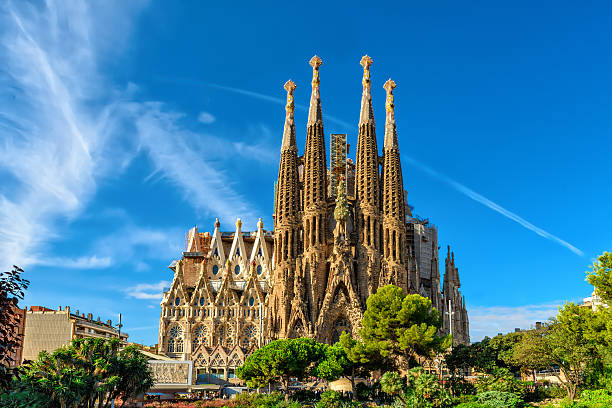
That history gives the Nativity side unusual interpretive weight. It is not simply the “decorative” façade versus the “modern” Passion side. It is a concentrated statement of Gaudí’s late architectural language: growth, branching, compression and release, dense iconography, textured stone and a skyline that dissolves mass into openings and pinnacles. A tower route here can reinforce the idea that the façade is not a flat screen. It is a deep, inhabited construction in which portal, buttressing logic, bell tower and sculptural surface work together.
The eastern orientation is part of that reading. The official booklet says that the rising sun illuminates the Nativity portals and strengthens the theme of birth and life. This does not make a morning booking a guarantee of luminous stone. Season, cloud, construction conditions and the exact route timing all intervene. It does mean that east light belongs to the façade’s intended symbolism. A morning visit can align architecture and orientation in a way that is conceptually satisfying, even when the weather is subdued.
The official tower description characterizes the view as looking over eastern Barcelona. That is useful for travelers who want the Basilica to sit within the city rather than above it as an isolated icon. Eastern views can help place the Eixample grid, the coastal direction and the neighborhoods beyond the monument. Yet the skyline should remain secondary to the façade. The strongest reason to select Nativity is that the route extends an argument already begun on the ground: how Gaudí turns stable geometry into an impression of organic ascent.
Choose this option when your questions sound like these: How do the bell towers gain lightness despite their height? How do catenary and parabolic forms carry both load and symbolism? Why did Gaudí need one completed portion to communicate the whole project? How does proximity alter the reading of a façade that appears almost impossibly detailed from the square? The tower is worthwhile when it gives you a better answer to those questions, not merely another image of Barcelona.
There is also a productive wider sequence for serious Gaudí travelers. The experiments at the crypt of Colònia Güell make the later Basilica easier to read because they expose the relationship between inclined supports, load paths and religious space at a smaller scale. The guide to seeing Colònia Güell before Sagrada Família explains why that chronological and structural progression can be more revealing than collecting façades in central Barcelona.
Choose the Passion tower for drama, structural tension and the western city
The Passion façade presents a different architectural problem. Its power comes from reduction, exposure and tension rather than from the Nativity side’s cumulative abundance. The official booklet describes the two levels of the Passion narthex as having six and eighteen columns that lean toward the centre and interior, intensifying the dramatic character of the entrance. The incline is not theatrical decoration applied to a conventional portico. It belongs to Gaudí’s conviction that a properly inclined column can be more stable than a vertical one when it follows the direction of forces.
For an architecture traveler, this is the façade where structure can feel almost adversarial. Supports appear to brace, thrust and converge. The western orientation adds another layer: the official booklet says the setting sun creates contrasting light and shadow that makes the façade feel coarser and harsher. Again, that is an architectural intention, not a promise that every late slot produces a cinematic effect. The value lies in understanding why the building assigns a different light logic to Passion than to Nativity.
The official tower description says the Passion route looks toward the city centre. That orientation can be more immediately legible to a first-time visitor who already knows Passeig de Gràcia, the old-city direction or Montjuïc as reference points. But choosing Passion for the “better view” is still too blunt. Visibility varies, and the route’s openings frame rather than neutralize the building. The more durable reason is the chance to connect the tower’s vertical system with the severe narthex below and the west-facing symbolism of the façade.
The Passion choice suits travelers who are less interested in Gaudí as a maker of luxuriant surfaces and more interested in how geometry produces psychological force. It also suits those who want to discuss the difference between design authorship and later realization. The façade and towers were constructed after Gaudí’s lifetime through the work of successors using evolving materials and methods. The scholarly construction study documents how reinforced concrete became increasingly important in the Passion façade, including its inclined entrance columns and tower pinnacles. That history makes the route a useful place to discuss continuity without pretending that a century-long building project has a single, uncomplicated authorship.
Choose Passion when your central questions concern load, severity, later construction and the way evening light can sharpen a theological narrative. If your interest is primarily the sculptural program, much of the essential comparison still happens from the ground. Tower access should support the façade reading, not displace it. Allow time before or after the ascent to step back across the street and see how the portico, towers and broad western front compose as one system.
Let light refine the choice, not control it
Light is one of the most meaningful criteria in this comparison because it is built into Sagrada Família’s symbolism. It is also one of the easiest criteria to misuse. Morning does not automatically make Nativity superior, and late afternoon does not automatically make Passion superior. The sun’s angle changes by season; cloud can flatten contrast; temporary works can alter what is visible; and a timed tower route may not coincide with the moment you stand before the façade.
Use orientation as an interpretive clue. East light belongs conceptually to Nativity and west light to Passion. Then judge the day in front of you. On a clear morning, the Nativity exterior may have greater relief and legibility. On a bright later day, the Passion side may produce stronger shadow. On a soft overcast day, sculpture and structural lines can still be easier to study because glare is reduced. None of those conditions makes tower access operationally certain.
The nave has its own light sequence. The official Basilica page emphasizes that color changes over the course of the day, while the architecture booklet describes daylight entering through wall openings and vault skylights. That means the interior payoff is not confined to one “perfect” hour. A bright day may intensify color and contrast. A cloudier day may produce a more even atmosphere that supports attention to geometry, material and spatial depth. The interior remains the more reliable architectural experience because it does not depend on a tower being open.
Photography-oriented visitors should be especially precise about their objective. A tower route can provide unusual framed views and a sense of height, but it is not the same as choosing an open panorama elsewhere in Barcelona. If your main objective is a broad cityscape, do not burden the Sagrada Família decision with that expectation. If your objective is to photograph the relationship between the building’s vertical fabric and the city immediately around it, the tower can be more relevant, subject to all current restrictions and visibility conditions.
The real time cost is coordination, not just thirty minutes
The official pages list approximately one hour for the standard Basilica visit and one hour and thirty minutes for the tower format. That thirty-minute difference is useful but incomplete for planning. Tower access introduces a second sequence inside the visit: locker use, presentation at the designated access point, lift movement, the descent and reorientation afterward. A calm traveler also needs enough time to return mentally to the nave or museum rather than treating the tower as the final item in a checklist.
For itinerary design, a more useful editorial allowance is about seventy-five to ninety minutes for a focused nave, façades and museum visit, and roughly one hour and forty-five minutes to two hours for the same depth plus one tower. Those are planning allowances, not official durations or guarantees. They assume you want to understand the building, not simply complete the included components. Security procedures, crowd flow, personal pace and temporary routing can change the actual result.
The extra time matters most on a day with another fixed reservation. Sagrada Família and Park Güell can share a day, but two Gaudí appointments create a clock-led sequence in which delays and fatigue accumulate. The guide to sequencing Sagrada Família, Park Güell and Passeig de Gràcia explains how the first major reservation should shape the rest. In that context, nave-only may preserve more interpretive quality across the day than a tower that compresses the second site.
The same logic applies when Sagrada Família is one part of a short first stay. A three-day itinerary has enough room for one deep Gaudí interior, a historic-city sequence and another cultural or landscape layer, but only if each reservation is sized realistically. Our three-day Barcelona framework shows where the Basilica can carry a morning without forcing every subsequent hour to remain fixed.
Choose the tower when the added half-hour on paper and the larger buffer in practice are both acceptable. Choose nave-only when the tower would make you shorten the museum, skip a full exterior comparison, arrive tense at the next appointment or ask a mixed-interest companion to absorb a physical demand they did not choose. The opportunity cost is not merely what comes later. It can be the quality of the Basilica visit itself.
Access, balance and age should decide before aesthetics
The access rule is unambiguous: the official tower format is not accessible for people with reduced mobility or functional diversity, and visitors go up by lift but come down on foot. The official rules and conditions also require luggage and accessories such as backpacks to be left in lockers before tower access. The tower product page states that children under six cannot visit the towers and that visitors aged six to sixteen must be accompanied by an adult.
These rules identify the formal boundary, but sensible self-selection should be broader. A traveler may not identify as mobility-impaired and still find a sustained stair descent unsuitable because of knee pain, balance concerns, recent surgery, fatigue, height sensitivity or anxiety in constrained circulation. None of those conditions needs to be dramatic to change the experience. A tower that produces apprehension can reduce attention to the architecture and make the remaining visit feel like recovery.
Couples and small groups should also avoid treating the most enthusiastic traveler’s preference as a group requirement. If one person cannot or does not want to descend the stairs, splitting briefly can work only when everyone is comfortable with separate pacing and a clear meeting plan. The better shared visit is often the one in which both people can discuss the same spaces. Nave-only keeps the interpretive field common and avoids turning access into a hierarchy within the group.
Families need to consider more than the age minimum. A child old enough to enter may still find the sequence tiring or unsettling, especially after standing, security and the main interior. A teenager interested in engineering may gain a great deal from the route; a younger child may gain more from tracing columns, animals, fruits, words and geometric forms at ground level. The correct choice follows attention and confidence, not eligibility alone.
For travelers using wheelchairs or planning around reduced walking tolerance, the nave-only format is the relevant Sagrada Família visit, not a lesser substitute. Our Barcelona guide for wheelchair-using architecture travelers places the Basilica within a wider route of accessible interiors and street conditions. Travelers visiting with older parents may also benefit from a Barcelona plan that limits cumulative physical demand rather than assessing each attraction in isolation.
When private planning materially changes the result
A private guide cannot guarantee tower operation, override safety rules or create access that the official format does not include. The genuine value is different: verifying the correct official product, matching the façade choice to the traveler’s interests, building enough time around the tower sub-slot and preparing a complete architectural reading that still works if the ascent is cancelled. That is especially useful for a first-time architecture traveler who has one chance to understand the Basilica and does not want the visit’s intellectual coherence to depend on weather.
The guide should be able to carry both versions of the visit. With Nativity access, the interpretation can emphasize catenary and parabolic support, Gaudí’s decision to complete a fragment and the relationship between east light and the theme of life. With Passion access, it can emphasize inclined supports, structural tension, later construction and the western light logic. With no tower, the same ideas can be recovered through exterior positions, the nave’s load paths and the museum. The service earns its place by making the ticket format less fragile, not by adding ceremonial language around it.
For travelers choosing between tower formats, the useful inquiry is about architectural priorities, mobility and the rest of the day. A well-briefed visit can confirm the official selection and preserve the full interpretation if access changes. Inquire now to plan the Sagrada Família visit around those conditions rather than around the assumption that a tower must operate.
Weather and closure: design the fallback before the day
Tower operation is conditional. The official rules state that the towers remain closed for safety in adverse weather and may also close because of breakdowns, maintenance or force majeure. The terms say that in those cases the tower portion is eligible for a partial refund while the Basilica visit remains valid. Because product wording and procedures can change, travelers should read the conditions attached to the exact purchase and use official channels rather than assuming that a third-party seller will follow the same process.
The more important planning issue is interpretive, not financial. If the tower closes and the day has been built around “the view,” disappointment can dominate the visit. If the day has been built around a façade thesis, the closure removes one perspective but not the argument. This is why the choice should be made before purchase in architectural terms: Nativity for emergence and Gaudí’s completed fragment; Passion for tension and the western dramatic front; nave-only for the building’s central space and the most resilient use of time.
A Nativity fallback without tower access
Begin outside at enough distance to see the three portals and four bell towers as a single composition. Identify the repeated upward curves rather than trying to decode every figure. Move closer to study how sculptural abundance gathers around openings and supports. Then enter the nave and trace the structural idea from inclined column to branching capital and vault. In the museum, look for the relationship between model-making, geometry and construction. The official booklet’s explanation of catenary and parabolic forms gives this sequence a clear focus even without elevation.
A Passion fallback without tower access
Start with the broad western composition and the narthex supports. Notice how the columns lean inward and how large areas of relative restraint make shadow and void more forceful. Inside, compare those supports with the nave’s branching system: both follow force, but they produce different emotional effects. Return outside later in the visit if the light has changed. The tower would have added vertical proximity and city orientation, but the ground-level route still contains the façade’s main architectural evidence.
A weather-proof nave sequence
On a wet or windy day, prioritize the interior before extensive exterior study. Begin with the central nave, then move toward each transept end, comparing how the building stages Nativity and Passion. Study materials at column bases, follow the changes in geometry upward and use the crossing to understand the Latin-cross plan. Continue to the museum while attention is still high. Finish with whichever exterior side is more comfortable and legible in the conditions. This sequence does not replicate a tower; it avoids pretending that the tower was the only route to architectural depth.
A closure can even improve pacing when it releases time for the museum or a fuller façade comparison. That is not an argument for buying a tower you do not want. It is a reminder that the Basilica contains several independent sources of payoff. The best fallback does not scramble to replace height with another attraction. It redirects attention to the building that is already there.
Six traveler situations and the visit format they support
The first-time architecture traveler with one major Gaudí interior
Choose nave-only unless the tower question is already specific. Your priority is a coherent reading of plan, columns, vaults, light, façades and construction history. Add Nativity when you are especially interested in Gaudí’s structural-organic language, or Passion when inclined supports and later realization are central to your interest. Do not add a tower merely because this may be your only visit; scarcity can make a weak add-on feel mandatory when it is not.
The traveler who values views more than construction
Choose nave-only and obtain the city panorama elsewhere. The official tower routes provide directional views, but the Basilica’s tower access is operationally constrained and architecturally framed. Barcelona has other places where a broad skyline is the main purpose. At Sagrada Família, the tower makes most sense when the building itself remains the subject. This distinction prevents disappointment on hazy days and keeps the interior from becoming a prelude to a viewpoint.
The traveler drawn to Gaudí’s methods
Choose Nativity, provided the stair descent and closure risk are acceptable. Study the official architecture booklet before or after the visit, then connect its discussion of catenary and parabolic forms to the façade and bell towers. Give the museum real time. The ascent adds value because you are comparing scale and proximity within a known structural argument, not because it raises the number of included features.
The traveler interested in severity, structure and twentieth-century continuation
Choose Passion. Frame the visit around the inclined narthex columns, the west-facing light logic and the distinction between Gaudí’s geometrical conception and later construction. Use the tower route to think about vertical continuity and the city-centre orientation, then return to the ground to see the complete front. The ground-to-tower-to-ground comparison is the payoff; the view alone is not.
The mixed-mobility couple or family
Choose nave-only together. The shared interior and exterior comparison will usually produce a better group experience than dividing around a route one person cannot use comfortably. A private guide can adjust standing time, identify places to pause and keep the structural explanation visible without making mobility the subject of every moment. The visit remains complete because the nave, museum and façades hold the central ideas.
The traveler with a second timed cultural appointment
Choose nave-only unless the tower is the day’s principal research interest. A fixed tower component creates more points at which the schedule can tighten. The extra thirty minutes in the official estimate should be treated as a larger planning buffer when followed by Park Güell, a museum or a train. Architectural depth is better protected by one unhurried major interior than by two reservations joined through constant clock-checking.
A compact decision sequence before purchase
- First, test physical suitability. If the required stair descent, height exposure, age rules or reduced-mobility restriction creates doubt, choose the standard Basilica format.
- Second, name the architectural return. Nativity should mean catenary and parabolic structure, Gaudí’s completed fragment and eastern orientation. Passion should mean inclined supports, dramatic western light and later construction. “A better view” is too vague.
- Third, test the day’s timing. Use the official one-hour and one-and-a-half-hour estimates as minimum planning references, then add enough margin for exterior study, museum time and calm movement.
- Fourth, accept operational uncertainty. Weather, maintenance, breakdown or force majeure can close the towers. Buy only if the Basilica visit still feels worthwhile without the ascent.
- Fifth, choose one façade deliberately. The routes are alternatives, not a hierarchy. The right selection follows your interpretive interest and available official inventory.
When all five tests point in the same direction, the choice is easy. When they conflict, physical suitability and itinerary resilience should outrank symbolic fear of missing out. A tower can deepen an already strong visit. It should not make the visit physically marginal, hurried or emotionally dependent on a view.
How the choice affects the rest of a Barcelona day
A nave-only Sagrada Família visit is easier to pair with one additional cultural focus because its circulation is simpler and its official duration shorter. That does not mean scheduling another landmark immediately. The Basilica is visually and conceptually dense. A nearby Modernisme comparison, a measured Eixample walk or a long lunch can provide contrast without asking the mind to absorb another theatrical interior at once.
A tower visit deserves more space around it. The physical descent and the need to reassemble the façade argument make a compressed departure unhelpful. Keep the next commitment flexible enough that a temporary delay does not turn the museum into an optional extra. For a multi-day stay, the most effective consequence may be to reduce, rather than add, the number of Gaudí interiors on the same day.
Travelers who want architecture without repeating Gaudí can continue toward Sant Pau, the Mies van der Rohe Pavilion or Montjuïc on a separate sequence. Travelers who want a deeper Gaudí chronology can build around Colònia Güell or one Eixample interior. The decision about the tower is therefore also a decision about concentration: do you want one monument at specialist depth, or a broader city sample? Neither is inherently more sophisticated, but the day should not pretend to do both at full intensity.
For a private, tailor-made visit, a focused Sagrada Família tour should be briefed with the chosen façade, mobility constraints, tolerance for stairs, interest in construction history and the next fixed appointment. Those details matter more than a general request for “the highlights.” They let the guide build a route that remains coherent with or without tower operation.
Final recommendation
For most first-time visitors, start from the nave-only visit and add a tower only when the added access has a defined purpose. The Basilica, museum and exterior viewpoints contain the main spatial, structural and symbolic experience. You do not miss the essence of Sagrada Família by staying below. You may, in fact, understand more when the time saved from tower coordination is invested in the nave, both façades and the museum.
Add the Nativity tower when you want to follow Gaudí’s language of catenary and parabolic support into the vertical fabric of the façade, and when eastern orientation and the history of his completed fragment matter to you. Add the Passion tower when you want to study inclined structure, dramatic western light and the long continuation of the project after Gaudí. In both cases, accept that the city view is directional and conditional, and that operation is never guaranteed.
Choose nave-only without hesitation when accessibility, stair comfort, age, weather sensitivity or a tightly reserved day changes the balance. This is not the cautious version of the visit. It is the format with the greatest resilience and the clearest access to the building’s central argument. The tower is valuable when it turns height into understanding. When it does not, the nave is not second best; it is the reason the visit matters.
If you’re interested in any private tours of Barcelona, please reach out to us.








 So if you are looking for the absolute best in Barcelona & surroundings with authentic local fully-licensed native guides whose English you can actually understand and with an exclusive and amazingly fun itinerary













