Colònia Güell First: A Barcelona Gaudí Sequence from Crypt Experiments to Sagrada Família and La Pedrera

Updated
Should Barcelona’s biggest Gaudí day begin outside Barcelona?
Should a first-time architecture traveler really leave the center before seeing Sagrada Família, begin at an unfinished church commonly called a crypt, and postpone Passeig de Gràcia until late afternoon? The instinctive answer is often no. Sagrada Família has the least forgiving reservation window, La Pedrera is easier to reach, and Colònia Güell appears to add a suburban transfer before the day has properly begun.
That instinct treats the three buildings as independent attractions. It assumes the main task is to fit famous interiors into a calendar with as little movement as possible. For a traveler who wants one rigorous Gaudí narrative, however, the more interesting question is not which monument is most important. It is which building gives the other two a vocabulary.
Colònia Güell matters because the surviving lower church and porch expose a design process that can be difficult to perceive once Gaudí’s ideas have expanded to the scale, light and symbolic density of Sagrada Família. Sagrada then shows those structural investigations enlarged and systematized. La Pedrera closes the sequence by moving the discussion from sacred construction to an urban apartment building, where structure, circulation, ventilation, façade and roof must serve domestic life as well as architectural invention.
This is therefore not a complete-Gaudí day, and it should not become one. Park Güell does not belong merely because there is space on a list, and Casa Batlló is not an automatic fourth act. Travelers seeking a more conventional icon-first route can compare the icon-first Gaudí day and its queue tradeoffs. The sequence developed here has a narrower purpose: make constructional ideas legible in the order that best reveals their development, while keeping timed entry, transfers and concentration within a workable full day.
The three buildings form an argument, not a ranking
The route depends on three different kinds of evidence. At Colònia Güell, the evidence is experimental and incomplete. At Sagrada Família, it is monumental and cumulative. At La Pedrera, it becomes residential and urban. None is a substitute for another, because each answers a different architectural question.
- Colònia Güell crypt: How can forces help generate form, and what happens when structure, irregular geometry, reused materials and landscape are treated as one problem?
- Sagrada Família nave and museum: How are inclined, branching supports and geometrically generated surfaces developed at a much larger scale, and how does a model-based method become a long construction system?
- La Pedrera structure and roof: How can Gaudí’s freedom of form operate inside a speculative apartment building, with tenants, courtyards, circulation, flexible floor plans, ventilation and service elements?
The interpretive dependency runs in that order. The crypt gives the eye a compact lesson in load paths and material assembly. Sagrada Família then becomes more than a forest of columns and colored light: it can be read as a transformation of earlier structural investigations. La Pedrera prevents the day from ending with the misleading idea that Gaudí’s geometry belongs only to sacred spectacle. Its apartment frame, non-load-bearing stone façade, courtyards, attic arches and sculptural service forms show invention constrained by habitation.
First anchor: Colònia Güell as a working hypothesis
Colònia Güell lies in Santa Coloma de Cervelló, southwest of central Barcelona. The industrial settlement was initiated by Eusebi Güell in 1890, and Gaudí’s church commission became a place to test forms and construction solutions later used at greater scale at Sagrada Família. The Gaudí Council dates evidence of the project to 1895, records construction under Gaudí from 1908 until work stopped in 1914, and notes that only the lower chapel and adjoining porch were substantially completed. The popular name “crypt” is convenient, but the surviving space was intended as the lower church beneath an upper nave that was never built. These distinctions are important because incompletion is not background trivia; it changes how the building should be read. The institutional account is available in the Gaudí Council’s history of the Colònia Güell church.
Begin with force, not with visual eccentricity
The most useful first question inside and around the crypt is not “What natural object does this resemble?” It is “Where does the weight appear to go?” Gaudí’s large polyfunicular model used fabric, strings and small weights to derive forms from static behavior. In simplified structural terms, a hanging network finds a geometry in tension; when its form is inverted, the corresponding arches and supports can work primarily through compression. The model did not produce a decorative outline to be imposed later. It made equilibrium part of the design process.
That principle helps explain why the columns do not behave like a conventional procession of upright shafts. Supports incline, separate and meet vaults at angles that make the route of forces perceptible. Brick surfaces bend and warp rather than resolving into a single flat ceiling. The porch is particularly valuable because structure, shelter, threshold and the unrealized upper church converge there. A traveler who rushes directly to the interior risks missing the clearest transition between the pine grove, the sloping supports and the lower chapel.
“Organic” is too broad to do much analytical work here. The building is not valuable simply because it looks earthy or irregular. Its irregularity is disciplined by load, site and construction. The eye should move from the ground to the columns, from the columns into the vaults, and from the vaults toward the projected mass that never arrived above them. Once that sequence is seen at human scale, Sagrada Família’s branching supports become less mysterious later in the day.
Materials record both experiment and place
The crypt’s material palette is unusually instructive because it refuses a polished separation between structure and finish. The Gaudí Council identifies basalt, limestone, several kinds of brick, foundry slag, ceramics, glass and wrought iron. Some elements are rough, some reflective, some industrial, and some associated with craft or liturgical symbolism. Their differences are not concealed behind one uniform skin.
That variety changes the reading of geometry. A sloping basalt support has a different visual weight from a brick vault; glass and ceramic catch light differently from slag or dark stone. The building therefore teaches through contrast. Material texture helps the visitor distinguish support, enclosure, infill, opening and ornament even when the overall space feels continuous. This is one reason the crypt works better as the opening chapter than as an afterthought following Sagrada Família: the structural lesson is close enough to touch and small enough to compare element by element.
There is also an urban-historical layer that should not be erased by concentrating only on Gaudí. The church belonged to an industrial colony with housing and social, educational and religious facilities connected to the Güell enterprise. A full colony visit can deepen that context, but it changes the day’s timing substantially. The core three-building sequence needs the church’s structural argument; the wider settlement is an optional expansion, not compulsory padding.
The unbuilt upper church remains part of the evidence
Incompletion often tempts visitors into reconstruction fantasies: imagine the towers, complete the silhouette, lament what was lost. A more useful approach is to study what the surviving fabric was prepared to carry. The columns and porch were conceived as part of a larger building. Their apparent excess, inclination and placement make more sense when understood as supports within an unrealized whole rather than picturesque fragments.
A 2002 CSIC journal article on the restoration of the roof describes a horizontal, usable surface designed to remain visually unobtrusive from outside. The study discusses how the new roof would be supported and how its paving could mark the reserved positions for columns of the unbuilt upper level, allowing the structural scheme of the missing nave to be recognized. It also notes that the lower gallery’s own pillars had been designed for loads far greater than those of the later flat roof. The CSIC restoration study is valuable because it turns the absent church into a matter of support and capacity, not romantic speculation.
This is the specialist payoff of beginning here. The crypt is simultaneously a finished sacred interior, an unfinished construction phase and a surviving portion of a larger structural proposition. Carry those three identities forward. At Sagrada Família, the question will no longer be merely how Gaudí made columns look like trees. It will be how a load-bearing system can generate spatial hierarchy, light openings and a building capable of continued development.
What deserves attention during a focused visit
- The approach through the pine setting: Notice how dark stone, brick and inclined supports sit against the landscape before looking for decorative symbols.
- The porch: Read it as a structural threshold and as the base of an unrealized stair and upper church, not simply as a sheltered exterior.
- Column angles and junctions: Follow each support upward until it meets a vault or branching condition. Compare supports rather than assuming one repeated type.
- Windows and grilles: Observe how openings, colored glass, ironwork and masonry are integrated into thick, irregular enclosure.
- Material changes: Separate basalt, limestone, brick, ceramic, glass, slag and iron visually. Ask what each contributes structurally, environmentally or symbolically.
- The scale of the room: Keep the bodily experience in memory. The low, compressed space will make the vertical release of Sagrada Família more intelligible.
A focused crypt visit can be intellectually complete without documenting every object. The aim is to leave with a small set of transferable questions: how the columns carry, how the vaults are generated, how materials distinguish roles, and how the built lower level anticipates a larger whole.
Second anchor: Sagrada Família as the experiment enlarged
Sagrada Família should not be introduced as the place where Gaudí suddenly became more visionary. He had been working on the temple before the Colònia Güell church, and the two projects overlapped. The useful chronological claim is more precise: the colony commission allowed him to test forms and construction solutions that were later applied at greater scale at the temple. That connection supports a comparison of methods; it does not mean that every later basilica form was first solved in the crypt.
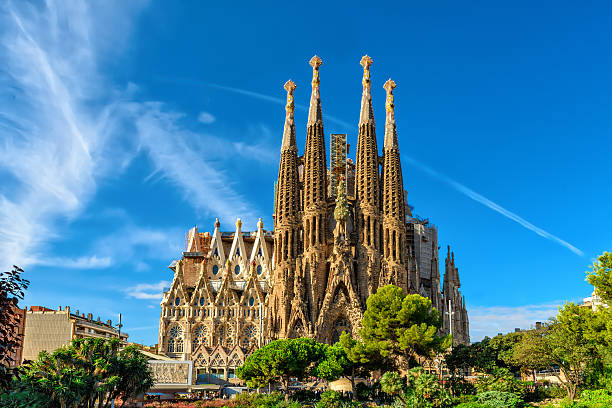
That relationship makes the nave the day’s second anchor. The crypt has taught the eye to trace structure at close range; Sagrada Família asks it to follow a far more complex hierarchy. Columns rise, change profile and branch. Their role is not merely to imitate trunks. They collect and redistribute loads while organizing a vast interior whose vertical proportions, vault geometry and openings create a radically different experience of light.
Look for continuity before contrast
The immediate contrast is overwhelming: low against tall, dark against luminous, intimate against metropolitan, rough material assembly against a highly coordinated basilica. Those differences are real, but beginning with them can hide the connection. First look for continuity in method.
At both buildings, structure is not a neutral frame waiting for decoration. The supports participate in the form of the room. Inclination is purposeful. Geometry helps reconcile load, enclosure and light. Surfaces do not need to be flat merely because masonry and stone are involved. The building’s symbolic reading grows through, rather than separately from, its constructional logic.
Only after that continuity is established should the differences become the subject. Sagrada Família regularizes and multiplies what the crypt presents in a compact, irregular field. Its nave must coordinate many more supports, greater heights, large congregational space, façades, towers and a construction process extending across generations. The result is not a scaled-up replica. It is an evolving system.
The nave is one chapter; the museum completes the comparison
A standard timed entry includes the basilica and museum, along with the official app and downloadable audio guide. The official page states that entry is valid only for the booked date and time, gives an approximate one-hour visit, and distinguishes the standard admission from tower or crypt access. It also explains that the museum addresses the building’s past, present and future as well as Gaudí’s life and work. Current inclusions and entry rules are listed on the official Sagrada Família ticket page.
For this route, the museum is not an optional add-on after the “main” space. It is where the comparison with Colònia Güell can become explicit through models, documentation and construction history. The nave offers spatial evidence; the museum offers process evidence. Skipping it reduces the day to visual analogy: sloping columns here, branching columns there. Including it allows the visitor to ask how Gaudí and later builders translated model-based thinking into drawings, components, prototypes and continued construction.
Allow more than the official approximate hour when the purpose is architectural study rather than basic orientation. A planning allowance of roughly ninety minutes to two hours for nave, key exterior context and museum is reasonable for a focused traveler, but it is an editorial allowance rather than an official duration guarantee. Tower access, when separately booked, adds another operational layer and is not necessary to complete the structural argument.
Do not let colored light erase the load-bearing story
Sagrada Família’s light is so memorable that it can dominate every other observation. The sequence from Colònia Güell offers a corrective. Before following color across the nave, identify the supports receiving the vaults. Notice changes in column diameter, profile and branching. Look at how openings are formed within geometrically complex surfaces rather than cut into a conventional flat wall. Then return to the light and ask how geometry makes it possible.
This does not reduce sacred atmosphere to engineering. It shows why the atmosphere is inseparable from engineering. The sense of ascent, the filtered color, the apparent continuity between column and vault, and the absence of a conventional heavy wall-and-roof reading all depend on structural and geometric decisions. The crypt’s compression gives the visitor a baseline; the basilica’s release becomes legible as a transformation rather than a disconnected spectacle.
The façades can absorb unlimited time, but the day has another interior ahead. The Nativity and Passion façades deserve a deliberate comparison, yet a complete sculptural inventory will weaken the route. Stay with the day’s question: how does a structural experiment become a monumental sacred system? Detailed iconography can belong to another visit.
Third anchor: La Pedrera as the domestic counterpoint
La Pedrera, or Casa Milà, was built from 1906 to 1912 on Passeig de Gràcia, overlapping with the construction years of the Colònia Güell church and Gaudí’s continuing work at Sagrada Família. Chronology alone does not make it the final stop; function does. After two sacred buildings, Casa Milà tests whether the visitor can recognize Gaudí’s architectural method when the program is housing rather than worship.
The official account of Casa Milà’s architecture explains that the stone street façade is a non-load-bearing curtain wall attached to the structural frame. It also describes column-supported floors, two large courtyards for light and ventilation, a basement planned for carriages and motor vehicles, and a complex attic and roof in which construction, circulation and service elements become architectural form. These features are outlined in La Pedrera’s official architecture account.
Separate the façade from the frame
The undulating façade is the building’s public image, but treating it as a stone sculpture misses the more consequential innovation. Because the façade does not carry the building in the conventional way, window placement and interior organization gain freedom. The structural frame, not a continuous load-bearing perimeter wall, does the principal work of supporting the floors.
That distinction is the domestic equivalent of the day’s earlier lesson. Form does not float free from structure; rather, structure is reorganized so other elements can become more flexible. At Colònia Güell, inclination and vault geometry make force visible. At Sagrada Família, branching supports coordinate a monumental interior. At La Pedrera, columns and metal framing help release the façade and apartments from rigid alignment.
Look from courtyard to façade and from columns to room divisions. The most productive question is not whether a particular wall or furnishing is original in every detail, but which elements belong to the enduring structural order and which could be altered as domestic needs changed. That is how Casa Milà becomes more than the “secular Gaudí stop.” It is a study in adaptable habitation.
Courtyards turn environmental performance into spatial drama
The two large courtyards distribute light and air into a deep urban building. They are functional voids, but Gaudí refuses to treat them as leftover service space. Their changing shapes, windows, ironwork, painted surfaces and stair conditions make movement through the building part of the design.
This is an important contrast with Sagrada Família. In the basilica, light carries sacred and symbolic force across a collective interior. In Casa Milà, daylight and ventilation must reach apartments repeatedly and practically. The courtyards show how environmental needs can organize plan and experience without being hidden behind the street façade.
For a first-time architecture traveler, this is where the day’s narrative broadens. Gaudí’s geometry is not only a way to span a nave or evoke natural growth. It can help solve density, circulation, daylight, ventilation and changing domestic layouts within the Eixample block.
The attic and roof make service elements legible
The attic’s repeated brick arches compress the visitor again after Sagrada Família’s height, but this compression is different from the crypt’s. It belongs to a roof zone and originally to the building’s service functions. Repetition replaces the crypt’s irregularity. The sequence is useful precisely because the three interiors do not look alike: they show several ways in which geometry, masonry and program can interact.
On the roof, chimneys, ventilation towers and stair enclosures are functional elements given strong sculptural presence. Their forms should be read from both directions. They are not decoration applied to machinery, yet neither are they merely technical equipment left exposed. Utility and representation are fused.
The roof is also the point at which fatigue can distort judgment. Uneven surfaces, steps, exposure and crowds can make the final thirty minutes feel more demanding than the same interval earlier in the day. The official practical page notes that the standard Essential visit generally takes about sixty to ninety minutes and that the rooftop may close in rain for safety. It also states that advance purchase is highly recommended and that ordinary reservations are not refundable or changeable unless the optional flexibility conditions apply. Current hours, closures, accessibility limits and booking terms appear on La Pedrera’s practical information page.
A reservation sequence that preserves the architectural argument
The day should be built around the strictest dependency, not the earliest opening alone. Sagrada Família requires arrival in the booked time slot. Colònia Güell has limited opening hours, especially on weekends and public holidays. La Pedrera usually offers a broader span of entry times, but its exact activity slots appear during booking and a late change may be difficult. The reservations must therefore be chosen as one linked system.
A workable full-day pattern
- Before 10:00: Reach the Colònia Güell visitor area shortly before opening. From Plaça Espanya, FGC services provide the public-transport spine; a private vehicle removes the rail interchange but not the need for an early departure from central Barcelona.
- 10:00 to about 11:20 or 11:30: Make a focused crypt visit, including the approach, porch, interior and enough interpretive material to understand the polyfunicular method and the unrealized upper church.
- Late morning to early afternoon: Return toward Barcelona and move to the Sagrada Família area. Preserve a buffer for the station walk, rail or road variation, crossing the city, security screening and a light meal.
- About 13:30 or 14:00: Enter Sagrada Família. Use roughly ninety minutes to two hours for the nave, selected exterior comparison and museum. The exact slot should be chosen only after the Colònia plan and transport mode are fixed.
- Mid to late afternoon: Move across the Eixample to La Pedrera and take a genuine seated pause before entry rather than filling the transfer with another façade checklist.
- About 17:00 or 17:30: Enter La Pedrera for the courtyards, apartment or exhibition route as included, attic and roof if open. A finish around early evening leaves the architecture complete without requiring a fourth Gaudí admission.
These times are planning bands, not promises. Actual inventory, service patterns, seasonal conditions, closures and the needs of the traveler determine the final bookings. The important relationship is the spacing: Colònia at opening, Sagrada after a protected return buffer, and La Pedrera late enough to absorb reasonable delay without becoming a rushed night visit.
Why the Colònia visit usually needs to be focused
The official Colònia Güell page currently lists weekday opening from 10:00 to 17:00 and weekend or holiday opening from 10:00 to 15:00. It lists adult admission with audio guide at €10, a two-hour crypt-and-colony guided visit at €13 with limited places and advance purchase recommended, and a combined admission, audio guide and round-trip train product at €15.30. It also lists scheduled weekend guided visits around midday, with earlier summer timings in July and August. Details and exceptions are published on the official Colònia Güell practical information page.
Those guided-visit times do not automatically suit this three-anchor sequence. A two-hour tour beginning around midday can push the Sagrada Família entry into late afternoon and La Pedrera into the evening, increasing both transfer risk and fatigue. The full colony context is worthwhile, but only when the later reservations have been built around it. Otherwise, an opening-time crypt-focused visit is the more coherent choice.
This is not an argument against guided interpretation at Colònia Güell. It is a warning against buying each admission independently. The moment a fixed guided visit is selected, it becomes the day’s controlling reservation. Sagrada Família must move later, the meal must become shorter or earlier, and La Pedrera must retain enough operating margin. If those consequences are unacceptable, keep the first stop narrower.
Sagrada Família is the hard appointment
The current standard Sagrada Família ticket is listed at €26 and includes the basilica, museum, official app and downloadable audio guide, but not towers or the crypt. Visitors must enter at the booked date and time, and personal items are checked. These conditions mean the entry slot cannot be treated as an approximate arrival target.
A sensible booking method works backward. Decide how much Colònia Güell you want, choose rail or road transport, assign a conservative return interval, add time for a light meal and arrival formalities, and only then select Sagrada Família. Do not begin by buying the most attractive basilica slot and assume the suburban morning will compress itself around it.
The route is strongest when the Sagrada entry is neither so early that Colònia becomes superficial nor so late that La Pedrera is experienced under heavy fatigue. Early afternoon usually provides the best bridge, but the exact hour is secondary to the buffer.
La Pedrera should absorb variation, not receive leftovers
For the period from 6 March through 1 November 2026, La Pedrera’s official page lists general daytime hours from 09:00 to 20:30, while stressing that exact activity times appear in the booking process. The broad span makes it the most flexible of the three anchors, but that flexibility should protect the route, not justify careless planning.
Book a late-afternoon time that still leaves room for the full visit before closing. A slot too close to the end of daytime operations turns the roof and attic into a race. A slot immediately after the expected Sagrada finish ignores the possibility of a longer museum visit, a slow exit, traffic or the need to sit down. The ideal interval is enough to move calmly across the Eixample and reset attention, but not so long that the day loses continuity.
La Pedrera’s non-refundable and limited-change conditions also matter. When available, optional flexibility may be worth considering for a day with two earlier dependencies, but it does not remove the need for a coherent schedule. Rain can close the rooftop even when the rest of the visit proceeds; the route should remain architecturally satisfying without making the roof the sole reason for admission.
Transfers are part of the cost of interpretation
The sequence has one significant movement penalty: Colònia Güell sits outside the central sightseeing grid. The official site describes the FGC trip from Plaça Espanya as about twenty minutes and directs visitors from Colònia Güell station along marked footprints to the visitor center. That figure should not be confused with a hotel-to-crypt journey. Reaching Plaça Espanya, waiting, walking from the station and orienting at the site all add time.
After the crypt, public transport requires a return to the city and an onward transfer toward Sagrada Família. For planning purposes, allow a broad door-to-door band rather than relying on the in-train time. A private vehicle can simplify the interchange and preserve a quieter transition for a small group, but it cannot eliminate urban traffic, drop-off constraints or the need to arrive before the basilica slot. The relevant question is not whether a car is more luxurious; it is whether reducing interchanges materially protects the architectural sequence for this group.
Travelers comparing rail, taxi and chauffeured movement can use when a car genuinely changes a Barcelona Gaudí day. For this route, a vehicle is most consequential for older travelers, guests who tire during repeated station changes, families carrying more than a light day bag, or a group whose Sagrada slot leaves little recovery margin. Strong walkers comfortable with the FGC and metro can keep the day entirely on public transport.
The second transition, from Sagrada Família to La Pedrera, is shorter but psychologically important. By then, the group has completed a suburban visit, a cross-city return and Barcelona’s most intense interior. Filling the interval with extra façades may look efficient while reducing what the final building can reveal. A seated drink or light snack near the route is not wasted time; it protects the ability to distinguish Casa Milà’s structural frame, courtyards and domestic program from the basilica just seen.
Mobility also affects the final anchor. La Pedrera’s public route is broadly accessible, but its rooftop and mezzanine have uneven conditions that are not suitable for wheelchairs or prams, with an overview available from a lift-exit platform. Sagrada Família states that its standard visit is accessible for people with reduced mobility. These official statements are useful starting points, but individual requirements should be checked directly before booking.
Branches that deepen the story without turning it into a checklist
A strong itinerary sequence allows branches, but each branch must have a consequence. Adding something because it is nearby or famous is not enough. The following options either deepen the same architectural question or shorten the day when its dependencies no longer work.
Branch one: add the colony, but move the rest of the day deliberately
The two-hour crypt-and-colony visit adds industrial, social and urban context. It can clarify that Gaudí’s church was one component of a settlement shaped by production, paternalism, worker housing and civic facilities. This branch is worthwhile for travelers interested in architecture as part of an economic and social landscape, not only in isolated masterpieces.
The cost is not merely sixty extra minutes. A longer first visit pushes the departure, narrows the meal window, increases exposure to transport delay and may require a Sagrada entry in mid-afternoon. On weekends, scheduled guided times can be especially difficult for the three-building arc. Choose this branch only when La Pedrera has a comfortably late entry and the group is prepared for a long day. If the timings force the basilica museum or Casa Milà attic to be cut, the branch has weakened the central argument.
Branch two: keep the Sagrada towers separate from the core route
Tower access can be rewarding for travelers interested in height, construction detail and views, but it is not required to understand the continuity from Colònia Güell. It adds a separate timed and mobility-sensitive component and can lengthen the visit beyond the point at which La Pedrera remains attentive.
For this day, the nave and museum have higher interpretive priority. The nave reveals the developed support system; the museum connects the model, project history and continuing construction. Choose a tower only when the group specifically values that experience and the La Pedrera slot has been moved accordingly. Do not cut the museum to preserve the tower, because that removes the most explicit bridge back to the morning.
Branch three: let rain change the roof, not the whole argument
If La Pedrera closes the rooftop for safety in rain, the sequence still has a valid conclusion. The courtyards demonstrate light and ventilation, the structural frame explains plan flexibility, and the attic shows a repeated masonry system beneath the roof. The service forms above are important, but they are not the only domestic counterpoint to the sacred buildings.
A rain closure is not a reason to insert Casa Batlló or Park Güell at the last minute. A new timed interior introduces another reservation, another interpretive vocabulary and more fatigue. Accept the altered Casa Milà visit, spend longer on its structural and residential logic, and preserve a coherent ending.
The shorter branch: Colònia Güell and Sagrada Família only
When the group has a late start, limited stamina or an evening commitment, the intellectually strongest reduction is to keep the experiment and its monumental development, then omit La Pedrera. That leaves a complete sacred-structure narrative, though it loses the domestic counterpoint.
Travelers with only one central Gaudí interior available should instead use the one-interior decision when time is tight. Trying to compress Colònia Güell, a hurried Sagrada entry and a partial La Pedrera visit into a short day gives the appearance of coverage without the understanding this route is designed to create.
The alternative branch: place Colònia Güell on a second Gaudí day
Some first-time visitors need the emotional certainty of Sagrada Família early in the stay. In that case, do not force chronology against the trip’s wider structure. See Sagrada and one central Modernisme building on the first architecture day, then visit Colònia Güell later with the advantage of recognition: the crypt becomes a retrospective explanation rather than a prologue.
That alternative is explored further in the choice between Colònia Güell and other post-icon Gaudí layers. It is less elegant as a single-day sequence but may be more realistic within a multi-day stay, especially when the only available Sagrada slot is early morning.
The stopping rule: end when the domestic counterpoint has landed
The day should stop after La Pedrera when three ideas have become clear. First, Colònia Güell showed a compact structural experiment in which force, geometry, material and an unrealized upper church remain visible. Second, Sagrada Família showed related methods enlarged into a monumental sacred system. Third, Casa Milà demonstrated that Gaudí’s structural freedom also served housing, circulation, daylight, ventilation and roof services.
Once those three ideas are secure, another Gaudí admission usually adds recognition rather than understanding. Casa Batlló would introduce a different renovation history and symbolic language; Park Güell would shift toward landscape, infrastructure and an unrealized residential development. Both deserve proper visits, but neither is needed to complete this day.
There is a practical stopping rule as well. If the La Pedrera entry would begin so late that the standard sixty-to-ninety-minute route cannot be completed without rushing, remove the building rather than treating its roof as a brief photo stop. If the group reaches Sagrada already fatigued enough to skip the museum, shorten the day there. If a two-hour Colònia visit forces both later anchors into narrow margins, move one to another date. The sequence is valuable only while each building can perform its assigned role.
For a longer Barcelona plan, place this architecture day inside a three-day Barcelona stay rather than stretching it with unrelated afternoon stops. A clear end is part of expert pacing, especially when the final building asks the visitor to distinguish structural frame, façade, courtyards, apartment life, attic and roof after two demanding sacred interiors.
Decision recap: who should choose Colònia Güell first
Choose this sequence when the primary goal is to understand Gaudí’s development through structure and geometry, not to collect the maximum number of celebrated façades. It suits first-time architecture travelers who are willing to spend a full day on three linked works, begin outside the center, and use the Sagrada Família museum as seriously as the nave.
The day works best with an opening-time Colònia visit, an early-afternoon Sagrada slot protected by a real transfer buffer, and a late-afternoon La Pedrera entry. The crypt should establish the questions. Sagrada Família should test them at monumental scale. La Pedrera should show how the same architect reorganized structure and environment for urban domestic life.
Do not choose the route in this form when the available Sagrada entry is early morning, when the group wants the full scheduled colony tour but cannot accept a late finish, or when mobility and concentration make three substantial interiors unrealistic. In those cases, split the sequence across two days or keep Colònia Güell and Sagrada Família as the shorter pair.
The specialist value of a privately guided version is not privileged entry or decorative commentary. It is continuity: one interpreter can carry the same structural questions from the polyfunicular experiment to the basilica nave and then to Casa Milà’s frame, while reservation timing is designed to protect that argument rather than produce a random order of available icons. Explore Barcelona private touring options when that coordination and cross-site interpretation would materially improve the day.
For a tailor-made sequence built around the current entry windows, the group’s mobility and the depth of architectural interpretation desired, Inquire now.
If you’re interested in any private tours of Barcelona, please reach out to us.








 So if you are looking for the absolute best in Barcelona & surroundings with authentic local fully-licensed native guides whose English you can actually understand and with an exclusive and amazingly fun itinerary













