When a Private Sitges Day Earns Its Place on a Luxury Barcelona Stay: Sea Air, Boutiques and a Smarter Reset After Gaudí

Updated
Yes, Sitges can earn a full day on a Barcelona stay, but only in one specific slot: after the second-afternoon slump that often follows Sagrada Família plus Gothic Quarter, when even generous pacing starts to feel like administration rather than pleasure. In real Barcelona conditions, that slot matters. Timed entries, long Eixample blocks, queue drag, the approach to Park Güell, and the stop-start rhythm of old-town sightseeing can leave travelers with one extra day on the calendar but very little appetite for another dense urban push. Sitges works because it trades friction for relief without requiring a major expedition: sea air arrives quickly, the center is walkable, and lunch, boutiques, beach, and old town can all happen without the city’s constant reset of taxis, stairs, and security lines.
The clearest exception is also the most important one: on a short first Barcelona stay of two or three nights, Sitges is usually the wrong use of time. If you have not yet secured Sagrada Família official tickets (https://sagradafamilia.org/en/tickets-individuals) or Park Güell official tickets (https://parkguell.barcelona/en/buy-tickets), Barcelona still owns that calendar real estate. A first trip should not surrender a core city day just because the sea sounds restorative.
This is the thesis that matters here: Sitges earns its place not as a generic beach add-on, but as the best replacement for the least efficient Barcelona day on an otherwise well-built stay. The overlooked local detail is departure geography. For many Eixample hotels, the practical difference between a smooth coastal day and an annoying one is whether you can leave easily via Barcelona-Sants or Passeig de Gràcia on the R2 Sud or Garraf line, rather than turning the morning into a chain of urban transfers first. That tiny station decision is more important than most glossy descriptions of Sitges itself.
There is also one correction worth making early. Travelers often assume the luxury version of a Sitges outing must be a chauffeured day from start to finish. Not always. The private-car premium is most valuable on the Barcelona side of the day, not within Sitges, because the town center is compact and largely pedestrian. If your Sitges plan is nothing more than beach, old town, and a simple lunch, the train may already solve the problem well enough. For the heavy city side of Barcelona itself, Gaudí day without queue burnout remains the more important place to get right first.
- Strong yes: four to six nights in Barcelona, core Gaudí already booked, and one spare day that would otherwise become a tired compromise between “one more sight” and “just go back to the hotel.”
- Conditional yes: a repeat visitor or a first-timer who values sea air, boutique browsing, and a gentler day more than another major monument.
- Conditional no: three nights with unfinished Barcelona priorities, especially if Sagrada Família, Park Güell, and your preferred neighborhood day are still unsettled.
- Strong no: two nights, architecture-maximalist travelers, or anyone trying to combine Sitges with a major Gaudí day in one sweep.
When is Sitges worth a day trip from Barcelona?
Sitges is worth a day trip from Barcelona when your stay is long enough to protect Barcelona first and still leave room for recovery. That usually means at least four nights for a first-time visitor, and often five nights if you want both the city’s major architecture and a genuinely unhurried coast day.
Two nights is simple: do not give one of them to Sitges. Barcelona has too much structural demand on a first stay, and every elegant justification for “just a quick coast day” usually conceals a loss elsewhere. You will either rush the city’s anchors, leave your best meals squeezed around logistics, or return home feeling you sampled Barcelona without ever settling into it.
Three nights is where people start trying to persuade themselves. Sometimes that works for repeat visitors, or for travelers who already know that museums and monuments are not their main pleasure. But for a first trip, three nights rarely supports Sitges well. You still need a coherent Gaudí day, you still need one non-Gaudí Barcelona day with room to absorb the city, and you still need arrivals, dinners, shopping, or simple recovery space. The coastal instinct is understandable; the calendar usually says no.
Four nights is the first stay length where Sitges becomes genuinely intelligent rather than aspirational. One day can belong to Gaudí. One can belong to the Gothic Quarter, El Born, Montjuïc, or another lighter Barcelona sequence. One can absorb arrival or departure drag, a major meal, shopping, or a celebration dinner. That leaves one day that can either deepen Barcelona or soften it. Sitges earns that final slot when you can already feel the trip’s rhythm turning over-serious.
Five or more nights is where Sitges often shines. You can preserve the city’s essentials and still edit the mood of the stay. This matters more than it sounds. Many high-end Barcelona itineraries are technically well designed but emotionally flat by day four: another church, another façade, another taxi, another reservation. Sitges interrupts that sameness. It gives the trip a horizontal day after several vertical ones, both literally and mentally.
If you are still unsure whether the stay can spare it, the clean test is this: if removing Sitges would force you to cancel Sagrada Família, Park Güell, Passeig de Gràcia architecture, or your one proper old-town day, Barcelona is not done with you yet. If removing Sitges would only produce another half-enthusiastic city day assembled from leftovers, then the coast may be the better edit. That broader trip-length calibration is worth reading alongside how many days Barcelona really needs.
There is another subtle point. Travelers often think of spare days as neutral inventory. They are not. A spare day late in a Barcelona stay behaves differently from a spare day early on. Early days should gather the city’s essentials while your attention is fresh. Late days can relieve repetition. Sitges is strongest in the second category. Place it too early and it dilutes the first impression of Barcelona; place it after Gaudí-heavy days and it often feels precisely timed.
That is why Sitges belongs less to the “best day trips from Barcelona” conversation and more to the “what should I do with the day after I have already done the hard parts well?” conversation. It is not competing with Montserrat for spiritual drama or with Costa Brava for dramatic coastline. It is solving a more specific planning problem: how to keep a Barcelona stay feeling expansive once the city’s required concentration has already taken its share.
The post-Gaudí hotel-reset versus Sitges-departure hinge
In Barcelona, the post-Gaudí hotel-reset versus Sitges-departure hinge is real, and it determines whether Sitges feels restorative or pointless. If you return from Sagrada Família and Park Güell wanting a shower, a silent room, and thirty minutes of not deciding anything, that is not a failure of enthusiasm. That is the city telling you something about sequence.
Barcelona wears on the body cumulatively. A single site rarely exhausts anyone. What accumulates is the choreography: a timed entry here, a wait there, a cab or metro transfer, a sloped approach, a warm pavement crossing, an hour spent standing to admire details, and then another transition into the Gothic Quarter’s narrower, slower lanes. Even travelers who love architecture can feel the drop on the second afternoon. It is not dramatic burnout. It is subtler: a thinning of curiosity.
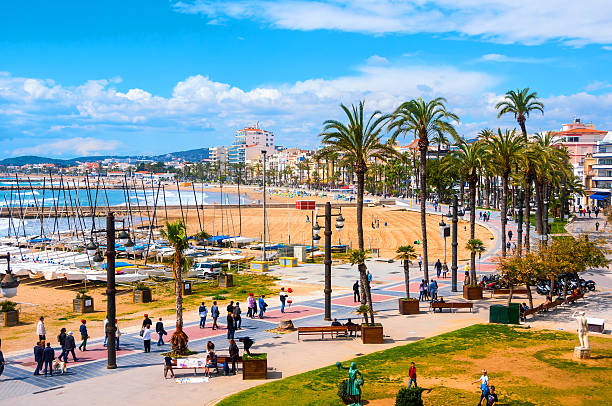
Sitges works because it reverses that pattern quickly. The town gives back immediate reward for modest effort. From the station, the walk toward the center is practical rather than ceremonial. The old town entrance at Plaça del Baluard arrives without a major climb. Carrer Fonollar slips toward the Maricel complex and Sant Sebastià with the sea already in the frame. You do not spend half a morning earning the right to relax. The ease starts early.
This is one reason Sitges feels better than another city-only compromise day for certain travelers. A half-committed Barcelona day often looks graceful on paper and heavy in practice: perhaps Passeig de Gràcia in the morning, a museum maybe, then a slow drift to the Gothic Quarter, then dinner. The problem is not that any one stop is wrong. It is that the city keeps asking you to re-enter its pace. Sitges asks less of you between moments.
The mood consequence is just as important as the physical one. Barcelona’s best evenings depend on how you arrive at them. Come back from a high-friction day and even an excellent dinner can feel like one more obligation. Come back from a coastal day with salt in the air, flatter walking behind you, and no sense that you have been “performing the city” since breakfast, and the evening opens again. The stay feels longer. Conversations improve. Small irritations disappear.
There is also a hotel-specific angle here. If you are staying near Passeig de Gràcia or elsewhere in the Eixample, a Sitges day often has a clean start and a calm return. If you are deep inside the Gothic Quarter, near Barceloneta, or in a hotel that already gives you easy access to the waterfront, Sitges becomes a more nuanced decision. The more complicated your route to the rail station, the more the day starts to spend energy before it earns any back. The more sea access you already have in Barcelona, the less radical Sitges feels.
That does not mean the coast loses value. It means the value changes. For an Eixample-based traveler, Sitges is often a deliberate contrast to the grid and the city’s appointment-like rhythm. For a Barceloneta-based traveler, it can feel like repeating a coastal mood you already bought into, only with more departure effort. In that case, another edited Barcelona day may be the better use of time.
The mistake is to judge Sitges by scenery alone. The right judge is itinerary physiology. If Barcelona still feels energizing, stay with Barcelona. If the city has begun to feel effortful even while you are still enjoying it, Sitges can arrive at exactly the right moment. It does not need to be your most important day. It only needs to be the day that stops the stay from becoming narrower than it looked on paper.
Rail versus chauffeur: beach plans and boutique time change the answer
Rail is usually the better answer for a simple Sitges day, while chauffeur earns its keep when your Barcelona-side logistics are the problem. That distinction matters because people often overpay on the wrong side of the equation.
The official Rodalies R2 line page (https://rodalies.gencat.cat/en/sobre-rodalies/linies-i-estacions/servei_rodalia_barcelona/r2/index.html) shows Sitges on the Barcelona suburban network with Barcelona-Sants and Barcelona-Passeig de Gràcia among the main stations. In practice, that means the train is not some romantic workaround. It is the normal, functional backbone of the outing. For many Eixample hotels, especially those with an easy taxi or short ride to Sants or a workable connection to Passeig de Gràcia, rail is the cleanest way to let Sitges stay simple.
Because suburban service patterns can shift with works and timetable adjustments, confirm the live departure pattern close to travel rather than assuming a fixed rhythm from memory. That check matters most if you are building the day around a lunch reservation or a sharply timed return to Barcelona.
The door-to-door threshold is the real decision point. If your hotel-to-platform move is easy, your group is traveling light, and the Sitges plan is beach, old town, and lunch, rail often turns the day into a manageable hotel-to-sea shift without much planning drag. If the start involves children, strollers, mobility limits, beach gear, shopping bags, or a hotel position that adds a messy pre-train transfer, the comfort case for door-to-door transport strengthens quickly.
Here is the counterintuitive part: once you are actually in Sitges, the chauffeur advantage narrows. The town center is compact, most of the useful core is walkable, and the good parts of the day are close enough together that being dropped from point to point is not the main luxury. The real value of private transport is not gliding between Sitges sights. It is preserving the edges of the day: hotel pickup, towel-and-bag management, dry clothes, purchases, late-afternoon tiredness, and a direct return before dinner.
Beach-first travelers should default to rail unless their group composition changes the math. Sitges station is close enough to the center that you can settle into the town quickly, and Sant Sebastià in particular works well because it sits beside the old town rather than apart from it. That means a day can flow naturally from coffee to browse to swim to lunch to one short cultural detour without repeated transport decisions. For couples or older children traveling with only what they can comfortably carry, that is often all the luxury required.
Shopping plans change the answer less than most people think. Sitges has charm for boutique browsing, but it is not a replacement for a serious Barcelona acquisition day on Passeig de Gràcia. Its commercial heart revolves around Cap de la Vila and the pedestrian streets that branch from it, especially Carrer de les Parellades, Carrer de Jesús, Carrer Major, and Carrer de Sant Francesc. Those streets are pleasant precisely because they are compact and walkable. If your goal is a relaxed browse and perhaps a few thoughtful purchases, rail is still sufficient.
Paying for a private Sitges day adds little beyond an easy self-guided rail outing if your plan is simply a late breakfast, a few hours on Sant Sebastià, and a browse through Carrer de les Parellades and Carrer Major.
Where, then, does premium spend actually change the experience? It helps when the day is not really about Sitges alone, but about the seamlessness around Sitges. A chauffeur becomes valuable when you want a hotel pickup that saves the first decision of the day, a place to leave extra items, the ability to move with older parents or a mixed-age family without negotiating platforms, a polished return to the hotel before an important dinner, or a broader tailored day that may combine the coast with other stops. That is the space where Luxury Chauffeured Barcelona Private Tour makes sense.
A private guide, meanwhile, is most useful not for explaining every façade in Sitges, but for editing the day. Good guiding here is curation: the right café instead of the first one, the calmer part of the seafront instead of the busiest, the right old-town entry, the right amount of culture before lunch, and an honest read on whether your group wants sea time or browsing time more. That is why a tailored coastal day such as Sitges Private Tours can outperform both a fully DIY wander and a needlessly elaborate private-car version.
Families deserve a separate note. Rail can work beautifully for families when the children are old enough to enjoy a compact town and the day stays light. But if your plan involves a stroller, swimsuits, changes, snacks, shade, and the possibility of an early retreat, chauffeur support becomes far more than a vanity upgrade. It turns unpredictable family rhythm into a softer, more controllable day. The same is true for travelers with older parents who may not want a perfect day ruined by the walk to and from platforms.
For celebration travelers or small groups, the judgment is slightly different again. The more the day needs to feel composed rather than improvised, the more door-to-door service earns its cost. That is especially true if the Sitges day is there to preserve the evening. A train can be elegant. A direct hotel return after sun, shopping, and lunch can be even more elegant when dinner actually matters.
Who benefits most from a coastal reset after Gaudí-heavy days?
The travelers who benefit most from Sitges are not the ones trying to “see more.” They are the ones trying to feel better without wasting a day. That sounds subtle, but it is the whole point.
Couples on a first or second Barcelona stay are often the best fit. After one architecture-heavy day and one more urban day, the city can begin to feel intensely rewarding but slightly over-programmed. Sitges changes that tone. It creates room for a long lunch, a slower browse, a swim if the weather invites it, and a return to Barcelona that still leaves appetite for cocktails or dinner. For couples who care about style and mood as much as monument count, that matters a great deal.
Food-and-wine travelers also tend to like Sitges for a reason that has little to do with formal gastronomy. Barcelona can deliver ambitious meals, but they often sit inside tightly booked days. Sitges allows the opposite: a lunch with sea air around it, time to walk afterward, and none of the sensation that the meal must be wedged between two cultural obligations. If the stay already includes serious dining in Barcelona, Sitges can provide the useful counterweight of a beautiful, lower-stakes meal by the coast.
Families and mixed-energy groups may be the most underrated fit of all. Barcelona is magnificent, but it rewards aligned energy. Sitges is kinder to uneven appetite. One person can browse. Another can sit by the water. Another can care most about lunch. Another may want one cultural stop and then no more information. Because the center, seafront, and old town are relatively close together, the day tolerates divergence without collapsing into logistical chaos.
Older parents often do well in Sitges if the transport is chosen carefully. The town itself is more forgiving than many Barcelona sightseeing sequences because the reward-to-effort ratio is higher. You walk and receive pleasure quickly. That said, the way you get there matters disproportionately. If the platform choreography or carrying requirements will already drain the day, private transport becomes the better answer. The town is gentle; the approach should be too.
There are also travelers who should avoid the recommendation even if it sounds attractive. Architecture maximalists on a first visit usually regret giving Sitges a prime day. So do travelers who still have unfinished business with Barcelona’s core neighborhoods. And travelers who already split their stay toward Barceloneta or another seafront base may find that Sitges does not transform the mood enough to justify the transfer. They already bought access to the water. Another Barcelona day may give them more substance.
Shopping-led travelers deserve honesty too. Sitges is appealing for boutiques because the browsing is pleasant, the streets are pedestrian-friendly, and the whole thing feels light. But if your real goal is serious designer shopping, Barcelona remains the stronger stage. Sitges is better understood as a stylish browse, not a major retail mission. The moment you need comparison, selection depth, or a full fashion day, stay in the city.
The best Sitges day also depends on how much structure you like. Travelers who dislike ambiguity often benefit from private design because Sitges can otherwise become too loose: a bit of beach, a bit of strolling, a bit of “shall we do this?” until the day dissolves. Travelers who relish a self-directed seaside day can love that looseness. Neither approach is inherently better. The question is whether you are using Sitges to reduce friction or to create more decisions. Only the first version actually improves the stay.
Put differently, Sitges is best for people who know that comfort is not the same thing as inactivity. They still want shape. They just do not want another day organized around entry windows, route optimization, and mental load. Sitges offers shape with lower demand. That is why it works so well after Gaudí-heavy sightseeing and so much less well as a substitute for Barcelona before those essentials are done.
What to cut first when the itinerary is getting crowded
If the trip is getting overpacked, cut the duplicate Barcelona fatigue day first, not the city’s essentials and not Sitges by default. The wrong instinct is to protect every urban ambition and then squeeze the coast into whatever remains. That usually produces either a rushed Sitges day or a resentful one.
The first thing to cut is the vague “we’ll probably do more old town” day. Barcelona’s historic core is rich, but after a proper visit it is easy to overestimate how much more wandering you need. Another version of the same lanes, another church, another market, another afternoon of stop-start movement can flatten the stay. If Sitges is entering the plan, that is the slot it should replace.
The second thing to cut is the urge to make Sitges prove itself by doing too much. Do not force beach, old town, museums, long lunch, shopping, and a grand sunset plan all into one outing. Sitges succeeds because it asks less. The moment you turn it into a checklist, you import Barcelona’s problem back into the day. Pick the dominant mode. If the day is about sea and lunch, let culture be a light accent. If it is about old town and boutiques, treat the beach as atmosphere rather than a second agenda.
The third thing to cut is the assumption that Sitges must be a full spectacle to justify itself. It can justify itself simply by changing the trip’s rhythm. Travelers often undervalue rhythm because it does not photograph as clearly as a monument does. Yet rhythm is what determines whether a five-night stay feels abundant or merely busy.
There is also one city-only alternative that deserves mention. If what you truly need is relief from queues rather than relief from Barcelona, a better answer may be to stay in the city and run a lighter neighborhood day instead of leaving for the coast. That is where a lighter Barcelona day beyond Gaudí can win. You preserve hotel ease, keep your evening simple, and still avoid another architecture marathon.
Another honest cut-first rule: if your weather confidence is low and the sea component is the main reason you want Sitges, leave it flexible rather than forcing it. Sitges still has old-town charm on cloudier days, but its disproportionate value comes from openness, light, and the bodily release of being by the water. If those conditions are not available and Barcelona still has unfinished business, the coast becomes easier to skip.
What you should not cut to make room for Sitges is the city’s foundational architecture. Barcelona is one of those places where the icons are not optional decoration. They are part of the city’s language. Sitges becomes more meaningful after you have heard that language clearly, not instead of it. A coastal reset works because it follows intensity. Without the intensity first, it is just a pretty detour.
The exact stay shape where Sitges earns its place
The most persuasive Barcelona stay shape for Sitges is this: an arrival day that is not overstuffed, one properly timed Gaudí day, one city day beyond Gaudí, one sea-air day, and at least one evening or half-day left open for dining, shopping, or celebration. In that structure, Sitges does not steal from Barcelona. It rescues the stay from becoming too single-note.
A very common winning sequence looks like this in practice. Day one: arrival, settling in, one neighborhood, easy dinner. Day two: Sagrada Família, Passeig de Gràcia architecture, and either Park Güell or a carefully edited second Gaudí stop. Day three: Gothic Quarter, El Born, Montjuïc, or another city-focused day with lighter cognitive load. Day four: Sitges. Day five: flexible Barcelona, shopping, fine dining, or departure. That is the shape in which the coast feels earned.
Notice what is doing the work here. Sitges is not inserted because Barcelona ran out of things to do. It is inserted because the stay benefits from a different kind of day before the city’s pleasures start to blur together. That is the short-stay optimization many travelers miss. They assume every excellent trip should intensify until departure. Barcelona often improves when one day relaxes instead.
If that is your stay shape, a tailored coastal day is not an indulgence. It is the correct edit. If your calendar still looks more like unfinished Barcelona than overload from good Barcelona, keep the day in the city. If, however, you can already see that another dense sightseeing block would flatten the trip rather than lift it, this is the moment to change tone with intention. Inquire now
And if you are still weighing Sitges against a completely different style of outing rather than against another city day, compare it against the broader day-trip field with care. Mountains, wine country, and dramatic coast answer different desires than sea air after Gaudí. For that wider choice set, other Barcelona day trips is the better comparison page. This guide solves a narrower question: when the smartest luxury move is not “more Barcelona” but not “farther away” either.
FAQ
Is Sitges worth it on a first trip to Barcelona?
Yes, but usually only from four nights upward. On a two- or three-night first stay, Sitges is often the wrong trade because Barcelona’s core sights and neighborhoods still deserve the day more.
Is Sitges better by train or by private chauffeur from Barcelona?
Train is often best for couples or independent travelers doing a light day of beach, old town, and lunch. Private chauffeur is better when hotel pickup, older parents, children, bags, shopping, or a polished late return matter more than the transport itself.
Can I do Sitges on the same day as Sagrada Família or Park Güell?
No, not if you want either day to feel good. Combining a major Gaudí plan with Sitges usually produces rushed transfers, thin enjoyment, and a late return that drains the evening.
How much Barcelona should I finish before giving a day to Sitges?
You should already have your main Gaudí priorities secured and at least one strong non-Gaudí Barcelona day in place. Sitges works best as relief after a well-built city stay, not as a substitute for it.
Is Sitges mainly a beach day or a shopping day?
It is best as a blended ease day rather than a single-purpose shopping mission. The beach, old town, and pedestrian boutique streets sit close enough together that the town shines when you combine them lightly instead of maximizing only one category.
Does Sitges work for families and small groups?
Yes. It works particularly well for mixed-energy groups because sea, strolling, lunch, and browsing can coexist without long cross-town moves. For families with strollers or a lot of beach gear, private transport often improves the day more than it does for couples.
What if the weather is not ideal?
If the weather removes most of the pleasure of being by the sea, Sitges becomes easier to skip on a first Barcelona stay. On a longer trip it can still work for old town and lunch, but the coast’s special value is lower when openness and light are missing.
What is the best alternative if I decide not to do Sitges?
A lighter Barcelona day is usually the strongest alternative. Another fully packed sightseeing block tends to repeat the same fatigue you were trying to solve, while an edited neighborhood day can keep the stay varied without spending time on transfers.
If you’re interested in any private tours of Barcelona, please reach out to us.














 So if you are looking for the absolute best in Barcelona & surroundings with authentic local fully-licensed native guides whose English you can actually understand and with an exclusive and amazingly fun itinerary













