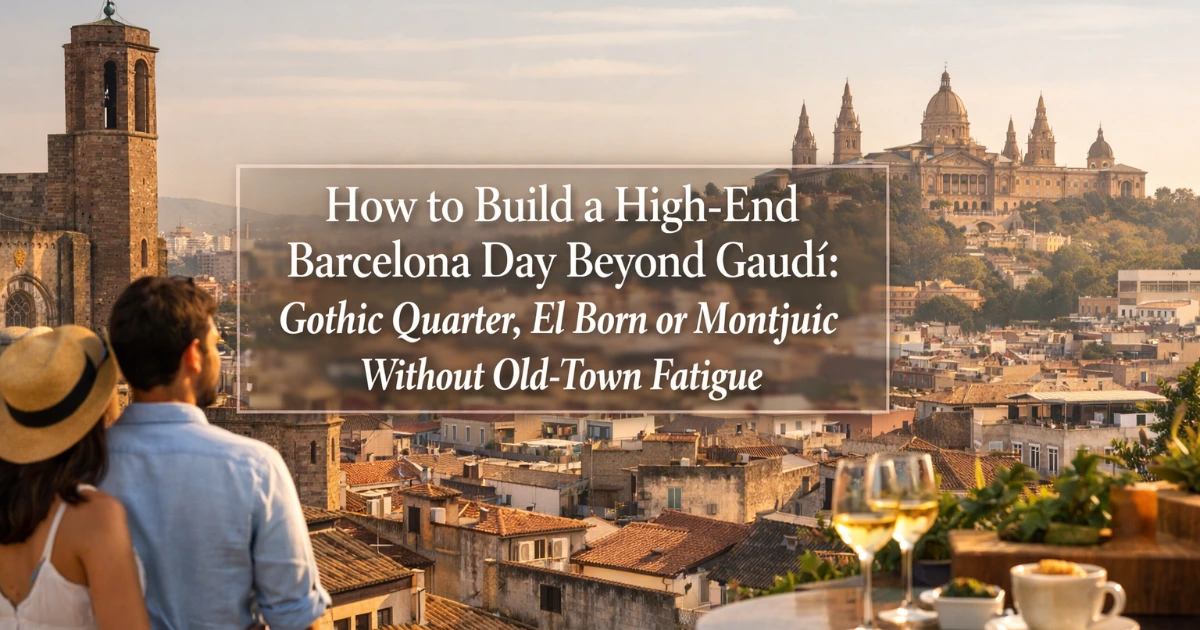
How to Build a High-End Barcelona Day Beyond Gaudí: Gothic Quarter, El Born or Montjuïc Without Old-Town Fatigue
Updated
For most first-time visitors, the strongest high-end Barcelona day beyond Gaudí is not a choice between the Gothic Quarter, El Born, or Montjuïc as isolated contenders. It is a sequence: begin in the Gothic Quarter, let the route breathe into El Born, and add Montjuïc only as a late-afternoon finish. That works because Barcelona’s center changes pace block by block in a way the map does not show; around the Plaça del Rei edge of the Gothic Quarter, the city stops being broad sightseeing and becomes slow, layered medieval reading. The clearest exception is a traveler already committed to early Sagrada Família official tickets (https://sagradafamilia.org/en/tickets-individuals) or a museum-heavy Montjuïc plan. In that case, keep Gaudí or Montjuïc separate rather than forcing both into the same day.
The elegant version of this day depends on changing textures at the right moment. The old core rewards concentration, El Born releases some of that pressure without breaking the historical thread, and Montjuïc works best once you want sky, distance, and a calmer finish. The common expensive mistake is not underbooking a car; it is overpacking the center. A driver cannot make medieval lanes feel shorter, which is why this article pairs naturally with a separate private Gaudí day guide rather than trying to cram everything Barcelona is famous for into one heroic but tiring route.
The day shapes that actually work, ranked by how they travel
The best answer for most discerning first-timers is old town first and Montjuïc last, because the day improves when the city gradually opens rather than repeatedly tightening and resetting.
The comparison criteria here are simple: walking continuity, narrative payoff, how easily lunch fits the route, whether the day gets more spacious instead of more cramped, and whether you still feel like dressing for dinner instead of collapsing before it.
- Default winner: Gothic Quarter to El Born to Montjuïc late. This is the strongest full non-Gaudí day for couples, small groups, and first-time visitors who want history, atmosphere, and one scenic finish without spending the afternoon retracing steps. It gives the morning to Barcelona’s densest storytelling, hands lunch to a livelier but more breathable part of the old city, and saves the hill for when you actually want release.
- Runner-up: Gothic Quarter to El Born, slower and deeper. This is the better choice if your group loves history, wants a longer lunch, prefers a wine bar or shopping drift in El Born, or has uneven walking tolerance. It trades the hilltop finale for a steadier day with fewer transitions.
- The shape that disappoints most often: Montjuïc first, old town later, with Gaudí squeezed somewhere in between. It sounds comprehensive, but it produces too many resets. You start broad, compress into the old city when energy is already falling, and usually end up spending the afternoon managing logistics instead of feeling Barcelona click into place.
That ranking is not about which area is “best” in the abstract. It is about what each neighborhood does to a day once real walking, midday appetite, hotel timing, and evening plans enter the picture. A premium trip is not improved by looking busy. It is improved by putting the densest concentration where attention is freshest and saving the widest views for the moment the group wants a reward rather than another lesson.
When the runner-up is actually the more refined choice
The slower Gothic Quarter and El Born day is the better premium choice whenever lunch, conversation, shopping, mixed mobility, or simple enjoyment of the city matters more than collecting one more altitude change.
There is a temptation, especially on high-budget trips, to assume that the fuller day is the better day. In Barcelona that is often wrong. The runner-up route, which stops after El Born or the Parc de la Ciutadella edge, is frequently the more elegant answer for travelers who already know they like to linger. It suits couples planning a substantial lunch, food-and-wine travelers who care as much about the middle of the day as the monuments around it, celebration groups who want to preserve energy for the evening, and visitors traveling with parents who can handle old-town walking but do not need the extra transition to a hill.
This is also the better answer for travelers who are emotionally more interested in city texture than in viewpoints. Montjuïc offers release, but it also changes the day’s character. Some travelers want that widening effect. Others prefer to stay inside the historical and social grain of the center, let the day end with a long table or a quieter drift through Born streets, and return to the hotel before dressing for dinner. That is not a lesser version. It is a more selective one.
The weather can also flip the verdict. On warmer days, especially when lunch runs late, the all-in route can lose polish during the transfer to Montjuïc. What looked like one final scenic flourish on paper can become the point where the group is already a little glazed, a little slower, and less receptive to one more move. In that situation, ending after the Passeig del Born to Parc de la Ciutadella hinge is not settling. It is editing.
If you have children, older parents, or a group with mixed enthusiasm for deep historical narration, the runner-up often protects harmony. The Gothic Quarter gives the history lovers their concentration. El Born gives everyone else better recovery space. The plan still feels substantial, but no one is being dragged uphill for the sake of completeness. That is often the point where a supposedly “smaller” day ends up feeling more generous.
Why old-town fatigue happens earlier than visitors expect
Old-town fatigue arrives early in Barcelona because the historic center is not a long, fluid promenade; it is a stop-start sequence of narrow lanes, small squares, visual interruptions, and tempting detours that reward attention but consume energy faster than a broad avenue does.
The issue is not mileage alone. In the Gothic Quarter, your body is constantly making micro-adjustments: slowing for paving, edging around photo bottlenecks, pausing for orientation, and turning corners that look short on a map but break rhythm in practice. Around the Plaça del Rei edge of the Gothic Quarter, the tonal shift is immediate. The city becomes denser, quieter in one lane and louder in the next, and each courtyard, wall fragment, church façade, and former civic space asks for context rather than quick consumption. Travelers often call that area “compact,” but compact in Barcelona can still feel mentally full. You are not simply walking; you are decoding.
Barcelona also does something very specific to the body on a day like this. It gives you plenty of short movement but not always restorative movement. The old center builds fatigue through constant starts and stops; El Born adds longer lines and easier strolling; Montjuïc then adds altitude, transfer time, and, in warm weather, more exposed walking. If you push all three without respecting that sequence, you get cobblestone drag in the morning, transfer reset at midday, and uphill or viewpoint fatigue just when the group should be shifting into late-afternoon ease.
The mood consequence matters just as much. Spend too long in the Gothic Quarter and even beautiful corners start to blend into one continuous medieval texture. The day begins to feel narrower than it really is. El Born changes that feeling because the streets widen just enough, the energy becomes more mercantile than ceremonial, and the route toward the park edge starts giving back sky and seating. Montjuïc then works as a release valve because it changes scale entirely. Done in the right order, the day feels as though it keeps unfolding. Done in the wrong order, it feels like three unrelated outings stitched together by taxis.
This is also where narrative value is easiest to underestimate. A self-guided wander can absolutely be pleasant, but the old city pays out better when the layers are connected for you: Roman traces, medieval civic power, Jewish quarter memory, merchant Barcelona, and the seam where the center loosens toward the east. That is why private guidance matters more here than many first-time visitors expect, and why a focused Gothic Quarter and Old Town private tour often feels more worthwhile than another paid transport upgrade.
One counterintuitive correction belongs here. The most photogenic section is not always where you should linger longest. Visitors often overvalue the cathedral-adjacent heart of the Gothic Quarter because it looks like the obvious centerpiece, then discover that mid-morning it can become the least comfortable part of the day. The smarter move is to treat that zone as a narrative peak to read well and then leave, not as a place to keep orbiting while the city gets busier around you.
How to sequence Gothic Quarter, El Born and Montjuïc without backtracking
The right sequence is morning in the Gothic Quarter, midday in El Born, then a single clean decision: continue by vehicle to Montjuïc for a broad late-afternoon finish, or stop after the park hinge and return fresh for the evening.
Think of the route in thirds rather than in attraction count. For most private days, the Gothic Quarter wants roughly a focused morning block, El Born wants enough time for lunch and a real exhale, and Montjuïc wants a concise scenic finish rather than a museum marathon. That rhythm matters because it prevents the classic Barcelona error of spending too long in the densest zone, rushing lunch, then arriving at the hill when the group has energy only for transport, not enjoyment. When the thirds feel balanced, the day reads as one arc. When one zone swallows the others, the route starts to feel improvised.
Start where the city is tightest, while attention is freshest
Begin in the Gothic Quarter rather than easing into the day elsewhere. This is when the historical density helps rather than overwhelms. Morning is the moment to let a guide establish the city’s older civic and religious logic, move through a limited number of lanes with intention, and avoid turning the quarter into a scavenger hunt. The goal is not to “cover” every medieval corner. The goal is to leave understanding why the quarter feels powerful and why it is easy to misread without context.
For most high-end visitors, that means resisting two common impulses. The first is opening with a long café drift before you enter the old core; that usually pushes your most mentally demanding walking into the busier part of the day. The second is trying to tag every atmospheric lane because the map makes them look adjacent. In practice, a carefully chosen arc through the Gothic Quarter feels richer than a wider one. Quality of reading matters more than total street count.
If your group includes older parents, teenagers with uneven interest, or anyone still carrying flight fatigue, this disciplined start becomes even more valuable. The quarter is best absorbed before decision fatigue sets in. Once people start asking for coffee, shopping, bathrooms, or “just one quick detour,” the old city becomes slower in a less rewarding way.
Use El Born as the hinge, not as a second old town
El Born should be treated as a hinge rather than a duplicate of the Gothic Quarter. That is the key to avoiding old-town fatigue.
Crossing out of the Gothic core toward El Born is not just a neighborhood tick on the list. It is the moment the day should loosen. Via Laietana is the practical seam here: once you cross it with purpose instead of bouncing back and forth across it, the route starts to make sense. The architecture still carries history, but the emotional tone changes. El Born is better for lunch, better for a measured shopping pause, and better for letting mixed-interest groups breathe after a narrative-heavy morning. This is where many first-time visitors finally feel the city stretch out rather than close in.
The proof cue to watch is the Passeig del Born to Parc de la Ciutadella hinge. That transition demonstrates exactly why El Born belongs after the Gothic Quarter. Around Santa Maria del Mar and the Passeig del Born, the district still has texture and story, but as you continue toward Parc de la Ciutadella, the route literally opens. Benches, wider paths, tree cover, and longer sight lines make the day feel less compressed. That breathing space is not decorative. It is what allows a first-time visitor to keep going well instead of merely continuing out of momentum.
This is also where lunch timing becomes strategic rather than incidental. A good lunch in El Born does more than feed the day; it resets the tempo before you decide whether Montjuïc deserves the last chapter. Celebration travelers, food-and-wine travelers, and couples heading into a polished evening often do best here because the district absorbs a leisurely midday stop without breaking the route. Families and mixed-age groups also benefit because this is the easiest point to gauge whether the group wants one more major move or has already had the best part of the day.
Put Montjuïc last, or leave it for another day
For most first-time visitors, Montjuïc belongs on the same day only as the last chapter, after the Gothic Quarter and El Born have already carried the narrative.
This is the plain editorial judgment: yes, Montjuïc belongs on the same day for most first-time visitors if it comes last. No, it should not be the opening stop for this route, and it usually should not sit awkwardly in the middle. The hill works because it changes the city’s scale. Once you have spent the day in the compressed fabric of the center, the transfer upward feels earned. If you start there, you flatten that contrast and make the old town feel more claustrophobic later.
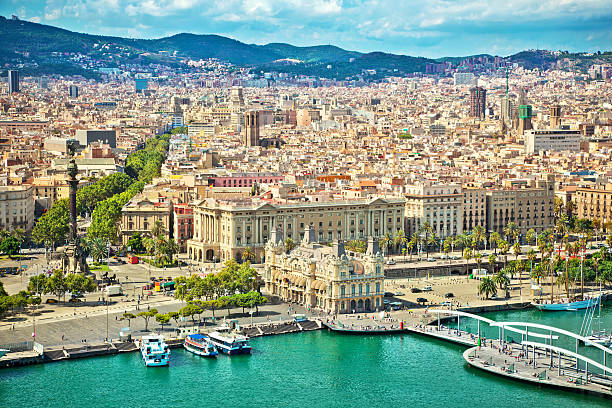
Montjuïc also works better late because it asks for a different kind of attention. By then, most travelers do not want another dense historical puzzle. They want perspective, breeze, and one more memorable image. A targeted finish at Mirador de l’Alcalde on Montjuïc gives precisely that: skyline, port, sea, and the sense of Barcelona arranged in front of you rather than wrapped tightly around you. It feels like a conclusion, not another chapter of homework.
The mistake is to overbuild the hill. If you add too many Montjuïc stops, you turn the release into another checklist. For a first-time, comfort-aware day, think of Montjuïc as one broad gesture: a scenic ascent, one or two well-chosen pauses, and a return to the hotel or dinner district before the day sags. If the group is already happy after El Born and Parc de la Ciutadella, it is perfectly reasonable to stop there. A day that ends at the right moment is more luxurious than one that insists on total coverage.
What this means in practical terms is simple: do not backtrack into the Gothic Quarter after lunch, do not collect a vehicle too early, and do not force Montjuïc if anyone is already moving more slowly by the park edge. If you are using a car at all, the handoff is cleaner from the Born or park side than from deep inside the medieval core. The best route feels inevitable. The weaker route keeps asking people to restart.
When to keep Gaudí separate from old-town history and Montjuïc
Keep Gaudí separate whenever your Gaudí plans involve timed interiors, strong architectural focus, or the desire to experience Eixample on its own terms rather than as a scheduling obstacle between older and hillier Barcelona.
This is where many first-time itineraries go wrong. Sagrada Família, Park Güell, Passeig de Gràcia, the Gothic Quarter, El Born, and Montjuïc all sound like “central Barcelona,” but they do not operate like one coherent day. Gaudí visits, especially when tied to timed entry, create a clock-led structure. The old city prefers curiosity-led wandering with historical context. Montjuïc wants a later rise and a scenic finish. Trying to make those three mechanics coexist usually produces a day that is technically full and emotionally thin.
If you already hold Sagrada Família official tickets, use that commitment to clarify the trip rather than complicate it. Either build a proper Gaudí day around it, or make it the sole major monument before a lighter Eixample and Born afternoon. Do not add the Gothic Quarter and Montjuïc as though they were casual nearby appendices. That is precisely where a dedicated Complete Gaudí private tour earns its place.
The clearest exception is the traveler with very little time who wants one taste of older Barcelona after a morning monument. In that case, choose El Born over the full Gothic-plus-Montjuïc sequence. El Born gives you texture, lunch, and a sense of the medieval city without demanding the same historical concentration as a full Gothic Quarter morning. It is the graceful compromise. The overambitious compromise is doing everything.
There is a second reason to separate Gaudí that has nothing to do with tickets. Barcelona feels better when you preserve thematic coherence. An Eixample-and-Gaudí day has one kind of rhythm: boulevards, façades, interiors, broader movement, more direct logistics. A Gothic-Born-Montjuïc day has another: compressed streets, layered history, a gradual eastward exhale, then a hilltop release. Keeping them distinct allows both to feel richer. Combining them often makes both feel rushed.
If your stay is short, that is not a sign to collapse the categories. It is a sign to choose the one that matches your priorities. Travelers who care most about historical atmosphere and city texture should take the non-Gaudí day and accept that not every headline sight belongs in the same 10-hour span. Travelers who care most about Gaudí should give that architecture its own space and leave Montjuïc or the deeper old-town route for another afternoon, or another trip.
Where private guiding changes the day, and where extra spend is wasted
Private guiding changes this route most in the old city and at the old-town-to-Montjuïc transition, not in adding expensive transport to parts of the day that are still best done on foot.
The first place a guide earns real value is narrative compression. In the Gothic Quarter and El Born, the city can either feel richly layered or simply crowded and old-looking. A strong guide turns the quarter from pretty confusion into an intelligible sequence. That matters to affluent travelers not because they need more facts, but because they want the time they are already spending to produce something memorable. The right story in the right square saves you from wandering for forty extra minutes and still missing the point.
The second place a guide matters is judgment. Barcelona rewards restraint, and restraint is hard to practice when every map pin looks close. A good private guide knows which short detour deepens the story, which one only burns time, where to cross from the Gothic Quarter into El Born without the route feeling abrupt, and when the group has reached the moment to stop layering history and start widening the day. That judgment is especially valuable for couples, celebration travelers, and small multigenerational groups, because different interests can be held together without making the itinerary feel negotiated minute by minute.
The third place value appears is in the transition to the hill. The old-town-to-Montjuïc move is where many independent itineraries lose polish. People linger too long over lunch, backtrack for transport, or arrive on the hill too late to enjoy the slower finish they imagined. When that handoff is managed properly, the day feels singular rather than segmented. That is why a city-spanning route such as Best of Barcelona private tour can make sense for travelers who want one coherent day rather than multiple disconnected outings, while a more focused Montjuïc private tour fits those who already know the hilltop finish is the priority.
A private vehicle is usually unnecessary until the Montjuïc portion, and paying more does not fix old-town overpacking.
That sentence matters because luxury travelers are often sold the wrong solution. The medieval core is still a walking environment. A car cannot enter your way out of atmospheric density. Where a vehicle does help is after the Born or park hinge, when the group is ready to shift environments cleanly and arrive on Montjuïc without draining another 30 to 45 minutes on avoidable transfer friction. Spend for that transition, or for a guide who can shape it. Do not assume a full-day chauffeur waiting through the old town automatically produces a better day.
Orange Donut Tours is strongest when this route is customized around pacing rather than piled with extras: a sharper Gothic arc for history lovers, a longer Born lunch for celebration travelers, a shorter hill finish for older parents, or a cleaner hotel drop before dinner. If that is the kind of Barcelona day you are trying to build on a short stay, Inquire now.
What to cut first when the plan starts looking too full
The first thing to cut is not lunch and not the guide; it is the urge to prove that every famous district belongs in the same day.
If your plan starts feeling crowded, cut in this order. First, cut any extra timed interior in the old town. A second museum or church visit often sounds enriching but usually steals the flexibility that makes the route feel human. Second, cut the idea of adding Gaudí to the same day. That combination is the easiest to regret because it tangles two different Barcelona logics. Third, cut Montjuïc if the group reaches El Born or Parc de la Ciutadella already tired. The hill is a wonderful finish when energy remains; it is not an obligation.
What you should protect, by contrast, is the transition logic. Keep the Gothic Quarter as the morning anchor. Keep El Born as the decompression zone. Keep the option to stop gracefully once the route has opened and the group feels satisfied. Travelers often think a premium day should get longer as the budget rises. In reality, the best high-end days are often the ones that know where fullness begins to become excess.
This is especially true on short stays. If Barcelona is one stop on a broader Spain itinerary, do not try to turn one day into a summary of the entire city. Give Gaudí its own window, give the old town its own logic, and let Montjuïc be the optional scenic coda rather than a compulsory badge. If you are still deciding how much room Barcelona deserves in the trip, how many days in Barcelona is the more useful next planning question.
The most successful version of this route is often the one that ends with the group wanting one more hour, not the one that squeezes every hour dry. That is the difference between a day you remember as beautifully shaped and a day you remember as an achievement.
FAQ
Should first-time visitors put Montjuïc on the same day as the Gothic Quarter and El Born?
Yes, for most first-time visitors Montjuïc works on the same day only if it comes last. Morning in the Gothic Quarter and midday in El Born create the right build; Montjuïc then acts as a spacious finish. Starting on the hill or placing it in the middle usually makes the route feel broken into separate outings.
Is El Born worth adding if I am already seeing the Gothic Quarter?
Yes. El Born is not just “more old town.” It changes the pace of the day. After the Gothic Quarter’s denser lanes and heavier historical reading, El Born gives you easier strolling, better lunch integration, and a natural progression toward Parc de la Ciutadella. That shift is one of the main reasons the overall route feels balanced rather than exhausting.
Can I combine Sagrada Família, the Gothic Quarter, El Born, and Montjuïc in one day?
You can, but it is rarely the best choice. Sagrada Família official tickets create a timed, monument-led structure; the Gothic Quarter wants slower historical attention; Montjuïc works best as a late scenic release. Most travelers enjoy Barcelona more when Gaudí is kept separate from a non-Gaudí old-town-and-hill day.
Where does a private guide add the most value on this route?
The guide matters most in the Gothic Quarter and in the transition toward El Born and Montjuïc. In the old city, guidance turns dense streets into a coherent story instead of a beautiful blur. Later in the day, a guide helps choose the right moment to stop, continue, or shift to the hill without wasting time or energy.
Do I need a chauffeur for the whole day?
Usually no. Walking is still the right way to experience the Gothic Quarter and most of El Born. Transport becomes more valuable once you are ready to leave the old city cleanly and reach Montjuïc without draining the group. Full-day chauffeuring often sounds more luxurious than it feels in the medieval core.
What if someone in my group dislikes cobblestones or uneven walking?
Choose the runner-up version of the day: Gothic Quarter to El Born, slower and deeper, without forcing Montjuïc. A shorter, more focused old-town day is often more comfortable and more elegant than insisting on the hill when the group is already managing footing and energy carefully.
What is the best late-afternoon finish if we skip Montjuïc?
The best finish is usually around the Parc de la Ciutadella side of El Born, followed by a return to the hotel before dinner. That keeps the day opening outward rather than collapsing back into the tightest lanes. It also leaves more appetite and energy for an evening reservation, rooftop drink, or celebration dinner.
Is this route good for food-and-wine travelers?
Yes, particularly because El Born sits naturally in the middle of the day rather than at the very end. It is one of the easiest places to place a substantial lunch without damaging the route. Food-and-wine travelers often do especially well with a deeper Born midday and either a shorter Montjuïc finish or no hill at all.
If you’re interested in any private tours of Barcelona, please reach out to us.








 So if you are looking for the absolute best in Barcelona & surroundings with authentic local fully-licensed native guides whose English you can actually understand and with an exclusive and amazingly fun itinerary













