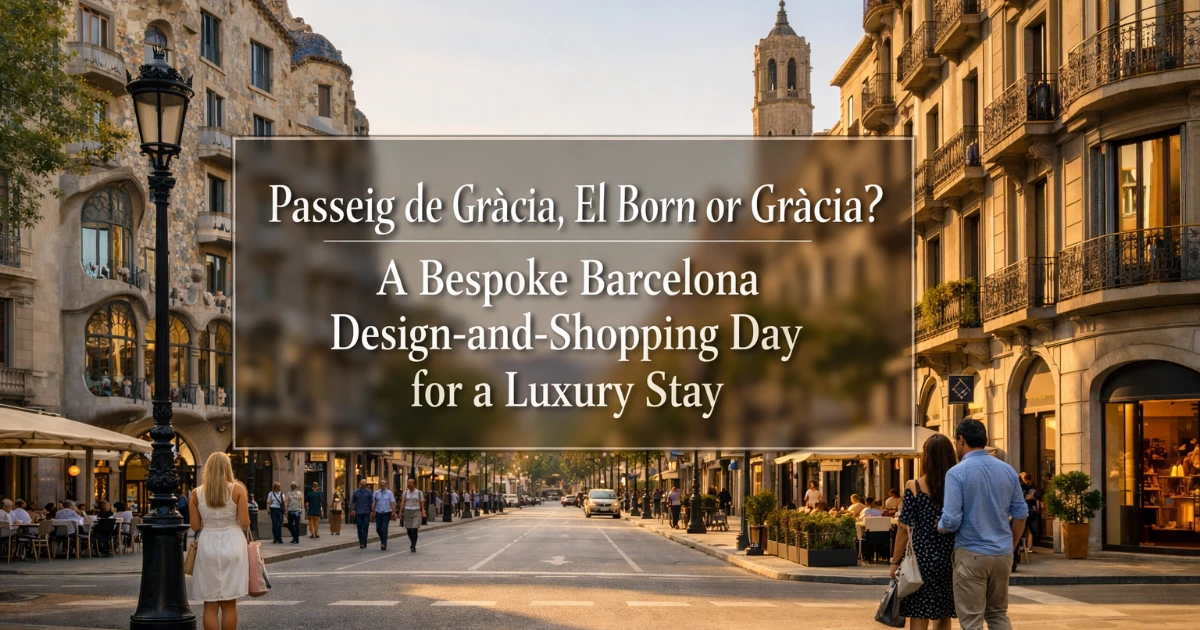
Passeig de Gràcia, El Born or Gràcia? A Bespoke Barcelona Design-and-Shopping Day for a Luxury Stay
Updated
Passeig de Gràcia is the strongest default for a bespoke Barcelona design-and-shopping day, not because it is glossier than El Born or Gràcia, but because it keeps architecture, browsing, lunch, and the return to a luxury hotel on the same track. In real city conditions, that matters more than the romantic idea of “seeing a bit of everything”: the Passeig de Gràcia-to-Born handoff is where a polished day often starts to split apart, usually around Plaça Catalunya or the drop toward Via Laietana, when the wide Eixample rhythm gives way to narrower lanes, slower crossings, and a very different browsing cadence. The clearest exception is Gràcia. If you care more about independent boutiques and neighborhood life than grand façades and marquee addresses, Gràcia can be the better choice precisely because it refuses to behave like central Eixample. In Barcelona, the best design day is not the district with the most charm per block; it is the one where architecture, boutique density, lunch placement, and walking texture all support the same mood instead of fighting it.
That means one honest answer for most style-led travelers staying well in Barcelona: choose Passeig de Gràcia if you want a day that looks and feels editorial from the first coffee to the last purchase. Put Gràcia in second place when independent discovery matters more than brand frontage. Use El Born only when old-town texture is part of the point and your hotel or lunch already pulls you east. And yes, a one-district Barcelona design day is often stronger than trying to touch all three. Travelers who want help shaping that kind of route will usually get more value from a focused Barcelona shopping private tour than from drifting district to district with no real sequence.
Read the three districts by what they do to the day, not by which one sounds most stylish.
- Default winner — Passeig de Gràcia: the best answer for architecture-led browsing, polished lunch placement, broad pavements, easy pauses, and a smooth return to Eixample hotels.
- Best independent alternative — Gràcia: the strongest option when local boutiques, neighborhood pace, and small-label taste matter more than big-name frontage.
- Most often overvalued as an add-on — El Born: the most atmospheric choice, but the weakest full-day default unless you are already based nearby or want the day to feel more textured than efficient.
- The first thing to cut: the idea that you need all three districts to have a “complete” Barcelona design day.
Passeig de Gràcia vs El Born vs Gràcia for architecture-led browsing and boutique density
If architecture-led browsing is the priority, Passeig de Gràcia wins; if boutique density means independent labels and slower discovery, Gràcia beats both; if texture is the point, El Born can be lovely, but it is the least reliable all-day answer. That comparison matters because these three districts are not different versions of the same Barcelona mood. They ask different things of your legs, your lunch, your shopping attention, and your patience.
Passeig de Gràcia is really an Eixample proposition. The avenue itself matters, but so do the spillover streets that make it usable: Rambla de Catalunya just to the west, the quieter stretches around Consell de Cent, and the broader north-south logic that lets you browse without constantly deciding where to turn next. Even if you never buy a ticket for a major house museum, the façades do part of the work. Modernist architecture is not just scenery here; it shapes the tempo of the day. You look up, you move slowly, you step into a shop, you return to a terrace, and the rhythm remains coherent.
El Born operates differently. It has boutique compression in the sense that interesting doors sit closer together, but it does not have the same legibility. The lanes around Santa Maria del Mar, Carrer dels Flassaders, Passeig del Born, and Carrer de la Princesa reward curiosity, not efficiency. That sounds appealing, and often is, but it creates an important consequence for comfort-first travelers: a district can feel full without feeling productive. In other words, El Born can deliver a memorable afternoon without delivering the strongest design-and-shopping day.
Gràcia is different again. It is not old-town theatrical like El Born and it is not Eixample grand like Passeig de Gràcia. Its appeal lies in authorship rather than spectacle. The blocks around Carrer d’Astúries, Carrer de Verdi, Plaça de la Virreina, and the side streets that pull away from Gran de Gràcia reward people who like independent fashion, homeware, smaller ateliers, and a neighborhood that feels lived in rather than staged for browsing. But that gain comes with a condition: Gràcia works only when you let it breathe. Treated as a quick add-on, it disappoints.
The counterintuitive correction is this: El Born is not the elegant, obvious second act many luxury travelers imagine after a Passeig de Gràcia morning. On a map, the shift looks easy. In reality, the Passeig de Gràcia-to-Born handoff changes the whole day. The pavements narrow, the visual logic breaks, the browsing becomes more stop-start, and any idea of gliding from polished shopping boulevard to atmospheric old-town treasure hunt starts to feel more fragmented than chic. When travelers tell us they want “a little Passeig, a little Born, maybe a little Gràcia,” what they usually want is variety. What they usually get is dilution.
That is why district choice should be made with explicit criteria. Ask four questions. Do you want architecture to be part of the shopping experience, or just a backdrop? Do you want labels and service density, or independent discovery? Does lunch need to feel cleanly placed, with nearby backup options? And are you browsing from a hotel base that makes returning easy, or are you effectively carrying the whole day on foot? Once those criteria are clear, the answer is rarely ambiguous.
Why Passeig de Gràcia is the default winner for a luxury-stay design day
Passeig de Gràcia is the best all-around answer because it gives you Barcelona design value without making you pay for it in friction. For a design-led day, that balance is unusually hard to beat. The avenue itself offers the most legible combination of architecture, luxury shopping, broad sidewalks, polished service culture, and easy transitions into calmer side streets. That does not mean it is the most original district. It means it is the district where more parts of the day work at once.
For travelers staying in Eixample, the advantage begins before the first stop. You are often already close to the day’s best starting point, so there is no early transfer, no old-town zigzag before coffee, and no sense of “commuting” to your shopping district. That may sound minor, but it changes the tone of the morning. You begin in control, not in transit. For couples celebrating something, small groups with mixed interests, or visitors who want the day to feel unhurried without wasting half of it, that opening matters.
The street’s design payoff is also broader than many visitors expect. Passeig de Gràcia is not only for travelers chasing known labels. The surrounding Eixample grid lets you move between statement façades, multi-brand shopping, quieter showrooms, and far better lunch options than many visitors realize. Rambla de Catalunya softens the day immediately; it is close enough to feel connected, but calm enough to act as a palate cleanser. Consell de Cent can do something similar, especially when the avenue itself starts to feel too exposed or too brand-heavy. This is one of the hidden strengths of Eixample: you can adjust the mood without changing districts.
Architecture also works differently here than it does in a standard sightseeing day. On Passeig de Gràcia, buildings such as Casa Batlló and La Pedrera are not just attractions to enter or skip; they are part of the day’s visual texture whether or not you buy admission. That is especially useful for travelers who want Barcelona design context without converting the whole plan into a Gaudí checklist. You can let the street teach the city’s visual language while still keeping the day anchored in browsing, terraces, fittings, and conversation.
Lunch placement is where Passeig de Gràcia usually seals the argument. In a style-led day, lunch should not feel like a logistics interruption. Around central and upper Eixample, it rarely does. You have more room to choose whether lunch is brisk and functional, leisurely and social, or celebratory. You can also protect the rest of the day if a reservation needs to move or if the group splits briefly. That flexibility is not glamorous, but it is the sort of thing discerning travelers notice only when it is missing.
Passeig de Gràcia is also the safest answer for travelers who value service standards and fitting-room sanity as much as visual charm. El Born and Gràcia may offer more surprise, but Passeig de Gràcia and its adjacent Eixample streets generally make browsing easier to sustain. There is more space between decisions, more straightforward access, and less sense that the day depends on every small lane rewarding the detour. For many travelers, that is the difference between a day that feels curated and a day that feels improvised.
There is another reason it wins: it leaves more of you intact for the evening. A polished Barcelona dinner, a celebration reservation, or a rooftop drink lands very differently after a controlled Eixample day than after hours of old-town weaving. That matters on shorter stays, when the day is not an isolated experience but part of a limited sequence of high-value hours.
Still, Passeig de Gràcia is not right for everyone. Its weakness is not subtle. If you want the day to feel deeply local, more independent, or less associated with prestige retail, it can seem over-scripted. Travelers who already know that big boulevards bore them should not force themselves to like it just because it is the easiest answer. That is where Gràcia, in particular, can outperform it.
It is also worth stating one clear spend judgment. A private car adds little once you are actually browsing Passeig de Gràcia, Rambla de Catalunya, and the core Eixample blocks around them, because the best design payoff is still on foot. Premium spend does not earn its cost on the avenue itself; it earns its keep only if it is solving arrival, departure, or a later cross-city transfer. If Passeig de Gràcia is your district, walking is not a compromise. It is the point. Travelers who know this is their lane usually do best with a focused Eixample private tour rather than trying to turn the day into an all-neighborhood sampler.
El Born works best as a mood-rich half day, not the automatic second act
El Born is strongest when texture is the point, not when efficiency is the goal. That distinction matters because El Born is often oversold to high-end travelers as the easy way to make a Passeig de Gràcia day feel more “real.” Sometimes it does that. Just as often, it interrupts a good day without actually improving it.
At its best, El Born has genuine seduction. Around Santa Maria del Mar, Passeig del Born, Carrer dels Flassaders, and the tighter lanes around Carrer de l’Argenteria and Carrer de la Princesa, the neighborhood gives you medieval fabric, small-scale browsing, galleries, jewelry, objects, and a sense of discovery that broad Eixample avenues cannot reproduce. For couples, especially, it can feel cinematic in a way Passeig de Gràcia never tries to. If your hotel is nearby, or if lunch and the afternoon are already committed to the old town, El Born can absolutely be the right answer.
But El Born asks more of the body for every hour of design return. The streets are narrower, the browsing rhythm is less linear, and the neighborhood is more vulnerable to slowdown from visitors who are not shopping at all. A day that looks pleasantly dense on a map can become a stop-start sequence of turns, crowd pockets, and micro-decisions. This is especially true once you brush up against the busier edges nearer to Via Laietana, the Picasso Museum zone, or the most photographed corners near Santa Maria del Mar.
That matters because boutique density is not the same thing as shopping efficiency. El Born often feels full faster than it rewards deep browsing. For travelers who like small finds, that can be enough. For travelers hoping to make real progress, compare options, or keep a group aligned, the neighborhood can feel more charming than practical.
Lunch is also decisive here. If you plan lunch in El Born and mean to stay there through the afternoon, the district becomes more coherent. If you plan lunch in Eixample and then “drop into Born” afterward, the district often underperforms. The day’s energy has already settled into one rhythm, and El Born demands another. That shift can be pleasant if you are doing almost nothing afterward. It can be mildly exhausting if you still imagine more shopping, a hotel return, and dinner preparations later the same day.
This is why El Born and Gràcia should never be treated as interchangeable “local” alternatives to Passeig de Gràcia. El Born is denser, more visitor-exposed, more decorative, and more immediately atmospheric. Gràcia is slower, more residential, and usually better for sustained local browsing. El Born gives you mood quickly. Gràcia gives you neighborhood depth if you stay long enough.
The traveler fit is narrower than many guides admit. El Born is a strong call for old-town hotel stays, celebration afternoons, lighter accessory shopping, design lovers who enjoy wandering more than accumulating purchases, and travelers whose emotional priority is texture. It is a weaker call for multi-generational groups, anyone who wants long, controlled fittings, and travelers trying to combine serious browsing with a polished lunch and a calm evening return.
There is also one editorial judgment worth making plainly: El Born is the most overvalued add-on in this comparison. Many visitors assume it upgrades a Passeig de Gràcia day because it sounds more intimate and less predictable. In practice, it often breaks the very qualities that made the day strong in the first place. If your real goal is an old-town afternoon rather than a design-shopping day, say so and plan for it honestly. Readers leaning that way may find our El Born beyond-Gaudí guide more useful than trying to squeeze Born into the wrong shape.
Gràcia earns the detour only when you want boutique depth more than speed
Gràcia is worth the detour when you want independent design and neighborhood life badly enough to give up a little glamour and a lot of convenience. That is not a compromise answer. For the right traveler, it is the best answer in this entire comparison. But it is never the casual answer.
The easiest mistake with Gràcia is assuming it sits “basically near” Passeig de Gràcia because the map suggests continuity through upper Eixample. In practice, Avinguda Diagonal is the honest seam, and once you move beyond it the day changes. Gran de Gràcia functions as the transition street, not the reward. The reward comes when you peel off into Carrer d’Astúries, Verdi, the smaller squares, and the side streets where independent taste becomes visible. If you never get properly into that fabric, you have not really done Gràcia; you have simply brushed its edge.
That is why the Gràcia linger-versus-transfer choice matters so much. If you are willing to make Gràcia the point of the day, including lunch or at least a long coffee, it can be excellent. If you are merely curious and want to “have a quick look” after Passeig de Gràcia or before heading elsewhere, the transfer rarely earns itself. Gràcia reveals itself through staying, not sampling.
Its design strength is different from both El Born and Passeig de Gràcia. Gràcia tends to reward travelers who like smaller labels, lifestyle objects, local rhythm, and the sense that a district has its own taste rather than simply housing attractive stores. The best hours here are often the ones without a fixed agenda. You move through a few streets, pause in a square, circle back, compare one store with another, and notice that the day feels personal rather than performative. For return visitors, style-led travelers, and anyone bored by prestige corridors, that can be the entire point.
Gràcia also handles groups in a different way. It can work beautifully for couples or friends with aligned taste, and it often works well for travelers who are willing to let the day evolve organically. It is more difficult for parties with mixed shopping interest because the neighborhood’s pleasure lies in small discoveries. If one person wants to dwell and another wants obvious landmarks or quick wins, Gràcia exposes that mismatch faster than Passeig de Gràcia does.
Lunch strategy again decides a great deal. In Gràcia, lunch is not just a break; it is part of the reason to choose the neighborhood at all. A long lunch or deliberate pause belongs here more naturally than a high-speed reservation sandwiched between destination stores. That makes Gràcia especially strong on the second or third day of a Barcelona stay, when travelers are ready for depth rather than orientation.
What Gràcia does not offer is effortless grandeur. If your image of a Barcelona design day includes major façades, luxury polish, hotel-adjacent convenience, and a sense of obvious prestige, Gràcia may feel almost too unassuming. That is not a flaw, but it is a real traveler-fit issue. Celebration travelers who want a day to feel formally elevated usually do better in Passeig de Gràcia. Families with younger children or older parents often do too, because Gràcia’s rewards can feel abstract if everyone is not equally engaged.
Yet when Gràcia is right, it can outperform the central districts precisely because it asks you to slow down. The neighborhood gives you a version of Barcelona that feels authored rather than assembled for visitors. For design-led travelers, that can be more valuable than another polished avenue or another medieval lane. But it only happens if you stop trying to make Gràcia share the day with too many other districts. Travelers ready to commit to that pace are usually better served by a purpose-built Gràcia private tour than by a route that treats Gràcia as decorative overflow from Eixample.
When combining districts helps, and when one district is the better Barcelona day
Combining districts works only when the hotel base, lunch placement, and end-of-day plan all point in the same direction; otherwise, one district is the stronger answer. This is where many high-end Barcelona days fail. The intention is understandable: travelers want variety, local contrast, and a feeling of having made the most of a short stay. The problem is that Barcelona does not always reward variety inside a single browsing day. It often rewards commitment.
If your hotel is in Eixample or just off Passeig de Gràcia
Stay in Passeig de Gràcia unless you have a very specific reason not to. This is the cleanest layout in the city for a style-led day. You can start on foot, build in lunch without losing momentum, drop purchases back if needed, and still finish looking ready for the evening. The most defensible combination from this base is Passeig de Gràcia plus a carefully chosen slice of Gràcia, especially if lunch is placed north-west and the group genuinely prefers independent browsing over polished labels after midday. The weakest combination is Passeig de Gràcia plus a late El Born detour. That move sounds more dynamic than it usually feels.
If your hotel is in the Gothic Quarter or El Born
El Born becomes much more persuasive. Not automatically better, but more coherent. You are already near the district’s strongest hours, and the emotional gain from walking out into atmospheric streets is real. In this case, a Born-first day with lunch nearby and only a short, deliberate late-afternoon transfer to Passeig de Gràcia can work. What rarely works is forcing both Born and Gràcia as well. Once an old-town-based day acquires too many district changes, the body feels every one of them.
If your hotel is in Gràcia or upper Eixample
Gràcia deserves a proper hearing. Travelers based here often underestimate how much easier it is to let Gràcia own the day, especially if they already know they prefer independent discovery to luxury-label frontage. Upper Eixample and Gràcia can combine reasonably well because the seam is more natural than the Eixample-to-Born shift. But even from this base, Gràcia and El Born together are usually a poor match for the same day unless shopping is secondary and the plan is really about neighborhood contrast.
If lunch is the emotional center of the day
Let lunch choose the district. If lunch needs to feel elegant, flexible, and close to a broad range of strong backup options, Eixample is the safest bet. If lunch is meant to be part of a textured old-town afternoon, El Born can win. If lunch is meant to stretch and loosen the day, Gràcia becomes more attractive. The mistake is placing lunch in one district and assuming another district will still perform afterward at full strength. A design day is not a museum circuit; appetite, shopping attention, and patience all change after lunch.
If you already have a timed booking
A timed booking should narrow the day, not widen it. If you already hold Sagrada Família official tickets (https://sagradafamilia.org/en/tickets-individuals), let that fixed point simplify the rest of the route. That often means pairing the visit with Passeig de Gràcia and nearby Eixample streets, or with upper Eixample and Gràcia, depending on timing and appetite. It does not usually mean trying to add El Born as well. The same logic applies to Park Güell official tickets (https://parkguell.barcelona/en/buy-tickets): timed entry can justify a northern or north-western emphasis, but it is a reason to cut a district, not to force a third one.
The first thing to cut, whenever the day starts looking overpacked, is the third district. The second thing to cut is the idea that a late-afternoon old-town detour automatically adds romance. In Barcelona, sequence is often more luxurious than quantity. A district day that ends with energy in reserve is usually better than a three-neighborhood sampler that leaves everyone bargaining with the evening.
This is also where private guidance starts to make real sense. Not because a guide magically improves every street, but because district choice changes the value of every hour after it. A smart planner can decide whether you need architecture as a frame, boutique density as the priority, or lunch as the pivot. That is a different service from simply showing shops. It is the difference between a route and a good day.
What Barcelona does to the body, and what that does to the mood
Barcelona makes design days feel longer than they look on the map. The Eixample grid can seem easy because it is rational and visually open, but those blocks are long enough to add up quickly. Then the city changes texture. Old-town paving slows the stride, crossings near major seams such as Via Laietana or Plaça Catalunya interrupt rhythm, and any midday heat multiplies the cost of indecision. By late afternoon, travelers are not only thinking about the next boutique; they are managing feet, shade, patience, and the return to the hotel.
That is why the “best” district on paper is not always the best district for your actual day. El Born can look compact and efficient until the crowd pockets, narrow passages, and stop-start browsing begin to drag. Gràcia can look charmingly local until you realize its rewards depend on staying long enough to sink into it. Passeig de Gràcia can look obvious until you understand how much physical and mental energy it saves simply by keeping the route readable.
What the city does to mood is just as important. Barcelona can give a day tremendous visual momentum: wide avenues, striking façades, sudden squares, strong indoor-outdoor life. But it can also flatten the mood very quickly when too many districts compete for the same afternoon. A morning in Eixample has one emotional register. A lunchtime shift into El Born has another. A late push to Gràcia has another again. None of these are bad on their own. The problem is stacking them without enough time for any one of them to settle.
For comfort-first travelers, the district that feels slightly less “special” in brochure language can produce the more memorable day because it protects the evening and keeps everyone calmer. That is one reason Eixample so often beats old-town texture in real trip conditions. Not because it is more romantic, but because it is easier to enjoy without noticing the logistics. If your dinner matters, your shopping decisions matter more when you are not already worn down by transfers and crowd friction.
This is also the point at which hotel choice comes back into the picture. A traveler based in Eixample experiences Passeig de Gràcia very differently from a traveler based in the Gothic Quarter, even if both walk the same blocks. If your stay is still in planning, our where to stay in Barcelona guide is the right companion piece, because base choice can change whether the design day feels effortless or oddly interrupted before it even begins.
Turning the right district into the right private day
The district choice matters because design-led days in Barcelona are unusually vulnerable to aimless abundance. There is always another attractive street, another lane worth peeking into, another lunch idea, another building that seems close enough to add. The winning move is not to see more neighborhoods. It is to choose the neighborhood whose logic matches the kind of day you actually want.
If you want architecture, polish, lunch control, and the least wasted motion, make Passeig de Gràcia your answer. If you want small-scale texture and you are already staying or dining in the old town, let El Born own a shorter, moodier part of the day rather than pretending it is the smoothest all-day browse. If you want independent boutiques and local design character, give Gràcia the dignity of enough time to work properly.
That is exactly where bespoke planning earns its keep. The difference between a strong Barcelona design day and an overfilled one is often invisible before you arrive: the wrong lunch district, the wrong handoff after noon, the wrong assumption about what is “near,” the wrong belief that a chauffeur can solve a walk that only makes sense on foot. A carefully shaped private day does not just save time. It protects tone, energy, and decision quality across the whole stay.
If your trip is short and the shopping or design day has to count, let Orange Donut Tours shape the district around your hotel, your pace, your lunch, and the sort of browsing you actually enjoy. Inquire now.
FAQ
Which district is best for luxury shopping in Barcelona if I only have one day?
Passeig de Gràcia is the strongest one-day answer for most luxury-stay travelers because it combines architecture, premium shopping, easier lunch placement, wide sidewalks, and straightforward hotel logistics. It is not the most atmospheric district, but it is the one that most consistently turns into a good full day without avoidable friction. El Born is more atmospheric and Gràcia is better for independent discovery, but both require a more specific fit to outperform Passeig de Gràcia.
Is El Born or Gràcia better for independent boutiques?
Gràcia is usually better for sustained independent-boutique browsing, while El Born is better for atmosphere and shorter bursts of discovery. El Born gives you small lanes, strong texture, and a quick sense of old Barcelona, but the browsing is less linear and more vulnerable to crowd slowdown. Gràcia asks more commitment, yet it tends to reward travelers who want neighborhood taste, smaller labels, and a day that feels less prestige-driven.
Can I combine Passeig de Gràcia and El Born in one day?
Yes, but only under the right conditions. It works best if you are staying near the old town, if lunch is already placed in El Born, or if you only want a short late-afternoon texture shift after a focused Eixample morning. It works poorly when travelers start in Eixample, browse seriously, eat a long lunch there, and then try to “pop into” Born as if it were a seamless extension. That is the moment many polished days start to lose shape.
Is Gràcia worth the detour from Eixample hotels?
Gràcia is worth the detour when independent design, neighborhood pace, and local character matter more to you than brand density or obvious grandeur. It is not worth the detour if you only mean to spend an hour there between other districts. Gràcia performs best when it receives a real share of the day, ideally with lunch or a long pause built in. Treated as a quick extra, it often feels more effortful than rewarding.
Does a private car help on a Barcelona design and shopping day?
A private car helps most with hotel pickup, cross-city repositioning, and getting you to dinner or another district after the browsing is done. It helps least inside the core walking zones that actually make a good design day. On Passeig de Gràcia, central Eixample, and much of central Gràcia, the best payoff is still on foot. The smartest use of premium transport in this context is usually to solve the edges of the day, not the heart of it.
What should I do if I already have Sagrada Família official tickets?
Treat the booking as the day’s fixed anchor and simplify the district plan around it. In most cases, that means pairing the visit with Passeig de Gràcia and nearby Eixample browsing, or with upper Eixample and Gràcia if that is a better fit for your taste. What it should not encourage is adding more districts just because the day already has a landmark. Timed tickets are usually a reason to reduce scope, not expand it.
Where should lunch go on a design-led day in Barcelona?
Lunch should go where it supports the district you chose rather than forcing a mood change halfway through the day. In Passeig de Gràcia and wider Eixample, lunch is easiest to place cleanly and elegantly. In El Born, lunch works best when it is part of a full old-town afternoon rather than a side trip. In Gràcia, lunch becomes part of the neighborhood’s value because it encourages the slower pace that makes the district rewarding in the first place.
Could families, older parents, or small groups still enjoy this kind of day?
Yes, but district choice matters even more. Passeig de Gràcia is usually the safest answer for mixed-energy groups because it offers clearer walking, easier pauses, better access to terraces, and fewer frustrating seams. El Born can be delightful in a shorter window, especially for visually curious families or celebration groups, but it is more tiring to sustain. Gràcia can be excellent for aligned small groups who enjoy slower discovery, yet it is less forgiving if attention spans or mobility needs differ.
If you’re interested in any private tours of Barcelona, please reach out to us.










 So if you are looking for the absolute best in Barcelona & surroundings with authentic local fully-licensed native guides whose English you can actually understand and with an exclusive and amazingly fun itinerary













