Barcelona After Modernisme: A Noucentisme Sequence From Plaça de Catalunya to Montjuïc

Updated
The route in one view
Barcelona’s Noucentisme is easiest to understand as a movement through the city, not as a hunt for façades that look calmer than Modernisme. Begin at Plaça de Catalunya, where sculpture and urban composition turn a difficult junction into a civic stage. Continue west through the Eixample to the Escola Industrial, where the political vocabulary of order, education and institutional capacity becomes tangible. Finish on Montjuïc, where the 1929 International Exposition enlarged those ambitions into an axis of palaces, terraces, gardens and controlled views.
That order matters. The square establishes the public language; the institutional campus shows who was expected to use it and to what end; Montjuïc reveals both the scale of the program and its contradictions. Starting on the hill may be visually impressive, but it risks making the Palau Nacional seem like an isolated monument. Starting with the institutions below lets the hill read as the culmination of a civic project rather than a collection of photogenic buildings.
A full specialist day can be organized around three fixed anchors and two optional layers:
- Morning, Plaça de Catalunya: allow roughly 45 to 60 minutes to read the square’s sculpture, edges and relationship to the old city and the Eixample.
- Late morning, Escola Industrial: allow 75 to 90 minutes for the campus, its industrial origins and its Mancomunitat-era institutional expansion. Treat interior access as conditional.
- Early afternoon, the cross-city transition: protect enough time for lunch and the move to Montjuïc; this is the day’s largest logistical change.
- Afternoon, Montjuïc: follow the exposition axis from Plaça d’Espanya toward the Palau Nacional, then decide between the museum, the gardens and one specialist branch.
- Finish: stop when the political argument is complete, not when every nearby attraction has been collected.
This sequence suits travelers who already know Barcelona’s major Modernisme landmarks and want the next chapter: how cultural nationalism, administrative reform and Mediterranean classicism were translated into civic space. For a contrasting day that remains within Modernisme but broadens the cast beyond a single architect, a Modernisme route through Sant Pau, the Eixample and Palau de la Música works as a useful companion rather than a substitute.
Before the first stop: what Noucentisme meant
Noucentisme was not merely a decorative reaction against sinuous lines, colored tile and individual expression. It was an early twentieth-century Catalan cultural and political program associated with intellectuals and politicians including Eugeni d’Ors and Enric Prat de la Riba, with the Lliga Regionalista and, institutionally, with the Mancomunitat de Catalunya. Its preferred vocabulary included civic order, measure, discipline, Mediterranean classicism and the creation of durable public institutions. Architecture, sculpture, education, language policy, libraries, museums and landscape design belonged to the same field of action.
The term itself points toward a new century and a desired new cultural condition. The movement’s advocates imagined a Catalonia that would be modern not because it celebrated perpetual novelty, but because it could organize knowledge, train professionals, codify culture and present itself through coherent civic forms. In this sense, a school, a library system or a carefully framed public square could carry as much ideological weight as a celebrated building.
David Mackay’s scholarly account connects Noucentisme’s Mediterranean and rational classicism with the Lliga, Prat de la Riba and the Mancomunitat, while also showing why the architecture of the 1929 Exposition cannot be reduced to one pure style. That wider argument is available in his study of Noucentisme and Barcelona’s exposition architecture. It is the most useful conceptual guardrail for this route: political alignment and civic purpose matter at least as much as cornices, columns or symmetry.
Two cautions keep the day intellectually honest. First, Modernisme and Noucentisme overlap in time, personnel and patronage. Josep Puig i Cadafalch, for example, cannot be sealed into one stylistic box; his political and institutional work matters to the later civic program even when his earlier architecture belongs to a different visual register. Second, the monumental classicism of the late 1920s is not automatically Noucentista simply because it is axial or symmetrical. Montjuïc contains local classicism, academic monumentality, regionalist display, technological spectacle and international modernism in close proximity.
The route therefore uses five questions instead of a style checklist:
- What kind of citizen or public does this space imagine?
- Which institution is being made visible, and what capacity does it claim?
- How are Catalan identity and Mediterranean culture translated into form?
- Where does order become persuasive, and where does it become theatrical?
- Which parts of the ensemble belong to Noucentisme’s program, and which expose the limits or afterlives of that program?
With those questions in mind, Plaça de Catalunya becomes more than a transport hub, the Escola Industrial more than an attractive campus, and the Palau Nacional more than a viewpoint. The day begins to read as a sequence of political scale: citizen, institution, city.
Plaça de Catalunya: civic order in a difficult urban hinge
Plaça de Catalunya sits where the medieval city, the Rambla, the Eixample and several major commercial avenues meet. Its geography is inherently unruly. People cross it in every direction; traffic wraps its edges; façades from different periods compete for attention. The Noucentista interest lies less in finding a perfectly unified square than in observing how planners and sculptors attempted to impose legibility on a place defined by movement and collision.
Turisme de Barcelona’s institutional account attributes the planning of the square to Pere Falqués, Josep Puig i Cadafalch and Francesc de Paula Nebot, and identifies sculptural contributions by figures including Josep Clarà and Josep Llimona. It also describes allegorical groups tied to Catalan geography and civic values. The official summary is useful precisely because it confirms that this is a coordinated civic ensemble with multiple authors, not a single-master monument; see the city tourism consortium’s history of Plaça de Catalunya.
Begin near the northern edge and look across the whole field before approaching individual works. The first task is orientation: identify the old city to the south, Passeig de Gràcia to the north, the Rambla descending toward the port and the broad Eixample grid opening beyond the square. Noucentisme’s civic ambition becomes clearer when the square is read as a hinge that gives symbolic form to Barcelona’s expansion. It mediates between inherited urban fabric and planned modern city.
Then move slowly around the perimeter. Do not ask only whether a sculpture is classical in anatomy or pose. Ask how the bodies are distributed, what they represent and how they help stabilize the square’s competing directions. Allegory converts geography, labor, knowledge and collective identity into a public language. The figures are not private reveries; they are intended to be readable components of a civic order.
Josep Clarà is especially useful here because his sculptural language embodies the Noucentista preference for controlled volume, poised bodies and Mediterranean calm. Yet even this should not become a connoisseurial game of attribution. In the square, the larger point is how autonomous artworks are subordinated to an urban composition. Their meaning comes partly from placement, repetition and relationship to circulation.
Notice also the gap between ideal and use. Plaça de Catalunya is noisy, commercially saturated and continually crossed. Its sculptural program proposes order without ever fully controlling the life around it. That tension is not a failure to be edited out; it is evidence. Noucentisme’s civic language had to operate in a mass city, not an abstract Mediterranean republic. The square shows the ambition to discipline public space and the stubborn plurality of the metropolis at the same time.
What to record before leaving the square
A specialist visit benefits from three concise observations rather than dozens of photographs. First, note one instance where sculpture frames a line of movement rather than standing as an isolated object. Second, identify one allegorical gesture that translates a collective value into the human body. Third, choose one place where the modern square resists its intended order: traffic, retail signage, crowd flow or an interrupted sightline. These observations will recur at the Escola Industrial and Montjuïc in more institutional forms.
Allow at least 45 minutes, and closer to an hour if the group wants to compare multiple sculptures. Early morning generally makes spatial relationships easier to see, but the square is never empty enough to become a pristine architectural set. That is useful. The purpose is to understand a civic composition under pressure.
The Eixample crossing is part of the argument
From Plaça de Catalunya to the Escola Industrial, a direct walk is feasible for travelers comfortable with roughly half an hour on level city streets. A practical line runs west through the Eixample toward Carrer del Comte d’Urgell. The exact street choice matters less than the transition from monumental square to repetitive urban grid. The walk places Noucentisme inside the ordinary city rather than treating it as a self-contained style district.
Use the crossing to notice how Barcelona’s Eixample distributes light, traffic and building frontage across a regular network. The grid predates Noucentisme, but it provides a spatial discipline that the movement’s civic program could inhabit. Along the way, avoid turning every restrained façade into a Noucentista example. The value of this segment is urban scale: blocks, institutions and circulation replace the square’s concentrated symbolism.
For travelers conserving energy, a short taxi or private-vehicle transfer is reasonable, especially in heat or for a group that intends to spend substantial time on Montjuïc later. The operational tradeoff is simple. Walking preserves continuity and lets the Eixample act as connective tissue; driving saves physical capacity but compresses the city into separate stops. Neither is inherently more authentic. Choose according to the day’s intellectual priority and the group’s walking tolerance.
Do not insert a major Modernisme interior between the square and the campus. A timed visit would dominate the morning, introduce queue and duration risk, and pull the interpretive center back toward individual artistic genius. Keep this segment quiet enough for the institutional argument to develop.
Escola Industrial: from factory compound to civic capacity
The Escola Industrial occupies the former Can Batlló industrial site, a fact that gives the stop its first layer. The campus was not conceived on untouched ground as a single ideal composition. It absorbed and transformed an existing productive complex. That makes it particularly revealing for Noucentisme: the movement’s political force lay not only in producing new forms, but in reorganizing inherited resources into systems of education, technical training and cultural administration.
The Diputació de Barcelona’s history of the complex traces its expansion during the Mancomunitat period, including the Escola del Treball, technical institutes, the Library School and other services developed under the educational and cultural direction associated with Puig i Cadafalch. The official account is detailed in the Diputació’s history of the Escola Industrial site. This is the key documentary support for reading the campus as an institutional project rather than a stylistic specimen.
Enter the site only where public access is clearly permitted, and treat occupied buildings as working institutions. The route does not depend on entering every interior. From the campus spaces, compare industrial fabric, later additions and the overall organization of circulation. Ask how a former manufacturing complex was made to serve a public educational mission. The answer is likely to be incremental and uneven, which is precisely why it is more instructive than a perfectly preserved showpiece.
At Plaça de Catalunya, civic order was represented through allegorical bodies and urban composition. Here, it is enacted through curricula, workshops, libraries and administrative networks. The Mancomunitat had limited formal powers, yet it pursued a program of practical state-building through coordination, infrastructure, language and education. The campus makes that ambition legible at the scale of daily work.
This is also where the phrase “Mediterranean classicism” needs to be handled carefully. Not every useful piece of the campus looks like a classical pavilion. Noucentisme’s deeper classical claim involved measure, intelligibility and a disciplined public realm. A technical school can participate in that program through organization and purpose even when its inherited industrial fabric resists stylistic purity. The political reading is stronger than any attempt to label every arch or courtyard.
Read the campus in four passes
- Industrial inheritance: identify the scale and material logic of the former factory environment. Consider what could be reused and what had to be redefined.
- Institutional insertion: look for the ways educational and administrative functions occupy, divide or connect the compound.
- Public choreography: observe thresholds, courtyards and routes between buildings. These determine how an institution is experienced as much as its façades do.
- Political consequence: connect the physical campus to the creation of trained workers, librarians, technicians and professionals. The built environment becomes a mechanism for cultural capacity.
The site also sharpens a distinction within Barcelona’s industrial history. Some former factories are most compelling as evidence of labor, production or adaptive reuse; Escola Industrial is additionally important because public institutions were layered onto industrial space as part of a wider Catalan civic project. Travelers who want to continue the industrial thread on another day can compare Poblenou and Sant Andreu through factories, labor history and adaptive reuse.
Allow 75 to 90 minutes if the group is comfortable with campus walking and discussion. Reduce that to 45 minutes if access is limited or if the MNAC interior is a fixed afternoon priority. The stop has done its work once the group can explain how Noucentisme moved from cultural vocabulary to institutional infrastructure. More time is useful only when it adds specific evidence.
Why sequence changes the quality of interpretation
If Plaça de Catalunya and the Escola Industrial are visited as unrelated architecture stops, their strongest connection is easily missed. The first supplies a public image of civic unity; the second reveals the administrative and educational machinery behind that image. A knowledgeable guide can keep authorship, chronology and ideology distinct, especially where buildings were inherited, altered or completed under different conditions. The value is not simply access. It is the construction of a cumulative argument from dispersed evidence.
This is the natural point to consider a bespoke private route: when the group wants the square, the campus and Montjuïc to function as chapters of one historical question rather than as three independent sights. Inquire now about shaping the sequence around specialist interests, walking tolerance and the MNAC calendar.
The move to Montjuïc: manage the largest transition
The transfer from the Escola Industrial to Montjuïc is where an elegant cultural day can lose coherence. The distance is not extreme, but the shift involves lunch, a change in topography and a decision about where to enter the exposition landscape. Treat it as a planned transition rather than a blank interval.
For a first reading, approach from Plaça d’Espanya and follow the processional axis up Avinguda de la Reina Maria Cristina. This preserves the intended escalation from gateway to monumental backdrop. Arriving directly at the upper terraces saves effort, but it removes the lower axis that explains how the Palau Nacional was staged. A vehicle can still be useful later, especially for a garden branch or a group with limited uphill capacity; it does not need to replace the whole ascent.
Public transport is economical but requires attention to ticket validity and the final approach. Under TMB’s fare schedule effective 15 January 2026, a one-zone single ticket is listed at €2.90, a one-zone T-casual at €13.00 and a one-zone T-dia at €12.00; the single ticket applies only to TMB metro and buses. Confirm current products before travel on TMB’s official fare page, because prices and conditions are operational facts rather than evergreen history.
For a mixed-mobility group, the best solution may be shared interpretation at the lower axis, a vehicle or accessible transfer to the upper level, and a planned rejoining point rather than forcing everyone through the same stairs and gradients. The related guide to shared anchors and rejoining points on Montjuïc develops that operational problem in greater detail.
Keep lunch moderate and geographically useful. A long meal before Montjuïc can turn the afternoon into a race against museum closing time; a rushed meal can make the climb unpleasant. On a Tuesday-to-Saturday plan with a museum visit, aim to reach the lower axis with at least three usable hours remaining before the building closes. On Sunday, when the museum closes earlier, the route needs a more aggressive morning or a reduced campus stop.
Montjuïc: a city staging itself
Montjuïc is where Noucentisme’s civic ideals expand into spectacle, but the hill should not be treated as a single coherent manifesto. The 1929 International Exposition gathered monumental classicism, regional display, landscape design, engineering, commercial pavilions and radical modern architecture. Its value for this route lies in the negotiation among those tendencies.
From Plaça d’Espanya to the Palau Nacional
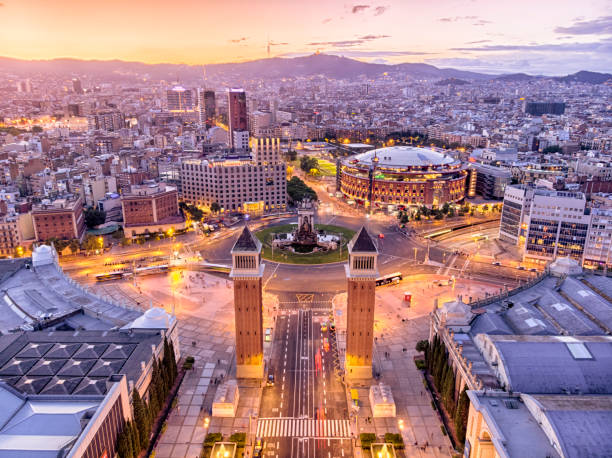
Stand at the lower end of Avinguda de la Reina Maria Cristina and look uphill before moving. The composition is designed as a sequence of thresholds, widening spaces, water, stairs and terraces, with the Palau Nacional as the dominant crown. The body is made to understand hierarchy through movement. This is civic order at a scale far beyond Plaça de Catalunya.
The twin towers at the entrance, the long avenue and the rising palace create a ceremonial frame. Yet the avenue is also an exposition machine: it once organized enormous visitor flows, temporary displays and technological effects. The political image of order depended on modern systems of circulation and spectacle. Noucentisme’s classical language was therefore not a retreat from modernity. It was one method of giving modern mass experience a controlled cultural form.
Walk the axis in stages. At the bottom, observe how the hill is converted into a frontal image. Midway, turn back toward the city and notice how Barcelona becomes part of the composition. Higher up, compare the increasingly panoramic view with the more disciplined axial view below. The route alternates control and release: first the visitor is directed; then the city opens outward.
The Palau Nacional was designed by Eugenio Cendoya, Enric Catà and Pere Domènech i Roura for the exposition. Its domes, towers, symmetry and elevated position create an image of institutional permanence, even though the building originated as an exposition palace. That transformation from temporary-event architecture into the home of the Museu Nacional d’Art de Catalunya is itself significant. A structure designed to stage national representation acquired a long institutional afterlife.
Do not call the palace a pure Noucentista work. Its monumentality can feel heavier, more academic and more state-like than the measured Mediterranean ideal associated with the movement’s earlier cultural program. This difference is productive. By the late 1920s, the civic desire for order had expanded into an exposition language shaped by many political and architectural currents. The hill shows both the success of the program and the difficulty of maintaining its intellectual precision at monumental scale.
Landscape as political form
Montjuïc’s gardens and terraces are not decorative relief from architecture. Landscape is one of the hill’s strongest arguments. Jean-Claude Nicolas Forestier and Nicolau Maria Rubió i Tudurí helped shape a system that used stairs, water, vegetation, retaining walls and framed views to convert rough topography into civic landscape. The result aligns Mediterranean planting and classical spatial discipline with modern metropolitan leisure.
This matters because Noucentisme imagined culture as a relationship among city, body and environment. A garden could teach measure through movement, shade, proportion and controlled prospect. The visitor does not merely look at an object; the visitor is choreographed through a sequence of rooms open to sky and city.
Choose one landscape branch rather than sampling every garden. The Laribal area and the approach toward the Teatre Grec are especially valuable for understanding how topography was edited rather than erased. Stairs and terraces acknowledge the hill’s slope while converting it into a legible civic experience. The Teatre Grec, formed from a former quarry and conceived through the model of an ancient theater, condenses several Noucentista desires: Mediterranean reference, disciplined public gathering and the transformation of industrially altered ground into cultural space.
The political reading should remain nuanced. A classical theater does not automatically prove a unified cultural consensus, and an exposition landscape is never neutral. These spaces selected which pasts to monumentalize and which forms of modern life to present as orderly. Their beauty is part of their persuasive force.
Where the international modern enters
The reconstructed Barcelona Pavilion by Ludwig Mies van der Rohe and Lilly Reich offers the most incisive optional contrast on the hill. Its planes, materials and spatial fluidity do not continue the Palau Nacional’s monumental classicism. They introduce a radically different way of making modern architecture authoritative: through precision, abstraction and controlled movement rather than allegory or historical mass.
Adding the pavilion is useful only when the group wants to compare competing modernities. It should not be treated as another item on a checklist. The question is whether Catalan civic classicism, exposition monumentality and international modernism produce different relationships among visitor, institution and nation. That comparison can illuminate Noucentisme more clearly than another nominally classical façade.
Travelers seeking a broader non-Gaudí architecture day, with Sant Pau, Mies and Montjuïc placed in a different twentieth-century sequence, can use this alternative Barcelona architecture day as the better framework. On the present route, Mies remains a branch, not the main argument.
Inside the MNAC: deepen the route without changing subjects
The Museu Nacional d’Art de Catalunya occupies the Palau Nacional, but entering the museum introduces a major time decision. The building and terrace complete the urban sequence even without a gallery visit. The collection adds value when the group wants to examine how Catalan art history was assembled, classified and displayed as a national narrative.
Current official hours are a hard dependency. The museum lists Tuesday through Saturday opening from 10:00 to 18:00 from October through April and from 10:00 to 20:00 from May through September. Sundays and public holidays are listed as 10:00 to 15:00, while Mondays are closed except public holidays. Verify the date-specific schedule and any exceptional closures on MNAC’s official opening-hours page before fixing the route.
Do not attempt a comprehensive museum visit after a full morning in the city. Choose a defined purpose. One option is to study the Palau Nacional as an institutional interior: entrance sequence, great spaces, viewpoints and the building’s adaptation from exposition palace to museum. Another is to focus on the Romanesque collection as evidence of how medieval Catalan art was gathered and presented within a modern national institution. The works themselves are not Noucentista, but the twentieth-century act of collecting, conserving and narrating them belongs to the broader history of cultural institution-building.
A third option is to follow a small number of works into the modern collection and ask how later artists accepted, revised or rejected the ideals of classicism, civic order and Mediterranean identity. This requires strong curatorial discipline. Without a narrow question, the museum will absorb the rest of the day and weaken the sequence that made the visit meaningful.
For travelers whose primary interest is Romanesque art rather than Noucentisme, the better plan begins elsewhere and culminates at MNAC. The route from Sant Pau del Camp to MNAC makes the collection, rather than the exposition landscape, the central narrative.
A practical museum allocation
- Thirty to 45 minutes: building, entrance sequence and terraces only. Suitable when the route has already delivered its main argument outdoors.
- Ninety minutes: one collection focus plus the building. This is the most balanced choice for a full Noucentisme day.
- Two hours or more: justified for an art-historical group with a preselected set of rooms. It requires shortening the campus or dropping a Montjuïc branch.
On Sunday, the 15:00 closing time makes a center-to-campus-to-museum sequence difficult unless the day starts early and the campus segment remains concise. If museum entry is non-negotiable, reverse the day: begin at MNAC, descend through the exposition axis, then continue to the Escola Industrial and Plaça de Catalunya. This sacrifices the ideal argumentative build but protects the fixed opening window. The reversal should be presented as a logistical compromise, not as an equivalent narrative.
Optional branches that change the reading
Montjuïc offers too many plausible additions. The correct branch is the one that answers a live question raised by the route. Choose one; two only if the day began early, museum time is limited and the group remains physically comfortable.
The Teatre Grec and gardens: choose landscape
Select this branch when the group is most interested in Mediterranean classicism, civic leisure and the shaping of topography. It extends the Noucentista theme through movement and landscape rather than adding another building. The cost is physical: gradients, stairs and indirect paths can consume more time than the map suggests. In warm weather, shade and water become planning conditions, not minor comforts.
The Barcelona Pavilion: choose competing modernities
Select Mies and Reich’s pavilion when the group wants a sharply framed comparison between civic classicism and international modern architecture. The benefit is conceptual clarity; the cost is that a focused pavilion visit can pull attention away from the Palau Nacional and gardens. Keep the discussion comparative and return to the question of public representation.
Poble Espanyol: choose constructed identity
Select Poble Espanyol when the group is interested in how an exposition classified and staged the architecture of Spain’s regions. Its value lies in representation, typology and the politics of assembling a synthetic “village,” not in mistaking it for an untouched historic settlement. Because it is a substantial attraction in its own right, this branch usually replaces a long MNAC visit rather than supplementing one.
Terraces and views: choose the city as evidence
Select the terraces when the group has reached saturation with interiors. The panorama lets the day’s geography resolve: the central square, the Eixample, the institutional corridor and the hill can be understood as parts of one metropolis. This is the lightest branch and often the most effective close.
A fuller decision framework for choosing among art, views and gardens is available in the Montjuïc guide organized by afternoon priority. Here, the branch must serve the Noucentisme argument rather than simply fill remaining hours.
Timing plans for different calendars
Tuesday to Saturday, full sequence
Begin at Plaça de Catalunya around 09:30. Leave the square by 10:30, reach the Escola Industrial around 11:00 and finish the campus between 12:15 and 12:30. After lunch and transfer, aim to stand at the lower Montjuïc axis around 14:15. This leaves time for a measured ascent, a 90-minute MNAC focus and one short landscape or pavilion branch. In the May-to-September museum schedule, the later closing creates more elasticity; in the October-to-April schedule, protect the museum entry time.
These are planning allowances, not guaranteed travel durations. Traffic, campus access, weather, group pace and temporary closures can change the day. The key dependency is the museum’s closing hour. Work backward from that fixed point, then decide how much of the campus and hill can be carried without rushing.
Sunday, compressed sequence
Sunday requires a choice because MNAC closes at 15:00 under its published schedule. The intellectually clean center-first route can still work if Plaça de Catalunya begins around 08:45, the campus is treated as an exterior and institutional reading, and Montjuïc is reached before 12:30. There is little margin for a long lunch or an extensive garden branch.
If the group values the museum more than sequence purity, begin at MNAC when it opens, then descend the axis and continue into the city. End at Plaça de Catalunya, where the civic sculpture becomes a compact summary rather than an opening proposition. The day will feel more like explanation after evidence, but it remains coherent if that reversal is stated plainly.
Monday, outdoor and institutional reading
When MNAC is closed, except on specified public holidays, the route can still succeed as an urban and landscape study. Retain Plaça de Catalunya and the Escola Industrial, spend more time on the exposition axis, and choose the gardens or Barcelona Pavilion according to their own current schedules. Do not treat the closed museum as a small omission if the group’s main interest is the national art collection; in that case, move the route to another day.
Shorter four-hour branch
A compressed version should not attempt all three anchors. Choose Plaça de Catalunya plus the Escola Industrial for a civic-institutional half day, or Plaça de Catalunya plus Montjuïc for a public-symbolic half day. The former is quieter and historically tighter; the latter is more visually legible but risks reducing Noucentisme to monumentality. A private vehicle can make the second option operationally smoother, but it cannot replace the interpretive link that the omitted campus would have supplied.
Hot-weather adjustment
In high summer, front-load exposed urban observation. Begin the square early, use the campus before the hottest part of the day, and reach Montjuïc with a deliberate plan for shade, indoor time and reduced climbing. The hill’s distances feel longer when heat is combined with stairs. A vehicle transfer to the upper level can preserve the lower axis as a short reading while avoiding a prolonged ascent, especially for older travelers or mixed-mobility parties.
Rain adjustment
Rain makes Plaça de Catalunya less comfortable but does not destroy its interpretive value. Keep the square concise, use covered pauses where available and shift more time toward the campus or museum if access permits. On Montjuïc, slippery stairs and reduced views weaken the landscape branch. The museum becomes more valuable, while the Barcelona Pavilion remains useful for spatial comparison. The route should become more interior, not simply faster.
The stopping rule
End the day when the group can state the sequence in its own words: Noucentisme proposed a disciplined civic culture; Barcelona gave that proposal public form through sculpture and urban order; the Mancomunitat translated it into institutions; Montjuïc magnified it into landscape and exposition spectacle, where the ideal became more heterogeneous and politically complicated.
That understanding usually arrives before every possible Montjuïc stop has been visited. Once the Palau Nacional, one landscape passage and one contrasting branch have been read, additional attractions often produce diminishing interpretive returns. Fatigue also changes the quality of looking. A final hour spent collecting another pavilion can blur distinctions that were clear earlier.
Use three tests:
- Argument test: does the next stop add a new claim, or merely repeat monumentality, classicism or views?
- Time test: can the stop be completed without compromising a fixed closing hour or creating a rushed descent?
- Attention test: is the group still comparing evidence, or has the day become passive sightseeing?
If the next stop fails two of the three, finish on the terrace or in a garden room with a view back across Barcelona. The route has succeeded when the city’s political and cultural structure is clearer, not when the map has been exhausted.
How this sequence changes Barcelona after Modernisme
Modernisme often teaches visitors to look for singular invention, material richness and the expressive authority of the architect. Noucentisme asks for a wider field of vision. Its most consequential works may be systems, curricula, public bodies, landscapes and ensembles whose authorship is shared. The visual language of classicism matters, but the civic program explains why that language was useful.
Plaça de Catalunya, the Escola Industrial and Montjuïc form a persuasive sequence because each changes the scale of the same question. How should Catalan culture appear in public? At the square, the answer is allegory and urban order. At the campus, it is education and administrative capacity. On the hill, it is a monumental landscape capable of representing the city to a mass international audience. The differences among the stops are as important as their continuities.
This is also why the day benefits from specialist interpretation. The evidence is dispersed, authorship is mixed, access varies and the 1929 exposition landscape contains multiple architectural positions. A bespoke sequence earns its place by deciding what to connect, what to contrast and what to leave out. Travelers building a broader Barcelona stay can use Orange Donut Tours’ private Barcelona planning to place this civic and architectural route beside, rather than underneath, the city’s better-known Modernisme days.
The most satisfying finish is not a verdict that Noucentisme replaced Modernisme. Barcelona is too layered for that. The stronger conclusion is that a new cultural coalition tried to redirect modern Catalan identity from expressive individualism toward civic discipline, institutions and a Mediterranean public realm. By walking from the central square to the school campus and then up the exposition hill, the traveler sees that project move from language to machinery to image—and can also see where the image exceeded, complicated or betrayed the original program.
If you’re interested in any private tours of Barcelona, please reach out to us.








 So if you are looking for the absolute best in Barcelona & surroundings with authentic local fully-licensed native guides whose English you can actually understand and with an exclusive and amazingly fun itinerary