Miró in Public Barcelona: How Mosaics and Sculpture Turned the City Into a Distributed Museum

Updated
Barcelona gives Joan Miró an unusual kind of visibility. His name belongs to a major museum on Montjuïc, yet some of his most consequential encounters with the city happen outside it: under shoes on La Rambla, above a park beside Plaça d’Espanya, and in the relationship between those works and the objects, models, drawings and ideas preserved at the Fundació Joan Miró. The historical tension is immediate. Miró wanted art to enter collective life, but the better known that public art becomes, the more easily it is reduced to a landmark, a souvenir image or a colored interruption in a busy itinerary.
The useful question is therefore not simply where to find Miró in Barcelona. It is what changes when his visual language leaves the protected wall and becomes a pavement, a monumental body or a museum building deliberately opened to light, landscape and public circulation. Pla de l’Os is meant to be crossed. Dona i Ocell is meant to be read at the scale of a park and a changing skyline. The Fundació Joan Miró supplies the evidence that prevents those encounters from floating free of the artist’s working process.
The argument of this guide is that Barcelona functions as a distributed Miró museum only if the word “museum” is used critically. The works do not form one tidy series, and the city does not preserve them under identical conditions. Their coherence comes from a shared civic ambition expressed through different commissions, materials, collaborators and bodily demands. One asks the viewer to step on art. Another makes a recurring figure twenty-two metres high. The Foundation reveals how ceramics, found objects, graphic signs, architectural thinking and repeated motifs made those gestures possible.
The documented framework comes from the Fundació’s collection and archive material, a museum-curated study of Miró’s affinities with Gaudí, municipal heritage documentation for the Rambla pavement, and technical monitoring of Dona i Ocell. The editorial interpretation is that material and placement are not secondary details: they are the content of the civic encounter. The route judgment is to keep the day to three principal nodes—Pla de l’Os, the Foundation and Dona i Ocell—while allowing the airport mural and the unrealized land-arrival monument to clarify the history without forcing extra stops.
A civic ambition with an unfinished map
By the late 1960s and 1970s, Miró had already spent decades breaking the boundary between painting and other forms. Ceramics, bronze, assemblage, printmaking, textiles, theatre and architectural collaboration were not side activities attached to a painter’s career. They were ways of testing whether a sign could survive a new substance, a new scale and a less controlled audience. Public space intensified that test. A canvas can be approached frontally; a work in a city must accept weather, traffic, distraction, maintenance and the fact that many people will encounter it without having chosen an art experience.
Barcelona’s best-known Miró narrative begins with the idea of welcoming arrivals by air, land and sea. The Fundació’s own ceramics note identifies the monumental airport mural as the air welcome, a projected monument for Parc de Cervantes as the land welcome, and the Pla de l’Os mosaic on La Rambla as the sea welcome. The land project was not built, although a study is preserved in the Foundation’s North Courtyard. This matters because it leaves the civic scheme visibly incomplete. The absence is part of the history, not a gap that Dona i Ocell should automatically be made to fill.
The distinction is easy to lose because Dona i Ocell is monumental, public, near a major arrival zone and often grouped with the other city works in popular summaries. Yet the institutional evidence describes a different sequence: the intended land-arrival monument belonged at Parc de Cervantes, while Dona i Ocell was made later for the former slaughterhouse park. The later sculpture can extend Miró’s argument about civic art without being treated as the missing member of an otherwise perfect trilogy.
That difference sharpens the larger point. Miró’s public Barcelona is coherent through recurring problems rather than through a single commission brief. How can color remain forceful outdoors? How can a sign belong to everyday movement rather than sit apart from it? What happens when craft collaboration becomes structurally necessary? How does an image retain its ambiguity when enlarged to architectural scale? And what kind of conservation respects a work whose original meaning includes exposure to ordinary use?
The Foundation’s 2016 ceramics note gives a concise historical line from Miró’s work with Josep Llorens Artigas to mural ceramics for the UNESCO headquarters in Paris and the Fondation Maeght, then to Barcelona’s welcome works and Dona i Ocell. It is available in the Fundació Joan Miró’s official ceramics document. The document does not make every work identical. Instead, it shows how sustained experimentation with earth, fire, glaze, architectural setting and monumental scale created the technical and imaginative conditions for public art.
For a repeat Barcelona visitor, this is more rewarding than another biography-led tour. The city sites are not illustrations of a life story. They are evidence of a mature artistic position: art should enter collective space, but it must change materially and conceptually to do so.
Pla de l’Os: an image that accepts the crowd
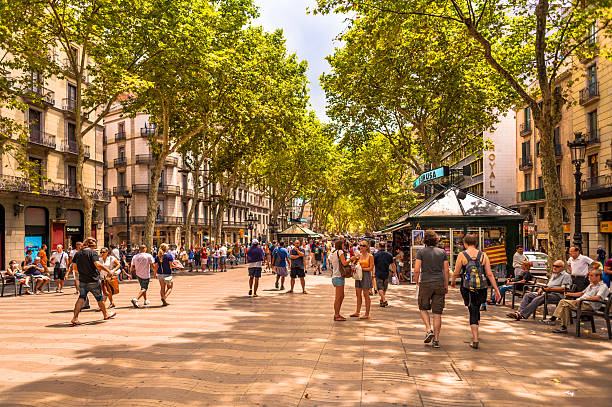
Pla de l’Os sits in the central pedestrian stream of La Rambla at Pla de la Boqueria. Its position is so exposed that the first interpretive fact can be missed: the mosaic is not merely outdoors; it is a pavement. The public does not stand at a respectful distance. People cross it, pause on it, wheel luggage over it, gather at its edges and sometimes pass without looking down. That apparent indignity is close to the work’s purpose.
The sea-welcome idea depends on geography. La Rambla historically draws movement inland from the lower city and port direction. Miró’s design therefore addressed arrival as a path rather than as a ceremonial façade. The work does not announce itself with a pedestal or a frame. It interrupts the ground along a route already charged with commerce, performance, tourism and local memory. The visitor enters the image before fully recognizing it.
Its broad circular field, roughly eight metres across, uses the compact vocabulary associated with Miró—black lines, primary colors, white ground and forms that can suggest an arrow, an eye, a celestial sign or a creature without settling into one reading. From a photograph taken directly above, the composition looks self-contained. At street level, it behaves differently. Bodies fragment the design; perspective compresses it; the surrounding paving competes with it. The whole must be reconstructed by moving around the perimeter and looking through gaps in the crowd.
That partial visibility is not a failure of presentation. It demonstrates the difference between a museum image and a civic image. In a gallery, the institution stabilizes the viewing distance. On La Rambla, the image accepts interrupted attention. Miró’s achievement is not that every passer-by stops, but that an artwork with a strong formal identity remains available within ordinary circulation.
Material is part of the invitation
Pla de l’Os is commonly called a mosaic, but its physical logic is closer to a durable urban terrazzo pavement than to a precious wall panel. The colored areas are carried by terrazzo slabs made from white cement and crushed colored glass, producing a dense, weather-capable surface. Joan Gardy Artigas translated Miró’s design into the installed work. The collaboration matters because a drawing that looks spontaneous must be converted into units, joints, thicknesses and tolerances able to survive as infrastructure.
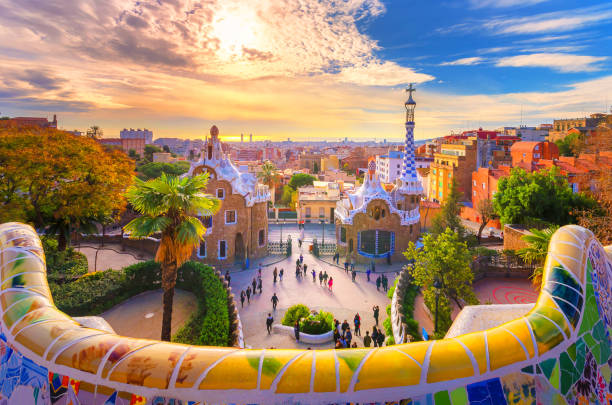
The museum-curated study Miró, Gaudí, Gomis: The Magical Meaning of Art makes the conceptual link explicit. It explains that Miró and Artigas looked to Gaudí’s trencadís partly because public works needed weather-resistant materials, and it records preparatory annotations imagining fragments of broken glass, metal and discarded matter. More important than literal imitation, the study argues, is the destination: like the pavement of Park Güell’s main plaza, Pla de l’Os was conceived to be stepped on and incorporated into daily life.
This is why the work should not be read as a flat quotation of Miró’s painting style. The black curve and colored zones are only one layer. Beneath them is an argument about making: a modern artist depends on ceramic expertise, industrial fabrication and public-works discipline; a seemingly free sign must negotiate gravity, abrasion and drainage; and the city becomes a co-producer through use and maintenance.
For travelers interested in how Barcelona turns craft into architectural surface, the comparison with Barcelona’s Modernisme in ceramics and glass is useful. Miró’s pavement belongs to a later artistic world, but it inherits the local understanding that color can be built into a surface rather than applied as a detachable decoration.
Conservation is not the opposite of use
A work designed to be walked on still requires care. Exposure does not mean neglect, and accepting wear does not mean every loss is artistically desirable. The conservation problem is unusually delicate because replacing a damaged pavement element may preserve the composition while also changing the material record of public use. Cleaning must recover legibility without pretending the work lives outside the city. Repairs must respect both the design and the engineering of a heavily trafficked surface.
A 2026 BIMSA procurement justification lists Paviment Miró, dated 1976 and catalogued under public-art code 1138-1, among heritage fountains, sculptures, artworks and pavements on La Rambla covered by repair works. The municipal procurement document is useful less as visitor news than as evidence of status: the mosaic is administered as a catalogued heritage pavement within a living street. The document alone does not establish what access or barriers a visitor will encounter on a particular date, so temporary conditions should be checked close to the visit.
The interpretive consequence is important. Pla de l’Os is not preserved by removing it from use; it is preserved so that use can continue without erasing the work. That makes conservation visible as part of the civic contract. The city accepts responsibility for a surface whose artistic purpose includes being crossed by people who may not know its title.
Gaudí is present, but not as a style quotation
Miró’s debt to Gaudí can be overstated in two opposite ways. One version reduces it to colorful broken tile: both artists used bright ceramic fragments, therefore Miró’s public works are “Gaudí-inspired.” The other treats the affinity as a vague Catalan kinship. The stronger evidence lies between them. Miró was interested in Gaudí’s ability to make material, structure, nature and everyday experience act together.
The museum-curated catalogue identifies Park Güell as a crucial reference when Miró and Josep Llorens Artigas developed the UNESCO murals and work for the Fondation Maeght. The lesson was not to copy Gaudí’s forms. It was to adapt art to terrain and architecture, to use robust materials without sacrificing color, and to let a work participate in movement through a place.
Pla de l’Os makes that affinity especially clear because the city does not offer a privileged frontal viewpoint. Park Güell’s great bench and plaza pavement are understood through walking, turning and changing sightlines. Miró’s Rambla pavement similarly asks the body to assemble a composition that cannot be owned from one stable position. The viewer becomes temporarily responsible for making the image whole.
The Foundation extends this comparison through works on paper. In 1979 Miró produced the Sèrie Gaudí and Enrajolats prints, while Gran rodona I and II recall the impact of Park Güell’s principal plaza and the rounded form later carried into the Rambla pavement. These are not preparatory drawings for Pla de l’Os in a simple sequence. They show a long return to the same formal and material problem across public art and printmaking.
That return matters because it resists the idea that public scale simply enlarges a private image. Miró’s signs move between media and are rethought each time. A curve in an etching is made by pressure, plate and ink. A curve in pavement is made by modules, joints and aggregate. The visual family resemblance is real, but the work’s meaning changes with its material obligations.
This is also where the word “primitive,” often associated with Miró’s own language about art, needs care. In the public works it should not be used as a synonym for naive or technically simple. The surfaces depend on sophisticated collaboration and engineering. What Miró sought was an elemental force—a sign that could feel prior to academic polish—while using modern systems capable of carrying it into collective space.
Seen this way, Gaudí’s relevance is methodological. He offered Miró an example of how an artwork could be inseparable from where and how people encountered it. Pla de l’Os is the most concentrated Barcelona demonstration of that lesson.
Dona i Ocell: from ground plane to urban body
If Pla de l’Os disperses itself horizontally beneath the crowd, Dona i Ocell does the opposite. It rises twenty-two metres from the park formerly known as Parc de l’Escorxador, near Plaça d’Espanya. The sculpture can be seen from a distance, but distance does not resolve it. Its body shifts among column, figure, vessel, organic growth and explicitly sexual form. A bright crescent and bird-like element crown the vertical mass, while dark incisions and colored ceramic zones complicate any single anatomical reading.
The setting is essential. The park occupies the former municipal slaughterhouse site and emerged as a major new public landscape in the early 1980s. Miró’s sculpture was made in 1981–82 and unveiled in 1983. It therefore belongs to a different urban situation from the Rambla pavement. Pla de l’Os enters an inherited promenade dense with historical layers. Dona i Ocell addresses a newly remade park, a large hard-surfaced and planted space whose scale needed a visual anchor.
This is one reason to resist folding the sculpture into the earlier air-land-sea scheme. The official Foundation account identifies the unrealized Parc de Cervantes monument as the intended land welcome. Dona i Ocell may evoke arrival, vitality and civic greeting, but its documented commission and site make it a later answer to another urban problem: how a monumental artwork can give identity to a new public landscape without becoming a conventional commemorative statue.
A collaborative monument, not an enlarged painting
The sculpture’s scale changes the role of material. Its body is concrete, while the colored skin is ceramic trencadís executed with Joan Gardy Artigas. At twenty-two metres, ceramic is no longer a small crafted object. It becomes an environmental surface subjected to sun, rain, thermal movement and the visual compression of long distance. Close up, the fragments and joints assert themselves; from across the park, they merge into color fields.
Miró’s collaboration with ceramic specialists is sometimes treated as technical assistance to an essentially individual design. That understates the artistic structure of the work. The monument depends on the translation from model to full scale, from drawn contour to formwork, from color indication to a ceramic envelope that can bend around an irregular body. Public art makes authorship more visibly collective because no single hand can perform every operation.
The scale also changes ambiguity. In a small painting, a black opening or curved sign can hover between body, eye, sex and constellation. Enlarged into a concrete figure, the same uncertainty becomes architectural. Viewers do not merely interpret a sign; they stand beside a bodily presence whose height exceeds surrounding trees and nearby human figures. The title offers “woman” and “bird,” but the work refuses a clean illustration of either noun.
Sexual readings are unavoidable, yet they should remain readings rather than a decoding key. The tall form has often been described as phallic, while the dark vertical opening can suggest female anatomy. Miró’s vocabulary repeatedly joins woman, bird, moon, star and sexual energy without fixing them into stable emblems. Dona i Ocell gains force from holding apparently contrary forms together: female and male, rooted and airborne, heavy concrete and luminous ceramic, body and sign.
The water and open space around the monument expand those oppositions. Reflection can double and fragment the colored surface; the hard plaza emphasizes weight; trees place the sculpture against organic growth. Unlike a museum plinth, the park permits many distances and accidental alignments. A child circling the base, a commuter crossing the edge of the park and an art traveler studying the ceramic skin do not receive the same work, even when they stand there at the same time.
What the Foundation helps you see
The Foundation collection contains numerous works in which women, birds and celestial signs migrate across painting, drawing, print and sculpture. The point is not to find a single canvas that “explains” Dona i Ocell. It is to recognize that the monument condenses a vocabulary Miró repeatedly altered. Works such as Woman and Birds in the Night, Woman, Bird, Star and the tall Woman, Bird I, II, III canvases demonstrate how verticality, sparse signs and bodily-cosmic fusion were already active problems before the park sculpture.
The Foundation’s catalogue entry for a one-metre bronze titled Woman and Bird, dated 1981, offers a particularly useful comparison. It should not be casually labeled a scale model for the public monument unless the museum identifies it that way. Its value is comparative: bronze concentrates surface and mass, while the public sculpture uses concrete and ceramic to turn a related title into architecture. The same motif can become materially different rather than simply larger.
The archive adds another caution. An official record for Assembled objects for the Joan Miró sculpture Woman and bird, 1967 documents the role of found forms and assemblage in his sculptural process. It is relevant to how Miró generated bodies from ordinary objects, but its date and related work prevent it from being used as direct evidence for the 1982 monument. Specialist interpretation is often the art of keeping such connections fertile without collapsing distinct objects into one origin story.
Conservation reveals the sculpture as engineering
Dona i Ocell looks fantastical, but its survival depends on measurement. During nearby construction involving perimeter walls, excavation and demolition, SOCOTEC monitored the sculpture from May 2016 to September 2017. Mini-prisms attached for observation were controlled through a topographic station, allowing movement to be tracked while structural work proceeded nearby. The company also reports that Barcelona City Council carried out maintenance and restoration operations during that period.
The SOCOTEC monitoring account is unusually revealing for an art traveler. It shows that a monumental sculpture is not conserved only by cleaning ceramic or discussing color. Its ground conditions, concrete body and response to adjacent excavation matter. The artwork participates physically in the city’s construction environment.
This technical history deepens rather than diminishes the poetry. Miró’s bird may signify flight, but the monument must be surveyed for movement. Its ceramic skin can suggest spontaneity, but every piece relies on adhesion and substrate. Public art lives between image and infrastructure, and Dona i Ocell makes that double identity impossible to ignore.
The Fundació Joan Miró is the city’s reading room
The Fundació on Montjuïc should not be treated as the respectable indoor stop added to two public landmarks. It is the interpretive center of the distributed museum because it preserves both the finished works and the evidence of becoming: drawings, models, notes, correspondence, photographs, prints, ceramics and sculptures that show Miró revising ideas across media.
Josep Lluís Sert’s building, opened to the public in 1975, strengthens that role. White concrete volumes, skylights, large windows, patios, ceramic floors and a roof terrace create a museum that repeatedly returns the visitor to light, landscape and movement. Miró wanted a living, human place rather than a grand monument. The architecture does not isolate his art from Barcelona; it frames views and pauses that keep the city present.
This matters after Pla de l’Os and before Dona i Ocell. The Foundation changes the pace from accidental encounter to deliberate comparison, but it does not eliminate bodily movement. Sert organized circulation around courtyards and changing natural light. The visitor still turns, crosses thresholds, sees works against exterior space and experiences scale through architecture. The museum is controlled, yet not sealed.
For the wider geography and the tradeoff between art, gardens and views on the hill, our guide to choosing what Montjuïc is for provides useful supporting context. On a Miró-focused day, the Foundation deserves to be the intellectual center rather than one attraction among several hilltop additions.
This is the point at which specialist guiding has a material effect on the experience. The value is not access to a secret room or the addition of more stops. It is the ability to keep commission history, preparatory evidence, material process and city geography connected while the viewer moves from pavement to museum to monument. For a tailored version of this sequence, see private Barcelona tours shaped around specialist interpretation or Inquire now.
The archive turns style into process
The official Fundació Joan Miró Archive description reports almost 10,000 items, including preparatory drawings, sketches, models, notes and correspondence personally archived across Miró’s life. That scale matters. It makes the Foundation more than a representative display of masterpieces; it is a research environment capable of showing how an apparently immediate sign passed through alternatives, annotations and technical negotiation.
For public art, preparatory evidence changes what can be asked. A drawing may identify intended materials that were later revised. A model reveals how a form was imagined in three dimensions before engineering. Correspondence can distinguish a donation from a commission, or an unrealized project from a later work that resembles it. Photographs can show studio assemblages before they were cast, fired or enlarged.
The unbuilt land-arrival monument is especially important. Its study in the North Courtyard preserves a branch of the welcome scheme that Barcelona never received at full scale. Seen conceptually beside the airport mural and Pla de l’Os, it demonstrates that a distributed museum includes unrealized thought as well as installed objects. It also prevents Dona i Ocell from being recruited too neatly into a plan to which it did not originally belong.
Archive evidence encourages a more exact kind of looking in the galleries. Rather than searching only for familiar stars and birds, notice changes in support and resistance. Cardboard absorbs differently from canvas. Bronze records the pressure of modeled or assembled forms. Stoneware and enamel submit color to firing. Prints reverse and repeat marks. The public works are the large-scale outcome of an artist who kept asking what each medium would permit and refuse.
Three Foundation comparisons that clarify the city works
- Ceramic monoliths and steles: smaller stoneware works expose clay, enamel, firing and irregular edge at close range. They make it easier to understand why outdoor ceramic was attractive to Miró: color is fused to a durable body, while fire introduces effects that cannot be fully controlled. Pla de l’Os and Dona i Ocell translate that material intelligence into pavement and architecture.
- Women, birds and stars across media: paintings, drawings and prints show that these terms are not fixed symbols with dictionary meanings. A bird may be a stroke, crescent, puncture, wing, sexual sign or direction of movement. Comparing several works protects Dona i Ocell from a single allegorical explanation.
- Gaudí-related prints and circular forms: Sèrie Gaudí, Enrajolats and Gran rodona reveal an extended dialogue with broken-tile logic, rhythmic line and Park Güell. They clarify that Pla de l’Os belongs to a network of returns rather than to one isolated flash of inspiration.
Collection displays change, particularly for works on paper and light-sensitive material. The route should therefore be built around questions and categories, not a promise that every named comparison will be on the wall. The catalogue and archive remain the stable evidence; the visible selection is the current opportunity.
The tidy trilogy is an attractive mistake
Barcelona travel writing often presents three Miró works as a complete welcome: airport for air, Pla de l’Os for sea and Dona i Ocell for land. The story is memorable, geographically intuitive and partly supported by the way later works have been received. It is also too neat.
The Fundació’s official account names a different land work: a monumental project for Parc de Cervantes that was not realized. Dona i Ocell appears after that sequence as a later monumental sculpture in Parc de l’Escorxador. The distinction does not reduce the importance of Dona i Ocell. It gives the sculpture its own commission history and protects the unrealized Cervantes project from disappearing.
Why does this matter to a visitor? Because incorrect grouping changes interpretation. If Dona i Ocell is treated as the land welcome, its park is read mainly as an arrival threshold. If it is read as a work for a newly remade urban park, questions of post-slaughterhouse landscape, civic scale, concrete construction and public identity come forward. The same object acquires a different urban meaning.
The airport mural still belongs in the argument even when it is not included as a city-day stop. It establishes Miró and Artigas’s command of monumental ceramic and the civic language of arrival. The unrealized project establishes that intention and installation are not the same thing. Pla de l’Os realizes the sea welcome through a work beneath the public. Dona i Ocell demonstrates how the artist later answered another Barcelona commission with a vertical, bodily landmark.
A distributed museum does not need a perfect trilogy. In fact, the unfinished map is more revealing. It shows artistic ambition meeting commission, site, feasibility and time. Barcelona contains completed works, displaced ideas, unrealized studies and later monuments that echo earlier concerns without belonging to the same administrative package.
A city route that preserves context without checklist drift
The most coherent sequence begins with Pla de l’Os, continues at the Fundació Joan Miró and ends at Dona i Ocell. This order is an editorial judgment, not a claim that it is the only practical route. Its advantage is interpretive: encounter the public work before receiving the museum’s explanations, use the Foundation to build an evidence chain, then test that understanding against Miró’s greatest Barcelona monument.
It also keeps the day within a legible urban arc: lower La Rambla, Montjuïc and the park beside Plaça d’Espanya. The airport mural remains historically essential but geographically separate. Adding it for completeness would turn a focused inquiry into collection behavior. The unrealized Parc de Cervantes work belongs in the Foundation discussion, where absence can be understood through the surviving study.
1. Pla de l’Os: reconstruct the sea welcome
Approach the mosaic from the lower Rambla side when possible so that the sea-arrival idea is present in the direction of movement. Before looking for individual symbols, establish the work’s urban boundaries. Walk the perimeter once. Notice where the Miró pavement gives way to ordinary paving, how surrounding bodies break the composition and how little institutional framing announces the work.
Then change distance. From the edge, look for the overall circular field and directional energy. Closer in, examine aggregate, joints, abrasion and replacement. The essential question is not “What does this shape represent?” but “What kind of image can remain public when the public walks across it?” Allow roughly twenty to thirty attentive minutes rather than a quick photograph. More time is rarely necessary unless conservation works or crowd conditions require patience.
Do not add La Boqueria merely because it is adjacent. A market visit has its own sensory and historical logic; using it as filler can dissolve the concentration established at the pavement. On a wider city day, the mosaic can sit naturally within La Rambla. On a Miró study route, its value comes from treating a familiar location as an art object with a commission and material history.
2. Fundació Joan Miró: build the evidence chain
At the Foundation, resist the pressure to summarize the whole career. The route has a narrower task. Begin with ceramic and sculptural process, then look for women, birds, stars, circular forms, found-object logic and works that engage architecture or landscape. Read labels closely enough to distinguish date, medium, collaborator and provenance.
Give special attention to the building. Courtyards, windows, skylights and changes of level are not neutral packaging. They demonstrate a parallel civic ideal: art brought closer to people through a human-scaled institution connected to nature and the city. The building turns museum circulation into part of the interpretation.
Use the archive concept even when archival material is not on view. The knowledge that Miró preserved drawings, models, notes and correspondence should alter how finished works are read. Spontaneity can be an achieved effect rather than the absence of planning. A line translated into ceramic or concrete may have passed through many practical decisions.
For travelers deciding whether this belongs inside a broader private art day, compare Miró with Barcelona’s other major art-day choices. The focused route here makes a different commitment: the Foundation is not one museum among several but the interpretive apparatus for the public works.
3. Dona i Ocell: test the argument at full scale
End at Parc Joan Miró because the sculpture asks for knowledge acquired earlier without becoming reducible to it. First view the monument from across the park, where the ceramic zones merge and the relation to trees, paving, water and surrounding buildings becomes clear. Then move closer until the trencadís fragments and concrete body separate.
Circle rather than search for a single “front.” The title may encourage a figurative reading, but each side reorganizes the body. Track how the black opening, yellow crown, red and blue areas and pale ground appear or disappear. Compare the monument mentally with smaller ceramics, bronze figures and tall paintings at the Foundation. The payoff lies in difference: public scale does not merely magnify; it changes the category of the work.
Finally, remember the monitoring history. The sculpture’s presence rests on surveying, maintenance and restoration as well as artistic imagination. Nearby construction can become a conservation risk; a park landmark is also a concrete structure embedded in changing ground. This awareness makes the work more civic, not less poetic.
What to leave out
Checklist drift begins when every Miró-related address is treated as equally necessary. The birthplace in Passatge del Crèdit, the airport mural, works at City Hall and other collection references can all extend a specialist study, but they answer different questions. The three-stop sequence is coherent because each node changes the mode of encounter: underfoot, interpreted indoors, then monumental outdoors.
The same restraint applies to nearby attractions. Montjuïc can absorb a full day, and Plaça d’Espanya can pull the route toward architecture, fountains or later urban history. Those are legitimate interests, but they should support rather than compete with the Miró argument. Readers interested in how another era remade public space can use Barcelona’s Olympic urban-design story as a separate supporting lens.
How to look at each work
A specialist route becomes most useful when it gives the viewer repeatable methods rather than a stream of facts. The following questions keep the three sites connected without pretending they are identical.
- At Pla de l’Os, ask who controls the viewpoint. The answer is no one. Crowd, direction, body height and movement continually reorganize the composition. The work’s civic character lies in giving up the stable museum view.
- At the Foundation, ask what evidence survives between idea and object. Drawings, models, correspondence, photographs and related works reveal choices, alternatives and collaborations. The archive turns apparent immediacy into a process that can be studied.
- At Dona i Ocell, ask what enlargement changes. Concrete requires engineering; ceramic becomes cladding; a recurrent sign becomes a landmark; ambiguity becomes bodily and architectural. Scale is not a number added to form. It creates a new relation between artwork and city.
- At every site, ask what conservation is trying to preserve. For the pavement, it is legibility within continued use. For the monument, it is structural and surface stability within an active park and construction environment. For museum objects and works on paper, controlled display and rotation may be part of care.
These questions also separate evidence from interpretation. A document can establish that the Rambla work was intended as a sea welcome. It cannot dictate what every passer-by experiences. Technical monitoring can establish how movement was measured around Dona i Ocell. It does not exhaust the sculpture’s meanings. A recurring woman-bird title can establish continuity in Miró’s vocabulary, but it does not assign one fixed symbolism to every appearance.
The route is strongest when the guide or reader makes those boundaries explicit. Certainty belongs to dates, materials, locations and documented intentions. Interpretation begins when those facts are placed in relation: pavement as democratic encounter, monument as urban body, archive as the memory of unrealized choices. Both are necessary, but they should not be confused.
The interpretive payoff: Barcelona becomes part of the medium
Calling Barcelona a distributed Miró museum is finally useful because it changes the status of the city. Barcelona is not a neutral container holding several works by the same artist. La Rambla supplies movement, abrasion and anonymity. Parc Joan Miró supplies distance, landscape, reflection and monumental scale. Montjuïc supplies the building, collection and archive through which those public encounters can be tested against a lifetime of material experiment.
The works also revise the idea of what a museum does. Pla de l’Os has no controlled entrance, but it teaches through exposure. Dona i Ocell has no gallery wall, but it stages comparison among body, architecture and landscape. The Foundation protects objects and documents, yet Sert’s building keeps opening the encounter toward patios, sky and city. Together they distribute not only art, but different kinds of attention.
This is why the route should preserve friction. The pavement may be crowded. The related work you hoped to see may not be displayed. The monument may first appear simpler from a distance than it becomes at the base. Those conditions are not inconveniences to edit out of the story. They demonstrate Miró’s wager that art could enter life without controlling life.
The most important connection between the public works and the Foundation is therefore not a repeated red, blue or yellow. It is a repeated transfer of responsibility. Miró gives material to fire, design to collaborators, a pavement to footsteps, a monument to weather and engineering, and an archive to future study. Each transfer risks loss of control, but it also allows the work to exceed the private studio.
For the repeat visitor, that is the deeper Barcelona revelation. Miró’s civic work is not a set of bright objects scattered across a map. It is an argument conducted through surfaces, scales and sites: art can be stepped on without becoming trivial, monumental without becoming authoritarian, preserved without being removed from public life, and studied without being reduced to a single explanation.
Once those distinctions are visible, the city no longer feels like a backdrop to Miró. It becomes one of his working materials.
If you’re interested in any private tours of Barcelona, please reach out to us.








 So if you are looking for the absolute best in Barcelona & surroundings with authentic local fully-licensed native guides whose English you can actually understand and with an exclusive and amazingly fun itinerary