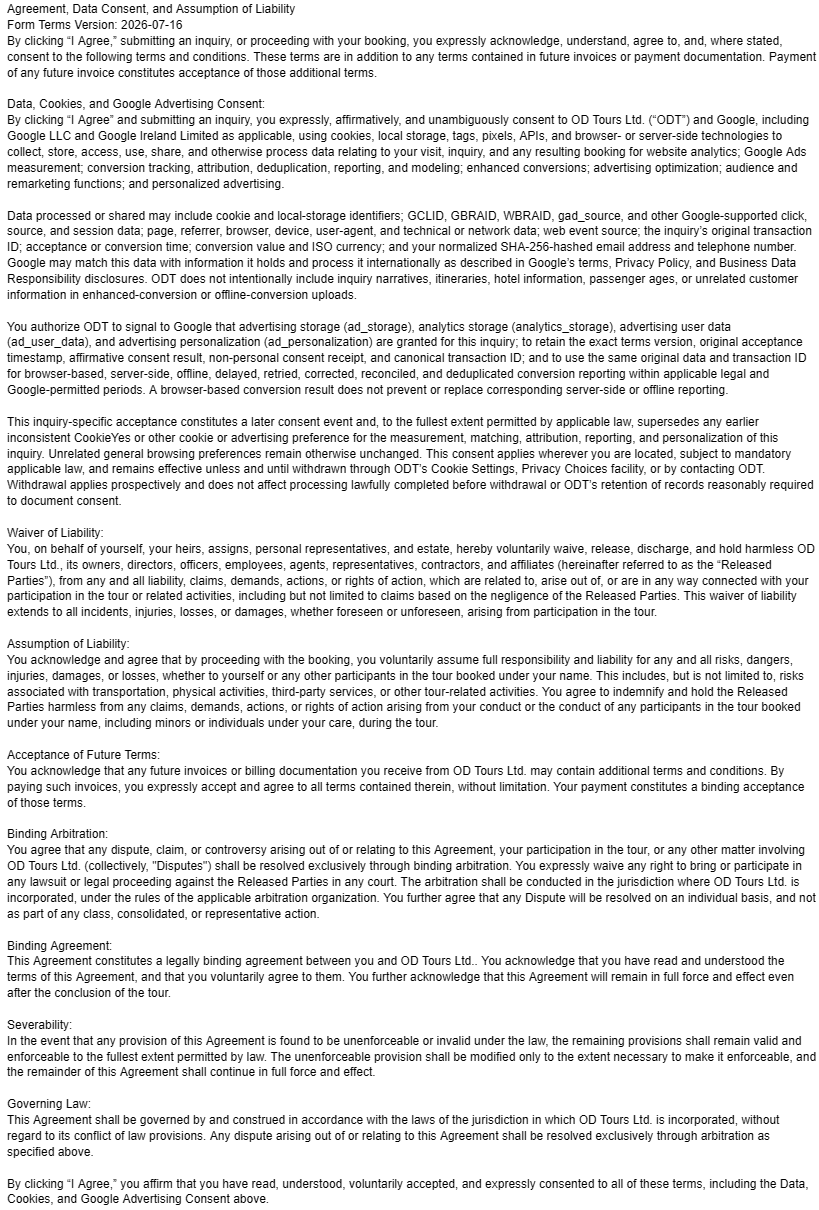
When Parliament Is Sitting: Planning a Westminster Visit During a London Stay

Updated
Plan around Parliament’s work, not simply around Westminster’s landmarks
When Parliament is sitting, a Westminster visit should be planned as an encounter with a working legislature rather than as a conventional interiors visit. That changes the first decision. A delegation interested in procedure should look first at the business of the House of Commons and House of Lords, then assess the public-gallery route and the time that an unticketed queue may absorb. A delegation interested chiefly in architecture should look first for an official Palace of Westminster tour, understanding that the broadest weekday tour schedule is generally associated with parliamentary recesses rather than ordinary sitting days. The two experiences overlap geographically, but they are not interchangeable and they do not use a single access rule.
The practical distinction is sharp. Watching a debate can reveal how questions, speeches, interventions and scrutiny operate in real time, yet general admission normally depends on the day’s business, security screening, available gallery capacity and a queue that a private guide cannot control. An official guided tour is structured around the Palace itself: the published route normally includes Westminster Hall, Central Lobby and both Chambers, but the Palace remains a working building, so access may be altered or cancelled at short notice. A serious plan therefore begins by deciding whether the primary outcome is procedural observation, architectural study or an interpreted Westminster exterior that remains valuable even if interior access disappears.
This matters most for executive delegations with a fixed London programme. A chamber queue cannot be treated like a timed museum entrance, and a confirmed tour cannot be treated as immunity from parliamentary business. Meetings in Whitehall, a Westminster Abbey visit, a working lunch and an evening commitment may all be individually feasible, yet the sequence fails when the Palace is given no operational margin. The useful planning question is not “How much Westminster can fit?” It is “Which parliamentary experience justifies uncertainty, and which surrounding elements can move if that uncertainty becomes real?”
For a wider London framework, a three-day London itinerary with Westminster kept in proportion helps prevent one calendar-sensitive morning from distorting the whole stay.
The sitting calendar is the primary constraint
“Parliament is sitting” is not one undifferentiated condition. The Commons and Lords can have slightly different recess patterns, and the official calendar warns that exact dates can change. A dated example shows why planners must check both Houses rather than rely on a generic London calendar: for the 2026–27 session, the official listing showed a Commons recess from 16 September to 11 October 2026 and a Lords recess from 18 September to 11 October 2026. Those dates were verified on 13 September 2026, but the planning instruction is to recheck the official recess and non-sitting calendar before the Westminster programme is fixed.
The two-day difference in that example is not trivia. A visit on 16 or 17 September could fall inside a Commons recess while the Lords had not yet entered the same recess period. The result is a hybrid day: one House may be operating under a different calendar condition from the other, and the availability of tours, galleries or specific spaces cannot be inferred from the word “recess” alone. A delegation interested in bicameral comparison should therefore verify the House-specific calendar and the day’s published business, not simply confirm that “Parliament is open.”
Sitting periods and recess periods change the balance of opportunity:
- During a sitting period, the most distinctive possibility is observing parliamentary work. Public galleries may be open on the relevant days, but subject matter, start times, queues and capacity remain variable. An interiors tour may still be possible on a Saturday, while weekday touring is more constrained.
- During a recess, ordinary chamber business is not the attraction. The official guided-tour programme is generally broader, running Monday to Saturday during parliamentary recesses as well as Saturdays throughout the year. This is usually the stronger condition for a delegation whose priority is the Palace’s architecture and ceremonial rooms.
- During a transition or unequal House calendar, planners should avoid broad assumptions. One House’s recess does not automatically establish the other House’s status, and a published tour route is still subordinate to operational requirements inside the Palace.
- During an unexpected access change, the visit should convert to an exterior and Whitehall interpretation rather than collapse. That fallback should be designed before the day, not improvised after a queue or cancellation has consumed the available window.
The material change is therefore not merely that “more or fewer rooms are open.” The purpose of the visit changes. Sitting days favour observation of institutions in motion; recess periods often favour a more coherent reading of architecture and interiors. Trying to force an architecture-first programme onto a sitting weekday can produce a thin experience, while treating a recess tour as a substitute for live procedure can disappoint a delegation that came to understand how Parliament actually works.
Use the calendar as a gate, then use the daily business as a filter
The recess calendar answers the first question: is each House expected to sit? It does not answer every operational question. On a sitting day, the subject and timing of business determine whether waiting for a public gallery is intellectually worthwhile. A debate of direct relevance to the delegation may justify uncertainty; a routine item with no connection to the group’s purpose may not. The official public-gallery guidance links onward to the parliamentary calendar because gallery planning depends on what is actually scheduled, not only on the date.
For senior visitors, this is where local interpretation should become selective rather than expansive. A delegation studying constitutional procedure may value even a short observation because the arrangement of the Chamber, the role of the Speaker, the relationship between government and opposition benches, and the pace of interventions become visible at once. A delegation studying architecture may learn less from a distant gallery seat than from a structured official tour, especially if the queue displaces the exterior elevation, Westminster Hall context and Whitehall. The same access opportunity can therefore be high value for one group and low value for another.
Debate observation and official tours are separate products
Public-gallery admission and official guided tours should be treated as two different visitor formats with different objectives, booking mechanics and failure points. Combining them into one line item called “visit Parliament” is the most common planning error.
Public galleries: procedure first, certainty second
UK residents and overseas visitors may watch debates in the Commons and Lords from the public galleries free of charge. The galleries are normally open Monday to Thursday and on some Fridays, with different times for each House. For general debates, the official guidance says a ticket is not required; visitors can usually arrive and wait for entry. It also states that there is normally a queue and that Visitor Assistants advise on the likely wait. Prime Minister’s Questions requires a ticket, while Ministerial Question Time has an advance ticket-request route. These distinctions are set out on Parliament’s official debate-attendance page.
The consequence for an executive group is that “free” does not mean frictionless, and “no ticket required” does not mean guaranteed admission. The queue is part of the format. Gallery capacity, the prominence of the business and security conditions can all affect the usable window. A guide can explain procedure before entry, keep the delegation oriented and adapt the surrounding route, but cannot reserve ordinary public-gallery seats, override staff decisions or promise chamber access. Nor should a London programme imply a meeting with an officeholder unless that meeting has been separately arranged and confirmed through the relevant office.
Prime Minister’s Questions is especially easy to misunderstand. Its public profile makes it attractive, but its ticket requirement puts it in a different planning category from a general debate. It should never be described as a walk-in enhancement to a Westminster morning. Where a group lacks the relevant ticket, the correct alternative is not optimism at the entrance; it is another published proceeding, an official tour if available, or the exterior-and-Whitehall plan.
There is also a naming trap. Commons proceedings called “Westminster Hall debates” take place in the Grand Committee Room just off Westminster Hall. They are not debates staged in the great historic hall itself. For a delegation, that distinction is worth making before arrival: “Westminster Hall” can refer to a major historic space within the Palace or to a category of Commons debate held nearby. Confusing the two can produce incorrect expectations about both setting and access.
Official guided tours: architecture and institutional history in a fixed format
The official English-language guided tour is published as a 90-minute experience led by Parliament’s in-house guides. Its normal route includes Westminster Hall, Central Lobby, the House of Commons Chamber and the House of Lords Chamber, connecting art, architecture, history and the contemporary work of Parliament. The current operating pattern states that tours run on Saturdays throughout the year and Monday to Saturday during parliamentary recesses. The same official page says visitors should arrive at least 20 minutes before the time shown, and that bookings of 10 or more tickets use a group-booking request. See the official guided-tour information and booking page.
This format gives architectural visitors far more structure than a public gallery. It makes the sequence of spaces legible: Westminster Hall as the surviving historic anchor; Central Lobby as the connective core; the Commons and Lords Chambers as distinct settings for the two Houses. Yet the published list is a normal route, not a contractual guarantee that every named room will be available on every date. Parliament expressly notes that tours may be cancelled or routes changed because the Palace is a working building. Big Ben is not included in this tour, so a clock-tower interest must be handled as a separate question rather than implied by the Palace booking.
The group threshold has a planning consequence beyond administration. Once a delegation reaches 10 people, the booking should be treated as a coordinated group request rather than as several unrelated retail purchases. Names, accessibility needs, language expectations and the surrounding timetable should be consolidated before the request is made. The tour is delivered in English, seating is limited along the route, and advance contact is advised when multiple participants need hearing loops or when the group has other specific accessibility requirements.
Which format fits which delegation?
A procedure-led delegation should prefer a sitting day when the published business is relevant enough to justify queue uncertainty. The intellectual value comes from seeing parliamentary practice, not from covering every famous room. An architecture-led delegation should usually prefer a confirmed official tour, particularly in a recess period when weekday availability is broader. A mixed delegation should identify a dominant purpose rather than demand both formats inside a compressed window. Trying to observe a debate, complete a full tour and maintain a fixed Whitehall schedule on the same half-day makes the least controllable element govern everything else.
A useful briefing sentence for participants is: “We will either observe live proceedings or study the Palace through its official tour; the exterior route remains the guaranteed interpretive core.” That wording is honest about access without diminishing the visit. It also prevents the organizer from presenting a provisional gallery attempt as a confirmed chamber appointment.
Group admission and security should shape the timetable
All visitors pass through security, and the Cromwell Green visitor entrance on St Margaret Street is the relevant threshold for public-gallery visitors and many booked visits. Parliament’s access guidance states that the entrance is step-free and leads down to the security search point. People and belongings undergo searches including x-ray screening. The official estimate is up to 30 minutes on average, rising to an average of 45 minutes at busier periods such as Monday, Tuesday and Wednesday afternoons. Visitors may queue outside, so weather preparation is part of the operational plan. The current details are on Parliament’s arrival and security guidance.
These figures should not be simplified into a universal arrival promise. The guided-tour page asks visitors to arrive at least 20 minutes before the booked time, while the broader security page reports longer average screening periods under some conditions. For an individual on a quiet Saturday, the ticket instruction may be sufficient. For a delegation arriving together during a busy weekday, the stronger planning judgment is to protect more time than the minimum and to regard security completion, rather than curb arrival, as the meaningful arrival point.
That distinction affects every appointment around Parliament. A vehicle reaching Parliament Square does not mean the group is inside. Participants still need to assemble, walk to the correct entrance, produce any confirmation required, clear security and receive directions. If one member carries a restricted item or needs assistance, the group may divide temporarily. A programme that places a hard-start Whitehall meeting immediately after a gallery attempt also assumes a predictable exit from an inherently variable visit. That is poor sequencing even when the walking distance appears short.
For groups with mobility, sensory or hearing requirements, the entrance is step-free, but step-free access does not remove the need for advance coordination. The security environment can involve queues, noise, close contact and strict procedures. Parliament says a Visitor Assistant can meet someone outside and accompany them through security when arranged in advance. The tour information also asks groups to make contact ahead of time when several visitors will use hearing loops or when other access support is needed. These are not optional refinements for a delegation whose shared experience depends on everyone moving through the same route.
The organizer’s working file
Before the surrounding Westminster programme is fixed, the organizer should have one reconciled record containing:
- the exact London date and the sitting or recess status of both Houses;
- the delegation’s primary objective: live procedure, Palace architecture or an exterior constitutional reading;
- the published visitor format being attempted, including whether it is queued, ticketed or subject to a group request;
- the confirmed headcount and whether it crosses the 10-person group threshold for the official guided tour;
- mobility, hearing, sensory and standing-duration needs that affect security or the tour route;
- the latest acceptable exit time for any Whitehall meeting, lunch, airport movement or evening commitment;
- the exterior sequence that will replace the interior component if parliamentary business, capacity or security conditions intervene.
This is the natural point at which private planning becomes materially useful. The value is not privileged control of Parliament; there is none. It is the reconciliation of calendar, group format, access needs, entry uncertainty and the rest of the London agenda before the delegation commits to incompatible timings. For coordinated help with that decision, Inquire now.
Organizers who are also balancing the City of London or St Paul’s can use this executive-group London planning framework as the next layer. It addresses the wider programme; the parliamentary calendar still has to be checked independently.
Sequence Whitehall according to the access risk
The Palace of Westminster, Parliament Square and Whitehall form one compact political landscape, but their visitor mechanics differ. Parliament has controlled entry and potentially variable duration. Whitehall is principally an exterior urban sequence, so its interpretive value survives when the Palace plan changes. That asymmetry should determine the order.
On a sitting day, put the least controllable element first
Where the delegation’s main purpose is to observe proceedings, begin with Parliament. Confirm the day’s business, approach the correct visitor entrance, clear security and assess the gallery queue before spending the available attention on Whitehall. If the wait is acceptable, the delegation enters knowing that the later route can contract. If the wait would consume the meeting or departure margin, convert immediately to the exterior plan.
Starting with a leisurely Whitehall walk and treating the gallery as a final stop is attractive on a map but weak operationally. The group reaches the only uncertain component after it has used the flexible portion of the morning. A queue then forces a choice between abandoning Parliament or overrunning the rest of the day. For a procedure-first visit, Whitehall is the adjustable layer; the gallery attempt is the time-sensitive one.
With a confirmed official tour, build toward the fixed start
A booked tour creates a different pattern. Whitehall can precede the Palace only if the route is deliberately curtailed and the security margin is protected. The guide should finish the contextual explanation before the delegation reaches the entrance, not while participants are searching for confirmations or preparing for screening. Any pre-tour meeting should end with enough margin to absorb a slow group departure, the walk to St Margaret Street and the security process.
After the tour, Whitehall often works better as synthesis. The delegation has seen the Chambers and Central Lobby; it can then read the wider government quarter as the administrative landscape around the legislature. The distinction between Parliament and government becomes spatially clearer. This is particularly useful for overseas executives who use “Westminster” as a catch-all term for British political institutions. The Palace houses Parliament; Whitehall names the government district and, by extension, the civil-service apparatus. Keeping those roles separate is more valuable than adding another landmark.
Do not use a vehicle for a problem walking solves better
Within the immediate Westminster core, vehicle repositioning can introduce more uncertainty than it removes. Parliament Square, the Cromwell Green entrance and the southern end of Whitehall are close enough that an able group normally gains continuity by walking. A vehicle becomes relevant for participants with limited walking tolerance, severe weather, luggage, a remote next appointment or a wider cross-city transfer. Even then, the vehicle should support the route rather than dictate it: security perimeters, traffic conditions and drop-off restrictions can prevent a door-to-door assumption.
This is also why the driver’s role and the guide’s role should be separated. A driver may improve arrival coordination and provide a contingency for the next movement, but cannot accelerate parliamentary security or influence public-gallery admission. A guide may prepare the group intellectually and manage the exterior pivot, but cannot convert an unticketed gallery into a reservation. Premium service is credible here only when it clarifies these limits.
For a deeper political-history sequence beyond Parliament alone, the Westminster, Whitehall and Churchill War Rooms power-corridor guide provides the supporting narrative.
What changes place by place
The Palace of Westminster
The Palace is simultaneously an architectural monument and a working parliamentary estate. That dual identity explains nearly every access caveat. On an official tour, the building is the subject and the route is structured. In a public gallery, the building is the setting for the subject, which is parliamentary business. During an exterior visit, the Palace becomes evidence of how a national legislature presents itself on the Thames while operating behind a contemporary security threshold.
For architecture-led groups, the official Heritage Collections record adds useful depth. Parliament’s Architectural Fabric Collection contains more than 5,000 objects commissioned for the Palace and wider estate, including detached stonework, tracery, grotesques, roofing, metalwork, tiles, stained glass, painted ceiling panels, doors and carved wood panelling. This is important because the Palace should not be read as a single picturesque façade. It is a maintained material system whose exterior carving, decorative interiors and replacement fabric belong to a continuing conservation history.
That collection also supports a more serious exterior fallback. Even without entering, a guide can direct attention toward stone carving, vertical rhythms, towers, roofline metalwork and the difference between long river elevation and secure visitor entrance. The aim is not to pretend the exterior equals the Chambers. It is to preserve architectural substance when the interior route is unavailable.
Westminster Hall
Westminster Hall is often the most historically resonant interior on the normal official tour, but it must be discussed precisely. It is a physical space within the Palace and also lends its name to a category of Commons debate conducted in the Grand Committee Room nearby. A delegation interested in architecture should seek the hall as part of the tour route. A delegation interested in procedure may attend a Westminster Hall debate without thereby receiving an architectural visit to the hall itself.
Because the official tour route can change, the hall should be described as normally included rather than guaranteed. If it is essential to the delegation’s purpose, that priority should be recorded, but no external planner should promise that parliamentary operations will preserve the expected route.
The Commons and Lords Chambers
The Chambers can be encountered in two fundamentally different states. On a guided tour, they are interpreted as spaces: their design, symbolism, arrangement and institutional function can be explained in a controlled sequence. From a public gallery, they are observed as working rooms, and the meaning comes from live procedure. The latter may be intellectually richer for a policy delegation but less predictable in duration and sightline.
The Commons and Lords should also be checked separately. Their calendars can differ, their daily schedules differ, and the character of debate differs. An organizer who says only “we are seeing Parliament” leaves too much unresolved. The stronger brief specifies which House matters, which proceeding is relevant, and what the fallback will be if the chosen gallery is not practical.
Central Lobby
Central Lobby is normally part of the official guided-tour route, where it helps visitors understand the Palace as a connected plan rather than a collection of famous rooms. It should not be promised through a public-gallery attempt. The gallery route serves access to proceedings; it is not a substitute tour through all principal interiors. This distinction is particularly important for architects, designers and institutional delegations who may care as much about circulation and spatial hierarchy as about the debate itself.
Whitehall
Whitehall has no recess in the visitor-planning sense used here. Its streetscape and institutional geography remain available as an exterior narrative even when Parliament’s interior access is constrained. Government buildings, memorials, ceremonial space and the route toward Trafalgar Square provide a broader account of executive power around the legislature. The route is therefore the best buffer in the programme: it can lengthen when Parliament is brief and contract when security or gallery waiting expands.
That flexibility should not make it filler. A good Whitehall interpretation explains the separation and interaction of legislature, executive, monarchy, civil service and defence rather than reciting building names. For an executive delegation, that institutional map often produces more transferable understanding than a hurried sequence of interiors.
Westminster Abbey
Westminster Abbey is adjacent in the visitor’s mental map but operationally separate from Parliament. It has its own worship, admission and guided-visit formats. A Parliament booking does not confer Abbey access, and a Parliament queue should not be allowed to consume a separately timed Abbey commitment. Organizers combining the two should decide which institution has priority and preserve the second booking accordingly. This guide to Westminster Abbey’s visit formats helps make that separate decision.
Three workable Westminster patterns
A sitting-day, procedure-first half-day
This pattern suits a policy, legal, governmental or corporate delegation that values parliamentary procedure above interiors. Begin with a briefing away from the security queue. The briefing should explain the day’s relevant business, the difference between Commons and Lords, the public-gallery process and the point at which waiting ceases to be worthwhile. Then approach Cromwell Green, pass through screening and ask Visitor Assistants for the current queue position or likely wait.
If entry is practical, observe one proceeding with a defined intellectual task. Participants might compare formal rules with actual speaking style, note how the Chamber’s layout shapes exchange, or examine the difference between questioning and extended debate. The objective should be narrow enough that a short observation has value. An open-ended instruction to “watch Parliament” encourages the group to stay too long merely because entry was difficult.
Afterward, move through Parliament Square and Whitehall, using the live observation as the reference point. Discuss how parliamentary scrutiny relates to departments and the executive. Keep the remainder of the morning flexible. Do not place an inflexible lunch, speech or transfer immediately after the gallery unless the programme includes a substantial margin.
If the queue is excessive or the relevant business changes, activate the exterior route immediately. The group can still study the Palace as a working estate, clarify the two-House system, distinguish Parliament from government and continue through Whitehall. The day remains coherent because the fallback answers the same institutional question through geography and architecture rather than live procedure.
A recess, architecture-first visit
This pattern suits architects, heritage professionals, cultural patrons and delegations seeking the Palace as a designed environment. Start with a confirmed official guided tour rather than a speculative gallery attempt. Recheck the tour status, assemble the group before reaching security and protect enough time for screening. For 10 or more participants, use the group-request process and consolidate access requirements in advance.
During the tour, encourage the group to read the Palace through sequence rather than isolated decoration: Westminster Hall as the older anchor; Central Lobby as a connective space; the Commons and Lords Chambers as distinct institutional rooms. The official guide controls the interior commentary and route. A private specialist can add value before or after by setting the Palace within the wider Westminster plan, but should not compete with the in-house tour or imply authority over interior access.
After the tour, use the riverfront and Whitehall to extend what was seen inside. The exterior makes massing, towers and the Thames relationship easier to grasp; Whitehall adds the governmental context. This order is especially effective when the group needs to translate architectural experience into an institutional understanding of London.
A recess day is not a lesser parliamentary day. It is a different one. What is lost in live proceedings may be gained in access to a more coherent tour schedule and a calmer architectural reading. The tradeoff should be stated before the date is chosen.
An uncertain-calendar or short-notice visit
This pattern is for a delegation whose London dates are fixed before parliamentary details are stable, or whose available window is too short to depend on a queue. Build the guaranteed core around exterior Westminster and Whitehall. Treat any official tour or gallery entry as an added confirmed layer, not the foundation.
Begin at a viewpoint that makes the Palace legible as a riverfront composition, then move toward Parliament Square and the Cromwell Green side to explain how the public approaches a secure working institution. Continue into Whitehall for the distinction between Parliament and government. Depending on separate availability, the route may be supported by Westminster Abbey or the Churchill War Rooms, but each should retain its own booking logic and should not be described as an automatic substitute.
This pattern is often the most responsible choice for senior groups with immovable meetings. It sacrifices the possibility of a long gallery wait in exchange for a reliable intellectual sequence. If a confirmed interior opportunity later appears, it can be inserted by shortening Whitehall rather than rebuilding the day.
The exterior route should be substantive, not apologetic
An exterior fallback earns its place when it teaches what the interior alone cannot: how Parliament occupies the Thames edge, how the visitor threshold differs from the ceremonial image, and how the legislature sits beside the Abbey and at the head of Whitehall. It should be designed as an interpretive route with several distinct readings.
Read the long river elevation
From an appropriate Thames viewpoint, the Palace can be understood as a long institutional frontage rather than as the single image of Elizabeth Tower. The eye can follow the repeated bays, towers and roofline and consider why a national legislature was given such a conspicuous river presence. The exterior also reveals the tension between visual openness and operational security: the building is one of London’s most recognisable public symbols, yet entry is channelled through controlled points away from the postcard view.
For architecture specialists, the Heritage Collections evidence gives the façade a material vocabulary. Stone tracery, carved grotesques, roofing and metalwork are not incidental decoration; they belong to a vast fabric that is documented, repaired and sometimes removed into the parliamentary collection. That perspective shifts the conversation from style alone to stewardship, replacement and the long life of a working monument.
Use Parliament Square as an institutional diagram
Parliament Square is the point at which several constitutional narratives can be seen together. The Palace, Westminster Abbey and surrounding governmental and judicial buildings are close enough to be compared, but they represent different authorities and histories. A concise stop can establish the legislature’s relationship to church, state ceremony, law and administration without claiming that proximity means institutional unity.
The square is also where group management matters. It is busy, exposed and often affected by traffic, demonstrations, security measures or temporary barriers. A guide should choose a safe place to speak and be prepared to move. No route should assume that a preferred pavement position will always be available.
Explain the visitor threshold at Cromwell Green
The St Margaret Street side is operationally revealing. It shows the difference between approaching the Palace as an image and entering it as a visitor. This is the appropriate place to explain security screening, the separation of ticketed and queued experiences, and why even a well-coordinated delegation remains subject to Parliament’s procedures. The threshold itself becomes part of the institutional lesson: public access exists, but it is managed within a working and protected estate.
Continue into Whitehall
The move from Parliament Square into Whitehall turns architectural observation into political geography. Rather than treating Whitehall as a collection of façades, use it to distinguish the legislature from government departments and the civil service. This is the point at which overseas visitors often revise an over-simple notion of “Westminster.” The term may describe a political system in conversation, but on the ground the relevant institutions occupy different buildings, follow different access rules and perform different functions.
The route can end toward Trafalgar Square, at a Whitehall appointment or at the Churchill War Rooms, depending on the wider day. Its length is adjustable, which makes it operationally valuable after an uncertain Parliament component. Its content, however, should remain fixed around a clear thesis: the British state is legible through the relationship of institutions, not through one famous building.
Accessibility and shared-group experience
Parliament states that entry is step-free, and the Cromwell Green ramp is designed to accommodate large motorised wheelchairs. That is an important baseline, but an accessible entrance does not automatically make every group experience equivalent. Standing in a public-gallery queue, limited seating on a guided tour, the sensory intensity of security and the pace of a large delegation can all affect participation.
A shared route should therefore be planned from the most restrictive operational requirement. If one participant cannot stand for extended periods, the group should not rely on a long speculative queue without discussing assistance. If several participants need hearing loops, Parliament asks for advance contact. If a quieter security process or outside meeting assistance is required, that too should be arranged rather than requested only when the group reaches the entrance.
The exterior fallback also needs an accessible version. Pavement conditions, crossing points, crowd density, weather exposure and the distance into Whitehall all matter. The goal is not to keep every participant on an identical line at any cost; it is to preserve a shared interpretation. A vehicle may be useful for a participant who cannot cover the full exterior sequence, while the guide maintains common briefing points. That is a contextual transport decision, not a reason to turn a compact Westminster visit into a sightseeing drive.
What private coordination can and cannot change
Private coordination can change the quality of preparation. It can align the delegation’s subject interest with the appropriate House, interpret the published calendar, identify whether the official tour or public gallery is the right format, consolidate a group request, collect access needs, protect the security margin and build a useful exterior alternative. It can also keep Whitehall, the Abbey and the rest of London from being scheduled as though Parliament were a predictable museum appointment.
It cannot create chamber capacity, waive security, control parliamentary business, guarantee a published tour route or arrange an officeholder meeting without separate confirmation. These boundaries should appear in the proposal, not only in small print. They protect the organizer from presenting institutional access as a purchased privilege.
For groups that want this work embedded in a broader private day, private London touring options can provide the commercial next step. The useful brief should name the date, headcount, policy or architectural interest, fixed appointments and the acceptable fallback. “Visit Parliament” is not yet a sufficient instruction.
A verification sequence before publication and before travel
Parliamentary planning needs a recheck habit because stable principles coexist with volatile operations. The durable principles are straightforward: the Commons and Lords may follow different calendars; general debate observation is usually a queued public-gallery experience; Prime Minister’s Questions has a different ticket rule; official tours have their own schedule and group process; all visitors clear security; and parliamentary business can change access. The volatile layer is the specific date, proceeding, tour inventory, route and queue condition.
Use the following verification sequence:
- When the London date is first chosen: check the official non-sitting calendar for both Houses and decide whether the delegation’s priority is compatible with a sitting or recess condition.
- Before confirming the Westminster programme: verify the official visitor format, group threshold, language, access support and the latest security guidance. Do not rely on a hotel concierge summary or an old itinerary.
- When daily business is published: assess whether the scheduled debate or question period is relevant enough to justify queue uncertainty. Confirm that a desired high-profile proceeding does not require a different ticket route.
- Shortly before the visit: recheck the parliamentary calendar, the official tour status, entrance instructions and any notices affecting access. Reconfirm the fixed appointments that determine the latest acceptable exit.
- On the day: retain the exterior route regardless of the apparent certainty of the interior plan. Parliamentary business, route changes, capacity and security conditions can still intervene.
The evergreen fallback is a Palace of Westminster exterior, Parliament Square and Whitehall sequence built around architecture and constitutional geography. It should be held even when a tour is confirmed, because a working legislature reserves the right to put its work first. The fallback is not a consolation itinerary; it is the part of the plan that remains under the organizer’s control.
The final planning judgment
Choose a sitting day when observing procedure is worth accepting uncertainty. Choose a recess tour when interiors and architecture are the priority. For a time-constrained delegation, do not promise both unless the official schedule, group admission and surrounding agenda genuinely leave room for both. Protect security time, check the Commons and Lords separately, and sequence Whitehall as the flexible interpretive layer rather than as another fixed appointment.
Most importantly, recheck the official parliamentary calendar before the Westminster programme is locked and again close to travel. A guide or planner can make the day coherent, but Parliament controls Parliament. The strongest itinerary is the one that acknowledges that fact early and still delivers a complete Westminster understanding when a chamber, tour route or queue does not behave as hoped.
If you’re interested in any private tours of London, please reach out to us.














 So if you are looking for the absolute best in London & surroundings with authentic local fully-licensed native guides whose English you can actually understand and with an exclusive and amazingly fun itinerary