Westminster Abbey, St Paul’s or Temple Church? Choosing a London Study of Tombs, Memory and National Identity

Updated
The choice in one view
Choose Westminster Abbey when one church must reveal the longest and most layered public story: medieval kingship around the shrine of St Edward the Confessor, Tudor succession, later statesmen and scientists, Poets’ Corner, and the Unknown Warrior. Choose St Paul’s Cathedral when the central question is how Britain commemorated national service, military command and imperial power from the late eighteenth century into the early twentieth, using large-scale sculpture and the separation between monuments on the cathedral floor and burials in the crypt. Choose Temple Church when the priority is medieval recumbent effigies, crusading-era visual culture, the survival and restoration of damaged sculpture, and the unusually close relationship between a sacred building and London’s legal institutions.
This is therefore a choice of historical argument, not a ranking of sacred buildings. Westminster offers the greatest density and chronological range, but that abundance can make individual objects difficult to study. St Paul’s offers the clearest sustained encounter with the public monument as a language of national service, yet it does not provide Westminster’s dynastic sequence or Temple’s concentration of medieval effigies. Temple Church offers intimacy and object-level focus, but it cannot stand in for a broad survey of British national memory. The most famous church is not automatically the most productive church for the question in hand.
For an art-minded first-time visitor with room for only one major memorial site, the practical recommendation is direct. Select Westminster for a wide national narrative, St Paul’s for monumental commemoration after 1790, and Temple Church for a close medieval study. Then refine that choice by asking four things: which period matters most, whether you want tombs or commemorative sculpture, how much visual density you can absorb, and whether stairs, worship schedules or conservation barriers will limit the objects you most want to see.
Begin with the kind of evidence you want to study
The words tomb, effigy, monument and memorial are often used as though they were interchangeable. They are not. A tomb is connected to burial, although the visible structure may have been moved, rebuilt or separated from the remains. An effigy is a represented body, usually recumbent in the medieval examples considered here, and may survive even when its original funerary setting has changed. A monument commemorates a person or group through sculpture, architecture or inscription; it need not contain a body. A memorial can be as substantial as a sculptural ensemble or as compressed as a name in stone. These distinctions matter because each church rewards a different mode of looking.
Westminster repeatedly asks the visitor to connect burial, dynastic placement and later commemoration. A royal tomb may be both a grave and a statement about succession, sanctity or legitimacy, while a writer’s name in Poets’ Corner may represent burial, memorialisation, or both. St Paul’s often separates the commemorative image above from the burial below: the public monument belongs to the cathedral’s ceremonial space, while the crypt concentrates graves and sarcophagi. Temple Church makes the sculpted body itself the principal evidence. The pose, armour, shield, surface and restoration history of the effigies carry more of the argument than a long sequence of inscriptions.
- For funerary sculpture as an object, favour Temple Church or selected royal tombs at Westminster.
- For a study of who enters a national pantheon, favour Westminster or St Paul’s.
- For medieval dynastic politics, favour Westminster; for chivalric and legal memory, favour Temple Church.
- For the public rhetoric of military and imperial commemoration, favour St Paul’s.
A monument program is also more than a collection of famous names. It is the cumulative result of permission, patronage, available space, institutional priorities, changing taste and later conservation. None of the three churches was arranged once by a single curator. Their present meanings were built through additions, removals, reinterpretations and physical damage. Reading the sites well means looking not only at whom they honour, but also at who had the authority to place memory there and how later generations have reframed it.
Three churches, three institutions of memory
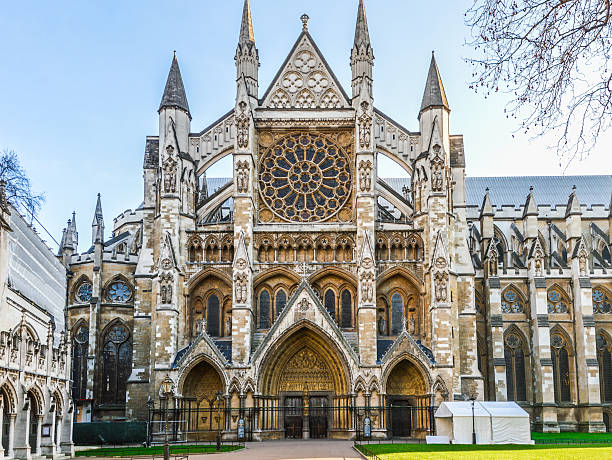
Westminster Abbey operates as a royal church, coronation church, burial place and national commemorative space. Its central medieval logic begins with proximity to St Edward the Confessor’s shrine. Royal bodies gathered around a saintly king, and later dynasties used chapels, tombs and inscriptions to position themselves within that inherited sanctity. Over time, the Abbey’s commemorative reach expanded far beyond monarchy. Writers, scientists, politicians, soldiers and public figures entered a setting whose authority still rested on royal ceremony and ancient sacred space. Its memory is cumulative, crowded and often competitive.
St Paul’s is a different kind of national church. The present cathedral, designed by Christopher Wren after the Great Fire, did not begin as a medieval royal necropolis. Its major commemorative identity was developed later, especially as monuments to military, political and cultural figures accumulated from the end of the eighteenth century. Here national memory is expressed through scale, public sculpture and the moral language of service, sacrifice and exemplary conduct. The cathedral’s vast interior gives those monuments a civic grandeur, but also turns them into parts of an architectural whole rather than a tightly packed sequence of tomb chambers.
Temple Church is smaller and institutionally more particular. Founded by the Knights Templar and later embedded within the Inner Temple and Middle Temple, it connects medieval sacred geography to the corporate memory of the legal profession. Its famous effigies do not create a complete national pantheon. Instead, they focus attention on aristocratic identity, chivalric reputation, crusading associations and the later legal communities that preserved and interpreted the church. The site’s selective survival is part of its meaning: what the visitor sees has passed through medieval alteration, Victorian restoration, wartime destruction and postwar repair.
These institutional differences explain why the same visitor can leave each church with a different understanding of “national identity.” Westminster presents identity as a long negotiation among crown, church, cultural achievement and public mourning. St Paul’s presents it through national service and monumental heroism, including the difficult legacy of empire. Temple Church presents a narrower but sharper case: how medieval elite memory can be adopted by a later profession and made central to its own origin story. The subject is not simply death. It is the authority to turn selected lives into public history.
Westminster Abbey: the royal dead arranged around sacred kingship
Westminster’s most important funerary idea is spatial before it is biographical. Henry III rebuilt the Abbey in the Gothic manner and placed the shrine of St Edward the Confessor at the devotional and dynastic centre of the church. Royal tombs gathered around that shrine, creating a geography in which proximity conveyed legitimacy. The visitor is not merely looking at a row of sovereigns. The visitor is seeing medieval and later rulers claim a relationship with a canonised predecessor, the coronation church and the continuity of monarchy.
The Abbey’s official visitor route describes a church containing about 3,300 memorials and burials and directs attention to the medieval royal tombs around St Edward’s shrine, the burials of Tudor queens and Poets’ Corner. That number is useful less as a promise of exhaustive viewing than as a warning about density. Even a serious visit cannot treat every inscription equally. A better study selects representative objects and reads their placement, material and political purpose.
Edward I’s relatively austere tomb chest, for example, makes a forceful contrast with more image-rich royal monuments. The double effigy of Richard II and Anne of Bohemia presents marriage and kingship through paired bodies. Henry V’s chantry turns commemoration into architecture, raising the king’s memory above the route toward the Confessor’s shrine. In the Lady Chapel, the tomb of Henry VII and Elizabeth of York, associated with the sculptor Pietro Torrigiano, gives the Tudor dynasty a technically sophisticated and tightly controlled image of union after civil conflict. Nearby burials and monuments to Elizabeth I, Mary I and Mary, Queen of Scots, turn succession, confessional division and retrospective reconciliation into a spatial argument that no list of reigns can reproduce.
The strongest reason to choose Westminster for royal tombs is therefore not the quantity of monarchs. It is the ability to compare different forms of legitimacy across centuries. Medieval kings sought closeness to a saint. The Tudors used dynastic marriage, chapel building and costly materials. Stuart patronage reshaped the memory of a rival queen. Later visitors and institutions interpreted these monuments through changing ideas of nation, religion and constitutional monarchy. The church allows the tomb to be read as political design.
The tradeoff is visual access. Chapels are compressed, some monuments are high, floor stones can be easy to miss, and the movement of other visitors may interrupt sustained looking. The Abbey rewards preparation because a visitor who knows which six or eight royal monuments carry the argument will see far more than one attempting to collect names. It is the most comprehensive choice, but also the church in which abundance most easily becomes blur.
Westminster beyond monarchy: writers, public achievement and shared mourning
Westminster’s national significance does not end with royal burial. Poets’ Corner turns literary reputation into a form of public belonging, but it must be read carefully. Geoffrey Chaucer’s burial became the seed of a commemorative tradition; later writers might be buried there, represented by a monument, or included through a memorial long after death elsewhere. The official Abbey account notes that more than 100 poets and writers are buried or memorialised in the area. The distinction between bodily presence and symbolic admission is central. Shakespeare’s monument does not make the site his grave, while the burials of figures such as Charles Dickens and George Frideric Handel create another kind of relationship between body, reputation and place.
Elsewhere in the Abbey, scientists, politicians, military figures and public servants broaden the definition of national achievement. The grave of the Unknown Warrior near the west entrance changes the scale of memory again. Rather than commemorating a named sovereign or celebrated individual, it gives one unidentified serviceman the representational weight of the many dead of the First World War. The movement from saintly king, to dynasty, to cultural pantheon, to anonymous national mourning is why Westminster can sustain the broadest study of national identity among the three churches.
Yet this breadth should not be mistaken for a neutral register of merit. Admission to Westminster memory has always depended on institutional permission, social values and the reputations available to a given age. Some figures are present because they were buried there for practical or courtly reasons and became canonical later. Others entered through campaigns for commemoration. Some monuments now require interpretation that addresses colonial power, exclusion or reputational change. The Abbey is most valuable when its density is treated as evidence of selection rather than as proof of consensus.
Visitors deciding between a service, general admission and a more interpretive visit can use a closer comparison of Westminster Abbey visit formats. For the present decision, the key point is that Westminster offers several national stories at once. Choose it when that multiplicity is the attraction. Avoid choosing it merely because it contains the largest number of recognisable names; the church becomes meaningful only when those names are organised into a question.
St Paul’s Cathedral: monument, service and the public language of empire
St Paul’s becomes the stronger choice when the visitor’s main interest begins in the late eighteenth century and centres on monumental sculpture. The cathedral’s commemorative program developed as Britain fought revolutionary and Napoleonic wars, expanded imperial power and sought public forms for honouring military, political and cultural service. A University of York and St Paul’s research project describes its guide to the cathedral’s monuments of 1796–1916 as the first devoted specifically to that body of work and identifies Admiral Horatio Nelson among the nationally important figures represented. The project’s guidebook announcement is useful evidence that St Paul’s should be studied as a coherent monumental program, not as an incidental collection beneath Wren’s dome.
Nelson and the Duke of Wellington provide the clearest entry into that program. Both are buried in the crypt, but their public memory extends into the cathedral above through large monuments and ceremonial association. The separation matters. Burial below gives the hero a place within a national pantheon; sculpture above turns the life into a public lesson visible within worship space. Wellington’s monument on the cathedral floor is especially valuable for studying how a nineteenth-century commission could become a prolonged negotiation among artist, institution, taste and setting. Nelson’s commemoration connects naval victory, death in battle and national mourning to a cathedral that became a stage for state funerals.
The official St Paul’s map identifies the cathedral floor as the setting of the main daily services and Wellington’s towering monument, while the crypt is the place where historical figures are buried and remembered. This vertical division makes St Paul’s easier to read conceptually than Westminster, even if the building’s scale can make individual sculptures feel distant. The visitor can ask how the monument performs in the liturgical and architectural volume above, then descend to the burial space and compare public image with funerary presence.
St Paul’s also requires a more critical vocabulary of empire. Many monuments celebrate officers and campaigns once presented through the language of sacrifice, conquest and civilising mission. Their sculpture can be admired for composition, carving and placement while their political messages are examined rather than repeated. Allegorical figures, classical dress, martial trophies and personifications of continents or peoples may encode hierarchies that modern viewers need to identify. The cathedral’s program is not weakened by such scrutiny. It becomes more historically legible because the gap between original commemoration and present interpretation is itself evidence.
Architecturally, St Paul’s gives monuments room to act at a civic scale. Wren’s ordered interior, long axes and dome create an environment in which sculpture competes with a powerful architectural system. That is a different viewing problem from Westminster’s crowded chapels. At St Paul’s, the question is often how a monument claims attention across distance and within a huge volume. A visitor especially interested in Wren’s spatial discipline can extend the theme through a wider study of Wren’s City churches and the architecture of rebuilding.
Choose St Paul’s when Nelson, Wellington and the broader culture of public commemoration are central. It is less suitable for a visitor whose primary goal is medieval effigy technique or a continuous royal genealogy. Its strength is a concentrated argument about how modern Britain monumentalised service, heroism and imperial reach within a living cathedral.
Temple Church: medieval effigies, damaged surfaces and legal memory
Temple Church offers the most focused encounter with medieval effigies. The Round Church, associated with the Knights Templar and the sacred model of the Holy Sepulchre, creates an architectural setting in which recumbent figures can be read at close range as bodies, costumes and symbols. The church’s official exhibitions page identifies the Round Church as the burial place of William Marshal I and William Marshal II and notes that their effigies remain side by side. That pairing is more than genealogical. It invites attention to how lineage, aristocratic identity and military reputation were materialised through sculpted form.
William Marshal I is a particularly rich figure because his posthumous reputation connects chivalry, royal service and the politics surrounding Magna Carta and the minority of Henry III. The temptation is to turn the effigy into a simple portrait of the “greatest knight.” A stronger reading asks what the sculpted body communicates: the treatment of armour, the handling of the sword and shield, the relation between repose and readiness, and the way later viewers projected ideals of knighthood onto medieval stone. Crossed legs, often treated in popular storytelling as proof that a knight went on crusade, do not provide a reliable code of that kind. Temple Church is valuable precisely because it allows myths about medieval effigies to be tested against the objects.
The surfaces also carry a conservation history. The effigies were damaged during the Second World War, and the official Temple Church account refers to nineteenth-century plaster casts lent by the Victoria and Albert Museum that preserve evidence of their earlier appearance. The visitor is therefore not looking at untouched medieval sculpture. The present objects combine original material, loss, restoration and later interpretation. For someone interested in conservation, this makes Temple more intellectually productive, not less: damage reveals how strongly modern institutions wished to reconstruct a medieval past and how dependent that reconstruction could be on casts, drawings and photographs.
Temple’s later institutional setting is equally important. The church serves the Inner Temple and Middle Temple, two of the Inns of Court. Medieval knightly memory was thus inherited within a landscape of barristers, legal education and professional ceremony. The Marshals’ connection with the constitutional history surrounding Magna Carta adds to that appeal, but the legal association should not be flattened into a direct line from Templars to modern law. The church has changed ownership, use and meaning. Its present identity is an accumulation of sacred, military, legal and antiquarian interests.
The smaller scale changes the quality of study. A visitor can spend time comparing figures rather than scanning hundreds of memorials. The Round Church makes bodily posture and sculptural rhythm easier to perceive, and the contrast between the round nave and later rectangular chancel gives the building itself a chronological argument. For a wider legal-urban context, a study of Temple Church, the Royal Courts and the Old Bailey places the church within London’s institutional landscape.
Temple Church is the best fit when the question is narrow and object-led: how medieval elite identity was embodied, damaged, restored and adopted by a later profession. It is less suitable when the visitor expects a panoramic account of national literature, monarchy or imperial commemoration. Its power lies in concentration, not comprehensiveness.
When expert selection materially changes the visit
A first-time visitor with one major church slot faces a curatorial problem rather than a simple booking problem. Westminster can overwhelm through abundance, St Paul’s can disperse attention through scale, and Temple can be misunderstood if its few famous effigies are detached from restoration and legal context. Expert interpretation changes the outcome by choosing a defensible set of objects before arrival, establishing the difference between burial and commemoration, and linking each object to the institution that authorised it. The practical gain is depth: the visitor leaves with an argument about memory, rather than a sequence of famous surnames.
For a private visit, the material service consequence is specific. A specialist can match the church to the visitor’s preferred period, check current worship and access conditions, identify which monuments are essential, and adjust the sequence when stairs, crowding, low light or temporary restrictions affect viewing. That does not confer private control over a living church, guarantee access to closed areas or replace conservation rules. It reduces the risk of spending the day’s principal historical visit in a building whose strongest evidence belongs to a different question.
This is where expert selection earns a place in a premium first trip. When one church must carry the desired historical depth, a privately guided London program built around specialist interpretation can connect the site to the rest of the day without diluting the subject. Inquire now with the period, monument type, mobility considerations and preferred level of religious or political context, so the church choice follows the inquiry rather than its fame.
Period changes the answer more than reputation
The chronological ranges overlap, but their centres of gravity are distinct. Westminster is the only choice among the three that can sustain a long sequence from medieval royal sanctity through Tudor and Stuart politics into modern cultural and public commemoration. Temple Church concentrates attention on the twelfth and thirteenth centuries, though what survives is mediated by later restoration. St Paul’s is architecturally a late seventeenth-century cathedral whose major monument program becomes especially important from the 1790s through the long nineteenth century and into the early twentieth.
For a visitor interested in the Middle Ages, the next distinction is between dynasty and effigy. Westminster explains how royal burial, sainthood and succession were organised in space. Temple explains how aristocratic bodies were fashioned as recumbent sculptural types and how later centuries reconstructed them. Westminster has medieval effigies of exceptional importance, but they sit within a dense royal and liturgical system. Temple offers fewer objects with more time to examine each one. The choice depends on whether the governing question is political placement or sculptural form.
For the Tudor and Stuart periods, Westminster is clearly the richer field. The monuments and burials around the Lady Chapel make dynastic union, religious conflict and posthumous image-making visible in a confined area. St Paul’s cannot provide an equivalent sequence because the medieval cathedral was lost in the Great Fire and Wren’s replacement developed a different commemorative role. Temple’s strongest contribution to these centuries lies more in institutional continuity and later restoration than in a major program of royal or national tombs.
For the age of revolution, global war and empire, St Paul’s gains force. Its monuments allow the visitor to see how Britain made military officers and public servants into exemplary figures, how classical visual language legitimised modern power, and how a cathedral interior became a civic pantheon. Westminster also contains major modern memorials, but they join a much older and more diverse field. St Paul’s offers the more coherent study when the purpose is to understand the monumental culture that accompanied Britain’s rise as an imperial state.
Patronage determines whose memory becomes permanent
At Westminster, patronage is inseparable from court, dynasty and the Abbey’s own authority. Kings commissioned tombs for themselves and relatives; successors reshaped the standing of predecessors; families and institutions pursued later memorials. The most important monuments often combine personal devotion with a political claim. Henry VII’s chapel and tomb do not merely express private mourning. They establish a new dynasty within the most authoritative royal sacred space in England. James I’s commemoration of his mother, Mary, Queen of Scots, similarly transformed a contested life into a statement about Stuart legitimacy.
At St Paul’s, the route from death to monument commonly involved cathedral authorities, public reputation, state or military networks, committees, artists and subscribers. The result is a more visibly civic culture of commemoration. The monuments present individual virtue as national instruction, yet the selection of subjects also exposes the priorities of the state and empire. Who received a commanding sculptural group, who was buried in the crypt, and which campaigns were translated into allegory are all patronage questions. Artistic quality and political endorsement cannot be separated.
Temple Church presents patronage through a more fragmentary record. The medieval effigies belong to aristocratic and military culture, but their current arrangement and condition reflect Victorian antiquarian interest, institutional stewardship by the Inns of Court, wartime loss and postwar reconstruction. Later custodians did not simply preserve a fixed medieval message; they decided how to repair, display and explain it. The V&A casts are part of that chain of authority because they preserve one historical state of objects that had already undergone change before the bombing.
These patronage systems produce different versions of national memory. Westminster can make monarchy appear continuous even when succession was violent. St Paul’s can make imperial and military service appear consensually national even when the politics were contested. Temple can make medieval chivalry appear foundational to English legal identity even though that relationship was assembled across centuries. The value of comparison lies in seeing that commemoration is never only about the deceased. It is also about the living institution that chooses the form, site and language of remembrance.
Spatial scale changes what the eye can understand
Westminster is the most spatially demanding. Its meaning is distributed across nave, transepts, ambulatory, chapels, floor stones, wall monuments and the elevated precinct around the Confessor’s shrine. The visitor is constantly changing viewing distance and angle. A recumbent effigy may be partly screened; an inscription may be below eye level; a major tomb may be visible only obliquely; and a small memorial may sit beside an object of overwhelming scale. This density is historically productive because it shows competition for prestigious space, but it also creates cognitive fatigue.
St Paul’s presents the opposite problem. Its monuments are set within a vast, ordered interior. Long sightlines help establish hierarchy, but the architecture can dominate the sculpture. Some works are understood first as silhouettes or masses and only later as detailed carving. The division between cathedral floor and crypt can be used deliberately: study the public monument above, then compare the burial below. The dome galleries are architecturally important, yet they are not necessary to a serious study of Nelson, Wellington or the monument program. Omitting them can preserve attention for the central subject.
Temple Church offers the closest and most coherent visual field. The effigies share a common scale and can be compared as a group. Because the Round Church is compact, the visitor can notice differences in posture, armour, shields and surface without the constant interruption of another monumental program. The limitation is that intimacy can create false confidence. Close viewing does not remove uncertainty about original placement, identity, damage or restoration. The objects are visually accessible but historically complex.
Viewing conditions also depend on light, visitor movement, worship and conservation. Stone that appears flat from one angle may become legible under raking light. Bronze, marble and painted surfaces respond differently to the surrounding architecture. Barriers can prevent the ideal viewpoint, and crowded passages may make lingering inappropriate. A specialist reading therefore plans for several kinds of evidence: what can be seen directly, what is known from documented history, and what must remain uncertain.
Stairs, access and the difference between entering and seeing
Physical entry does not guarantee access to every important monument. Westminster’s current official visit page says that most of the self-guided route is step-free, while also identifying stepped exceptions in important areas, including spaces associated with Tudor queens. This distinction can change the historical argument. A visitor may be able to enter and experience much of the Abbey but not reach the exact chapel or vantage point needed for a planned comparison. Current accessibility notes should therefore be checked against the selected objects, not treated as a single yes-or-no label.
At St Paul’s, the official map shows accessibility provision to the crypt through a lift and ramp, while the dome galleries depend on stairs. For a funerary and monument study, this creates a useful separation between essential and optional exertion. The cathedral floor and crypt contain the main evidence for Wellington, Nelson and the wider memorial program. The climb into the dome can be excluded without damaging that argument. A visitor interested primarily in architecture may decide differently, but the memorial question itself does not require the galleries.
Temple Church requires a direct check close to the visit because opening patterns, historic thresholds, services and events can affect how the Round Church is approached and used. The evidence supplied here does not support a universal claim that every relevant area will be step-free under all conditions. That uncertainty is itself a planning factor: a small church with a seemingly simple plan may offer fewer alternative routes if one threshold, temporary arrangement or conservation boundary becomes limiting.
For visitors managing fatigue, balance, low vision or limited standing tolerance, the church with the greatest theoretical range may not deliver the greatest usable depth. Westminster’s density can make orientation difficult; St Paul’s scale can increase walking and visual distance; Temple’s intimacy can reduce movement but depends heavily on current access and opening. A wider guide to stairs and step-heavy London icons can help place the church decision within a realistic day.
The decisive planning question is therefore not “Can I get inside?” but “Can I reach, see and spend time with the objects that justify this choice?” That wording keeps access connected to the intellectual purpose of the visit. It also prevents a common mismatch in which a site is selected for a particular tomb or chapel even though the visitor’s likely route excludes it.
Worship, admission and conservation are part of the interpretation
All three sites are living churches. Worship is not an inconvenience added to a visitor attraction; it is the continuing purpose that gives the buildings their present religious life. General admission, guided interpretation and attendance at a service are different forms of access. A service can offer music, liturgy and sacred atmosphere, but it is not an opportunity to move around freely studying monuments. Conversely, a sightseeing visit should remain responsive to prayer, clergy instructions and temporary closures.
At Westminster, advance booking is recommended on the official visit page, and Sunday is presented primarily for services rather than ordinary visitor circulation. At St Paul’s, the cathedral floor remains the setting for main daily services even while it supports a major visitor route. Temple Church’s smaller scale and institutional calendar can make its public opening windows more variable. These operational points were verified against the cited official pages on 10 November 2026, but admission hours, service arrangements and access conditions are the parts of this article most likely to change and should be checked again close to the visit.
Conservation also shapes what is visible. Westminster’s tombs and memorials have accumulated repairs, cleaning campaigns, moved elements and protective boundaries. St Paul’s monuments exist within a heavily used cathedral and may be affected by maintenance, liturgical installations or interpretive work. Temple’s effigies make conservation history impossible to ignore because wartime damage and restoration are central to their current appearance. A barrier, darkened surface or reconstructed element should not be treated simply as a failure of presentation. It may be evidence of the object’s survival.
The most responsible reading separates three layers. The first is the original commemorative intention: what patrons and artists wanted the monument to say. The second is the object’s material biography: damage, movement, repair and changing surroundings. The third is present interpretation: how a church now explains monarchy, war, empire, gender, faith and reputation. None of the sites is frozen at the moment of burial. Their authority comes partly from continuity, but their honesty depends on acknowledging change.
Conditions that change the recommendation
The broad choice is stable, but several conditions can reverse an initial preference. A visitor may begin with Westminster because it is the best-known site, then discover that the real interest is armour and recumbent medieval bodies; Temple becomes the more precise answer. Another may begin with Temple because of a fascination with Magna Carta, then realise that the desired subject is dynastic kingship and royal burial; Westminster becomes essential. A visitor drawn to “famous heroes” may find that the actual question concerns how military and imperial reputation was sculpted for a public audience; St Paul’s then offers the strongest evidence.
- Choose Westminster when the visit must connect royal tombs, literary commemoration and national mourning within one building.
- Choose St Paul’s when the main evidence should be large-scale monuments to service, war and empire, especially from 1796 to 1916.
- Choose Temple Church when a small group of medieval effigies, their damaged surfaces and their legal afterlife deserve sustained attention.
- Reconsider Westminster when key stepped chapels are central to the plan and cannot be reached comfortably.
- Reconsider St Paul’s when the visitor wants intimate close viewing rather than sculpture understood across a monumental interior.
- Reconsider Temple when public opening is uncertain or when the visitor expects a broad national pantheon rather than a focused medieval case.
Available time also changes the answer. Westminster is difficult to reduce without a strong selection because each additional chapel opens another historical branch. St Paul’s can support a disciplined floor-and-crypt study if the dome galleries are excluded. Temple can deliver a concentrated object study in a shorter window, provided access is confirmed and some historical preparation has already been done. A shorter visit is not automatically superficial; it can be rigorous when the evidence set is intentionally narrow.
The composition of the group matters as well. A mixed-interest party may respond better to Westminster’s variety, where literature, monarchy, science and war offer several entry points. An architecture-led group may prefer St Paul’s because Wren’s design and the monuments can be read together. A specialist group interested in conservation, medieval dress or legal history may find Temple more satisfying despite its smaller scale. The church should match the shared question, not merely the most enthusiastic individual’s list.
Religious intention can alter the whole framework. Someone who primarily wants prayer, choral worship or participation in a service should begin with the liturgical calendar and treat monuments as secondary. Someone seeking art-historical study should choose a visitor period that permits movement and sustained looking. Respecting that difference avoids using worship as a substitute for admission and avoids treating worshippers as obstacles to sightseeing.
Decision recap: choose the argument you want the church to make
Westminster Abbey is the right choice when breadth is essential. It can connect medieval royal sanctity, dynastic competition, Tudor and Stuart memory, literature, science and national mourning within one sacred institution. Its cost is density: sightlines, stairs, crowds and the sheer number of memorials make selection necessary. It offers the richest national narrative, but only when the visit is organised around representative tombs and memorials rather than recognition alone.
St Paul’s Cathedral is the right choice when monumental sculpture and modern national service are central. Nelson, Wellington and the wider program of 1796–1916 make the cathedral a major study of war, public virtue and empire. The relationship between floor and crypt gives the subject a clear structure, while Wren’s architecture tests how sculpture operates at civic scale. Its cost is distance: the building can overpower the objects, and its strongest evidence belongs to a later period than Westminster or Temple.
Temple Church is the right choice when medieval effigies deserve close attention. The Marshals, the Round Church, the legal setting and the history of wartime damage create a compact but sophisticated study of chivalric identity, material survival and institutional memory. Its cost is narrowness and operational dependence: it cannot substitute for a broad national pantheon, and current opening and access conditions matter greatly. What it offers is concentration that the larger churches cannot reproduce.
The final decision should therefore follow the object and the question. Choose Westminster to study how a nation accumulates memory across centuries. Choose St Paul’s to study how modern Britain monumentalised service and power. Choose Temple Church to study how medieval bodies and later restorations sustain a selective institutional past. None is merely a container of celebrated dead. Each is an active system that decides where memory sits, how it is seen and what kind of national identity it is asked to support.
If you’re interested in any private tours of London, please reach out to us.


















 So if you are looking for the absolute best in London & surroundings with authentic local fully-licensed native guides whose English you can actually understand and with an exclusive and amazingly fun itinerary













