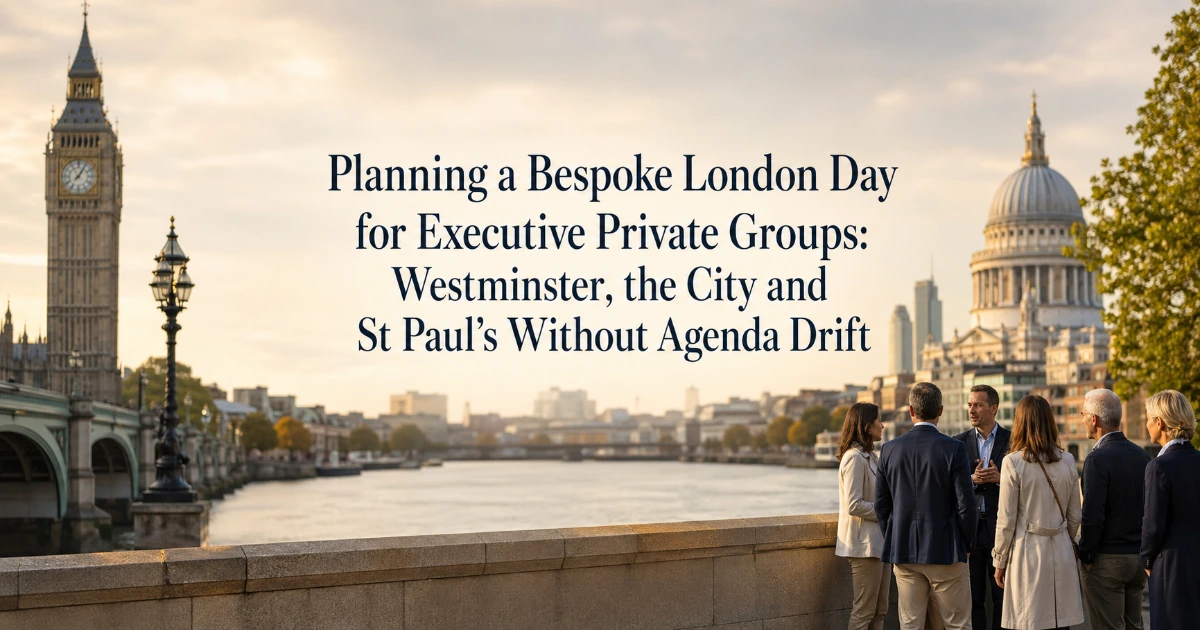
Planning a Bespoke London Day for Executive Private Groups: Westminster, the City and St Paul’s Without Agenda Drift
Updated
The best executive private-group day in London runs as one west-to-east line: Westminster first, St Paul’s and the City as the intellectual middle, and the Tower of London only if the group has not already spent its energy. That works because London rewards directional planning; once you cross from Parliament Square toward Ludgate Hill, the St Paul’s-to-Tower transfer hinge can either feel composed or expose every loose assumption in the brief. The clearest exception is a group whose true priority is the Tower, not Westminster; in that case, reverse the day rather than forcing a late, tired Crown Jewels visit.
The thesis is simple: for executive private groups, Westminster, the City and St Paul’s belong together only when the day is governed by route discipline, not by a running list of famous names. This is not a generic first-time London sprint. It is a controlled agenda for executives, companions, hosts and guests who may have different walking speeds, different appetite for history, and the same expectation that the day should not become a public negotiation at every corner. Orange Donut Tours’ Corporate Group Private Tours are built around that kind of brief: one public-facing plan, with enough private flexibility behind it to keep the group moving cleanly.
The executive route matrix: one agenda, three levels of control
The best plan is not the one with the most stops; it is the one with the fewest decision leaks. For a bespoke London day for executive private groups, use the matrix below before you choose tickets, lunch, transport or guide depth. Each option keeps Westminster, the City and St Paul’s in a logical relationship, but each solves a different planning pressure.
The governing route: Westminster to St Paul’s to the City
This is the baseline choice for a polished first London day. Begin near Westminster Abbey, Parliament Square or a Mayfair hotel pickup, move east toward St Paul’s, then use the City to explain London as a financial, legal and civic capital rather than as a string of postcard views. It suits groups that need a strong shared narrative and a clean finish near the City, Tower Hill, a river pier or an eastern dinner plan.
- Choose it when: the group wants the clearest London arc without backtracking.
- Cut first: a full Tower of London interior if lunch runs long or the group starts late.
- Watch the hinge: the move from St Paul’s Churchyard through Cheapside, Bank or Tower Hill is where a casual stroll becomes a group-management problem.
The chauffeur-reset route: Westminster pickup, City drop-off
This is the better choice when the group is larger, dressed for meetings, carrying coats or working around a formal lunch. The chauffeur is most useful as a controlled beginning, a weather buffer, or a clean east-end finish; it is not a cure for an overloaded route. Use the car to remove avoidable strain, not to pretend that Westminster, St Paul’s, the Tower, the British Museum and the West End can all be handled with dignity in one day.
- Choose it when: the day has senior guests, multiple walking speeds, or a firm lunch time.
- Cut first: any mid-route Mayfair return that breaks the west-to-east line.
- Watch the hinge: large vehicles and City kerbs make some short transfers less elegant than they look on a map.
The depth-split route: one line, different levels of detail
This is the strongest model for mixed executive and companion groups. Everyone shares Westminster context, the St Paul’s exterior-to-interior pivot and a City narrative; then the group separates briefly into deeper history, lighter walking, coffee, river view or architectural context before rejoining. It preserves one agenda without forcing every guest to stand through the same museum-depth explanation.
- Choose it when: some guests want dense political, legal or financial history while others want a lighter pace.
- Cut first: the idea that every guest must enter every interior together.
- Watch the hinge: reunion points must be obvious, sheltered where possible, and close enough that the guide is not spending the afternoon finding people.
The Tower-led exception: start east and keep Westminster lighter
This is the exception, not the default. If the Tower of London is the emotional priority, start there and let Westminster become a shorter political and ceremonial frame later. The Tower is too substantial to be treated as a decorative add-on after a long Westminster morning, a City walk and a detailed St Paul’s visit.
- Choose it when: the guest of honor, host or principal decision-maker has named the Tower as the non-negotiable.
- Cut first: a deep Abbey visit and a full City walk on the same day.
- Watch the hinge: ending at Westminster after a Tower-first day can work, but only if the group is not expected to return to Mayfair before dinner and then head out again.
Why Mayfair is a base, not the route
Mayfair can be the right hotel base and still be the wrong organizing principle for this day. This is the counterintuitive correction many premium planners miss: a beautiful Mayfair start does not mean the day should keep returning west for comfort. Once a group has left Grosvenor Square, Green Park or Park Lane for Westminster, a later loop back to Mayfair for lunch often costs more than it gives. The group loses the clean narrative line, the guide has to reassemble momentum after lunch, and the afternoon becomes a series of travel decisions rather than one coherent London story.
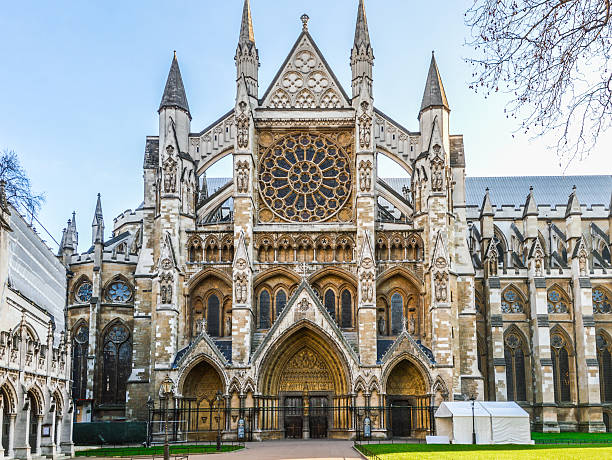
Westminster works first because it gives the day immediate authority. Parliament Square, Westminster Abbey, the Palace of Westminster and the edge of St James’s Park are dense enough to satisfy first-time guests quickly, but close enough together that a guide can manage attention without burning the group’s legs. The important choice is whether Westminster gets one interior or none. For many executive groups, a focused Abbey visit or a strong exterior-and-context sequence is better than trying to add every ceremonial site in the district.
Interior rules also matter. Westminster Abbey is not just another stop where any guide can improvise at will; for groups, planner-facing guidance should be checked against the Abbey’s official information, including its group visits guidance (https://www.westminster-abbey.org/visit-us/group-visits/). The practical consequence is that Westminster should be decided early, not negotiated at the gate. If the group needs a reverent, content-rich interior, build around it. If the group needs a lighter morning and a stronger City afternoon, keep Westminster as a guided exterior frame and preserve energy for St Paul’s.
The popular mistake is to treat Westminster as a warm-up because the City and St Paul’s feel “later” in the day. In reality, Westminster is where walking pace, guide audibility and group discipline are established. A slow first twenty minutes around Parliament Square usually predicts a compressed St Paul’s visit and a rushed transfer toward Tower Hill. A precise first hour, by contrast, makes the day feel calmer even when the route contains major London landmarks.
How to place Westminster, the City and St Paul’s without backtracking
The cleanest sequence is Westminster, then St Paul’s, then the City, with the Tower of London as a conditional eastern finish. This order respects both geography and mood: ceremonial London first, Wren’s cathedral and post-Fire London in the middle, and financial or fortress London at the end. It also allows a City drop-off, a river continuation, or a dinner plan east of the West End without dragging the group back across town.
Morning: Westminster should decide the tone, not consume the day
Use Westminster to set the political and ceremonial frame. A guide can connect coronation history, Parliament, monarchy, protest, empire, war memory and modern government without turning the morning into a lecture. For a private executive group, the better test is not “Did we see everything?” but “Did the group leave with a shared vocabulary for London?” If yes, Westminster has done its job.
The body consequence is real here. London does not exhaust visitors only through long distances; it wears them down through repeated crossings, kerb pauses, security checks, stone floors, uneven pavements and the small hesitations that happen when ten or more people try to move as one near traffic, cameras and crowds. Parliament Square to Westminster Abbey may look compact, but a group with two walking speeds will still stretch, pause, re-form and lose the guide’s voice unless the route is actively managed. That is why the guide’s job is as much choreography as commentary.
For many groups, the best Westminster morning is one of two shapes: a guided exterior-and-context route with no major interior, or one pre-decided interior with no guilt about skipping the rest. The Abbey is the most natural interior for heritage depth; the Churchill War Rooms belong only if the day shifts toward wartime London and abandons the St Paul’s-and-City depth. Big Ben photos, Downing Street context and St James’s Park edges can be useful, but they should not become extra stops that steal the morning in five-minute increments.
Midday: St Paul’s is the pivot, not just the cathedral stop
St Paul’s works best when it changes the subject from state ceremony to the rebuilding, commerce, faith and resilience of London. The walk into St Paul’s Churchyard, the sightline from Ludgate Hill, the approach from Blackfriars or the view back toward the dome from the Millennium Bridge can all serve different group moods. For executive guests, St Paul’s is often the point where London stops feeling like a royal itinerary and starts feeling like a city that has repeatedly rebuilt itself around power, trade and memory.
Planner caution matters here, because St Paul’s has a wide range of possible depth. Some guests want the cathedral floor and crypt; others are tempted by the dome galleries. For group days, the dome is not a default upgrade. The official St Paul’s ticketing page notes that the galleries are reached by stairs, which makes the climb a fitness, height-comfort and time decision rather than a simple premium add-on; check the official St Paul’s sightseeing ticket information (https://tickets.stpauls.co.uk/en/sightseeing-tickets) before promising it. A private St Paul’s focus can be highly rewarding, and St Paul’s Cathedral Private Tours are strongest when the group’s depth level is defined before the day begins.
The best St Paul’s visit for a mixed executive group is usually tiered. Everyone gets the cathedral’s role in the Great Fire aftermath, Wren’s London, the dome, the crypt’s national memory and the cathedral’s relationship to the City. Guests who want more can go deeper into architectural symbolism, military memorials or the dome story. Guests who need a lighter pace can remain with the main group, pause nearby, or continue to a shorter City segment without being made to feel they have opted out of the day.
Afternoon: the City should clarify the day, not add another checklist
The City belongs after St Paul’s because it gives the cathedral context. Cheapside, Guildhall, Bank, the Royal Exchange, Mansion House, Leadenhall Market and the approaches toward Tower Hill can each make sense, but they should not all be forced into one afternoon. A guide should choose the City segment that best supports the group’s purpose: financial London, Roman and medieval layers, post-Fire rebuilding, legal London, architecture, or the move toward the Tower.
The St Paul’s-to-Tower transfer hinge is the most important operational point in the route. A small private party may enjoy walking east through the City, pausing at Bank, cutting toward Leadenhall, then continuing toward Tower Hill. A larger executive group may find the same sequence too exposed, too stop-start or too difficult for audibility in traffic. The difference is not whether the route is beautiful; it is whether the group can hear, move and reassemble without the host becoming a human logistics desk.
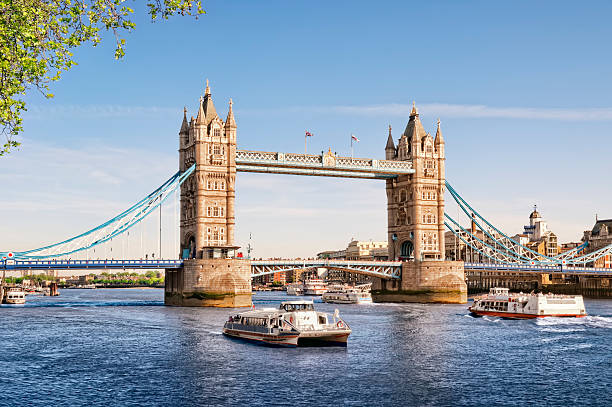
If the Tower of London is included, it should be given enough respect to be worthwhile. The Tower’s own official visit page (https://www.hrp.org.uk/tower-of-london/visit/) is a useful reminder that this is a substantial site with its own routes, interiors and visitor decisions, not a quick eastern garnish. For executive groups, the Tower either becomes the afternoon’s main interior or it is cut. A quick exterior view can still be valuable, especially if the day ends near Tower Bridge, but a half-committed Tower visit usually flattens the mood because everyone senses the rush.
How private-group size changes pace, audio, pickup points and lunch
Group size changes the day before the first sight is reached. A route that feels effortless for four guests can become fragile for sixteen, not because anyone is difficult, but because London compresses groups at crossings, station entries, narrow pavements, security points and lunch doors. Treat headcount as a planning variable, not an administrative afterthought.
Up to six guests: the route can stay conversational
Small executive groups can move with the guide’s voice, adjust pace without ceremony and use shorter decision windows. They can often handle a walking-and-Tube segment from Westminster toward the St Paul’s area if everyone is mobile, lightly dressed and comfortable with public transport. The advantage is not only speed; it is continuity. The group stays in conversation instead of dispersing into separate vehicles, and the guide can use transitions as part of the story.
Seven to twelve guests: the day needs visible control
This is the size where a private day begins to show whether it has been planned properly. The guide may need an audio system, a clearer walking order, and a firmer rule for when the group stops. Pickup should be a single point, not a rolling collection from three hotel doors, unless the transport plan has been built around that reality. Lunch should be near the route, ideally after the Westminster decision and before the St Paul’s or City depth, so the afternoon does not begin with a search for coats, restrooms and missing guests.
Thirteen or more guests: logistics become part of the product
Larger private groups need the day to be simplified in public and more carefully engineered behind the scenes. A second guide, guide audio, a host lead, pre-agreed pickup points and realistic lunch timing may matter more than adding another sight. This is where private tours for any group size become valuable: the plan must account for how people actually move through Westminster crossings, St Paul’s entry, City pavements and Tower Hill approaches, not only what appears possible in an itinerary document.
Lunch is the hidden hinge in many executive London days. A long lunch can be welcome if it is intended; it is damaging when it is accidental. If the group eats in Mayfair after Westminster, the day often loses the eastward line. If lunch sits closer to Fleet Street, Ludgate Hill, the City or a pre-planned private dining point, St Paul’s can follow naturally and the City does not feel like an afterthought. Food-and-wine travelers may prefer a more ambitious lunch, but on this route the meal must serve the agenda rather than compete with it.
Guide audio is not a luxury flourish for larger groups; it can be the difference between a calm shared experience and a day where half the guests hear only traffic. Around Parliament Square, Ludgate Hill, Bank and Tower Hill, the guide’s voice has to compete with buses, wind, crowds and the group’s own spacing. If an executive host has to keep repeating instructions, the perceived quality of the day drops even when the content is excellent.
When a chauffeur reset helps, and when walking or the Tube is cleaner
A chauffeur reset helps when it removes a real obstacle; it hurts when it interrupts a route that would be cleaner on foot or by a short public-transport move. For this Westminster, City and St Paul’s day, the best chauffeur logic is usually a controlled Westminster pickup, a mid-route support point if the group genuinely needs it, and a City or Tower-side finish. The least convincing use is constant micro-transfers inside compact areas where vehicles create waiting, kerb uncertainty and separation.
A chauffeur is worth considering when senior guests need reduced walking exposure, the group is dressed for business, the weather is poor, the group size makes Tube movement inelegant, or the day must end precisely for a reception. A car can also help when the hotel is in Mayfair or South Kensington and the finish is in the City, because it prevents the final return from becoming the group’s last memory. For planners comparing options, Luxury Chauffeured London Private Tour support is most convincing when it is tied to specific thresholds: hotel pickup, luggage or coats, mobility, weather, formal lunch, or a firm evening commitment.
Premium spend does not fix a late start, vague guest priorities or an agenda that overpacks Westminster, the Tower, the British Museum and the West End into one day. It can improve privacy, comfort, timing control and the dignity of transitions, but it cannot create a good route from a confused brief. A private executive day should not try to satisfy every possible London interest in one route.
The walking-and-Tube segment can be cleaner when the group is small, alert and happy to move with the city. Westminster to the St Paul’s area can be handled without turning the day into a chauffeur exercise, especially if the guide uses the transfer to preserve momentum rather than narrating every yard. The risk is group psychology: some guests interpret public transport as efficient and local; others read it as a mismatch with a premium brief. The planner needs to know which group is in front of them.
Inside the City, walking often beats driving. From St Paul’s Churchyard to Cheapside, Bank, the Royal Exchange or Leadenhall Market, the distances are interpretive, not merely functional. Put everyone into vehicles too often and the City becomes a set of isolated stops. Walk every inch with a large, mixed-speed group and the afternoon can feel ragged. The better answer is selective walking: enough to make the City legible, not so much that the Tower or dinner becomes a recovery exercise.
How to preserve one agenda without forcing one museum depth
The strongest executive-group plans keep a single public agenda while allowing private variation in depth. This is the difference between a bespoke day and a rigid tour. The host can say, truthfully, that everyone is doing Westminster, St Paul’s and the City; behind that, the guide and planner can create different levels of attention, walking and interior time.
Imagine an executive group splitting between deep history and a lighter companion pace. The principals want constitutional context at Westminster, Wren and post-Fire London at St Paul’s, and a serious explanation of the City’s financial architecture. Their companions want the same London day, but with fewer standing lectures, a more graceful coffee pause and no sense of being trapped inside every site. The wrong solution is to water everything down. The better solution is to build a shared route with one or two planned divergence points.
St Paul’s is the most useful divergence point because it can carry multiple levels of engagement. One group can go deeper into cathedral history or crypt interpretation while another keeps to a shorter floor visit, a nearby pause or a City exterior sequence. The guide then reunites the group at a clear location such as St Paul’s Churchyard, the top of Ludgate Hill, or a pre-agreed point near Mansion House or Bank. The key is that the split is designed, not improvised after fatigue appears.
The City can also absorb different levels of attention. A history-forward group can continue into Guildhall, Roman and medieval layers, livery-company context or financial institutions. A lighter group can focus on architectural contrast, Leadenhall Market, the Royal Exchange, river orientation or a shorter Tower Hill finish. Both groups still share the same London arc; they simply experience it at different density.
This matters for mood. A private day feels shorter and calmer when guests understand why they are moving, where they will rejoin, and what has intentionally been left out. It feels longer and flatter when every stop is presented as mandatory and every guest is quietly calculating how much remains. London is generous, but it punishes indecision; the city gives a group endless plausible additions, and each one steals attention from the agreed day.
The cut-first rule: protect the route before adding famous names
The first thing to cut is not the least famous sight; it is the sight that breaks the day’s line. On this route, the British Museum is usually the first major name to remove, not because it lacks value, but because it pulls the day north and changes the subject. The West End should also be separated unless the evening is theatre-led. A Mayfair shopping or dining return belongs on another day, or after the tour has ended, not in the middle of a Westminster-to-City plan.
This is where the article differs from a broader first-time London itinerary. A three-day stay can absolutely include the British Museum, Covent Garden, the National Gallery, theatre, shopping, food and a Thames cruise. A single executive group day cannot absorb them all and remain polished. If the broader stay needs sequencing help, the adjacent guide on a white-glove London day beyond Westminster can sit beside this one; this article’s narrower job is to protect one executive route from agenda drift.
Cutting does not make the day smaller. It makes the day more confident. Westminster gives the state and ceremony frame. St Paul’s gives rebuilding, faith, architecture and national memory. The City gives finance, law, trade and urban reinvention. The Tower of London, when included, gives fortress, crown, imprisonment and ceremony at a depth that deserves time. That is already a full day of London. Adding another unrelated interior often weakens the day by making each site feel thinner.
The host’s regret risk is usually social, not factual. They worry a guest will ask, “Are we seeing the British Museum?” or “Can we also do the West End?” The guide’s answer should be calm and specific: not on this route, not without sacrificing the quality of Westminster, St Paul’s and the City. A confident omission reads as planning; a nervous addition reads as drift.
How to plan a bespoke London day for executive private groups without agenda drift
The planning handoff should happen at the point where the route is clear but the operational variables still need expert handling. For this day, that means the planner has decided the west-to-east logic, the Tower threshold, the lunch position and the acceptable walking range. Orange Donut Tours can then shape the guide team, pickup points, pace, audio needs, chauffeur support and split-depth moments around the real group rather than around a generic London template.
The most important service threshold is Westminster pickup versus City drop-off logic. If the group starts in Mayfair, the day can begin with hotel pickup and a Westminster first act. If the group has an evening in the City, near Tower Hill, by the river or at a private reception, the day should probably end east rather than forcing everyone back west. If the itinerary requires both a Mayfair return and a City finish, the planner should ask whether the route has lost its central discipline.
For executive groups, private guiding earns its cost when it prevents the day from becoming a logistics negotiation. The guide is not only explaining Westminster Abbey, St Paul’s or the City; the guide is making judgment calls about when to move, when to stop, when to split, when to skip an interior and when a famous add-on is about to damage the afternoon. Tailor-made planning matters because the visible itinerary is only half the work. The private version includes the route that guests see and the contingency logic they should never have to discuss in public.
If your group needs one polished London day with Westminster, the City and St Paul’s held in a single agenda, use Tailor-Made planning to set the route before adding transport, tickets or lunch. Inquire now.
FAQ
Can Westminster, the City and St Paul’s fit into one private executive-group day?
Yes, they fit well when the route runs west to east and the day does not also try to absorb multiple unrelated interiors. Westminster sets the political and ceremonial frame, St Paul’s provides the architectural and historical pivot, and the City gives the financial and civic context.
Should the Tower of London be included on the same day?
The Tower of London should be included only if it is a true priority and the rest of the route is kept disciplined. It works as an eastern finish after St Paul’s and the City, but it should not be treated as a quick add-on after a slow Westminster morning.
Is a chauffeur necessary for this London route?
A chauffeur is helpful for larger groups, senior guests, formal clothing, poor weather, hotel pickup or a precise City-side finish. For smaller mobile groups, a guided walking-and-Tube segment can be cleaner because it keeps the group together and avoids vehicle waiting inside compact parts of the city.
Where should lunch sit in a Westminster, St Paul’s and City day?
Lunch should sit on the route, not against it. A Mayfair lunch after Westminster can work only if the afternoon is deliberately lighter; otherwise, lunch nearer Fleet Street, Ludgate Hill or the City usually preserves the line toward St Paul’s and the eastern finish.
How do you handle mixed walking speeds in an executive private group?
Mixed walking speeds should be planned for before the day begins. The guide can set a clearer walking order, use appropriate audio support, choose fewer standing stops, and create a short split-depth moment so slower guests are not forced to rush and faster guests do not feel held back.
Can some guests do deeper history while others keep a lighter pace?
Yes, and St Paul’s is often the best place to do it. Everyone can share the main route, then split briefly between deeper cathedral or City context and a lighter companion pace before rejoining at a clear point such as St Paul’s Churchyard, Bank or a pre-agreed City location.
What is the biggest mistake in planning this kind of private London day?
The biggest mistake is adding famous names after the route is already full. The British Museum, the West End, Mayfair shopping and a full Tower interior may all be worthwhile, but not when they break the Westminster-to-St Paul’s-to-City logic of this specific executive day.
What should be decided before requesting a bespoke private tour?
Decide the true priority, the maximum walking tolerance, whether the Tower is essential, where lunch should sit, and whether the group needs a City-side finish. Once those decisions are clear, guide depth, chauffeur support, ticket planning and split pacing can be shaped around the group.
If you’re interested in any private tours of London, please reach out to us.














 So if you are looking for the absolute best in London & surroundings with authentic local fully-licensed native guides whose English you can actually understand and with an exclusive and amazingly fun itinerary