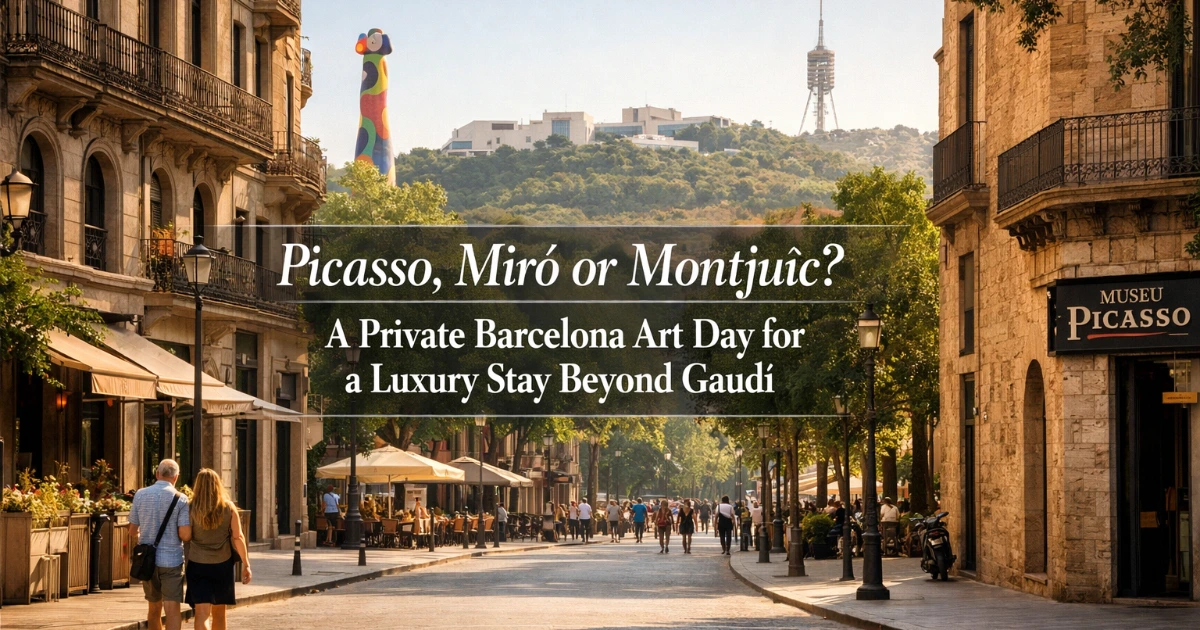
Picasso, Miró or Montjuïc? A Private Barcelona Art Day for a Luxury Stay Beyond Gaudí
Updated
Make Fundació Joan Miró and a disciplined Montjuïc route the default spine of a private Barcelona art day beyond Gaudí. It works because it changes the physical rhythm of the trip: after Sagrada Família, Park Güell or Passeig de Gràcia, you leave the city’s most photographed architecture for a hilltop museum, viewpoints and a less compressed afternoon. The clearest exception is a short first visit where you still have not seen Barcelona’s Gaudí essentials; in that case, skip the dedicated art day and keep the focus on Gaudí. The best Barcelona art day is not the one with the most museum names, but the one that understands the hinge between Carrer de Montcada, Via Laietana, Paral·lel, Plaça d’Espanya and the slopes of Montjuïc.
The non-obvious friction appears before you even enter a gallery: the El Born-to-Picasso Museum arrival pinch point can make a refined morning feel crowded if you approach Carrer de Montcada at the same time as school groups, cruise visitors and old-town walking tours. That does not make the Picasso Museum a poor choice. It means the route order matters more than the museum name. With private planning, the day should be built around emotional payoff, walking load and the kind of evening you want afterward, not around a checklist of famous rooms. For a bespoke version, tailor-made Barcelona planning is the right frame because the best answer changes with hotel base, mobility, heat, lunch style and how much Gaudí is already in your itinerary.
Which Barcelona art day beyond Gaudí fits your stay?
The recommendation hierarchy is clear: Miró with a focused Montjuïc loop is the default anchor, Picasso with El Born is the runner-up for travelers who want biography and streets, and the full “Picasso plus Miró plus every Montjuïc viewpoint” idea is the choice most likely to disappoint unless your group has unusual museum stamina. The comparison criteria are simple: emotional tone, physical effort, route compression, ticket friction and whether the day leaves enough appetite for dinner.
Choose Picasso Museum plus El Born when you want an intimate, biography-led morning in the old city, especially if Picasso’s Barcelona years matter to you more than broad modern-art range. It is the best fit for art lovers who enjoy dense galleries, small streets and a guide who can connect paintings to the city outside the door.
Choose Fundació Joan Miró plus Montjuïc when you want the strongest post-Gaudí contrast: open sky, a purpose-built modern-art setting, the hill’s layered civic memory and a day that can include views without chasing every landmark. This is the best default for couples, returning visitors and guests who want art without spending the whole day in the old town.
Choose a wider modern-art route when your group has already seen Barcelona’s major first-visit sights and is willing to cut lunch length, shopping time or viewpoints. This route can include Picasso, Miró and another art institution, but it should be designed as a curated line through Catalan modernity, not a museum marathon.
Do not force a dedicated art day when your Barcelona stay is one full day, when children or older parents are already near their walking limit, or when your group is still divided on whether Gaudí is complete. In that case, a short art accent inside a broader private sightseeing plan will feel better than a full museum day.
Picasso Museum versus Fundació Joan Miró: choose biography or breathing room
The Picasso Museum gives you a more intimate story; Fundació Joan Miró gives you a larger change of air. That is the core difference, and it matters more than the prestige of either name. The Picasso Museum is strongest when a guide can make the city outside the galleries feel inseparable from the paintings inside them: the medieval palaces of Carrer de Montcada, the short walk toward Passeig del Born, the route across Via Laietana toward the Gothic Quarter and the fact that old Barcelona compresses time rather than opening it out. The emotional payoff is close-up and layered. You feel the making of an artist in a city that still presses around the museum walls.
The physical effort at the Picasso Museum is not about hills; it is about density. Galleries, doorways, narrow old-town approaches and the slow current of people near the museum create a different kind of fatigue from Montjuïc. A chauffeured drop-off can help with the approach, but it does not change the fact that the museum itself requires standing, shifting and concentrating in a compact environment. This is why the Picasso Museum is best as a controlled morning, not as the third stop after a long Gothic Quarter walk. A private Picasso Museum private tour earns its value when it edits the rooms, explains what to notice and stops the visit from becoming a dutiful shuffle past too many works.
Fundació Joan Miró is the opposite kind of reward. It belongs to the hill, and the day feels different as soon as you leave the grid and old-town lanes behind. The museum’s official ticket page is worth checking before you go because special exhibitions, ticket formats and visitor guidance can change, and the same is true for the Fundació Joan Miró official tickets (https://www.fmirobcn.org/en/visit-us/tickets/) page. The emotional payoff is less about decoding a young artist’s biography and more about letting Miró’s signs, color, sculpture and space breathe. This can be a relief after Gaudí, because you are not competing with the city’s most heavily visited facades. You are letting a different Barcelona come forward: experimental, civic, elevated and tied to the mountain.
The counterintuitive correction is that El Born is not automatically the more elegant base for a high-end art morning just because it is atmospheric. The neighborhood can be charming, but its charm becomes a planning liability when a group arrives at the Picasso Museum after wandering the Gothic Quarter, crossing Via Laietana without a clear pause, then trying to find a refined lunch while everyone is already warm and footsore. Sometimes the more polished choice is to use El Born sparingly: arrive deliberately, see the museum with focus, then leave before the old-town lanes start dictating the pace.
The Picasso Museum day: who should choose it, and what to cut
Choose the Picasso Museum when the day’s purpose is concentrated art context, not broad sightseeing. It is a strong option for travelers who like early work, artistic biography, old-town texture and a guide who can explain why Barcelona mattered to Picasso before Paris dominates the story. It also works well for families with older children or teens who can handle a compact museum visit when the narrative is kept sharp. What it does not do well is absorb every nearby old-town attraction without consequence.
The usual mistake is pairing the Picasso Museum with too much Gothic Quarter before or after. On a map, El Born and the Gothic Quarter look close enough to merge into one neat cultural block. In practice, that merge creates repeated starts and stops: narrow lanes, uneven paving, shopfront pauses, group bottlenecks near Plaça Sant Jaume, photo interruptions around the Cathedral and a mental shift from gallery looking to street navigation. A guide can make the transition meaningful, but the group still has to spend the energy. The cut-first rule is simple: if you want the Picasso Museum to land emotionally, cut the long Gothic Quarter loop first, not lunch.
That does not mean the Gothic Quarter has no place. It means it should be used as context, not as a second headline. A tight crossing from El Born toward the Roman and medieval core can work beautifully when it connects the museum to the city’s older power structures, craft streets and civic spaces. A full old-town sweep belongs on another day or in a different private route such as a Gothic Quarter and Old Town private tour. For a Picasso-centered day, the old city should behave like a frame around the museum, not a competing exhibition.
Advance planning matters here because the Picasso Museum is not a place to approach casually during peak travel periods. Do not invent precision by assuming one fixed ideal hour all year; instead, confirm the current ticket format and visit notices on the Picasso Museum official tickets and opening-hours page (https://museupicassobcn.cat/en/plan-your-visit/buy-tickets-and-opening-hours) before you lock the day. Private guiding changes the quality of the visit more than it changes the physical footprint. It helps you see fewer works better, understand the sequence and decide whether El Born should be a prelude, a lunch setting or only the exit route.
The Picasso version is emotionally satisfying but not airy. It can feel like a private conversation with the city, especially when the guide links Carrer de Montcada to Barcelona’s mercantile past and Picasso’s youth. Yet it does not provide the same visual exhale as Montjuïc. If your group has already had a heavy Gaudí morning the day before, or if you are staying in the Gothic Quarter and have been surrounded by old stone every night, choose Picasso only if that closeness is exactly what you want. Otherwise, you may be paying for more atmosphere when what your body is asking for is space.
Why Miró and Montjuïc win the default art day
Miró and Montjuïc win for many luxury stays because they give Barcelona a different rhythm after Gaudí without requiring a full escape from the city. The route can be built around Fundació Joan Miró, a selective look at Montjuïc’s civic layers and one or two viewpoints rather than a heavy chain of interiors. This is where the day starts to feel designed rather than merely efficient: the art has room around it, and the hill gives the group a sense of arrival that old-town museum-hopping often lacks.
The physical tradeoff is real. Montjuïc is a hill, not a flat museum district. The slopes around Poble-sec, the approaches from Plaça d’Espanya, the terraces near MNAC and the distances between the Miró Foundation, the Olympic areas and the castle can quietly add up. This is where private transport, taxis or a carefully timed funicular can make the day more comfortable. But the goal is not to touch every point on the hill. The goal is to choose the segment that adds meaning to Miró rather than turning the afternoon into a scenic endurance test. A focused private Montjuïc route is useful because Montjuïc has too many tempting add-ons for a traveler who is planning from a map.
Montjuïc also changes the mood of a Barcelona stay. Old-town routes can make the day feel busy even when the walking distance is modest, because the streets keep narrowing and the attention keeps fracturing. Montjuïc does the opposite when edited well. It gives the trip a broader visual field: city, port, museums, gardens and civic memory. This matters for couples and celebration travelers because the day can end with a sense of composure rather than a feeling that everyone has been squeezed through one more famous district. It also matters for food-and-wine travelers because an overfull museum morning can dull the pleasure of a long lunch or tasting-menu evening.
The strongest Miró-and-Montjuïc route does not need to pretend that Montjuïc is only pretty. The hill carries the 1929 International Exposition, the Olympic legacy, military memory, museum culture and changing views over the port. That density gives a private guide room to connect Miró’s artistic freedom to a wider Barcelona story without overloading the day. When the guide links the museum to the hill, the city stops feeling like a sequence of unrelated masterpieces. Picasso, Miró, Civil War memory, Montjuïc and old-town context can become one coherent art narrative rather than separate appointments. For a short stay where one route must do serious interpretive work, Inquire now.
The correction here is to resist the castle reflex. Montjuïc Castle is compelling in the right context, but it is not automatically the best add-on after Miró. If the group is interested in military history, repression, port views or the politics of the hill, it can belong. If the group wants a graceful art day with a strong evening afterward, a garden, terrace or viewpoint closer to the museum may earn its place more easily. The most expensive version of the day is not necessarily the best version; the best version is the one that stops before the hill starts feeling like a second city.
The broader modern-art route only works when you cut aggressively
A broader modern-art route can be excellent for returning travelers, but it is the least forgiving option. The temptation is obvious: Picasso in the morning, Miró in the afternoon, perhaps another museum or a pass-based art circuit if the group is ambitious. Barcelona makes that look reasonable on paper because the distances are not Madrid-scale or London-scale. The trap is that museum attention is not measured only in kilometers. It is measured in standing time, gallery transitions, ticket windows, lunch timing, heat exposure and how much interpretive density a group can absorb before everything starts to blur.
This is where the official ArticketBCN museum pass (https://articketbcn.org/) can be worth reviewing for travelers who genuinely plan several museums, but a pass should not become a dare. The fact that multiple institutions can be bundled does not mean they belong on one private day. A wider route needs a clear theme: Picasso and the formation of modern Barcelona, Miró and the hill, Catalan modernity beyond Gaudí, or the city’s shift from old-town palaces to modern exhibition spaces. Without that theme, the day becomes a high-end version of collecting stamps.
If you choose the broader route, cut something visible. Cut the long old-town walk. Cut the castle. Cut the extra shopping stop. Cut the post-lunch museum if the morning ran long. The mistake is to preserve every headline and hope a private car will solve the day. Premium spend can reduce transfer discomfort, shorten some waiting and make the experience feel more private, but it cannot create fresh attention after too many interiors. Private transport does not solve the internal walking and standing time inside museums. Paying more does not earn its cost when the spend is used to add a fourth venue instead of protecting the quality of the first two.
The broader route suits adults who actively want art, have already seen the Gaudí core and are comfortable with a day that is intellectually full. It is not the best choice for mixed-interest families, older parents who need frequent seated pauses, or celebration travelers who want a generous lunch and an unhurried evening. A private guide can make the wider route coherent, but the group still needs to consent to the discipline of editing. The luxury is not excess. The luxury is knowing what not to include.
How route order changes the quality of the day
Route order is the hidden lever in a Barcelona art day. The same places can feel graceful or punishing depending on whether you treat El Born and Montjuïc as separate moods or try to fuse them into one continuous sightseeing march. The safest structure is to give the morning to the more mentally demanding interior, pause properly for lunch, then use the afternoon for the site that changes the body’s rhythm. For many groups, that means Picasso first only when Picasso is the priority, and Miró or Montjuïc first when the hill is the day’s main event.
A Picasso-first day should start with precision. Arrive before the old-town current is at its heaviest, avoid a meandering approach through the Gothic Quarter and keep the museum visit edited. Afterward, use El Born selectively: Santa Maria del Mar from the outside or with a short interior visit if it serves the story, Passeig del Born for a brief neighborhood read, then lunch that does not require crossing half the city. Do not treat La Rambla, the Cathedral, the waterfront and the Picasso Museum as a single “nearby” cluster. They are nearby in distance but not in attention.
A Miró-first day should treat Montjuïc as a hill with zones. One zone is the art-and-gardens area around Fundació Joan Miró and the nearby green spaces. Another is the ceremonial axis around Plaça d’Espanya, Avinguda de la Reina Maria Cristina and MNAC. Another is the higher castle and cable-car world. Trying to cover all three after a museum visit makes the day feel longer than the map suggests. The better approach is to choose the zone that fits your group’s appetite. Art lovers may stay close to Miró and a nearby viewpoint. First-time visitors may add the MNAC terraces for the city view. History-focused travelers may push higher only if the castle’s story is genuinely part of the day.
Montjuïc after lunch is the route hinge that can either refresh the afternoon or overextend it. It refreshes the day when transport is planned, the lunch is not too heavy and the hill segment is edited to one clear purpose. It overextends the day when lunch runs late in El Born, the group crosses town without a pause, then tries to add Miró, the Olympic area, castle views and a hotel return before dinner. That is how a sophisticated plan starts to feel like errands. If the day includes a tasting-menu dinner, a celebration toast or a family evening, Montjuïc after lunch should be shorter, not more ambitious.
Barcelona does specific things to the body on this route. It asks you to stand in museum rooms, move slowly through narrow lanes, adjust to sun and wind on Montjuïc, cross busy traffic edges around Via Laietana or Plaça d’Espanya and manage repeated changes in surface underfoot. None of those details is dramatic alone. Together, they decide whether the day feels cultivated or draining. A good private art day is built with seated pauses, direct transfers, clean transitions and permission to leave a museum before the group has seen everything.
When to pair art with El Born, the Gothic Quarter or Montjuïc viewpoints
Pair art with El Born when the Picasso Museum is the emotional center of the day. El Born works as a living footnote: Carrer de Montcada, the medieval street pattern, the basilica presence of Santa Maria del Mar, small squares and the edge toward the old market district can deepen the museum. It fails when it becomes a shopping-and-snacking drift before the gallery visit. If you want El Born to feel polished, use it after the museum or as a precise prelude, not as a loose warm-up.
Pair art with the Gothic Quarter only when the route is interpretive, not decorative. The Gothic Quarter can connect Picasso to older Barcelona, but it also introduces some of the city’s most stop-start walking. The Cathedral area, Plaça del Rei, Plaça Sant Jaume and the lanes toward El Call can be rewarding, but they are not effortless. They work best with a guide who knows when to explain and when to keep moving. If the group is already old-town saturated from dinners, shopping or a previous walking tour, do not add the Gothic Quarter just because it is close.
Pair art with Montjuïc viewpoints when the day needs contrast. A viewpoint can make the Miró route feel larger without adding another full museum. The view from the MNAC terraces toward Plaça d’Espanya is easier to fold into a lower-hill route than a push to the castle. The Mirador del Alcalde or higher castle area can be rewarding, but it changes the time budget and may require more transport choreography. The viewpoint should answer a question: do you want the city grid, the port, the ceremonial axis or the feeling of being above the old town? If the viewpoint is only there for a photo, it may be the first thing to cut.
The companion guide to the broader old-town-versus-hill question is high-end Barcelona day beyond Gaudí, but this art-day plan should stay narrower. Do not turn it into a general Barcelona sampler. If Picasso is the anchor, let El Born carry the context. If Miró is the anchor, let Montjuïc carry the contrast. If the route tries to make every neighborhood equally important, the museums become interruptions rather than reasons for the day.
What a private guide changes, and what extra spend cannot change
A private guide changes the art day by making the route interpretive before it becomes logistical. In the Picasso Museum, that means selecting works and explaining why Barcelona matters to the artist’s early formation instead of reciting a full chronology. In Fundació Joan Miró, it means giving visitors a way into signs, color, space and Catalan context without flattening Miró into cheerful abstraction. On Montjuïc, it means deciding which layers of the hill belong to your day: art, gardens, exhibition history, Olympic memory, military history, port views or a quieter return to the hotel.
The guide also changes the social rhythm. Couples can spend more time with a few works and less time negotiating where to stand. Families can have the story calibrated for attention spans. Small groups can move with one clear voice instead of several competing phone maps. Celebration travelers can keep the day from becoming over-explained. Food-and-wine travelers can protect lunch from being squeezed by museum overruns. These are not theatrical upgrades; they are the small interventions that keep a private day from feeling like a public tour with nicer transport.
Extra spend is most valuable when it buys judgment: the right ticket format, a guide who can edit, transport where the city’s slopes and transfers justify it, and a route that knows when to stop. It is least valuable when it is spent on forcing more places into the same day. A luxury vehicle can help with hotel pickups in Eixample, a smoother move from El Born to Montjuïc, or a less tiring return after the hill. It cannot eliminate gallery standing, guarantee quiet rooms, or make a group care about a third museum after the second has already done the emotional work.
The strongest private art day is therefore not the most enclosed one. Sometimes the best segment is a guided walk of three streets between the museum and lunch. Sometimes it is a five-minute pause above Plaça d’Espanya to understand how the city performs itself from the hill. Sometimes it is skipping a famous add-on because the guide can tell the group, with authority, that the day has already reached its natural ending. That restraint is where premium planning feels different from ordinary sightseeing.
When Barcelona visitors should skip a dedicated art day and stay with Gaudí
Skip the dedicated art day when your trip still has unresolved Gaudí priorities. If you have not yet seen Sagrada Família, Park Güell or the Passeig de Gràcia houses in a way that feels satisfying, a full Picasso-Miró-Montjuïc day may be premature. Barcelona’s art story extends far beyond Gaudí, but first-time visitors often regret diluting the architecture that made them choose the city in the first place. A half-day art accent can still work, especially Picasso with El Born or Miró with one viewpoint, but the main private day should not fight the trip’s reason for being.
Also skip or shorten the art day when the group is divided. One passionate museumgoer can enjoy a full day; three companions who are tolerating it will change the mood. In that case, choose one museum and pair it with a meal, a view or a short neighborhood transition. The day will feel more generous, and the art will be remembered better. Families with younger children should be especially careful with the broader route. A short Picasso visit with a lively guide may work; a multi-museum route with hill transfers usually asks too much.
The clearest stop-forcing move is to remove the third cultural headline. If the plan says Picasso, Gothic Quarter, lunch, Miró, Montjuïc viewpoints and a special dinner, cut one major element before the day begins. Do not wait until the group is tired to make the decision. Cutting in advance feels like taste. Cutting in the moment can feel like failure. A private day should make the guests feel that the route was composed for them, not reduced because the original plan was unrealistic.
A realistic private art-day blueprint
A strong private Barcelona art day usually works best as one museum with a meaningful urban frame, or two art anchors with a very controlled middle. The following blueprint is not a timetable; it is a decision sequence. It lets the day adapt to hotel location, heat, ticket availability, lunch style and whether the group wants a full art immersion or a more balanced cultural day.
- If Picasso is the anchor, begin with the museum, keep El Born as context, use lunch nearby or with one clean transfer, and avoid turning the Gothic Quarter into a second tour unless the group specifically wants old-city history.
- If Miró is the anchor, reach Montjuïc deliberately, give the museum enough attention, choose one hill layer afterward and leave before the route becomes a hill survey. A viewpoint, garden or MNAC terrace can be enough.
- If both Picasso and Miró are included, keep the morning tightly edited, place lunch as a genuine pause and decide in advance whether Montjuïc after lunch is only Miró or Miró plus one nearby view. Do not add the castle by default.
- If the group includes older parents or mixed ages, build seated pauses into the plan and use private transport where it reduces slope, transfer stress or hotel-return fatigue. Do not rely on transport to solve museum standing.
- If dinner matters, end the cultural day earlier than your ambition suggests. Barcelona evenings are part of the trip, and an art day that consumes the evening has probably asked for too much.
The best private version feels calm because the day has a point of view. It knows whether it is about Picasso’s Barcelona, Miró’s hilltop world or the broader arc of modern art in the city. It also knows what not to prove. A discerning traveler does not need every famous name in one day. They need the right name, in the right order, with enough context to make the art belong to Barcelona rather than to a checklist.
FAQ
Is the Picasso Museum or Fundació Joan Miró better for a private Barcelona art day?
Fundació Joan Miró with Montjuïc is the better default after a Gaudí-heavy visit because it gives the day more space, views and contrast. The Picasso Museum is better when you specifically want old-town context, biography and a concentrated story of Picasso’s Barcelona years.
Can you visit the Picasso Museum and Fundació Joan Miró in one day?
Yes, you can visit both in one day, but the route needs discipline. Make one museum the emotional anchor, keep lunch realistic and add only one Montjuïc viewpoint or old-town context stop rather than trying to include every nearby sight.
Is Montjuïc worth adding after lunch?
Montjuïc is worth adding after lunch when transport is planned and the hill segment has one clear purpose, such as Miró, a viewpoint or a focused history layer. It becomes too much when you try to add Miró, the Olympic area, the castle and several viewpoints before dinner.
Should first-time visitors skip a dedicated art day in Barcelona?
First-time visitors should skip a full dedicated art day if they have not yet seen the Gaudí essentials in a satisfying way. A shorter Picasso or Miró accent can work, but a full art day is best once Sagrada Família, Park Güell or Passeig de Gràcia are already properly handled.
Do advance tickets matter for the Picasso Museum and Fundació Joan Miró?
Advance tickets matter because they reduce uncertainty and help the route hold together, especially when lunch, guiding and transfers are coordinated. Always confirm current ticket formats, closures and visit notices on the official museum pages before finalizing the day.
Does a private guide help more at Picasso or Miró?
A private guide helps in different ways. At Picasso, the guide edits a dense museum and connects the works to El Born and old Barcelona. At Miró, the guide helps the art, building, hill and broader Catalan context read as one experience rather than separate stops.
Is a private Barcelona art day suitable for families or older parents?
It can be suitable if the day is edited. Families often do better with one museum and a lively neighborhood or viewpoint pairing, while older parents benefit from shorter interiors, planned seating, selective transport and fewer hill segments.
What should we cut first if the art day feels too full?
Cut the third headline first. If the route already includes Picasso, lunch and Miró, remove the long Gothic Quarter walk, the castle or the extra museum before cutting the core art anchor that made you choose the day.
If you’re interested in any private tours of Barcelona, please reach out to us.








 So if you are looking for the absolute best in Barcelona & surroundings with authentic local fully-licensed native guides whose English you can actually understand and with an exclusive and amazingly fun itinerary













