When Versailles Runs on Its Winter Regime: A Paris Day Built Around Gardens, Estate Transport and Early Dusk

Updated
The winter Versailles failure happens before anyone reaches the Hall of Mirrors
A winter day at Versailles can fail while every major component still appears to be available. The Palace has an admission slot. The gardens are open. The Trianon estate appears on the map. A form of estate transport is listed online. Paris is close enough to make the excursion look forgiving. Then the hidden sequence asserts itself: entrance screening takes longer than the bare admission time suggests, the outer estate does not become usable as early as the Palace, a cold garden crossing takes more energy than expected, the transport option has a queue or a day-specific interruption, and the light begins to flatten before the group has reached the Queen’s Hamlet.
That is not a story about Versailles being disappointing in winter. It is a story about applying a fountain-season mental model to a different operating system. From early November through the end of March, the practical question is not how many famous places can be named on an itinerary. It is which parts of the domain will be open, legible and worth the movement cost at the hour when the group can actually reach them.
The winter version of the excursion therefore begins with verification, not inspiration. On the operational pages checked on 26 October 2026, the Château de Versailles defined low season as 2 November through 31 March. The published pattern showed the Palace opening in the morning and the Trianon estate beginning later, with both ending their admissions in the late afternoon. Those facts are useful, but they are not a promise for a future date. Before treating any route as fixed, consult the official practical information page and the day-specific notices it points to.
The planning rule: verify three items together—the Palace slot, the opening status of the outer estate, and the current estate-transport notice. A route built from only one of those checks is incomplete.
What the winter regime materially changes
Versailles is not one building with a large garden attached. It is a dispersed royal domain whose parts become available at different times and whose distances matter. In warm weather, long light and a more generous outdoor rhythm can conceal weak sequencing. In winter, poor sequencing is visible immediately because daylight, temperature and closing times all apply pressure in the same direction.
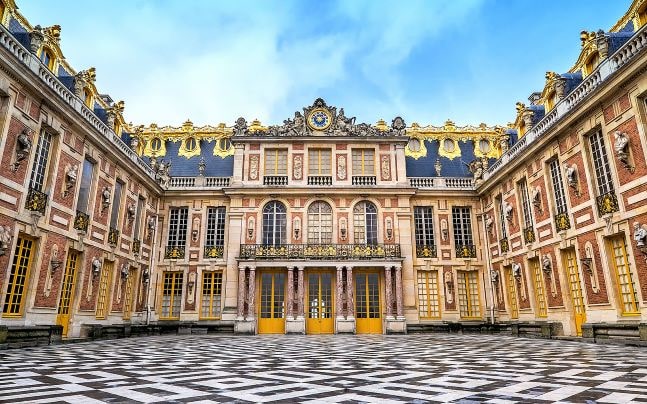
The Palace is the most time-sensitive interior commitment because independent visitors need a specific entry time. The formal gardens are geographically immediate but exposed. The Grand Trianon, Petit Trianon and Queen’s Hamlet sit farther out and demand either substantial walking or reliance on a separate movement system. The hamlet is especially dependent on daylight because much of its value comes from reading buildings, paths, water, planting and landscape composition together. The return to Paris is not a neutral final step: it competes with the last useful light and with any evening reservation placed too close to the excursion.
Winter also changes what counts as success. A summer plan may measure the day by spectacle: fountain programming, broad garden occupation and a long outdoor sequence. A winter plan is better judged by coherence. Did the Palace visit begin without unnecessary risk? Did the group understand the formal gardens rather than merely cross them? Was the outer estate reached while its architecture and landscape were still readable? Was there a warm alternative when conditions deteriorated? Did the Paris return remain calm enough that the evening did not become a second logistics problem?
This distinction matters for first-time visitors. Versailles can still justify a substantive day from Paris in winter, but only when the plan accepts that the domain’s parts are not interchangeable. Losing the hamlet to darkness is not repaired by adding another palace room. Missing the Palace slot is not repaired by a longer garden walk. A closed or interrupted estate shuttle cannot be treated as a minor detail when someone in the group has limited walking tolerance. Each dependency has a different consequence.
Start with the date, then build the route
The first decision is whether the intended day is operationally viable at all. The official low-season pattern verified for this article listed the Palace from Tuesday through Sunday, 09:00 to 17:30, with last admission at 16:45, and the Trianon estate from 12:00 to 17:30, also with last admission at 16:45. Mondays and certain holidays require particular attention. These hours explain the central winter asymmetry: the Palace can absorb the morning, while the outer estate cannot simply replace it at the same hour.
That asymmetry should shape the booking order. Secure the Palace commitment first, then test whether the remaining daylight supports the desired outer-estate ambition. Do not begin by imagining a perfect hamlet photograph at the end of the day and then force the Palace around it. The Palace slot is the hard appointment; the garden and estate sequence is the variable design problem.
There are also conditions that should trigger a fresh check even after the overall itinerary has been confirmed:
- A change of travel date. Moving from Sunday to Monday, or across a holiday period, can alter the viability of the whole excursion.
- A material weather shift. Heavy rain, strong wind, frost, snow or saturated ground changes the value and physical cost of gardens and hamlet paths even when entrances remain open.
- A notice affecting estate movement. The listed little train, other on-site movement options or individual stops may operate differently from the general seasonal pattern.
- A change in Palace admission time. Even a one-hour shift can move the outer estate from usable daylight into a dusk-dependent gamble.
- A mobility or stamina change within the group. A route that was acceptable as a walking day may need a different hierarchy when cold, standing tolerance or pace becomes a concern.
For travelers still deciding where Versailles belongs within a larger stay, place Versailles within a three-, four- or five-day Paris plan before protecting a specific date. Winter Versailles benefits from being assigned a day that can remain structurally simple, rather than being paired with another major commitment.
The Palace slot is an arrival window, not the start of a room-by-room tour
The Château’s official visitor guidance states that unaccompanied Palace visits require a specific time slot. It also explains that a timed-entry Passport guarantees access within 30 minutes after the selected time, while online purchase does not create priority over entrance checks and waiting can still occur. The distinction is operationally important. A 09:30 slot does not mean the group will be standing in the first state apartment at 09:30, and a 10:00 lunch calculation should not be built from that assumption. The current wording can be checked on the official Versailles visitor FAQ.
Build a security and orientation buffer on both sides of the booked time. Before the slot, allow for the Paris-to-Versailles journey, the final approach, the correct entrance and any queue at screening. After entry, allow for the fact that a first visit to the State Apartments, Hall of Mirrors and associated rooms is not a fixed-duration conveyor belt. Congestion, temporary circulation changes, interest level and the physical pace of the group all affect the exit time.
A useful winter planning assumption is that the Palace occupies a block, not a point. The slot anchors the block; it does not define its full duration. That is why an early slot usually creates the most optionality for a first-time winter visit. It leaves room for a proper interior visit, a warm pause and a move toward Trianon after its published opening time. A later slot can still work, but it should be chosen for a reason—for example, because the outer estate is intentionally omitted, or because weather makes an interior-led day more valuable than a broad domain circuit.
The risk of a very late Palace slot is not merely that the Palace closes. It is that the day becomes internally contradictory. The group may spend the brightest hours waiting to enter or walking without a clear interpretive purpose, then leave the Palace just as the gardens and outer estate become less legible. In December, that can mean having nominal opening time left but very little useful landscape time.
Conversely, an early slot should not be treated as permission to overpack the day. The Palace itself deserves interpretive focus. Versailles makes more sense when rooms are connected to court ritual, political display, dynastic memory and the transformation of a hunting lodge into a governing environment. Rushing through the interior simply to “save” the gardens can reduce the entire excursion to transit between famous surfaces.
Read the formal gardens as winter architecture
The gardens do not cease to matter when fountains are not the organizing event. Their winter value changes. The strongest reason to include them is no longer animated water or long occupation in mild weather; it is the ability to read André Le Nôtre’s spatial argument with fewer distractions. Terraces, axes, bosquets, sculpture, clipped forms, basins and distant horizons reveal how the garden extends the Palace’s ceremonial order into the landscape.
That reading works best when the route is selective. A winter visitor does not need to walk every accessible path to understand the garden. From the Palace terrace and the central axis, the group can establish scale, perspective and hierarchy. One or two carefully chosen descents or lateral moves can then show how views are controlled and released. The point is not to collect garden sectors; it is to see how architecture, topography and monarchy were made to support one another.
Cold changes the cost of that understanding. The nearby Météo-France station at Trappes records 1991–2020 mean monthly maximum and minimum temperatures of 10.4°C and 4.8°C in November, 7.2°C and 2.4°C in December, 6.8°C and 1.9°C in January, and 8.0°C and 1.8°C in February. Those are climate normals rather than a forecast, but they show why “just cross the gardens” is a poor operational phrase. Wind exposure, wet stone, damp air and periods near freezing can make a moderate distance feel longer, especially after standing inside the Palace. The underlying data are available in the Météo-France climate sheet for Trappes.
The winter garden should therefore be divided into three levels of ambition:
- Essential reading: the terrace, principal axis and enough movement to understand the relationship between the Palace, Latona’s perspective and the Grand Canal.
- Condition-dependent extension: selected groves, lateral axes or a longer descent when surfaces, wind and group energy make the extra distance worthwhile.
- Optional landscape time: unhurried wandering that is pleasant in dry, bright conditions but should be released first when rain, cold or delay begins to erode the outer-estate plan.
This hierarchy prevents two common errors. The first is eliminating the gardens entirely because fountain programming is not central to the day. That removes the spatial explanation for the Palace. The second is preserving an expansive garden circuit after conditions have made it low-value, thereby sacrificing Trianon or the Paris return. A winter route should protect the essential reading and make the rest conditional.
Travelers comparing seasons should keep the distinction explicit. A fountain-season Versailles day is organized around different scheduled experiences and should not be copied into November, December, January, February or March with the fountain references removed.
Trianon becomes more important when the main gardens become less theatrical
The Grand Trianon and Petit Trianon are not consolation prizes for a subdued garden day. In winter, they can provide some of the strongest information gain of the excursion because they shift the scale from state display to retreat, intimacy and changing ideas of royal privacy. The contrast is architectural, political and emotional. After the Palace’s ceremonial sequence, the lower, more distributed world of Trianon explains why Versailles was never experienced by the court as a single monumental interior.
The Grand Trianon’s long, low composition and relationship to its gardens make it particularly useful for reading a less vertical, less congested form of royal residence. The Petit Trianon introduces a different kind of control: compact classical architecture, carefully framed views and a domain associated with changing patterns of use across reigns. The Queen’s Hamlet extends that story into a constructed rural landscape whose buildings and water setting are best understood as a designed environment rather than as picturesque decoration detached from court culture.
Winter sharpens the differences among these places. The Trianon interiors offer a warmer and more contained interpretive experience when weather deteriorates. The hamlet remains predominantly a landscape proposition, so its value falls more quickly with poor light, heavy rain, strong wind or ground conditions. A group may still care deeply about seeing it, but the plan should acknowledge that reaching the hamlet late is not equivalent to seeing it well.
For that reason, the outer estate should be sequenced by value under the day’s actual conditions:
- When the afternoon is dry and bright: use the available light for the hamlet and landscape transitions, while keeping enough time for at least one Trianon interior.
- When the afternoon is cold but stable: shorten exposed walking, use interiors as anchors and treat the hamlet as a focused extension rather than a long wander.
- When rain or wind is persistent: prioritize the Palace and the most meaningful open interiors; reduce the hamlet to a conditional stop or omit it without pretending that a dark, wet circuit would have delivered the intended experience.
- When the group has limited walking tolerance: verify the day’s movement options before departure and choose a smaller number of outer-estate targets. The distances do not disappear because the itinerary is private.
The most important editorial judgment is that Trianon should not automatically be the part cut from a first visit. For travelers interested in how power was lived rather than only displayed, the contrast between the Palace and the outer residences may be the day’s most revealing sequence. What should be cut first is low-purpose movement: long crossings without interpretation, repeated backtracking, or a hamlet visit begun too late to read its setting.
Those deciding which specialist additions deserve priority can use the guide to Versailles beyond the State Apartments as supporting context. In winter, however, every addition still has to pass the daylight and opening-status test.
Estate transport is a dependency, not an entitlement
The outer estate is where many winter plans become fragile. Distances that look modest on a schematic map can accumulate across terraces, slopes, garden paths, Trianon and the hamlet. A visitor who has already spent time standing in the Palace may experience the afternoon very differently from someone assessing the route from a desk.
The official little-train page verified for this article listed service every day except Monday, with a published winter operating span of 11:10 to 17:10 in January through March and November through December. It also stated that departure intervals can vary—10, 15, 20 or 30 minutes depending on the season—and described a circuit connecting the Palace’s North Terrace with outer-estate stops in the Trianon area. This is useful planning evidence, but it is not a guarantee that a particular departure, vehicle, stop or circuit will be available on a future day. Check the official little-train notice close to travel.
The distinction between listed service and dependable sequence is essential. A plan that requires boarding at a precise minute, reaching a specific stop without a queue and returning on an exact departure has no resilience. Even a service operating normally can introduce waiting, exposure and uncertainty. A day-specific suspension or stop change can be more consequential.
Build the outer estate with three movement assumptions:
- Preferred movement: the verified on-site option that best preserves energy and daylight for the group.
- Walking fallback: a reduced route that remains realistic if the preferred option is delayed or unavailable.
- Abandonment point: the moment when continuing toward the hamlet or another distant stop would create a poor experience or jeopardize the return.
The walking fallback should not be a disguised version of the original plan. It should be smaller. For example, if the intended circuit included both Trianon residences and the hamlet, an interruption may require choosing the most meaningful open residence and one landscape connection, rather than walking the entire original circuit at a faster pace.
Private road transport between Paris and Versailles can solve the hotel-to-domain and domain-to-Paris segments, especially for travelers who value a controlled departure, have mobility concerns or need a fixed return. It does not automatically solve movement inside the estate. Access rules, drop points and internal circulation remain separate operational questions. That boundary should be understood before anyone assumes that hiring a driver eliminates the need to verify on-site transport.
Early dusk changes the meaning of “open until 17:30”
Closing time and useful light are different clocks. In December 2026, the published solar table for Versailles places sunset at approximately 16:54 to 16:57 through much of the month. On 21 December, it lists sunrise at 08:41, sunset at 16:57 and the end of civil twilight at 17:34. These figures are specific to that month and year, but they illustrate the planning problem: the estate can remain nominally open while the hamlet and broader landscape are already moving beyond their most legible period. The dated figures can be checked in the December 2026 sun table for Versailles.
For route design, sunset should be treated as an interpretive deadline rather than a photographic one. The issue is not simply whether there is enough light for a camera. It is whether the group can understand spatial relationships, see path surfaces comfortably, distinguish water and planting edges, and move without turning the last part of the estate into an exit march.
A sensible December sequence works backward from the last landscape stop. If the hamlet matters, it should be reached with a meaningful margin before sunset, not at sunset. Trianon interiors can absorb some of the later afternoon because they do not depend on open-sky visibility in the same way, although admission and closing rules still control access. The formal gardens nearest the Palace can be read earlier, when the central axis is clearest and the group is not yet calculating how to leave.
In November and February, the exact light envelope differs; in March, it changes again, especially around the clock change. The evergreen principle is therefore not “leave the hamlet by 16:00.” It is “check sunset for the exact date, identify the final outdoor place that matters, and reserve enough pre-sunset margin to experience it rather than merely arrive.”
A winter route should have a warm fallback before weather forces one
A fallback is not a vague promise to spend more time indoors. It is a defined alternative that still justifies leaving Paris. The alternative must protect the excursion’s intellectual value, not simply its duration.
For a first-time visitor, the most durable fallback is an interior-led Versailles day with a concise garden reading and a selective outer-estate extension only if conditions allow. That means giving the Palace enough time for context, using the terrace and principal axis to explain the garden’s design, taking a warm pause, and then entering one or both Trianon residences if they are open and reachable without turning the afternoon into a cold endurance exercise.
The fallback should be activated by evidence, not mood. Persistent rain, strong wind, a late Palace exit, a transport interruption or a visible drop in group energy are legitimate triggers. Light drizzle, ordinary winter temperatures or bare trees are not automatically reasons to abandon the gardens. Versailles in winter can be visually austere and analytically clear; the route should distinguish discomfort that can be managed from conditions that destroy the value of the planned landscape sequence.
Three fallback versions are especially useful:
- Weather fallback: Palace in depth, essential garden views from the terraces and central axis, then the most valuable open Trianon interior. The hamlet becomes optional.
- Delay fallback: preserve the Palace visit and one coherent outer-estate objective; eliminate repeated crossings and any stop that would begin in failing light.
- Mobility fallback: verify on-site movement, reduce the number of distant stops, protect seated or sheltered intervals, and avoid counting a long return walk as an acceptable contingency.
A fallback can also include a deliberate earlier return to Paris. That is not a failure when the remaining estate time would be cold, dark and low-yield. The excursion has already justified itself if the group has understood the Palace, read the garden’s primary structure and experienced the shift in scale at Trianon. More minutes on site are not automatically more value.
Four route models for different winter conditions
Dry, bright and cold: protect landscape light
Choose an early Palace slot and arrive with a genuine screening buffer. Visit the State Apartments and Hall of Mirrors with enough interpretation to establish the political and ceremonial framework. Avoid an overlong indoor pause immediately afterward; the day’s best light belongs to the garden and outer estate.
Read the principal garden axis, then move toward Trianon using the verified on-site option or a realistic walking plan. Because the hamlet depends most strongly on daylight, place it before the final interior stop when the route and opening status permit. Use the Grand Trianon or Petit Trianon later as a contained conclusion to the outer-estate story. Begin the return before the group is forced to make every movement in darkness.
This model is appropriate for visitors who want Versailles as a domain rather than only as a palace. Its risk is overconfidence: bright winter sun can make the day feel generous at noon, but the remaining light declines quickly. Keep the optional garden wandering genuinely optional.
Cold rain or strong wind: turn the day inward without erasing the gardens
Retain the Palace slot and interior depth. Use sheltered or interior pauses strategically, but do not spend the entire day inside without establishing the garden’s spatial logic. A short terrace and axis reading can explain more than a long, uncomfortable crossing undertaken without attention.
After the Palace, reassess rather than automatically continue. If the Trianon interiors are open and movement is dependable, they can still make the excursion complete. If reaching them requires a long exposed wait or a difficult walk, the outer estate may no longer justify the cost. In that case, return earlier to Paris and use the recovered time deliberately rather than filling it with another major attraction.
The judgment here is not whether the weather is “bad enough” to cancel. It is whether each additional segment still produces meaning proportional to exposure, delay and fatigue.
A later Palace slot: accept a smaller Versailles
A late-morning or early-afternoon Palace time can be workable when it is the only viable admission, but the route must stop pretending to be comprehensive. Before entry, use only nearby garden views or a tightly controlled walk that cannot jeopardize the slot. Do not undertake an outer-estate circuit that depends on a perfectly timed return to the Palace entrance.
After the Palace, choose between a concise garden reading and one outer-estate objective according to the remaining light and opening status. In midwinter, the hamlet may no longer be the sensible choice. A Trianon interior, if open and reachable, can provide a stronger conclusion than a hurried landscape circuit begun at dusk.
This is the version most likely to benefit from a future second visit. It can still be substantive, but only if the group is told in advance that the domain is being edited rather than “covered.”
Limited walking tolerance: design around the weakest movement link
Begin with the person for whom standing, cold or distance is most consequential. Verify the approach to the Palace, screening expectations, the day’s internal movement options and the location of the desired outer-estate stops. The route should include fewer transitions, not merely more time.
An early Palace slot remains useful because it provides the broadest margin. After the interior, take a warm pause and reassess energy before committing to Trianon. If the on-site movement option is operating, use it to preserve attention for the places themselves. If it is not, choose a reduced walking route with a clear turnaround point. The Queen’s Hamlet should not be treated as compulsory when reaching it would exhaust the group before the return.
Travelers with wheelchair-specific questions should consult the dedicated Versailles accessibility planning guide, because general winter sequencing cannot substitute for current access and route verification.
The Paris return should be fixed by consequence, not optimism
Versailles is close enough to Paris that travelers often make the evening too ambitious. A late afternoon exit is followed by the station or vehicle pickup, the return corridor, urban traffic or rail variability, arrival at the hotel, changing for dinner and another transfer. Each stage looks manageable in isolation. Together they can turn a well-planned day into a rushed evening.
The return time should be set by the first fixed Paris consequence. That may be a tasting-menu reservation, a performance, a family meal, a private appointment or simply the group’s tolerance for remaining in motion. Work backward from that consequence and include a real buffer. Do not use the estate’s closing time as the default departure time unless the evening is intentionally uncommitted.
Road and rail each have advantages, but neither should be romanticized. Rail can avoid some road congestion and may suit travelers staying near a convenient line, yet it requires station access, platform movement and comfort with service changes. Private road transport can simplify hotel pickup, clothing, mobility aids and a controlled departure, but it remains exposed to traffic and still does not solve every movement question inside Versailles. The right choice depends on hotel geography, group needs and the importance of a fixed return.
For a route that continues into an evening plan, decide where the Paris return belongs before dinner rather than adding that decision after leaving the estate. A demanding dinner should not be used as the reason to rush the Palace; it should be the reason to define the latest sensible departure in advance.
What to verify, and when
A winter Versailles itinerary should be treated as a sequence with an expiry date. The structural logic is durable; the operational details are not. Use a layered verification process.
When choosing the date
- Confirm that the Palace and intended outer-estate components are scheduled to open.
- Check whether the date falls within the low-season pattern and whether a Monday or holiday closure affects the plan.
- Secure the Palace time before committing the day to another fixed Paris obligation.
- Look up sunset for the exact date, especially from late November through January.
Several days before the excursion
- Read the official practical-information and visitor-notice pages again.
- Check the estate-transport page rather than relying on a saved screenshot or an old itinerary.
- Review the forecast for temperature, rain, wind and any freeze or snow risk.
- Decide which element will be released first if the day becomes slower than planned.
On the morning of travel
- Confirm that no new closure or movement notice has appeared.
- Reassess clothing and footwear for wet stone, exposed terraces and outdoor waits.
- Keep the Palace admission details accessible and preserve the arrival buffer.
- Tell the group which parts are fixed, which are condition-dependent and what the fallback will be.
This final briefing is more than courtesy. It prevents the outer estate from feeling like an unexplained cancellation if weather or delay forces an edit. A premium private day earns trust by making the decision logic visible: the group understands why the Palace is protected, why the hamlet depends on light, and why a timely return can be more valuable than one last cold crossing.
Where bespoke planning changes the outcome
Bespoke planning matters when the Palace slot, the delayed opening of the outer estate, the day’s estate-transport status, the group’s walking tolerance and a fixed Paris return all have to agree. The value is not in adding more stops. It is in deciding which sequence remains coherent under the specific date’s constraints and in knowing what to release when one dependency changes.
For some travelers, that means a Palace-first route with a protected hamlet window. For others, it means a deeper Palace interpretation, a selective Trianon visit and an earlier return because the weather has made broad garden movement low-value. Families may need shorter exposed intervals. Older travelers may need movement certainty before committing to the outer estate. Repeat visitors may reverse priorities and spend less time in the State Apartments. The plan should reflect those differences rather than applying one universal Versailles day.
Orange Donut Tours can coordinate that sequence as part of a private Versailles day from Paris, including the route logic, interpretive priorities and return timing that need to be agreed before the excursion begins. The transport element is useful only when it supports those decisions; it is not a substitute for them.
Verify the operating day before you lock the promise
The durable winter model is straightforward: protect the Palace appointment, preserve an essential reading of the gardens, use the best daylight for the most landscape-dependent outer-estate stop, treat on-site transport as conditional, keep a warm fallback, and leave Versailles according to the consequence awaiting in Paris. The exact hours, closures and movement notices can change, so recheck the official Château pages after any date change and again close to departure. Once those facts align with the group’s pace and evening, Inquire now
If you’re interested in any private tours of Paris, please reach out to us.



 So if you are looking for the absolute best in Paris & surroundings with authentic local fully-licensed native guides whose English you can actually understand and with an exclusive and amazingly fun itinerary













