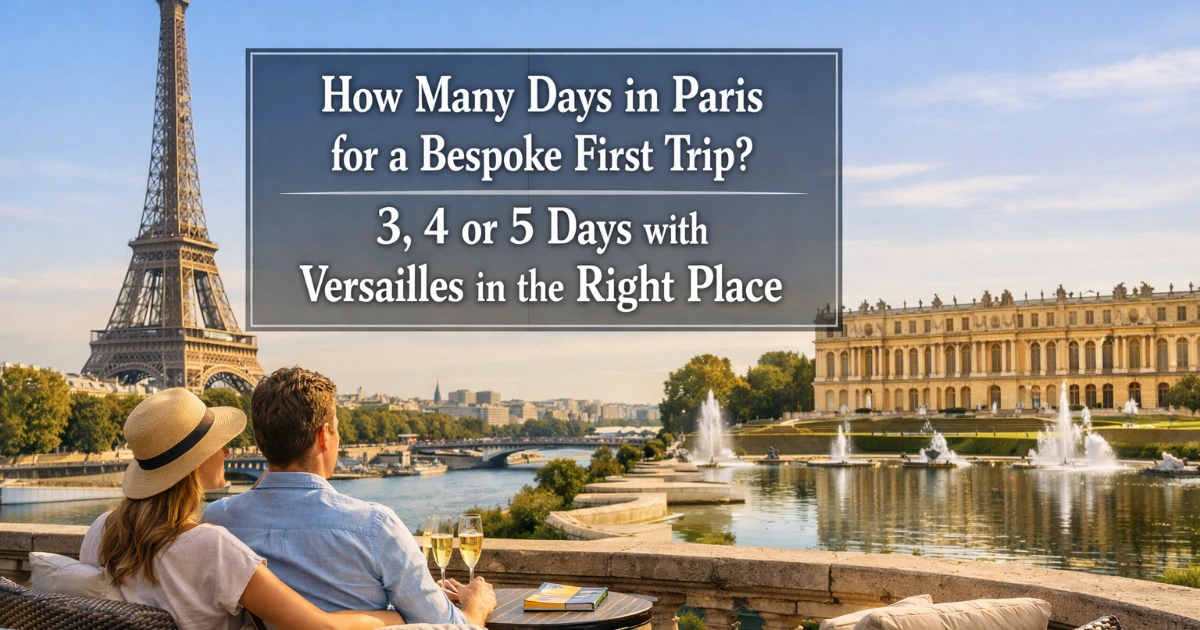
How Many Days in Paris for a Bespoke First Trip? 3, 4 or 5 Days with Versailles in the Right Place
Updated
For a bespoke first trip to Paris, four full sightseeing days is the best answer. It wins because Paris is not difficult in the dramatic sense; it is difficult in the way short stays get eaten by museum scale, river crossings, reservation slots, and the simple fact that Versailles is not an add-on but a day of its own. The exception is simple: three days can be lovely for a stylish long weekend, but not if you also insist on Versailles.
The threshold that matters in Paris is the point at which Versailles displaces a core Paris neighborhood day. Once that happens, a first visit stops feeling coherent. You may still see famous names, but you lose the connective tissue: a proper Louvre morning, a real walk through Saint-Germain-des-Prés, time to handle Montmartre’s slopes without hurrying, and at least one evening that does not feel like recovery. That is why our default recommendation for first-timers is four days, not three, and why five days becomes the stronger answer the moment Versailles is emotionally important.
One counterintuitive correction belongs near the top: a more romantic Left Bank hotel is not automatically the smartest base for a short first trip. When the plan includes the Louvre, the Seine, and possibly Versailles, the Opéra / Palais Garnier side of the Right Bank often gives you more usable sightseeing time than readers expect, because it sits closer to the Louvre-Tuileries spine and to Saint-Lazare’s westbound departures without asking you to keep recrossing the river just to start the day.
If you are already comparing guided formats, multi-day private touring in Paris makes more sense once the stay length is settled. Paris rewards a trip built around full days, not an inflated night count.
The fork in one glance
Most balanced first trip: 4 days. Best for a true first visit that includes the Louvre, Montmartre, a Left Bank neighborhood such as Saint-Germain-des-Prés, a Seine moment, and enough elasticity to avoid turning every afternoon into a transit problem.
Best upgrade if Versailles matters: 5 days. Choose this when Versailles genuinely matters, when you want a more generous food-and-wine rhythm, or when your group includes children, older relatives, or celebration travelers who value room around the plan.
The version that disappoints fastest: 3 days with Versailles. It looks glamorous on paper and often lands as a sampler platter with expensive shoes.
The decision criteria: count full sightseeing days, not hotel nights; decide whether Versailles is a top-two priority or just a famous maybe; and notice whether your base reduces or multiplies river crossings and transfer resets.
- Choose 3 days if Paris is one stop on a longer trip, you are happy with one major museum rather than a broad sweep, and you would rather have two excellent quarters plus one landmark axis than force the whole city into a blur.
- Choose 4 days if this is your first real Paris visit and you want the city itself to feel complete.
- Choose 5 days if you want Versailles without sacrificing Paris, or if your idea of a first trip includes better lunches, more elegant evenings, and some margin for weather, shopping, family pace, or spontaneous detours.
How many days in Paris for a first trip? The real thresholds are not emotional, they are structural.
Three, four, and five days each create a different Paris. That is the first thing to understand. They are not simply shorter or longer versions of the same itinerary. A three-day Paris is a selective first taste. A four-day Paris is a first visit with shape. A five-day Paris can finally absorb Versailles or indulge in a slower, more layered city rhythm.
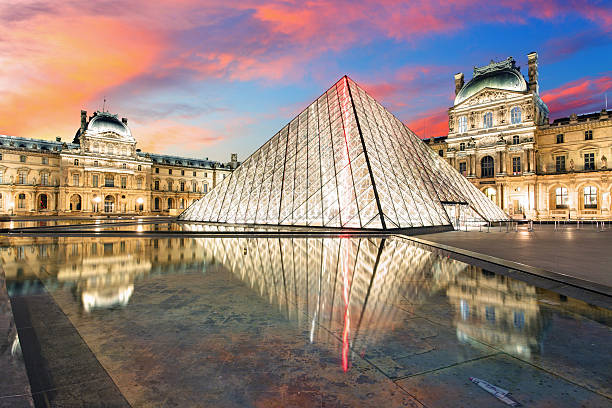
Start with the Louvre. For many first-time visitors, the Louvre is not optional, but it is also not a ninety-minute checkbox. The building itself is huge, the arrival routine takes concentration, and once you are inside, the simple act of moving from one wing to another takes more out of a short stay than travelers imagine. You feel this most on three-day trips, where the Louvre can quietly consume the mental and physical energy that should have supported a second substantial experience later the same day.
Then add Paris geography. The postcard version suggests everything is close because so many major sights sit along or near the Seine. Yet a short stay is usually decided by small frictions, not long distances: crossing from a Saint-Germain-des-Prés hotel to a Right Bank museum, doubling back after lunch because of a reservation, or losing momentum between a hilltop district and an evening booking. Paris does not punish you with one giant transfer; it taxes you with repeated resets.
Versailles changes the equation even more. It is not just transport out and back. It is a palace visit, a security rhythm, decisions about the gardens and Trianon, and a return that often lands later than an optimistic planner expects. Before you lock the day, use the official Versailles planning page (https://en.chateauversailles.fr/plan-your-visit) to confirm the current logistics. More importantly, plan the day as if Versailles is the destination, not a side mission.
That is why the trip-length question in Paris is really this: do you want Paris to be the trip, or do you want Paris plus one large out-of-city statement day? If the answer is the second, the city needs enough remaining time to breathe. If you do not protect that time, you do not get a richer trip; you get a more expensive compression exercise.
Three days in Paris works when you edit aggressively.
Three full days in Paris is enough only when you accept that your first trip cannot be comprehensive. That is not a compromise to mourn; it is a strategy to embrace. The right three-day Paris usually means one major museum or monument anchor, one neighborhood day on the Left Bank or in the Marais, one high-view or high-character district such as Montmartre, and one river-centered evening or scenic axis tying it together.
What three days does well is concentration. You can stay close to the Louvre and Tuileries one day, give Montmartre real time another, and then let a Left Bank day unfold through Saint-Germain-des-Prés, the Seine, and perhaps a well-timed cruise or tower moment. That kind of plan feels elegant because each day carries a single identity. The mistake is assuming that elegance will survive once Versailles enters the picture.
If Paris is your first trip and you care about the Louvre, Montmartre, and a real neighborhood day, squeezing Versailles into three days is the wrong premium choice. Something essential gets displaced. Usually it is not a monument; it is the city feeling itself. You lose the wandering hour before dinner in Saint-Germain-des-Prés, or the chance to let Montmartre be more than a steep photo stop, or the ability to let one museum day remain one museum day.
This is also where a private guide helps and where another kind of spending does not. Guiding can make a short day cleaner because it reduces indecision, helps you enter large sites with a plan, and protects momentum between districts. But no guide, driver, or room upgrade can turn three sightseeing days into four. Paris is one of those cities where expert handling compresses friction but cannot repeal time.
Three days is therefore best for travelers who actively prefer selectivity: couples adding Paris to Italy or Spain, families who know children will have one major-museum limit, celebration travelers who want one glorious dinner and do not need to prove anything to a checklist, or repeat Europe visitors who know they will return. It is a weaker fit for first-timers arriving with a long Paris wish list and an emotional attachment to Versailles simply because it is famous.
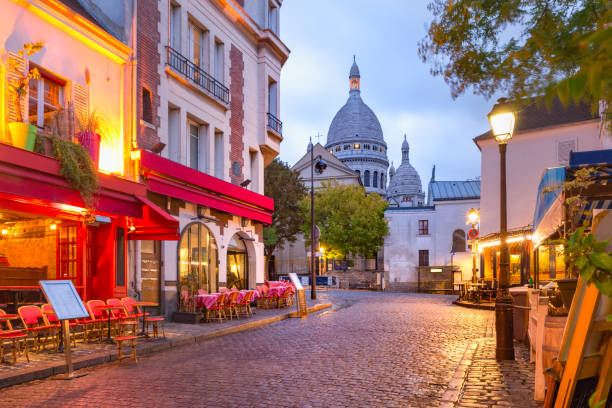
A useful cut-first rule belongs here. If your plan is getting crowded, cut the day trip before you cut the neighborhood. A first Paris trip remembers texture better than accumulation: café terraces near Place Saint-Sulpice, the gradual reveal from Rue des Abbesses toward Sacré-Cœur, the shift from the Louvre’s stone scale to the softer river light near Pont Neuf. Those are the parts that make Paris feel like Paris, and they disappear first when the itinerary is overpacked.
Readers who know they only have three days and still want a polished city-first framework may find it useful to compare this judgment piece with a more fixed 3-day Paris itinerary. The difference is important: those pages help once you have accepted the three-day limit, while this article is about whether that limit is the right one in the first place.
Is 4 days enough in Paris for a first trip? Yes, and it is usually the point where the city starts making sense.
Four days is enough in Paris for a first trip precisely because it restores one day of breathing room. That sounds modest, but in Paris it changes the entire emotional temperature of the stay. A fourth full day lets you keep a proper Louvre day, a neighborhood-led day, a Montmartre or major-monument day, and still preserve one flexible day for a second museum, the Eiffel Tower area, Le Marais, a food focus, or simply the weather correction that every big city benefits from.
This is the trip length at which Paris stops feeling like a highlight reel and starts feeling sequenced. You no longer need every day to serve two masters. The Louvre can be followed by lunch and a softer afternoon nearby rather than another major transit move. Montmartre can remain Montmartre, with time for the hill, small streets, and pauses rather than a rushed down-and-across transfer. Saint-Germain-des-Prés can stay a neighborhood rather than a corridor on the way to something else.
Four days also gives you permission to be honest about what first-time travelers actually enjoy. Many people think they need constant monument density to justify Paris. In reality, they need shape. They need one day that belongs to the historic center and river axis, one day that belongs to art or royal scale, one day that belongs to local texture, and one day that can absorb taste, shopping, family needs, or rest without guilt. That is why four days beats a manic three even when the headline list of sights looks similar.
The body feels the difference too. Paris is walkable, but not in the lazy fantasy version. Montmartre has real climbing. Major museums mean standing, turning, and reorienting rather than just strolling. Versailles adds enormous ground even for visitors who think they will be selective. Repeated Métro staircases, security stops, and the simple effort of crossing between Left Bank and Right Bank districts accumulate faster than travelers predict. With four days, those demands feel like part of the trip; with three, they often become the trip.
The mood improves as well. A good Paris evening depends on arriving at it with some energy left. When every afternoon has been built on overcorrection, dinner becomes triage. Four days keeps the evening usable because the day no longer has to prove your worthiness as a first-time visitor. You can come back to the hotel, change calmly, and head out again without feeling that one missed church or one closed museum wing has ruined the trip.
This is also the most adaptable length for different kinds of discerning travelers. Couples can combine landmark days with a real sense of place. Families can build around one big anchor per day. Small groups can vary interests without fragmenting the whole trip. Food-and-wine travelers can give one lunch the time it deserves instead of treating every meal as a pit stop. Celebration travelers can choose one elevated evening without needing the rest of the stay to be punitive.
The Louvre is a good example of why four days wins. Before you place it on the schedule, check the Louvre hours and admission page (https://www.louvre.fr/en/visit/hours-admission) for the current opening pattern and ticketing rules. The museum works best as an anchor day, not an in-between errand squeezed around other major commitments.
Would we do Versailles on a four-day first trip? Sometimes, yes, but only under a stricter condition than most guides admit. Versailles should already be one of your top priorities, not a trophy appendage. If it is that important, four days can absorb it, but the tradeoff must be visible: you are choosing Versailles instead of a deeper neighborhood day in Paris, not in addition to it.
Five days is where Versailles becomes a clean addition instead of a raid on the city.
Five days in Paris is the answer when you want both the city and Versailles to feel properly chosen. This is the length at which Versailles belongs most naturally, because it no longer steals from the very experiences that make a first trip emotionally complete.
The extra day changes more than the sight count. It gives you margin. Margin means you can let one day stretch without resentment, absorb weather or queue drag, build in a long lunch, or reserve one morning for shopping, a sweets-focused outing, or a family-friendly reset. Paris becomes more forgiving at five days, and that forgiveness is especially valuable for travelers who are not trying to travel like graduate students on a test of endurance.
Versailles benefits from this generosity as much as Paris does. On five days, you can assign Versailles a full day and still retain a real Louvre day, a Montmartre day or partial day, and a Left Bank neighborhood day that feels intentional rather than leftover. The palace then becomes additive. It enriches the trip’s contrast between urban Paris and ceremonial France instead of flattening the city into little more than a base camp.
Five days is also the better answer for travelers with a celebration mood, multigenerational groups, food-and-wine priorities, or a strong interest in doing one or two things especially well. A remarkable lunch, a polished shopping interval, or a late start after a serious dinner all become easier to justify. In a three-day trip those moments compete with must-sees. In a five-day trip they belong.
There is another subtle gain. Paris with five days allows one district to surprise you. Maybe Le Marais gets longer than planned. Maybe the river draw becomes stronger than the museum draw after a big morning. Maybe you prefer a second Left Bank afternoon to another famous interior. That kind of rebalancing is the privilege of time, and it is one of the clearest differences between a trip that feels curated and a trip that feels merely efficient.
For travelers considering several excursions, five days is also where it becomes sensible to compare Versailles with other options rather than assuming the palace wins by default. If you reach that stage, this Paris day-trip guide is the more useful comparison tool. But for a first trip, our judgment remains firm: if Versailles is the day trip, five days is where it finally sits in the right place.
Where Versailles belongs on a first Paris trip, and where it simply does not
Versailles belongs on a first Paris trip only when it is important enough to take a whole day and when the rest of the city still has enough time to feel complete. That is the cleanest rule in this article.
On three days, Versailles almost never belongs. The only exception is a traveler who genuinely prefers palaces, formal gardens, and royal history over urban neighborhood texture and accepts Paris as a short preview rather than a rounded first visit. That traveler exists. Most first-time visitors, however, are not that person. They think they want Versailles because it is famous. Once in Paris, what they actually want is more time in Paris.
On four days, Versailles belongs only if it outranks one of the city’s core days. That means you are comfortable giving up either a real Left Bank day, a deeper Right Bank neighborhood, or the kind of flexible buffer day that often becomes the trip’s quiet hero. If that trade feels painful when stated plainly, the answer is no: keep all four days in Paris and save Versailles for a return trip or a longer stay.
On five days, Versailles earns its place much more often. It no longer needs to pose as efficient. It can be what it is: a major day out that broadens the trip’s historical scope. For travelers who appreciate context, gardens, ceremonial architecture, and the contrast between city intimacy and royal scale, that is a real upgrade.
The private-touring version of this decision is straightforward. A guided Versailles day is worth its cost when the site is a priority and the trip is long enough for the day not to cannibalize Paris. It is less worth its cost when it is being used to force a palace into a too-short stay just because the trip is meant to feel special. Special is not the same as crowded. If Versailles is right for you, private Versailles touring is the logical next step. If it is not, the stronger premium decision is to deepen Paris itself.
There is also a body-level truth here that planners often understate. Versailles is not one room called the Hall of Mirrors. It is approach, screening, palace circulation, visual overload, choices about the gardens, and a return journey when your feet are already reporting to management. That can be exhilarating on the right trip and flattening on the wrong one. The site is magnificent; the question is whether your schedule lets you experience it as magnificent rather than obligatory.
Your base changes more than readers expect: Opéra / Palais Garnier side of the Right Bank versus Left Bank hotels
For short first trips, base choice changes usable sightseeing time more than room category does. That is especially true once you are deciding between keeping Paris in the city and sending one day to Versailles.
The Opéra / Palais Garnier side of the Right Bank is the more efficient default base for many three- and four-day first trips. It puts you in practical reach of the Louvre-Tuileries-Palais Royal axis, keeps the western pull of the city manageable, and connects naturally to the sort of departures and cross-town moves that short stays make repeatedly. It is not the only good base, but it is better aligned with a trip built around the Louvre, the Seine, and a possible Versailles day than many first-timers assume.
Saint-Germain-des-Prés is more romantic and, for some travelers, more emotionally Parisian. On a longer stay without Versailles, or on a five-day trip where cafés, bookstores, and slower evenings matter as much as logistics, it can be a beautiful choice. But on a compressed first visit it is often overvalued. Many travelers say they want the Left Bank and actually mean they want Left Bank mood. Mood is real, but so is the cost of starting multiple days by crossing the river or backtracking toward major anchors on the Right Bank.
This is where specific micro-location matters. A Left Bank hotel very near Musée d’Orsay or Saint-Michel-Notre-Dame can make the Versailles conversation more nuanced, especially for travelers comfortable with rail. But a tucked-away address deeper into Saint-Germain-des-Prés may feel superb at midnight and mildly inefficient at 8:30 in the morning. By contrast, a hotel around Opéra, Madeleine, or the streets feeding Palais Garnier can feel slightly less cinematic at first glance and then prove itself every time you set out for the Louvre, head west, or return for a quick reset before dinner.
The hidden tax in Paris is not distance alone. It is broken rhythm. A clean day might move from the Louvre toward the Tuileries and on toward the Seine with almost no psychological friction. A clumsy day adds a river crossing, an extra transfer, and the sense that the city is making you start over. That is one reason an Opéra-side base often performs so well on first trips: it reduces the number of times the day needs to be rebooted.
If Montmartre is in the plan, the story gets even clearer. The district deserves more than an up-and-down victory lap. Starting from the Opéra / Palais Garnier side of the Right Bank often makes it easier to handle Montmartre as its own chapter and still come back into the rest of the city gracefully. Starting from a Left Bank hotel can make the same day feel like two separate outings stitched together by transit.
This does not mean everyone should abandon the Left Bank. It means travelers should stop assuming that the prettiest hotel address solves the trip. In Paris, base selection is a planning tool, not a mood board. On a short first visit, the best base is the one that quietly preserves hours you can actually use.
What to buy with the next night, and what not to buy
If you are debating whether to add another night, buy time before you buy status. That is the most commercially honest advice in this guide.
A fourth full day usually buys more value than a more expensive hotel room on a three-day trip. The added day lets the city unfold at the scale it needs. It protects a neighborhood day from being sacrificed, gives the Louvre proper room, and allows the evenings to remain enjoyable. For many first-timers, that extra day is the single most effective comfort upgrade available.
A fifth day buys value when Versailles matters or when the group would benefit from margin. That can mean older travelers, families, travelers with mobility concerns, people planning a celebratory meal, or anyone who knows that shopping, tasting, or photography is part of the point rather than a distraction from it. Five days is also the length that lets a chauffeured or guided Versailles day feel earned rather than compensatory.
Premium spend does not help if you use it on a pricier hotel category while still forcing Versailles into a three-day stay; the trip is constrained by hours and transfers, not thread count.
Another hotel night adds cost without solving the real Paris-versus-Versailles pacing problem if it lands on a late-arrival evening or an early-departure morning. Count full operating days in the city. Many travelers tell themselves they have four nights and therefore four days; in reality they have three useful days and a pair of edges.
There is a second place where spending can miss the target. A glamorous Left Bank address does not automatically earn its cost on a short stay if your days keep pulling you back toward the Louvre, the Right Bank, and westbound departures. The room may be lovelier. The trip may still be less well assembled. In Paris, money is best spent where it buys actual travel function: an extra full day, a guide for a sprawling site, arrival handling after a long flight, or a Versailles day once the city has enough time left around it.
When the decision becomes “Should the next night fund more Paris or a guided Versailles day?” the answer is usually simple. If you have only three full days, fund more Paris. If you already have four and Versailles is truly high on the list, consider the guided Versailles day. If you have five, choose whichever best matches the trip you want to remember.
That is the practical handoff point. Once you know whether the next night should protect city time or support Versailles, the rest of the trip gets much easier to shape. If you want help aligning the base, the stay length, and the right balance of museum days, neighborhood time, and one possible excursion, Inquire now. You can also explore private tours in Paris if you already know the city deserves a more tailored plan.
FAQ
Is 3 days enough for Paris and Versailles?
Usually no, not for a first trip. Three full days can produce a very good city-first Paris, or a selective Paris-plus-Versailles preview for a narrow type of traveler, but it rarely produces both without obvious compromise. For most first-timers, Versailles in three days displaces one of the city experiences that should have defined the trip.
Is 4 days enough in Paris without feeling rushed?
Yes. Four full sightseeing days is the strongest default for a first trip because it gives Paris enough room for one major museum day, one neighborhood-led day, one high-character district such as Montmartre, and one flexible day for a second priority, better pacing, or weather adjustment.
Should first-time visitors choose Paris or Versailles if they only have one more day?
Choose Paris unless Versailles is already one of the main reasons for the trip. An extra city day usually improves the first-visit experience more than a day trip does, because it protects the texture of the city rather than replacing it.
When does Versailles make sense on a first Paris trip?
Versailles makes sense when you can give it a full day and still leave Paris enough time to feel complete. In practice, that usually means a five-day stay, or a four-day stay where Versailles clearly outranks a deeper neighborhood day in the city.
Where should you stay in Paris for a short first trip with Versailles in mind?
The Opéra / Palais Garnier side of the Right Bank is often the most efficient default because it keeps the Louvre and central Right Bank routes convenient while also working well for a Versailles day. Saint-Germain-des-Prés can be wonderful, especially on longer stays, but it is not automatically the most efficient base for a short first trip.
Does a more expensive Paris hotel fix a short itinerary?
No. Better hotels improve rest, service, and atmosphere, but they do not create more sightseeing hours. On a too-short trip, extra nights or better sequencing usually do more for the experience than a room upgrade alone.
What should you cut first when Paris starts feeling overpacked?
Cut the day trip before you cut the neighborhood time. A first trip is usually remembered through the city’s flow, not just its headline sites. Losing Saint-Germain-des-Prés or compressing Montmartre into a sprint often does more damage than skipping Versailles.
Is 5 days in Paris too much for a first visit?
No. Five days is often ideal for travelers who want Paris to feel generous rather than compressed, especially if Versailles, food-and-wine plans, family pace, or celebration travel are part of the trip. It is not too much; it is simply a different kind of first visit.
If you’re interested in any private tours of Paris, please reach out to us.










 So if you are looking for the absolute best in Paris & surroundings with authentic local fully-licensed native guides whose English you can actually understand and with an exclusive and amazingly fun itinerary













