The Paris Commune in Place and Memory: Hôtel de Ville, Montmartre and Père Lachaise

Updated
The Paris Commune is easy to reduce to a sequence of dramatic images: cannon on the heights of Montmartre, a red flag above the Hôtel de Ville, the Vendôme Column falling, flames around public buildings, and the dead at Père Lachaise. Those images matter, but they can also flatten the event into legend. The more demanding question is not simply where the Commune happened. It is how a city at war became a revolutionary municipality, how authority moved through streets and institutions, and how later generations turned selected sites into evidence, accusation, mourning and political inheritance.
The most useful way to read 1871 in Paris is therefore as a chain of places whose meanings changed. Montmartre was not yet the postcard quarter crowned by the completed Sacré-Cœur. The Hôtel de Ville seen today is not the building occupied by the Commune council. Père Lachaise is both a cemetery in which fighting occurred and a later commemorative landscape shaped by pilgrimage. Between those points lie newspapers, proclamations, police files, photographs, caricatures, ruins and rebuilt monuments. They do not tell one seamless story. They reveal where fact, representation and memory diverge.
This distinction separates the Commune from a generic revolutionary itinerary. A visitor interested in the longer Parisian history of insurrection can use a separate French Revolution reading of Paris to understand why 1789, 1792, 1830, 1848 and 1871 should not be collapsed into one republican myth. The Commune belonged to a different urban scale, a different war, a different social coalition and a different media environment. Its surviving geography becomes legible only when those differences stay in view.
A city already divided before 18 March
The Commune grew out of the Franco-Prussian War, but military defeat alone does not explain it. After Napoleon III was captured at Sedan in September 1870, the Second Empire collapsed and the Republic was proclaimed in Paris. The capital then endured a Prussian siege lasting through the winter. Hunger, bombardment, political agitation and the experience of collective defense changed the relationship between Parisians and the state. The National Guard, greatly expanded during the siege, was not merely a military formation. Its neighborhood battalions elected officers, debated policy and became a framework through which armed citizens understood themselves as guardians of the Republic.
The armistice of January 1871 ended the siege without resolving that political transformation. A newly elected National Assembly, chosen largely by a rural electorate and containing strong conservative and monarchist currents, appeared to many in republican Paris as socially and politically distant. Adolphe Thiers, head of the executive power, sought to restore governmental authority, fiscal order and control over weapons. Parisians faced the resumption of economic obligations suspended during the siege, while radicals feared that the Republic itself might be provisional. The quarrel was therefore constitutional, social and municipal as much as military: who represented France, who controlled Paris, and whether the capital could claim meaningful self-government.
The Bibliothèque nationale de France summarizes this prehistory through defeat, siege, famine, resentment over the peace settlement and Thiers’s attempt to disarm the National Guard on 18 March. Its overview also points toward the documentary record through which the crisis can be reconstructed: manuscripts, personal papers, interrogation files, newspapers and images. That institutional evidence map is available in the BnF’s account, “Commémorer la Commune de Paris”. The value of the source is not that it settles every interpretation, but that it places political memory beside surviving documents.
Urban form also mattered, though not in the simplistic way often repeated. Haussmann’s rebuilding under the Second Empire created broad avenues that could move troops and artillery, displaced populations through demolition and rising rents, and displayed centralized power in stone. Yet it is misleading to describe the entire program as one enormous anti-barricade scheme. Sanitation, circulation, real-estate development, administrative control and imperial spectacle were all part of it. In 1871, wide routes could assist the army, but resistance still depended on the dense local knowledge of side streets, slopes, courtyards and working-class eastern districts. For a fuller architectural frame, an architecture-led reading of Haussmann’s Paris helps distinguish the transformed city from the political uses later made of it.
This was the setting on the eve of 18 March: a capital recently starved, armed through its National Guard, suspicious of a conservative national government and accustomed to political action by arrondissement and neighborhood. The Commune did not emerge from an abstract doctrine imposed on Paris. It emerged from a rupture between institutions whose claims to legitimacy had become incompatible.
Montmartre: when an artillery operation became an uprising
Montmartre is the right place to begin because the morning of 18 March converted a dispute over cannon into a break in state authority. National Guard artillery had been moved to elevated districts, including the Butte Montmartre. Many guardsmen regarded the pieces as belonging to the people because they had been paid for in part by public subscription during the siege. Thiers’s government regarded them as state weapons that had to be recovered. Before dawn, regular troops were sent to seize them.
The operation failed for practical and political reasons. Removing heavy guns from the hill required horses and coordination that were not fully in place. As the morning advanced, residents gathered. Soldiers confronted civilians and National Guards rather than an isolated military depot. Some regular troops refused orders to fire. General Claude Lecomte was detained; General Jacques Léon Clément-Thomas, associated with repression during 1848, was recognized nearby. Both men were killed later that day. The killings became central to anti-Commune narratives, while revolutionary memory emphasized fraternization between troops and the population. A serious reading must hold both facts together: an attempted disarmament collapsed, and lethal violence accompanied the collapse.
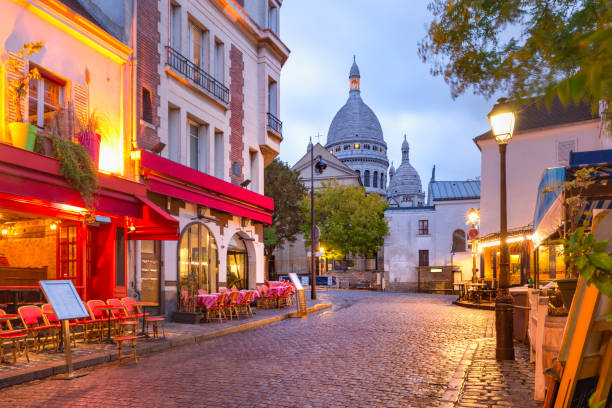
The Ville de Paris identifies Montmartre as the site of the cannon seizure attempt and the deaths of Lecomte and Clément-Thomas in its official guide to emblematic Commune locations, “Les lieux emblématiques”. On the ground, however, the contemporary visitor sees a neighborhood profoundly altered after 1871. The street names and alignments require care; the old rue des Rosiers associated with the executions should not be confused with the Marais street of the same historical name. The present basilica of Sacré-Cœur, begun after the Commune, dominates the hill and visually overwrites the earlier landscape.
Sacré-Cœur demands particular restraint. It is commonly described as a monument built simply to punish or expiate the Commune. That formula is too neat. The project arose from Catholic vows made amid military defeat and national crisis, and its promoters framed France’s misfortunes in moral and religious terms. Yet the choice of Montmartre, the post-Commune political climate and later polemics made the basilica inseparable from the struggle over 1871. It is best understood not as a literal plaque explaining the uprising, but as a powerful later layer in the hill’s contested memory.
Montmartre thus presents the first interpretive test. The key event was not a picturesque barricade scene but the failure of an operation to restore state control. The hill’s later fame can obscure the mechanics: artillery, command, crowd formation, refusal of obedience and the rapid retreat of government authority. Once the troops and officials withdrew toward Versailles, Paris did not simply become ungoverned. Competing institutions rushed to govern it.
Hôtel de Ville: municipal power, revolutionary theatre and archival loss
The Hôtel de Ville gave the uprising a center. The Central Committee of the National Guard occupied the building, organized elections and transferred authority to the elected Commune, proclaimed on 28 March. Its placement mattered. Parisian revolutions had repeatedly used the municipal palace as a stage on which a new political order could announce itself. Possession of the Hôtel de Ville made a claim not only to administrative control but to the historic sovereignty of the capital’s people.
The Commune council met there, but it was not a unified cabinet following a settled program. Its members included Jacobins, Blanquists, internationalists, socialists, republicans of different generations and independent radicals. They disagreed over executive power, military priorities, the Committee of Public Safety, relations with the arrondissements and the balance between symbolic decrees and urgent defense. Measures associated with the Commune included the separation of church and state, support for secular education, the remittance of certain rents, the reopening of abandoned workshops through worker associations, and recognition of elected or accountable public authority. Implementation was uneven because the government existed under military pressure and for only a matter of weeks.
The square outside the Hôtel de Ville was a political theatre of ceremonies, crowds, uniforms, banners and proclamations. That theatre should not be mistaken for total control. The Commune’s authority had to pass through arrondissement town halls, National Guard battalions, commissions, clubs, newspapers and local committees. Some decisions were ambitious statements of principle; others responded to food, finance, public services and war. The building was central because it condensed these claims, not because every part of revolutionary Paris obeyed it smoothly.
The structure visible today cannot serve as an unchanged witness. During the final fighting in May, the nineteenth-century Hôtel de Ville burned. It was later rebuilt in a historicizing form that recalls its predecessor while belonging to the post-Commune city. The reconstruction is itself political evidence: the Third Republic restored a municipal palace on the same site, reclaiming the symbol while removing the ruin through which the Commune might have remained materially present.
The fire also destroyed evidence. The Archives de la Seine had been housed at the Hôtel de Ville, and the loss encompassed extensive parish, civil-status, corporate, religious and judicial records. The official history of the Archives de Paris explains the scale of the destruction and the institutional effort that followed. This is more than an archival footnote. It changes how historians can know nineteenth-century Paris. The Commune’s end did not merely leave images of burning administration; it created gaps in the records through which earlier lives and institutions would otherwise be traced.
At the Hôtel de Ville, therefore, three histories overlap. There is the history of revolutionary municipal government, the history of urban destruction during civil war, and the history of a later republic rebuilding authority in familiar architectural language. The façade offers continuity. The evidence underneath it records rupture.
The Commune was a network, not one square
Concentrating on three famous sites can unintentionally imply that the Commune moved in a clean line from Montmartre to the Hôtel de Ville and then to Père Lachaise. In practice it operated through a dispersed Paris. Arrondissement mairies handled local administration. National Guard units were rooted in particular quarters. Political clubs met in churches and public halls. Newspapers created daily arguments about authority and betrayal. Barricades were built where local topography, available materials and defensive judgment allowed.
Several additional places clarify different phases. The Place Vendôme embodied imperial military glory through its column, which the Commune pulled down. The Tuileries Palace and other government buildings became sites of fire during the final week. The Ministry of Finance and the Banque de France represented the practical problem of money and state continuity. The prison of La Roquette and the rue Haxo are tied to the killing of hostages by Communards as defeat approached. Western gates mark the entry of Versailles troops; eastern districts mark the contraction of resistance.
This geography prevents a partisan morality play. The Commune combined democratic aspiration, social experimentation, factional conflict, administrative improvisation and coercion. The Versailles government combined a claim to national legality with a campaign of overwhelming force, summary killing and mass arrest. Civilians lived inside both systems of fear. Places matter because they expose the sequence and scale of choices. They make it harder to turn either camp into a single moral character.
Primary evidence: what can actually be seen, read and tested
The Commune was one of the first major European political conflicts to leave a dense photographic record. That does not mean photographs provide a transparent view. They are objects produced by particular operators, under technical constraints, for audiences who often encountered them after events had moved on. Long exposure times favored static barricades, posed groups, damaged buildings and carefully arranged scenes. Combat itself was rarely captured in the modern sense.
Bruno Braquehais produced some of the most important images of the Commune, including barricades, National Guards and the Vendôme Column before and after its fall. His photographs can feel immediate because they show streets and figures rather than allegorical engravings. Yet even these images require questions: who chose the position, whether the subjects posed, when the print was circulated, and what caption later accompanied it. A photograph of a barricade can document construction, clothing, weapons and urban setting while still failing to explain who ordered it, how long it stood or what happened there.
Eugène Appert’s series commonly known as Crimes de la Commune demonstrates the opposite problem. These were staged or composite reconstructions of violent episodes, presented with the visual authority of photography. They helped transform political accusation into seemingly witnessed fact. Their value today lies partly in their unreliability as direct reportage: they reveal how quickly photography became an instrument of post-conflict narrative. A viewer who cannot distinguish Braquehais’s street record from Appert’s fabricated scenes may leave with a vivid but false sense of evidence.
The broader history of the medium matters here. Paris had already become a laboratory for photographic portraiture, urban documentation and public celebrity. The story of Daguerre and Nadar in Paris provides useful support for understanding why images of 1871 carried such authority and circulated through an established visual culture. The Commune did not invent political photography, but it showed how photographs could be evidence, commodity, souvenir and prosecution tool at the same time.
Printed material is equally important. The Journal officiel of the Commune records decrees and administrative language. Newspapers such as Jules Vallès’s Le Cri du Peuple convey argument, urgency and factional position. Posters and proclamations pasted on walls show the government addressing citizens in compressed public form. Caricatures reduce adversaries to recognizable types, often with cruelty. Letters and diaries disclose uncertainty unavailable in retrospective manifestos. Police interrogations and trial records preserve testimony under coercive conditions and must be read accordingly.
Objects add another register. National Guard uniforms, weapons, medals, seals, printing plates, fragments of damaged buildings, commemorative ribbons and personal possessions make institutions tangible. Yet an object’s later collecting history can alter its meaning. A rifle displayed as an emblem of popular defense may also have been catalogued by police as evidence of rebellion. A red scarf may become a relic only because descendants, veterans or activists preserved it. Museum labels are therefore part of the evidence chain, not neutral endpoints.
The most rigorous method compares unlike sources. A decree can be checked against minutes, a newspaper claim against another paper, a photograph against a map, a memoir against a trial file, and a commemorative plaque against the date it was installed. Contradictions are productive. They show which parts of the story were stable, which were disputed immediately, and which acquired certainty only through repetition.
One particularly revealing comparison concerns ruins. Photographs of the burned Hôtel de Ville, Tuileries Palace and other buildings were circulated as proof of Communard barbarism. The destruction was real, and Communards did set major fires. But a complete account also asks what was damaged by artillery and street fighting, why retreating forces chose fire, how government imagery grouped different losses together, and why some ruins were restored while others were erased. The image does not become less true when placed in context. It becomes more exact.
The Vendôme Column: a monument can be both object and argument
The Vendôme Column offers a compact lesson in the politics of objects. Created under Napoleon I and sheathed in bronze reliefs celebrating military victory, it represented imperial conquest in one of Paris’s most formal squares. The Commune decreed its demolition as a repudiation of militarism and imperial glory. It was pulled down on 16 May 1871 in a carefully prepared public event.
Photographs of the fallen column became evidence for opposing claims. Supporters could read the horizontal monument as the defeat of chauvinism. Enemies could read it as vandalism directed at national history. Gustave Courbet, who had advocated dismantling or relocating the monument, was later held financially responsible for its reconstruction, though the relationship between his proposal and the final demolition order was more complicated than the punishment suggested. The column was re-erected in the 1870s.
Standing there now, the visitor confronts an apparent original that has already been toppled, fragmented and reconstructed. That sequence is the point. The object does not simply survive the Commune; it contains the history of the state’s decision to restore the symbol that the Commune had rejected. A monument can therefore testify less through untouched fabric than through its cycles of destruction and return.
When an on-site day becomes more than three disconnected stops
Montmartre, the Hôtel de Ville and Père Lachaise are far enough apart in meaning that an unguided visit can produce three separate impressions: origin, government and defeat. The deeper value comes from connecting each site to the right class of evidence. At Montmartre, military orders and topography matter more than bohemian atmosphere. At the Hôtel de Ville, council divisions and archival destruction matter more than the present façade. At Père Lachaise, the history of later pilgrimage matters as much as the last fighting.
For political-history travelers, this is where expert interpretation changes the result. A specialist can distinguish a surviving wall from a later memorial focus, a contemporary photograph from a staged reconstruction, and a post-1871 monument from the landscape it replaced. That is the useful role of a tailored day, not simply adding more facts. Orange Donut Tours’ private Paris touring options provide the commercial next step when the aim is to connect dispersed evidence without losing the argument between sites. Inquire now
The standard is intellectual rather than ceremonial: each stop should answer a different question, and the transitions should explain why authority moved from one part of Paris to another. The reward is a city that becomes an archive rather than a backdrop.
Bloody Week: reading defeat from west to east
The final phase began when Versailles forces entered Paris on 21 May. The geography of the advance matters. Government troops came through the west and moved across the city, while Communard resistance contracted toward the north and east. This was not a single battle but a series of street engagements, artillery positions, barricades, arrests and executions. The movement across Paris explains why the Commune’s memory is distributed: different quarters encountered the defeat on different days and under different conditions.
Broad avenues could facilitate the army’s advance, but the conquest was neither automatic nor bloodless. Barricades delayed troops at selected points; defenders used familiar streets and elevated terrain; government forces outflanked positions through buildings and side routes. The imbalance in organization, numbers, artillery and command nevertheless favored Versailles. As the perimeter shrank, political and military decisions became more desperate.
Major public buildings burned during the week, including the Tuileries Palace and the Hôtel de Ville. Communards deliberately set several of the fires as acts of destruction, denial or symbolic retaliation. Later polemic condensed the fires into the figure of the pétroleuse, a supposedly ubiquitous female incendiary. Women did participate in the Commune in substantial and varied ways: organizing relief, debating in clubs, working in ambulances, supporting defense and, in some cases, fighting. But the pétroleuse panic often turned rumor and misogyny into justification for arrest or violence against women seen with bottles or containers. The myth is evidence of counterrevolutionary fear, not a reliable census of arson.
Communard forces also killed hostages. Archbishop Georges Darboy and other prisoners were executed at La Roquette; additional captives were killed at the rue Haxo. These acts belong in the account without euphemism. So do the summary executions carried out by Versailles troops, often after rapid identification based on clothing, weapons, denunciation or suspicion. Prisoners were gathered in large numbers, marched, confined, tried, imprisoned or deported. The death toll remains debated, but the scale of killing was immense.
Because the violence was later used to validate opposing political identities, precision is essential. Explaining the disproportionate force of the repression does not require denying Communard violence. Recording hostage killings does not turn the government campaign into a neutral police action. The city’s sites help maintain that distinction. La Roquette and rue Haxo point to one set of crimes; mass execution sites, prison routes and cemeteries point to another.
The west-to-east movement also explains why Père Lachaise became so powerful. By the time fighting reached the cemetery and surrounding districts, the Commune’s political institutions had largely ceased to function as a coordinated government. The conflict had become a shrinking military defense and a series of local last stands. Père Lachaise is therefore not merely the final chapter. It is where a municipal revolution was recast, through defeat, as martyrdom.
Père Lachaise: battlefield, burial ground and political shrine
Père Lachaise already carried immense symbolic weight before 1871. It was a landscaped cemetery filled with famous graves, family monuments and pathways through which private mourning became part of public culture. During Bloody Week, its walls, elevation and dense funerary architecture gave it military value. Fighting took place among tombs, and government troops overcame the remaining defenders.
The best-known narrative holds that 147 fédérés were shot against a cemetery wall on 28 May and buried nearby. The Mur des Fédérés became the central site of Commune commemoration. Yet the exact number, precise location and relationship between execution, burial and the wall later used for ceremonies have been debated by historians. That uncertainty does not empty the site of meaning. It clarifies that the wall’s power was constructed through repeated acts of remembrance as well as through the violence of 1871.
This is the critical difference between a battlefield marker and a political shrine. At a battlefield marker, the visitor often asks what happened at that exact spot. At the Mur des Fédérés, one must also ask who came later, under what banners, and what they wanted the dead to mean. Socialists, communists, trade unionists, anarchists, republican groups, descendants and international visitors have not all interpreted the Commune identically. Their processions turned one section of the cemetery into a durable place of collective identity.
The cemetery itself complicates any singular message. Nearby graves and monuments belong to multiple political traditions, victims and protagonists. Later memorials can stand close to older family tombs. The landscape absorbs conflict into an environment designed for continuity and mourning. That coexistence is more revealing than a purified memorial park would be. It shows how the Commune entered Parisian civic memory without achieving an uncontested official meaning.
A visitor should also resist imagining the entire cemetery as a frozen battlefield. Paths, vegetation, tombs, maintenance practices and commemorative installations have changed. The surviving wall is meaningful, but it does not provide an untouched panorama of May 1871. Maps, photographs and contemporary accounts are needed to reconstruct the fighting. The site’s visible form speaks most clearly about remembrance.
From suppression to pilgrimage: how later regimes changed the memory
Immediately after defeat, the dominant official language treated the Commune as criminal insurrection. Trials, imprisonment, deportation and exile dispersed its participants. The new Third Republic eventually stabilized itself as a republican regime, but that did not mean it adopted the Commune as a founding ancestor. Republican institutions could honor 1789, national defense or municipal liberty while distancing themselves from the social revolution and civil war of 1871.
The amnesty of 1880 allowed many surviving Communards to return. Return changed memory from clandestine loyalty into visible organization. Veterans could publish, assemble, preserve papers and participate in commemorations. An association of former Communards founded in 1882 helped sustain personal and political continuity. Annual gatherings at Père Lachaise transformed mourning into public claim: the defeated had descendants, organizations and a place in the city.
Different movements selected different inheritances. Revolutionary socialists emphasized workers’ power and the destruction of the old state. Reformist republicans could praise municipal democracy while rejecting insurrection. Anarchists found anti-authoritarian strands but criticized governmental forms. Communists after 1917 interpreted the Commune through Lenin’s analysis of state power and proletarian revolution. Trade unions foregrounded labor organization and repression. Feminist historians recovered women whose work had been minimized or caricatured, including Louise Michel, Elisabeth Dmitrieff, Nathalie Lemel and participants in the Union des femmes.
These readings did not simply accumulate; they competed. Louise Michel, for example, became a global icon whose later anarchism, deportation to New Caledonia, teaching and activism reshaped how her Commune role was remembered. The red flag could signify municipal revolution, socialism, communism or a broader culture of resistance depending on the commemorator. The Wall could be a grave, a rallying point, a workers’ memorial or an international revolutionary symbol.
Official silence was never total, but it was often selective. Streets, plaques, school curricula, municipal exhibitions and national ceremonies did not move in step. Local left-wing authorities might sponsor remembrance while the central state remained cautious. The 1971 centenary is especially revealing. In a scholarly study of that anniversary, Cerf and Zwirn describe a dispersed field of political, university and cultural initiatives and contrast extensive commemorative activity with the relative silence of official France. Their analysis, available through Persée’s study of the centenary and its memory, shows that absence from a national ceremony does not equal absence from public culture.
Commemoration also changed as the people with direct memory died. Veterans’ testimony became archives; family relics became museum objects; political songs became performance traditions; photographs were reproduced without their original captions. Each transfer could preserve and simplify at once. A veteran might remember uncertainty, argument and fear. A later movement might prefer a coherent heroic narrative. Historians then return to the documents to recover conflict within the Commune rather than only conflict between Commune and Versailles.
The centenary and later anniversaries expanded the range of institutions involved. Universities held conferences, libraries displayed manuscripts, museums assembled objects, publishers reissued memoirs, and municipalities mapped local sites. The resulting memory became more historically informed but not apolitical. Scholarship can correct invented scenes or inflated certainties, yet choosing to exhibit the Commune is itself a statement about what belongs in national history.
Paris today contains both recognition and residue. Plaques name people and events once excluded from official honor. The Mur des Fédérés remains active as a commemorative destination. Hôtel de Ville exhibitions and city publications have integrated the Commune into municipal history. At the same time, the most famous skyline of Montmartre is dominated by a basilica whose relationship to 1871 remains contested. The city has not resolved the Commune into consensus. It has made the argument visible.
The museum at Saint-Denis: why collections matter more than relic hunting
For travelers who want objects rather than only sites, the major dedicated collection lies outside central Paris at the Musée d’art et d’histoire Paul Éluard in Saint-Denis. Its Commune holdings grew from a successful exhibition in 1934 that prompted donations and acquisitions. The museum describes a collection of more than 10,000 items, including prints, caricatures, drawings, periodicals, bound albums, posters, photographs, paintings and other material. The institutional account is set out in the museum’s presentation of its renewed Commune display.
The scale matters because it shifts attention away from the hunt for a single authentic relic. A large collection allows comparison: official proclamation beside hostile caricature, portrait beside police record, battlefield photograph beside staged image, veteran keepsake beside later poster. It also reveals how memory was collected. The 1934 exhibition did not merely display an already complete archive; it stimulated the creation of one through public response.
Saint-Denis adds geographic meaning. Long associated with working-class politics and a powerful municipal left, it became an appropriate custodian for material that national institutions had not always foregrounded. Yet the collection should not be treated as a shrine exempt from criticism. Its labels, selections and gallery design belong to later moments. The museum is strongest when visitors read both the 1871 object and the twentieth- or twenty-first-century decision to preserve it.
How to read the surviving city without pretending it is unchanged
A productive Commune itinerary uses five tests at every stop.
- What happened here, and on what date? This guards against merging the uprising of 18 March, the elected Commune of late March, the internal political conflicts of April and the military collapse of May.
- What physical fabric survives? A wall, street alignment or monument may be original, reconstructed, moved, renamed or entirely later.
- Which primary sources support the claim? Contemporary photographs, maps, decrees, newspapers and trial files do not carry equal evidentiary weight.
- When did commemoration begin? A plaque installed decades later may say more about its sponsors than about the visibility of the event in 1871.
- What interpretation is being advanced? Words such as martyr, insurgent, citizen, criminal, victim and revolutionary are not interchangeable.
Applied to Montmartre, these tests separate the artillery crisis from the later basilica landscape. Applied to the Hôtel de Ville, they distinguish the Commune’s seat from the reconstructed municipal palace and the archive that vanished. Applied to Père Lachaise, they distinguish combat and execution from the long life of the Mur des Fédérés as a political destination.
They also reveal why one iconic image is never enough. The fallen Vendôme Column needs the decree that condemned it, the photographs that documented it, the debates around Courbet, the state’s decision to rebuild it and later interpretations of militarism. The burned Hôtel de Ville needs the council that governed there, the urban fighting that preceded the fire, the records lost inside and the republic that reconstructed the façade. The wall at Père Lachaise needs both the contested event and the processions that made it central.
For a broader Paris stay, the Commune is best treated as a specialist historical layer rather than a decorative addition to Montmartre sightseeing. It rewards readers who are willing to compare sources, accept uncertainty and allow buildings to carry more than one political era. The city does not offer a perfectly preserved revolutionary route. It offers something more demanding: fragments whose later uses are themselves evidence.
What the three places finally reveal
Montmartre, the Hôtel de Ville and Père Lachaise form a coherent arc only when their differences remain intact. Montmartre explains how state disarmament failed and popular authority emerged. The Hôtel de Ville explains how that authority tried to become government, while also exposing the fragility of institutions and archives under civil war. Père Lachaise explains how military defeat became a durable politics of mourning.
The Commune’s Paris is therefore not hidden beneath the modern city waiting to be uncovered in pristine form. It survives through reconstruction, loss, collection and ritual. A rebuilt façade can testify to an erased ruin. A photograph can document a barricade or fabricate a crime scene. A cemetery wall can gather meaning far beyond the exact certainty of what occurred against it. A museum collection can preserve 1871 while revealing the politics of 1934, 1971 or the present.
That is the interpretive payoff of following the event through place and memory. The question is not whether Paris remembers the Commune. It plainly does. The question is which Paris remembers it: the besieged capital, the revolutionary municipality, the victorious republic, the workers’ movement, the archive, the museum, or the city visitor looking for a stable story. The answer is all of them, but never in the same voice. Reading those voices against one another is what turns three famous locations into a serious history of 1871.
If you’re interested in any private tours of Paris, please reach out to us.



 So if you are looking for the absolute best in Paris & surroundings with authentic local fully-licensed native guides whose English you can actually understand and with an exclusive and amazingly fun itinerary













