Can a Wheelchair-Using Private Group Share Versailles Palace and Gardens?

Updated
Yes, a wheelchair-using private group can share the Palace of Versailles and a meaningful part of the estate, but the defensible plan is a sequence of shared segments rather than one identical, uninterrupted route. The Palace is the most reliably shared zone: the estate states that wheelchair users can access visitor-open areas and that lifts serve every level open to visitors. The gardens require a different test. A route may be described as accessible while still involving a steep ramp, long outdoor distances, changing surface resistance, exposure to weather and a transport dependency. Trianon adds another layer because the buildings, gardens and links between them do not have the same access profile.
The practical question is therefore not simply, “Is Versailles accessible?” It is, “Which parts can this particular group experience together, at what effort, and with what rejoining plan if circulation briefly diverges?” That distinction matters for a multigenerational party. One traveler may use a power chair, another may self-propel a manual chair, an older relative may walk slowly, and children may have abundant energy until the Palace has already consumed their concentration. A route that is technically possible for one person may still be a poor shared day for the party.
The operational facts in this guide were checked on 18 August 2026. Versailles publishes a dedicated official page for visitors with reduced mobility, but entrance procedures, lift availability, weather closures, estate transport and temporary works can change. Reconfirm the exact route against the group’s chair dimensions, transfer needs and admission format before travel. Step-free access should never be treated as a promise of low effort.
The useful answer is a segmented yes
A coherent Versailles day is easiest to understand as five linked tests: arrival, Palace circulation, the transition into the gardens, movement across the estate, and the optional Trianon extension. The group is likely to share some of those tests completely and others conditionally.
- Arrival and the Palace: usually shareable, provided the correct entrance and drop-off procedure are confirmed for the party’s booking type. Lifts support access to visitor-open levels, but lift users may take a parallel circulation line and rejoin the rest of the group a few rooms later.
- Upper gardens near the Palace: the strongest outdoor shared segment. The Water Parterre and the first view over André Le Nôtre’s Grand Perspective deliver the visual logic of Versailles without committing the party to the full descent.
- Latona, the Tapis Vert and the lower gardens: conditionally shareable. The estate’s own reduced-mobility route warns that the lateral ramp beside the Latona Basin exceeds the regulatory slope threshold, and the Tapis Vert alone runs for 335 metres. The return is an ascent unless transport changes the geometry.
- Grand Canal and Trianon: shareable only when the movement plan is real rather than assumed. The little train, an accessible electric vehicle, or vehicle access within the Park may preserve the group; each has capacity, boarding and timing questions.
- Grand Trianon, Petit Trianon and the Queen’s Hamlet: not one uniform accessible zone. They can be selected independently, and several internal links or upper levels are inaccessible. A party can still share a good Trianon visit by choosing one or two zones and naming rejoining points before anyone separates.
This is different from a compact Paris neighborhood, where an inaccessible street can often be bypassed within a few minutes. Versailles is an estate measured in long axes. The consequence of a wrong turn is not merely an awkward curb; it can be a draining descent, an uncertain wait for transport, or a forty-minute separation between relatives who thought they were following the same plan. For a useful comparison with a city route whose obstacles are steepness and street texture rather than estate scale, see compare Versailles with Montmartre’s wheelchair-access tradeoffs.
Start with the fixed Palace entry, not with an idealized estate map
The Palace admission time is the day’s fixed commitment. Everything else should be arranged around it. This sounds obvious, but accessibility planning often begins with a map of ramps and lifts while overlooking the operational question that determines the first hour: which entrance applies to this party?
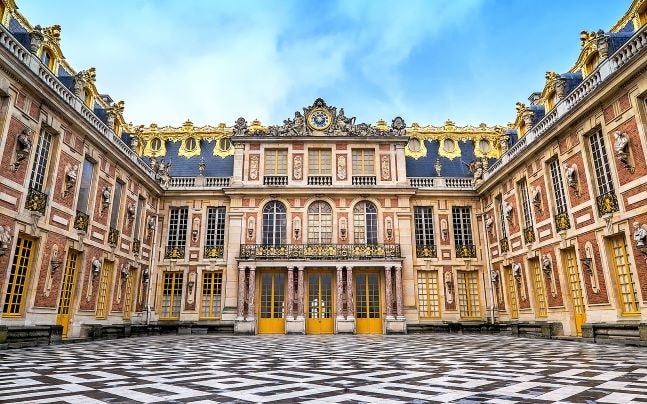
Versailles publishes several relevant rules on its official practical-information page. Groups are directed to Entrance B in the Gabriel Pavilion, on the right side of the Main Courtyard. The same page says that, with proof of disability, a traveler may be dropped off in the Main Courtyard near Entrance B. Yet the dedicated reduced-mobility page directs a disabled visitor and one companion seeking free admission to Entrance A. Those statements describe different operational categories rather than one universal path.
For a private party, the planning implication is precise: do not assume that “wheelchair user,” “group,” “guided visit” and “free companion admission” all point to the same door. Ask which entrance applies to the actual reservation and whether the entire party may remain together through screening. The answer may depend on whether the visit is processed as an individual booking, an accredited group, a scheduled guided visit or another format. The official pages verify the available pathways, but they do not remove the need to match the pathway to the booking.
The drop-off is equally important. Place d’Armes is visually close to the Palace, but “close” on a map does not describe the effort of crossing a monumental approach, managing security, and reaching the correct side of the courtyard. The official allowance for a disability drop-off near Entrance B can materially reduce pre-visit exertion. It is most useful when the driver or transfer coordinator knows the proof required, the authorized access point, the exact handoff place and what will happen after the vehicle leaves. A vague promise to “drop at Versailles” is not enough.
What the arrival plan should settle
- Booking category: whether the party is entering as individuals, a private guided group or another recognized format.
- Admission entitlement: the estate states that entry is free for a disabled visitor and one companion upon presentation of qualifying proof. Other members of the party remain subject to their own admission arrangements.
- Door and meeting point: Entrance A, Entrance B or a designated guided-visit point, confirmed rather than inferred.
- Drop-off and later collection: whether the vehicle may enter the Main Courtyard, where it will wait or leave, and which estate exit will be used at the end.
- Mobility equipment: whether the traveler will remain in a personal chair throughout. Loan wheelchairs are available for interior visits at the Palace, Grand Trianon and Petit Trianon, but the Palace states that those chairs cannot be used outside in the gardens.
That last distinction prevents a common planning error. An interior loan chair can solve a short-term Palace need; it does not create an estate-wide mobility solution. A traveler who arrives walking with limited endurance and expects to borrow a chair for the gardens may discover that the equipment is restricted to the interiors. The outdoor plan must therefore stand on its own.
Arrival is also the right moment to define the first bailout. If screening, crowd density, pain or fatigue is already worse than expected, the party should know whether it will continue with the Palace only, shorten the state apartments, or abandon the outdoor extension. A bailout is defensible when it is named before it is needed. It is much harder to choose calmly when several relatives are already across the courtyard and the driver has no agreed return point.
Inside the Palace, lift access solves levels but not group choreography
The Palace is the part of Versailles most likely to be shared from beginning to end. The official accessibility statement is broad: visitor-open areas are accessible to wheelchair users, and lifts serve every level open to visitors. That is a substantial fact. It means the party should not begin from the assumption that the wheelchair user must skip the state apartments or the Hall of Mirrors.
It does not mean every member will move through every threshold in the same line. Historic-palace circulation is constrained by security, room sequence, visitor flow and the location of lifts. When stairs lie on the main visitor path, the wheelchair user and a companion may be directed to a lift or staff-controlled passage while the rest of the party continues along the public route. The separation may be brief, but it needs a named rejoining point. “We will meet after the lift” is not precise enough if the two routes emerge on different sides of a room.
The best rejoining point is selected with staff at the moment of divergence: a specific room entrance, the far end of a gallery, or another unmistakable supervised location. One companion stays with the wheelchair user unless staff directs otherwise; another adult remains responsible for children or slower walkers on the main route. The guide, when present, should not disappear with the faster half of the party and leave interpretation suspended for the person taking the accessible path.
This is where private guiding has a practical rather than ceremonial value. A guide who knows the historical sequence can pause the narrative before a split, give both halves a clear visual objective, and resume after the rejoin without making the wheelchair user feel that the essential material happened elsewhere. The outcome is not “special access.” It is continuity: the group still understands how the King’s State Apartment, the Hall of Mirrors and the Queen’s State Apartment relate, even if a lift briefly changes the line of movement.
Why a lift-served route can still be tiring
Palace fatigue is often cognitive and postural rather than distance-based. A wheelchair user may be seated, yet still manage pressure, pain, temperature, limited turning space and long periods without an easy change of position. A companion pushing a manual chair may work harder in starts and stops than on an open path. Older relatives may find standing in slow-moving rooms more difficult than walking at their own rhythm. Children may tolerate the first suite of rooms and then lose patience precisely as the group reaches the most crowded sequence.
The official reduced-mobility page notes that flat benches are available in reception and museum areas and that accessible toilets exist at multiple locations. Those are useful facilities, but they should not be translated into a promise that a seat or toilet will appear at the exact moment the group needs one. Before entering the main visitor sequence, identify the last reliable toilet, the next known opportunity to sit, and the point at which shortening the route remains simple.
Crowd conditions matter because a wheelchair changes the space a group needs to stop together. In a narrow flow, six relatives cannot form a semicircle around a guide without blocking others. The better pattern is compact: the wheelchair user has a clear sightline, the guide speaks from a position that does not force repeated turning, and the rest of the party gathers behind or to one side. A guide may also reserve deeper explanation for a wider gallery rather than trying to deliver every detail in a compressed doorway.
Versailles itself advises that school-holiday periods are very busy and suggests considering a Palace visit after 3:30 p.m. as one way to encounter lower visitor volume. That is not automatically the right answer for this audience. A later Palace entry can conflict with the later-opening Trianon estate, reduce the outdoor weather margin and push the return toward evening traffic. The useful lesson is that crowd avoidance, garden ambition and Trianon ambition cannot all be maximized on the same day. The party must decide which outcome matters most.
The Palace-only shared route is a complete option, not a failed full day
A group that completes the state apartments, pauses at the Water Parterre and then returns to its vehicle has still shared the core political and visual argument of Versailles. The Palace shows the machinery of monarchy indoors; the view from the terrace reveals how that authority was projected into the landscape. Reaching the Grand Canal or the Queen’s Hamlet adds scale and contrast, but it is not required for the visit to be intellectually whole.
This matters when a wheelchair user has limited sitting tolerance, when a caregiver has already expended substantial effort, or when another generation is becoming tired. The temptation to “get value” by adding the gardens can make the shared experience worse. A private group does not need to prove endurance. Its advantage is the ability to stop at a meaningful boundary rather than following the maximum itinerary implied by an all-estate admission.
For a three-generation Paris stay, that restraint also protects the rest of the trip. Versailles should be placed where the family has enough recovery margin before and after it, not inserted between two other demanding days. Plan another Paris day around three-generation energy when the group needs a gentler city counterpart to the estate.
The gardens are where “accessible” and “low-effort” separate
The Water Parterre immediately behind the Palace is the most reliable outdoor reward for a mixed-mobility group. From this upper level, the party can read Le Nôtre’s Grand Perspective: the Latona Basin, the Tapis Vert, the Apollo Basin and the Grand Canal align below. That view provides the estate’s governing idea before anyone commits to the descent. For some groups, this should be the planned garden experience rather than merely the first five minutes of a longer one.
The estate’s official reduced-mobility garden route is unusually revealing. It recommends allowing about three hours. It also directs visitors toward the lateral ramp beside the Latona Basin while warning that the slope exceeds the regulatory threshold. Those two facts should change expectations. An official accessible itinerary can be long, and a route included within it can still contain a gradient that is unsuitable for some wheelchair users without assistance.
The slope warning is not a minor technical note. A power chair’s safe operating gradient, a manual chair user’s propulsion capacity and an attendant’s ability to control a descent are different questions. Wet conditions, hand strength, chair weight and anti-tip configuration can alter the answer again. The group should not decide at the top of the ramp based on appearance or on another traveler’s experience. It should decide beforehand whether that precise gradient is within the traveler’s equipment and comfort limits, and what alternative preserves the day if it is not.
Surface is a performance variable, not a label
The official route verifies the sequence and flags specific gradients, but it does not publish a metre-by-metre surface specification for every garden allée. That absence is important. “Outdoor accessible route” does not tell a manual chair user how much rolling resistance to expect after rain, whether a recently maintained path feels compact or loose, or how much vibration a particular chair and cushion will transmit. The same mapped line can be manageable in a power chair and exhausting when self-propelled.
A useful pre-visit check therefore describes the traveler and chair, not merely the disability. Ask about current conditions for a power chair, a rigid manual chair, a folding chair pushed by a companion, or a mobility scooter as applicable. Include chair width, total weight, transfer ability and tolerance for uneven outdoor movement. The estate’s specific-needs team can give route advice, and staff on site may direct visitors through more accessible passages that are not part of general public circulation. Neither contact should be reduced to the vague question, “Is it wheelchair accessible?”
The group also needs to distinguish descent effort from return effort. Going down toward Latona and the Grand Canal can feel deceptively easy for walking relatives. A manual chair user or companion is managing braking and control rather than simply coasting. Later, the same axis becomes an ascent. Unless the route ends at transport, every metre descended creates a future energy obligation.
The Tapis Vert is a distance test hiding in a view
The Royal Walk, usually called the Tapis Vert, is 335 metres long according to the official route. That number concerns only one prominent segment, not the Palace-to-canal journey as a whole. Its visual simplicity can be misleading: because the axis is straight and the destination remains in view, the group may underestimate how long it has already been moving and how far it would need to return.
For a wheelchair-using party, the relevant unit is not just metres. It is metres multiplied by gradient, surface resistance, crowding, temperature and the number of stops. A family that pauses for sculpture, photography and explanation may spend much longer on the axis than a map suggests. A companion pushing uphill later may have no reserve left for Trianon, even though the timetable appears to allow it.
The official route identifies accessible toilets near the Girandole area, Little Venice and the Dauphin’s Grove. These are useful anchors for planning, but facilities should be checked on the current estate map because openings and routes can change. Little Venice, near the Apollo Basin and the Grand Canal, is especially valuable as a decision point: it offers services and connects toward estate transport. Once the group reaches it, the next move should be chosen deliberately rather than by momentum.
Four defensible garden choices
- Upper-terrace view only: share the Water Parterre and Grand Perspective, then return toward the Palace exit. This has the lowest transport dependency and preserves the strongest visual relationship between architecture and landscape.
- Upper gardens plus Latona: approach only if the current accessible line and the warned-about slope suit the chair and assistance available. The group should know whether it will climb back or continue to transport below.
- Axis to Apollo and Little Venice: a substantial garden commitment. It should end with a confirmed onward or return movement plan, not a hope that a vehicle or train will be convenient on arrival.
- Selected garden circuit by accessible electric vehicle: potentially the most coherent way to share wider views without making distance the main event. Verify the current rental procedure, boarding method, wheelchair configuration, operating limits and weather policy.
Fountain and Musical Gardens days change more than atmosphere. They can affect garden admission, grove access, crowd patterns and the logic of a reduced-mobility route; the official accessibility itinerary itself recommends other days for its standard three-hour circuit. Before locking the date, check how fountain-season programming changes a Versailles day. The aim is not automatically to avoid programmed days, but to understand that an entertainment schedule and an access route may pull the group in different directions.
For families, the upper-terrace choice has another advantage: it lets the Palace remain the shared cultural center rather than turning the afternoon into a test of who can cover the most ground. Children can identify the long axis and mythological basins from above; older relatives can absorb the composition without a forced descent; and the wheelchair user is not placed in the role of limiting an itinerary that was unrealistic from the start.
Estate transport can keep the group together, but only after a capacity check
Versailles offers three broad ways to reduce the long transition between the Palace, Grand Canal and Trianon: the little train, an electric vehicle hired on the estate, and authorized vehicle access within the Park. They are not interchangeable. Each changes who can remain together, where the party can stop, how certain the return is and what happens if weather or demand disrupts service.
The official little-train information describes a circuit linking the Palace North Terrace, Petit Trianon, Grand Trianon, the top of the Grand Canal near Little Venice and the Palace. A passenger with a circuit fare may leave and reboard at different stops. The operator states that the train is accessible with the driver’s help and can carry one or two wheelchairs.
Those facts make the train useful, but they do not guarantee a whole private group will board or reboard together at the desired moment. A capacity of one or two wheelchairs is not a reservation for those spaces, and a wheelchair place does not establish how many relatives can accompany the traveler on the same departure. Service intervals vary by season, and people already holding return passage receive priority in some waiting situations. A group that treats the train as an on-demand shuttle may therefore create exactly the separation it hoped to avoid.
At this point the private-service relevance becomes concrete. When the day depends on the correct Palace drop-off, a fixed entry, a verified chair-compatible movement option and four named rejoining points, coordination protects shared time rather than adding ceremony. A guide and driver who work from the same route brief can change the plan before the party becomes scattered across the estate. For a tailored assessment of that sequence, Inquire now.
Use stops as named rejoining points
The train circuit does provide four unusually clear landmarks. They can become the group’s rejoining architecture even when different members move in different ways:
- Palace North Terrace: the starting or final estate-transport point near the upper gardens.
- Little Venice at the Grand Canal: the natural decision point after a long garden descent.
- Grand Trianon: a strong independent destination with a main entrance and nearby vehicle access.
- Petit Trianon: the gateway for the palace, its gardens and the longer continuation toward the Queen’s Hamlet.
A rejoining instruction should include the stop, the side or landmark, the responsible adult and a time rule. “Meet at Grand Trianon” is weaker than “wait at the main visitor entrance beside the transport stop; one adult remains with the wheelchair user; no one begins the garden path until the whole party is present.” This may sound formal for a family day, but Versailles is large enough that casual coordination fails quickly.
An accessible electric vehicle can offer more control over sequence and pauses. The official garden and Trianon routes recommend it as a mobility aid, including for travel between the Palace and Trianon. Yet “accessible electric vehicle” still requires operational questions: whether the traveler remains in the chair, whether a transfer is required, which chair types fit, how many companions can travel, whether the vehicle may be reserved, and which surfaces or zones it may enter. Do not infer these details from the accessibility label.
Authorized vehicle access in the Park can be the most robust option for a traveler who cannot rely on the little train or an on-site rental. Versailles states that, with proof of disability, vehicle entry and parking near the Trianon palaces can be free, with reserved spaces. This can transform Trianon from a long continuation across the estate into a second arrival. It also means the group may leave the central gardens, regroup at the vehicle and approach Grand Trianon or Petit Trianon from the Park side rather than forcing one continuous route.
Trianon works best as a choice among zones, not a compulsory sequence
The Estate of Trianon opens later than the Palace and is substantial enough for its own afternoon. The official reduced-mobility Trianon route recommends allowing a full afternoon and explicitly says that Grand Trianon, Petit Trianon and the Queen’s Hamlet can be visited independently. That is the most useful planning fact in the entire Trianon brief. It gives the group permission to select rather than complete.
Grand Trianon is the strongest shared Trianon choice for many parties. Access ramps are available at the Trianon palaces, and the principal visitor route through Grand Trianon offers a concentrated contrast with the main Palace: lower scale, pink marble, the open Peristyle and rooms associated with both Louis XIV and the Napoleonic period. The official route notes two limits. The French gardens of Grand Trianon are not accessible to visitors with reduced mobility, and the garden path linking Grand Trianon to Petit Trianon is also inaccessible. The wheelchair-using traveler should leave by the main entrance and use an accessible exterior connection rather than following relatives into the garden link.
That creates a clear shared-and-split decision. The party can visit Grand Trianon together, then either all return to the main entrance and transfer onward, or allow a brief optional garden look for some members while the rest wait at a precisely agreed point. The latter should be short and subordinate. It is poor group design to send walking relatives through the inaccessible connection with no reliable arrival time at Petit Trianon.
Petit Trianon offers a partial interior rather than full vertical access. The official route states that the first floor is not accessible to people with motor disabilities. A ground-floor audiovisual room helps communicate the inaccessible upper spaces. This is a thoughtful interpretive substitute, but it is still a substitute; the article should not blur that distinction. The group can share the ground level, then decide whether anyone will continue upstairs while the wheelchair user uses the audiovisual presentation with a companion.
The right answer depends on the party’s priorities. When the family cares most about staying together, everyone can remain on the accessible level and treat the upper floor as omitted. When a teenager, architectural specialist or first-time visitor strongly wants the upper rooms, a short split can be acceptable if the rejoin is at the ground-floor exit and the interpretation is not delivered exclusively upstairs. The wheelchair user should not become the person waiting without context while the “real visit” happens elsewhere.
The Petit Trianon gardens contain further distinctions. The official route recommends a gentler line into the French garden by taking the second path on the left after a tree. It also states that the Queen’s Theatre is not wheelchair accessible. The route continues through the English garden toward the Queen’s Hamlet, but that continuation adds distance, outdoor surface exposure and another return problem. The fact that a route is published does not mean every group that has already toured the main Palace should undertake it late in the day.
The Queen’s Hamlet is best treated as its own ambition. It appeals strongly to families because the landscape feels less formal and the story of Marie Antoinette becomes tangible. Yet the Hamlet is not a small exhibit attached to Petit Trianon. Reaching and exploring it extends the outdoor movement chain, and the group must still return to transport. For a party with a fixed morning Palace entry, the Hamlet should usually replace a deep formal-garden circuit or an extended Grand Trianon visit, not be added to both.
Three coherent Trianon versions
- Grand Trianon only: the most compact, historically substantial choice. Arrive by confirmed transport, tour the accessible interiors together, omit the inaccessible French gardens, and return from the main entrance.
- Grand Trianon plus Petit Trianon ground level: useful when the group wants the chronological shift from Louis XIV to Marie Antoinette. Move between the palaces by an accessible exterior option, not the inaccessible garden path, and decide in advance whether anyone will go upstairs.
- Petit Trianon plus Queen’s Hamlet: a landscape-led choice that deserves time and energy of its own. It is most defensible when the formal gardens have been shortened and the return transport is confirmed before the party starts toward the Hamlet.
A full Palace, three-hour garden route and full-afternoon Trianon route do not fit together merely because opening hours overlap. The official duration guidance itself shows the mismatch. For most mixed-mobility private groups, attempting all three would turn interpretation into transit and leave the final zone vulnerable to fatigue, weather or missed transport. Selection is what keeps the visit shared.
Choose the day by the traveler’s limiting factor
Wheelchair use alone does not determine the route. The decisive constraint may be propulsion, sitting tolerance, transfer ability, pain, temperature sensitivity, continence, cognitive fatigue or the stamina of the person providing assistance. A useful plan starts with the factor that becomes unsafe or unpleasant first.
- For an independent power-chair user: confirm gradients, chair dimensions, battery margin and whether estate transport can carry the occupied chair or requires a transfer. The Palace may be straightforward while the Latona descent or a transport interface becomes the real constraint.
- For a self-propelled manual-chair user: surface resistance and cumulative ascent matter as much as step-free routing. The upper gardens may be satisfying; the long axis should be chosen only with a realistic return method.
- For a traveler pushed by a relative: assess the companion’s capacity, not just the chair user’s. Braking on a steep descent, repeated starts in the Palace and an uphill return can exhaust the attendant before the traveler feels tired.
- For a traveler with limited sitting tolerance: shorten each continuous segment and protect opportunities to change position. A longer train wait or immobile queue may be harder than a modest distance.
- For a group with young children and older adults: avoid designing two simultaneous races, one toward the Hamlet and one back to the vehicle. Choose one principal outdoor story and keep the whole party on it.
This analysis also helps decide where Versailles belongs within a Paris stay. A family arriving after a long flight, changing hotels, or leaving early the next morning has less resilience for an estate day with uncertain transport. Place Versailles in a three-, four-, or five-day Paris itinerary before making its Palace slot the immovable center of an already compressed trip.
Weather and fatigue need a bailout that still feels like a designed day
Versailles is exposed. Heat can turn the formal axis into a long unshaded effort; rain can increase rolling resistance and reduce grip; strong wind, snow or other exceptional conditions can affect garden and Park access. The Palace’s practical information warns that outdoor areas may close in exceptional weather. A useful weather plan therefore changes the route, not merely the clothing.
In heat, prioritize the Palace, the Water Parterre and one transport-assisted exterior segment. Do not use the cool start of the morning as proof that a long return will be comfortable in mid-afternoon. Carry water within current security rules, know where the accessible toilets are, and set a temperature or fatigue trigger for ending the outdoor plan.
In steady rain, treat the Latona gradient and long garden allées more conservatively. The fallback can be Palace plus upper terrace if conditions allow, followed by a direct vehicle movement to Grand Trianon. If the traveler’s chair, cushion or controls should not remain wet, an outdoor transfer chain may be a worse choice than ending after the Palace.
In high wind or an official closure, do not improvise around barriers. The bailout is the Palace-centered visit and an earlier return to Paris. This is not lost time: the group has preserved the fixed admission and avoided becoming stranded at a lower estate stop with reduced service.
Use four decision gates
- Gate one, before Palace entry: continue with the booked interior route or shorten immediately if arrival has already consumed too much energy.
- Gate two, at the Water Parterre: remain on the upper terrace, descend toward Latona, or move directly to estate transport.
- Gate three, at Little Venice: return to the Palace, transfer to Trianon, or end the estate visit. Do not begin another long leg without a confirmed return.
- Gate four, at Grand or Petit Trianon: choose one additional zone or leave. The Queen’s Hamlet should never be entered as an unplanned final flourish.
A defensible bailout has three features: the wheelchair user is not left alone, the rest of the party knows whether it is also leaving, and the vehicle or transport provider has an exact collection point. When those conditions are set in advance, stopping early feels like exercising a plan rather than disappointing the family.
A shorter Versailles version that most groups can share
For a party that values togetherness over estate coverage, the most robust sequence is simple: disability drop-off and the correct group entrance; the Palace state apartments using lifts and staff-directed passages; a pause at the Water Parterre; then either return to the vehicle or take confirmed transport to Grand Trianon for one additional shared interior. This version removes the Latona gradient, the full Tapis Vert, the uncertain uphill return and the inaccessible garden connection between the Trianon palaces.
A slightly more ambitious version adds Little Venice by accessible transport, not by requiring the wheelchair user and older relatives to cover the whole garden axis. The party can see Apollo and the Grand Canal, use that stop as a shared landmark, and then return or continue to one Trianon palace. What it should not do is combine a full Palace circuit, a complete three-hour garden itinerary and every Trianon zone under the assumption that private touring makes the estate smaller.
Groups considering a coordinated guide-and-vehicle day can review the private Versailles touring option. The relevant question is not whether a private format sounds more comfortable; it is whether the proposed service will verify the entrance category, carry the actual mobility equipment, preserve the group through the estate transitions and provide a credible exit at every decision gate.
Recheck the volatile details before publication and before travel
The estate’s architectural logic is stable, but operational accessibility is not. Lift outages, works, weather, programmed garden days, entrance processing, transport capacity and authorized vehicle routes can change. Recheck the following against official Versailles information and, where needed, the specific-needs team:
- the correct Palace entrance for the party’s booking category;
- the documents required for free disability admission, companion admission, drop-off and Park vehicle access;
- the status and location of lifts needed for the planned Palace circuit;
- the current garden route, especially the Latona ramp and any closed paths or groves;
- the surface and weather conditions relevant to the traveler’s exact chair;
- little-train operation, wheelchair capacity, boarding assistance and reboarding expectations;
- electric-vehicle availability, reservation rules, transfer method and companion capacity;
- accessible toilets and the current route to each one;
- Grand Trianon, Petit Trianon and Queen’s Hamlet openings, plus any temporary access restrictions;
- the driver’s authorized drop-off, Park entry and collection points.
The final route should be written in shared and split segments. Name who stays with the wheelchair user, where the group rejoins, and what is omitted if the first segment runs long. That is the difference between an estate that is technically accessible in parts and a day that genuinely belongs to the whole family.
The verdict
Versailles can work well for a wheelchair-using private group when the Palace is treated as the fixed shared core, the upper gardens as a meaningful destination in their own right, and the lower estate as an optional transport-assisted extension. The group should expect brief parallel circulation around some lifts and clear access limits at Trianon, but it need not accept repeated or prolonged separation.
The least defensible plan is the maximal one: Palace, full formal gardens, Grand Canal, both Trianon palaces and the Queen’s Hamlet simply because each appears on the same estate map. The strongest plan chooses one outdoor ambition, verifies how the chair will move, and preserves an exit before fatigue or weather makes the decision. Done that way, accessibility is not an appendix to the Versailles day. It is the structure that allows three generations to share its history, scale and landscape.
If you’re interested in any private tours of Paris, please reach out to us.

 So if you are looking for the absolute best in Paris & surroundings with authentic local fully-licensed native guides whose English you can actually understand and with an exclusive and amazingly fun itinerary