Brie de Meaux From Paris: Milk Territory, Affinage and Planning a Producer-Led Cheese Day

Updated
Brie de Meaux begins east of Paris, but not at one photogenic farm
On a map, the journey appears straightforward: leave Paris toward the east, pass the outer suburbs, and enter the agricultural country historically associated with Brie and the town of Meaux. The useful map is more complicated. Brie de Meaux is not defined by a single dairy, a single village or even by the municipal boundary of Meaux. It is a protected cheese whose milk production, cheesemaking and maturation belong to a delimited territory. The name points toward a historic center of trade and identity; the legal geography reaches farther across eastern France.
That distinction changes the purpose of a day outside Paris. A casual cheese outing might seek a rustic setting and a generous tasting. A provenance-led day asks different questions. Where was the milk produced? Who transformed it? Who controlled the maturation? At what point did the wheel acquire the texture, aroma and balance now presented to the traveler? And does the place being visited actually reveal those answers, or merely sell an excellent finished cheese?
For a serious cheese traveler, Paris and the Brie territory are not competing experiences. They reveal different layers. Paris offers concentration: skilled affineurs, multiple maturities, comparative tasting and the ability to place Brie de Meaux beside cheeses from other regions in one controlled session. The countryside offers dispersion: the milk zone, the manufacturing site, a maturation cellar, the practical limits of raw-milk work and the travel distances that a protected designation quietly contains. The city is often better for breadth. The territory is better when the aim is to understand why a wheel is the result of geography, craft and time rather than a generic soft cheese with a famous name.
The first planning question, therefore, is not “Where can I taste Brie de Meaux?” Paris can answer that easily. It is “Which missing piece of evidence would justify leaving Paris?” For some travelers, the answer is an affineur’s cellar in Jouarre, where maturation becomes visible. For others, it is a confirmed cheesemaker visit farther into the production area. For many, the strongest plan remains in Paris: a specialist counter, a guided maturity comparison and a market context that does not depend on uncertain dairy access. The right format follows the question, not the romance of the road.
The protected geography: what the AOP guarantees, and what it does not
Brie de Meaux carries an Appellation d’Origine Protégée, or AOP, the French form of the European protected designation system. The official framework is unusually important for this cheese because the name “brie” is used broadly around the world. “Brie de Meaux” is narrower. According to the official INAO summary for Brie de Meaux, it is made exclusively from raw cow’s milk, must mature for at least four weeks and must have its milk production, manufacture and maturation conducted inside the defined geographical area.
Three consequences follow. First, raw milk is not an optional artisanal flourish added by one especially traditional maker; it is part of the protected identity. Second, maturation is not an afterthought that can be detached from origin and completed anywhere without consequence for the designation. Third, the production area is a working agricultural and industrial geography, not a tourism zone built around the town sign for Meaux.
The designation protects a chain, not merely a recipe. That chain begins with dairy farming. Feed, herd management and the timing and condition of milk collection affect the raw material before a cheesemaker touches it. It continues through coagulation, moulding, draining, salting and surface development. It then enters affinage, when temperature, humidity, air movement, handling and judgment determine how the paste opens and how the rind develops. The protected name holds those stages together geographically, but it does not make every wheel taste identical. Within the rules, milk, house technique, maturation choices and the moment of sale still matter.
It also does not guarantee that a visitor can see every stage. A dairy may supply milk without receiving travelers. A cheesemaker may operate under strict hygiene controls that rule out public access to active rooms. An affineur may offer the clearest educational visit precisely because the cellar, historical material and tasting can be separated from sensitive production. The AOP tells you what must happen to the cheese. It does not promise a visitor pathway through that work.
This is why “made in Meaux” is an unreliable shorthand. Some Brie de Meaux is made well beyond the town itself, yet still fully within the protected zone. Conversely, a cheese sold in Meaux is not automatically evidence of a particular farm or maker. The serious traveler should ask for the producer name, the maturation responsibility and, when available, the origin of the milk. Those questions turn a purchase into a traceability exercise.
There is also a broader geographic insight. Paris sits close enough to consume the products of this eastern agricultural belt, but far enough that the labor behind them disappears at the counter. A Brie de Meaux day is therefore a study of Paris’s foodshed: the invisible territory supplying a capital whose best shops can make provenance feel effortless. The journey east restores the distances, handoffs and constraints that the finished display conceals.
One wheel, three responsibilities: dairy, cheesemaker and affineur
Travel planning improves once the production chain is separated into roles. The categories can overlap within one company, but they answer different questions.
The dairy: the origin of the raw material
The dairy farm produces the milk under the conditions required by the protected specification. For a traveler, this is the most intuitively appealing visit: cows, pasture, feed and the immediate link between landscape and cheese. It is also the form most likely to be romanticized. A functioning dairy is governed by milking schedules, animal health, biosecurity, staff workload and the need to keep visitors away from sensitive areas. Even when a farm welcomes guests, the visit may explain milk production without showing the transformation into Brie de Meaux. A dairy visit is most valuable when the traveler’s central question concerns agriculture: herd management, feed, seasonal milk variation and how raw milk enters the protected chain.
The cheesemaker: the architecture of the curd
The cheesemaker turns milk into a young wheel. This stage establishes moisture, structure and the conditions under which maturation can proceed. The work is less picturesque than the finished cheese suggests. It involves repeatable gestures, careful timing and constant sanitation. Manual skill may remain central even in a business producing at significant volume. A February 2026 profile from the French Ministry of Agriculture reports that Fromagerie Dongé in the Meuse makes about 1,500 raw-milk Bries de Meaux per day, moulds them by hand and matures them on site. The same profile notes more than 400 bacteriological analyses per week.
Those numbers are useful because they dismantle a false opposition between craft and control. Hand moulding does not imply a tiny, informal workshop. High output does not eliminate skilled gesture. Raw-milk production does not mean relaxed hygiene; it demands rigorous monitoring because the desirable microbial life of the cheese must coexist with food-safety discipline. A producer visit worth making should help the traveler understand that tension rather than stage a vague scene of tradition.
The affineur: the management of time
The affineur receives young cheeses or manages maturation after manufacture, then decides how they progress and when they are ready for sale. In some businesses, the cheesemaker and affineur are the same entity. In others, responsibility passes from one specialist to another. Affinage is where a wheel’s potential is interpreted. The rind must develop, moisture must move, texture changes from the outside inward, and the cheese must be turned, observed and judged. The final character is not “added” like a flavoring; it is steered through conditions and timing.
For visitors, the affineur often offers the most legible evidence. Different batches or stages can be compared. The cellar makes temperature and humidity tangible. The tasting can connect appearance, aroma and texture to weeks of maturation. A skilled explanation also reveals why “ripe” is not one universal state. A wheel intended to travel, one intended for immediate service and one chosen for a customer who prefers a firmer center may leave the cellar at different moments.
This is the essential distinction between a producer-led day and a good shop visit. A Paris affineur can still teach maturation brilliantly; indeed, the city may provide a broader comparison across makers. The territory adds the physical setting in which the protected chain is carried out and the chance to connect one cellar’s decisions to its local history and supply relationships. Travelers deciding whether they need that extra layer should first read how Paris affineurs shape a serious cheese tasting. It clarifies what can already be learned without leaving the city.
What leaving Paris can reveal that an excellent counter cannot
A city counter can identify a producer, explain maturity and cut a cheese at the right point. It can present two ages side by side, compare Brie de Meaux with Brie de Melun or place the cheese in a broader French taxonomy. For many visitors, that is the highest-value use of limited time. The information is concentrated, the tasting conditions are controlled and the day can remain integrated with museums, shopping or an evening reservation.
The production territory becomes worthwhile when the missing evidence is spatial. The road east shows that the AOP is not an abstract line in a regulation. Milk must move within it. Young cheeses may move within it. Maturation must occur within it. Producers are separated by real distances, and a visit to one site illuminates only the responsibilities carried out there. The traveler begins to see Brie de Meaux as a network rather than a single destination.
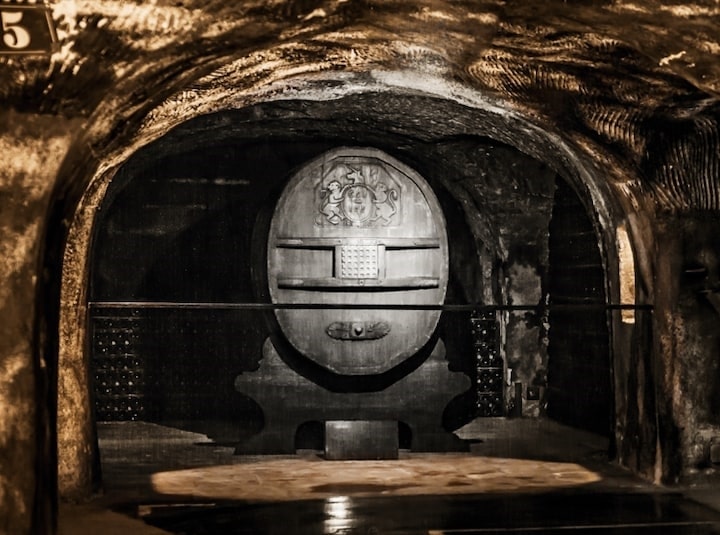
A cellar visit can also make time visible. At a counter, the finished cheese arrives as a selected object. In a maturation tunnel, rows of wheels demonstrate that readiness is staggered, that rind development is uneven enough to require judgment and that storage is productive work rather than passive waiting. A film, museum display or guided explanation may be less thrilling than standing beside a vat, but it can be more honest about the whole chain if active production access is impossible.
The territory adds local memory as well. In and around Jouarre, Brie is not only a product placed on a national retail shelf. It belongs to family businesses, local trade routes and a landscape historically tied to the cheese. That does not make every local tasting superior. It gives the tasting a denser frame: why the business is located there, which stage it controls and how the protected name circulates between farms, makers, cellars and Paris.
What the territory does not automatically add is variety. A single affineur may present only its own selection. A producer may offer one maturity because that is what is ready. A fixed tour may spend more time on heritage than on technical tasting. Travelers who want a comparative seminar should ask in advance whether multiple maturation stages will be available. If the answer is no, a Paris specialist may still provide the more revealing sensory session.
The decision is therefore not city authenticity versus rural authenticity. It is breadth versus depth, concentration versus context, and flexible access versus appointment-dependent access. The most satisfying itineraries recognize that each setting has a distinct evidentiary advantage.
Ganot and Dongé: two instructive examples, not interchangeable visits
Fromagerie Ganot in Jouarre and Fromagerie Dongé in the Meuse illustrate why the word “producer” needs precision.
Fromagerie Ganot: a visitor-facing affinage story near Paris
Ganot’s published visit format is structured around interpretation. Its official visit page describes an owner-led sequence through a small historical museum, a film about Brie production, the maturation tunnel and a final tasting. That progression is significant. It does not pretend that every guest will walk freely through active manufacturing. Instead, it combines historical evidence, process explanation, the cellar and sensory confirmation.
For a traveler based in Paris, Ganot is geographically compelling because Jouarre is reachable without committing to the much longer journey required for the eastern edge of the appellation. The visit is particularly suited to someone whose main interest is affinage: how a young wheel becomes a saleable Brie, how cellar conditions are managed and how local family history intersects with the protected cheese.
Appointment reality matters. The Ganot page checked on November 1, 2026 listed limited individual visit slots, including Saturday at 16:30 and certain Thursday sessions at 15:30, rather than continuous drop-in access. Group arrangements follow their own conditions. Those details are volatile and should be reconfirmed directly before a route is built. The planning lesson is durable: the appointment anchors the day. Paris departure time, lunch, any stop in Meaux and the return all sit around it.
Fromagerie Dongé: production scale, hand work and microbiological control
Dongé offers a different kind of evidence. The Ministry profile presents a cheesemaking business carrying out both hand moulding and onsite maturation at meaningful scale. It also foregrounds risk management, staff training and bacteriological testing. For the specialist traveler, that is a valuable corrective to the idea that authenticity is measured by how small or informal a facility appears.
However, a published institutional profile is not a visitor invitation. Nothing in that evidence should be converted into a claim of private dairy or production-floor access. Dongé belongs in the planning discussion as a named producer that demonstrates how Brie de Meaux can be made and matured within one operation, and as a possible research target only if access is explicitly confirmed. It should not be inserted into an itinerary on assumption.
The comparison shows why a nearer affineur may be a better excursion than a farther cheesemaker. Ganot provides a defined public pathway and a coherent educational sequence. Dongé provides compelling production evidence but no automatic tourism promise. For a private day, the “best” site is not the one deepest in the territory. It is the one whose confirmed access matches the traveler’s question.
Seasonality is agricultural, operational and sensory
Brie de Meaux is available throughout the year, but that does not make every month identical. Seasonality enters at three levels.
Milk and feed conditions
Raw milk carries the effects of herd diet, weather and farm management into the cheesemaking process. Those effects are moderated by the specification and by the cheesemaker’s need for consistency, yet they are not irrelevant. The protected rules themselves can respond to difficult agricultural conditions. A French order dated September 11, 2026 temporarily raised the annual allowance for concentrate feed from 2,000 to 2,300 kilograms of dry matter per producing dairy cow for the period from October 1, 2026 through September 30, 2027. The official text is available on Légifrance.
This temporary measure should not be turned into a tasting claim about any specific wheel. It is evidence of something more useful: an AOP exists within real farming conditions. Drought, forage availability and other pressures can require narrowly defined regulatory responses. Provenance is not a static postcard. It is a managed relationship between tradition, agricultural reality and the integrity of the designation.
Visit calendars
Producer and affineur visits follow working calendars, not the daily rhythm of a major Paris attraction. Fixed weekly slots, school-holiday variations, annual closures and group-only periods are common planning constraints. A visit advertised in autumn may change before spring. The responsible approach is to treat every operational detail as provisional until the host confirms the date, start time, language, group size and what parts of the site are included.
Season also changes the road day. Winter brings earlier darkness and can make a late-afternoon cellar visit feel like the entire outing. Summer increases the risk of heat exposure for purchases and can produce heavier return traffic on leisure routes. Spring and autumn may offer the most comfortable temperatures, but there is no universal “Brie season” that guarantees better access or a superior tasting.
Maturation and the moment of service
The sensory experience depends as much on maturity as on month. A young Brie de Meaux may be firmer, chalkier toward the center and more restrained in aroma. With further maturation, the paste softens and flavors deepen, though the ideal point depends on the wheel, storage and the eater’s preference. A useful tasting compares stages rather than declaring one state correct.
Travelers should also distinguish cellar seasonality from serving temperature. A cheese carried cold from a shop or cellar will not reveal its full aroma immediately. Conversely, a wheel left in a warm vehicle can deteriorate rapidly. A planned tasting needs time for the cheese to temper under safe conditions, neutral bread, water and a sequence that moves from milder or younger samples toward more mature ones. Strong condiments and powerful wine served too early can erase the differences the day was designed to study.
Hygiene limits are part of the story, not a failure of hospitality
Raw-milk cheese invites curiosity about microbes, but an active dairy or cheesemaking room cannot operate as an open studio. Clothing, footwear, visitor movement, hand contact and air flow can introduce risk. Hosts may therefore use viewing windows, films, small museums or separated tasting spaces. These are not necessarily evasions. They can be the responsible interface between public education and food production.
The Dongé profile’s reported testing volume makes the point concrete. More than 400 bacteriological analyses per week indicate that microbial control is continuous work. A visit that explains cleaning protocols, traceability and testing may offer more meaningful access than one that simply lets guests stand closer to equipment.
For planners, this means asking exact questions before promising an experience:
- Is the visit to a dairy farm, a cheesemaking facility, an affinage cellar, a museum space or a combination?
- Will active production be operating at the visit time, or will the process be explained through film and demonstration?
- Are closed shoes, protective clothing or mobility accommodations required?
- Is photography allowed, restricted or prohibited?
- Does the tasting include multiple maturities, other Brie cheeses or only one current batch?
- Can the host accommodate children, pregnant travelers, immunocompromised guests or others following medical advice about raw-milk products?
- Is the visit available in English, or is specialist interpretation needed?
These questions protect both the host and the traveler. They also prevent a common mismatch: a guest expecting intimate dairy access arrives for a museum-and-tasting format, then judges a responsible visit against an experience that was never offered.
The language issue can be material. Technical terms about milk handling, rind development and defects are easy to flatten in casual translation. A specialist guide is valuable when interpretation must connect what the host says to the broader AOP chain, distinguish making from maturing and keep the discussion precise without interrupting the facility’s workflow. That is an earned service need, not decorative accompaniment.
Three credible formats for a Paris-based cheese study
The user’s real decision is between a dairy- or cheesemaker-led excursion, an affineur-led excursion and a market-centered study. Each can be excellent, but they solve different problems.
1. The affineur-led day in Jouarre
This is the most balanced choice for travelers who want to leave Paris, see a maturation environment and keep the road commitment proportionate. The day can include Meaux or another nearby stop, but the confirmed cellar appointment should remain the intellectual center.
Choose this format when the main questions are about ripening, house style, cellar practice and the relationship between local history and present-day selection. It is also the safest choice when public access matters, because a formal visit structure can be verified before departure.
Its limitation is that it may not show milk production or active cheesemaking. Do not describe it as a dairy day. The value lies in seeing how time is managed and in understanding an affineur as a producer of final character, even when the milk and curd originated elsewhere.
2. A confirmed cheesemaker or dairy appointment deeper in the AOP
This format is for travelers whose interest begins before the cellar. It can reveal herd and feed questions, raw-milk handling, moulding technique or the integration of making and maturation. It usually requires more lead time, greater travel tolerance and a willingness to accept that access may be partial.
Choose it only when the appointment is explicit about what will be seen. A company profile, distributor page or award listing is not an invitation. Confirmation should cover the date, language, production status, hygiene requirements, duration, tasting and purchase possibilities. If the site is far enough east that the return becomes tiring, an overnight or a second regional purpose may be more intelligent than forcing the visit into a Paris day trip.
Its limitation is concentration risk. Considerable road time may lead to one facility, one house style and one tasting. The experience is justified when the host can answer the traveler’s specific production questions, not merely because the address is rural.
3. A market- and affineur-centered study in Paris
This is not the lesser option. It is often the best choice for a first encounter with Brie de Meaux or for a traveler with only half a day. A specialist can compare makers, ages and neighboring cheeses under controlled conditions. A market adds commercial context: how protected cheese is displayed, cut, stored and explained to urban customers.
A Paris session can be designed around one specialist counter and one market rather than a scatter of shops. The aim is not collecting samples. It is building a sequence: establish the AOP rules, examine rind and paste, compare maturity, identify producer and affineur, then taste. A broader food day can follow the same principle; a Paris market morning before a serious dinner shows how to keep market study focused rather than exhausting.
Choose this format when appointment certainty, flexible pacing or comparative tasting matters more than geographic immersion. It is also the appropriate fallback when producer access cannot be confirmed without compromise or exaggeration.
A fourth possibility is a hybrid: a Paris baseline tasting on one day and a Jouarre visit on another. This is the most educational structure for a serious cheese traveler because the city session teaches the vocabulary needed to read the cellar. It also prevents the excursion from carrying every expectation at once. The approach resembles the progression used in a producer-led study of Paris bread, where raw material, transformation and appointment reality are treated as separate layers rather than one picturesque stop.
Road timing from Paris: build around the fixed point
Jouarre is close enough to Paris to sound simple and far enough for small errors to matter. The Commune of Jouarre states that the town is approximately 50 minutes from Paris by road via the A4 and exit 18. It also gives an indicative rail journey of about 45 minutes on Line P from Gare de l’Est to La Ferté-sous-Jouarre, with Jouarre around 10 minutes from the station. These estimates appear on the commune’s geographic information page.
Those figures are orientation, not a promise. Paris departure point, A4 traffic, roadworks, parking, the station transfer and the need to arrive before a fixed visit can widen the real journey. A producer-led day should contain a buffer before the appointment, not only after it. Missing a timed cellar visit is not equivalent to arriving late at a shop; the host may be leading a group, returning to production or unable to restart the sequence.
A sensible road structure
For a late-afternoon Jouarre visit, an efficient day does not need to begin at dawn. A calm departure after the Paris peak can lead to Meaux or the surrounding area for context, followed by lunch and the transfer to Jouarre with generous margin. The cellar visit then forms the final regional act before a direct return to Paris.
The lunch should be modest. A heavy, long meal before a cheese tasting dulls attention and threatens the appointment. Strong garlic, sweet desserts and multiple glasses of wine are similarly unhelpful when the afternoon is meant to distinguish rind, lactic notes, mushroom, cellar aroma and degrees of softening. The tasting order should move from explanation to observation and only then to eating.
After the visit, the cleanest logic is usually to return directly to Paris. Adding another major stop after a late appointment creates a weak final hour and increases the time that purchased cheese spends in transit. Travelers with an important dinner should allow for traffic and for the simple sensory fact that a serious cheese tasting can reduce appetite. A lighter evening or a later reservation may be wiser than pairing the excursion with the most demanding meal of the stay. The Paris fine-dining planning guide is useful here not as a list to append, but as a reminder that dinner geography and reservation stakes should shape the return.
Rail works for a narrow plan, but the last connection still matters
Line P can be practical when the visit is concentrated in Jouarre and a local transfer is secured. It is less convenient for a multi-stop provenance day involving Meaux, a rural producer and purchases. The station-to-Jouarre segment must be solved in advance; relying on an immediate taxi at a smaller station can turn a comfortable rail plan into an appointment risk.
A private vehicle becomes relevant when it protects a confirmed schedule, connects sites that do not align with rail, accommodates limited mobility or allows purchases to be stored responsibly. It should not be presented as automatic luxury. The value is operational: one accountable movement plan, controlled buffers and no dependence on uncertain local transfers. The same vehicle also creates obligations. Cheese should not remain in a warm parked car, and a cooler should be planned rather than improvised.
Do not make the driver wait while the itinerary drifts
A fixed vehicle can tempt planners to add stops simply because movement seems easy. Resist that. A provenance day benefits from intellectual continuity. One market, one cellar and one contextual town are usually more useful than a chain of unrelated attractions. The driver or guide should know which element can be dropped if traffic compresses the schedule. The appointment is protected; the optional stop is not.
Tasting order: use the day to compare, not merely consume
A producer-led excursion should end with a sharper palate and a clearer model of the cheese, not just a purchase. The tasting can be organized around four observations.
1. Read the wheel before cutting
Look at size, profile, rind coverage, color and any visible difference between the edge and center. Ask whether the wheel was made and matured by the same company. Identify the producer and, if different, the affineur. A label is evidence only when the terms are understood.
2. Compare maturity rather than brands alone
Two samples from the same producer at different stages can teach more than two unrelated cheeses. Begin with the younger or firmer sample. Notice the center, the gradual softening toward the rind and the degree to which aroma has developed. Move toward the more mature sample after the palate has a reference point.
3. Keep accompaniments quiet
Neutral bread and water are sufficient for the analytical portion. Fruit, preserves, nuts and wine can be enjoyable later, but they should not lead. The tasting is meant to isolate texture, salt, milk character, rind influence and cellar development. A bold pairing can make every sample seem more dramatic while making the important distinctions less visible.
4. Ask the release question
“Why is this wheel ready now?” is often more revealing than “How old is it?” Age matters, but readiness also depends on batch development, storage, intended use and the affineur’s judgment. The answer exposes whether the host is describing a fixed calendar or a living assessment.
If a Paris comparison is planned later, purchase with purpose. One well-documented piece, wrapped and transported correctly, is more useful than a bag of loosely identified samples. Record the producer, affineur, date of purchase and the seller’s serving advice. Back in Paris, compare it with a city-selected Brie de Meaux at a similar maturity. The contrast may reveal house selection, storage and timing more than geographic superiority.
The day should not become a contest between “country” and “city” cheese. A rural cellar may sell a younger piece for travel. A Paris affineur may present a wheel at a more expressive moment because it has been held for a specific clientele. The meaningful comparison is between chains of custody and decisions, not postal codes.
How to choose the right excursion for your Paris stay
A concise set of criteria is more useful than a ranked list.
- Choose Paris only when time is limited, comparative tasting is the priority, mobility or medical constraints make uncertain facility access undesirable, or no producer appointment has been confirmed.
- Choose an affineur-led Jouarre day when maturation, local history and a visible cellar matter more than seeing cows or vats, and when a structured public visit offers the most reliable evidence.
- Choose a cheesemaker or dairy appointment when the traveler has a specific agricultural or production question, the host has explicitly confirmed access and the road commitment is acceptable.
- Choose a hybrid over two days when Brie de Meaux is a central interest of the trip. Learn the tasting vocabulary in Paris first, then use the territory to test it.
- Choose no excursion at all when the plan depends on assumptions: an unconfirmed farm, an inferred English-language visit, a casual taxi connection or a hope that active rooms will be open to guests.
The most important threshold is evidence. Leaving Paris should add something the city cannot reproduce: a maturation environment, a confirmed production conversation, the agricultural geography or the local chain of custody. If the excursion offers only a tasting and a shop, a strong Paris affineur may provide more substance with less friction.
There is also a trip-design threshold. A cheese day belongs most naturally in a Paris stay of four days or more, or in a repeat visit where major monuments are no longer competing for every hour. On a first three-day stay, a half-day city tasting is usually easier to justify. On a longer food-and-wine itinerary, the excursion can become a thematic counterpoint to Paris dining: the quiet labor of raw milk and maturation before the polished service of the capital.
Families and mixed-interest groups need an additional test. A film, museum and cellar can engage non-specialists for a defined period; a long technical production visit may not. The best private plan can split the level of interpretation without splitting the group: concise context for everyone, deeper questions for the cheese-focused traveler and a controlled tasting that does not overrun the day.
The local insight: Brie de Meaux is a chain of custody made edible
The most revealing lesson of a day east of Paris is that provenance does not reside in one picturesque moment. It is distributed. The farm shapes the milk. The cheesemaker creates the structure. The affineur manages the transformation through time. The retailer or final affineur chooses the moment of sale. The eater completes the chain by serving the cheese at a temperature and maturity that either reveals or obscures the work.
This is why the apparently modest affineur visit can outperform a more dramatic but poorly defined farm outing. Affinage is where the separate histories of milk, curd, cellar and market become legible in the finished wheel. A visitor who sees only cows may leave with a pleasant rural image. A visitor who understands the handoffs can read the cheese.
It is also why Paris remains part of the provenance story rather than merely the departure point. The capital’s specialist counters are places of selection and translation. They decide which makers reach particular customers, how long a cheese is held and how its condition is explained. A market-centered study can therefore be rigorous, especially when it names the producer and affineur instead of treating “Brie de Meaux” as sufficient identification.
For travelers who want to extend that study into a broader day, private Paris touring becomes relevant when appointments, interpretation and movement need to be coordinated as one chain. The service has value only when it protects the evidence: the right host, a realistic transfer, enough time in the cellar and a return plan that does not sacrifice the rest of the stay.
A producer-led Brie de Meaux day is worth making when geography, access and maturation matter more than the number of samples. It should leave the traveler able to explain not simply that the cheese came from near Meaux, but how raw milk, protected territory, handwork, microbial control and affineur judgment converged in one wheel. That understanding is the real return on the road east.
For a tailored day built around confirmed producer or affineur access, specialist interpretation and a responsible return to Paris, Inquire now.
If you’re interested in any private tours of Paris, please reach out to us.



 So if you are looking for the absolute best in Paris & surroundings with authentic local fully-licensed native guides whose English you can actually understand and with an exclusive and amazingly fun itinerary













