Delacroix’s Paris: Studio, Saint-Sulpice and the Murals That Change How the Louvre Reads

Updated
Delacroix’s Paris is best read in this order: his final studio at 6 rue de Fürstenberg, the Chapel of the Holy Angels at Saint-Sulpice, then the Louvre. The sequence moves from private working evidence to site-bound public decoration and finally to history painting absorbed into a national museum. It reveals the central tension in his Paris career: a painter remembered for liberated color and dramatic feeling also worked through commissions, architecture and institutions that disciplined how his images were made and seen.
Why the three settings must be read together
No single stop explains Eugène Delacroix. The studio preserves traces of making: drawings, manuscripts, personal objects and the purpose-built room in which he worked late in life. Saint-Sulpice preserves a commission in the architecture for which it was conceived. The Louvre presents the painter through works that have entered the canon of French public art. Seen separately, each setting encourages a partial Delacroix: private genius, monumental decorator or national master.
Seen in sequence, the settings expose what changes when a subject moves from paper and studio thought to a wall, or from a contemporary Salon canvas to a museum masterpiece. The useful questions remain consistent throughout: Who commissioned or acquired the work? What scale did the setting demand? How did the surface and viewing distance shape the composition? What happens to meaning when the work leaves its first public context?
- Begin at the Musée National Eugène-Delacroix to establish working method, late-career context and the difference between evidence preserved around a workplace and art encountered in a national collection.
- Continue to Saint-Sulpice to see what architecture, religious patronage and a long decorative campaign required of that method.
- End at the Louvre so the famous public canvas is interpreted through evidence already gathered, rather than allowed to define the painter from the outset.
The studio: evidence of work rather than a shrine
Delacroix moved to 6 rue de Fürstenberg in late 1857 because it placed him near Saint-Sulpice, where he was decorating the Chapel of the Holy Angels. He secured permission to build and decorate a studio in the garden. The present museum occupies his former apartment and studio, and its collection includes paintings, drawings, lithographs, autographs, manuscripts and personal objects. The connection between residence and commission is fundamental. It was a working base chosen in relation to a demanding public project. The Louvre sets out that history in its account of the Musée National Eugène-Delacroix and its collection.
The most productive way to look here is to resist the search for one relic that supposedly contains the artist’s personality. Instead, compare categories of evidence. Drawings show decisions in abbreviated form; manuscripts preserve thought in language; lithographs reveal how an image changes through another medium; personal objects restore the scale of daily work. The garden studio itself adds a further layer: Delacroix did not simply inherit a room but arranged for one to be built and decorated. That fact turns architecture into part of the evidence.
The wider archival record reinforces this reading. The Institut national d’histoire de l’art records twenty-eight signed autograph letters from Delacroix to the painter Constant Dutilleux, dated from 11 September 1840 to 8 March 1863. It also records the manuscript Journal for 1847–1862 as 1,820 folios in eleven containers, with both bodies of material digitized. Those quantities matter because they counter the myth of inspiration arriving whole. Delacroix’s late practice was sustained by correspondence, accumulated notes and repeated reflection, as documented in the INHA archival guide.
Scholarship on the Journal describes it as an associative working instrument: memories recur, combine and acquire new force rather than proceeding as a tidy chronological ledger. The same reading connects his compositions to expressive irregularity, modulation, detail and multiple points of view. Jean Lacoste’s discussion of Michèle Hannoosh’s work develops this approach in Romantisme. That makes the studio a useful place to begin. It encourages attention to process before Saint-Sulpice overwhelms the eye with scale. A comparable question—how a studio changes the interpretation of finished work—also structures the choice between Rodin’s museum, garden, studio and working landscape.
Saint-Sulpice: when painting becomes architecture
Delacroix received the commission for the church’s south chapel in April 1849. The program placed Jacob Wrestling with the Angel on the east wall, Heliodorus Driven from the Temple on the west wall and Saint Michael Defeating the Demon in an oval format above. He produced drawn and painted presentation studies in 1849–1850, while the completed chapel was inaugurated between 31 July and 3 August 1861. The City of Paris documents both the long chronology and the placement of the three works in its account of the Chapel of the Holy Angels.
That twelve-year span changes the meaning of the nearby studio. Rue de Fürstenberg belongs to the final phase of a commission already years in progress. The studio therefore offers less a prelude than the working context of completion: a place from which the artist could continue resolving a public ensemble that had to function across opposing walls and a ceiling.
Reproductions cannot provide the decisive evidence here. A photograph isolates one scene and chooses a frontal viewpoint. The chapel makes the three works compete and cooperate within a bounded volume. Jacob’s struggle occupies one wall; Heliodorus’s expulsion answers from the other; Saint Michael extends the language of combat overhead. The viewer’s body turns between them. Scale, peripheral vision and the chapel’s architecture make conflict spatial before it becomes iconographic.
The two wall paintings should therefore be compared before either is examined in detail. Both organize force through crowded bodies and directional movement, but their narrative pressure differs. Jacob’s encounter concentrates struggle around a resistant pair, while Heliodorus expands violence into a public scene of intervention and dispersal. The ceiling adds a third subject while changing the axis of attention, completing a room in which spiritual conflict arrives from several directions.
Material evidence complicates the old shorthand of Delacroix as a purely impetuous colorist. Conservation research identified a mixed wax-and-oil binder. During the 2015–2016 treatment, a specially developed cleaning protocol was used under scientific and state oversight, and the work clarified visual correspondences between the two wall compositions. The technical finding matters interpretively: the surfaces were engineered for a difficult architectural setting, and their effects depended on materials as well as gesture. The same City of Paris account records the conservation findings and treatment.
A scholarly reading of Delacroix’s public decorative cycles identifies a recurring tension between civilization and violence, and argues that the long Saint-Sulpice project gave that ambivalence a new form. That is a stronger key than treating the murals as enlarged illustrations. Sacred order is present, but it is reached through collision, strain and expulsion. The chapel asks whether violence is being mastered, sanctified or simply made inseparable from historical change. Jean Lacoste’s discussion of Michèle Hannoosh’s work develops this connection between the Journal, compositional method and the public cycles in Romantisme.
The Louvre after Saint-Sulpice
Only after the chapel should the Louvre’s Delacroix be allowed to become monumental. Liberty Leading the People measures 2.6 by 3.25 metres and was painted from September to December 1830. It entered the 1831 Salon, was purchased from Delacroix by the Ministry of Commerce and Public Works for 3,000 francs in August 1831, and was transferred to the Louvre in 1874. The Louvre collection record makes its institutional history unusually clear.
Those dates prevent the painting from floating free as a timeless emblem. A concentrated 1830 painting campaign led to Salon exposure, state acquisition and, decades later, the work’s stabilization as a Louvre masterpiece. Its public life passed through several institutions before the museum gave it the authority of permanence. For a fuller account of how exhibition juries, criticism and museums shaped reputations, follow the machinery of the Paris Salon.
Saint-Sulpice changes the formal reading as well. After seeing Delacroix manage opposing walls, architectural distance and a program of sacred conflict, the crowd and directional energy of Liberty Leading the People look less like uncontrolled eruption. They look like calculated public address. The painting’s emotional force remains, but it is joined by evidence of orchestration: bodies are ranked, movement is steered and allegory is made to inhabit contemporary history at a scale designed to command a public.
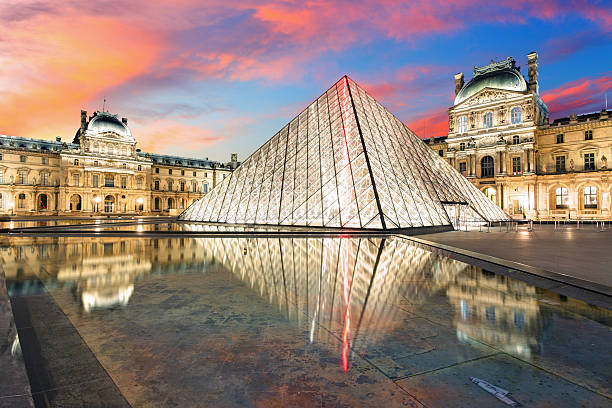
The museum setting also performs a transformation. At Saint-Sulpice, the paintings remain answerable to the chapel around them. In the Louvre, the canvas enters a sequence built by collecting, classification and national display. Its stature remains, while the terms of encounter change. Reading the Louvre as a former fortress, royal palace and architecture of public display helps explain why museum context is never neutral.
Why the Louvre should come last
Beginning with Liberty Leading the People is tempting because recognition is immediate. The danger is interpretive gravity: every later object becomes evidence for the famous canvas, and the church decoration can seem like a secondary branch of the same dramatic style. The studio-first sequence reverses that hierarchy. It gives method, patronage and architectural constraint enough weight to challenge the masterpiece.
Ending at the Louvre also produces a sharper distinction between three kinds of publicness. The studio museum turns a private workplace into cultural heritage. Saint-Sulpice retains a work within the religious architecture that commissioned it. The Louvre places an easel painting within a national canon after an earlier life that included the Salon and state purchase. “Public art” therefore does not name one condition. It can mean a room made accessible after an artist’s death, a decoration still embedded in its program, or a canvas reorganized by a museum narrative.
For visitors building a larger museum day around this sequence, the Delacroix works are better treated as a concentrated argument than as one stop in a sweep of highlights. A curated Louvre plan built around a limited number of connected works preserves the comparisons made on the Left Bank instead of burying them under volume.
Three comparisons that keep the route intellectually honest
Patronage
At the studio, the evidence belongs to working practice and the conditions of the workroom. At Saint-Sulpice, an 1849 church commission governs subject, location and architectural obligation. At the Louvre, Liberty Leading the People carries the history of Salon exposure, state acquisition and eventual museum transfer. The painter’s freedom is real in all three settings, but it operates inside different structures of permission and expectation.
Scale
Drawings and manuscripts permit intimacy and revision. The chapel requires images that remain legible across distance and around the viewer’s body. The Louvre canvas is monumental, yet still portable: unlike the murals, it can change buildings, ownership and interpretive company. Scale includes more than dimensions. It determines how a work circulates and how completely its setting can be separated from it.
Memory
The studio preserves the memory of making. Saint-Sulpice preserves the memory of a commission in place. The Louvre preserves—and continually renews—the memory of national importance. Delacroix’s Journal, as described by scholarship, recombined memories rather than filing them neatly. Paris now does something similar with the artist: fragments of work, place and institution remain distributed across the city, and their meaning emerges through comparison.
If only two Delacroix stops fit
Choose the studio and Saint-Sulpice when the priority is process: how a late working environment, studies and written thought relate to a prolonged architectural commission. Choose Saint-Sulpice and the Louvre when the priority is public painting: how Delacroix addresses viewers through a functioning sacred interior and through a monumental canvas later absorbed into the national collection.
If one site must carry the argument alone, Saint-Sulpice is the most revealing choice. It preserves the strongest relationship among subject, surface, scale and room, while also pointing backward to the nearby studio and forward to the public authority of the Louvre. It is the central comparison that prevents “Delacroix” from collapsing into either biography or a single canonical image.
The question the route leaves open
A specialist guide is most useful when technique, patronage and original setting must be compared across the intimate density of a studio museum, the spatial demands of a church chapel and the selective abundance of the Louvre. The practical gain is a disciplined comparison carried intact from one setting to the next. Travelers shaping a wider art-focused stay can use private Paris tours organized around specialist interests as a planning next step. Which Delacroix emerges when studio, chapel and museum are allowed to challenge one another: private maker, architect of sacred conflict, painter of public history—or an artist whose power lies precisely in moving among all three? To build a privately guided sequence around that question, inquire now.
If you’re interested in any private tours of Paris, please reach out to us.




 So if you are looking for the absolute best in Paris & surroundings with authentic local fully-licensed native guides whose English you can actually understand and with an exclusive and amazingly fun itinerary