Barcelona’s Palau de la Música Choice: Concert, Guided Visit or Modernisme Morning?

Updated
Choose a guided visit if Palau de la Música is one stop in a full Barcelona day; choose a concert if you want the building to reshape the evening; choose a Modernisme morning if you want Palau to explain Barcelona beyond Gaudí. That verdict works because the Palau sits at a city hinge: just above Via Laietana, close to Urquinaona, and within an easy Palau-to-El Born transition when the day wants to continue on foot. The clearest exception is a short first stay already ruled by Sagrada Família and Park Güell. In that case, Palau may be better saved for a future Barcelona visit than forced in as another interior.
In Barcelona, Palau is not merely another beautiful building to collect; it is a routing decision between a musical evening, a compact architecture visit, and a Domènech i Montaner thread that should not become another Gaudí day. The right choice depends less on how much you like stained glass and more on what Palau does to the rest of your day: lunch timing, old-town walking, dinner energy, and whether your group still has attention left after one or two major interiors. That is why a tailor-made plan for private tours in Barcelona should decide whether Palau is the anchor or the accent before adding more stops.
Choose the Palau format before you choose the route
The best Palau plan starts by deciding what job the building should do in the day. A concert, a guided visit, and a Modernisme morning may all put you inside the same building, but they create different consequences. A guided visit is a contained cultural stop. A concert becomes the evening’s fixed point. A Modernisme morning uses Palau as part of a wider Barcelona story that includes Eixample, Sant Pau, and the city’s civic architecture, without sliding into a repeat of Gaudí.
Guided visit: choose it when you want Palau de la Música clearly explained, beautifully paced, and finished without taking over the day. It suits first-time visitors, families, older travelers, and private groups that already have Sagrada Família or the Gothic Quarter elsewhere in the itinerary. It is the default winner when time is limited.
Concert: choose it when the music matters, the evening can revolve around one venue, and dinner can be planned around the performance rather than squeezed in after sightseeing. It is the runner-up for architecture-focused travelers, but the best choice for music lovers and celebration evenings.
Modernisme morning: choose it when you want Palau to connect with Sant Pau, the Eixample grid, and the political confidence of early twentieth-century Barcelona. It is the richest intellectual choice, but only if you resist adding too many interiors.
Save it for later: choose this when your Barcelona stay is already locked around Sagrada Família, Park Güell, one Gaudí house, and a food evening. Palau is strong enough to deserve better than the tired final slot.
The comparison criteria are practical: how much fixed time the format creates, how much interpretation you need, whether the group can absorb another interior, and what the choice does after the visit. This last point is where many polished itineraries fail. Palau is close enough to El Born to continue elegantly, but it is not magically close to every Barcelona plan. Coming from Passeig de Gràcia after Casa Batlló feels different from arriving fresh from a hotel near Plaça de Catalunya. Arriving after Sagrada Família, Park Güell, and a long lunch can turn an exquisite hall into one more ceiling.
The counterintuitive correction is that the Gothic Quarter is not always the better base for Palau, even though it looks more romantic on a map. For a comfort-first morning, Eixample often gives cleaner timing, wider pavements, and easier hotel pickups; the old town gives atmosphere but can add lane-by-lane fatigue before the visit has even started. Better tickets do not fix a day that treats Palau as an afterthought after too many interiors.
When a guided visit is enough at Palau de la Música
A guided visit is enough when Palau is meant to be understood, not turned into the emotional climax of the trip. The official Palau site separates guided, audio-guided, and self-guided visit formats, and its guided-tour page (https://www.palaumusica.cat/en/visites/guided-tour_1174259) describes the standard guided visit as a 50-minute format; confirm current language, schedule, and access details when booking. For most first-time private days, that is exactly the right scale. It gives the building a clear beginning and end, leaves room for lunch or El Born afterward, and avoids the false economy of lingering until everyone is visually saturated.
The guided visit works especially well for travelers who care about architecture but do not want a full architecture seminar. Palau’s value is not only the concert hall. It is the compression of ceramic, ironwork, glass, civic pride, choral culture, and street placement into a building that feels denser than its footprint. A good explanation helps the visitor notice why the hall is not just decorative. The ceiling, the sculptural proscenium, the staircase, and the way the building brings daylight into performance space all need interpretation, but they do not need an entire half day unless Modernisme is the trip’s chosen subject.
For couples and families, the guided visit also creates cleaner social rhythm. A concert asks everyone to sit, listen, and accept the programme; a guided visit lets the group ask questions, reposition, and then move on before attention drops. For older parents or multigenerational travelers, it avoids the late return that a concert can create. For small groups, it prevents the awkward split between those who love classical music and those who only wanted to see the famous hall.
In a first Barcelona stay, Palau as a guided visit pairs best with a limited nearby continuation, not a second major monument. The simplest continuation is the Palau-to-El Born transition: leave the building, cross the Via Laietana edge, and let the day loosen around Santa Caterina, the Ribera lanes, or Santa Maria del Mar from the outside. This is not a generic “old town wander.” It works because Palau sits close enough to El Born for the day to keep its shape without a taxi reset, while still giving a change in scale from Modernista interior to medieval street pattern.
If you are using Palau as an accent in a broader first-day route, it can sit inside a well-edited Best of Barcelona private tour when the guide keeps the day disciplined. The mistake is not adding Palau; the mistake is adding Palau after too much else. If Sagrada Família has already carried the morning, Palau should either be the short cultural punctuation before lunch or removed. Do not let it become the fourth interior of the day simply because it is nearby enough to justify on a map.
The guided visit is also the best format when you care about the building’s architecture but not necessarily the acoustics. A concert can be memorable, but it is not a better architectural visit by default. During a performance, you are there to attend music, not to stop, ask why the muses appear above the stage, compare Domènech i Montaner with Gaudí, or step through the building at explanatory pace. If your main question is “will I understand why this building matters?”, a guided visit answers it more reliably.
When a concert changes the evening plan
A concert is the right choice when Palau de la Música deserves to own the evening, not when you are trying to see the hall because you missed the daytime visit. Check the official Palau programme (https://www.palaumusica.cat/en/programme_1158636) for the actual music, because the format only earns its place when the performance interests you or suits the occasion. A concert calendar is not the point of this guide; the point is the planning consequence. Once you choose a concert, dinner, transport, and the previous afternoon must bend around it.
This matters because Barcelona evenings are not empty space. They often carry the best meal of the day, a celebration reservation, a tapas walk, a flamenco plan, or the only slow hour a couple gets after a dense sightseeing morning. A Palau concert can make the evening feel composed and local, but it can also crowd out the food-and-wine arc if you keep dinner too far away or expect the group to cross the city afterward. A concert at Palau is not just “Palau plus music.” It is a decision to give the night a fixed cultural center.
The strongest concert plan keeps the afternoon lighter. Do not do Sagrada Família, Park Güell, Passeig de Gràcia interiors, a hotel change, and then a concert. The body pays for that sequence. Barcelona’s central walking looks easy in fragments, but the Eixample blocks are long, the heat load builds on open pavements, and old-town stone underfoot slows the final hour. By the time you have crossed from a Gaudí-heavy day into the Palau area, even a superb seat can feel like a test of stamina rather than a pleasure.
The mood consequence is just as important. A concert can preserve a sense of occasion when the day has been kept light: late afternoon rest, a short transfer, music, and a nearby dinner or nightcap. It can flatten the evening when it follows a day that already felt like a checklist. The hall should feel like a deliberate arrival, not a last obligation before bed. For celebration travelers, this is the difference between a night that feels choreographed and a night that feels like everyone is politely enduring the final booking.
Use El Born carefully after a concert. The Palau-to-El Born transition can be excellent if dinner or a walk is close by, because the route lets the evening change texture without a long ride. It is less successful if the restaurant is deep in Barceloneta, high in Gràcia, or back across town near the upper Eixample. A short walk into El Born can feel cinematic; a late cross-city transfer can undo the elegance of the performance. When the plan includes wine, a special dinner, or mixed ages, the exit matters as much as the seat.
For travelers already thinking about a tapas or flamenco night, Palau needs to win the evening outright or step aside. If you want a food-led first night, let food lead it. If you want Palau, build the food around the performance instead of pretending both experiences can be equally central. A related evening-planning lens appears in Barcelona between Sagrada Família and a late dinner, where the same principle applies: the best Barcelona night usually has one anchor, not three competing moods.
When Palau belongs in a Modernisme morning
Palau belongs in a Modernisme morning when the traveler wants Barcelona’s architectural story to widen beyond Gaudí without becoming a museum march. This is the most rewarding format for design-minded visitors, return travelers, and first-timers who already know they will see at least one Gaudí interior elsewhere. The point is not to rank Palau against Casa Batlló or La Pedrera. The point is to understand a different civic imagination: choral society, Catalan cultural confidence, the Eixample’s urban ambitions, and Domènech i Montaner’s ability to make structure, ornament, and public life speak together.
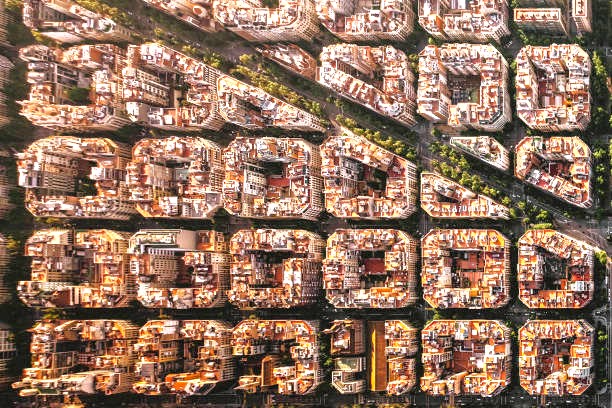
The cleanest Modernisme morning uses Palau as either the closing note or the sharp contrast, not as one more interior added to a Gaudí-heavy day. Sant Pau can supply scale and institutional breadth. Eixample can supply street logic, façades, courtyards, and the city’s expansion grid. Palau then brings the story inward toward music and civic performance near the old-city edge. That arc is very different from a Gaudí day, and it should feel different in the body: fewer ticket windows, less vertical spectacle, more street-to-building comparison.
If you are interested in this deeper thread, an Eixample Private Tour can make Palau feel less isolated. The guide can read the chamfered corners, the long Eixample blocks, and the way private residential façades differ from a public concert hall. That context changes what you notice inside Palau. You are no longer only admiring color and glass; you are seeing how Barcelona’s wealth, craft, politics, and cultural institutions shaped different kinds of Modernisme.
The risk is duplication. Sant Pau and Palau are both associated with Lluís Domènech i Montaner, but that does not mean every traveler should do both interiors on the same day. If the group is fresh, curious, and architecture-led, the pairing can be superb. If the group has already spent a long morning at Sagrada Família or expects a relaxed lunch, combining Sant Pau and Palau may be too much. The better private-route decision is often one interior plus exterior context, not two interiors plus every façade that appears in a guidebook.
This is where Palau differs most clearly from the broader Modernisme route question. A full Domènech i Montaner and Eixample day can be excellent, and the related guide to a Modernisme day without Gaudí overload is the better next read if you want that whole arc. This article is narrower: it asks whether Palau should be the format choice, the evening anchor, or one stop in a morning. If the answer is “one stop,” you must still decide whether it is the stop that explains the day or the stop that elegantly ends it.
A private guide’s value is not simply reciting dates inside Palau. The real value is deciding whether Palau is the anchor or the accent, then cutting the tempting extra interior that would weaken the day. On a short stay, that judgment saves more pleasure than another reservation. Inquire now to shape a Barcelona day around the role Palau should actually play: guided visit, concert evening, Modernisme morning, or a deliberate save for next time.
What not to pair with Palau de la Música
The first thing not to pair with Palau is a fully loaded Gaudí interior day. Sagrada Família is enough to command a morning, and the timing should be respected through Sagrada Família official tickets (https://sagradafamilia.org/en/tickets-individuals) rather than improvised around the rest of the day. Park Güell adds hill logistics and a different kind of crowd management. Casa Batlló or La Pedrera adds another immersive interior. Put Palau at the end of that sequence and you are no longer curating Barcelona; you are testing how many ceilings a traveler can admire before the details blur.
The cut-first rule is firm: if the day already has Sagrada Família and one Gaudí house, cut Palau before you cut lunch, rest, or the evening. This is not because Palau is weaker. It is because Palau deserves a mind that can still compare, listen, and notice. If you try to preserve every major interior, the whole day becomes less intelligent. The traveler remembers motion, not meaning.
Palau also pairs poorly with a maximal Gothic Quarter push. The Gothic Quarter and El Born are not the same experience, and pushing through both after Palau can create old-town blur. If Palau sits before El Born, keep the continuation selective: Santa Caterina for a market edge, Santa Maria del Mar for exterior context or a focused interior if the group is still fresh, and then a meal. Do not turn the Palau-to-El Born transition into a scavenger hunt through every medieval lane between Via Laietana and the waterfront.
Another poor pairing is Palau plus Barceloneta as a forced seaside finish when the group is dressed for a concert or architecture morning. Barceloneta can be right on a different day, especially when the trip needs sea air, but it is not automatically the best release after Palau. The walk and mood shift can be too much: from jewel-box concert hall to beach crowds, from cultural concentration to open promenade. If the evening needs elegance, stay closer to El Born or return to the hotel before dinner.
Do not use a chauffeur to solve a fundamentally overpacked center-city plan. A driver can make a Barcelona day smoother when hills, heat, port timing, or mobility needs are real; it cannot make four interiors feel like two. For Palau specifically, premium spend helps when it buys expert sequencing, private interpretation, a cleaner pickup after a concert, or a better hotel reset. It does not earn its cost when it merely transports travelers between too many fixed entries. The expensive version of a crowded plan is still a crowded plan.
For Gaudí-heavy travelers, use Sagrada Família, Park Güell or Passeig de Gràcia first to set the main architectural day, then decide whether Palau belongs elsewhere. This prevents the common mistake of treating every famous building as if it belongs in one architecture bucket. Gaudí and Palau can live beautifully in the same Barcelona stay. They do not have to live in the same day.
How the choice changes the body, the route, and the mood
The Palau choice changes how Barcelona feels physically. On a map, the central city looks compact: Eixample above, old town below, Palau near the seam. In practice, a day can include long Eixample blocks, open sun on Passeig de Gràcia, a crossing at Via Laietana, tighter old-town lanes, and standing time inside buildings. Add a warm afternoon or a family member who walks slowly, and the difference between “one more stop” and “one stop too many” is not theoretical. It shows up in shoulders, feet, patience, and how much anyone wants to dress again for dinner.
A guided Palau visit asks the least of the body. It can be slotted before lunch, after a lighter Eixample walk, or before a short El Born continuation. A concert asks less walking during the experience but more planning around the return. A Modernisme morning asks the most mental attention and should reduce other interiors. The comfort answer is not always to walk less; it is to make each movement belong to the same story so the body is not constantly switching modes.
The route consequence is clearest at the Palau-to-El Born transition. If Palau ends a guided visit and the group is still curious, El Born gives a lower-friction continuation than returning to Passeig de Gràcia for another interior. If Palau precedes a concert evening, El Born can hold dinner nearby. If Palau is part of a Modernisme morning, El Born may be only the soft landing, not a second heritage deep dive. The same geography supports three different plans; the difference is intention.
The mood consequence is subtler. Palau can make a Barcelona day feel shorter, more edited, and more humane when it replaces an extra Gaudí stop. It can make the day feel heavier when it is added because “it is famous and central.” A concert can give the evening ceremony. A guided visit can give the afternoon clarity. A Modernisme morning can give the trip an intellectual spine beyond the obvious icons. But Palau cannot do all three jobs at once. Ask it to be architecture lesson, concert, old-town gateway, and late-night prelude, and the day loses its tone.
This is why comfort-first planning in Barcelona is not only about avoiding hills. It is about avoiding needless mood changes. Eixample comfort, old-town atmosphere, concert formality, tapas looseness, and beach informality are all valuable, but they do not always sit well in one sequence. Palau works best when it clarifies the day’s tone. If it complicates the tone, cut it or move it.
When Palau should be skipped or saved for a future stay
Palau should be skipped when the trip already has enough architectural intensity and too little uncommitted time. This is the required honest answer. If your first Barcelona stay is two days, and one day is Sagrada Família plus Park Güell while the other must cover old town, food, and the sea, Palau may be the wrong addition. Saving it for a return trip is better than seeing it tired.
Skip it, too, if no one in the group wants the format available. Do not book a concert because the hall is beautiful if the programme does not appeal. Do not book a guided visit if the group is already resistant to formal explanations after several museum-like experiences. Do not build a Modernisme morning if your travelers mainly want food markets, family flexibility, or shopping. Palau is versatile, but it is not a universal fix for a thin itinerary.
Palau can also be the wrong choice on an arrival day after an overnight flight or cruise disembarkation. The building rewards attention to detail; jet-lagged travelers often need air, a gentle meal, a hotel check-in, and one short walk before anything dense. If the first day already has luggage timing or port logistics, Palau should only appear if the location is genuinely convenient and the format is brief. Otherwise, let the first day breathe.
The future-stay argument is especially strong for travelers who suspect they will return to Barcelona. Palau often improves on a second visit, when Sagrada Família is no longer absorbing the planning oxygen and the visitor can appreciate Domènech i Montaner, El Born, Sant Pau, and Eixample without measuring every stop against Gaudí. A return trip also makes a concert easier to justify, because the evening does not have to compete with first-time obligations.
For food-and-wine travelers, skipping Palau may be the right move when the day’s real priority is a long lunch or a serious dinner. Barcelona rewards meals that are not jammed between time slots. If the table is the celebration, Palau should either set up the evening gracefully or stay out of the way. Cultural restraint can be the more premium choice.
Three polished ways to place Palau in a Barcelona day
The strongest Palau plans are not complicated; they are edited. Use these as planning models, not rigid itineraries, because the correct version depends on hotel location, reservation times, group stamina, and whether Sagrada Família already sits elsewhere in the trip.
- The guided-visit day: begin with a light Eixample or Plaça de Catalunya approach, visit Palau, then continue through the Palau-to-El Born transition for one focused neighborhood layer and lunch. This is best when Palau is an accent and the afternoon should remain flexible.
- The concert evening: keep the afternoon deliberately lighter, return to the hotel before dressing if the occasion matters, attend the performance, then dine nearby or end with a short El Born walk. This is best when music and mood matter more than adding another daytime monument.
- The Modernisme morning: use Sant Pau, selected Eixample context, and Palau to show Barcelona beyond Gaudí, but keep the interior count disciplined. This is best for architecture travelers who want the city’s civic Modernisme, not another version of the Gaudí greatest hits.
- The save-it-for-later plan: remove Palau from a crowded first stay and give the time back to lunch, rest, or the evening. This is best when the building would otherwise be seen at the weakest point of the day.
For a couple on a celebration trip, the concert plan often feels the most memorable, provided the rest of the day is restrained. For a family with mixed interests, the guided visit is usually safer. For design-minded travelers, the Modernisme morning is the most satisfying, as long as it is not made too encyclopedic. For travelers trying to cover Barcelona in too little time, saving Palau is often the clearest sign of good planning rather than a failure to be thorough.
FAQ
Is Palau de la Música better as a concert or guided visit?
Choose a guided visit if your main goal is to understand the architecture. Choose a concert if the music appeals and you are willing to organize the evening around the performance. A concert is not automatically the better architectural experience.
How long should I allow for Palau de la Música?
Allow enough time for the visit itself, arrival, and a calm continuation afterward. The official guided format is described as a 50-minute visit, but the practical planning block should be longer so the building does not feel rushed.
Should Palau be paired with Sagrada Família?
Palau can be in the same Barcelona stay as Sagrada Família, but it should rarely be forced into the same heavy interior day. If Sagrada Família already owns the morning, Palau works only as a short, deliberate accent or on another day.
Is Palau worth it if I am already seeing Gaudí houses?
Yes, if you want a broader view of Catalan Modernisme beyond Gaudí. No, if it would simply become another decorative interior after Casa Batlló, La Pedrera, or Sagrada Família. The value depends on sequencing, not fame.
Can Palau and El Born work together?
Yes. The Palau-to-El Born transition is one of the cleanest ways to continue after a guided visit or concert, because it changes the scale of the day without a long transfer. Keep the El Born portion selective rather than turning it into a second full tour.
Is a Palau concert a good celebration-night idea?
It can be excellent when the programme suits the travelers and dinner is planned around the performance. It is weaker when it is added after a full sightseeing day and forces a late, tired return across the city.
Should families choose a concert or guided visit?
Most families should choose the guided visit unless the children or teenagers are genuinely interested in the performance. The guided visit is shorter, more flexible, and easier to pair with a meal or El Born walk.
Do I need a private guide for Palau de la Música?
You do not need a private guide simply to enter Palau, but a private guide can be valuable when Palau has to be placed correctly among Sagrada Família, Eixample, Sant Pau, El Born, lunch, and the evening plan.
If you’re interested in any private tours of Barcelona, please reach out to us.








 So if you are looking for the absolute best in Barcelona & surroundings with authentic local fully-licensed native guides whose English you can actually understand and with an exclusive and amazingly fun itinerary