Barcelona for Sacred-Art Travelers: Santa Maria del Mar, the Cathedral and Sagrada Família Context Without Church Fatigue

Updated
Build the day around two interiors: Sagrada Família plus Santa Maria del Mar, using Barcelona Cathedral as exterior and cloister context unless your group genuinely wants a third sacred space. Barcelona’s strongest sacred-art day is not three churches; it is one medieval interior, one Gaudí interior, and enough guided street context between them for the contrast to stay legible. That works in real city conditions because Ribera’s tight lanes compress the eye, while Sagrada Família requires timed entry, security, and a transfer back through the Eixample grid. The clearest exception is a traveler for whom Barcelona Cathedral’s cloister, choir, rooftop, or Saint Eulalia context is the emotional point; then keep the Cathedral and cut Santa Maria del Mar, or make Sagrada Família a separate morning.
The useful contrast is Santa Maria del Mar versus Sagrada Família: one shows how a medieval merchant quarter made space for collective worship, and the other shows how Gaudí made structure, nature, and light carry a theological argument. The hinge that keeps the day from blurring is not La Rambla or a scenic detour; it is the short, purposeful walk from Santa Maria del Mar through Carrer de Montcada and the Plaça del Rei area toward Pla de la Seu, then a clean transfer out of the old town. If that old-city walk becomes a wandering survey of every lane and chapel, the route loses its force. For travelers who want the medieval streets interpreted rather than padded, the Gothic Quarter private tour is the natural old-town companion to this plan.
The sacred-art ladder for a Barcelona day without church fatigue
The best route is a ladder, not a roundup: start with the amount of sacred art your group can absorb, then add only the interiors that sharpen the contrast. This is not a ranking of churches. It is a decision about how much architectural and devotional information a traveler can still feel after lunch, a transfer, and the cognitive weight of Sagrada Família.
- First rung: two interiors. Choose Santa Maria del Mar and Sagrada Família. This is the strongest option for couples, families, first-time visitors, and food-and-wine travelers with a serious evening plan. It gives you medieval Barcelona and Gaudí’s Barcelona without turning the day into a sequence of ticket checks and pew pauses.
- Second rung: two interiors plus one Cathedral focus. Add Barcelona Cathedral as a cloister, choir, crypt, façade, or rooftop moment, not as a full third sacred-art deep dive. This works when the group has genuine interest in the institutional Church, Saint Eulalia, or the city’s episcopal center.
- Third rung: three interiors. Visit Santa Maria del Mar, Barcelona Cathedral, and Sagrada Família only when the group is small, rested, and explicitly sacred-art motivated. Even then, the Cathedral must be edited hard, because its side chapels, cloister, choir, roof access, and relic context can easily become a second full visit.
- Fourth rung: one interior. Choose Sagrada Família alone if your Barcelona day already includes Park Güell, Passeig de Gràcia, a long lunch, or older parents who will not enjoy repeated stone floors and seated interpretation. A single interior can be more memorable than three that arrive too close together.
The counterintuitive correction is that the Cathedral rooftop is often overvalued on this particular route. It can be worthwhile in a Cathedral-centered morning, but when the day already needs Santa Maria del Mar and Sagrada Família, a rooftop can steal time from the architectural comparison that makes the route worth doing. A view is not the same as context. If you want skyline context, take it deliberately; do not add it just because it sounds like an upgrade.
Use official pages for operational checks, not inherited travel notes. Santa Maria del Mar posts its cultural-visit information on its official visitor page (https://www.santamariadelmar.barcelona/en/opening-hours-and-admission-fees/), Barcelona Cathedral maintains a visiting-hours page (https://catedralbcn.org/en/tourist-visit/visiting-hours/), and Sagrada Família planning should start with Sagrada Família official tickets (https://sagradafamilia.org/en/tickets-individuals). Those links do not decide the route for you, but they keep the day from being built on stale assumptions.
How Santa Maria del Mar differs from Barcelona Cathedral
Santa Maria del Mar is the clearer medieval contrast for Sagrada Família; Barcelona Cathedral is the richer institutional monument when the old city itself is the subject. The difference matters because visitors do not tire only from walking. They tire when two interiors ask them to process the same category of information without a new question.
Santa Maria del Mar is the better first sacred stop when the goal is contrast. Its power lies in space, proportion, and communal memory. In La Ribera, close to the Born market area and Carrer de Montcada, the basilica feels tied to the density of the neighborhood around it. You come in from narrow streets, register a sudden rise in height, and understand immediately why Catalan Gothic can feel both austere and grand. The traveler consequence is simple: Santa Maria del Mar can be understood quickly without feeling thin. A good guide can use the interior to teach structure, neighborhood, guild life, and urban devotion in a way that leaves mental room for Gaudí later.
Barcelona Cathedral asks for a different kind of attention. It is not simply another Gothic church. It is the city’s episcopal center at Pla de la Seu, with a cloister that changes the mood of the visit, a choir that changes how you read ceremonial life, and a crypt and saintly devotion that pull the story toward Saint Eulalia and the hierarchy of the medieval city. That richness is exactly why it can overfill a sacred-art day. The Cathedral is not too similar to Santa Maria del Mar; it is too internally layered to be treated as a quick stop unless the guide has chosen one or two lenses before entering.
The biggest mistake is to treat Santa Maria del Mar and Barcelona Cathedral as interchangeable “Gothic churches.” They produce opposite travel effects. Santa Maria del Mar tends to clarify. Barcelona Cathedral tends to accumulate. Santa Maria gives you a single architectural note held with force; the Cathedral gives you multiple registers of city, clergy, relic, choir, cloister, and roof. If Sagrada Família is still ahead, clarity usually beats accumulation.
Families and mixed-interest groups should usually favor Santa Maria del Mar over a full Cathedral visit. Children and teenagers often respond better to a strong spatial contrast than to chapel-by-chapel explanation. Older parents may appreciate the Cathedral, but they may not appreciate the extra standing, entry choreography, and choice points inside. Couples with a late lunch in El Born or an evening in the Eixample often do better with Santa Maria del Mar, a short guided old-town thread, and a deliberate pause before Sagrada Família.
The exception is not rare, but it is specific. Choose Barcelona Cathedral as the medieval interior if the traveler cares about saintly devotion, the cloister, episcopal authority, or the Cathedral’s position at the old Roman and medieval center. In that version, Santa Maria del Mar can become exterior context during a walk through La Ribera, or it can be saved for a second day. The mistake is not choosing the Cathedral. The mistake is choosing the Cathedral and then pretending the day still has the clean rhythm of a two-interior route.
Where Sagrada Família belongs in the sacred-art route
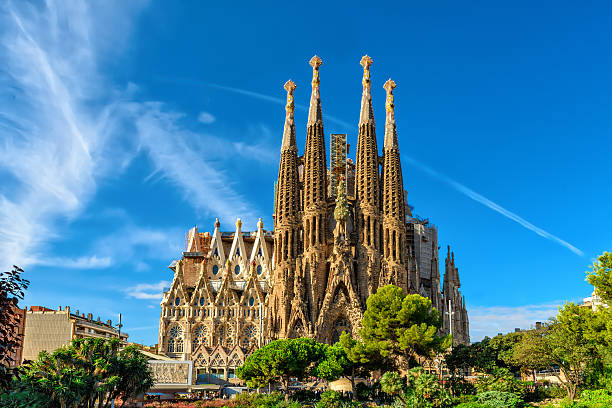
Sagrada Família belongs after the medieval contrast, not as the third sacred interior tacked onto a fading afternoon. Its ticketed entry, security process, density of visitors, and emotional scale require a fresher mind than most travelers have at the end of a long old-town morning. The cleanest sequencing is Santa Maria del Mar first, a selective Cathedral moment or old-town context walk second, then a transfer to Sagrada Família with time to arrive unhurried.
This order works because Sagrada Família is not just another church in a Barcelona sacred-art day. It changes the terms of the conversation. After Santa Maria del Mar, the traveler has a memory of medieval stone, rhythm, and civic austerity. At Sagrada Família, the guide can show how Gaudí turns columns into branching structure, surfaces into narrative, and colored light into an experience that feels less like decoration than atmosphere. Without the medieval comparison, Sagrada can feel overwhelming. With too many earlier interiors, it can feel like the final assignment in a day of stone.
The site-to-site transition matters. Walking from Santa Maria del Mar to the Cathedral area is plausible and useful because the route passes through real old-city fabric: La Ribera, Carrer de Montcada, the edge of the Born cultural zone, and the Plaça del Rei area. Walking from the old town to Sagrada Família is usually the wrong virtue. The distance looks tempting on a map for energetic travelers, but in practice it creates street-crossing drag, sun exposure, and a psychological reset before a major timed entry. A taxi or chauffeured transfer from the Cathedral or El Born edge into the Eixample is often the more elegant choice, especially with older parents or celebration travelers who do not want the day to feel like a civic endurance test.
Sagrada Família should also not be allowed to swallow the whole sacred-art route by accident. If your visit includes towers, a detailed façade reading, extended museum time, or a group member who wants every symbolic layer explained, make Sagrada Família the main event and cut back earlier. The Sagrada Família private tour belongs in the plan when the basilica is not just a photo stop but the interpretive climax. In that case, the earlier medieval section should be shorter, sharper, and more selective.
The best guide-led comparison is not “old versus new.” That is too broad to be useful. The more useful frame is how each building manages attention. Santa Maria del Mar draws the eye into unified vertical space; Barcelona Cathedral distributes attention through chapels, cloister, choir, and saintly memory; Sagrada Família orchestrates movement, light, sculpture, and structure into a total environment. Once you name that difference, you can decide what to cut. The route does not need every sacred interior in Barcelona. It needs enough contrast for the traveler to feel how Barcelona changed the language of sacred space.
The cut-first rule: when two interiors are enough
Keep the route to two interiors when the group wants culture but not devotional detail, when Sagrada Família is non-negotiable, or when the day has an ambitious dinner, shopping, or family component afterward. Two interiors are also enough when the travelers have already seen major churches elsewhere in Spain and are more interested in Barcelona’s local architectural differences than in a complete ecclesiastical survey.
The cut-first rule is this: if the day starts to feel overbuilt, cut the full Barcelona Cathedral interior before cutting Santa Maria del Mar or Sagrada Família. That sounds severe, but it protects the route’s central argument. Santa Maria del Mar gives the medieval counterweight. Sagrada Família gives the Gaudí climax. The Cathedral gives depth, but it also adds the most internal branching. If your group stops absorbing contrast, the Cathedral becomes another beautiful layer rather than a clarifying one.
Skip Barcelona Cathedral as an interior when your group is traveling with children who have limited tolerance for repeated sacred spaces, when older parents need fewer standing intervals, when the afternoon Sagrada Família entry is fixed, or when you have a late lunch that should not be sacrificed to a rushed cloister. Skip a third church entirely when the first two have already done the interpretive work. In Barcelona, restraint is not a lack of seriousness; it is the thing that allows the serious stops to stay distinct.
Premium access does not make three sacred interiors better if the traveler stops absorbing contrast. Paying more can improve timing, privacy, guidance, transfers, and the quality of explanation. It cannot create fresh attention after the group has already stood through too many similar-feeling thresholds. A private plan earns its value not by adding one more door, but by knowing which door should remain closed.
There are, however, conditions that make the third interior worthwhile. Add the Cathedral when the traveler wants the cloister, choir, rooftop, or Saint Eulalia narrative specifically. Add it when the route is entirely old-town focused and Sagrada Família is on another day. Add it when the group is art-historical, not merely first-time curious, and understands that lunch may need to be later, lighter, or closer to the Cathedral. Add it when the guide can say in advance: “We are entering for this reason, and we are leaving before it becomes a second full monument.”
The city does something physical to the body on this route. Old-town stone streets make short walks feel longer because the eye is constantly adjusting: narrow lanes, uneven paving, small squares, façade stops, and queue edges around Pla de la Seu. Then the Eixample transfer asks the body to reset into a brighter, wider grid with longer blocks and less shade. Add a tower, a rooftop, or a chapel-by-chapel Cathedral visit, and the fatigue is not dramatic; it is cumulative. Travelers often notice it only when Sagrada Família arrives and they no longer have the same appetite for looking upward.
A sacred-art route that keeps context without turning into a church crawl
The route works best when the morning teaches one medieval idea, the midday movement clears the head, and Sagrada Família arrives as a contrast rather than a final obligation. This is a mistake-prevention route, not a maximalist itinerary.
- Start in La Ribera, not at the Cathedral doors. Begin near Santa Maria del Mar so the first interior is tied to the neighborhood that produced it. The streets around Passeig del Born, Carrer de Montcada, and the basilica’s side approaches let the guide explain urban fabric before the group enters.
- Use Santa Maria del Mar as the medieval interior. Keep the visit focused on structure, civic devotion, and the feeling of Catalan Gothic space. Do not turn it into a long inventory of details. The point is to create a memory that Sagrada Família can later challenge.
- Walk toward the Cathedral through selected old-city context. The Plaça del Rei area, the Roman wall edges, and Pla de la Seu can do more for orientation than another interior if time is tight. The guide’s job is to make the medieval city legible without asking the traveler to collect every stop.
- Choose one Cathedral lens if entering. Cloister, choir, crypt, or roof: choose before you enter. A full Cathedral visit plus Santa Maria del Mar plus Sagrada Família is the version most likely to flatten the day.
- Leave the old town cleanly. Transfer from the Gothic Quarter or El Born edge rather than walking the whole way to Sagrada Família. The route should feel curated, not stubborn.
- Arrive at Sagrada Família with buffer. This is the wrong place to arrive rushed, hungry, or mid-argument about what to skip. Confirm the ticket details on the official site and preserve enough margin for entry logistics.
The mood consequence is just as important as the logistics. A well-edited sacred-art day makes Barcelona feel more coherent: medieval streets, mercantile Gothic, episcopal power, and Gaudí’s Eixample basilica all speak to one another. An overfilled day makes the city feel like a stack of famous interiors. The difference shows up later, at dinner. The edited version leaves travelers with a clear story to discuss. The crowded version leaves them trying to remember which stone vault, cloister, or façade belonged where.
That is why this route should not be paired casually with a full Modernisme survey. If you want Sant Pau, Palau de la Música, and Eixample façades, build that as a different architecture day. The supporting guide to a Modernisme day without Gaudí overload is useful precisely because it solves a different problem. Mixing that whole arc into a sacred-art route blurs both.
What a private guide changes in a sacred-art day
A private guide changes the day by selecting fewer interiors with more intention, then making the architectural contrast understandable while the group still has energy. The value is not a longer lecture. It is knowing when to stop explaining one building so the next one can still land.
At Santa Maria del Mar, a guide can keep the interpretation spatial: why the nave feels unified, how the neighborhood context matters, and why Catalan Gothic should not be explained as merely a local version of a French or Castilian story. At Barcelona Cathedral, the same guide can prevent drift by choosing a specific focus: cloister life, liturgical hierarchy, Saint Eulalia, choir, or rooftop orientation. At Sagrada Família, the guide can connect structure to meaning without making every façade and symbol compete for attention.
This is especially valuable for small groups with mixed interests. One traveler may want architecture, another devotional art, another Barcelona history, and another simply wants not to lose the afternoon to standing indoors. A private guide can keep the day honest by naming what is being omitted. That can feel counterintuitive to travelers who associate premium touring with more access, but the better version of this day often has fewer entries, clearer transitions, and a stronger final impression.
There is also a social advantage. Families, celebration groups, and couples do not always tire at the same pace. A guide can read when the group has stopped absorbing symbolic explanation and needs a shorter walk, a coffee pause, or a transfer. Without that judgment, the day can become a polite march through spaces nobody wants to disrespect but nobody is fully receiving. The private tour guide in Barcelona option is most useful here when the brief is not “show us everything,” but “make the sacred-art contrast meaningful without exhausting the day.”
If you want this route built around your hotel location, entry times, food plans, mobility needs, or a celebration evening, the inquiry should be specific about what the group wants to feel at the end of the day: awe, context, quiet, or a cleaner transition into dinner. Inquire now
Upgrade decisions to make before you book
The most important upgrade is not a more expensive ticket; it is a better decision about where the day’s attention should peak. Once that is clear, spend can help with comfort, transfer quality, guiding depth, and timing. Spend cannot rescue a route that asks too much of the same part of the mind.
Consider a private transfer between the old town and Sagrada Família if your group includes older parents, younger children, a guest with limited stamina, or anyone dressed for a special lunch or evening. Barcelona is very walkable in pieces, but the old town to Eixample shift can become a dead zone in the middle of the day. The chauffeured or taxi-supported move is not about distance alone. It is about arriving at Sagrada Família without the mood of the morning leaking away through heat, traffic lights, and block after block of transitional walking.
Be careful with tower and rooftop upgrades on the same day. A Sagrada Família tower visit can be memorable for the right traveler, and the Cathedral roof can orient the city beautifully, but stacking vertical add-ons changes the physical texture of the route. More steps, more waiting, and more threshold management mean less patience for interpretation. Choose one vertical perspective if it genuinely supports the story. Do not collect both just because they are available.
Skip-the-line language also deserves restraint. Timed entry and guide coordination can reduce stress, but sacred-art fatigue is not only caused by queues. It is caused by a day that never lets one idea settle before introducing another. The stronger upgrade is a guide who can say, before the day begins, that the Cathedral will be a cloister stop rather than a full monument, or that Santa Maria del Mar will be the old-town interior and the Cathedral will remain exterior context.
For food-and-wine travelers, the evening plan should shape the sacred-art day earlier than you think. If a tasting dinner or serious reservation is the emotional close, do not schedule a third interior simply because there is a slot free. Study the restaurant’s official menu (https://www.disfrutarbarcelona.com/en/menu) with the same respect you give monument timing, then leave enough space in the afternoon for a hotel return or a calmer walk. The meal will not feel more special because the day was harder.
When the Cathedral should win, when Santa Maria del Mar should win
Santa Maria del Mar should win when the question is how to give Sagrada Família meaningful medieval context without overloading the day. Barcelona Cathedral should win when the question is how to understand the city’s ecclesiastical center, saintly devotion, or old-town hierarchy. Those are different questions, and the route improves when you stop forcing one building to answer the other.
Choose Santa Maria del Mar if you want the cleanest architectural contrast, a more contained visit, and a route that can still leave room for Sagrada Família to dominate the afternoon. It is the better choice for first-time travelers who already have several major sights in the same stay, for families who need the day to move, and for couples who want culture without losing the evening. It also fits a route that threads El Born, Carrer de Montcada, and the Cathedral exterior without asking every stop to become an entry.
Choose Barcelona Cathedral if your group is specifically interested in the cloister, Saint Eulalia, the choir, the rooftop, or the Cathedral’s position at the symbolic center of the old city. It is also the better medieval interior if the day is not including Sagrada Família, or if Sagrada Família has already been handled on a Gaudí-focused route such as a private Gaudí day without queue burnout. In those conditions, the Cathedral has enough room to breathe.
Do not choose both by default. If you enter both before Sagrada Família, each needs a different job. Santa Maria del Mar can be structure and neighborhood. Barcelona Cathedral can be cloister and institutional center. Sagrada Família can be the theological and architectural climax. Without those roles, the day becomes a polite version of “another church, another explanation,” which is exactly what sacred-art travelers are trying to avoid.
How to protect the evening after Sagrada Família
The route should end with either a reset or a soft landing, not another demanding cultural stop. Sagrada Família leaves many travelers visually full, especially if the guide has done the comparison properly. The next move should help the day settle: a hotel pause in the Eixample, a short walk along Avinguda de Gaudí, or an easy dinner transition that does not require crossing the old town again.
El Born can still work after Sagrada Família, but only when the group wants evening streets and has enough energy for noise, crowds, and the return. The Gothic Quarter can be lovely later, but it is a poor reward if the morning already used those lanes intensively. Eixample is often the more graceful evening base after Sagrada Família because the streets are wider, transfers are simpler, and the group does not have to re-enter the same medieval density it has already processed.
For couples and celebration travelers, the right ending may be a deliberate pause before dinner rather than another view. This is where the sacred-art day gains commercial sense without becoming sales copy: a private route that cuts one interior can leave the evening intact. If dinner is part of the occasion, use the guidance in Barcelona between Sagrada Família and a late dinner to decide whether the night belongs in the Eixample, El Born, or back at the hotel.
The final editorial judgment is firm: for a sacred-art route that includes Sagrada Família, Santa Maria del Mar plus one controlled Cathedral lens is the ceiling for most groups, and Santa Maria del Mar plus Sagrada Família is the best version when you want the day to remain elegant. Add more only when the traveler’s specific interest justifies the cost in attention.
FAQ
Can you visit Santa Maria del Mar, Barcelona Cathedral, and Sagrada Família in one day?
Yes, but it is usually better to treat Barcelona Cathedral as a focused stop rather than a full third interior. Three complete sacred interiors can make the day feel repetitive before Sagrada Família has a chance to land properly.
Which is better for Sagrada Família context, Santa Maria del Mar or Barcelona Cathedral?
Santa Maria del Mar is usually better for Sagrada Família context because it gives a clear medieval spatial contrast without demanding too much time. Barcelona Cathedral is better when the traveler specifically wants the cloister, Saint Eulalia, choir, or episcopal history.
Should Sagrada Família come first or last in a sacred-art route?
Sagrada Família usually belongs after a shorter medieval context section, not as the last stop after two long church interiors. It needs enough energy, buffer, and attention to feel like the climax rather than the final obligation.
When should Barcelona Cathedral be skipped?
Skip Barcelona Cathedral as an interior when Sagrada Família is fixed, Santa Maria del Mar already supplies the medieval contrast, the group includes children or older parents with limited stamina, or the day needs to preserve a serious lunch or dinner plan.
Is Santa Maria del Mar worth entering if we already have Sagrada Família tickets?
Yes, Santa Maria del Mar is worth entering when you want Sagrada Família to feel more intelligible. Its Catalan Gothic restraint helps travelers understand how dramatically Gaudí changes the language of sacred space.
Does a private guide make a sacred-art route better?
A private guide is most valuable when the day needs editing. The guide can choose fewer interiors, connect the buildings through architecture and neighborhood context, and stop the route before sacred-art fatigue sets in.
Is this route good for families?
Yes, if it is kept to two interiors and the Cathedral is handled selectively or from the exterior. Families usually do better with strong contrasts, shorter explanations, and a clean transfer to Sagrada Família.
Can this sacred-art route fit before a fine-dining evening?
Yes, but keep it lean. Choose Santa Maria del Mar and Sagrada Família, avoid a full third interior, and leave enough time after Sagrada Família for a hotel reset or a calm Eixample transition.
If you’re interested in any private tours of Barcelona, please reach out to us.








 So if you are looking for the absolute best in Barcelona & surroundings with authentic local fully-licensed native guides whose English you can actually understand and with an exclusive and amazingly fun itinerary













