Lisbon When Port Calls Cluster: Old-Town Access, Timed Entries and a Route That Can Pivot

Updated
The direct answer: verify the day, then change only the vulnerable parts
Several cruise calls on Lisbon’s official schedule should trigger a recheck, not an automatic rewrite of the whole day. For a private group with one fixed date, the useful sequence is to verify three separate conditions: the live port schedule, current vehicle-access or road controls around the planned old-town approach, and any operating notice or defined entry time at the monument that anchors the route. Change the order only where those conditions actually intersect. A ship list can tell you that additional arrivals are expected; it cannot, by itself, prove how crowded Alfama, Baixa or Belém will feel at a particular hour.
The official Lisbon Cruise Port schedule is the correct starting point because it can be filtered by date range and cruise line. Its own warning matters just as much as the listings: published schedules are for reference and may change for weather or operational reasons. That makes the schedule a live planning input rather than a permanent label attached to a date. It is worth checking when the route is first built, again when timed entries are confirmed, and once more close enough to travel that an operational change can still be absorbed.
What should move when pressure is verified? Usually the district order, the old-town drop or pickup point, and the amount of slack around a timed entry. What should usually remain stable? The group’s most important interior visit, mobility limits, a fixed end time, and the city story the day is meant to tell. The practical aim is not to “beat” every other visitor. It is to stop one brittle transition—a vehicle trying to reach a controlled lane, a slow Alfama descent, or a late cross-town transfer—from consuming the only Lisbon day available.
Build the day in modules rather than as one continuous chain. Alfama can be a high-to-low historic walk, Baixa can be the central regrouping spine, and Belém can be a western monument-and-river module. Each has a different operational role. When one becomes unreliable, the answer is not to pretend that another district is identical; it is to preserve the function that matters most and substitute the rest honestly. That is how a route can pivot without becoming thin or improvised.
A port-call cluster is a signal to investigate, not a crowd forecast
“Clustered calls” is useful only as an operating condition. It means the official schedule shows several calls close enough in date or arrival pattern to justify a closer look at the city route. It does not establish the number of people who will leave each ship, when they will move, which districts they will choose, or whether their movement will overlap with a private group’s plan. Those outcomes also depend on ship operations, shore programs, weather, terminal use, road conditions, attraction capacity and ordinary city demand. None of those should be inferred from ship count alone.
A sound planning threshold therefore uses more than one signal. First, confirm that the schedule is relevant to the hours in which the group would approach eastern Lisbon. Second, identify a route-specific constraint: controlled vehicle access in Alfama or Castelo, a pickup that depends on a narrow approach, or a defined Belém entry that cannot slide. Third, ask whether the group can absorb disruption. A compact, mobile party with no reserved interior has more room to adjust than a multigenerational group with a fixed entry, a prearranged vehicle and a hard finish. The more of those conditions coincide, the stronger the case for changing sequence before the day begins.
This distinction prevents two common planning errors. One is overreaction: abandoning Alfama on every date with multiple listed ships, even when access is clear and the group starts elsewhere. The other is complacency: keeping a tightly coupled east-to-west plan because the port schedule looked quiet when first checked, even though a road-control notice or monument update later changed the practical route. The schedule initiates the question; access and entry conditions answer it.
Dated operating note: the official sources used for this guide were reviewed on 5 August 2026. The port schedule, São Jorge Castle arrival guidance and Belém Tower operating notice are inherently more changeable than Lisbon’s basic geography. Recheck the live pages for the actual travel date rather than relying on a saved screenshot or an old itinerary.
For a group staying in Lisbon, the port is an external pressure point, not necessarily the day’s origin. A hotel in Avenida da Liberdade, Chiado or another central district creates a different first movement from a party disembarking at Santa Apolónia. The correct response to a busy port date must therefore start with the group’s real pickup location. This guide is not a cruise-passenger circuit; it is a method for protecting any fixed Lisbon day from a condition that can concentrate movement near the historic centre.
Why Santa Apolónia can concentrate early movement near the old town
The geography explains why the port check belongs near the start of the decision. The Port of Lisbon’s Santa Apolónia terminal page states that Santa Apolónia is integrated with the Lisbon Cruise Terminal, handles embarkation, disembarkation and transit operations for smaller ships, and sits next to the historic and cultural centre. The operational implication is not that every nearby street will be overwhelmed. It is that arriving groups, taxis, coaches and independent walkers can begin their city movement beside the same eastern historic area that many first-time Lisbon plans place first.
On a map, Santa Apolónia lies on the river edge below the eastern hills. Alfama rises immediately inland and westward toward the castle approaches; Baixa occupies the more regular central grid farther west; Belém sits well beyond the central core along the Tagus. A group beginning near the terminal can therefore join the same east-to-centre flow as visitors heading to Alfama, São Jorge Castle, cathedral approaches or Baixa. A private group beginning at a hotel may encounter the effect indirectly through vehicle availability, curb pressure or a slower approach rather than through the terminal itself.
The concentration is usually most relevant at transitions. The first is arrival-to-street movement around the eastern riverfront. The second is the climb or vehicle approach toward Alfama and Castelo. The third is the later release of groups toward Baixa or west along the river. This does not mean pressure remains constant all day. People disperse, calls operate differently, and many visitors choose other destinations. The planning value lies in recognizing that the eastern start can be more fragile than the rest of the route, especially when the group has paired it with a precise Belém commitment later.
Terminal geography also explains why a small delay can become disproportionately expensive. An unhurried Alfama walk is not a problem in itself. It becomes a problem when the vehicle meeting point is uncertain, the descent takes longer than expected, and a timed western entry leaves no recovery margin. The lost time is created by dependency, not simply by crowd density. A resilient day reduces the number of transitions that must happen exactly on cue.
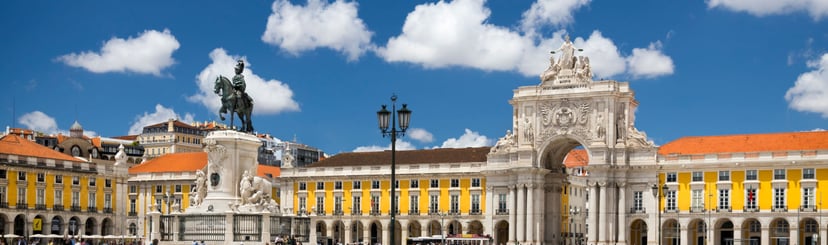
Baixa is valuable here because it can act as an interpretive district and a logistical hinge without being reduced to a waiting room. Its Pombaline grid, Praça do Comércio and connection to the river carry a coherent account of Lisbon after the 1755 earthquake. A group that delays or shortens Alfama can still have a substantive central chapter rather than empty time. For deeper context, Baixa’s post-1755 urban story provides a supporting cultural framework.
The dependencies that actually decide the route
Alfama access is a vehicle question before it is a walking question
Alfama can remain open and rewarding for pedestrians while the vehicle plan around it becomes awkward. Lisbon’s municipal mobility operator lists Alfama and Castelo among the historic neighbourhoods governed by Zonas de Acesso Automóvel Condicionado. According to the official EMEL historic-neighbourhood access page, access is managed remotely around the clock and vehicle entry and parking are restricted. The important distinction is that a controlled-access zone is not a declaration that the neighbourhood is closed to visitors. It means a group should not assume that a driver, minibus or coach can follow the most convenient map route or wait near the final walking stop.
That changes the design of an Alfama visit. The route needs a confirmed pedestrian start, a realistic finish and a lawful vehicle meeting point outside any lane where access or waiting is uncertain. It also needs a fallback that does not require the driver to improvise inside the historic fabric. A route that starts higher and descends can reduce repeated climbing, but only when the arrival point is confirmed for the actual vehicle and the group can manage the surfaces. A route that begins lower may be simpler to access yet more demanding physically if it turns into an uphill search for the castle.
São Jorge Castle’s official arrival guidance offers useful orientation. It describes an approach from Baixa-Chiado using the Castelo and Chão do Loureiro lifts and identifies Portas do Sol and Chão do Loureiro as the closest parking locations, roughly five minutes away on foot. Those details help define the last pedestrian segment. They should not be read as blanket permission for every group vehicle to load, unload or wait there. The current access rules, vehicle type and any special-needs arrangement still need direct confirmation.
A defined Belém entry can become the day’s hard anchor
Belém creates a different kind of dependency. The district is spatially more open than Alfama, but major interiors can impose exact operating conditions. An official notice dated 20 May 2026 announced the restored Belém Tower’s inauguration on 26 May and public visits from 27 May. The Museums and Monuments of Portugal notice says the visitor model uses defined access times, or slots, to manage visitor flow and protect the monument. For route planning, that converts the Tower from a flexible riverfront stop into a potential clock-setting appointment.
A slot should be treated as specific to the monument and date shown. It does not confirm conditions at Jerónimos Monastery, another museum, a nearby loading area or the cross-town road. Nor does an exterior view equal an interior visit. When the interior matters, keep the reserved time and let a less constrained district move around it. When the interior is optional, the riverfront and architectural context can remain useful even if the slot no longer fits—but the itinerary should describe that substitution accurately.
The most fragile design is a full Alfama morning with an uncertain pickup followed by a tightly timed Belém interior. It couples the hardest old-town transition to the least flexible western appointment. The route may work perfectly on a clear day, yet it has little tolerance for a late start, a slower descent, a changed meeting point or cross-town traffic. The safer design either protects the Belém entry with more slack or makes the eastern visit compact enough that it can be shortened without losing its central idea.
Group conditions matter as much as city conditions
A route that is resilient for two strong walkers may be unsuitable for eight relatives moving at different speeds. Group size affects counting, reassembly and vehicle loading. Mobility affects whether a steep lane, lift approach or extended cobbled descent can remain optional. A fixed lunch, train, airport transfer, performance or evening commitment reduces the amount of recovery time available. A larger vehicle may have a different legal and practical approach from a standard car. These are not secondary preferences; they determine which district can absorb uncertainty.
For a premium private group, the useful question is not how many sights can be retained under pressure. It is which experiences deserve to remain protected. One deeply interpreted old-town descent, one major Belém interior or one coherent Baixa chapter can each anchor the day. Trying to protect all three at equal intensity is what turns a port-related delay into a city-wide failure. Route coordination earns its value by deciding in advance what can contract, what can move and what must remain fixed.
Alfama, Baixa and Belém are substitutes only by function
These districts are often placed in the same first-time itinerary, yet they do different work. Alfama supplies medieval topography, intimate urban texture and a high-to-low reading of the eastern city. Baixa supplies the planned post-earthquake centre, ceremonial squares and a comparatively legible grid. Belém supplies the monumental and Atlantic-facing narrative of Lisbon along the western riverfront. A pivot should preserve the group’s chosen theme or operational need, not merely replace one place name with another.
Keep Alfama when historic texture is the priority and the access plan is credible
Alfama is worth retaining when the group’s main interest is the lived geometry of old Lisbon: layered lanes, changing river views, the relationship between the castle hill and the lower city, and the way topography shaped movement. It is also the district least suited to a vague vehicle plan. Keep it when the walking ability is known, the start and finish are confirmed, and the day can tolerate a slower passage without threatening the next hard commitment.
When port-related pressure or access uncertainty is real, reduce Alfama by editing its shape rather than rushing through it. One upper approach, one interpretive descent and a clear handoff into Baixa can retain the district’s meaning. Repeated viewpoints, a second climb or a long search through similar lanes are the first elements to remove because they add exposure without necessarily adding a new chapter. An Alfama-to-Baixa route with a Belém escape develops that shorter eastern sequence.
Baixa cannot reproduce Alfama’s medieval fabric, so the substitution should be stated honestly. A group that skips the upper hill has chosen urban continuity and reliability over the full old-town immersion. That can be the right decision for a fixed day, particularly when the alternative is to hurry the descent, miss the vehicle, and arrive late at the western anchor.
Use Baixa as the central absorber when information is incomplete
Baixa is the most useful district when the port schedule raises concern but the street-level effect is still uncertain. Its grid offers several ways to shorten, extend or redirect the walk. It can connect an eastern arrival to the river, hold cultural value while a driver repositions, and finish near multiple onward routes. It is not guaranteed to be quiet, and it can receive its own group traffic. Its advantage is lower dependency: the district’s main story does not rest on a single gate, one uphill lane or one vehicle approach.
A central-first start is especially useful when the group is collected from a hotel rather than the port. Begin with a defined Baixa chapter, then make the east-or-west decision after checking the latest access and entry status. If Alfama remains practical, continue toward the lifts or a confirmed upper approach. If the eastern lanes are producing avoidable delay, move west toward Belém before the reserved window. This holds the route open without wasting the first part of the day.
Baixa also works as a dignified fallback after a shortened Alfama visit. The narrative transition is strong: from irregular hillside fabric to the ordered reconstruction below, then to the Tagus-facing Praça do Comércio. That sequence turns an operational change into historical explanation. It is far better than filling time with disconnected stops simply because the original list has become impossible.
Use Belém as a western pivot when the river or a timed interior is the priority
Belém can remove the group from the eastern terminal-to-old-town corridor, but it should not be described as an empty alternative. The district has its own visitor demand, road conditions and operating rules. Its value as a pivot comes from geography and subject matter: it is west of the central hills, spread along the river, and capable of supporting a coherent maritime and monumental chapter even when Alfama is postponed.
Start in Belém when a defined entry is non-negotiable, when eastern vehicle access is unresolved, or when the group’s energy is better used on a comparatively level riverfront before any hill. Protect the appointment, then return to Baixa and decide whether Alfama still fits. This order makes the old town the flexible module rather than allowing it to threaten the fixed western time. A focused version is set out in a focused private Belém morning.
If the Tower interior is unavailable or its slot would distort the day, the honest fallback is not to claim the same experience from outside. Use the exterior to discuss defensive form, river position and the relationship between monument and estuary; pair it with a broader riverfront reading or another currently available interior that has been separately verified. The cultural payoff changes, but it need not disappear. The decision should be made before the group crosses the city, not after arriving without a workable entry.
Choose the substitute by the job it needs to perform
- For medieval topography and close-grained old-city atmosphere: retain a shortened Alfama descent, provided walking and access are credible.
- For a low-dependency historical chapter and reliable regrouping: use Baixa’s post-1755 plan, commercial centre and river threshold.
- For a protected major interior or an Atlantic-facing Lisbon story: keep Belém and make the eastern hill conditional.
- For a group that cannot absorb cobbles, gradients or uncertain last-mile access: place more of the day in Baixa and the riverfront, then add only the old-town edge that current conditions support.
- For a fixed finish: choose the district that leaves the simplest final transfer rather than crossing Lisbon again for one minor stop.
This functional approach also stops the route from zigzagging. A day that goes east to west and back east is difficult to rescue when one segment slips. A day that moves once across the city—or begins centrally and commits in one direction—contains the risk. The port schedule matters because it may change the best starting side, not because it dictates every later choice.
Three route shapes that can pivot without losing coherence
The most reliable way to plan is to separate the day into an anchor, a connector and an optional module. The anchor is the experience that justifies the date or reservation. The connector is a district with enough substance to remain worthwhile even if timing changes; Baixa often fills this role. The optional module is the part that can contract or disappear without making the whole day incoherent. The order changes according to verified conditions, but the hierarchy remains clear.
East first, then one clean move west
Use an east-first route when the official schedule does not indicate a relevant concentration in the group’s starting window, the Alfama access plan has been confirmed, and the party can complete the old-town walk without relying on an uncertain pickup. Begin at the agreed upper or perimeter point, interpret Alfama on a descending line, and enter Baixa as the transition between medieval and reconstructed Lisbon. Continue west only once, with enough slack to protect any defined Belém entry.
The pivot is prepared before the walk starts. If access changes, the vehicle cannot use the planned point, or the group’s pace makes the western appointment vulnerable, do not wait inside the hill for the route to repair itself. Move the interpretive start to Baixa, retain a shorter lower-Alfama edge if practical, and protect the westbound transfer. The route still tells a Lisbon story; it simply changes the amount of medieval fabric included.
This shape is strongest when Alfama is the cultural priority and Belém is important but not overloaded with serial reservations. It becomes weak when the group has several separate entry times in the west. Every additional hard time reduces the ability to let the old town unfold naturally.
West first, then finish through the centre
Use a west-first route when Belém holds the day’s non-negotiable entry, when eastern road access is uncertain, or when port activity is concentrated beside the old-town approaches during the opening part of the day. Complete the reserved interior and river context first. Then travel once to Baixa, where the group can continue with a coherent urban chapter and decide whether a compact Alfama segment remains sensible.
The critical discipline is to make Alfama conditional. It should not be added merely because the original plan included it. Add the hill only if the group has enough walking capacity, the current access route is known, and the final transfer remains simple. Otherwise finish in Baixa, along the central riverfront, or at a nearby cultural stop whose current opening has been verified. This protects the quality of the day from a late, compressed climb.
A west-first day can feel less conventionally “old Lisbon” at the start, but it is often operationally cleaner when a Belém slot sets the clock. The route can still reach historical depth by tracing the river’s role, the monumental western edge and the reconstructed centre before deciding how much pre-earthquake fabric to add.
Central first, then commit east or west after the latest check
A central-first route is useful when the evidence is mixed. The port schedule may show several calls, yet no specific access warning has appeared; or the group may start from a central hotel with time before a western entry. Use Baixa as a substantive opening rather than as a holding pattern. During that chapter, confirm the live conditions that decide the second half.
The route needs a decision point. Before the group begins a long transfer or climbs beyond the practical exit, choose east or west. Continuing to “keep both options open” too long creates the very zigzag the plan was meant to avoid. A central-first morning works because Baixa is connected and flexible; it fails when indecision turns it into extra mileage.
For private groups moving across all three districts, group routing across Belém, Baixa and Alfama offers a supporting framework. The principle remains the same: one major cross-city movement, one clearly protected anchor, and an old-town segment whose start and finish are known before the group enters it.
Pickup points and buffers should be designed, not guessed
Old-town route plans often name the first sight but not the exact moment when walking ends and vehicle movement resumes. That omission is costly for a group. A useful pickup plan contains four elements: a lawful primary meeting point, a fallback point outside the constrained area, the expected walking segment between them, and one communication method understood by the organizer, guide and driver. A shared map pin helps, but it is not enough when a square has several sides, a vehicle cannot wait, or the group exits by a different lane.
The official castle page’s references to Portas do Sol and Chão do Loureiro are useful as geographic orientation, not universal loading instructions. The actual vehicle and current controls decide what is possible. A sedan, licensed tour vehicle, minibus and coach should not be treated as interchangeable. The route should be confirmed for the vehicle that will operate, including where it may legally stop and where it can reposition while the group is on foot.
For a larger party, the regrouping point should come before the vehicle point. Count the group in a calm, visible place, then move together to the pickup. Trying to assemble people at the curb while the driver waits creates pressure and increases the chance that someone follows the wrong vehicle or remains behind. In Baixa or Belém, choose a landmark that is visually unambiguous and does not depend on standing at a monument gate. In Alfama, choose the end of the interpretive walk before the access edge, not an optimistic point deep inside the lanes.
Buffers should be tied to the risk they absorb. An old-town egress buffer covers a slower descent, a lift queue or a changed meeting point. A cross-town buffer covers the transition from pedestrian group to vehicle and the movement between eastern or central Lisbon and Belém. An entry buffer covers the monument’s current arrival procedure, security and the possibility that the group reaches the wrong entrance. A mobility buffer covers rest, uneven surfaces and the fact that a mixed-pace party does not move at the speed of its fastest member.
There is no single number that is correct for every Lisbon group. A better test is whether the plan can absorb one adverse transition without sacrificing the protected anchor. If a missed lift, a delayed pickup or a slower crossing would immediately cause the reserved entry to be lost, the route is too tightly coupled. Add slack, shorten the preceding module or reverse the order. Do not solve the problem by asking the group to walk faster than its known pace.
Accessibility requires its own check. The existence of a lift route does not make every connecting lane step-free, and a nearby parking location does not guarantee direct vehicle access to a monument entrance. Groups using wheelchairs, canes or other support should confirm current arrival arrangements with the relevant site and adapt the walking segment. A shared Lisbon day with a wheelchair is a useful supporting guide for the honest limits of the hills.
Private transport becomes materially useful when it can reposition while the group walks, hold a verified fallback pickup and execute a pre-agreed east-to-west pivot. The benefit is not the presence of a car for its own sake. It is the reduction of uncertain handoffs. If the driver has no confirmed access plan, no alternate meeting point and no knowledge of the timed entry, the service does not solve the operational problem.
Reserve the scarce elements and leave the geography flexible
On a date that may face port-driven pressure, reservations should protect what is genuinely scarce. A defined monument entry, a necessary accessible-arrival arrangement, a meal that matters to the day, and a suitable vehicle for the group can justify advance commitment. The exact sequence of public spaces, viewpoints and unreserved streets should remain more flexible. This division allows the route to respond to current conditions without discarding the elements that required planning.
A prudent editorial rule is to avoid stacking several hard appointments on opposite sides of Lisbon with minimal recovery time. One major clock-setting commitment in each broad half of the day is easier to protect than a chain of unrelated entries. The rule is not an official city standard; it is a way to preserve decision room. Each monument also needs its own verification. The Belém Tower notice does not establish the opening, entry system or late-arrival policy of any other site.
When a reservation is made, record more than the confirmation code. Note the official entrance, required arrival process, current cancellation or change terms, the person holding the booking, and the latest point at which the preceding district must end. That final field turns a reservation into a route decision. Without it, the group may continue sightseeing until the transfer has already become unrealistic.
Leave one element visibly optional in the written plan. It might be an upper Alfama viewpoint, a second Belém exterior, or an additional central interior. Labeling it optional prevents the guide or organizer from treating its removal as failure. The day then has an intentional release valve rather than an emergency cut made under pressure.
The recheck sequence that keeps the plan current
The first check happens when the date is chosen. Use the official port schedule to see whether calls are listed and whether the date deserves closer attention. Do not turn that list into a prediction of street conditions. At the same stage, identify the route’s vulnerable point: the Alfama vehicle approach, the old-town pickup, the cross-city transfer or the Belém appointment. A schedule matters only in relation to a real dependency.
The second check happens when the anchor is reserved. Confirm the official operating notice for that site, the arrival process and the location of the entrance. Then work backward through the route. If the anchor is in Belém, decide when Alfama must end and where the vehicle will meet. If the anchor is the old town, decide how much of Belém can remain flexible. This is the moment to reverse the order if the original plan has become too tight.
The third check happens close to the visit. Reopen the live cruise schedule because the operator warns that calls may change. Review the municipal access information and any site-specific notice that affects the planned day. Confirm the pickup with the actual driver or transport provider, not only with an itinerary document. Check that the group’s hotel, terminal or other origin has not changed and that mobility needs are still accurately represented.
Recheck immediately when any of the following occurs:
- the official port schedule adds, removes or materially changes calls relevant to the planned window;
- a road-control, access-zone or vehicle instruction affects the agreed old-town approach;
- a monument changes its operating notice, defined entry time, entrance or visitor-flow procedure;
- the group changes size, vehicle type, mobility requirements, pickup origin or fixed finish;
- weather or another operational issue causes the port operator or site to update its guidance.
Several shortcuts are unreliable. Do not reuse a screenshot of the port schedule without reopening the official page. Do not assume a map application understands controlled access for the operating vehicle. Do not infer a monument’s rules from a nearby site. Do not keep Alfama, Baixa and Belém equally mandatory after one of the connecting assumptions has failed. The route should respond to verified conditions, not to the emotional weight of the original wish list.
The durable part of this method is the decision structure. Ship names, operating times and access notices will change. Lisbon’s east-central-west geography, the contrast between Alfama’s constrained lanes and Baixa’s grid, and the risk of coupling an uncertain old-town exit to a defined Belém entry remain useful. That is the evergreen value: not a forecast of a particular day, but a repeatable way to know what deserves rechecking and what should move when the evidence changes.
An evergreen fallback when both the port and monument plan remain uncertain
When the port schedule is active, old-town access is unresolved and the preferred Belém interior cannot be secured, use a low-dependency central route rather than forcing two uncertain districts into the same day. Begin with Baixa’s planned geometry and the Praça do Comércio river threshold. Continue through the central streets with a focused account of the 1755 rupture and reconstruction. Add a Tagus-facing walk whose length can expand or contract. Then choose one verified extension: the lower edge of Alfama if the group and access conditions allow, or Belém’s exterior and river context if the western movement remains sensible.
This fallback is not a claim that public space is immune to disruption. Temporary civic controls, construction, weather and ordinary city use can still affect it. Its advantage is that the main cultural value does not depend on a single interior slot or a vehicle entering a historic lane. It gives the group several places to pause, regroup and redirect while maintaining a legible Lisbon narrative.
The fallback should still contain one clear ambition. It might be to understand how Lisbon turns from irregular hillside city to planned river capital, or to trace the Tagus from commercial gateway to Atlantic monument landscape. A low-dependency day is not an excuse for generic wandering. The guide’s interpretation must do more work because fewer fixed attractions are carrying the structure.
For organizers, the final operating sheet can be brief:
- the current official port-schedule link and the date it was last reopened;
- the group’s actual origin, fixed finish, size, mobility notes and vehicle type;
- one protected interior or cultural anchor, with its current arrival requirement;
- the primary and fallback pickup points for the old-town segment;
- the latest decision point for choosing Alfama, Baixa or Belém next;
- the optional stop that can be removed without damaging the day’s main idea.
Coordination becomes worth paying for when the date cannot move and the group cannot afford to discover these dependencies one by one on the street. The service connection is specific: current port checks, reserved entries, confirmed vehicle access, a shared pickup plan and an alternative route ready before the first constraint appears. It is not a promise that Lisbon will be empty. It is a way to prevent one crowded or controlled district from consuming the group’s only city day.
For broader planning, review private Lisbon touring options and send the travel date, group size, mobility needs, fixed entries, pickup origin and required finish. When those details need to become one coordinated, transport-ready route, Inquire now.
If you’re interested in any private tours of Lisbon, please reach out to us.


 So if you are looking for the absolute best in Lisbon & surroundings with authentic local fully-licensed native guides whose English you can actually understand and with an exclusive and amazingly fun itinerary













