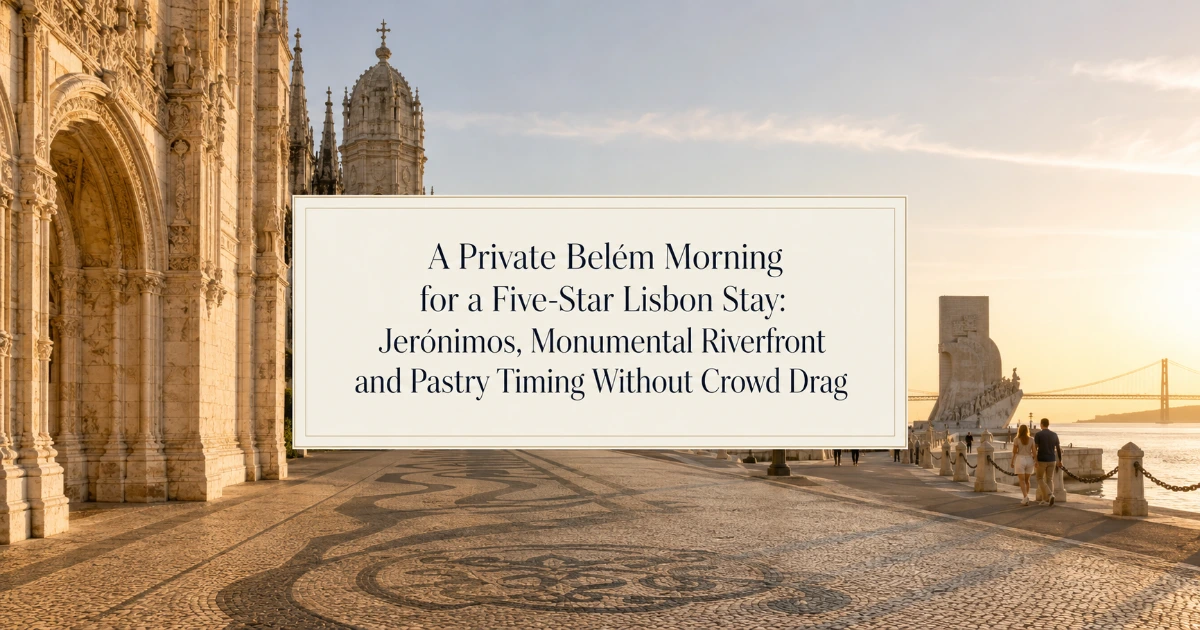
A Private Belém Morning for a Five-Star Lisbon Stay: Jerónimos, Monumental Riverfront and Pastry Timing Without Crowd Drag
Updated
Plan Belém as a contained private morning, not as a full-day monument crawl: begin with Jerónimos, use the pastry stop as a timed pause, then finish along the monumental riverfront. It works in real Lisbon conditions because Belém sits west and mostly river-level, so a clean morning avoids tram crowding, cross-city resets and the late-day climb that can ambush a polished itinerary; the non-obvious hinge is the Alfama slope above the tram corridor, which should not be forced on top of Belém unless the day has been deliberately shortened. The exception is a traveler who wants deep museum time or a long riverside lunch; that is a different day, not a better Belém morning.
The article-specific thesis is simple: Belém feels five-star when it is treated as a sequence problem, not an attraction inventory. Jerónimos gives the morning its intellectual weight, Pastéis de Belém gives it a Lisbon-specific pause, and the Tagus riverfront gives it air before you return to the city center. The wrong order makes the same places feel slow, public and oddly tiring. The right order makes Belém feel shorter than it is.
For travelers who want the route hosted rather than self-managed, the natural starting point is a private Belém and Jerónimos plan such as Belém and Jerónimos private route. The value is not that a private guide makes Belém more ornate. The value is that the guide keeps the district from becoming a queue-heavy monument run, deciding when to enter, when to pause, when to skip an interior and when to use the riverfront as the reset rather than the reward for exhaustion.
The planning verdict: Belém wins when it stays west, early and selective
Belém is strongest as a morning because the district has a rare Lisbon advantage: the major pieces sit close enough to read as one story, but spread out enough to punish anyone who tries to complete everything. Jerónimos, Rua de Belém, Jardim Vasco da Gama, Praça do Império, the Padrão dos Descobrimentos, Torre de Belém and the riverfront are all plausible in one route. That does not mean they all deserve equal time. The first planning decision is to give the monastery priority, give pastry a defined role and edit the riverside before the group’s attention starts flattening.
The overvalued default most travelers should reconsider is putting the pastry stop first. It sounds charming, and it is easy to justify as breakfast. In practice, it can consume the clearest early energy of the day and make Jerónimos feel like the second appointment in a queue-shaped morning. For a discerning traveler, the better move is to let pastry follow context. See the architecture, understand why Belém matters, then taste the custard tart as a local hinge between monastery and river. The pastry becomes a pause with meaning rather than the first crowd negotiation of the day.
There is also an editorial no here: stop forcing Torre de Belém as an interior visit when the day is already tight. The tower is visually important from the outside, especially when read from the riverfront with the monastery and the Discoveries monument in the same westward story. Its interior can be worthwhile for travelers who specifically want fortification detail, but it is often the first thing to cut when the morning is trying to preserve comfort, timing and appetite for the rest of Lisbon.
Belém also benefits from containment because it is not central Lisbon. From Chiado, Avenida da Liberdade, Príncipe Real or the Baixa grid, the westward move is a real transfer, not a casual wander. If you drift in late, add a slow pastry queue, walk the riverfront without a cut line and then try to attach Alfama, the day changes character. The city starts doing what Lisbon often does to unedited plans: it adds cobbles, exposure, gradients and transfer friction until a beautiful morning becomes a long recovery.
The Belém morning ladder: best order for Jerónimos, pastry and the riverfront
The best order for a private Belém morning is Jerónimos first, pastry second, riverfront third, with optional add-ons ranked below the core sequence. This ladder keeps the group’s best attention for the place that needs interpretation, then lets the day open outward toward the Tagus.
- 1. Jerónimos first, with context before completion. The monastery should receive the first serious hour because it benefits most from a fresh group and a guide who can connect Manueline detail, maritime ambition and the district’s royal-religious setting without turning the visit into a lecture. The consequence is practical: you enter the most demanding site before fatigue, pastry decisions or riverside exposure start competing for attention.
- 2. Pastéis de Belém after Jerónimos, not before. The pastry stop works best as a reward and a reset. Placing it after the monastery lets the group choose between seated pause, quick counter rhythm or takeaway depending on the queue, the weather and the rest of the morning. The consequence is emotional: the tart feels like Lisbon timing, not a tourist errand.
- 3. Praça do Império and Jardim Vasco da Gama as the breathing space. Do not treat the stretch between monastery and pastry as dead ground. These spaces are where the group can slow down, regroup and avoid the compressed feeling that comes from moving directly from one line to the next. The consequence is physical: shoulders drop before the riverfront walking begins.
- 4. Padrão dos Descobrimentos before chasing the whole waterfront. The Discoveries monument is the cleanest riverfront continuation because it gives the morning scale without requiring the group to overcommit west. The consequence is sequencing clarity: you can decide from there whether Torre de Belém belongs as an exterior view, a longer walk or a chauffeured reposition.
- 5. Torre de Belém exterior before interior, unless the tower is the point. For many first-time visitors, the exterior gives enough payoff. The interior only earns its place when the traveler is genuinely interested in military architecture, stair movement and a slower monument rhythm. The consequence is time saved for Baixa-Chiado, a calm lunch or an easier return.
- 6. MAAT, the Tejo Power Station or CCB only when they match the traveler. These can be excellent extensions for design, contemporary art or architecture-minded guests, but they should not be used as filler. The consequence is focus: Belém remains a polished half-day rather than a museum-and-monument bundle with no hierarchy.
This ladder is intentionally selective. A private morning does not need to prove value by adding more stops. It proves value by making the highest-payoff stops feel unrushed, connected and correctly timed.
Why Jerónimos should anchor the first serious hour
Jerónimos deserves first position because it is the one Belém site where context changes the experience most. Without a guide, many travelers admire the stonework, photograph the cloister, and move on with a vague sense of maritime grandeur. With a guide, the monastery becomes a readable Lisbon hinge: royal ambition, monastic life, the Age of Discoveries, the Tagus, and the idea of Portugal looking outward from this western edge of the city. That context is easier to absorb before the group has negotiated pastry, river wind, sun, photographs and the soft impatience that comes with multiple public stops.
The practical benefit is just as important. Jerónimos concentrates attention. It rewards a clear entrance plan, a defined viewing rhythm and a guide who knows when to slow down and when not to over-explain. Families do not need every sculptural detail. Couples may want the cloister to feel contemplative rather than checked off. Older travelers may need fewer standing explanations and more purposeful movement between shaded or calmer points. A small group celebrating an anniversary may value a beautiful hour that does not feel academic. The same building can support all of those travelers, but not if the route treats it like stop one in a checklist.
Jerónimos also solves a mood problem. If the morning begins with the monastery, the district feels anchored and consequential. If the morning begins with pastry, then drifts to the monastery, then wanders to the water, the district can feel like a sequence of famous names. That difference is subtle but real. The first version feels curated. The second feels self-guided even when it is expensive.
The guide’s judgment matters most in the transition out of Jerónimos. The move toward Rua de Belém should not feel like a sudden exit from culture into consumption. It should feel like the district changing register: stone, empire and devotion giving way to tiled interiors, custard, coffee and the everyday choreography of a famous pastry house. That bridge is one reason a private Belém morning can feel more polished than a luxury itinerary that simply names the same stops.
Pastry timing without crowd drag: make Pastéis de Belém a hinge, not the headline
Pastéis de Belém belongs in the morning, but it should not control the morning. The strongest private route treats the pastry stop as a hinge between the monastery and the riverfront. That timing gives the tart its proper place: local, sensory, specific and welcome, but not heavy enough to define the whole district.
For comfort-first travelers, the decision is not only whether to go. It is how to use the stop. A seated pause can be the right move for grandparents, children, celebration travelers or anyone who needs a proper reset before the river. A quicker counter or takeaway approach can be better when the group is alert and the riverfront conditions are inviting. What matters is that the choice happens after a real-time read of the queue, the group’s energy and the next segment of the route. A private guide cannot make public demand disappear, but a guide can prevent a pastry stop from quietly consuming the most valuable part of the morning.
Food-and-wine travelers should resist the urge to turn Belém into a pastry comparison crawl. That is a different article and usually a weaker morning. Belém’s pastry value is not in collecting three versions of custard tart before lunch. Its value is in tasting the district’s defining sweet at the point when the route needs warmth, coffee and a pause. The editorial call is firm: one pastry stop, well timed, beats a pastry list that leaves the riverfront feeling like an afterthought.
The physical consequence is obvious once you have done the route badly. A pastry-first morning often stacks standing time early, then asks the group to reassemble for the monastery, then exposes them to riverfront walking when the day is already less elastic. A pastry-after-Jerónimos morning uses the same stop to interrupt fatigue. It turns a potential drag point into the morning’s only deliberate pause.
The riverfront should be edited, not completed
The Belém riverfront is best handled as an edited finish because the Tagus can make travelers overconfident. The sightlines are generous, the monuments are photogenic, and the district looks flatter than the rest of Lisbon. That makes it tempting to keep adding distance: Padrão dos Descobrimentos, Torre de Belém, Doca do Bom Sucesso, MAAT, the 25 de Abril Bridge in the distance, maybe even a museum detour. The problem is not that these are weak places. The problem is that the group may not notice the accumulating exposure until the return transfer feels late.
For a polished morning, the Padrão dos Descobrimentos is usually the cleanest first riverfront move. It gives scale, photographs and a direct connection to Belém’s outward-facing story without committing the group to the full western waterfront. From there, the guide should decide whether Torre de Belém is best reached on foot, viewed from a sensible distance, or handled with a chauffeured reposition. That choice depends on mobility, weather, group size and whether the tower is a must-see or simply a name everyone recognizes.
The tower is the most common place where travelers confuse fame with priority. Exterior viewing often provides the necessary payoff. Interior completion can add stairs, waiting and a slower tempo that does not suit a morning designed around Jerónimos, pastry and a graceful return. The same logic applies to riverfront viewpoints and museum extensions. A view platform or additional cultural stop can be excellent when it matches a traveler’s interest. It is not automatically better because it adds another ticketed element.
MAAT and the Tejo Power Station can make sense for design-minded guests, especially if the rest of the Lisbon stay already covers older quarters. CCB can make sense when the group values architecture, cultural programming or a calmer indoor extension. But those are specific profiles. They do not belong as automatic add-ons to a first Belém morning. The riverfront should end the route with space, not restart the day with a new institution.
This is where the district’s westward position matters. Every extra riverfront move has to be paid back with a return to central Lisbon, a lunch decision or a transition into the afternoon. A self-guided plan often notices that cost late. A private route prices it in from the start.
How private pacing keeps Belém from becoming a queue-heavy monument run
Private pacing changes Belém when it changes decisions, not when it merely makes the morning sound exclusive. The useful upgrades are a guide who can compress history without flattening it, a route that avoids unnecessary backtracking between Rua de Belém and the river, and transport that appears when it saves the group from a dull or tiring transfer rather than when it looks impressive on paper.
This is why a guided Belém morning can be more valuable than a broader three-day itinerary mention. A generic itinerary may tell you to see Jerónimos, taste a pastry and visit the tower. It rarely tells you what to cut when a child is fading, when an older parent is done with standing, when a couple wants the morning to feel romantic rather than educational, or when the pastry queue changes the rest of the route. The high-value work is in those edits.
Premium spend does not help at Belém when it is spent on a prestige car sitting idle while you still force a late pastry queue and a rushed monument entrance. It helps when it changes the shape of the morning: a better pickup, a well-placed drop-off, a guide who knows when to pause, and a chauffeur used for the segments where walking adds no meaning. That is why travelers comparing a walking-led morning with a car-supported one should think in terms of decision relief, not status. For a car-supported version, Luxury Chauffeured Lisbon Private Tour is relevant when the broader day includes Baixa-Chiado, Alfama, hotel returns or a westward continuation.
The best private guide also protects the evening without saying so grandly. A Belém morning that ends cleanly leaves room for a proper lunch, an unhurried hotel pause, or a dinner reservation that feels like a pleasure rather than a performance after an overstuffed day. When travelers ask Orange Donut Tours to build Belém into a tailored Lisbon stay, the goal is not more sightseeing. It is a morning that does not steal from the rest of the trip. Inquire now
When should you pair Belém with Baixa-Chiado, Alfama or a Sintra-side plan?
Belém pairs best with Baixa-Chiado when the traveler wants a first-time Lisbon day that remains coherent after the morning. The west-to-center move makes sense: Belém gives the maritime and royal-monastic frame, Baixa adds the rebuilt downtown grid, and Chiado gives a more elegant city-center finish. This is the pairing to choose when guests want Lisbon’s story to move from river edge to central city without climbing too early. For a fuller version of that sequencing logic, use the citywide planning frame in chauffeur-led Lisbon day in the right order.
Belém pairs with Alfama only when the Alfama portion is deliberately shortened or supported by transport. The issue is not cultural fit; Belém and Alfama together can tell a powerful story of outward empire, older settlement and the city’s layered identities. The issue is the body. The Alfama slope above the tram corridor changes the day from mostly river-level to cobbled, stair-shaped and stop-start. If the group has already spent the morning standing at Jerónimos and walking the riverfront, a full Alfama climb can turn the afternoon into endurance. Pair them when the guide can control the ascent, choose one viewpoint or one heritage thread, and avoid pretending that Alfama is just another flat add-on.
Belém pairs with a Sintra-side plan only under narrower conditions. It can work as a westward launch when the day is intentionally coastal, when the group is not trying to do a full palace program, or when the travelers have already seen central Lisbon. It is not the best lead-in to an ambitious Sintra interior day with multiple timed sites. In that case, Belém will either be rushed or Sintra will be. For most travelers, a dedicated Sintra and Cascais Private Tour deserves its own day, while Belém stays a refined Lisbon morning.
Belém also pairs well with a broader city route when the traveler wants a guided overview but not a cruise-day structure. A route such as Best of Lisbon Private Tour can make sense when Belém is one chapter in a wider first-timer day. The key is that Belém should still have a cut line. If the morning is given too much riverfront ambition, the old city portion becomes compressed, and the group ends the day remembering transfers instead of Lisbon.
What Belém does to the body and to the mood of the day
Belém is gentler than Lisbon’s hills, but it is not friction-free. The body still absorbs standing time, stone surfaces, river exposure, tram-corridor congestion, photography stops and the distance between monuments. Compared with Alfama, Bairro Alto or the climb toward certain viewpoints, Belém is mercifully level. Compared with a hotel morning, it is still a public, exterior-heavy district with enough walking to matter. That is why the best private plan uses Belém’s flatness strategically instead of assuming flat means effortless.
The city’s topography makes sequencing more consequential than it looks on paper. A traveler based near Avenida da Liberdade may feel fresh at pickup, relaxed at Jerónimos and delighted by pastry, then suddenly less enthusiastic when the plan adds a long riverfront walk, a return transfer, a central lunch and an Alfama ascent. Lisbon fatigue rarely arrives all at once. It accumulates through cobbles, thresholds, standing explanations and small climbs. Belém’s morning role is to give the trip a high-value day segment before that accumulation becomes the dominant memory.
The mood consequence is just as important. A well-edited Belém morning gives the day a sense of completion by early afternoon: one major monument understood, one Lisbon-specific pastry tasted, one riverfront story seen in scale. That leaves the rest of the day with room for conversation, lunch, a hotel pause, shopping, a private evening or a dinner that does not feel like compensation for over-touring. A poorly edited Belém morning can make the same guests feel as though they spent half a day moving between queues and photo stops. The difference is not luxury language. It is the emotional texture of the afternoon.
Food, dinner and source discipline after a pastry-heavy morning
Belém’s pastry stop should not be allowed to blur the rest of the day’s food planning. If the evening is ambitious, keep the morning sweet, light and well-timed rather than adding a heavy lunch immediately after the riverfront. The better rhythm is pastry as the morning pause, a measured lunch later, and dinner planned from direct sources rather than from vague prestige assumptions.
This matters for five-star travelers because Lisbon dining days often fail from overstacking, not from lack of quality. A group that has turned Belém into a pastry-first, tower-interior, full-riverfront morning may arrive at a serious dinner tired rather than hungry. The planning discipline is to separate Belém’s iconic sweet from the evening’s culinary ambition. For source checks, use direct pages such as Marlene, on MICHELIN Guide (https://guide.michelin.com/us/en/lisboa-region/lisboa/restaurant/marlene), restaurant documents such as an official PDF (https://belcanto.pt/uploads/Belcanto_FAQ_EN_Abr25.pdf), or a venue’s own reservation channel such as an official site (https://www.fiftysecondsexperience.com/en/reservations/) when those sources are relevant to your evening. Belém itself does not need a restaurant-listicle treatment; it needs restraint so the rest of the day can still taste good.
For celebration travelers, this is especially important. The morning should create anticipation, not depletion. A custard tart in Belém can be charming before a special dinner. Three pastry detours, a long walk to every riverfront marker and a late return to the hotel can make even an excellent dinner feel like a scheduled obligation.
Adjustments that change the morning without changing the route
The core order can stay the same while the texture changes for different travelers. That is the advantage of a private Belém morning: the route does not need reinvention, but the emphasis should shift.
For couples
Couples should keep the morning elegant and uncluttered: Jerónimos with enough silence to absorb the cloister, pastry without making the queue the story, and a riverfront finish that allows photographs without chasing every monument. The best couple’s Belém morning is not necessarily the longest one. It is the one that leaves space for lunch, a hotel pause and an evening that still feels intimate.
For families
Families should use Belém’s level ground and clear landmarks but avoid overexplaining Jerónimos. Children often respond better to a guide who can turn the monastery and maritime story into a handful of vivid ideas, then move. The pastry stop should be used as a reset before the riverfront, not as a bribe after too much standing. If attention drops, cut the tower interior first and keep the exterior view.
For older parents or multigenerational groups
Older parents usually benefit from Belém because it avoids the steepest parts of Lisbon, but the plan still needs seating, shade awareness and fewer standing lectures. The route should be paced around comfort points: monastery focus, pastry pause, edited riverfront, then a controlled return. Do not attach a full Alfama afternoon unless the group genuinely wants it and the ascent is managed.
For food-and-wine travelers
Food-and-wine travelers should treat Pastéis de Belém as the district’s essential taste, not as the start of a bakery hunt. Save appetite and curiosity for lunch or dinner elsewhere. The pastry is most satisfying when it arrives after Jerónimos because the flavor then belongs to the district’s story rather than replacing it.
For celebration travelers
Celebration travelers should use Belém when they want a morning with ceremony but not pressure. Jerónimos brings grandeur, the riverfront brings scale, and pastry brings a relaxed local note. The route should avoid anything that turns the celebration into logistics: unnecessary interiors, too many photo stops, and a return that runs into lunch or dinner timing.
How to know the Belém plan is getting too crowded
A Belém morning is getting too crowded when every famous name is treated as mandatory. The warning signs are easy to spot: pastry before Jerónimos because it is “right there,” tower interior because the tower is famous, MAAT because it is nearby, a riverfront walk because the map makes it look simple, and Alfama because the group also wants old Lisbon. Each choice is defensible alone. Together, they create the crowd drag the title is trying to avoid.
The cut-first rule is this: remove the least contextual interior before removing the monastery, the pastry pause or the riverfront view. For many travelers, that means cutting Torre de Belém interior, a view platform or an unrelated museum extension. Do not cut the pause first. Without the pastry pause or an equivalent reset, the morning becomes more efficient but less humane.
Another warning sign is a plan that cannot explain the return. A polished Belém morning knows where the group goes after the riverfront: lunch in the center, a hotel pause, Baixa-Chiado, a shorter Alfama thread or a westward continuation. A weak plan simply reaches the tower and then improvises. That may be fine for casual travelers. It is not good enough for a five-star stay where the afternoon and evening matter as much as the monument list.
FAQ
Is Belém better in the morning or afternoon for a private Lisbon tour?
Belém is usually better in the morning because Jerónimos benefits from fresh attention, the pastry stop works as a mid-morning pause, and the riverfront can be edited before the day’s walking load accumulates. Afternoon Belém can work, but it is easier for the district to feel like a slow monument checklist.
Should Pastéis de Belém come before or after Jerónimos?
Pastéis de Belém should usually come after Jerónimos. The monastery needs the group’s clearest attention, while the pastry stop works better as a reset between the monastery and the riverfront.
Is Torre de Belém worth entering on a luxury private morning?
Torre de Belém is often worth seeing from the outside, but its interior is not always worth the time on a selective morning. Enter it only when the tower itself is a priority; otherwise, keep the exterior view and preserve the rhythm of the day.
Can Belém, Baixa-Chiado and Alfama fit into one private day?
They can fit into one private day only if the route is deliberately edited. Belém should stay selective, Baixa-Chiado should be used as the central transition, and Alfama should be shortened or supported because its slope and cobbles change the physical demand of the day.
Is Belém a good choice for older travelers or families?
Yes, Belém is often a good choice for older travelers and families because it is more level than Lisbon’s hill quarters and has clear landmarks. The plan still needs seating, queue judgment and a cut line for extra interiors.
Should Belém be paired with Sintra on the same day?
Belém should be paired with Sintra only in a narrow, westward plan that does not attempt a full Sintra palace day. For most five-star travelers, Sintra and Cascais deserve a separate day, while Belém works best as a contained Lisbon morning.
How long should a private Belém morning feel?
A private Belém morning should feel like a focused half-day, not a full-day crawl. The exact duration depends on entrances, mobility and add-ons, but the felt rhythm should be monastery, pastry pause, edited riverfront and a clean return.
What is the first thing to cut from an overpacked Belém plan?
The first thing to cut is usually an extra interior, such as Torre de Belém or an unrelated museum extension. Do not cut Jerónimos, the pastry pause or the main riverfront view unless the traveler’s interests clearly point elsewhere.
The polished version of Belém is shorter, sharper and more Lisbon-specific
A five-star Belém morning does not need to be theatrical. It needs to be ordered. Jerónimos should hold the first serious attention, pastry should interrupt rather than dominate, and the riverfront should close the district with scale before the plan asks the group to move again. That sequence is what keeps Belém from feeling like a public queue dressed in luxury language.
The best version also knows when not to continue. It does not add every waterfront landmark because the map allows it. It does not attach a full Alfama climb because the guide is capable. It does not turn pastry into a list. It does not assume a more expensive car solves a poorly edited route. The morning feels premium because someone has made the cuts before the traveler has to feel the cost of them.
For discerning travelers, that is the real value of a private Belém morning: a district that can easily become crowded, famous and slightly mechanical becomes specific, sequenced and calm enough to support the rest of a Lisbon stay.
If you’re interested in any private tours of Lisbon, please reach out to us.


 So if you are looking for the absolute best in Lisbon & surroundings with authentic local fully-licensed native guides whose English you can actually understand and with an exclusive and amazingly fun itinerary













