Belém, Baixa and Alfama for a Lisbon Private Group: River Logistics Without Old-Town Bottlenecks

Updated
Belém should usually come first, Baixa should act as the hinge, and Alfama should be a controlled descent rather than a full old-town crawl for a Lisbon private group. That order works because the western riverfront is broad and legible, Baixa gives the party a flat reconvening zone around Praça do Comércio, and the Alfama hill constraint becomes manageable only after the day has already earned its sense of Lisbon. The exception is a group whose central purpose is castle views, old-town music or a deep Alfama story; then start high in Alfama and accept that Belém may need to become a separate half day.
The point is not to see fewer important places. It is to stop treating Lisbon as if every district can absorb the same size group at the same speed. A couple can drift from Cais do Sodré to a tram stop, wait, change direction and climb into Alfama with little consequence. A private group of ten, eighteen or thirty has a different problem: the slowest walker, the least patient guest, the person who needs shade, the person filming, and the person who lost sight of the guide all become part of the route. In Lisbon, the best private day is not the one with the longest list; it is the one that puts the Tagus-side distance, downtown flats and old-town slopes in the right relationship.
One non-obvious proof cue is the Belém riverfront loading point. Belém has room to breathe around Avenida da Índia, Praça do Império and the waterfront museums; Alfama does not offer the same margin once the group is threaded into lanes above the Sé or near Portas do Sol. That is why a private group day can feel polished in Belém and suddenly improvised in Alfama if the driver is asked to solve streets that were never built for repeated group transitions. For group-specific planning, Lisbon private group tour support is useful only when the route itself respects the city’s geometry.
The planning answer: Belém first, Baixa as the hinge, Alfama only as far as the group can keep together
The strongest sequence for most Lisbon private groups is Belém in the morning, Baixa as the flat central chapter, and Alfama as a shortened, guide-led finish. Belém belongs first because it is far enough west to change the day’s length, but open enough to absorb the early regrouping that private parties need. Baixa belongs in the middle because it lets the group reconnect with central Lisbon without adding a hill immediately. Alfama belongs last only if the group still has the appetite for irregular paving, narrow lanes and the attention required to stay together.
This is a logistics judgment, not an attraction ranking. Jerónimos, the Belém riverfront and the Tagus are not “better” than Alfama; they are easier to manage before the day has accumulated delays. Praça do Comércio, Rua Augusta and the downtown grid are not the emotional peak of the city; they are the place where a group can pause, absorb context and make a clean decision about whether to climb. Alfama is often the most memorable chapter, but it is also where a poor plan shows first. A route that keeps pushing uphill after Belém and Baixa can turn the last ninety minutes into crowd management instead of discovery.
The counterintuitive correction is this: the famous tram is usually overvalued for private groups on this specific route. Carris lists the 15E route between Praça da Figueira and Algés via Cais do Sodré, Alcântara and Belém on its official 15E route page (https://www.carris.pt/en/travel/carreiras/15e/), which confirms why it is a real riverfront connector. But a tram that is charming for two people can be a cohesion risk for a group when seating, boarding, personal space and reassembly matter. If the group wants one atmospheric transit moment, choose it deliberately; do not make the whole Belém-Baixa-Alfama day depend on public transport behaving like a private vehicle.
A larger vehicle or premium service does not fix a route that forces the group through too many narrow old-town transitions. Premium spend changes comfort when it is used for the right legs: hotel to Belém, Belém back toward Baixa, and a carefully chosen exit after Alfama. It does not change the fact that several Alfama streets are better handled on foot with a guide who knows when to pause, when to descend, and when to stop pretending that one more viewpoint will improve the day.
A ranked ladder for private-group movement in Belém, Baixa and Alfama
The cleanest way to choose the route is to rank each chapter by how much cohesion it gives back to the group. Lisbon’s sights are not the issue here; the issue is whether each chapter makes the next one easier or harder.
1. Best default: Belém morning, Baixa middle, short Alfama descent
This wins when the group wants Lisbon’s river, monuments and old town in one day without finishing exhausted. Start west, where the Tagus opens the city and the streets give the guide room to gather everyone before the first interpretive stop. Move toward Baixa when the group still has energy to listen, ask questions and make choices. Use Alfama as a concentrated old-town chapter: a view, a church or street sequence, and a descent that feels intentional rather than endless.
2. Best for old-town devotees: start high in Alfama, then choose between Baixa and Belém
This works when Alfama is the purpose of the day rather than the add-on. Starting high near the castle-side or Portas do Sol side can let the group descend instead of climb, which is the only way a longer Alfama chapter stays elegant for mixed ages. The tradeoff is clear: Belém becomes tighter, especially if Jerónimos is more than an exterior stop. For a group that truly wants the castle-and-Alfama story, start high in Alfama is the more honest logic.
3. Best for heat, older guests or celebration pacing: Belém plus Baixa, with Alfama reduced to one framed moment
This is the route many planners resist and later wish they had chosen. It accepts that one strong old-town view can be better than an hour of fragmented lanes when the group includes older parents, formal shoes, children, guests with different walking speeds, or a dinner reservation that should not feel like a medical recovery. In this version, Alfama is not ignored; it is edited.
4. Weakest choice: Baixa first, then Belém, then a full Alfama climb
This order often looks tidy on a map because Baixa is central, but it spends the city’s easiest chapter too early and pushes both distance and slope later. It is especially weak for groups staying around Avenida da Liberdade, Príncipe Real or Chiado, because the day begins close to the hotel, leaves the centre, returns to the centre, and then asks the group to climb or thread through Alfama after several resets. It can work for a very small, highly mobile party, but it is not the first plan we would build for a private group that values flow.
Where group pickups work best without splitting the party
Group pickups work best where Lisbon gives the driver room, the guide visibility, and the guests a simple meeting point. For many private groups, that means a hotel pickup on a wider avenue, a Belém pickup or drop near the riverfront edge, and a Baixa reconvening point close to the flat grid rather than inside Alfama’s tight lanes.
Avenida da Liberdade, Restauradores and the lower parts of Chiado are often easier starting points than an old-town doorway because the group can gather without blocking a lane or immediately negotiating steps. From a comfort-first hotel base, the first vehicle leg should do the unromantic work: move everyone west before the city starts asking for effort. This is where a chauffeured element earns its cost. The vehicle removes the least rewarding distance and keeps the group from arriving in Belém already divided by tram boarding, taxi matching or separate rideshare arrivals. When the day requires this kind of targeted driving rather than a vehicle shadowing every step, chauffeured Lisbon routing is most valuable as a precision tool.
Belém is forgiving because its scale is different. Around Praça do Império, the Jerónimos frontage, the riverfront museums and the open axis toward the Padrão dos Descobrimentos, guests can see one another, pause without feeling trapped, and understand where the guide wants them to look next. The UNESCO listing for the Monastery of the Hieronymites and Tower of Belém (https://whc.unesco.org/en/list/263/) is useful background because it reinforces that Belém is not merely a pastry stop or a photo add-on; it is a separate monumental landscape on the shore of the Tagus. That scale is exactly why it changes the movement plan.
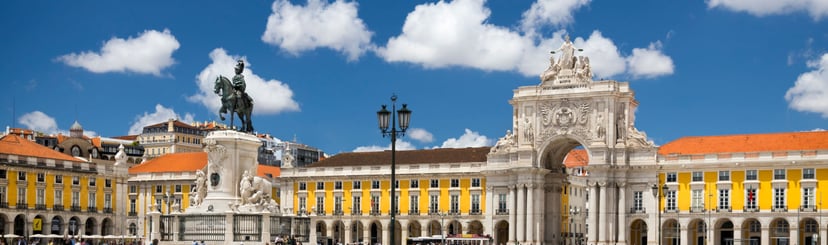
Baixa pickups and drop-offs should be treated as hinges, not endpoints. Praça do Comércio, Rua da Prata, Rua Augusta and the Rossio side of the grid let the guide reassemble the group before deciding whether Alfama still belongs. The driver does not need to follow every block. In fact, too many vehicle meetings in Baixa can make the day feel more interrupted. The better use is one clean transfer into the centre, then a walking chapter that lets the group understand the rebuilt downtown, the river square and the transition toward the old city.
Alfama is the place to stop asking the vehicle to behave like a magic wand. If the group starts high, the driver can help with the difficult gain and the guide can turn the old-town chapter into a descent. If the group approaches from Baixa, the guide should choose a lower, controlled sequence around the Sé, the lower lanes and a manageable viewpoint rather than promising a full uphill weave. For large groups, a precise walking exit matters more than a dramatic entrance.
Which district should come first: Belém, Baixa or Alfama?
Belém should come first when the group wants the most balanced private Lisbon day. The reason is practical: Belém adds distance before it adds slope. By doing that distance early, the route keeps the day from becoming a string of late transfers. It also gives the guide a spacious setting for the opening narrative: the Tagus, the age of departures, the Manueline language of Jerónimos, and the relationship between river, empire and city.
There is a subtle psychological advantage too. Belém gives a private group a shared horizon. Guests can look toward the Tagus, orient themselves, and feel that the day has begun with air rather than compression. That matters for executive groups, families and celebration travelers because the first hour sets the level of patience for the next five. If the first chapter is narrow, crowded or uphill, small inconveniences feel like failures. If the first chapter is broad and coherent, later edits feel like intelligent pacing rather than loss.
Baixa should come first only when the morning is deliberately short, the hotel is extremely central, or the group has a fixed appointment downtown. Baixa is valuable because it explains Lisbon’s lower city: the Pombaline grid, Praça do Comércio, the river-facing reconstruction, and the cleaner sightlines that contrast with Alfama. But if Baixa starts the day, Belém is pushed into the middle, and Alfama often becomes the “while we are here” ending. That ending is where private groups get into trouble.
Alfama should come first when the old town is the point. This is not the default for a Belém-Baixa-Alfama day, but it can be correct. A history-focused group, a family with a strong castle interest, or guests who want fado context before an evening performance may benefit from starting high and descending. The key is honesty: once Alfama leads, Belém must be lighter. Trying to keep a full Belém chapter after a deep Alfama morning asks the group to absorb both vertical and horizontal Lisbon in one push.
For first-time visitors who are comparing this with a more general chauffeur-led day, the nearby planning question is different: how to plan a chauffeur-led Lisbon day for first-timers. This article is narrower. It is about how private groups stay together when Belém, Baixa and Alfama all compete for one day.
How Belém changes the day length
Belém changes the day length because it is not a downtown stop; it is a western chapter with its own internal walking, decision points and regrouping needs. A private group that includes Jerónimos, the riverfront, the exterior relationship to Belém Tower, and a pastry or coffee pause should think of Belém as a half-day behavior, even when the visible sightseeing list looks compact.
This is where many itineraries understate the cost. On paper, Belém can look like one line: Jerónimos, Monument to the Discoveries, Belém Tower. In practice, the group must arrive, orient, cross or skirt broad avenues, decide whether to go inside or stay outside, pause for photographs, find restrooms or shade, and reassemble after every interruption. None of those actions is dramatic, but all of them take longer with a group than with a couple. A guide who controls the sequence can keep the interpretation moving while the driver handles only the legs that would otherwise drain the group.
The most efficient Belém plan is not necessarily the shortest one. A rushed Belém visit can create the worst of both worlds: the group spends the transfer time but never settles into the riverfront story. A better plan chooses two or three meaningful moves. For architecture-focused guests, Jerónimos deserves priority and the riverfront becomes context. For first-timers, an exterior sequence from Jerónimos toward the Tagus may be enough if the old town still matters later. For food-and-wine travelers, the pastry stop should not be treated as a random queue; it should sit where it does not break the guide’s control of the group.
Belém also affects lunch. If the group eats west, Baixa and Alfama must become an afternoon pairing, which usually means less old-town depth. If the group returns toward Baixa for lunch, the transfer can double as the day’s reset, but only if the driver is used for that specific movement rather than hovering. If the group has a serious dinner, the day should not spend all its patience by mid-afternoon. A strong private route leaves enough margin for the evening to feel chosen, not endured.
There is one boundary worth stating because it prevents itinerary creep. This is not the day to add Évora, Sintra or a wine-country detour. Évora, for example, has its own weight; the UNESCO Historic Centre of Évora listing (https://whc.unesco.org/en/list/361/) is a reminder that it belongs to a different planning decision, not as a bonus after Belém. If Belém, Baixa and Alfama are already sharing one day, the first cut should be outside-the-city ambition, not the breathing room that makes the city day work.
When should Alfama be shortened for a Lisbon private group?
Alfama should be shortened when the group is large, mixed in mobility, dressed for a celebration, traveling in heat, or already carrying the fatigue of Belém and Baixa. It should also be shortened when the evening matters. A full Alfama weave may sound atmospheric during planning, but after a western riverfront morning and a downtown chapter, the old-town lanes can become the place where attention breaks and the group starts asking how much longer remains.
The Alfama hill constraint is not just steepness. It is the combination of gradient, cobblestones, side-sloping pavements, narrow corners, photo stops, street traffic, and the difficulty of keeping everyone within hearing range. A single lane can be charming for six people and awkward for twenty. A viewpoint can be rewarding for the first half of the group and invisible to the guests still turning the corner. A guide can manage that, but only if the route has been edited before the group is tired.
Alfama should be shortened or replaced for a large private group when the party cannot move at one pace, when the day already includes an interior Belém visit, or when a dinner, fado evening, cruise schedule or family celebration needs the group to arrive composed. The replacement is not a generic bus panorama. It can be one framed hill moment, a lower Alfama passage near the Sé, a descent from Santa Luzia toward the cathedral, or a downtown-to-river finish that lets the old city remain vivid without becoming the entire afternoon.
What should be cut first? Cut the second viewpoint. One strong view can give the group its Lisbon memory; two or three viewpoints often create repeated climbs, repeated photo delays and diminishing returns. Also cut any plan that tries to combine a full castle visit, a deep Alfama weave and Belém interiors in one group day. The castle can be excellent in the right context, but it is not a free add-on when the group also wants the Tagus and Baixa.
For travelers who want a deeper old-town evening rather than an afternoon push, it can be wiser to separate Alfama from the Belém-Baixa day. A fado-focused route, a shorter pre-dinner context walk, or a hill strategy built around one view can make Alfama feel more generous precisely because it is not carrying the whole day. If the group wants that kind of old-town emphasis, Alfama and Bairro Alto private touring may fit better than forcing Alfama to be the third act of a long riverfront day.
What Lisbon does to the body, and why that changes the route
Lisbon makes the body pay attention. The city is not only uphill or downhill; it is textured underfoot, angled at the curb, exposed in open riverfront stretches, and compressed in old-town passages where a group cannot always spread out. After Belém, the group may feel fresh because the riverfront offers air and horizon. After Baixa, feet have already absorbed stone paving and standing interpretation. By the time Alfama arrives, the issue is not whether guests are fit; it is whether the day has asked the same joints, shoes and attention spans to do too many different things in succession.
This is especially important for comfort-first visitors who do not identify as having mobility concerns. A private group can include strong walkers and still struggle if the route changes texture too often: vehicle, monument, pavement, curb, plaza, lunch, vehicle, hill, lane, viewpoint, descent. Each transition looks minor. Together they create a physical tax that does not show on a map. The guide’s job is not to eliminate walking; it is to make the walking feel purposeful and to avoid spending the group’s energy on the least meaningful links.
Heat and light can also alter the decision. The Tagus can feel open and relieving, but broad Belém spaces have less shade than a planner may imagine when looking at photographs. Baixa’s plazas can feel reflective. Alfama can offer pockets of shade, yet those pockets come with uneven surfaces and corners where a group bunches. On a warm day, the route should be even less ambitious: Belém early, Baixa with a measured pause, Alfama reduced to a descent or single view.
The body consequence is simple: once guests become aware of their feet, they listen less well. That is the moment a private guide’s expertise shifts from storytelling to preservation of attention. It is better to end with the group still asking questions than to earn one more lane and lose the room.
What Lisbon does to the mood of a private group
Lisbon rewards a group when the day feels like a sequence of widening and narrowing, not a constant squeeze. Belém widens the mood because the Tagus gives space and the monuments create a shared frame. Baixa steadies the mood because the grid and Praça do Comércio make the city legible. Alfama intensifies the mood because the lanes, views and fragments of daily life create closeness. The problem begins when Alfama is asked to intensify an already overfull day.
A group mood can flatten quickly when people feel that every stop is another negotiation. Someone asks whether there is time for coffee. Someone else wants the photograph from the opposite side. Two people fall behind on a slope. The guide pauses, then repeats, then edits in real time. None of this is a disaster, but it changes the day’s emotional texture. Instead of feeling tailored, the plan starts to feel like a polite traffic jam.
The calmer version has a different emotional rhythm. Belém gives scale, Baixa gives orientation, and Alfama gives a final, chosen dose of old Lisbon. Dinner then feels like the continuation of the day rather than the place where everyone recovers from it. For celebration travelers, family groups and executive guests, that matters as much as any single monument. The best compliment after this route is not “we saw everything”; it is “the day felt shorter than it was.”
How a guide and driver should divide the work
A private guide should keep the group together; a driver should change only the difficult movement legs. That division sounds simple, but it is the difference between a polished Lisbon day and a day that feels expensive without feeling easier.
The guide’s value is strongest in the places where the group needs interpretation and cohesion: the Belém riverfront story, the transition from Praça do Comércio into Baixa, and the decision point before Alfama. The guide knows when the group has enough context, when the second explanation will not land, and when an extra climb will cost more mood than it returns. The driver’s value is strongest where the city’s distance would otherwise drain the day: hotel to Belém, Belém back toward the centre, and the selected exit after a hill chapter.
A driver who shadows every few blocks can accidentally make the day slower. Every vehicle meeting requires a place, a pause, a headcount and a re-entry into traffic. In Belém, those handoffs can be useful because the area is spread. In Baixa, too many handoffs can break the walking logic. In Alfama, they can be unrealistic or intrusive. The most comfortable private route is not necessarily the one with the vehicle closest at every minute; it is the one where the vehicle appears only when it removes a bad transition.
This is also why one large coach is not always the premium answer. For some groups, a right-sized vehicle plan, staggered movement or a walking-forward route will feel smoother than forcing one big vehicle to solve every leg. The city decides the tool. When the party size, hotel location, dinner timing or mobility profile requires a bespoke plan, tailor-made Lisbon private touring is most useful after the route has already been edited for the hills.
If your group has a dinner, fado evening, cruise return, family celebration or client hosting moment after the day, build the afternoon backward from that evening. A private guide can keep the group together in the interpretive chapters, and a driver can remove the tiring transfers without pretending that Alfama’s lanes are a driveway. Inquire now.
A practical day flow that avoids old-town bottlenecks
The most reliable day flow is a river-first arc with one old-town edit at the end. It does not need minute-by-minute rigidity; it needs a hierarchy of decisions so the guide can protect the group’s energy as conditions unfold.
- Hotel pickup or central meeting: Gather where the group can actually stand together. A wider avenue or clear hotel forecourt is usually better than a picturesque old-town corner. The first transfer should take the group west before attention is spent.
- Belém opening: Use the Tagus, Jerónimos and the monumental riverfront to establish Lisbon’s maritime scale. Decide in advance whether Jerónimos is an interior priority or an exterior anchor. If it is an interior priority, reduce Alfama later.
- Riverfront pause: Give the group one controlled break rather than several improvised ones. A private group loses time when coffee, restrooms and photographs happen separately. A guided pause keeps the day social without letting it scatter.
- Transfer to Baixa: Use the driver for the movement that matters. The route back along the river edge, past Alcântara and Cais do Sodré, is a functional reset, not wasted time, when the guide frames what is changing from western Lisbon to downtown Lisbon.
- Baixa orientation: Let Praça do Comércio, the grid and the river-facing axis explain the city’s lower structure. This is the chapter where the group should feel reassembled before any old-town decision.
- Alfama decision point: Choose one of three endings: a short lower Alfama walk, a start-high descent if the driver and timing support it, or a river/downtown finish if the group is already full. Do not let the word “nearby” trick the group into a climb it no longer wants.
This flow also leaves room for customization without losing discipline. Food-and-wine travelers may want the Belém pause to be more intentional. Families may need the old-town chapter shortened sooner. Executive groups may prefer fewer interpretive stops and cleaner transitions. Couples traveling with friends may accept a little more walking if the guide keeps the group compact. The route adapts, but the city logic remains the same: do the western distance early, use Baixa as the hinge, and edit Alfama before it edits the mood for you.
What to skip when the Lisbon private group day starts to swell
When the plan starts to swell, skip the extra hill before you skip the river logic. The first cut should be the second viewpoint, the full castle add-on, or the idea that every guest must experience the tram between districts. Those can all be excellent in the right day. They are not essential to the Belém-Baixa-Alfama group problem.
Do not cut Baixa too aggressively. Many planners see Baixa as the least romantic of the three districts and try to pass through it quickly. For private groups, that is often a mistake. Baixa is the hinge that lets the group understand Lisbon without immediately climbing. It is also where the guide can read the room. If the group is lively, Alfama can continue. If the group is fading, the day can resolve with dignity near the river rather than pushing into lanes where a retreat feels awkward.
Be careful with pastry timing in Belém. A famous sweet stop can be a delight or a drag depending on where it sits in the route. If it splits the group, creates a queue conversation, or pushes the transfer later, it should be shortened or reframed. For a Belém-focused morning with more monument depth, Belém and Jerónimos private touring can carry that weight better than an overpacked city-wide day.
Do not add Évora, Sintra or a coast lunch because the vehicle is already booked. A chauffeur can make hard movement easier, but it should not become permission to treat Portugal as a checklist. If the group wants a day outside Lisbon, that deserves its own decision. If the group wants Belém, Baixa and Alfama to work as one city day, the win is not more mileage; it is fewer bad transitions.
FAQ
Is Belém, Baixa and Alfama too much for one Lisbon private group day?
It is not too much if Belém comes first, Baixa is used as the flat central hinge, and Alfama is shortened to a controlled old-town chapter. It becomes too much when the plan adds full interiors, a castle visit, multiple viewpoints and several vehicle handoffs in the same day.
Which district should a Lisbon private group visit first?
Belém should usually come first because it handles group movement better and removes the western riverfront distance early. Alfama should come first only when old-town depth is the main purpose of the day and Belém can be made lighter.
Where should a private group be picked up for Belém, Baixa and Alfama?
The easiest pickups are usually wider hotel or avenue settings, followed by a Belém riverfront loading point and a Baixa reconvening area near the flat grid. Alfama pickups should be planned carefully because narrow lanes and slopes make casual vehicle meetings harder.
How long does Belém add to a Lisbon private tour?
Belém usually behaves like a half-day chapter once transfers, regrouping, Jerónimos, the riverfront and a pause are included. It can be shorter if treated as an exterior overview, but it should not be planned as a quick downtown detour.
When should Alfama be shortened or replaced?
Alfama should be shortened or replaced when the group is large, mixed in mobility, traveling in heat, already doing a substantial Belém visit, or preserving energy for dinner, fado or a celebration. One strong view and a guided descent are often better than a full old-town weave.
Does a chauffeur solve Lisbon old-town bottlenecks?
A chauffeur solves the difficult distance legs, especially hotel to Belém and Belém back toward the centre. A chauffeur does not solve narrow Alfama lanes, repeated old-town transitions or a route that asks the group to climb too much too late.
Is tram 15E a good way for a private group to reach Belém?
Tram 15E is a real riverfront connector, but it is usually better for individuals or very small parties than for a private group that needs cohesion, seating certainty and a controlled schedule. For groups, use it only as a deliberate experience, not as the backbone of the day.
Should Évora be added to a Belém, Baixa and Alfama private day?
No. Évora belongs to a separate day-trip decision. Adding it to Belém, Baixa and Alfama would turn a city-flow problem into an overextended regional itinerary and would weaken the Lisbon day.
If you’re interested in any private tours of Lisbon, please reach out to us.


 So if you are looking for the absolute best in Lisbon & surroundings with authentic local fully-licensed native guides whose English you can actually understand and with an exclusive and amazingly fun itinerary













