Following Pessoa Through Lisbon: Campo de Ourique, Chiado and the Written City

Updated
Read Lisbon in three different registers
A serious Fernando Pessoa day in Lisbon is not a trail of plaques. It is a movement between three kinds of evidence. Campo de Ourique holds the domestic and archival register: the last home, books Pessoa owned, objects that belonged to him, and an exhibition designed to explain the literary system of heteronyms. Chiado supplies the biographical and public register: his birthplace, the streets of literary sociability, and the modernist city in which magazines, friendships and reputations circulated. Baixa supplies the textual register: commercial streets that become the imagined working world of Bernardo Soares, together with the larger river city addressed by Pessoa’s other voices.
Those registers should be visited in that order. Beginning at Casa Fernando Pessoa gives you the vocabulary needed to avoid the most common mistake on a literary walk: treating every first-person sentence as straightforward autobiography. The street sequence then tests that vocabulary against real places. Chiado establishes what can be documented about Pessoa’s life; Baixa shows how a fictional author can occupy a real street without becoming a disguised entry in Pessoa’s address book.
This is especially useful for returning Lisbon visitors. You may already know Rua Garrett, the Baixa grid and Praça do Comércio as urban scenery. The purpose here is to see how their meaning changes when one distinguishes an inhabited house, a recorded association, a literary setting and a later memorial. For the physical history of the lower city before adding Pessoa, read Baixa through its rebuilt street plan and river logic.
A well-paced version occupies roughly four and a half to five hours, excluding a long meal. The allowances below are editorial planning ranges rather than published visit durations:
- Casa Fernando Pessoa: 75 to 90 minutes, beginning near opening time.
- Campo de Ourique to Chiado: 20 to 35 minutes, depending on the mode of travel and traffic.
- Largo de São Carlos and central Chiado: 45 to 60 minutes.
- Descent through Baixa and Rua dos Douradores: 75 to 90 minutes.
- Final reading at Praça do Comércio: 15 to 25 minutes, then stop.
The last instruction matters. A literary route becomes weaker when every nearby landmark is added merely because it is nearby. Alfama, the castle and Belém belong to other arguments. This day should end when the relationship among the house, the voices and the commercial river city has become clear.
Make the house museum the intellectual beginning, not a biographical shrine
Casa Fernando Pessoa stands at Rua Coelho da Rocha 16–18 in Campo de Ourique, in the building where Pessoa lived during the final fifteen years of his life. Lisbon’s municipal cultural operator describes the collection as including books from his private library and personal objects; the house’s long-term exhibition extends across three floors. The current operational listing states Tuesday to Sunday opening from 10:00 to 18:00, with last entry at 17:00, and closure on Mondays and several fixed holidays. Because those details can change, confirm them close to the visit on the official Casa Fernando Pessoa listing.
The productive question inside is not “Which object is most famous?” It is “What kind of claim can this object support?” A book carrying Pessoa’s marks can reveal something about reading, attention or intellectual contact. A personal object can establish material proximity to a life without explaining a poem. A reconstructed apartment plan can clarify domestic scale, yet it should not be mistaken for a room preserved untouched since 1935. A portrait produced after his death belongs partly to the history of Pessoa’s image, not simply to his biography.
The museum itself encourages this layered reading. Its permanent exhibition places the heteronyms early, gives a central position to the private library, reconstructs the apartment’s plan, and displays documents and objects connected with Pessoa’s many Lisbon addresses and his South African youth. It also includes later artistic representations, among them Almada Negreiros’s celebrated image of Pessoa reading Orpheu. The official exhibition description is valuable precisely because it separates memory, literary creation, reading and residence rather than collapsing them into a single relic narrative.
The private library is evidence of reading, not a shortcut to interpretation
Pessoa’s books deserve time because they restore the active reader behind the monumental author. The collection includes volumes gathered across languages and stages of his life, and the museum presents it as the heart of the house. Marks in books can show engagement, but even annotated pages require restraint: a line underlined by Pessoa is not automatically the source of a later poem, and ownership does not prove agreement.
For a visitor, the most useful practice is selective looking. Choose two or three volumes whose language, genre or subject relates to the texts you plan to carry into the city. A reader concentrating on Álvaro de Campos might attend to the cosmopolitan and technical imagination behind that voice; a reader interested in Ricardo Reis might notice classical and philosophical frames; a reader approaching The Book of Disquiet may be more interested in the tension between reading and the routines of commercial work. The point is not to solve a source hunt in the gallery. It is to leave with a more precise sense of Pessoa as a maker who read, reorganized and invented.
Use the objects to establish scale
House museums often invite an illusion of intimacy: the desk, the chest, the spectacles or the room seem to promise access to the person. Pessoa makes that temptation particularly strong because so much of the writing turns around unstable identity. Yet the more useful outcome is almost the reverse. The objects give scale to the physical life from which an unusually large literary population was produced. They show that the heteronyms did not require several historical people to exist; they required one writer’s sustained acts of differentiation, documentation and composition.
That distinction protects the route from sentimental overreach. The chest associated with manuscripts can be discussed as a material container and as part of the later story of the archive. It should not be made to “explain” multiplicity by itself. The apartment can ground the final fifteen years of Pessoa’s biography, but Alberto Caeiro did not literally occupy another bedroom, and Ricardo Reis did not keep a separate Lisbon tenancy. The museum is most revealing when the ordinary domestic setting and the extraordinary literary construction remain in view at the same time.
Learn the heteronyms before assigning them streets
Pessoa’s heteronyms were not merely pen names used to conceal authorship. He created literary figures with distinct biographies, temperaments, styles and relations to one another. The official Casa Fernando Pessoa account identifies three central heteronyms—Alberto Caeiro, Ricardo Reis and Álvaro de Campos—and describes Bernardo Soares as a semi-heteronym. It also notes that Pessoa created many more authorial figures, while publishing only a small portion of an immense body of work during his lifetime. More than 25,000 text-bearing leaves are held by the National Library of Portugal. The concise institutional overview appears on the museum’s official page on Pessoa’s work.
For the route, four distinctions are enough. Caeiro offers an anti-metaphysical attention to things and is given a largely rural imaginative world; forcing him into a downtown address misses the point. Reis writes with classical measure and a cultivated distance from circumstance; his usefulness in Lisbon is tonal rather than topographical. Campos is the most expansively urban and modern of the major heteronyms, capable of turning machines, movement, maritime space and Lisbon itself into emotional pressure. Soares, the assistant bookkeeper attached to The Book of Disquiet, gives the lower city its most exact literary role.
These summaries are interpretive tools, not substitute biographies. Pessoa’s famous 13 January 1935 letter to Adolfo Casais Monteiro narrates the genesis of the principal heteronyms and looks back to an extraordinary creative episode in March 1914. The letter is indispensable, but it is also a retrospective story told by a writer skilled in self-dramatization. At the museum, treat it as primary evidence for how Pessoa chose to explain his system in 1935—not as a stenographic record of creativity unfolding without revision.
A useful guide will therefore establish three labels before leaving Campo de Ourique:
- Documented life: a residence, workplace connection, relationship, object or recorded event involving Fernando Pessoa.
- Textual city: a real Lisbon setting used or transformed by a poem, prose fragment or fictional author.
- Afterlife: a statue, commemorative table, branded association or later image through which Lisbon remembers and markets Pessoa.
Nothing is wrong with the third category. The problem begins only when it is presented as if it were identical to the first. That is why the house visit is more than an attractive opening stop: it creates a method for the rest of the day.
Treat museum opening as the day’s fixed dependency
The route should normally begin at 10:00 or shortly after. Starting later pushes Chiado into its busiest midday conditions and makes it easier to cut the very street reading that gives the museum meaning. Starting downtown and visiting the house last appears efficient on a map, but it weakens the intellectual sequence and risks arriving close to last entry. A pre-booked or at least pre-checked museum visit is therefore the only hard dependency in an otherwise flexible day.
Campo de Ourique is not contiguous with Chiado. The official arrival page places the museum about a fifteen-minute walk from Rato metro and about five minutes on foot from several tram and bus stops, including services arriving from Praça da Figueira, Martim Moniz and Rossio. Those details are published on the Casa Fernando Pessoa access page. They are useful for reaching the museum, but they do not mean every visitor should make the onward journey by historic tram.
The transition has three costs: elapsed time, physical energy and loss of concentration. A direct car or taxi between Rua Coelho da Rocha and the Largo de São Carlos area usually protects the literary day best, especially for a party with limited walking range. It is not an indulgent add-on; it prevents a cross-city transfer from consuming the attention needed for Chiado and Baixa. A tram can be enjoyable when it arrives conveniently and the group is comfortable standing or waiting, but boarding solely to manufacture period atmosphere confuses transport with interpretation. Pessoa’s Lisbon is not made more authentic by spending an uncertain interval in a crowded vehicle.
Strong walkers can continue on foot through Campo de Ourique, Estrela and the Rato side of the city, but that creates a second urban essay before the Pessoa sequence has reached its central texts. Allow at least forty additional minutes and accept that the walking surface, traffic crossings and gradual descents will change the balance of the day. This option works for visitors whose primary pleasure is continuous urban walking. It is less suitable for readers who want sustained discussion, close reading and enough energy for the lower city.
When the museum is closed, do not pretend that a café photograph or exterior glance is an adequate substitute. Run the Chiado–Baixa sequence as a street-only route and return to the house on another day. The result will be incomplete, but intellectually honest. The order can be explained in advance through a short introduction to the heteronyms, while the missing archive remains visible as a limitation rather than being covered by anecdote.
Begin the street route at Largo de São Carlos
Largo de São Carlos is the right second beginning because it carries a clear biographical association: Pessoa was born there, opposite the opera house. Casa Fernando Pessoa’s own ninety-minute educational walk meets in the square before passing through Baixa and Chiado among places connected with family, work, love, friendship and writing. That official route description supports the basic downtown geography without requiring every doorway to bear the weight of a major literary claim; see the Casa Fernando Pessoa street-walk page.
Stand first where the square can be read as a whole. The opera house establishes the social and cultural world into which Pessoa was born, but avoid arguing that its façade predetermined his literary imagination. The documented fact is powerful enough. The square also helps the returning visitor recognize that Pessoa’s Lisbon is not confined to a picturesque marginal quarter. It begins in a central, cultivated district and later passes into the repetitive working streets below.
From here, the useful movement is short and deliberate: cross the Chiado streets rather than roam them. Select only sites that clarify one of the three labels established at the museum. A family or birthplace association belongs to documented life. A magazine, bookshop or modernist discussion belongs to literary networks. A statue or commemorative terrace belongs to the afterlife. A guide should say which category applies before adding interpretation.
Keep A Brasileira in proportion
A Brasileira is difficult to omit because the seated bronze image of Pessoa has become one of Lisbon’s most recognizable literary memorials. It is also easy to overvalue. The useful stop is often five minutes: identify the café’s place in Chiado’s culture of sociability, acknowledge Pessoa’s association with the district, and then examine how a posthumous image has become more publicly familiar than most of the texts.
Do not build the route around securing the famous table, reproducing the statue pose or collecting several café interiors. Those actions may be enjoyable, but they do not establish what Pessoa wrote, where a narrator was placed or how modernist publication worked. A pause becomes meaningful when it supports a text discussion or allows the group to compare the composed public image with the more complicated authorial system introduced in the house.
Readers interested in the city’s coffee culture as trade, commodity and contemporary craft can pursue that history separately rather than forcing it into a Pessoa itinerary: separate Lisbon coffee history from literary café legend. Here, one café is enough to discuss sociability and memory. A checklist would dilute the evidence.
Use Chiado to explain public modernism
Pessoa’s work did not emerge from private isolation alone. He wrote for and helped shape periodicals and publishing projects, including Orpheu, Athena and the Íbis and Olisipo ventures. The house exhibition and official work chronology provide that publishing context. Chiado is where it becomes spatially intelligible: newspapers, books, performance, commerce and conversation occupied a compact central district in which reputations could form rapidly and controversies could circulate.
The interpretive gain is not to identify one magical modernist corner. It is to see a network. Orpheu appeared in 1915 and gave public form to work by Pessoa and Álvaro de Campos, among others. Campos could publish alongside Pessoa because the heteronym operated as an authorial presence, not merely as an unsigned mood. In the street, that fact should feel stranger than it does on a museum label: one historical writer entered the literary public as several differentiated authors.
This is the point at which expert interpretation materially changes the day. A bespoke route can match passages to the editions a guest has read, distinguish a documented address from a narrator’s setting, reduce or extend the descent according to walking range, and keep the museum evidence active rather than allowing the afternoon to become a general Chiado tour. For a route built around particular texts and voices, with the house and streets coordinated as one argument, Inquire now.
Travelers considering a broader privately guided stay can also review private Lisbon touring options without turning this literary day into a collection of unrelated highlights. The service is relevant when it protects interpretation and sequence: the guide’s value lies in the evidence distinctions, the choice of excerpts and the decision about what to leave out.
Descend from Chiado into the commercial city
The physical descent into Baixa should coincide with a change in literary method. Chiado has been largely biographical and institutional. Baixa should become textual. Move from the higher cultural district into the more regular commercial grid, where repeated façades, narrow blocks, offices above shops and the pull of the river create the setting associated with Bernardo Soares.
The exact descending street matters less than keeping the group together and avoiding unnecessary reversals. Rua do Carmo offers a direct visual connection toward Rossio but can be busy. Rua Nova do Almada gives a useful commercial line toward the lower grid. Guests who find slopes or polished paving difficult can make a short vehicle transfer to the vicinity of Rua dos Douradores and resume on flatter ground. The aim is not to prove endurance. It is to arrive with enough attention to read an ordinary street closely.
Before entering Rua dos Douradores, restate the three labels. The buildings are real. Bernardo Soares is a created authorial figure. The relation between them is literary, not a claim that Soares can be inserted into the civil registry. That sentence prevents the most consequential confusion of the day.
Let Rua dos Douradores belong to Bernardo Soares without turning him into Pessoa
Rua dos Douradores is the route’s strongest textual location. Casa Fernando Pessoa’s material on The Book of Disquiet explains that the work’s authorial plans changed over time. Earlier material was connected first with Pessoa and then with the figure Vicente Guedes; from 1929, most of the later, more diaristic texts were attributed to Bernardo Soares, an assistant bookkeeper in Lisbon who lives and works on Rua dos Douradores. The official explanation appears on the museum’s page about the authorship of The Book of Disquiet.
That evidence supports a firm distinction. Rua dos Douradores is a literary address for Soares, not Pessoa’s final residence and not proof that every observation in the book records an incident from Pessoa’s working day. The real street gives the fictional author a credible commercial habitat. Pessoa’s own occupation as a foreign correspondent for commercial firms—writing business letters in other languages—creates a biographical resonance with downtown office life, but resonance is not identity.
This distinction makes the street more interesting, not less. A simple biography hunt asks which window was “his.” A literary reading asks why a minor commercial street suits a consciousness built from routine, observation, deferment and inward expansion. The regular Baixa grid can feel both legible and anonymous. Upper floors suggest clerical interiors while the street below continually circulates goods and people. A narrator can therefore remain socially peripheral while absorbing the city’s movement in minute detail.
Read urban form, not a preserved film set
Do not promise that present-day Rua dos Douradores reproduces the exact sensory world of the 1930s. Businesses change, façades are repaired, traffic patterns shift and short-term accommodation alters who occupies central buildings. The durable evidence lies in the street’s position within Baixa, its commercial scale, its repeated blocks and its relation to the riverward grid. Those elements allow a reader to understand why Soares’s imagined office life belongs here even when no individual storefront can be treated as untouched scenery.
A useful stop uses one short passage from the visitor’s chosen edition and then looks outward for structure rather than illustration. Where is the implied office above street level? What can be seen from a window that cannot be possessed? How does the grid produce routine? How quickly does the river appear as an idea even when it is not visible? The city should complicate the passage, not merely confirm it.
Edition choice matters. The Book of Disquiet was assembled posthumously from fragments, and editors have arranged and attributed material differently. A private guide should ask in advance which translation and edition the guests know, because page numbers, sequence and even the felt identity of the book can vary. Carrying a random quotation found online may create a false sense of textual certainty. Carrying the guest’s edition turns the walk into a conversation with an actual reading history.
Use Pessoa’s commercial work as context, not as a claim of equivalence
Pessoa’s paid work in commercial correspondence is essential because it connects the literary archive with the economic city. He was not simply a poet looking down on office life from outside. He knew the forms, languages and repetitions of business communication. Yet Soares is more than Pessoa with a changed name. The semi-heteronym has a specific narrative function and a deliberately reduced social profile. The distinction between lived work and created author is exactly the kind of nuance that disappears on a landmark-only route.
This is also where the house museum’s scale returns. The man who wrote commercial letters, maintained publishing projects, produced astrology and criticism, and constructed multiple authors lived amid ordinary constraints. Baixa makes those constraints spatial. The literary achievement was not escape from the commercial city but its transformation into several kinds of language.
Bring Álvaro de Campos to the river, but do not pin a poem to one paving stone
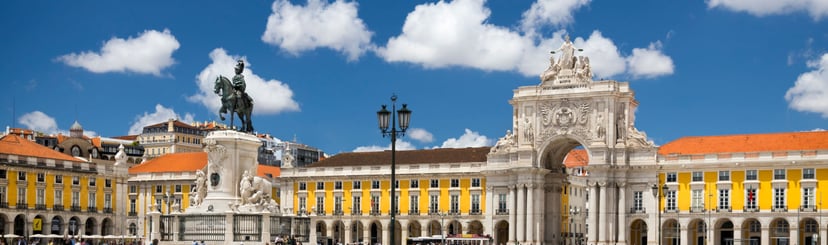
From Rua dos Douradores, continue south toward Praça do Comércio. The opening toward the Tagus changes the scale of the route: the confined office grid releases into state architecture, river light and maritime distance. This is the right place to introduce Álvaro de Campos more fully, especially his intense relation to modern movement, ports, ships, departure and the estranging experience of Lisbon.
The interpretation should remain textual rather than falsely topographical. Campos’s maritime and Lisbon poems can be read at the river because the setting clarifies their spatial and emotional pressures. That does not require claiming that a particular stanza was composed on the exact spot where the group is standing. The riverfront is a reading position, not a certified desk.
Campos also helps separate two kinds of urban modernity. Soares’s Baixa is repetitive, interior and clerical. Campos expands toward engines, voyages, crowds and impossible intensity. Both are Pessoa’s creations, yet they make different Lisbons from overlapping geography. Ending at the river allows the day to move from the contained domestic house, through the social city of Chiado, into the commercial grid and finally toward an imagined world beyond Lisbon.
A practical sequence for the full day
The times below assume a Tuesday-to-Sunday opening day, a reasonably punctual start and guests who can manage central Lisbon’s paving with ordinary pauses. They should be adjusted for mobility, heat, rain and the length of text discussion.
10:00–11:20: Casa Fernando Pessoa
Begin with the heteronyms, then move to the private library and the apartment material. Do not spend equal time on every floor. The visit has succeeded when the group can distinguish Pessoa, Caeiro, Reis, Campos and Soares at a functional level and can name the difference among an original object, a reconstructed domestic setting and a later representation.
11:20–11:50: Campo de Ourique to Chiado
Use a direct transfer unless continuous walking is part of the day’s purpose. During the journey, leave a few quiet minutes. The museum presents a dense system, and immediate commentary can prevent it from settling. Resume with a short reminder that Largo de São Carlos will begin the documented-life layer.
11:50–12:40: Largo de São Carlos and Chiado
Establish the birthplace association, then cross only the portion of Chiado needed to discuss literary networks and public memory. A Brasileira can be acknowledged without waiting for a terrace table. If the group needs a seated pause, use it to compare a passage, a page from the 1935 letter or a reproduction from the house rather than allowing the stop to become the subject.
12:40–13:15: A restrained pause
Thirty to thirty-five minutes is enough for water, coffee or a light bite. A longer meal splits the route just before its strongest textual section. Returning visitors with a major lunch reservation should instead start the museum at opening, complete Chiado and Rua dos Douradores first, and let Praça do Comércio become the release point before lunch.
13:15–14:30: Rua dos Douradores and the Baixa grid
Read Soares with the real street in view. Keep the number of passages small: one longer fragment or two short ones is usually stronger than a recital. Add Pessoa’s commercial work as context, then explicitly state why Soares remains a literary figure rather than a biographical substitute.
14:30–15:00: Praça do Comércio and the Tagus
Shift from Soares to Campos, from office enclosure to maritime scale, and from exact address to interpretive horizon. End before the discussion thins. A later drink, meal or independent walk can follow, but the formal route should close here.
Choose optional branches by literary question, not proximity
The base route is intentionally selective. Add a branch only when it answers a question the reader already has. Four branches work particularly well.
The Book of Disquiet branch
Extend Rua dos Douradores and nearby Baixa streets by thirty to forty-five minutes. Compare two editorial arrangements of the same fragment, discuss the shift from Vicente Guedes to Bernardo Soares, and examine how the lower city’s regularity supports the book’s recurring tension between routine and limitless inwardness. This is the best addition for readers who know the book well and the least suitable for guests who have not yet read any of it.
The modernist-publication branch
Spend more time in Chiado on Orpheu, Athena, Almada Negreiros and the construction of a modernist public. The emphasis should remain on magazines, collaboration, controversy and designed self-presentation rather than on accumulating café claims. Travelers who want to continue from Pessoa into the city’s later architectural answers to modernity can extend the inquiry through a Lisbon modernism sequence.
The historical-cartography branch
Use a tablet or printed extract to compare the inherited street geometry with the city encountered on foot. Lisbon City Council’s official ArcGIS service identifies an 1871 historical cartography layer, produced before Pessoa’s birth. It can help separate long-standing urban structure from twentieth- and twenty-first-century memorial surfaces; the technical source is the municipal 1871 map service. This branch suits readers interested in how literature occupies a city that already has its own chronology.
The archive-and-reception branch
Keep the walking route unchanged but deepen the discussion of what happened after Pessoa’s death: the slow editing of manuscripts, the formation of the canon, the changing arrangement of The Book of Disquiet, and the conversion of Pessoa into a global image of Lisbon. The National Library of Portugal is not a convenient add-on to this Campo de Ourique–Chiado–Baixa line; it belongs to a separate research visit. The same is true of more extensive study in the house library.
For travelers drawn to the broader question of how an urban voice is archived, mediated and later performed, compare Lisbon’s fado archive and the making of another city identity. The subjects differ, but the method—distinguishing source, performance, memory and later mythology—is a productive sibling inquiry.
Use the shorter branch when concentration matters more than coverage
A compact version can be completed in about three and a half hours without reducing the day to superficial landmarks. Visit Casa Fernando Pessoa for sixty to seventy-five minutes, transfer directly to Largo de São Carlos, cross Chiado without a seated café stop, spend forty-five minutes around Rua dos Douradores, and finish at Praça do Comércio.
Cut the extended modernist discussion first, not the heteronym introduction. Cut secondary Chiado memorials before cutting Rua dos Douradores. Keep one passage from Soares and one from Campos. This preserves the route’s argument: house evidence creates the interpretive method; documented birthplace anchors the biography; the lower city demonstrates literary transformation; the river opens the scale.
For a guest with reduced walking tolerance, a vehicle can bridge both Campo de Ourique to Chiado and the steeper descent into lower Baixa. The essential walking can then be concentrated on the flatter section from Rua dos Douradores toward Praça do Comércio. The result is not a compromised version. It is a better allocation of limited steps to the streets where close observation matters most.
Know when to stop in Baixa
The formal stopping point is the river side of Praça do Comércio, after the group has completed four moves: domestic evidence in Campo de Ourique, documented biography in Largo de São Carlos, literary public life in Chiado, and fictional-commercial space in Rua dos Douradores. The Tagus then provides one final shift toward Campos’s outward, maritime imagination.
Stop when each traveler can answer three questions. Which places belonged to Pessoa’s documented life? Which real streets were assigned to literary figures? Which familiar images belong mainly to the later culture of remembrance? Once those distinctions are secure, another monument rarely adds more. Continuing uphill into Alfama or west toward Belém may produce an enjoyable Lisbon afternoon, but it no longer strengthens this particular reading.
There is also an emotional reason to end here. Pessoa’s Lisbon is often presented as a city of endless melancholy, but the route reveals something more exact: a system of distances. There is distance between writer and heteronym, house and street, office routine and imaginative expansion, lived biography and posthumous fame. Praça do Comércio makes that structure visible without pretending to resolve it.
What a carefully made Pessoa day should leave behind
The best outcome is not a photograph beside a bronze poet or a complete inventory of cafés. It is the ability to move through Lisbon with sharper categories. Casa Fernando Pessoa shows the material life, the reading life and the deliberate invention of other authors. Chiado demonstrates how biography, sociability and modernist publication entered the public city. Baixa gives a fictional bookkeeper a convincing address while reminding us that fictional credibility is not documentary fact.
That sequence also explains why private interpretation is most valuable here when it is specific. The useful service is not simply transport between famous places. It is the preparation of passages from the guest’s edition, the choice of which heteronyms matter, the management of museum timing, the adjustment of slopes and pauses, and the discipline to end before the literary argument becomes a general sightseeing loop.
For returning visitors, this is the reward: familiar central Lisbon becomes less familiar without becoming obscure. Campo de Ourique, Chiado and Baixa remain real districts with their own histories, yet the movement among them reveals how Pessoa made a city that could be inhabited by several authors at once—and how Lisbon, in turn, made those authors part of its public memory.
If you’re interested in any private tours of Lisbon, please reach out to us.


 So if you are looking for the absolute best in Lisbon & surroundings with authentic local fully-licensed native guides whose English you can actually understand and with an exclusive and amazingly fun itinerary













