A Shared Lisbon Day With a Wheelchair: Belém, Baixa and the Honest Limits of the Hills

Updated
Why an accessible-attraction list can still produce a failed Lisbon day
A Lisbon day can fail without anyone choosing an obviously unsuitable sight. The family confirms that one monument has an accessible interior, the vehicle is spacious, lunch is booked in the center, and Alfama appears to be a short distance away. Then the gaps take over. The designated entrance is not the public entrance everyone naturally walks toward. A lift reaches one level but not the viewpoint the group expected to share. The vehicle cannot stop where the map pin sits. A smooth riverside stretch ends at a crossing or curb transition that requires a detour. The older relatives continue while the wheelchair-using traveler and one companion wait for a second handoff. By mid-afternoon, the group has technically visited Lisbon together but has experienced it in fragments.
The correct unit of planning is therefore not the attraction. It is the continuous accessible segment: arrival point, unloading space, entrance, internal circulation, exit, pavement to the next stop, crossing, restroom opportunity, and reliable pickup. Every break in that chain creates a choice between delay, physical risk, and separation. For an affluent multigenerational family, the real standard is not whether one person can be accommodated eventually. It is whether children, parents, grandparents, and the wheelchair user can remain part of the same story without turning access into the day’s dominant subject.
Accessibility is not a synonym for slower sightseeing. A wheelchair user may have more energy and curiosity than anyone else in the party; the constraint is often city geometry, not stamina. A successful day protects equal choice while removing avoidable friction between the experiences the traveler actually values.
The three geographic zones in this guide play different roles. Belém offers major monuments and long, relatively open riverfront sequences, but openness does not guarantee easy surfaces or short transfers. Baixa offers the most legible central grid and the strongest potential for keeping the family together on foot or wheel, but individual curb, paving, and crossing conditions still matter. Alfama offers historic atmosphere and topographic drama, yet its steep, irregular interior cannot honestly be presented as a barrier-free old town. The workable answer is usually an Alfama edge, a carefully verified vehicle approach, or an interpretation of the old city from lower ground.
For wider context on choosing a base and reducing daily slope exposure, read the Lisbon hills and hotel-location guide. This article goes further into one shared day: what must be verified, where continuity is most likely to break, and how to keep the family’s experience intact when a route needs to change.
Plan the person, the chair and the companions before drawing the route
“Wheelchair accessible” is too broad to be a useful planning specification. A manual chair that can use a pre-arranged stair climber, a powered chair that cannot be transferred, and a compact travel chair used by someone who can stand briefly are three different operational cases. The same curb, ramp, vehicle, or monument policy may work for one and fail for another. Before choosing the order of Belém, Baixa, and Alfama, record the facts that affect every handoff.
- Chair type and dimensions: note overall width, length, height, total occupied weight, turning needs, and whether footrests or other parts can be removed without discomfort or risk.
- Transfer ability: establish whether the traveler remains seated in the chair during transport, can transfer to a vehicle seat, can stand briefly, or should not be asked to transfer at all.
- Assistance preference: clarify whether help with slopes, thresholds, doors, or chair handling is welcome, and who should offer it. Assistance should never be improvised by strangers without consent.
- Surface tolerance: small front casters, suspension, power-assist equipment, and the traveler’s pain or balance profile can radically change how uneven paving feels.
- Battery and equipment needs: for powered mobility, include realistic reserve, charging compatibility, and the effect of repeated gradients rather than relying only on a nominal range.
- Restroom and personal-care needs: identify the level of accessible space, transfer configuration, privacy, and frequency required. A symbol alone may not answer those questions.
- Heat, wind, rain, and medication considerations: these are not reasons to reduce ambition automatically, but they change the value of exposed riverfront time, long waits, and unplanned detours.
- Companion constraints: include a grandparent who cannot stand for long, a child who needs a predictable meal, a stroller, hearing or visual access needs, and anyone likely to struggle with repeated vehicle boarding.
The family should also agree on what “shared” means. For some groups, it means every person enters every site. For others, it means nobody is routinely sent to a side entrance alone and all major interpretation happens together, even if one upper level is skipped. A useful definition is that no one becomes the logistics project while the rest of the group gets the holiday. That principle changes the selection of monuments, the length of walking segments, and the way an Alfama visit is framed.
Children and older relatives add different constraints. A child may cover distance happily but struggle with a long access negotiation; a grandparent may walk well yet tire while standing at crossings; the wheelchair user may tolerate distance but not vibration. Choose segments where those needs can coexist: purposeful transitions, seated interpretation, and enough flexibility to shorten one element without erasing the day.
One more question belongs before the itinerary: what is the family unwilling to sacrifice? It might be Jerónimos as a cultural priority, a Tagus view, a pastry stop, the 1755 rebuilding story, or even a child’s wish to see a tram. Once that priority is named, secondary stops can be selected for continuity rather than prestige. This keeps access planning from becoming a sequence of exclusions. The day still has an intellectual and emotional center.
Families comparing broader multigenerational choices can use the Lisbon guide for grandparents and grandchildren as supporting context. Its pacing principles are useful here, but a wheelchair day requires a more exact layer: equipment compatibility, entrance verification, curb transitions, and legally workable vehicle handoffs.
Belém is a promising segment, not a blanket accessibility promise
Belém is often selected first because it looks flat on a city map and places major landmarks near the Tagus. That is a sensible starting instinct, but the word “flat” can conceal the actual workload. A long open district may involve more exposed distance, more crossings, and more transitions between monument forecourts, gardens, rail infrastructure, road edges, and riverfront paths than a compact central block. The right question is not whether Belém is flatter than Alfama. It is whether the exact sequence from vehicle to entrance to riverside to pickup has been checked for the chair and traveler in this group.
The Padrão dos Descobrimentos shows why entrance details matter
The official accessibility page for the Padrão dos Descobrimentos is unusually instructive because it distinguishes different parts of the experience rather than applying one broad label. It states that the entrance is preceded by two flights of stairs that may be negotiated with a pre-arranged stair climber limited to manual wheelchairs. It also states that the level minus one exhibition room has a wheelchair-accessible lift, while the viewpoint remains inaccessible. The source should be checked directly before travel: Padrão dos Descobrimentos accessibility information.
These facts lead to different legitimate choices. A powered-chair user may reject the interior because the stair-climber provision does not apply. A manual-chair user may consider it only after confirming booking, chair compatibility, staffing, and personal comfort with the device. Another family may choose exterior interpretation and use the saved time for a checked riverfront segment. The mistake is discovering these distinctions only after arrival.
The viewpoint limitation matters because partial internal access does not deliver a shared elevated view. Say so before the day begins, then replace that expectation with a ground-level reading of the monument, the Tagus setting, or another viewpoint whose vehicle approach and surface have been verified.
Verify each monument independently
Belém’s famous names sit close enough on a map to tempt a single assumption. Resist it. Jerónimos Monastery, the Padrão dos Descobrimentos, museums, and other cultural buildings should each have a current entrance and internal-circulation check. Ask for the exact accessible entrance, whether it is the same entrance as the group entrance, whether any lift serves all intended levels, whether temporary works affect access, whether a wheelchair slot or advance notice is required, and whether an accessible restroom is available after entry. This guide does not certify a current Jerónimos entrance or lift arrangement. Confirm it directly rather than inferring access from the monument’s prominence.
A monument plan should include a replacement that preserves the theme. If an interior lift is out of service, the alternative should not be “wait outside while everyone else goes in.” It could be an exterior architectural reading, a maritime-history segment along the river, a shorter museum with confirmed circulation, or an early move to Baixa for the earthquake-and-rebuilding narrative. The replacement should be intellectually equivalent enough that the wheelchair user is still part of the day’s central content.
For a deeper Belém sequence that can be adapted after access checks, see the private Belém morning guide. Its monument order and crowd logic are useful, but the accessible version must override any elegant sequence that depends on an unverified entrance, long exposed transfer, or inaccessible upper level.
The municipal evidence argues against complacency
An October 2024 Lisbon municipal assessment identifies the central area beginning around Baixa-Chiado as having higher potential pedestrian accessibility, while the western area that includes Belém records worse conditions in that metric. The report is available at the Lisbon municipal neighborhood assessment. “Potential” is the critical word. The assessment is not a guarantee about one curb or one path, and it does not mean every part of Baixa is easy or every part of Belém is difficult. It does, however, support a more cautious reading of the common map impression that Belém is automatically the easiest zone.
Editorially, the consequence is to make Belém shorter and more deliberate. Select one major cultural anchor whose access has been confirmed, one shared outdoor interpretation segment, and one dependable handoff. Avoid building the morning around several separate entrances that require repeated unloading and reloading. The riverfront may feel spacious, yet spaciousness can increase the cost of a wrong turn when a path, crossing, or surface proves unsuitable.
Inspect the whole Belém chain
- Arrival: confirm the legal and physically usable unloading point, the side of the road, ramp or lift clearance, and the distance to the correct entrance.
- Entrance: obtain the precise door or route, not simply a statement that the site is accessible.
- Interior: match lifts, thresholds, turning space, seating, and restrooms to the traveler’s requirements and intended rooms.
- Outdoor segment: check the selected pavement, crossings, gradients, construction, temporary barriers, and exposure rather than treating the entire waterfront as one surface.
- Exit and pickup: decide whether the vehicle returns to the arrival point or meets the group elsewhere, and identify what happens if it cannot approach at the expected time.
Belém works best when the shared highlight and conditional elements are decided in advance, with accurate information and alternatives. The wheelchair user should not have to negotiate every compromise in public while the group waits.
Baixa offers the best central framework, but the grid still needs a route audit
Baixa is the strongest candidate for the middle of a shared day because its grid is legible, its history can be interpreted at street level, and parallel blocks make rerouting more plausible than in Alfama. The municipal finding of higher potential pedestrian accessibility around Baixa-Chiado supports that judgment without certifying every crossing, curb, or work zone.
The useful feature of a grid is redundancy. When one street edge is blocked or uncomfortable, a parallel route may preserve the direction of travel. In a steep, irregular quarter, the alternative may require a much larger climb. Baixa therefore gives a guide or family more chances to solve a local problem without dividing the group. This is one reason to place the historical explanation here rather than treating Baixa merely as the transfer between Belém and Alfama.
Make the street-level story the main event
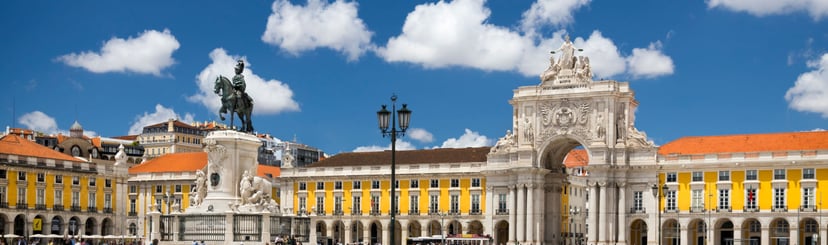
Baixa can carry a substantial Lisbon narrative without depending on stairs or upper-floor access. Praça do Comércio, the river approach, the ordered streets north of the square, and the city’s reconstruction after the 1755 earthquake provide a coherent sequence. The exact corridor should still be checked, but the intellectual value does not rely on reaching a hilltop or completing a long interior. The family can discuss power, trade, disaster, reconstruction, and the logic of the Pombaline grid while moving through a comparatively understandable urban framework.
That is more than a convenience. It changes the balance of the day. If Belém has delivered one verified monument and Alfama remains conditional, Baixa becomes the place where nobody receives a reduced version. The wheelchair user is not on an “accessible alternative” while the rest of the group gets the real city. Everyone receives one of Lisbon’s central stories together.
For a history-focused expansion, continue with the guide to Baixa after 1755. On a wheelchair-aware day, use its interpretive spine but verify the pavement and crossings of the chosen corridor shortly before travel.
Pavement, curb and crossing friction are cumulative
Small obstacles matter when they repeat. Uneven stone, drainage edges, awkward curb approaches, short crossing phases, deliveries, furniture, or temporary barriers may each be manageable once. Across several blocks they create vibration, repeated assistance, and route corrections. An audit should record not only whether a segment is possible, but what effort accumulates before Alfama.
For a manual-chair user, the question may be whether a companion is expected to push repeatedly and whether that is wanted. For a powered-chair user, it may be traction, caster clearance, safe alignment at curb transitions, or battery demand. For someone with pain or spasticity, vibration may be more limiting than distance. For a grandparent walking beside the chair, repeated waiting at curb problems may be more tiring than steady movement. These are different consequences from the same street.
A good Baixa route therefore favors fewer meaningful blocks over a broad sweep. It chooses a reliable crossing rather than the most photogenic diagonal. It allows interpretation to happen while the group is stationary somewhere that does not obstruct movement. It includes a seated pause that is a planned part of the city story, not an apology for access. It also keeps the vehicle reachable without assuming that a driver can hover at the nearest doorway.
Use the Baixa stop to decide Alfama, not merely to approach it
By the end of Baixa, the group has useful live information. The traveler knows how the chair is responding to Lisbon’s surfaces. The family knows whether repeated boarding is tiring. The weather and crowd level are no longer hypothetical. This is the correct moment to activate or cancel the Alfama component. The decision should not be framed as whether the wheelchair user can “manage” one more thing. It should ask whether the available Alfama version is good enough to deserve everyone’s energy.
The vehicle handoff is part of the attraction, not empty time between sights
Many Lisbon plans treat transportation as a line between pins. For a wheelchair-using traveler, the handoff can be the most operationally complex part of the day. A route may be accessible inside the vehicle and inside the monument yet fail at the curb between them. The solution is not automatically a private car. The solution is matching the transport mode, chair, street regulation, unloading space, and group composition with enough precision that the arrival actually works.
Separate a wheelchair-accessible vehicle from a large vehicle
A spacious van is not necessarily wheelchair accessible. If the traveler remains in the chair, the vehicle needs a compatible ramp or lift, adequate door and interior dimensions, appropriate securement, and safe passenger restraint. Confirm the occupied chair’s dimensions and weight against the vehicle’s actual capacity. Confirm whether the traveler faces forward or in another approved position, how the chair is secured, and whether companions, child seats, and any mobility equipment still fit.
If the traveler transfers to a seat, the questions change but do not disappear. Door opening, step height, grab points, transfer space, privacy, the handling of the folded chair, and the number of transfers across the day all matter. A transfer that is technically possible may be tiring, painful, or undignified when repeated. The traveler’s preference governs. No itinerary advantage justifies assuming a transfer that has not been discussed.
Public transport is a real option only when the complete trip works
CARRIS states that all its buses are low-floor, that more than 80 percent have access ramps, and that wheelchair carriage is subject to a listed envelope of 1250 by 700 by 1350 millimetres and 300 kilograms. Its reduced-mobility page also lists routes 714, 727, 728, 729, and 751 among routes with full accessibility. The current wording and route status should be checked at CARRIS reduced-mobility information.
Those facts make buses relevant, especially when the family wants flexibility or does not require a dedicated vehicle. They do not remove the need to evaluate the stop approach, ramp deployment, available wheelchair space, crowd conditions, and the route from the destination stop to the intended entrance. “Low-floor” describes the vehicle. It does not certify the whole journey. The same is true of any transport mode: accessible rolling stock or a ramped vehicle cannot compensate for an unusable boarding point or a final steep block.
A private vehicle becomes materially valuable when it can connect verified segments without forcing the group to improvise each curb. That value is coordination, not decoration. It depends on a driver or operations team having the correct chair specifications, permitted access information, exact handoff points, backup pickup locations, and a communication plan. A premium booking that lacks those facts is merely expensive uncertainty.
Do not promise door-to-door access in controlled or constrained streets
Lisbon’s old quarters include regulated access zones and streets where stopping space is limited. A map pin at a church, viewpoint, or lane does not establish that a vehicle can reach the door, wait, deploy a ramp, or unload safely. The itinerary should name an arrival zone only after confirming current traffic rules and physical clearance. It should also distinguish three different actions: passing through, briefly stopping to unload, and parking. Permission for one does not necessarily imply the others.
For each handoff, record the curb side and sequence: who exits first, where the ramp or lift deploys, whether the chair clears it safely, what surface follows, where children wait, and who remains with the traveler if the vehicle must move. This granularity is what keeps the itinerary intact at street level.
- Primary handoff: the legally usable point closest to the verified route.
- Backup handoff: a second point that avoids the same restriction or surface problem.
- Communication trigger: a clear message or call before the group reaches the curb, not after everyone is waiting in traffic.
- Maximum wait condition: a pre-agreed point at which the group moves to the backup rather than remaining exposed.
- Group formation: decide who accompanies the wheelchair user and who manages children, tickets, bags, or doors so nobody is unintentionally left behind.
These handoffs also determine whether Belém and Baixa should be joined by one long transit movement or several shorter ones. Fewer boardings can be beneficial, but a long vehicle wait between distant pickup and drop-off points can erase that advantage. The correct number is the one that produces the least total friction for this traveler, not the fewest lines on the itinerary.
Alfama should be treated as an access edge, not a district to conquer
Alfama is where honest planning matters most. Its identity is tied to slope, irregular lanes, stairways, tight corners, and a street pattern that was not designed around modern vehicle turning or continuous step-free circulation. It is misleading to promise a barrier-free old town. It is equally unnecessary to remove Alfama from the day automatically. The useful strategy is to define what the family wants from Alfama, then find the lowest-friction place where that experience can be shared.
Start with regulation, then check the physical route
EMEL’s regulation designates Alfama as controlled-access zone ZAAC 042. It provides that vehicles of people with mobility disabilities, or their legal representatives, displaying the official parking card may be authorized to access and park without buying access cards. The exact current conditions and authorization process should be read in the official document at the EMEL access regulation.
This is useful, but it is not a promise of doorstep delivery. Regulatory authorization does not widen a lane, create ramp-deployment space, remove a stair, guarantee parking availability, or make the remaining pavement suitable. It should be understood as one possible component of an access plan. The vehicle, traveler documentation, exact authorization, street conditions, and desired stop still require confirmation.
The distinction protects the family from a common misunderstanding: “authorized to enter Alfama” is not the same as “able to reach any Alfama sight comfortably.” A responsible plan names the accessible objective and the verified handoff, not merely the district.
Use gradient data as a filter, not as a verdict
Lisbon’s municipal slope layer represents streets as polylines and includes fields for overall slope as well as maximum and average uphill and downhill gradients. The service records its latest data edit as 22 August 2024. The layer can be consulted at the Lisbon municipal street-gradient service.
This matters because a street that appears short may contain a severe section, and an average gradient can conceal a sharper local pitch. The layer supports route screening, but it cannot answer every accessibility question. It does not by itself confirm surface smoothness, curb geometry, temporary works, crowding, stair interruptions, or whether a powered chair can safely manage a wet descent. Gradient should therefore eliminate unsuitable candidates and guide live verification, not serve as a complete certification.
For a manual-chair user, both ascent and descent need attention. A steep descent may demand sustained braking or companion control and can be more stressful than climbing with assistance. For a powered chair, manufacturer limits, traction, caster behavior, battery reserve, and user confidence matter. For an ambulant companion, a steep cobbled descent while stabilizing a chair may create risk for two people. “Downhill” is not automatically the accessible direction.
Choose the Alfama experience before choosing the street
Alfama can mean several different things: a high viewpoint, an old-city street atmosphere, the relationship between the cathedral area and the river, a discussion of urban continuity, fado history, or the experience of moving through narrow lanes. Those aims do not require the same route.
If the family wants a high view, use a vehicle-assisted approach only after verifying the drop-off, surface, gradient, return, and a pickup that does not depend on a steep descent. For old-city atmosphere, a lower-edge interpretation around Campo das Cebolas and Casa dos Bicos may provide historical texture, subject to current pavement and crossing checks. Baixa or the river edge can also carry the uphill story without requiring the group to penetrate the quarter.
A brief split is valid only when the wheelchair user actively prefers it and receives an experience of equal interest. It should never be imposed as the default. Keep the main narrative shared, and make any separation elective, brief, and balanced.
For a route designed around the transition between the river, Baixa, and old-city bottlenecks, use the Belém, Baixa and Alfama group-planning guide as a sibling reference. Its group-movement logic is relevant, but wheelchair access requires stricter proof at every slope and handoff.
Define bailout points before entering the edge
A bailout point is not an admission that the route was poorly planned. It is a planned place where the family can preserve the day when a volatile condition changes: a lift stops, a street is blocked, the chair responds badly to the surface, wind becomes uncomfortable, a child is exhausted, or a legal drop-off cannot be used. Alfama needs more than one because returning along the same street may be harder than continuing.
Useful bailout planning names a direction and a verified pickup zone rather than a vague instruction to “go back down.” Lower Alfama’s river-facing edge, the Campo das Cebolas area, the broader approaches toward Santa Apolónia, and the return toward Baixa are geographic candidates to investigate. None should be promised without checking the actual curb, traffic rule, and surface close to travel. The driver or coordinator should know which one is active before the family begins the segment.
The family should also know what replaces Alfama if the bailout is used. A return to Baixa can deepen the reconstruction story. A riverfront stop can restore open space and shared orientation. A seated cultural conversation can connect the cathedral, castle hill, and Tagus without asking the traveler to endure a poor route for the sake of checking a district name. The replacement needs enough substance that the change feels like judgment, not loss.
A shared day architecture that survives changes
The most resilient Lisbon day uses three distinct kinds of movement: a verified Belém anchor, a central Baixa segment with route redundancy, and an optional Alfama edge activated only when current conditions justify it. The sequence below is not a timetable. Exact durations would depend on the chair, group, entry procedures, traffic, and current access status. It is an operating structure that prevents one unavailable lift or blocked curb from taking down the whole day.
Begin in Belém with the highest-certainty experience
Start at the cultural stop whose entrance, internal circulation, and restroom conditions have been confirmed most precisely. Do not begin with a long unverified promenade and hope the monument works later. The early part of the day is when the family has the most energy and the transport team has the clearest chance to correct a handoff. Use that advantage on the day’s priority.
If the Padrão dos Descobrimentos is chosen, decide in advance whether the plan is exterior interpretation, a pre-arranged manual-wheelchair stair-climber visit, or another verified form. Do not leave the viewpoint expectation unresolved. If Jerónimos is the priority, obtain its current access details directly and create an exterior or thematic replacement before departure. After the anchor, add only the amount of riverfront that has been checked as a continuous route. The outdoor segment should end at a known pickup, not at the point where the family happens to become tired.
Move to Baixa for the fully shared core
Baixa should carry the part of the day that cannot be allowed to become secondary: the shared city narrative, a comfortable seated interval, and the decision about whether Alfama remains worthwhile. Keep the route compact enough that one poor pavement section can be bypassed. Use the grid to maintain group cohesion, not to accumulate streets.
A meal or substantial pause belongs here when its entrance, seating, restroom access, and vehicle relationship are suitable. The purpose is not to slow the sightseeing. It is to give the family a stable place to reassess surfaces, weather, chair comfort, children’s energy, and boarding fatigue before committing to the old-city edge. A pause is operationally useful when it produces a better next decision.
Activate one Alfama objective, not an open-ended wander
After Baixa, choose one of three aims: a verified high view, a lower-edge old-city interpretation, or no Alfama movement at all. The third can be the best decision on a wet day, after repeated transfer strain, or when the available handoff is legally or physically uncertain. The family has not failed to see Lisbon; it has refused to exchange a good shared day for a district label.
A high-view plan requires a confirmed vehicle approach, unloading geometry, surface, gradient, and return. A lower-edge plan requires a checked street-level loop and active pickup. A no-hill plan can continue along the river-facing center, deepen Baixa, or finish in another accessible cultural interior that has been independently verified. The important point is that the three endings are designed before the day begins, so the choice can be made calmly.
Branches for different travelers
For a powered-chair user who remains seated in transport: prioritize a documented compatible vehicle, conservative gradients, and fewer boardings. Remove stops dependent on manual-wheelchair-only equipment, retain battery reserve for detours, and remember that steep descents still demand traction and control.
For a manual-chair user who welcomes assistance: agree who may help and on which gradients; do not assume relatives can provide sustained pushing. Evaluate vibration and downhill braking as carefully as ascent effort. Plan any power-assist device before the day.
For a traveler who can transfer: limit transfers and protect privacy. A standard vehicle is viable only when door height, steps, seating, transfer space, and chair storage suit the traveler. Possible does not mean effortless.
For a family with young children: avoid procedures that leave them waiting in exposed curb space. Give them a role in the story during pauses and one checked open segment where they can move without pulling the group apart.
For grandparents walking with the chair: include seated intervals for them too. A route may be wheelable yet demanding for an older companion standing through entrance checks, watching children, or crossing uneven paving. Shared access must not depend on exhausting the supporting relatives.
Travelers who decide that the hill component adds little can use the riverfront, Baixa and Belém first-day guide as an alternative framework. Adapt it with the more exact entrance and handoff checks in this article rather than assuming a walking-friendly route is automatically wheelchair suitable.
Know when the shorter version is the better shared day
The strongest shorter version is Belém plus Baixa, with Alfama interpreted from its lower edge or left for a separately verified outing. This preserves two different Lisbons: the monumental Atlantic-facing west and the ordered post-earthquake center. It also avoids asking the family to absorb a third set of surface, access, and vehicle uncertainties after a full morning.
Shorten before the group is forced to split. Triggers include an unavailable lift, poor chair response to the paving, repeated curb delays, faster-than-planned battery use, wet traction, uncomfortable river exposure, or companions who can no longer manage the handoffs safely. Activate the prepared ending rather than abandoning the day.
A second short version begins in Baixa and adds only a confirmed Belém cultural stop. This can suit a traveler arriving after a flight, a family with a medical or personal-care schedule, or a group that wants fewer transfers. It also gives the planner more freedom to cancel Belém if the selected monument’s access changes, because Baixa can still carry a complete historical narrative.
A third version is a river-and-center day with no monument interior. It may sound less ambitious on paper, yet it can be the most equal version when lifts, stair devices, or entrance routes remain uncertain. Ground-level interpretation at the Padrão, a checked riverfront segment, the Praça do Comércio approach, and the Baixa rebuilding story can form a coherent day. The measure is not the number of interiors. It is the quality of the shared experience and the absence of avoidable exclusion.
A practical bailout protocol
- Confirm the reason for changing course with the wheelchair user first, not with the group around them.
- Activate the named pickup or accessible replacement rather than debating several new ideas at the curb.
- Tell the whole family what they are gaining from the change: a longer Baixa story, a calmer river finish, a verified interior, or fewer transfers.
- Preserve food, restroom, medication, and charging needs before adding a substitute sight.
- Record the failed condition for later days so the same assumption is not repeated.
This approach removes the emotional burden from the traveler. They do not have to apologize for the city’s lift status, street regulation, or paving. The plan changes because the evidence changed, not because the person became inconvenient.
What private coordination must actually accomplish
Private coordination is justified here when access verification, vehicle handoffs, and group pacing operate as one system. A guide alone cannot solve an unsuitable vehicle. A driver alone cannot determine whether a monument’s accessible entrance reaches the experience the family values. A reservation alone cannot guarantee the curb between vehicle and door. The service becomes meaningful when one person or team reconciles those parts before the family is standing in the street.
That work should produce concrete outputs: the chair specifications have been shared with the transport provider; the vehicle’s ramp, lift, securement, and passenger capacity are confirmed; each major site has a named accessible entrance and a current internal-access check; the primary and backup handoffs are understood; the Alfama objective is conditional; and the family knows the replacement if a volatile element changes. The guide’s interpretation should also travel with the route. When an upper level or steep lane is excluded, the historical content should be relocated rather than deleted.
The commercial test is simple in practice: does the private arrangement reduce separation, unsafe improvisation, and the number of decisions the wheelchair user must make under public pressure? When the answer is yes, the service has changed the quality of the day. When the answer is only that a luxury vehicle waits nearby, it has not addressed the real problem.
For the broader service context, review Orange Donut Tours’ Lisbon private tours. A credible inquiry should include chair type and dimensions, transfer preferences, the number and ages of companions, must-see priorities, and any restroom or care requirements that affect route design.
Recheck the volatile facts before travel
The evidence supporting this guide was verified on 27 July 2026, but operational access can change. The Padrão dos Descobrimentos stair-climber procedure and level access, CARRIS ramp and route information, and EMEL authorization rules are operational details that can change quickly. Recheck them close to travel and again after any substantive itinerary change. The municipal accessibility assessment and street-gradient layer are useful planning evidence, not live guarantees about temporary works, surface damage, crowd control, or a specific curb.
- Confirm every selected monument’s exact accessible entrance, advance-notice requirement, lift coverage, temporary closures, restroom access, and exit route.
- Confirm whether any stair device accepts the traveler’s chair type and whether the traveler consents to using it.
- Match the occupied chair dimensions and weight to public-transport limits or the booked vehicle’s documented capacity.
- Confirm each vehicle handoff as a legal stop with enough clearance for the actual ramp or lift, plus a checked path from curb to entrance.
- Verify Alfama access authorization separately from the physical suitability of the street and pickup point.
- Review current gradient, surface, construction, weather, and traction conditions for every optional hill segment.
- Keep one shared replacement ready for Belém, one for Alfama, and one shorter ending that still feels complete.
Lisbon rewards ambition when the route respects its geography. The lasting principle is to verify the links between places, not merely the places themselves. A family can share Belém, Baixa, and an honest encounter with Alfama when the day is built around continuous access, equal cultural value, and the freedom to change course before anyone is separated. For a tailor-made plan that integrates current access checks, suitable transport, handoffs, and interpretation, Inquire now
If you’re interested in any private tours of Lisbon, please reach out to us.


 So if you are looking for the absolute best in Lisbon & surroundings with authentic local fully-licensed native guides whose English you can actually understand and with an exclusive and amazingly fun itinerary













