A Sensory-Predictable Barcelona Architecture Day for Autistic Adults: Sant Pau, Eixample and Quiet Rejoining Points

Updated
Sensory predictability does not require an architecture-light day
The common mistake is to equate an autism-aware Barcelona plan with seeing less, going nowhere busy, or replacing serious architecture with a sequence of quiet benches. That can be as limiting as ignoring sensory needs altogether. An autistic adult may actively want dense ornament, complex spatial ideas, close visual study and a full cultural conversation. The harder part may be uncertainty: not knowing how long an entry process will take, whether a room can be left easily, where companions will be after a separation, or whether a supposedly restful stop will involve another negotiation.
A useful architecture day therefore separates desired intensity from avoidable unpredictability. Sant Pau can provide extraordinary visual richness while still being planned as one bounded interior anchor. An Eixample interior block can reveal Barcelona’s urban logic without another formal admission. Palau Robert’s gardens can function both as an architectural setting and as a deliberate rejoining place. The day remains ambitious because its three anchors operate at different scales: institutional campus, residential block and urban residence with garden.
Crowd size alone is a poor planning measure. Ten people moving unpredictably through an echoing threshold may be more difficult than a larger group dispersed outdoors. A calm-looking courtyard may feel uncertain if there is no agreed exit or if companions are expected to improvise the next move. Conversely, an ornamentally intense interior may be welcome when the start time, duration, exit rule and next location are known in advance.
This guide is written for private companion parties supporting an autistic adult architecture traveler. It assumes that the traveler’s own account of sound, light, proximity, motion, smell, communication and recovery needs takes precedence over generalizations. The methodological lesson from this 2025 doctoral research record, led by an autistic researcher using participatory and emancipatory methods, is relevant here: planning should be shaped with autistic people rather than built around assumptions about them. The route below is consequently a framework for individual choice, not a claim that one sensory profile fits all autistic adults.
Build the day around control, not around an impossible promise of silence
Barcelona cannot be made acoustically or visually neutral. Motorbikes, deliveries, construction, school movement, hard stone surfaces, bright sun and sudden street-to-interior contrasts are part of the city. A credible plan does not promise that they will disappear. It identifies which exposures are worth accepting for the architectural return, which uncertainties can be removed before the day, and where the traveler can leave without causing the whole party to abandon the cultural purpose.
Before choosing times, define four personal planning facts. First, identify the sensations that are costly rather than merely noticeable. Second, distinguish early warning signs from a point at which recovery becomes difficult. Third, agree how the traveler will signal a pause, a branch or an exit without having to justify it publicly. Fourth, decide whether solitude, one familiar companion, movement, shade, low conversation or a controlled vehicle is the most effective transition condition. Those answers matter more than a generic instruction to arrive early.
The most reliable unit for this day is not “attraction followed by attraction.” It is shared anchor, optional separation, quiet or controlled transition, and named rejoining point. Each anchor should have a minimum version and an extended version. The minimum version preserves the central architectural idea; the extended version is available only when the traveler chooses it in the moment.
- Sant Pau minimum: one coherent section of the Modernista complex, followed by exit at the agreed time. Extended: additional pavilions or interpretive material only if the route remains comfortable.
- Eixample minimum: one interior block garden and a short reading of chamfers, rear façades and the block’s public-private threshold. Extended: a longer façade walk or additional block study.
- Palau Robert minimum: the garden as a shared architectural endpoint and rejoining place. Extended: exhibitions or a Passeig de Gràcia detail walk after current conditions have been checked.
This structure protects autonomy because stopping after the minimum is not treated as failure. It also protects the companions’ cultural day: an optional branch can continue without turning the traveler’s need to leave into a group crisis.
Why Sant Pau, an Eixample interior block and Palau Robert belong in one argument
The route is strongest when read as an architectural sequence rather than as three convenient locations. Recinte Modernista de Sant Pau presents architecture as an organized environment: separate buildings, circulation, gardens, ornament and institutional purpose work together. The Eixample then shifts attention from a designed campus to the larger urban grid, especially the tension between Cerdà’s block ideal and the more enclosed residential reality that developed. Palau Robert completes the day with a neoclassical residence and garden positioned against one of the city’s most assertive bourgeois avenues.
That sequence gives the traveler three different kinds of visual and spatial information. Sant Pau is the richest and most controlled cultural commitment, but it also has the greatest entry and route uncertainty. The Eixample interior garden has little formal admission friction, yet its neighborhood use is less schedulable. Palau Robert is useful because the garden has official recognition as a place of pause, while the surrounding streets make the contrast between refuge and metropolitan intensity legible.
For deeper context on the grid, chamfers and interior-block idea, Cerdà’s Barcelona in plan and street expands the urban history. Travelers seeking a broader Modernisme survey with more conventional sightseeing intensity can compare this framework with a fuller Sant Pau and Eixample Modernisme route. The distinction here is not a reduced architectural syllabus. It is the explicit design of exits, choices and rejoining.
Sant Pau: make one rich interior anchor predictable enough to be worth it
Recinte Modernista de Sant Pau is the day’s major interior commitment and its largest concentration of visual information. Lluís Domènech i Montaner’s former hospital complex rewards attention to brick, ceramic, sculpture, stained glass, garden planning and the relationship between separate pavilions. It is well suited to an architecture traveler who wants more than a famous façade, because the intellectual subject is not a single decorative object. It is how a care institution was imagined as a distributed environment of buildings, light, air and landscape.
That richness should not be confused with sensory ease. The likely demands come from alternation: street approach, admission threshold, enclosed heritage spaces, open air, ornamental surfaces, groups changing pace, and the possibility that the available visitor route differs from the anticipated one. Some travelers may find the outdoor-interior rhythm regulating; others may find repeated changes in brightness, temperature, acoustics and social spacing more difficult than remaining in one continuous gallery. This cannot be decided from a diagnosis. It must be discussed with the traveler.
Verified operational fact: as checked on 1 September 2026, Sant Pau’s official visitor information listed self-guided hours of 09:30 to 18:30 from April through October and 09:30 to 17:00 from November through March, with last access thirty minutes before closing. The same page warned that the visitor route may change according to space availability. Hours, access conditions and available spaces are operational facts, not evergreen promises, so they should be checked again for the intended date.
The route-change warning has a direct sensory consequence. Do not prepare a room-by-room script that will feel broken if one pavilion is unavailable or the sequence is altered. Prepare a hierarchy of ideas instead. A robust Sant Pau brief might identify three things the traveler most wants to understand: the campus plan, one example of applied arts, and one interior where structure and decoration can be read together. If all three are available, the visit can expand. If the route changes, the architectural purpose survives.
Choose the start condition before choosing the exact duration
A morning start is often suggested automatically, but “first available” is not universally better. It may reduce accumulated city fatigue, yet it can also create pressure around breakfast, departure and punctual arrival. A later start may allow a calmer preparation period but expose the party to more street activity. The right choice is the start that makes the arrival sequence most predictable for this traveler.
Confirm the current entry process, not just the opening hours. Questions worth resolving include whether a reserved slot has a grace period, whether every member of the party must enter together, what security or bag checks occur, whether the traveler may exit independently, whether re-entry is allowed, which spaces are unavailable on the date, and where staff recommend waiting outside the paid route. These are verification questions; this guide does not assume answers that the official material has not supplied.
Set an internal stop time earlier than the absolute latest tolerable moment. For example, the party might agree to reassess after the first complete architectural idea rather than after a fixed number of rooms. The traveler can then choose among continuing, moving to open air within the allowed route, or leaving. The purpose is to act while choice remains easy, not after sensory load has made communication more difficult.
Use one unmistakable rejoining point
“Meet outside” is not precise enough at a large heritage complex. Before entering, stand together at the chosen public-side location, photograph the view, identify the nearest street reference, and agree whether the meeting point is before or after any admission barrier. If the traveler exits early with one companion, the rest of the group should know whether to finish a defined module or leave immediately. The plan should not depend on a string of real-time messages.
The architectural conversation can continue even if the group separates. Give both branches the same question: how does the complex use separation between pavilions to shape movement, care and access to light or garden space? The traveler who leaves can study the external composition or rest at the agreed point; companions who continue can collect one additional example. At rejoining, everyone contributes to the same subject rather than recounting two unrelated experiences.
Preserve value if the interior becomes the wrong choice
If the admission threshold already feels costly, do not force entry simply because it was reserved. A fallback can retain the Modernista argument by reading the complex from the public realm, considering the long institutional frontage and the urban axis toward Sagrada Família, then moving to the Eixample block study. This is less complete than the interior, and it should be described honestly as a changed visit, but it is not culturally empty. The day shifts from applied arts and interior circulation toward urban presence, sightlines and the relationship between monumental institutions and the grid.
The transition from Sant Pau is a design problem, not dead time
The period after Sant Pau is often where a carefully planned day becomes uncertain. Everyone has absorbed different amounts of information; one person may want silence, another may want to discuss details immediately, and companions may assume that the next stop can be negotiated on the pavement. For an autistic traveler, that social and logistical ambiguity may be more expensive than the next building itself.
Choose the transition mode in advance, but allow the traveler to activate a different branch without debate. Walking offers control over speed and the ability to stop, while exposing the party to crossings, traffic sound, changing sun and street-level obstacles. A pre-arranged vehicle can provide a bounded environment and reduce navigation decisions, but it introduces its own sensory variables: waiting, curbside uncertainty, motion, scent, temperature and conversation inside a confined cabin. Public transport may be efficient, yet gates, platforms, announcements, crowd movement and transfer choices add layers that some travelers will prefer to avoid on this particular day.
Distance should not be the only criterion. The better question is which mode creates the fewest unknowns after the traveler’s most demanding interior. A useful split is for companions who want more street context to follow the Avinguda de Gaudí sightline or a short Eixample exterior sequence, while the traveler and one chosen companion move directly to the agreed garden entrance. The group then rejoins without requiring everyone to take the same transition.
Do not use the Sagrada Família forecourt as an improvised meeting place. It is architecturally compelling, but its multiple flows and high visual salience make it a poor point for finding one another under pressure. It can be a companion branch or a viewed urban axis, not the default recovery location. Any interior addition there should be treated as a separate timed commitment and verified through current official information rather than assumed to fit after Sant Pau.
The Eixample interior block: lower formal friction, higher everyday variability
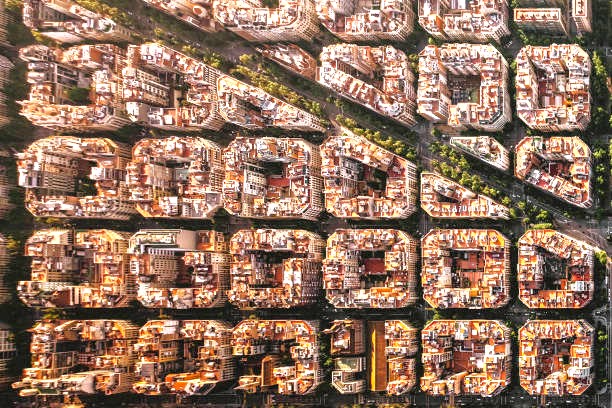
The Eixample is often presented through its ceremonial façades, especially along Passeig de Gràcia. For this route, the more revealing architectural move is to enter an interior block garden and look back at the residential fabric. Here Barcelona’s urban idea becomes three-dimensional: the chamfered street corner belongs to the public grid, while the block interior exposes balconies, service elevations, additions, repairs and the uneven consequences of density.
Jardins d’Interior d’Illa de Clotilde Cerdà is especially useful because it offers two practical thresholds and an explicit architectural view. Verified fact: Barcelona’s official directory entry describes the partially open Eixample block as revealing residential façades that are normally hidden. It lists access from Carrer de la Marina 197 and Carrer de Sardenya 254, and describes a lower section as quieter. Current opening and access conditions should still be checked near the visit because municipal garden operations can change.
The word “quieter” should be interpreted comparatively, not as a guarantee of silence. This is a neighborhood garden rather than a controlled sensory room. The number and behavior of users, maintenance activity, nearby construction, voices from surrounding homes and street noise at the gates can vary. Its advantage is different: there is no elaborate interpretive sequence to complete, the party can see the exits, and two named addresses make branching and rejoining more precise.
Approach through the gate that best serves the next move
The two entrances allow the party to assign different functions. One can be the primary arrival gate; the other can be the no-discussion exit if the first area feels busy. Agree which address is the rejoining point and copy it into everyone’s itinerary. Do not simply say “the courtyard,” because someone who exits through the other side may be on a different street with no obvious line of sight.
A short visit can still carry substantial architectural value. Stand where the relationship between the garden, rear façades and block depth can be read. Notice how private balconies face a semi-public interior, how the block’s center differs from the formal street elevation, and how the promise of light and communal space has been altered by subsequent building history. The traveler does not need to circle every path for the idea to be complete.
Account for the sensory contrast at the threshold
The transition from a traffic street into a partially enclosed garden can produce a strong change in sound, light and spatial enclosure. For some people that contrast is welcome; for others any abrupt shift requires a pause. The group should not enter while continuing a complex conversation or deciding the next hour. Cross the threshold, orient to both exits, then begin interpretation.
Visual density is different here from Sant Pau. Instead of concentrated ornament, the eye encounters many simultaneous domestic details without an official hierarchy: shutters, railings, plants, utility elements, windows, surfaces and signs of alteration. An architecture-focused autistic traveler may find this open-ended pattern study absorbing. Another may prefer a single framing question to prevent the scene from becoming visually diffuse. A guide or informed companion can offer one prompt at a time rather than narrating continuously.
Make the interior block a valid endpoint, not merely a pause
If Sant Pau has used most of the traveler’s capacity, the Eixample garden can be the final shared architectural achievement. The party can rejoin at the chosen gate, compare one observation from the institutional campus with one from the residential block, and end without treating Palau Robert as obligatory. This matters because a fallback only feels genuine when it is allowed to conclude the day.
If energy remains, the route can continue west through the grid toward Palau Robert. Companions who want a denser façade sequence may take a longer line past notable Eixample elevations; the traveler may choose the quieter or more controlled transition. The next shared commitment is not another interior. It is the garden rejoining point.
When bespoke coordination materially changes the day
Private coordination earns its place here when it reduces the social cost of choosing differently. One person can hold the verified admission details, keep the two branch itineraries, confirm the exact meeting addresses, and maintain interpretive continuity when the party separates. A guide can brief both branches around the same architectural question; a pre-arranged transfer can be used only for the transition in which a controlled cabin is genuinely preferable. The service is valuable because the autistic traveler does not have to become the group’s logistics manager while also monitoring sensory load.
This is also where group coordination should protect adult agency. The traveler should be able to leave an interior, decline an extension or reach the next anchor separately without the decision being framed as an emergency. Companions retain a substantive route, and the traveler retains control over exposure and recovery. For parties that need this level of route design, private Barcelona touring options provide the commercial next step. Inquire now when the practical need is a day with pre-agreed branches, current access checks and exact rejoining points rather than a single inflexible circuit.
Palau Robert: use a real architectural place of pause, not a vague “quiet stop”
Palau Robert works because the pause remains part of the architecture day. The former private residence is neoclassical rather than Modernista, and its garden creates a spatial buffer beside the commercial intensity of Passeig de Gràcia and Avinguda Diagonal. Ending here allows the party to compare three models of open space: Sant Pau’s institutional landscape, the Eixample block interior, and the garden of an urban residence.
Verified fact: Palau Robert’s official description identifies the vegetated garden between the main residence and the Cotxeres building as a quiet place for rest and pause amid the surrounding city. That makes it unusually suitable as a named rejoining anchor. It does not mean the garden will be empty or uniformly silent; it means the venue itself recognizes the garden’s restorative role.
Verified operational fact: as checked on 1 September 2026, the official visitor page listed opening hours of 09:00 to 20:00 Monday through Saturday and 09:00 to 14:30 on Sundays and holidays, with annual closures and shorter hours on specified holiday eves. It also stated that groups of more than ten must arrange visits in advance. These details are volatile and should be checked for the actual date, especially when Palau Robert is carrying the operational burden of being the day’s principal rejoining place.
Define the garden meeting point more precisely than the venue name
Palau Robert is a complex, not a single dot. Agree on the exact gate or building-side landmark and use the same wording in every itinerary. Photograph the location before any optional split. Set a meeting window rather than one brittle minute: for example, companions arrive within an agreed span, and the traveler knows what happens if they are late. The failure rule might be to remain at the photographed point for a fixed period and then use one predetermined contact method. The details should match the traveler’s preferences; the important feature is that they are decided before separation.
The garden can also be used asymmetrically. The traveler may arrive first with one companion, while others complete a short exterior study of Passeig de Gràcia. Or the whole party may regroup in the garden before deciding whether anyone wants an exhibition. The architecture day does not depend on everyone entering the same final space.
Keep the architectural interpretation concise and connected
Palau Robert should not become an ornamental afterthought. Ask how a private residence uses setback, vegetation and approach to negotiate status and privacy within the expanding city. Compare that with Sant Pau, where landscape served an institutional program, and with the interior block, where shared open space sits behind continuous residential frontage. The traveler can participate in this comparison from the garden without committing to another lengthy interior.
If the surrounding avenue is too stimulating, there is no requirement to add Casa Batlló, Casa Amatller or La Pedrera as exterior stops. Their façades can be studied another day under conditions chosen for them. If the traveler actively wants that visual intensity, companions can take a defined detail loop and return to Palau Robert. The garden remains the stable base, not merely the place everyone hopes to find later.
Four fallback branches that preserve architectural ambition
A fallback should answer the same cultural question by a different route. Replacing architecture with unstructured free time may reduce immediate pressure, but it can also erase the purpose that motivated the traveler. The following branches preserve a serious subject while changing the sensory or logistical demand.
1. Sant Pau becomes an exterior-and-urban-form study
Use this branch when the admission threshold, interior acoustics or route uncertainty becomes unacceptable before entry. Read the complex’s public presence, the distribution of volumes visible from outside, and its relationship to the Avinguda de Gaudí axis. Then continue to the Eixample interior block. The loss is interior applied arts and circulation; the gain is a more predictable sequence with no need to complete a controlled visitor route.
2. The Eixample becomes the principal subject
Use this branch when the traveler wants architecture but not another formal venue after Sant Pau. Spend the intellectual energy on Cerdà’s block geometry, chamfered intersections, street width, rear façades and the Clotilde Cerdà garden. Palau Robert remains an optional finish. This is not a lesser version of a monument day; it is a shift from object architecture to urban system.
3. Companions take the dense façade branch; the traveler takes the direct garden branch
Use this when the party’s interests diverge after the interior block. Companions may want Passeig de Gràcia’s famous façades, while the traveler wants a shorter, more predictable transition to Palau Robert. Both branches receive one shared observation task, such as identifying how façades control attention at street level. Rejoining in the garden turns the split into a comparative exercise rather than a separation caused by “not coping.”
4. End after two anchors and reserve the third for another day
Use this when the traveler has achieved a satisfying Sant Pau and Eixample sequence. Stopping is the correct architectural decision when adding Palau Robert would produce only a hurried arrival or force recovery to happen after capacity has already been exceeded. The third anchor remains available for a different day because it is centrally placed and can pair with a focused Passeig de Gràcia study.
Do not substitute Montjuïc or the Mies van der Rohe Pavilion as an emergency extension. Both can be excellent architecture choices, but from this route they add a substantial geographic transition and new access variables. They belong in a separately designed day, such as a Barcelona architecture day beyond repeated Gaudí interiors, not in a bailout improvised after Sant Pau.
Rejoining is an accessibility tool, not a courtesy detail
Many group itineraries assume that separation is a failure of planning. Here it is part of the plan. A rejoining protocol allows the autistic traveler to preserve agency without requiring companions to surrender every optional module. It also reduces the pressure to remain in a space simply to avoid inconveniencing others.
A workable protocol has five parts:
- One exact place: a photographed gate, entrance or landmark, not “near the garden” or “outside the building.”
- One time window: an arrival span that accounts for different walking speeds and a clear rule for what happens after it ends.
- One communication method: the agreed person and channel, with an offline copy of addresses in case connectivity fails.
- One support choice: the traveler decides whether to wait alone, with one familiar companion or with the guide.
- One next action: continue, finish, or move to the next predetermined location without reopening the whole day’s negotiation.
At Sant Pau, the rejoining point should be on the public side of any admission control. At Clotilde Cerdà, use either Carrer de la Marina 197 or Carrer de Sardenya 254 and state which one. At Palau Robert, name the chosen gate or building-side marker. These details should appear in the written itinerary in the same wording used aloud.
Interpretive continuity is equally important. Before a split, give each branch a question that can be answered independently. After Sant Pau, it may concern how gardens organize circulation. In the Eixample, it may concern what rear façades reveal that prestigious street façades conceal. At Palau Robert, it may concern how a residence creates distance from a major avenue. Rejoining then has content as well as logistics.
Parties combining sensory requirements with other access needs should avoid importing one framework unchanged into another. The low-vision architecture day offers useful methods for verbal geometry and shared description, while the mixed-mobility Montjuïc guide develops rejoining around steep transitions. The relevant techniques can be combined, but the traveler’s own priorities should determine which one leads.
A practical sequence with branch points already built in
This is a sequence rather than a minute-by-minute prescription. Exact times should be set only after current admissions, opening hours, the traveler’s preferred start condition and the day’s weather are known.
Opening anchor: Sant Pau
Arrive with the main entrance and public-side rejoining point already documented. Keep the pre-entry briefing short: today’s confirmed route conditions, the first architectural question, the signal for pause, and the minimum visit. Do not review the whole day on the pavement. The traveler enters knowing that the first complete segment is already a valid visit.
During the visit, interpretation should be paced by attention rather than by a script. Offer one architectural layer at a time: campus organization, material detail, then the relationship between interior and garden. Leave pauses without filling them. At the agreed reassessment point, the traveler chooses to extend, move toward open air if permitted, or exit.
First branch: shared walk or separate transition
After Sant Pau, companions can either move together toward the Eixample or use the pre-agreed split. The street-context branch studies the visual axis and the changing urban fabric. The direct branch minimizes decisions and goes to the selected Clotilde Cerdà gate. No one has to negotiate the split in real time; the traveler simply activates the option.
Second anchor: Clotilde Cerdà interior block
Enter through the chosen address, orient to the second exit, and allow the sensory contrast to settle before interpretation. Complete the minimum architectural task first: read the block depth, garden and rear elevations from one position. Then decide whether to move to the lower, officially described quieter section, make a short circuit, or rejoin at the gate.
This is a suitable place for food or a longer pause only if that setting has been separately selected for the traveler’s needs. Do not assume that an unreserved nearby option will provide low conversation, predictable seating or rapid service. Meal logistics should not be allowed to become a new uncertainty inserted between the two most important anchors.
Second branch: direct to Palau Robert or façade study
The traveler may go directly to Palau Robert with the chosen companion. Others may take a defined Eixample façade route with a strict end condition. The companions’ branch should not expand spontaneously because they see another interesting building. Its purpose is to use the planned separation, then arrive within the agreed meeting window.
Final shared anchor: Palau Robert garden
Rejoin at the photographed point. Begin with recovery and orientation rather than immediate discussion. When the traveler is ready, make the three-part comparison: institutional garden, block interior and private urban garden. This gives the day a coherent conclusion even if no further interior is attempted.
The day may end in the garden, continue with a brief exhibition only after current conditions are understood, or split once more for a Passeig de Gràcia exterior loop. The traveler’s choice should be accepted without a persuasion phase. Predictability includes knowing that “finished” will be treated as a complete decision.
What to verify before publication, booking and the morning of the visit
The durable architecture does not change quickly; the operational layer can. Sant Pau’s hours, last access, available visitor route, entry procedure and exit or re-entry conditions should be checked on the official page for the intended date. The Clotilde Cerdà garden’s access and opening conditions should be confirmed through Barcelona’s municipal listing. Palau Robert’s hours, closures, group-arrangement rule and garden access should be rechecked, especially on Sundays, holidays and holiday eves.
Also verify the facts that are personal rather than public: the traveler’s current tolerance for bright outdoor-to-indoor shifts, whether headphones or other supports are useful in this context, whether waiting alone is preferred, how much advance detail is regulating rather than overwhelming, and which companion will leave with the traveler if a split occurs. These decisions should not be inferred from a previous trip or from someone else’s autism profile.
Finally, write the route as two coordinated itineraries, even if the party expects to remain together. Include the exact addresses for the Eixample garden gates, the photographed Sant Pau meeting point, the chosen Palau Robert gate, the current official hours, the stop rules and the agreed communication method. Recheck the official sources shortly before the visit rather than relying on this article’s 1 September 2026 verification. The architecture day succeeds when the traveler can pursue serious visual and intellectual interests while retaining control over transitions, exits and rejoining at every stage.
If you’re interested in any private tours of Barcelona, please reach out to us.
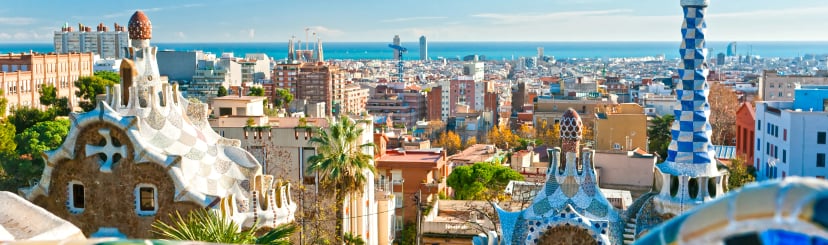








 So if you are looking for the absolute best in Barcelona & surroundings with authentic local fully-licensed native guides whose English you can actually understand and with an exclusive and amazingly fun itinerary