Does Your Cruise Dock in Seville or Cádiz? Planning the Right Shore Excursion

Updated
An anniversary couple can lose the shape of a Seville shore day before they have even stepped off the ship. The itinerary says “Seville.” They reserve a timed admission to the Real Alcázar, arrange to meet a guide near Patio de Banderas and picture a measured walk through the royal palace, the Cathedral quarter and Santa Cruz. Then the morning program names Cádiz as the berth. The scheduled arrival is not the gangway opening, the gangway is not beside the Alcázar, and the return is now an intercity road movement rather than a short urban transfer. Nothing about the monuments has changed, but almost every useful assumption has.
This is the central planning distinction: a destination label is not a docking location. A ship may market a call through the city travelers most want to visit, while the operational documents identify a different port. For Seville, the difference is unusually consequential. A vessel at the Port of Seville has already traveled inland on the Guadalquivir and is close to the city. A vessel at a Cádiz cruise terminal is on the Atlantic coast, with Seville still ahead by road and the same road to be covered again before the ship’s deadline.
The correct sequence therefore begins with four facts, in this order: the confirmed berth, the gangway arrangement, the ship’s all-aboard time and the transport exposure between port and city. Only after those are known should a couple commit to a timed monument. A private vehicle and coordinated guide can make the movement more controlled, but neither can guarantee a road, recover a missed entrance nor override the ship’s departure. The value lies in building a day that remains credible when the optimistic version of the schedule does not occur.
Start with the berth, not the word “Seville”
The berth should be treated as a named operating fact, not a clue inferred from the cruise brochure. Look for the exact port and terminal in the line’s final documents, the daily program, the port-agent notice or the gangway information shown onboard. “Seville,” “Seville/Cádiz” and “Cádiz for Seville” can describe the same visitor ambition while producing very different excursion mathematics. The city label alone is never enough.
For a usable shore plan, confirm all of the following before reserving an admission that cannot move:
- The exact port and berth. Distinguish the Port of Seville and its river facilities from the Cádiz cruise terminals. If the document gives only a city name, ask for the terminal or pier.
- The expected gangway opening. Scheduled arrival is a nautical or operational milestone. Passengers may leave later, and the first wave ashore can add its own delay.
- The all-aboard time. This is the practical return deadline. It normally precedes the published sailing time and must be read from the ship’s own instructions.
- The time standard. Confirm whether ship time and local time match. Phones can update automatically; printed programs and onboard clocks may use the ship’s convention.
- The meeting point. “At the port” is not precise enough. A driver may be allowed at an organized-transport area, while a guide may meet at a pedestrian exit or in the city.
- The reboarding conditions. Carry the identification and ship card required by the line, and preserve time for port access, security and the walk back to the gangway.
As one major cruise line explains in its current guidance, guests are told onboard when to return; its all-aboard time is generally earlier than sailing, often by about 30 minutes, but the controlling time must be verified onboard and near the gangway. That is a useful illustration, not a universal rule for every line or every call. The ship’s own notice for that day prevails. See Royal Caribbean’s shore-excursion guidance for the line-specific wording.
A second distinction matters for independently arranged touring: an all-aboard deadline is not a target arrival at the terminal gate. It is the latest time passengers are expected back aboard. A responsible plan chooses an earlier self-imposed port-return time, leaving space for the last road segment, the port entrance, security and the walk to the ship. That margin is part of the excursion, not unused sightseeing time.
Keep the shore movement light. For an ordinary port call, the couple should carry only the documents, medication, water and personal items needed ashore, while checking the ship’s and monument’s current bag rules. Large bags can slow terminal and entrance screening and complicate the final walk through the monument precinct. If the travelers are ending the cruise with full luggage, the problem is no longer a standard shore excursion: terminal release, baggage collection, vehicle capacity and onward hotel arrangements require a separate transfer plan, and the timing assumptions in this guide should be rebuilt.
Three clocks govern the shore day
Cruise planning becomes clearer when the day is separated into three clocks rather than treated as one block between “arrival” and “departure.” The first is the ship’s operating clock, the second is the visitor’s usable clock and the third is the return clock.
The ship’s operating clock
This includes the published arrival, the actual berth completion, clearance and the opening of the gangway. A ship can be visibly alongside while passengers are not yet free to leave. On a river arrival, local port operations may also affect when the shore movement begins. The excursion should never assume that a scheduled 08:00 arrival creates an 08:00 pickup.
The visitor’s usable clock
This starts when the couple has actually passed the gangway, found the correct exit and joined the driver or guide. It ends at the agreed city-departure cutoff, not at all aboard. For a Cádiz-based excursion, this usable window must contain two road transfers as well as the Seville visit. For a Port of Seville arrival, it contains shorter urban movements but still includes a legal drop-off, a final walk and monument procedures.
The return clock
This runs backward from the ship’s all-aboard time. It contains the return drive, a reserve for disruption, the port approach, any terminal screening and the walk to the gangway. Its most important property is that it cannot be spent twice. A late start, a slow palace visit and an extended lunch cannot each be absorbed by the same 30-minute cushion.
Planning equation: latest safe departure from Seville equals the verified all-aboard time, minus the port re-entry allowance, minus the realistic return-road allowance, minus the disruption reserve.
The same backward logic sets the admission time. The earliest credible Alcázar entry equals the actual gangway exit, plus the port handoff, plus the outward transfer, plus the drop-off-to-entrance walk, plus admission and security margin. Use credible allowances, not the fastest map estimate. The result may be later than the first available entrance, and that is acceptable. A later reservation that the couple can reach calmly is more useful than an early one that turns the entire day into a chase.
For a broader view of how a city day can be sequenced once the arrival problem is solved, see a paced private Seville day through the Alcázar, Cathedral, Santa Cruz and Triana. That itinerary logic should be applied only after the shore-day clocks have been established.
Two arrival scenarios that should never be blended
When the ship is genuinely at the Port of Seville
The Port of Seville is an inland river port, and its cruise facilities place passengers within the urban area rather than on the coast. The current terminal operator describes Sevilla Cruise Port as having direct river access, three berths and one terminal at Delicias Quay, around 1.5 kilometres from the city centre, with space for organized coach movements. Those are useful orientation facts, but they do not identify a passenger’s exact gangway or guarantee that every vehicle can wait immediately beside it. The operational profile is available on the Sevilla Cruise Port page.
The practical advantage is the absence of the Cádiz–Seville round trip. A delayed gangway may still compress the visit, yet it does not automatically consume several additional road blocks. This often supports a more ambitious city sequence: a timed Alcázar visit, carefully placed Cathedral access, and one flexible neighborhood or riverside segment. It also makes a late adjustment more manageable because the ship remains within Seville rather than on the coast.
However, “close to the centre” should not be translated into “at the monument door.” The Alcázar–Cathedral precinct is a pedestrian environment surrounded by controlled streets and busy public space. Even when a car can approach efficiently, the couple may still have to walk from an agreed legal drop-off to Plaza del Triunfo or Patio de Banderas. The driver’s task and the guide’s task may therefore meet at a handoff point rather than at the same curb.
A Port of Seville day works best when the first fixed commitment leaves enough space for the actual disembarkation. If the gangway opens promptly, the spare interval can become a short orientation along the river or through El Arenal. If it opens late, that interval disappears without jeopardizing the admission. This is a stronger design than placing the palace at the first theoretically reachable minute.
The route can also remain urban and modular. A couple might move directly to the Alcázar, place the Cathedral before or after it according to current admission conditions, and use Santa Cruz, Arenal, Triana or Plaza de España as the flexible component. The more detailed question of what to choose after a cruise arrival is explored in a Seville cruise-arrival guide comparing Arenal, the Cathedral area and Plaza de España. A hotel-arrival day has a different endpoint, but the neighborhood geography is useful.
When the ship is at a Cádiz cruise terminal
Cádiz changes the day from an urban excursion into a round-trip transfer with a city visit in the middle. The Cádiz Bay Port Authority identifies cruise facilities at Alfonso XIII Pier and Ciudad Pier, describes the city centre as roughly a five-minute walk away, and notes organized-tour coach parking and an external taxi rank. That proximity is excellent for a Cádiz day and valuable as a fallback. It does not shorten the road to Seville. The official facilities overview is on the Cádiz Bay Port Authority cruise page.
A Seville excursion from Cádiz can still be worthwhile when the port call is generous, the gangway is expected to open early, the road is clear and the city plan is disciplined. The discipline is the key. One timed centerpiece usually deserves priority over a chain of fixed admissions. For many first-time visitors, that centerpiece is the Real Alcázar; the Cathedral quarter, Archivo de Indias exterior, Plaza del Triunfo and a focused walk can then absorb variation without creating another missed appointment.
The outbound and inbound journeys should not be treated as identical copies. The outward drive answers, “Can we reach the first commitment?” The return drive answers, “Can we reach the ship despite what has changed since morning?” An incident can arise after the couple is already in Seville. A plan that monitors traffic only before leaving Cádiz solves half the problem.
The city-departure cutoff therefore belongs in the itinerary from the beginning. It should be visible to the guide, driver and travelers, and it should not move later because lunch ran long or the gardens invited another circuit. If the return route develops a problem, the response is to shorten the flexible portion and leave earlier, not to hope that the final buffer will absorb every loss.
For travelers who wish to understand Cádiz as more than an emergency substitute, this Cádiz planning guide gives the coastal city its own logic. On a shore day, that local knowledge can turn a canceled Seville transfer into a deliberate old-town route rather than an improvised walk near the terminal.
River-berth uncertainty and road uncertainty are not the same risk
Both arrival scenarios require buffers, but the buffers protect against different things. At the Port of Seville, the most consequential uncertainty is often front-loaded: the final berth, the gangway opening, the meeting point and the timing of the first urban movement. Once the couple is ashore and inside the city, the return geography is comparatively compact.
From Cádiz, uncertainty continues throughout the day because the road remains part of the return. A clear morning does not prove a clear afternoon. The useful question is not simply whether navigation software shows traffic at breakfast; it is whether there is a live process for checking incidents before departure from Cádiz and again before departure from Seville.
Spain’s Dirección General de Tráfico publishes a live traffic-status and incident service that it says is updated automatically around the clock using information from traffic units and management centres. The official reference is the DGT traffic-status page. A private road plan should use an official incident source alongside navigation, not rely on a single optimistic journey estimate captured hours earlier.
This produces two separate decision points:
- Before leaving Cádiz: confirm that the outward road conditions still support the reserved admission and that the return allowance remains credible.
- Before leaving Seville: recheck the return corridor and advance the departure if conditions have deteriorated. This second check is essential because the excursion is already committed to the inland city.
A road reserve is not a promise that delay will be harmless. It is an amount of time chosen to absorb ordinary variation while leaving a port-local alternative when conditions are already unfavorable. Severe disruption can exceed any sensible margin. The correct operational response may be to remain in Cádiz, even when every traveler would prefer Seville.
The asymmetry also affects emotional pacing. On an anniversary trip, a couple may be tempted to protect the palace visit and sacrifice the return margin because the day feels singular. That reverses the proper priority. The ship’s cutoff is fixed; the palace plan is conditional. A thoughtfully designed Cádiz day can preserve the celebration. A missed ship cannot.
Place the Alcázar inside the transfer plan, not above it
The Real Alcázar is a natural anchor for a first Seville visit, but its importance does not exempt it from the shore-day clock. The official visitor page provides advance online admission and lists the ticket office at Patio de Banderas. It currently gives seasonal public hours of 09:30–17:00 from October through March and 09:30–19:00 from April through September, subject to the institution’s current conditions. Those hours should be checked for the specific date on the Real Alcázar visit-planning page.
The useful planning consequence is not “book the earliest time.” It is “book the earliest time the actual berth can support without spending the return reserve.” From the Port of Seville, that may be a morning admission after a modest urban approach. From Cádiz, the credible time must include disembarkation, finding the vehicle, the entire outward road allowance, the Seville drop-off and the walk to the entrance.
Five buffers belong around the admission:
- Gangway buffer: the difference between scheduled arrival and actual passenger exit.
- Port-handoff buffer: the walk through the terminal area, identification of the vehicle and boarding.
- Transfer buffer: realistic road time rather than a best-case prediction.
- Old-town approach buffer: legal drop-off, pedestrian movement and locating the correct entrance.
- Admission buffer: document checks, security and any queue specified by the monument.
None of these should be exaggerated into an hour-by-hour void. The aim is proportionality. A berth beside Seville does not need the same road allowance as Cádiz. A couple traveling light and meeting one coordinator may need less handoff time than a large group. But removing every buffer because the map looks short produces a fragile itinerary.
The palace visit itself also needs an endpoint. The gardens make it easy to extend a visit beyond the planned duration, especially for travelers who value architecture and landscape. On a hotel day, that extension may be welcome. On a Cádiz shore day, it can consume the only flexible margin. The guide should know when the route must turn toward the exit, and the couple should understand why the decision is being made.
Once the berth and timing support the reservation, a specialist guide to choosing an Alcázar tour can help distinguish simple access from deeper interpretation. That is the right order: establish feasibility first, then choose the quality and depth of the visit.
The Alcázar–Cathedral precinct is a pedestrian handoff
Maps often make central Seville look easier than it is operationally. The Alcázar, Seville Cathedral, the Archivo de Indias and Plaza del Triunfo sit close together, but closeness between monuments does not mean a vehicle can deliver passengers to every entrance. The final segment is part of the route and must be assigned to someone.
For a coordinated excursion, the driver should have an agreed legal approach and the guide should know whether to meet at that drop-off or at a specific monument entrance. The couple should not be left to bridge an undefined gap through a crowded square while watching an admission time. This handoff is especially important when the ship is in Cádiz, because a small city delay comes after a long transfer and before a fixed entry.
A useful sequence is to separate the day into three environments:
- Vehicle environment: port exit, road transfer and the approved approach to central Seville.
- Pedestrian monument environment: Plaza del Triunfo, the Alcázar entrance, Cathedral approaches, Santa Cruz and nearby streets.
- Return environment: a pre-agreed collection point that can be reached without searching for the vehicle at the last minute.
The collection point may differ from the drop-off. That is not a flaw if it is planned; it can prevent a driver from circling restricted streets and can shorten the return. The guide should lead the couple to it with enough time to board calmly. A location name, map pin and telephone contact should be shared before the visit begins.
The same logic argues against two tightly adjacent fixed entries. The Cathedral and Giralda can be a major visit in their own right. If both the palace and Cathedral are reserved with no recovery interval, a delayed palace admission can cascade into a second missed slot. A more resilient Cádiz plan uses one fixed admission and treats the rest of the precinct as a flexible interpretive walk, adding a second interior only when the verified window is generous.
For a Port of Seville call, more can fit because the road exposure is lower, but the sequence should still respect pedestrian reality. A short transfer does not eliminate security lines, heat, crowd density or the time required to cross the precinct. It merely gives the planner more room to absorb them.
Build the day backward with a visible cutoff
A shore-excursion itinerary should be readable as a chain of dependencies. The easiest way to test it is to build it backward from all aboard and then forward from the gangway. If the two calculations do not leave a meaningful overlap for Seville, the excursion is not ready to reserve.
Backward calculation
Start with the verified all-aboard time. Subtract the port re-entry and gangway allowance. Subtract the return road allowance appropriate to the actual berth. Subtract a disruption reserve based on current conditions. The result is the latest city-departure cutoff. This is the time the couple must be in the vehicle and moving, not the time they begin looking for the meeting point.
Forward calculation
Start with the credible gangway exit rather than the scheduled arrival. Add the port walk and pickup. Add the outward transfer. Add the old-town drop-off and final walk. Add admission procedures. The result is the earliest sensible start for a fixed monument.
Overlap test
Between the end of the monument visit and the latest city departure, there should be a flexible block, not a second chain of obligations. This block can hold a guided walk through the Cathedral quarter, a calm meal, a short Arenal route or a transfer toward the collection point. If the block disappears on paper, it will not reappear on the day.
A hypothetical example: imagine that the ship’s daily program gives an all-aboard time in late afternoon. The planner first establishes an earlier port-return target. For a Cádiz berth, the return road allowance and incident reserve are then removed, producing a firm Seville departure time. Only after that does the planner test whether a palace admission leaves enough room to walk back to the car. The exact minutes will vary by ship, berth and traffic; the method does not.
This method also reveals when a “full-day” marketing phrase is misleading. A ten-hour port call is not ten hours in Seville if passengers spend part of it waiting for the gangway, locating transport, crossing from Cádiz and returning early enough to board. Conversely, a shorter call at Delicias may produce more usable city time because the ship is already in Seville. Duration without geography is incomplete information.
Do not allow lunch to become an invisible fixed booking unless the schedule supports it. A reserved table, a tasting sequence or a distant venue adds another clock. On a Cádiz-based day, a flexible meal near the monument precinct is usually easier to shorten than a formal multi-course commitment. The point is not to diminish the celebration; it is to protect the experience that matters most and the return that cannot move.
Choose the scope by condition, not by ambition
When a fuller Seville day is justified
A broader route is credible when the berth is confirmed in Seville, the gangway window is reliable, all aboard leaves a substantial urban day and the chosen admissions have breathing room. Under those conditions, the Alcázar and Cathedral can potentially share the day, with Arenal, Santa Cruz, Triana or Plaza de España placed according to current access and the couple’s interests. The operative word is “potentially”: final entry conditions still need verification.
When a Cádiz-to-Seville day should be narrowed
From Cádiz, protect one major interior and one flexible supporting sequence. For example, the Alcázar can be the fixed centerpiece; Plaza del Triunfo, the Cathedral exterior, Archivo de Indias context and a controlled walk toward Arenal can expand or contract. A second reserved monument should be added only when the port call, road allowances and return cutoff still leave recovery time.
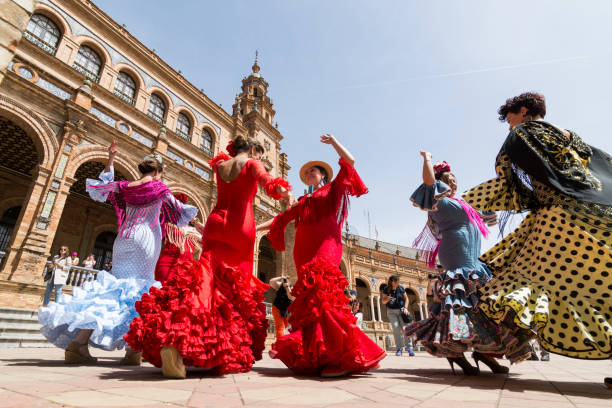
Evening flamenco is normally a separate decision rather than an automatic extension. Venues such as Teatro Flamenco Triana, Museo del Baile Flamenco and Casa de la Memoria create another fixed-time commitment. They may suit a genuinely late sailing from Seville, but they should not be layered onto a Cádiz round trip merely because the program labels the day “Seville.” The ship’s deadline, not the appeal of the performance, determines feasibility.
When to remain in Cádiz
A port-local day is the stronger choice when the berth remains unclear, the gangway opens materially late, all aboard moves earlier, the road shows significant disruption, or the available Alcázar entry would force an unsafe return margin. It is also sensible when the couple would spend more time monitoring the clock than engaging with Seville.
This is not a consolation verdict. Cádiz places its historic centre immediately beside the cruise facilities and supports a coherent day on foot. The choice becomes disappointing only when it is made after hours of uncertainty with no prepared route. A planned Cádiz alternative can preserve history, sea views, architecture and an unhurried anniversary meal while keeping the ship within easy reach.
Failure modes should have named responses
A robust shore excursion is not one that assumes nothing will go wrong. It is one in which the most important failures already have a response, a cutoff and a person responsible for the decision.
- The berth changes. Recalculate the day from the beginning. Do not carry over an Alcázar time selected for Delicias to a Cádiz arrival without retesting the outward and return roads.
- The ship arrives on time but the gangway opens late. Remove the first flexible element or move the monument plan if the admission permits. Do not solve the delay by shrinking the return reserve.
- The meeting point is inaccessible. Use a pre-agreed secondary point and direct contact. “Outside the terminal” is too vague when several exits, coach areas or security barriers are involved.
- Outbound traffic deteriorates. Compare the new arrival forecast with the monument’s real admission tolerance and the latest safe return. If the numbers no longer work, turn the day toward Cádiz before the road commitment becomes irreversible.
- The Alcázar entry is missed. Do not assume that another major monument can be entered spontaneously. Switch to a flexible central route and preserve the return. The loss is frustrating; compounding it with another uncertain queue is worse.
- Return traffic deteriorates. Leave Seville earlier, cut the final stop and use the pre-agreed collection point. The city portion is the adjustable element.
- Ship time and local time diverge. Use the ship’s stated deadline and ensure every member of the team has translated it into the same working clock. A phone’s automatic time change should not set the return plan by accident.
- The sailing time changes. Treat any earlier all-aboard instruction as a complete recheck trigger. A route built for the old deadline is no longer valid.
The key operational concept is an abort point: the latest moment at which the excursion can abandon the Seville objective and still deliver a worthwhile Cádiz day. That point might be before the vehicle leaves the port area, after a first traffic review or when the revised arrival would miss the palace. It should be decided in advance, not negotiated emotionally while the clock is running.
There is no responsible promise of a guaranteed ship return on an independently arranged excursion. There can be conservative planning, current monitoring, clear communication and an early cutoff. Those controls reduce risk; they do not remove it.
Design the Cádiz fallback as a real shore day
The strength of Cádiz as a fallback comes from its port geography. With the historic centre close to the cruise terminals, the couple can move from the ship into the city without committing to a long road transfer. This gives the guide room to build a route around current access rather than around a single high-stakes reservation.
A port-local sequence can begin near Plaza de San Juan de Dios and El Pópulo, continue toward Cádiz Cathedral and the lanes of the old city, and then turn toward the Atlantic edge, Campo del Sur or La Caleta according to time and weather. Torre Tavira or another interior can be considered only if current admission fits; the route should remain complete without it. The point is to create a narrative—merchant Cádiz, fortified Cádiz, Atlantic Cádiz—not a list of substitute sights.
For an anniversary couple, the local option may also support a calmer meal and a seafront walk without the anxiety of a distant return. The premium outcome is not simply a nicer vehicle. It is the ability to change the city objective without losing the coherence of the day.
The fallback needs its own practical details:
- a named meeting point at the correct terminal exit;
- a walking route that can shorten cleanly if the gangway opens late;
- one optional interior rather than several dependent admissions;
- a meal location kept within the old-town return radius;
- a final ship-return time that remains earlier than all aboard.
Because organized-tour parking and a taxi rank are adjacent to the cruise facilities, a transport-based fallback can also work for a limited wider circuit if conditions support it. But a private car is not required to make Cádiz meaningful. Its greatest advantage on a disrupted day is often the ability to stay close and walk.
Keep a Seville fallback for a Seville berth
A ship at Delicias can still experience a late gangway, a changed monument condition or a missed admission. The appropriate fallback is different because the couple is already in Seville. Instead of abandoning the city, the plan can exchange fixed interiors for flexible urban interpretation.
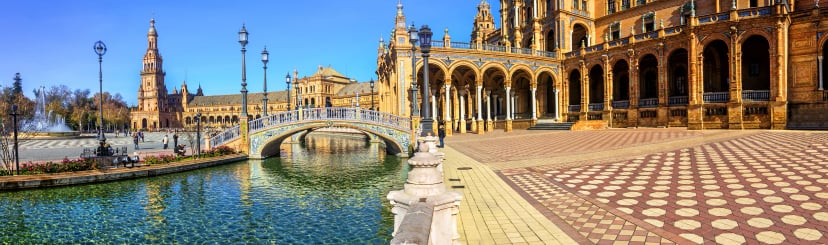
El Arenal and the Guadalquivir provide a natural first layer: maritime history, the Torre del Oro exterior, the relationship between the river and imperial trade, and a route toward the Cathedral quarter. Triana can add ceramics and flamenco context if the crossings and return remain comfortable. Plaza de España and María Luisa Park can serve when a spacious outdoor sequence is preferable, although heat and weather must be considered.
The alternative should not be a frantic attempt to collect whatever monument still has an opening. A strong guide can make the city legible through exterior architecture, urban history and neighborhood transitions. On a fixed ship day, certainty and interpretation are often more valuable than replacing one lost entrance with another untested queue.
If the revised day remains centered on the Alcázar precinct but needs a simpler rhythm, the Giralda-or-Cathedral-first planning guide helps explain how the order of nearby monuments affects the palace. Again, the ship’s return clock remains the controlling constraint.
What coordinated private transport materially changes
Private transport is relevant here because the reader’s problem is movement under a fixed deadline, not because every premium visitor needs a chauffeur. Its practical contribution is to join the berth, road, monument and return decisions into one operating plan.
At minimum, coordination should establish the exact pickup location, the current terminal access, the outward route, the central Seville drop-off, the guide handoff, the latest city departure and the return monitoring process. From Cádiz, the driver should be able to reassess the road before departure in both directions. In Seville, the guide should know the collection point and lead the couple there before the cutoff.
For anniversary travelers, this removes a specific burden: they should not have to arbitrate between a guide who wants ten more minutes in the gardens, a driver estimating the road and a ship notice stored on one traveler’s phone. One coordinator can state the consequence clearly—continue, shorten or switch to Cádiz—while the couple retains the final choice.
This service does not make an impossible schedule possible. It makes the feasibility test more accurate and the fallback more graceful. The moment to reserve monument admissions is after the actual berth and return margin support the road plan. Before that point, the palace time is a hope rather than a coordinated excursion.
Travelers ready to commission the movement, guide handoff and return cutoff together can review a private Seville cruise-layover service. The useful brief should include the ship name, call date, exact berth if known, published arrival, all-aboard time, mobility needs and the monument that matters most.
A verification protocol for the days before sailing and the morning of arrival
Operational facts can change after an excursion is first discussed. The planning process should therefore have explicit recheck moments rather than a single confirmation weeks in advance.
Before committing to timed admission
- Obtain the exact port and terminal, not only “Seville.”
- Record the ship’s published arrival, sailing and all-aboard information separately.
- Confirm whether ship time matches local Spanish time.
- Test both the outward and return movement with realistic allowances.
- Identify a Cádiz fallback before paying for a rigid Seville sequence.
- Use the official Alcázar page for the current date, admission conditions and opening information.
In the days immediately before the call
- Recheck the berth and any port advisory.
- Confirm the driver’s permitted pickup area and the guide’s meeting point.
- Review the DGT incident service and any known road disruption.
- Reconfirm the admission and the name or identification required.
- Restate the latest city-departure cutoff in writing.
Onboard and at the gangway
- Read the ship’s daily program and the notice posted near the exit.
- Use the ship’s current all-aboard time even if it differs from earlier documents.
- Message the coordinator when the gangway actually opens.
- Verify that the pickup point has not changed because of berth operations.
- If the ship is late, rerun the scope decision before leaving the port.
Before the vehicle leaves Seville
- Check the live return-road condition again.
- Confirm that every traveler is at the collection point before the cutoff.
- Remove any final stop that depends on an optimistic arrival at the port.
- Keep the ship cards and required identification accessible for re-entry.
The recheck triggers are straightforward: a berth change, a different gangway arrangement, an earlier sailing or all-aboard time, a delayed passenger release, a road incident or a changed monument condition. Any one of these can alter the feasible route. The correct response is recalculation, not reassurance.
The decision in one sentence
Commit to Seville only when the ship’s confirmed berth, actual passenger-release window, monument approach and return allowance all fit before a conservative port-return target; otherwise choose a designed Cádiz day or a flexible Seville route without the fragile admission.
Before leaving the ship, verify the exact terminal, the gangway instruction, the ship’s clock and the posted all-aboard time. Before leaving Cádiz, check the road. Before leaving Seville, check it again. A city label can inspire the excursion, but only the berth and deadline can authorize it. When those facts support a coordinated palace visit and a protected return, Inquire now.
If you’re interested in any private tours of Seville, please reach out to us.





 So if you are looking for the absolute best in Seville & surroundings with authentic local fully-licensed native guides whose English you can actually understand and with an exclusive and amazingly fun itinerary













