Dancewear or Feria Dress? Choosing a Flamenco Commission in Seville

Updated
Choose the garment by its hardest job, not by the image that first catches your eye. A dress commissioned for professional or serious amateur performance must permit the dancer’s actual vocabulary: arm carriage, torso rotation, hip articulation, footwork, kneeling if relevant, turns, skirt handling and, in some choreographies, management of a train. A feria dress has a different centre of gravity. It must hold a deliberate social silhouette while the wearer walks, stands, sits and spends hours in a crowded celebration setting. An adaptable finished garment is the sensible third option when the travel window is short, the future use is mixed or the buyer needs to see and move in the piece before accepting its limits.
These are not three quality levels. They are three answers to different briefs. A highly constructed feria dress can be more elaborate and costly than stage clothing, yet still be unsuitable for a dancer whose choreography requires wider stride, lower resistance and predictable skirt recovery. Conversely, light performance clothing may move beautifully under theatre lighting but feel visually underpowered for a formal feria entrance. The important question is not whether a garment looks “flamenco.” It is whether its cut, weight, balance, finishing and fitting sequence match the occasion for which it will be worn.
For an overseas client, the decision also has a clock attached. A Seville commission can be worthwhile when purpose is settled, the atelier can explain its construction choices, fitting dates are real rather than aspirational, and a responsible delivery plan survives the client’s departure date. When any of those elements is missing, a finished model with intelligent alterations can be the more exacting purchase because the unknowns are visible early.
Why stage clothing and feria dress separate at the level of movement
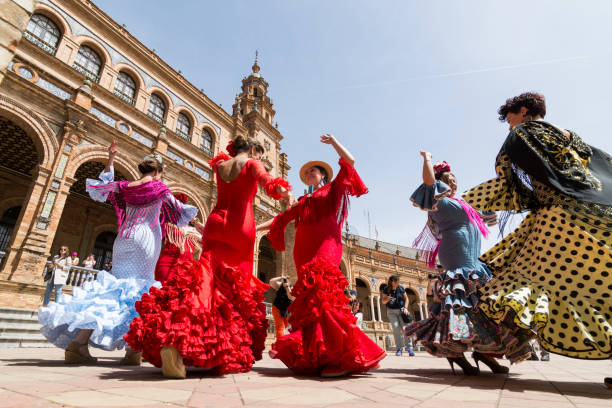
Seville’s own costume history gives a useful starting point. The official catalogue of the Museo de Artes y Costumbres Populares distinguishes clothing used for fairs and pilgrimages from professional performance adaptations. It describes the familiar fitted, ruffled feria silhouette while noting stage-oriented changes such as lighter textiles, godets and fewer ruffles. That evidence matters because it prevents a common shopping mistake: treating the visible language of ruffles, fitted lines and movement as proof that all garments sharing those features perform the same task.
A stage garment is part of choreography. Its fabric does not merely drape; it accelerates, stops, folds, rebounds and changes the apparent scale of a gesture. Its hem does not merely finish a silhouette; it sets the clearance around shoes and determines whether a skirt can be gathered, flicked or opened without catching. Its sleeves do not merely frame the body; they must permit the shoulder and arm pathways the dancer actually uses. Even the placement of a zip, hook or internal stay can become important when repeated torso work places strain at one point.
A feria dress is part of social presentation. It is usually judged close up as well as at a distance, and its sculptural effect may depend on a firmer textile, a closer line through the torso or hip, a particular cascade of ruffles, and a controlled relationship between neckline, sleeve and skirt. None of those choices is inherently restrictive. The problem appears when a design is assumed to be dance-ready without testing the exact movements that matter. A wearer may be able to walk gracefully and dance informally while still lacking the range needed for a rehearsed stage passage.
The distinction becomes clearest when you separate four kinds of movement:
- Travel through space. Measure the stride needed for entrances, exits and directional changes, not only the short steps possible in a fitting room.
- Rotation and level change. Test turns, torso spirals, bends and any descent toward the floor that appears in the choreography. A garment can feel comfortable when upright yet bind under rotation.
- Upper-body articulation. Raise and circle the arms while watching the neckline, armhole and waist. If the whole bodice lifts, the apparent sleeve freedom may be misleading.
- Skirt response. Observe whether fabric opens, returns and clears the shoes at the speed required. More volume can create drama, but it also creates more material to control.
For performance, the fitting should therefore include movement at something close to rehearsal intensity. A polite turn and two steps are not enough. The dancer should arrive with the shoes intended for use and a concise movement sample: a marking sequence for arms and torso, a few travelling steps, a turn, the widest required stance, and any skirt or train manipulation. The atelier does not need to judge the dancing. It needs to see where the garment is pulled, lifted, compressed or delayed.
For feria use, the test is broader and slower. Can the wearer sit without the neckline or waist shifting? Can she enter a car, step over a curb and move through a doorway without lifting the dress so high that the silhouette collapses? Does the skirt remain manageable when held for walking? Is the textile tolerable against the skin for the expected duration? These questions may sound less artistic, but they protect the social ease that the dress is meant to create.
An adaptable garment sits between the two only when its structure allows it. A finished dress with useful seam allowance, a workable armhole, a hem that can be reset and ruffles attached in a modifiable way may accept substantial refinement. A finished dress whose proportions are wrong through the rise of the skirt, whose bodice balance shifts under arm movement, or whose decorative weight is integral to the cut may resist alteration no matter how skilled the workshop. The price of the garment is not evidence of adaptability; the internal construction is.
Define the use before choosing the silhouette
A commission brief should begin with a sentence specific enough to exclude unsuitable options. “I want a flamenco dress” is a style request. “I need a dress for a spring feria, with long periods of walking and sitting, and no expectation of staged choreography” is a use brief. “I need performance clothing for a twelve-minute piece with fast turns, repeated overhead arm work and a section using the skirt in both hands” is a construction brief. “I want one finished garment for a celebration dinner, portraits and light social dancing” is an adaptability brief.
That sentence should then be expanded with evidence the atelier can use:
- The date and location of the first wearing, together with the likely temperature range if known.
- The exact shoes, undergarments and support garments that will be worn.
- Video of representative movement when the purpose is performance.
- Whether the wearer expects weight fluctuation, pregnancy-related change or another foreseeable fit change.
- How the garment will travel: carried in cabin luggage, packed in a larger case, shipped or collected by another person.
- Whether later alteration must be possible outside Spain.
The visual brief comes after this functional one. It can include preferred necklines, sleeve lengths, colour families, ruffle scale, print or solid cloth, contrast trim and the desired relationship between tradition and contemporary design. But the atelier should be allowed to say that a favourite image conflicts with the intended use. A very low armhole may undermine clean upper-body lines. A heavy ruffle system may overwhelm a small frame or slow a fast sequence. A narrow line through the knees may be elegant for standing and walking yet insufficient for a dancer’s stride.
It is useful to study live performance before freezing the design, but observation must be interpreted carefully. At Teatro Flamenco Triana, Museo del Baile Flamenco or Casa de la Memoria, a costume is seen through lighting, distance, choreography and the performer’s own technique. What appears weightless from the audience may depend on disciplined handling. What appears richly voluminous may be strategically light. Use a performance to generate questions, not to copy a silhouette without understanding it. For a more deliberate cultural sequence, build cultural context before judging stage clothing; then choose the performance setting that best reveals costume and movement.
Three viable purchase paths, each with a different risk profile
A performance-led commission
This path makes sense when the choreography is known, the dancer can attend enough fittings, and the atelier is prepared to discuss movement rather than only appearance. The commission may be a complete dress, a skirt and top, or another coordinated system. Separates can be useful when the dancer wants interchangeable pieces, easier replacement of a high-wear component or more flexibility across repertoire. A full dress can create a stronger uninterrupted line and may distribute weight differently. Neither format is automatically superior.
The benefit is specificity. The cut can be balanced around the dancer’s posture, the hem set to the intended shoes, the volume placed where it supports the choreographic image, and closures positioned with repeated movement in mind. The cost is that performance fit cannot be responsibly approved from static measurements alone. If the client cannot return for movement testing, the commission becomes more dependent on remote interpretation and more exposed to small errors with large consequences.
A commission also asks the buyer to know what she wants from the garment over time. Is it for one piece or several? Will the choreography change? Does the dancer expect to use a shawl, fan or train? Does the costume need to read in a large theatre or an intimate room? A design optimized for one visual distance may not have the same authority at another. This is why a performance brief should include venue scale and audience relationship, even if the atelier’s primary concern remains construction.
A feria-led commission
This path suits a client who values an intentional, occasion-specific silhouette and can commit to the fitting process. The dress may be designed around the wearer’s proportions, preferred degree of structure, and appetite for visual statement. Here, refinement lies not only in ornament but in line: where the waist is read, where the skirt begins to open, how ruffles progress, how the sleeve and neckline balance the body, and how the textile behaves in daylight and close conversation.
The principal tradeoff is that the very qualities that make a feria dress visually resolved can reduce its range for staged movement. A closely controlled hip line, substantial ruffle architecture or fabric selected for shape may be excellent for the fair and awkward for choreography. Buyers seeking “one dress for everything” should not ask the atelier to blur this distinction with vague assurances. They should request movement tests and accept that a compromise garment may be less perfect in both settings than two purpose-built pieces.
A feria commission is also sensitive to timing because the garment’s finish is cumulative. Design decisions, fabric availability, cutting, ruffle construction, assembly, fittings and final corrections depend on one another. A delayed first decision compresses every later stage. The relevant promise is therefore not “we can make it quickly,” but “these are the dated steps, this is what must be approved at each one, and this is the contingency if a correction takes longer.”
An adaptable finished garment with alterations
This is often the most intelligent route for a short Seville stay. The client sees the actual cloth, weight, colour placement and baseline movement before committing. The garment can be rejected immediately if the proportion is wrong, rather than after weeks of work. Alteration then concentrates resources on solvable issues: length, localized fit, closure, sleeve adjustment, ruffle repair or modification, and the relationship between garment and shoes.
A current example of the finished-model route appears on Micaela Villa’s shop page, which lists a Calle Cuna 31 branch, invites clients to try catalogue models and ask about materials or alterations, and describes flexible, lightweight fabrics in its ready-to-wear offer. That is evidence for one producer’s offer, not a claim that all Calle Cuna shops work the same way. Its planning value is concrete: a central try-on can establish whether the client’s preferred silhouette works on the body before an atelier appointment becomes a commission discussion.
Alteration capacity can be more extensive than a simple hem. The published services of Gracia Beltrán’s Los Remedios workshop include size and length changes, zip replacement, fit personalization, adding or renewing ruffles and ornaments, and repairs to fabric, seams and decoration. Again, this is a producer-specific example, but it shows the range of questions worth asking any alteration specialist.
The limitation is structural. Alterations are excellent when the underlying balance is sound. They are poor rescue tools for a bodice cut that rises with the arms, a skirt whose opening point conflicts with the wearer’s stride, a print placement that becomes awkward after shortening, or a garment that would need to be dismantled to redistribute weight. Before buying, ask the alteration specialist which changes are straightforward, which are technically possible but uneconomic, and which would leave the garment visibly compromised.
Made-to-order, made-to-measure and bespoke are not self-defining terms
Atelier vocabulary is not perfectly standardized, so the buyer should ask what each term means in that workshop. A useful working distinction is that made-to-order starts from an existing model and produces it in an agreed size, fabric or set of options; made-to-measure adapts fit around the client’s measurements and usually includes one or more fittings; and bespoke or fully custom may involve a unique design, a newly developed pattern or substantial departure from a house model. But those labels are only helpful when translated into deliverables.
Ask the atelier to identify the pattern basis. Is the garment cut from a standard size and adjusted? Is an existing pattern modified before cutting? Is a new pattern drafted? Will there be a toile or test shell, or will the first fitting use the actual fabric? How many fitting opportunities are included? Which design elements are fixed once cutting begins? These questions reveal far more than the prestige of the label.
Made-to-order can be the right choice when the client already likes a proven model and needs controlled customization rather than invention. It can reduce design ambiguity and may make the final appearance easier to predict. Its weakness is that the underlying proportion belongs to the model. A colour or sleeve change does not transform the way the dress balances on a different torso or responds to a different stride.
Made-to-measure earns its value when fit is central and the client can participate in fittings. It is particularly persuasive when the wearer falls between standard sizes, has asymmetry that affects hang, needs the waist and hip relationship controlled precisely, or requires stage movement to be checked. Its weakness is logistical: measurements are only the opening data. Balance corrections emerge on the body, and a compressed itinerary can turn the most valuable part of the process into the least available.
A full custom commission is justified when the design itself must solve a defined problem that an existing model cannot. That might be a choreographic requirement, a distinctive proportion, a specific visual relationship between pieces, or an important celebration brief. Custom work is not justified merely because the buyer has reached Seville and likes the romance of commissioning. The workshop must have enough time to interpret, construct, test and correct.
One atelier’s published process offers a useful benchmark for clarity. Carmen Latorre’s made-to-measure page sets out a design consultation with sketches, fabric and colour selection alongside body measurements, artisan construction with the necessary fittings, and a final full-look fitting with accessories and shoes before delivery. This should not be treated as a universal Seville protocol. It should be used as a model of the questions a serious client deserves to have answered in advance.
The fitting sequence that protects both movement and delivery
A credible fitting plan is a chain of decisions, not a single appointment called “the fitting.” The exact number of stages varies by garment and workshop, but the client should be able to see how uncertainty decreases from one stage to the next. The following sequence is a practical benchmark rather than a demand that every atelier use identical methods.
Before arrival: purpose, calendar and non-negotiables
Send the use brief, date of first wearing, travel dates, measurements requested by the atelier, clear photographs if requested, shoe details and movement video for a performance piece. State the latest moment at which you can attend a final fitting in Seville. Do not present the hotel checkout time as if it were a production deadline the atelier has already accepted. Ask for a written outline of what can realistically be completed within the window.
This is also the moment to disclose fit variables. If measurements may change materially before delivery, the atelier needs to know. If the garment will be worn over particular support garments, bring or specify them. If a dancer alternates between shoe heights, choose which pair controls the hem. Trying to preserve every future option usually produces a less exact result.
First appointment: design and measurement agreement
The first appointment should end with shared language. Confirm the garment’s purpose, silhouette, fabric, colour, sleeve and neckline, ruffle concept, closure, lining where relevant, shoe height, expected range of motion, fitting dates, price basis, included corrections and delivery method. If sketches are part of the service, identify which view or details are binding. If the atelier plans to adjust a house model, inspect that model on the body when possible.
For performance clothing, demonstrate the required movement before finalizing the narrowest points of the design. For feria clothing, sit, walk and hold the skirt as you expect to use it. The aim is not to perform in the salon; it is to expose contradictions before fabric is committed.
Intermediate fitting: balance before decoration
The most useful intermediate fitting focuses on balance, length, mobility and stress before the garment is too finished to change economically. Check whether side seams hang as intended, whether the waist remains level, whether the bodice lifts with the arms, whether the skirt clears the feet, and whether the wearer can breathe and sit without forcing the closure. If ruffles or heavy decorative elements are not yet complete, ask how their later weight is expected to affect the hang.
Construction evidence matters here. Look inside. Ask where seam allowance remains and where it has already been trimmed. Identify reinforcement at strain points. Check whether the hem can be reset after the intended shoes are worn. Understand how ruffles are attached and whether a damaged section can be replaced. A beautifully finished interior with no alteration margin may be appropriate for a stable, exact fit; it is less reassuring for a client who anticipates future change.
Movement and full-look fitting
The near-final fitting should use the actual shoes and, when relevant, accessories that change posture or handling. A dancer should repeat the agreed movement sample at realistic speed. A feria wearer should sit, walk, turn, manage the skirt and test the garment’s weight over time rather than for thirty seconds. Photographing front, side and back views can help the client see balance, but the workshop’s permission should be obtained before recording its space or process.
This fitting should also establish what remains unfinished. “Almost done” is not a delivery status. Ask whether final work concerns decoration, closure, pressing, hem, lining, reinforcement or repair of a fitting mark. Confirm whether another body check is required after that work. A change at the hem can affect ruffle spacing; a change at the waist can alter the fall of the entire skirt.
Handover: acceptance, care and contingency
At handover, inspect the garment in good light and repeat the critical movements. Confirm care instructions, packing method and what to do if a closure, seam or ornament fails. Ask whether spare trim, buttons, hooks or a fabric swatch can be supplied. For an overseas client, request a concise written record of fabric composition if available, key alterations already made, and any construction detail a future specialist should know.
Delivery must be defined as possession of a wearable, checked garment, not merely the atelier completing work after the client has left. If shipping is part of the plan, settle who approves the final fit, who bears shipping and customs costs, how the piece will be packed, what happens if transit is delayed, and whether local correction is anticipated. A commission that depends on untested shipping after departure is not equivalent to an in-person final delivery.
How to use Seville itself as part of the decision
The most useful Seville sequence is not an afternoon of unrelated browsing. It is a progression from context to comparison to commitment. Begin with the Museo de Artes y Costumbres Populares to understand how the feria silhouette and professional-performance adaptations answer different uses. Continue to a central retail appointment around Calle Cuna to try finished models, identify proportion and fabric preferences, and discover which assumptions fail on the body. Reserve a separate appointment in Los Remedios for an atelier or alteration discussion, with enough time afterward to review notes before paying a deposit.
This order matters. Museum study gives names and historical context but cannot tell you whether a particular armhole will work. A finished-model try-on gives immediate body evidence but may tempt the buyer to solve every problem through alteration. An atelier consultation can explain construction, but it is most productive when the client already understands the purpose and has tested a few silhouettes.
For a collector-design buyer, Orange Donut Tours’ private Seville tour planning becomes materially useful when those three forms of evidence must be connected within a limited travel window. A specialist guide can interpret the museum material and distinguish stage adaptation from feria convention, while coordinated atelier appointments preserve enough time for trying, movement testing and note comparison before the client pays a deposit. This planning cannot replace the atelier’s technical responsibility, guarantee production capacity or certify fit; its concrete value is sequencing evidence and appointments so the client reaches the commission discussion with a sharper brief and a realistic decision about what the trip can support.
When garment purpose, museum study and fitting appointments need to be sequenced within a larger stay, place the commission inside a wider Seville artisan-shopping day or coordinate specialist context and appointments on a private Seville day. Inquire now
The questions that reveal whether an atelier is the right match
A good consultation is not an interrogation, but it should produce specific answers. The atelier needs room for professional judgment; the client needs enough clarity to understand what is being promised. Group the questions by consequence rather than asking for every technical term you have encountered.
Questions about purpose and design
- Do you consider this design primarily suitable for stage movement, feria use or adaptable social wear?
- Which element of my reference images conflicts most with the intended use?
- Will you work from an existing model, modify a house pattern or develop a new pattern?
- Which parts of the silhouette can still change after the first fitting, and which become fixed once the fabric is cut?
- For performance, what movement do you need to see before approving the cut?
- For feria use, how will the textile and ruffle construction affect walking, sitting and prolonged wear?
Listen for tradeoffs. “Yes, we can do that” is less useful than “we can preserve that neckline if we change the sleeve,” or “we can keep the ruffle volume if we lighten the base fabric.” An atelier that names the cost of a choice is giving you design information. One that agrees to every reference without explaining interactions may simply be postponing conflict until the fitting.
Questions about construction
- What is the fabric composition, and why is it appropriate for this use?
- Where will the garment be lined or reinforced?
- How are the ruffles attached, and can a damaged or worn section be replaced?
- How much alteration margin is expected at the principal seams?
- Where is the closure placed, and how is that area protected from repeated strain?
- Will the first fitting use a toile, a partial assembly or the actual fabric?
The goal is not to dictate technique. Different workshops can solve the same problem differently. The goal is to hear a coherent relationship between use and construction. A light textile may support speed but need reinforcement. A firm textile may hold a sculptural line but require added width or godets for movement. A visually generous ruffle system may need careful weight distribution. The answer should be a design logic, not a list of fashionable materials.
Questions about fittings and corrections
- How many in-person fittings are included, and on which dates can they occur?
- What must be present at each fitting: shoes, undergarments, accessories or movement video?
- Which corrections are included in the agreed price?
- Who decides that the garment is ready for the final fitting?
- If the garment needs another correction after my last available appointment, what is the alternative?
- Can a local specialist outside Seville alter the garment later without dismantling its defining structure?
Dates should be attached to stages, not only to a final aspiration. A workshop may have every intention of meeting a delivery date, yet the client’s own delayed fabric approval or missed fitting can make it impossible. The written plan should show dependencies: design sign-off before cutting, shoe choice before final hem, movement test before finishing a restrictive area, and final body approval before handover.
Questions about price and responsibility
- What does the quoted price include: design, fabric, fittings, alterations, accessories, pressing, packaging and shipping?
- Which changes would trigger a revised price?
- What deposit is required, and at what point does it become non-refundable?
- Who is responsible if measurements supplied remotely differ from the body at fitting?
- How are defects distinguished from later fit change or accidental damage?
- What written record will I receive at handover?
A premium commission should not be judged by whether every contingency is absorbed into the price. It should be judged by whether responsibilities are legible. Clear boundaries protect the workshop as well as the client. They also make it easier to decide whether a finished garment with alteration is the more proportionate choice.
Construction evidence to inspect rather than assume
The outside of a flamenco garment communicates style; the inside reveals how confidently it can be fitted, worn and repaired. You do not need to be a dressmaker to ask for a guided inspection. Invite the atelier to show the features it considers important and explain what each one does.
Begin with balance. On the body, the centre front and centre back should behave as intended, the side seams should not be pulled into a new position by tightness, and the neckline should settle after the arms move. A garment can be close-fitting without looking strained. Wrinkles are not all equal: some express design or body posture; others indicate that the cut is fighting the wearer.
Then examine stress. Look at the waist closure, the base of the zip, the armhole, the point where a fitted skirt begins to open, and the attachment of heavy ruffles. Ask what has been reinforced and whether reinforcement creates a hard edge against the body. For a dancer, repeat the movement that loads each area. For a feria wearer, sit and rise several times rather than judging only in front of a mirror.
Consider weight distribution. Ruffles create visual movement, but their mass must be supported. If the skirt feels heavy, ask whether the weight is carried comfortably at the waist and whether the dress rotates around the body during walking or turns. If the garment includes a train, confirm that the wearer can control it with the technique and rehearsal time available. A train should not be selected because it is emblematic; it should be selected because the use brief can support it.
Inspect the hem in relation to shoes. A stage hem must clear the footwork and remain visually intentional. A feria hem needs to work while walking and when the skirt is held. The correct length cannot be approved in socks or a different heel. If the shoes are not yet available, the atelier should state how much uncertainty remains and when the final hem will be set.
Finally, ask about repairability. A garment intended for repeated use will eventually need maintenance. Replaceable hooks, accessible seams, spare trim and a known fabric source can extend its useful life. Dense ornament placed over every construction line may make future work harder. Repairability does not require a plain interior; it requires awareness of how the piece will age.
Conditions that should change the answer
Your Seville stay is shorter than the fitting logic
Do not compress a made-to-measure process merely because the trip dates are fixed. When the workshop cannot place the necessary body checks inside the stay, choose a finished garment that can be approved immediately, commission only after agreeing a credible remote and shipping plan, or defer. The most expensive mistake is not leaving without a dress; it is leaving with a commission whose decisive fit questions remain unanswered.
The choreography is still changing
A performance commission depends on stable movement requirements. If the dancer has not decided whether she will use a train, how much skirt handling appears in the piece, or which shoes set the hem, commission a more modular system or wait. A skirt and top may tolerate repertoire change better than a highly specific full dress, but even separates need a defined movement envelope.
The buyer wants one garment for stage and feria
This can work only when the intended performance is modest in movement demand and the feria brief accepts some reduction in sculptural structure, or when the garment is designed as a system with removable or interchangeable elements. Ask the atelier to name the compromise in each direction. If the answer is that there is no compromise, the brief has probably not been tested hard enough.
The client is buying before learning basic movement
Beginner instruction often prioritizes body position, steps, rhythm, palmas, arms and hands before movement is assembled into choreography. One Seville provider’s published beginner lesson description also recommends comfortable clothing and suitable shoes rather than requiring a formal dress. The practical inference is restrained: a beginner does not need to commission stage clothing in order to start learning. Early lessons may reveal posture, shoe preference and movement habits that improve a later brief.
The fit is likely to change materially
When the body is expected to change, prioritize adjustment capacity and timing. Ask where seams can be released, whether the closure can be moved, and whether the design will remain balanced after alteration. If the anticipated change is large or unpredictable, a major commission may be better placed closer to the wearing date. This is not a judgment about the body; it is a judgment about when precise cutting becomes useful.
The first wearing is outside Spain and there is no local specialist
Handover becomes more important, not less. The garment should be fully tested before departure, and the atelier should identify which future corrections are safe for a competent dressmaker who does not specialize in flamenco construction. If the design depends on proprietary or unusually complex internal work, understand what happens when maintenance is needed abroad.
When to decline, when to defer and when to proceed
Decline the commission when the atelier cannot or will not explain which use the design serves; when promised dates do not include actual fitting opportunities; when a performance piece is approved without seeing the required movement; when the final fitting is scheduled after the client’s departure but delivery is still described as assured; or when the buyer is pressured to pay before fabric, scope and correction responsibility are clear.
Declining does not mean accusing a workshop of poor craftsmanship. A respected atelier may simply be unavailable, unsuited to the specific brief or unable to meet the travel window. Capacity is part of fit. So is communication. The correct response to a mismatch is to preserve the relationship and avoid a rushed promise.
Defer the commission when the purpose is not settled, choreography is changing, shoes are undecided, measurements are likely to shift, or the client has not left enough time for the atelier’s normal process. Use the Seville visit for research: study historical examples, try finished silhouettes, collect fabric knowledge, learn the workshop’s calendar and leave with a better brief. A later commission can still be rooted in Seville without being forced into the current trip.
Proceed when the atelier understands the intended use, names the construction tradeoffs, provides dated fitting stages, can test the garment in the relevant shoes and movements, and has a clear handover plan. The buyer should know what is fixed, what can still change, what is included, and what happens if a correction extends beyond the last appointment.
For a finished garment, proceed when the baseline fit and balance are already convincing and the alteration specialist can describe the changes without dismantling the design’s essential structure. The shorter path is not a lesser path. It is often the more accountable one because the client is approving an existing object rather than a future interpretation.
A practical handoff for your Seville appointments
Arrive with one written use brief, the correct shoes and undergarments, movement video if performance is involved, travel dates, the first-wearing date, and a clear spending range. Keep reference images limited and annotate what you like in each one: neckline, sleeve, colour, ruffle scale or overall proportion. Do not ask one photograph to stand in for a complete design.
During each appointment, record the model or concept discussed, the construction basis, fabric, included fittings, dated milestones, alteration margin, delivery method and the atelier’s stated concerns. Afterward, compare answers rather than atmospheres. The most persuasive atelier is the one whose design logic matches your use and whose calendar still contains the work required to prove the fit.
The final choice is therefore conditional but clear. Commission performance clothing when choreography and fittings can lead the design. Commission a feria dress when social silhouette, occasion and construction detail are the true priorities. Choose an adaptable finished garment when seeing the real object, controlling the deadline and concentrating alteration on known issues matter more than owning a unique pattern. Seville offers meaningful context for all three decisions, but the city should sharpen the brief, not pressure you into placing an order before the garment’s purpose and delivery are secure.
If you’re interested in any private tours of Seville, please reach out to us.






 So if you are looking for the absolute best in Seville & surroundings with authentic local fully-licensed native guides whose English you can actually understand and with an exclusive and amazingly fun itinerary













