The Women Behind Carmen: Labor, Literature and Seville's Royal Tobacco Factory

Updated
Above the principal portal of Seville’s former Real Fábrica de Tabacos, the figure of Fame raises a trumpet over a building made to contain labor, tobacco, animals, machinery, offices, guards, a chapel and a prison. The image is an apt warning. Fame is what most visitors bring to this place: Carmen’s flower, the factory bell, the cigarette girls’ chorus and the fatal encounter with Don José. The masonry below preserves another order of evidence—gates, patios, galleries, work hierarchies and records of women whose lives did not unfold to Bizet’s score.
The question worth asking here is not whether Carmen was “real.” She was not a recoverable employee waiting to be matched with a name in a payroll. The more revealing question is how a documented industrial institution became the setting through which European readers and audiences imagined a free, dangerous and eroticized working woman. Once that question is posed, the factory stops being a picturesque backdrop and becomes the point where state power, skilled labor, gender, literature and performance meet.
A historically responsible reading keeps three bodies of evidence separate long enough to compare them. The surviving building tells us about scale, circulation, control and production. Administrative and labor records tell us when women entered the workforce, how workshops were organized and how skill and discipline operated. Mérimée’s novella and Bizet’s opera tell us how those materials were selected, compressed and transformed for particular audiences. The overlaps matter, but they do not make fiction a document or turn every corridor into a scene from the story.
- Verified material evidence: the factory’s footprint, pier grid, patios, moat, guarded thresholds and changing uses.
- Verified labor evidence: petitions, appointments, workshop ranks, training structures, controls and conflict over mechanization.
- Literary and theatrical evidence: a male-framed confession in Mérimée, then a four-act Parisian opera that moves the workers into a public chorus.
- Editorial interpretation: Carmen’s power came partly from concentrating the visibility of thousands of working women into one unforgettable figure, while detaching that figure from much of the work itself.
Start with the factory as an instrument of the tobacco system
The Real Fábrica de Tabacos is monumental because tobacco was not being treated as a modest craft. It was a highly valuable, regulated commodity whose production demanded a purpose-built complex. Work on the new factory began in 1728 on land outside the old city walls near the Puerta de Jerez, between the Alcázar’s Huerta de la Alcoba, the Palace of San Telmo and the former convent of San Diego. The location placed an enormous industrial establishment beside the southern approach to Seville while leaving room for a moat, service circulation and the handling of raw materials.
The scale remains legible even after the city has grown around it. A University of Seville-hosted architectural history gives the rectangular footprint as 185 by 147 metres and describes a building conceived as a container for workers, draught animals, machines and tools: https://personal.us.es/alporu/fabricatabaco/vision_general.htm. Those dimensions are not trivia. They explain why an opera visitor who arrives looking only for a balcony, doorway or imagined knife fight risks missing the historical subject. The first fact is institutional mass.
The building’s construction history is long enough to resist a single stylistic label. Early plans were revised; work stopped and resumed; military engineers, local architects, stoneworkers and sculptors contributed over decades. The resulting complex combines a rational grid with defensive features, Renaissance echoes, Baroque display and later neoclassical elements. Sebastián Van der Borcht directed the decisive mid-eighteenth-century phase. The main portal was built in the 1750s, the factory formally opened in 1757 and production began in the new complex in 1758, while parts of the moat and other works continued later.
Its structural intelligence is especially important. Cruciform sandstone piers were laid out in a regular grid, with patios appearing where modules were omitted. Walls and partitions could be altered without destroying the primary structural order. That flexibility helped the building absorb changing production arrangements and, much later, university use. It also means that present-day room boundaries cannot automatically be projected backward. A space that now reads as a classroom, office or circulation zone may occupy fabric shaped by several phases of alteration.
Why the moat, guard posts and single controlled threshold matter
The moat and sentry boxes can look theatrical to a visitor already thinking about soldiers in Carmen. Their more basic meaning is administrative. Tobacco had to be secured, workers and goods had to move through supervised points, and extraction had to be prevented. The complex included a guardhouse and a factory prison as well as a chapel. These were not decorative additions to a “palace of industry”; they were parts of a regime that joined production, surveillance, punishment and moral order.
An early nineteenth-century report discussed the operational advantage of bringing different branches of production through one entrance because additional doors would make control more difficult. The same document worried about men and women entering together and being searched at the threshold. Its language is gendered and anxious, but the spatial logic is clear: architecture organized who could cross, in what sequence and under whose inspection.
This is the most useful meaning of “monopoly architecture” at the site. The phrase does not merely describe an oversized state building. It describes a system made visible in stone: monumental authority at the portal, modular work space within, environmental management through patios and galleries, guarded edges, controlled access and facilities for both worship and confinement. Carmen’s fictional meeting with a soldier becomes more intelligible when the soldier is restored to this institutional landscape rather than treated as a decorative uniform.
The building was also designed against local conditions. Its floor level was planned above remembered flood heights, an important decision in a low-lying city shaped by the Guadalquivir and the Tagarete stream. Rooftops, galleries and open courts were not simply picturesque Sevillian forms. Different stages of tobacco preparation required drying, airing, movement and the management of heavy materials. The factory therefore joined urban monumentality to a working environmental machine.
The cigarreras were a historical development, not an eternal Seville type
Popular memory can make it seem as though women had always filled the Royal Tobacco Factory. The records show otherwise. For roughly the first two centuries of Seville’s tobacco manufacture, work in the establishments was overwhelmingly male. The main product was powdered tobacco, whose processing involved carrying bulky bales, spreading leaves on roofs, working mills powered by horses or mules, changing heavy stones and moving material through stages known as azoteas, monte, moja, oreo and repaso. Cigar making also employed men in Seville before the nineteenth-century shift.
The arrival of women cannot be explained by a timeless belief that they possessed naturally delicate hands. It followed a change in demand toward cigars, criticism of the quality and cost of Seville’s production, comparison with factories such as Cádiz, and the severe disruption of the Peninsular War. Administrators also assumed that women could be paid less. An 1807 discussion justified male wages through the claim that men supported families while women’s earnings were merely supplementary, then added moral anxieties about unmarried female workers. That argument is evidence of the labor system’s gender ideology, not proof that women’s income was unimportant to households.
In April 1811, amid crisis, more than seven hundred male cigar workers were dismissed when production was suspended. The following year, as cigar manufacture was being restarted, women were considered as a workforce. A petition dated 7 December 1812 asked for posts for the three adult daughters of Matías Martínez, a retired factory porter. One daughter, Josefa Martínez, was appointed second porter, while two sisters were admitted as workers. The petition passed through paternal service, family dependency and certification of moral conduct. It records opportunity, but opportunity conditioned by patronage and respectability.
In February 1813 the factory created an Establecimiento de mujeres, or women’s establishment, and brought a small group of experienced women from Cádiz to train the new workers. The University-hosted labor history transcribes the petition and traces this transition in detail: https://personal.us.es/alporu/fabricatabaco/cigarreras_sevilla.htm. The sequence matters. First came war, production crisis and managerial calculation; then recruitment, instruction and the creation of dedicated arrangements. The cigarrera was made by policy, training and workplace organization.
The transition was not instantaneous. Men returned when demand recovered, and the two workforces overlapped amid conflict over jobs. From 1829, however, the administration decisively favored women for cigar production, and their numbers rose. By the time foreign travelers and writers turned the Sevillian cigarrera into a recognizable social figure, the female workforce was already the outcome of several decades of institutional change.
What the 1812 petition reveals—and what it does not
The petition is valuable precisely because it is so unlike a romantic character sketch. It does not describe beauty, defiance or seductive freedom. It describes an elderly former porter, three unmarried daughters, a claim based on long service, and an official decision about suitability. It shows the factory as a household economy as well as an industrial one: employment could pass through family ties, and losing a male wage or pension exposed women to insecurity.
It also reminds us that “the women behind Carmen” cannot be reduced to a single rebellious original. They included porters, apprentices, ordinary cigar makers, highly skilled cigar rollers, workshop supervisors and women who trained others. They entered at different ages, occupied different ranks, earned different amounts and experienced the factory through different relations of dependence and authority. A named petition can restore individuality, but it should not be used to nominate Josefa or either sister as “the real Carmen.” The document answers a labor-history question, not a casting question.
The larger correction is chronological. Cigarreras were not an ancient folkloric population inhabiting a timeless Andalusian scene. They were an industrial workforce that expanded under specific political and economic pressures in the nineteenth century. Recognizing that fact does not make them less culturally important. It makes their importance more exact.
Inside the workshop: skill, hierarchy and control
The work was organized through ranks that are almost entirely absent from popular versions of Carmen. The documented hierarchy included capatazas, maestras, pureras, cigarreras and aprendizas. These terms separated supervision, advanced skill, ordinary production and training. An apprentice might enter young, begin by removing stems from leaves and learn beside an experienced worker. The veteran trainer received part of the apprentice’s earnings, so instruction was embedded in the wage relationship rather than standing outside it.
To become a purera was to command a demanding manual craft. The wrapper leaf had to be selected and cut, the filler arranged, the cigar rolled to a consistent tension, the exterior wound neatly and the tip finished with precision. Too tight and it would not draw; too loose and it would deform. The finished object depended on touch, judgment and repetition. This is a more substantial basis for respect than the old cliché of feminine nimbleness. Skill was learned, graded, supervised and paid.
Workshops were divided into smaller groups, often of six to ten women, known as ranchos. A maestra oversaw the workshop, while an ama de rancho supervised a group and was responsible for the tobacco leaf issued to it and the work returned. The allocation of raw material and collection of finished product were tightly regulated. That system created intermediate female authority inside a factory governed at higher levels by the state administration.
The arrangement complicates any simple story of either emancipation or oppression. Waged work could provide income, collective identity and practical independence. It also placed women inside a system of piece rates, output checks, searches and dismissal. Both are historically true. Calling the cigarreras “free” because Carmen declares herself free ignores the terms under which actual workers earned. Calling them only victims erases mastery, workplace rank, solidarity and their ability to defend collective interests.
The threshold was a place of inspection, not just flirtation
Tobacco loss was treated seriously. Workers were searched when leaving; unauthorized possession could lead to dismissal, exclusion from re-employment and, in some cases, confinement in the factory prison or a formal proceeding. Popular verses and travelers turned the searches into bawdy anecdotes, but the underlying fact is a coercive labor practice focused on a valuable state product. The same portal could therefore signify employment, public visibility and bodily scrutiny.
This context changes the meaning of the crowds that gathered to watch women enter or leave. The cigarreras were conspicuous because they were numerous wage earners moving collectively through the city, not because they existed for the male gaze. Their visibility was socially unusual and easily converted into spectacle. Literature kept the spectacle and discarded much of the inspection, calculation and repetition that produced it.
Photographs from the late nineteenth and early twentieth centuries offer another corrective. Some were posed to confirm the familiar type: shawl, flower, fan, flounced skirt. Others show mixed ages, workplace ranks and women holding small children. The University-hosted study notes that the factory provided cradles, but that detail should not be inflated into a modern childcare system without further evidence. It does show that maternity and work occupied the same institutional world, a reality far removed from the solitary femme fatale.
Mechanization exposes the workers’ collective history
In March 1885, cigarreras protested rumors that Bonsack cigarette-rolling machines would threaten their employment. Mechanization gradually changed the workforce: new cutting, stemming, rolling and pressing machinery reduced the number of women while increasing demand for men assigned to maintain equipment. The labor history records 3,332 women among maestras, porters and operatives in 1906, fewer than 2,000 by 1920 and about 1,100 two decades later.
Those figures reveal a history of deindustrialization and technical change within the old building. They also show why the cigarreras became a civic memory. By the time tobacco production gave way to university use in the mid-twentieth century, generations of women had built identities around the factory. Encarnación Lozana, herself a cigarrera, wrote a farewell poem about entering as girls, working in the galleries and seeing the place become a university. Her voice belongs beside Mérimée and Bizet because it speaks from the workforce rather than about it.
The contrast is not between dull fact and vivid art. The labor record contains conflict, expertise, family strategy, mechanization, discipline and loss. It is already a human story. What art adds is a different structure of attention.
Mérimée’s factory is a narrated scene, not a floor plan
Prosper Mérimée’s Carmen reaches the tobacco factory through layers of male narration. A French traveler and antiquarian encounters Don José, and José later recounts the chain of events that led to Carmen’s death. In Chapter III he remembers being posted as a corporal at the Seville Tobacco Factory. He describes the guardroom by the entrance, the bell announcing the women’s return, a large female workforce and restricted male access to the cigar room. After a fight, he is sent upstairs to arrest Carmen.
The factory passage can be read in full at https://www.gutenberg.org/files/2465/2465-h/2465-h.htm. Some details correspond to the institution we know from other evidence: a monumental building outside the old ramparts, guards at the threshold, bells, controlled entry and hundreds of women working together. Those points give the fiction material credibility. They do not certify the fight, identify Carmen as an employee or locate a particular “Carmen room.”
The narrative filter is decisive. We do not encounter the factory through a worker’s account of leaf, wages, training or supervision. We encounter it through a soldier remembering the woman he will eventually kill, within a confession transmitted by another man. José notices the women as a collective spectacle before he notices Carmen as an exception. The prose dwells on clothing, bodies, ethnic difference, teasing and disorder. Work is present mainly to place many women together and make their encounter with soldiers plausible.
This does not make the scene useless to a historian. It makes it evidence of representation. Mérimée’s factory tells us how a literate foreign audience could be invited to see industrial Seville: as a controlled state establishment containing a supposedly unruly female population, and as a threshold where northern discipline confronts an exoticized Andalusian and Romani femininity. The opposition is crafted, not discovered.
The great cigar room should remain literary unless a document proves otherwise
Visitors are often tempted to ask which staircase Don José climbed or where Carmen cut her co-worker. The honest answer is that the novella does not provide a reliable architectural coordinate, and the surviving building has undergone industrial, military and academic alterations. Its modular structure made internal reconfiguration comparatively easy. A modern room name, a convenient landing or an evocative patio is not evidence.
A specialist can still use place precisely. The main portal and guardhouse clarify the logic of José’s posting. The moat and sentry boxes establish the factory’s defensive and fiscal character. Patios and galleries help explain ventilation, movement and the distribution of work. The grid demonstrates why large halls and subdivisions could change. These are legitimate connections between text and fabric. Pinning a fictional assault to an unsourced interior is not.
The distinction protects both history and literature. Mérimée did not need to write a technical survey; he needed an intelligible, charged setting. The factory offered a bell, a gate, a guard, hundreds of women and an enclosed room into which male authority was suddenly summoned. Those elements create narrative pressure. Their effectiveness does not depend on the scene having occurred.
Don José’s confession is not neutral testimony
José tells the story of his own fall. He repeatedly presents Carmen as the force that overturns his discipline, career and identity. Yet he is also the narrator who selects details and the man who kills her when she refuses to resume the relationship. Reading the novella through his language alone can reproduce his transfer of responsibility: the woman becomes fatal, while the murderer becomes ruined by passion.
Carmen’s insistence on choosing and leaving lovers gives the character an extraordinary dramatic will, but it unfolds inside a story that ends by punishing that will. The factory episode begins the pattern. Her verbal boldness and refusal of deference attract José; the state’s guard becomes personally compromised; official custody turns into escape. The scene converts an institutional breach into an erotic bond.
For labor history, the limitation is obvious. A workplace involving ranks, materials, rates and collective routines is narrowed to female noise and male fascination. For literary history, that narrowing is the point to analyze. Mérimée used the visible female workforce to make independence imaginable, then translated economic and social mobility into sexual danger.
Bizet turns the factory workforce into a public chorus
Georges Bizet’s Carmen is not the novella with music added. Ludovic Halévy and Henri Meilhac reshaped Mérimée’s story into a four-act opéra-comique. The Bibliothèque nationale de France catalogue records the Paris premiere at the Opéra-Comique on 3 March 1875 and notes that Ernest Guiraud supplied recitatives for the Vienna production of 23 October 1875, replacing spoken dialogue: https://catalogue.bnf.fr/ark:/12148/cb12241834c.
That adaptation history matters because performance form changes what audiences perceive as evidence. The novella begins with a traveler’s archaeological problem and reaches the factory later through José’s recollection. The opera places the tobacco factory at the front of the action. Soldiers, street life, a bell and the chorus of cigarette workers establish Seville immediately. Instead of being told about the women by José, the audience sees and hears an ensemble emerge into public space.
The change gives the workers greater theatrical presence but not necessarily greater social detail. They sing as a group, attract the gaze of soldiers and townspeople, and create the field from which Carmen steps forward. Their work is largely represented by schedule and smoke: the bell releases them, the chorus announces them, and the factory door frames their appearance. We hear collective identity, but little about ranks, leaf allocation, apprenticeships or pay.
Carmen is then separated musically from the group. Her entrance numbers make autonomy audible and memorable. The stage therefore performs a double operation: it acknowledges an industrial female collective and immediately concentrates attention on an exceptional woman. The cigarreras become atmosphere, witness and chorus; Carmen becomes the bearer of desire, refusal and fate.
What the opera changes from the novella
The librettists simplify Mérimée’s narrative frames and redistribute roles. Micaëla provides a contrasting moral and emotional world for Don José. Escamillo expands the bullfighter’s theatrical appeal, while Carmen’s husband and much of the novella’s criminal and ethnographic material disappear or recede. The action becomes more direct, the rivalries clearer and the fatal trajectory easier to follow in the theatre.
These changes also alter responsibility. Without the French traveler mediating José’s confession, audiences watch the relationship unfold. Music can give Carmen a presence that exceeds what José says about her. At the same time, the score’s sensuous power can make the fatalist reading feel inevitable: freedom becomes a musical signature, jealousy becomes dramatic propulsion and murder becomes the culmination of a tightly organized evening.
A historically grounded hearing resists that inevitability. The final violence is not a timeless law of passion; it is a man killing a woman who refuses him. The opera can support this reading because Carmen states her refusal with clarity. Yet productions, publicity and tourism have often preferred the more marketable image of mutually consuming passion. The difference is not pedantic. It determines whether the work is understood as a glamorous legend or as a tragedy of possession.
Parisian adaptation made Seville portable
The opera’s first audience encountered a French stage work based on a French novella set in Spain. Seville was translated through musical, visual and theatrical conventions legible in Paris. That does not render the score inauthentic or diminish its artistic achievement. It identifies the direction of mediation. The Seville of Carmen is not a transparent recording of local life; it is a brilliantly constructed performance environment.
Guiraud’s recitatives are part of that portability. Replacing spoken dialogue helped the work travel in houses organized around continuous sung opera. Later productions, recordings and films further detached Carmen from the specific conditions of the Royal Tobacco Factory. A scholarly survey of the myth counts more than fifty screen adaptations and argues that the sound era favored Bizet’s musical version over Mérimée’s framed travel narrative: https://institucional.us.es/revistas/Ambitos/17/Ambitos.2008.i17.21.pdf.
For an opera traveler in Seville, this is a productive distinction rather than a disappointment. A performance at the Teatro de la Maestranza belongs to the international life of Bizet’s work; the former factory belongs to the local history that the work transformed. They are connected, but neither substitutes for the other. A thoughtful sequence can place the two in dialogue: set the factory’s history beside a Seville opera evening at the Teatro de la Maestranza.
Carmen’s afterlives reveal what each audience wants from her
Once a character can survive removal from her original narrative frame, she has become a mythic structure. Film, dance, musical theatre and popular culture have repeatedly changed Carmen’s place, occupation, ethnicity and historical moment while retaining a recognizable triangle of desire, institutional authority and fatal control. The 2008 study of Carmen’s adaptations identifies eighteen silent films based on Mérimée’s story and more than fifty film and television versions overall.
The sound era strengthened Bizet’s advantage because familiar music could carry the identity of the story even when plot and setting changed. Carmen Jones, for example, relocates the drama to the United States, makes Carmen a parachute-factory worker and replaces the bullfighter’s world with boxing. The transformation is not an eccentric footnote. It shows that the factory function can migrate: Carmen remains a wage-earning woman in a controlled industrial environment, visible to military authority and punished within a story organized around male possession.
Other adaptations have emphasized flamenco, nationalism, race, class conflict or contemporary gender politics. This long afterlife explains why visitors may arrive in Seville with images that do not belong to either Mérimée’s page or Bizet’s original stage. The character has accumulated gestures, costumes and sounds from many works. Historical interpretation begins by asking which Carmen is being remembered.
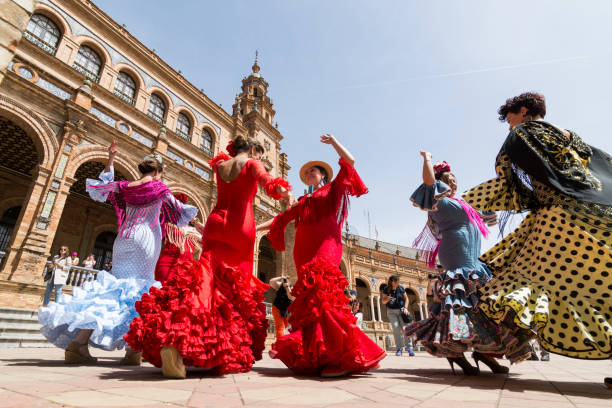
It also helps to separate opera from flamenco. Seville’s Teatro Flamenco Triana, Museo del Baile Flamenco and Casa de la Memoria present forms of live performance connected to Andalusian dance and music, but they are not documentary extensions of the Royal Tobacco Factory, and flamenco is not the hidden source code of Bizet’s score. Pairing the subjects can be culturally rewarding when the differences are explained. Treating any flamenco performance as proof of Carmen’s historical world simply replaces one stereotype with another.
The broader lesson applies to visual style as well. A flower in the hair, a shawl or a sharply posed hip may identify “Carmen” instantly, yet those signs often tell us more about later stage and screen conventions than about everyday factory dress. Costume is evidence when its production and date are known. Otherwise it is part of the myth’s circulation.
The myth is not useless because it is inaccurate
It would be easy to oppose the real cigarreras to a false Carmen and stop there. That correction is necessary but incomplete. Myths endure because they organize genuine tensions, even when they distort the people through whom those tensions are expressed. Carmen made a working woman central to a major European narrative. She earns, moves through public space, chooses partners, mocks authority and refuses domestic obedience. Those qualities had social force because nineteenth-century audiences understood that wage-earning women unsettled established hierarchies.
The factory’s actual history sharpens this reading. Thousands of women did acquire income, workplace expertise and a conspicuous collective presence. Female supervisors exercised authority over production groups. Workers resisted threats to employment. Their movement through the gate created a recurring urban spectacle. Carmen’s independence did not emerge from nothing.
But the myth changes the terms. Collective labor becomes individual temperament. Economic independence becomes sexual availability. Workplace conflict becomes a knife fight over an insult. State inspection becomes flirtation with soldiers. A complex workforce becomes “the cigarette girls,” and one woman’s refusal becomes the cause of male ruin. The transformation preserves the visibility of working women while making their labor easier to consume as romance.
This is the central interpretive payoff of the site. Carmen is neither a faithful portrait of the cigarreras nor an arbitrary fantasy pasted onto Seville. She is an adaptation of social visibility. The women’s presence made the figure imaginable; literature and opera selected the parts that could carry exoticism, rebellion and desire; later media repeated the selection until it seemed older and more natural than the labor system itself.
How to read the former factory without turning it into a fictional set
The Real Fábrica de Tabacos is now part of the University of Seville. That change of use is not an inconvenience to be wished away. It is part of the building’s history and a practical limit on interpretation. Academic activity, security needs and temporary restrictions can affect interior access, so no responsible guide should present entry to particular rooms as guaranteed. A serious reading can begin outside and proceed only through areas that are legitimately accessible at the time.
The following sequence keeps evidence and imagination in proportion:
- Read the portal as institutional theatre. Fame, royal inscription and sculptural display announce prestige before any story of Carmen begins.
- Read the moat, sentry boxes and former guard functions as controls. They belong to the protection of product, revenue and order, not merely to operatic atmosphere.
- Read the structural grid. Repeated stone piers, patios and galleries explain how a vast interior could be organized and repeatedly altered.
- Read thresholds as labor spaces. Entry, exit, bells, inspection and the mass movement of workers connected factory discipline to the street.
- Read absence honestly. There is no securely identified “Carmen room,” and a lack of certainty is more informative than an invented location.
- Read the university conversion as another layer. The building’s survival depended partly on adaptability; present use is evidence of that capacity.
This method resembles the way other Seville monuments benefit from being read across successive functions rather than frozen at their most famous moment. The same discipline can be applied to the Giralda’s transformation from minaret to Christian bell tower. In both cases, later fame should not erase earlier systems, and visible fabric should not be forced to illustrate every story attached to it.
What a specialist adds for an opera-focused visitor
The value of specialist interpretation is not privileged access to a secret Carmen chamber. It is control of categories. A well-prepared visit can distinguish original or early fabric from later partitions, explain why particular architectural features served production and security, introduce the 1812 petition and workshop hierarchy, and then identify exactly what Mérimée and the librettists changed.
That sequence produces a different kind of opera preparation. Instead of collecting colorful anecdotes before a performance, the visitor learns to hear the factory scene as an adaptation of industrial life. The bell becomes work discipline as well as musical cue. The chorus becomes a selective image of a female workforce. Don José’s uniform connects him to a guarded institution. Carmen’s exceptional visibility can be measured against the many women whose names, ranks and routines were not carried onto the stage.
It also prevents two common category errors. The first is to treat any evocative university interior as a documented scene. The second is to use contemporary flamenco performance as an all-purpose explanation for a French opera. A specialist can relate opera, labor history and Andalusian performance culture without collapsing them into a single atmospheric “Seville.”
This subject suits travelers who already know the score, are preparing to see the opera, or want to understand why Carmen has shaped the world’s image of Seville so powerfully. It is less about covering a checklist of rooms than about building an evidence chain. The strongest visit may spend as much attention on one petition, one workshop hierarchy and one narrative frame as on an ornate façade.
The women behind Carmen are plural
At the end of this inquiry, Carmen does not disappear. She becomes more interesting because she is no longer asked to impersonate everyone. Beside her stand Josefa Martínez and her sisters, admitted through a family petition; the Cádiz trainers who helped establish women’s production; apprentices learning to prepare leaves; pureras mastering the most exacting cigar work; maestras and amas de rancho responsible for people and material; workers searched at the gate; women protesting mechanization; mothers recorded in group photographs; and Encarnación Lozana writing farewell to the factory from within its community.
Their history changes the building’s emotional register. The great façade is no longer only the backdrop to a seductive entrance. It belongs to a system that recruited, trained, supervised and gradually displaced generations of workers. The galleries are not automatically stages for a fictional fight; they are traces of production and adaptation. The portal is where monumental display met daily inspection. Fame above the door becomes less an answer than a question: whose labor is remembered when one invented woman becomes more famous than the workforce?
For an opera-focused visitor who wants the former factory interpreted through architecture, labor records and adaptation history rather than recycled Carmen anecdotes, explore private tours in Seville and Inquire now.
If you’re interested in any private tours of Seville, please reach out to us.





 So if you are looking for the absolute best in Seville & surroundings with authentic local fully-licensed native guides whose English you can actually understand and with an exclusive and amazingly fun itinerary













