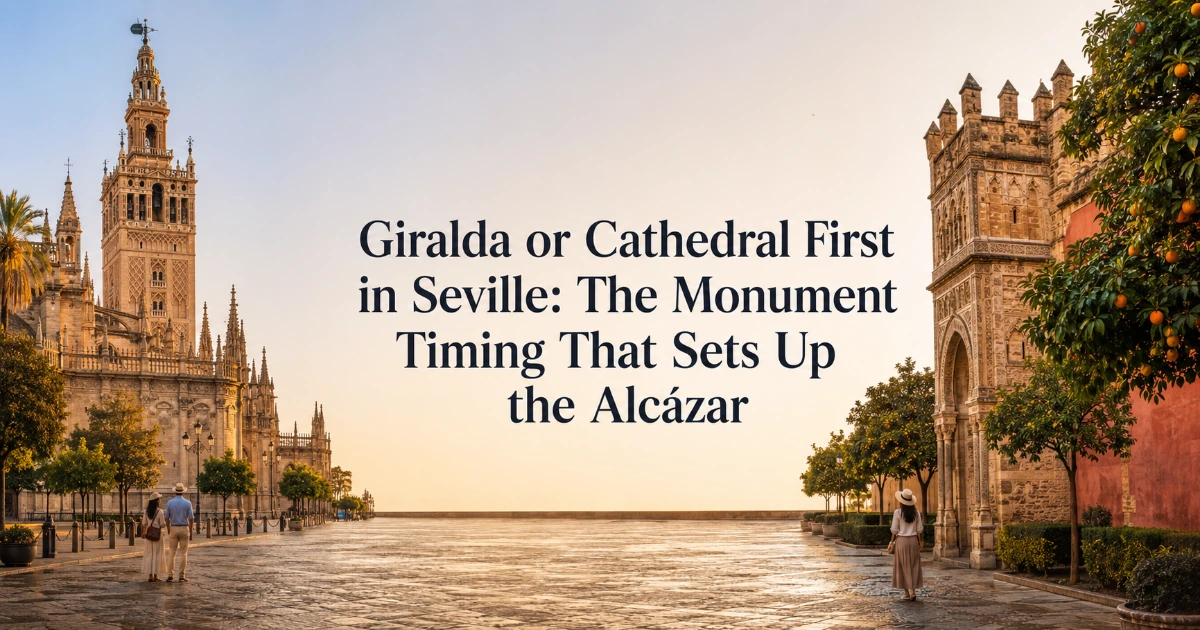
Giralda or Cathedral First in Seville: The Monument Timing That Sets Up the Alcázar
Updated
Climb the Giralda first when the Alcázar is the real anchor of your day: it clears the one strenuous segment before the Cathedral interior, then leaves the Cathedral-to-Alcázar hand-off around Santa Cruz calmer rather than squeezed. In real Seville conditions, the Cathedral, the Giralda, the Patio de los Naranjos, Plaza del Triunfo and the Alcázar sit close together, but they do not feel equally light once queues, ramp-climbing, standing interpretation and garden wandering start to stack. The clearest exception is a sacred-art or history-focused traveler who needs Cathedral context first; in that case, let the Cathedral lead and make the Giralda optional.
In Seville, this is not a prestige question about whether the tower view or the nave is more famous; it is a hand-off problem between stone, legs, story and the Alcázar’s palaces and gardens. The non-obvious hinge is the small zone between Plaza Virgen de los Reyes, Plaza del Triunfo and Patio de Banderas: it looks like a quick stroll on the map, yet it is where a relaxed sequence either stays elegant or starts to feel like a forced march. That is why a private plan should decide the climb, the Cathedral story and the Alcázar entry as one rhythm, not as three separate tickets.
The official Cathedral site (https://www.catedraldesevilla.es/en/) treats the Giralda, the Patio de los Naranjos, the main altarpiece, the choir and other spaces as parts of the Cathedral complex, while the official Alcázar visit page (https://alcazarsevilla.org/prepara-la-visita/) makes the palace its own appointment with its own access logic. The UNESCO World Heritage listing (https://whc.unesco.org/en/list/383/) links the Cathedral, Alcázar and Archivo de Indias as one monumental ensemble in the heart of Seville. The traveler’s challenge is not whether to see them; it is whether the order lets you understand them without spending your best concentration before the Alcázar even begins.
For travelers who already know they want the Cathedral and tower guided together, Giralda and Cathedral private visit is the natural reference point. This guide stays narrower: it answers whether the Giralda or Cathedral should come first, and how that choice sets up the Alcázar rather than competing with it.
Giralda or Cathedral first in Seville: the timing matrix
The best default is Giralda first, Cathedral second, Alcázar third, unless the Cathedral’s art and sacred history matter more to you than the tower climb. The decision should be made through four criteria: physical load, interpretive clarity, Alcázar slot protection and group mood. A beautiful view is not enough reason to spend the morning badly.
Default winner: Giralda first, then Cathedral, then Alcázar.
- Best for travelers who want the tower view but do not want it hanging over the day.
- Best when the Alcázar is later in the morning or early afternoon and you need a clean hand-off from Plaza del Triunfo to Patio de Banderas.
- Best for couples, families with capable walkers and small groups that lose patience when a climb is left as a final obligation.
Runner-up: Cathedral context first, Giralda optional, Alcázar after.
- Best for sacred-art travelers, history-minded visitors and guests who want the mosque-to-Cathedral-to-empire story to unfold before the view.
- Best when the group includes older parents, guests with knee concerns or travelers who dislike compressed transitions.
- Best when the Cathedral is the intellectual anchor and the Alcázar is the atmospheric continuation rather than the main booking pressure.
Wrong fit: forcing both the full Cathedral and the full Giralda climb before a tight Alcázar entry.
- Wrong when the Alcázar entry is early and immovable.
- Wrong when children or mixed-mobility travelers are already near their walking limit.
- Wrong when the plan also tries to add deep Santa Cruz, lunch, shopping and flamenco without a proper pause.
Cut-first rule: cut the climb before you cut the Alcázar’s breathing room.
- If the day is becoming crowded, skipping the Giralda climb creates a better day than rushing the Alcázar palaces and gardens.
- If the Cathedral interior is the reason you came, do not let the tower turn the Cathedral into a corridor on the way to something else.
- If the Alcázar is the day’s emotional center, protect that window even if it means seeing the Giralda from the square instead of from inside.
The counterintuitive correction is that skip-the-line access is not the same thing as a well-ordered monument day. Skip-the-line access does not fix a monument order that burns the best Alcázar window. It can remove one kind of waiting, but it cannot give a tired group fresh legs after the Giralda or restore attention after the Cathedral has been treated as a pre-Alcázar holding room.
Should you climb the Giralda before or after the Cathedral?
Climb the Giralda before the Cathedral if you genuinely want the view and you are physically comfortable with a sustained ramped ascent. The Giralda is not a gentle decorative add-on to the Cathedral; it is the moment when the day asks your body to participate. Doing it first makes the climb deliberate rather than punitive.
The logic is simple. Before the Cathedral interior, the group is usually fresher, more willing to move and less likely to compare the climb with what still needs to be done. After the nave, side chapels, main altarpiece, tomb, choir and sacristy context, the same climb can feel like a second test. For a couple on a private cultural morning, that may be fine. For a family with teenagers, a small celebration group or travelers managing energy carefully, postponing the climb often turns it from highlight into negotiation.
Climbing first also changes how the Cathedral interior lands. You descend from a city view into the scale of the building instead of moving from the building into a view. That order helps many first-time visitors read the Cathedral as part of Seville’s urban fabric rather than as an isolated monument. You have seen the roofline, the old-town density, the relationship to the Alcázar and the edge of Santa Cruz. Then, inside, the chapels and altarpiece feel grounded in a real city rather than floating in guidebook grandeur.
The Giralda-first choice suits travelers who value sequencing more than completion. It is especially sensible when you have a fixed Alcázar entry later and want the physically demanding element done before the Cathedral’s slower, more interpretive section. It also helps small groups avoid a common mood drop: one person wants the view, another wants art context, someone else is watching the time, and the Alcázar begins to feel like a deadline instead of a palace visit.
Do not climb first just because someone told you “the view is essential.” The view is memorable, but it is not essential for every premium Seville day. A guest who dislikes heights, a parent managing knees, a child already overstimulated, or a traveler who has a later flamenco evening may get more from a clear Cathedral narrative and a composed Alcázar visit than from adding the tower at any cost. Premium travel judgment is often the art of leaving out one famous thing so the day keeps its shape.
If the Cathedral itself is your main interest, consider a guided Cathedral-first structure through Seville Cathedral Private Tours and keep the Giralda as an option rather than a duty. That small change in language matters: optional means the guide can read the group, the clock and the Alcázar slot before committing to the ascent.
When Cathedral context should lead
Cathedral context should lead when the story matters more than the climb. Seville Cathedral is not merely the room beneath the Giralda; it is the place where the city’s Islamic, Christian, imperial and artistic layers become legible before the Alcázar extends them into palace space.
This is the better sequence for travelers who came for sacred art, architecture or the long arc from the former mosque site to the Gothic Cathedral and the Spanish imperial city. The Cathedral’s official visitor information notes that schedules can be modified by worship and cultural activity, which is a useful reminder to check the official Cathedral visit page (https://www.catedraldesevilla.es/en/cultural-visit/schedules-and-rates/) close to the date rather than building a fragile plan around assumptions. But the deeper planning point is not operational; it is interpretive. Some visitors need the building’s story first so the Alcázar does not become a decorative garden afterthought.
Cathedral-first works well when you want to understand the Patio de los Naranjos as more than a pretty courtyard, the Giralda as more than a bell tower, and the main altarpiece as more than a large gilded object. It also works when you want the Cathedral’s Columbus and empire associations to connect to the Archivo de Indias across Plaza del Triunfo and then to the Alcázar’s royal rooms. That is a different rhythm from “climb, look, descend, move on.”
This sequence is especially strong for older parents, art lovers and travelers who prefer fewer physical spikes. The Cathedral interior still requires standing, slow walking and visual concentration, but it does not ask for the same upward effort as the Giralda. If the guide begins with the Cathedral’s structure, patronage and city role, the Alcázar can receive a group whose attention has been warmed up rather than drained. For some travelers, that is a better use of the morning than trying to win both the view and every chapel.
Here is the firm editorial call: if you are not excited by the climb, skip it. Skipping the Giralda climb creates a better day when it preserves your attention for the Cathedral’s interior and the Alcázar’s rooms, courtyards and gardens. The mistake is not skipping the tower; the mistake is climbing it reluctantly and then having too little patience for the Alcázar.
For travelers whose Cathedral interest runs toward sacred art rather than monument completion, the day should be designed differently from a tower-to-Alcázar sequence. It should give the Cathedral more interpretive room, keep the Giralda optional and resist the urge to make the Alcázar a compressed finale.
How Alcázar timing changes the answer
The Alcázar changes the answer because it is usually the appointment that punishes poor sequencing most sharply. A Cathedral delay is annoying; a badly protected Alcázar window can flatten the most important part of the day.
The Alcázar is close enough to the Cathedral that travelers underestimate the transition. From the Cathedral side, you can move through Plaza del Triunfo toward Patio de Banderas and the Puerta del León area without a long transfer. Yet proximity is exactly why people overpack the hinge. They add the Giralda because it is attached, a little Santa Cruz because it is right there, a pause at the Archivo de Indias because it is across the square, and suddenly the Alcázar begins with everyone aware of the clock.
If your Alcázar entry sits later in the morning or early afternoon, the Giralda-first sequence usually gives the cleanest build. Climb, descend, enter Cathedral interpretation, then move across the short monumental hinge with enough time to breathe. If the Alcázar entry is early, flip the hierarchy: Alcázar first, Cathedral after, and treat the Giralda as optional later. The Alcázar’s value is not only access to rooms and gardens; it is the feeling of entering without having already spent the day’s patience.
A private guide’s job here is not to stack monuments. It is to decide what the group should understand before the Alcázar, what can wait until after, and what should be cut. The palace works better when the Cathedral context has been selected, not dumped. A brief explanation of the Cathedral-Giralda-Archivo-Alcázar ensemble can be enough before entry; a full Cathedral art route may be better after the Alcázar if the ticket timing demands it.
Premium spend helps when it buys expert sequencing, official-entry discipline, a guide who can compress context without making it shallow, and a plan that avoids unnecessary backtracking. Premium spend does not help when it simply purchases more entries than the body and calendar can absorb. Skip-the-line access does not fix a monument order that burns the best Alcázar window; the order itself has to be right.
If the Alcázar is the day’s center, use Real Alcázar Private Tours as the anchor and build the Cathedral-Giralda decision around that anchor. This is the cleanest way to prevent the morning from turning into a checklist before the palace.
The Cathedral-to-Alcázar hand-off around Santa Cruz
The Cathedral-to-Alcázar hand-off around Santa Cruz should be short, intentional and protected from detours. This is not the moment to “just wander a little” unless wandering is the actual plan.
The hand-off usually lives around Plaza Virgen de los Reyes, the Cathedral flank, Plaza del Triunfo, the Archivo de Indias, Patio de Banderas and the Santa Cruz edge near Calle Mateos Gago. These are not obscure places, but their planning consequence is often missed. They create a deceptively compact zone where travelers feel they can add one more thing without consequence. In practice, that “one more thing” often becomes a standing pause in sun, a wrong turn into narrow lanes, or a group conversation about whether lunch should happen before the Alcázar.
The smarter move is to decide the hand-off before the morning begins. If the Alcázar entry is soon, cross the hinge cleanly and save Santa Cruz atmosphere for after. If there is a real gap, use it deliberately: a short shaded pause, a single interpretive stop at the Archivo exterior, or a controlled Santa Cruz edge rather than a full neighborhood drift. Deep Santa Cruz is rewarding, but it should not steal the mental space that the Alcázar needs.
This is where the nearest planning question differs from this article. If your real decision is what to do after the Cathedral but before the Alcázar, use Archivo, Santa Cruz or Arenal before the Alcázar for that narrower lunch-and-gap problem. Here, the question is earlier and more decisive: whether the climb or the Cathedral context sets up the palace.
The micro-location also matters for hotels and pickups. A hotel near Santa Cruz can be charming, but it is not automatically a friction-free base for this sequence. Narrow streets, pedestrian edges and the difference between being near the Cathedral and being easy to collect are not the same thing. For a comfort-first traveler, the best base is the one that lets the morning start cleanly and the Alcázar entry stay protected, not necessarily the one with the prettiest lane outside the door.
What Seville does to the body in this zone is subtle before it becomes obvious. The old-town walking is not long by distance, but it is slow by texture: stone paving, standing interpretation, short waits, sun-exposed squares, ramped climbing and the repeated stop-start of a group trying to stay together. A ten-minute map segment can feel twice as long when it follows the Giralda and precedes the Alcázar gardens. That is why the sequence should be judged by cumulative load, not by distance alone.
Three sequences that actually hold together
There are three sequences that hold together well; anything more elaborate usually needs a full-day private design rather than a monument-morning squeeze. Choose the sequence by Alcázar timing first, then by climb appetite, then by how much Cathedral context your group will genuinely absorb.
Sequence one: Giralda first, Cathedral second, Alcázar third
This is the strongest default when the Alcázar entry is not too early and the group wants the tower. Start with the Giralda while legs and patience are fresh. Let the view orient the old town: Cathedral mass below, Santa Cruz close by, the Alcázar almost deceptively near, the city opening beyond the monument core. Then descend into the Cathedral interior with the climb behind you and the story ahead of you.
The consequence is a morning that feels progressive rather than repetitive. You move from physical orientation to interior interpretation to palace and garden immersion. The guide can trim Cathedral detail according to the Alcázar slot, but the group does not have the Giralda lingering as an unresolved decision. This is a good fit for first-time couples, culture-minded families and small groups who want both the famous tower and a composed Alcázar entry.
The risk is overconfidence. Because the sites are close, travelers may assume the sequence can absorb a late start, a long photography pause, a coffee stop and a full Cathedral route. It usually cannot without changing the quality of the Alcázar. If you choose this order, treat the first half of the morning as disciplined rather than casual.
Sequence two: Cathedral first, Giralda optional, Alcázar third
This is the best runner-up when the Cathedral’s story is the reason for the morning. Begin inside the Cathedral, connect the former mosque site, the Patio de los Naranjos, the Giralda’s layered identity, the main altarpiece and the city’s imperial role, then decide whether the tower is still worth the physical spend before moving to the Alcázar.
The consequence is a more intellectual build. The Alcázar receives a visitor who understands why the ensemble matters rather than someone who has simply collected a view. This is excellent for art travelers, guests who have read ahead, and visitors who prefer fewer physical peaks. It is also the better plan when one member of the group might climb and another might not; the guide can let the non-climbers use the time without making them feel they have missed the point of the morning.
The risk is that the tower becomes rushed or emotionally irrelevant. If the Cathedral interpretation runs long, do not force the climb. The Giralda is not a failure if omitted; it is a choice. In a private day, the better result is often a group that leaves the Cathedral with clarity and enters the Alcázar with curiosity, not a group that technically did everything and remembers little after noon.
Sequence three: Alcázar first, Cathedral after, Giralda only if energy remains
This is the right sequence when the Alcázar entry is early, scarce or central to the trip. Do not contort the Cathedral and Giralda around an early Alcázar slot. Let the palace lead, then use the Cathedral after as the interpretive counterweight. The Giralda can become a later choice, not a promise made before the day reveals itself.
The consequence is a calmer palace visit. Instead of entering the Alcázar after ramp-climbing and Cathedral density, you meet it with fresh attention. The gardens feel like part of the day’s design rather than a final section to get through. Afterward, the Cathedral can either deepen the history or provide a cooler interior rhythm, depending on the season, service schedule and the group’s energy.
The risk is that the Cathedral can feel secondary if the group has spent too much time in the Alcázar gardens. That is not a problem if the Alcázar is the priority. It is a problem only when the group claims to want both monuments equally but refuses to make choices. Equal priority is rarely a good planning principle in Seville; sequence priority is what keeps the day readable.
For a broader city-day structure around these monuments, expand the question beyond this article only after the core order is settled. A whole-day plan can add Santa Cruz, Triana or an evening layer, but those choices should not be allowed to distort the Giralda-Cathedral-Alcázar order.
What this order does to your body and your evening
The right order reduces the day’s physical spikes before they become mood problems. Seville’s monument core is compact, but compact does not mean effortless.
The body cost comes from accumulation. The Giralda asks for a sustained ascent and descent. The Cathedral asks for standing attention and visual density. The Alcázar asks for walking through rooms, courtyards and gardens after you have already made decisions, followed a guide, watched the time and navigated stone spaces. Add old-town paving, sun-exposed plazas and group stop-starts, and the day can become heavier than the map suggests. This is why the climb belongs early if you are doing it at all.
The mood cost is more delicate. When the order is wrong, the day does not always feel disastrous; it simply becomes flatter. The Alcázar gardens are seen rather than felt. The Cathedral becomes a prelude instead of a building. The group begins talking about lunch, taxis or the next reservation while standing in places that deserve attention. A better sequence makes the day feel shorter, not because it contains less, but because each segment has a reason to happen when it does.
Evening plans make this especially important. A traveler heading to the Museo del Baile Flamenco (https://museodelbaileflamenco.com/index.php/el-museo/) or Casa de la Memoria (https://www.sevillaflamenco.org/en/casa-de-la-memoria/) does not need a monument morning that spends every ounce of attention before dinner. The same is true for a food-and-wine traveler with a serious lunch or a couple celebrating an anniversary. You are not planning only the morning; you are deciding whether the evening still has space to feel like Seville rather than recovery.
Season and heat can intensify every one of these consequences. The rule does not change, but the tolerance for overpacking drops. In warmer months, read the monument order alongside Seville in high heat and be more willing to skip the climb, shorten the Cathedral route or move a non-essential neighborhood walk out of the monument block.
What to stop forcing when the plan gets crowded
When the plan gets crowded, stop forcing the Giralda climb as proof that you “did” the Cathedral properly. The Cathedral can be complete enough without the tower, and the Alcázar can be diminished by trying to win everything before it.
The first thing to cut is the famous thing that least supports the day’s main anchor. If the Alcázar is the anchor, cut the climb before cutting palace time. If the Cathedral is the anchor, cut the deep Santa Cruz detour before cutting the art and architecture context. If the evening is important, cut the second viewpoint, the extra shop stop or the “quick” neighborhood wander that everyone knows will not be quick.
Do not cut the transition. This is where many self-planned itineraries fail. Travelers protect every attraction but leave no space between them, as if the body moves instantly from one interpretive mode to another. A private guide can make a short transition useful: one exterior explanation, one shaded pause, one clear move toward the Puerta del León area. Without that, the hand-off becomes a time leak.
Do not over-prioritize ticket language either. “Skip-the-line” is useful, but it is not a substitute for pacing judgment. It helps at access points; it does not solve climb fatigue, Cathedral density, group disagreement or the need to enter the Alcázar with attention intact. Paying more earns its cost when it changes the design of the morning. It does not earn its cost when it merely adds pressure to consume more monuments.
The cleanest private version is often modest: one climb if the group wants it, one Cathedral route with selected context, one protected Alcázar entry, one short hand-off around Santa Cruz, and no apology for omitting what would make the day less elegant. That is not a lighter cultural day. It is a better edited one.
How private sequencing changes the day
Private sequencing changes the day by aligning monument context with human pacing instead of simply stacking entries. The guide’s value is not only what they explain; it is what they decline to force.
For a couple, that may mean climbing first, then letting the Cathedral story stay crisp enough to preserve an Alcázar garden mood. For a family, it may mean turning the Giralda into an early challenge and avoiding a later negotiation. For older parents, it may mean Cathedral-first with no tower and a slower, more graceful move through Patio de Banderas. For a celebration group, it may mean treating the Alcázar as the emotional center and using the Cathedral as context rather than competition.
This is also where private planning becomes more honest than a pre-set monument package. A guide can read when the group is leaning into detail and when it is time to move. A guide can connect the Giralda and Cathedral to the Alcázar without making the morning feel like an exam. A guide can decide whether Santa Cruz belongs as a quick edge, a later walk or not at all. The result is not less Seville; it is Seville in the right order.
If you want Orange Donut Tours to shape the Cathedral, Giralda and Alcázar around your actual travelers, pace and evening plans, start with Tailor-Made Seville private touring and Inquire now. The useful question is not how many entries can fit on paper; it is which order lets the monuments stay vivid.
FAQ
Should I climb the Giralda before the Cathedral?
Climb the Giralda before the Cathedral if you want the view and have an Alcázar visit later in the same monument block. Doing the climb first clears the most physical part of the Cathedral complex before the slower interior interpretation and makes the move toward the Alcázar calmer.
When is Cathedral first better than Giralda first?
Cathedral first is better when sacred art, architecture, history or the mosque-to-Cathedral story matters more than the tower view. It is also better for mixed-mobility groups, older parents and travelers who would rather preserve attention for the Alcázar than spend energy on the climb.
How does Alcázar timing change the Giralda or Cathedral decision?
Alcázar timing should control the decision. If the Alcázar entry is later, Giralda first and Cathedral second often work well. If the Alcázar entry is early, let the Alcázar lead and move the Cathedral and Giralda after it, with the climb optional.
Is skip-the-line access enough for the Cathedral, Giralda and Alcázar?
No. Skip-the-line access can reduce waiting at an entry point, but it does not solve a poor monument order, the physical load of the Giralda, or the attention needed for the Alcázar. The sequence still has to protect the best palace window.
Should families climb the Giralda before the Alcázar?
Families should climb the Giralda before the Alcázar only if the children are comfortable with the ascent and the Alcázar entry is not too tight. If the climb will become a negotiation, skip it and preserve energy for the palace and gardens.
When should I skip the Giralda climb?
Skip the Giralda climb when the group has mobility concerns, the Alcázar entry is tight, the Cathedral story is the priority, or the evening plan matters. Skipping the climb can create a more satisfying day than rushing the Cathedral and arriving at the Alcázar tired.
Can I see the Giralda, Cathedral and Alcázar in one half day?
You can see them in one half day only with a focused route, disciplined timing and a willingness to cut detail. For discerning travelers, the better version is usually a curated monument block that protects the Alcázar rather than a half-day attempt to exhaust every corner.
Where does Santa Cruz fit between the Cathedral and Alcázar?
Santa Cruz fits as a short edge or later walk unless there is a real gap before the Alcázar. Do not let a casual Santa Cruz detour steal the transition from Plaza del Triunfo and Patio de Banderas into the Alcázar entry.
If you’re interested in any private tours of Seville, please reach out to us.





 So if you are looking for the absolute best in Seville & surroundings with authentic local fully-licensed native guides whose English you can actually understand and with an exclusive and amazingly fun itinerary













