Best Seville Alcázar Tours for Skipping the Line and Understanding the Palace
Updated
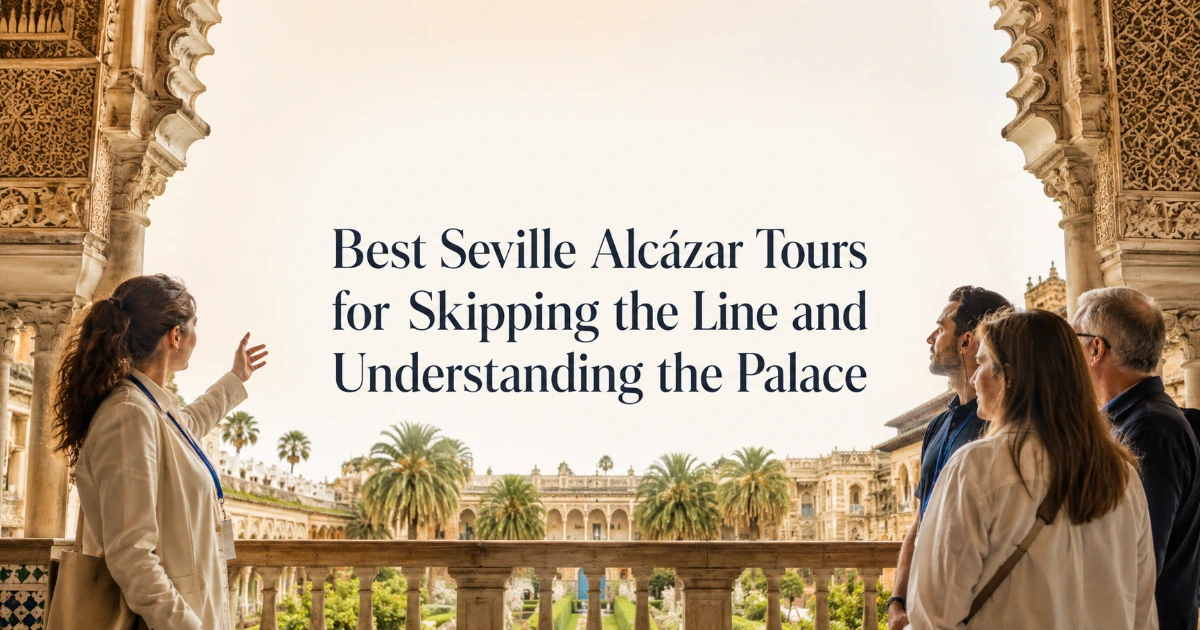
The best Seville Alcázar tour is a guided, skip-the-line private route that treats the palace as a story to be sequenced, not a sight to be squeezed between photo stops. That verdict works because Seville’s monumental core is compact but physically punishing when entrance admin, heat, narrow Santa Cruz lanes, and the Santa Justa-to-old-town reset all land in the same half day. The exception is simple: if you want a light garden wander, already know the history, and do not mind managing the ticket window yourself, a self-guided timed entry can be enough. For most discerning first visits, the smarter base is a guided Alcázar visit such as Royal Alcázar Skip-the-line Private Tour, then a carefully chosen add-on rather than a packed monuments marathon.
The thesis of this guide is specific to Seville: the Alcázar rewards travelers who buy back attention, not just minutes, because the palace sits at the hinge between the Cathedral, Archivo de Indias, Santa Cruz, and the late-day pull toward Triana. A stronger tour does not merely get you inside faster. It decides when to enter, which rooms deserve explanation, where the gardens belong, and what should be left out so the rest of the day still feels elegant.
The useful verdict: buy guidance before you buy more monuments
The best Alcázar tour for most private travelers is a skip-the-line guided visit focused on the palace first, with Cathedral or Santa Cruz context added only if the day has enough space. This is the part many visitors misread. The overvalued default is the giant “see everything” bundle that promises Alcázar, Cathedral, Giralda, Santa Cruz, Plaza de España, Triana, tapas, and flamenco in one continuous push. It looks efficient on paper. In Seville, it often turns a palace day into an endurance test.
Best base choice: A private skip-the-line Alcázar tour that gives priority to entrance handling, room-to-room context, and a calm garden finish. Choose this when the palace is the main reason you are booking.
Best upgrade: Alcázar plus Cathedral when you want the full UNESCO monumental core, but only if the route is built around shade, lunch timing, and a clean stopping point.
Best context add-on: Alcázar plus a short Santa Cruz walk, especially for first-time visitors who need the palace to connect to the old Jewish quarter without adding another ticketed interior.
Best slower option: An Alcázar-focused private deep dive for history lovers, older parents, or travelers who prefer fewer sites with richer interpretation.
Best self-guided exception: Timed entry without a guide if your goal is chiefly gardens, photography, or a short palace pass-through rather than understanding the layered royal, Islamic, Mudéjar, and Christian context.
The editorial no is simple: do not force the Alcázar, Cathedral, Santa Cruz, Plaza de España, Triana, and a flamenco night into one unbroken day just because the map makes them appear close. The distance is not the only issue. The drag comes from standing, waiting, repeating security and ticket checks, navigating lanes that do not allow fast group movement, then trying to enjoy an evening when everyone has already spent their attention.
A private format earns its cost when it turns a dense area into a cleaner sequence. If your hotel is around El Arenal or Santa Cruz, the guide can keep the morning nearly car-free and avoid needless transfer resets. If you are coming from Santa Justa, the decision changes: the station-to-old-town transition is not long in absolute terms, but it does create a mental reset, luggage question, and arrival-day energy cost. That is why the Santa Justa-to-old-town reset matters early in the planning. A palace tour placed after that reset should be shorter, cleaner, and less ambitious than a fresh first-full-day morning.
What “skip the line” really fixes at the Real Alcázar
Skip-the-line value at the Alcázar is mainly about reducing entrance uncertainty and preserving attention for the palace, not about making every queue or checkpoint disappear. This distinction matters because travelers sometimes expect a private tour to turn a public monument into a frictionless private building. It cannot. What it can do is handle the booking logic, set the meeting point clearly, move the group into the correct admission flow, and prevent the first emotional note of the day from being ticket stress.
The entrance zone around the Puerta del León and Patio de Banderas can feel deceptively simple. The Cathedral is nearby, Avenida de la Constitución is within easy reach, and Santa Cruz begins just behind the palace edge. Yet this compactness is precisely why poorly built plans unravel. Everyone assumes they can adjust on the fly. Then one person needs shade, another wants coffee, a child is bored by the line, an older parent has already stood too long, and the guide has to compress the rooms that deserved the most explanation.
A guided skip-the-line Alcázar tour fixes three things better than a bare ticket. First, it prevents the morning from becoming a series of small administrative decisions. Second, it gives the palace a route, so you are not wandering from courtyard to hall with only decorative impressions. Third, it helps decide when to leave. That last point is underrated. Many visitors stay too long in the gardens simply because the space is beautiful and open-ended, then emerge with too little appetite for the Cathedral, Santa Cruz, or lunch.
Where skip-the-line language can mislead is access psychology. You may still encounter controlled flows, identity checks, group pacing, or moments when the palace itself slows movement. That does not make the tour less valuable. It means the value is not a magic door. The value is a day that does not begin with confusion and does not lose its best mental energy before the first major room.
Best Seville Alcázar tour formats for different travel days
The right Alcázar tour format depends on what you want the rest of the day to feel like after the palace. The palace can be the main event, the anchor of a monuments morning, a family-friendly cultural core, or a quieter specialist visit. Choosing the format by traveler consequence is more useful than choosing by headline length.
Private skip-the-line Alcázar tour: the strongest base for first-time visitors
A private skip-the-line Alcázar tour is the cleanest choice when you want access help and real interpretation without turning the day into a checklist. It suits couples, families, celebration travelers, and comfort-first visitors because it lets the guide calibrate detail while the group is moving. A good guide knows when to pause for tilework, when to explain court life, when to let the architecture breathe, and when to keep the gardens from becoming a slow drift.
This format is especially strong if the Alcázar is your first major Seville monument. The guide can frame the city before the rooms become a blur: Islamic rule, Christian monarchy, Mudéjar craftsmanship, royal ceremony, garden design, and the strange continuity that makes the palace feel less like a single-era museum and more like a living political stage. The practical consequence is that the Cathedral later makes more sense, Santa Cruz feels less like a decorative maze, and the evening does not have to carry the burden of everything you failed to understand in the morning.
For travelers comparing options, Real Alcázar Private Tours is the natural next step when the palace itself deserves the center of gravity. Choose this over a larger city overview when your real question is not “What are the top sights?” but “How do we understand this palace without wasting our best hours?”
Alcázar plus Cathedral: powerful, but only with a hard stop
Alcázar plus Cathedral is the best add-on only when the day has a hard stop for lunch, hotel recovery, or a lighter afternoon. The two monuments belong together historically and spatially, but they do not have the same physical rhythm. The Alcázar asks you to move through intimate rooms, shaded patios, and gardens. The Cathedral asks you to absorb scale, ceremony, chapels, and often a different kind of standing fatigue. If both are treated as “must-see interiors” with equal weight, the second one often suffers.
The better approach is to decide which site carries the deeper explanation and which receives tighter framing. If the Alcázar is the priority, let the Cathedral become a shorter, focused companion: exterior context, main interior logic, and the Giralda only if your group genuinely wants the climb and has the energy. If the Cathedral is the priority, keep the Alcázar route cleaner and resist the temptation to examine every garden corner.
This pairing is where a private guide can change the day materially. The guide can adjust tone when a family is fading, shorten a chapel-heavy explanation for travelers who care more about architecture, or make the Cathedral feel like a continuation of royal and religious power rather than a second lecture. For a broader monuments route that avoids midday overload, use how to plan a private Seville day without midday burnout as the companion planning frame.
Alcázar plus Santa Cruz: best when you want context without another major interior
Alcázar plus Santa Cruz is the better choice when you want Seville to feel coherent but do not want another long ticketed site. This format works because it turns the area immediately around the palace into historical context: narrow lanes, former Jewish quarter associations, shaded pauses, and the shift from royal compound to neighborhood texture. It is not the most dramatic add-on, but it is often the one that keeps the day human.
The consequence is pacing. After the palace, a short Santa Cruz walk lets the group decompress while still learning. It gives children a change of scene. It gives older travelers intermittent shade and more chances to pause. It gives couples and celebration travelers a better emotional transition into lunch than another formal interior. The risk is turning Santa Cruz into filler. A good guide should not over-narrate every lane. The point is to connect the palace to the city, not to convert the entire neighborhood into a second museum.
Alcázar deep dive: best for travelers who would rather understand one thing well
An Alcázar deep dive is the best format for travelers who dislike shallow overviews and are willing to cut elsewhere. It suits Islamic art enthusiasts, architecture lovers, heritage travelers, and families with older teens who can handle a more interpretive route. The palace rewards this attention because its meaning is not obvious from beauty alone. Without guidance, many visitors remember surfaces: arches, tiles, courtyards, gardens. With guidance, those surfaces become evidence of power, adaptation, and courtly taste.
The tradeoff is real. A deep dive can make a same-day Cathedral visit feel heavier than expected, especially in warm months or after a long arrival. If you choose this format, keep the rest of the day lighter. Add lunch, a shaded Santa Cruz pause, or a return to the hotel. Do not add another palace just because Casa de Pilatos, Dueñas, or Lebrija appear tempting. Those belong to a different day if you want them to matter.
Self-guided timed entry: useful, but only for a narrower kind of visit
Self-guided timed entry is useful when your expectations are modest and your group does not need the palace explained in real time. It can work for repeat visitors, photographers who primarily want visual time, or travelers with a short gap between other plans. It is not the best format for a first visit that hopes to understand why the Alcázar matters.
The hidden cost of self-guiding is not only information. It is route confidence. You may spend more time deciding what deserves attention than actually absorbing it. You may linger in the wrong places because they photograph well and rush past rooms that needed context. You may also finish at an awkward moment, too late for a relaxed lunch but too early to call the afternoon complete. A private guide reduces those micro-decisions.
The route through the palace should make the history legible
A strong Alcázar tour should move through the palace in an order that makes its layered history understandable rather than merely attractive. The point is not to recite every dynasty, patron, or decorative term. The point is to help the traveler see why the palace looks the way it does, why Christian royal power retained and reworked Andalusi visual language, and why Seville’s royal complex feels so different from a single-period palace.
That route usually needs a controlled beginning. The guide should orient you before the decorative abundance takes over. If the first ten minutes are only logistics and admiration, the palace can become visually saturated too quickly. You want the early frame to answer a few essential questions: what kind of royal site this is, why the palace changed over time, how the Mudéjar language functions, and why the gardens are not merely an afterthought.
Inside, the best guide uses selective emphasis. Not every ceiling needs the same explanation. Not every tile panel needs to become an art-history stop. A discerning route should choose the rooms where meaning and visual payoff align, then keep the group moving before detail turns into fatigue. The palace is dense enough that restraint becomes a form of expertise.
The gardens require the same discipline. They are seductive because they feel open after the interior rooms, but open space can quietly consume time. A good Alcázar tour uses the gardens as a release and a final layer of context, not as an aimless extension. For families, this is where the mood can recover. For couples, it is where the visit can slow down. For older travelers, it is where shade and seating decisions matter. For history-focused travelers, it is where the guide can explain continuity without trapping everyone in another long speech.
The city-specific point is that the palace exit does not deliver you into neutral space. You are still in the dense old-town core, with the Cathedral, Archivo de Indias, Santa Cruz, and lunch decisions pressing close. A tour that ends without a next-step plan leaves you to solve the day at the moment when your group is least objective.
Timing the Alcázar: morning usually wins, but not at any cost
The Alcázar is usually best in the morning because Seville’s heat, walking rhythm, and lunch timing punish vague mid-day plans. This does not mean the earliest possible slot is always the best. The counterintuitive correction is that “first entry” can be overvalued if it forces a rushed hotel breakfast, a stressful transfer, or a tired family into a palace that needs attention. A well-paced morning beats a theoretically perfect slot that your group reaches already irritated.
For a first full day in Seville, the cleanest sequence is breakfast, short transfer or walk, Alcázar entrance, guided palace route, gardens, then either Cathedral context or Santa Cruz before lunch. This works because everyone begins with enough cognitive energy to understand the palace. It also keeps the afternoon available for rest, river air, shopping, or a lighter neighborhood plan.
For an arrival day, be more conservative. The Santa Justa-to-old-town reset is manageable, but it still asks travelers to leave the station, handle luggage or hotel check-in, adjust to the old-town walking pace, and reassemble as a group. If you put a dense Alcázar tour immediately after that, the palace may technically fit and emotionally fail. A short orientation, lunch, or shaded neighborhood walk often makes a better arrival-day bridge, with the Alcázar saved for the next morning.
Seville changes how the body feels during a monument day. The strain is cumulative: standing at entrances, walking over old-town surfaces, pausing in sun pockets near broad approaches, slowing down in Santa Cruz lanes, and sometimes crossing toward Triana later when the group is already warm and thirsty. The city is mostly walkable in this core, but walkable does not mean effortless. A poor sequence can make a half day feel like a full day before lunch.
Seville also changes the mood of the trip. When the Alcázar morning is clean, the city feels generous: palace, shade, lunch, rest, and an evening that still has appetite. When the morning is overpacked, the day flattens. The Cathedral becomes another obligation, Santa Cruz becomes a corridor, and flamenco becomes something to endure politely rather than anticipate. Preserving the evening is not a soft luxury concern here; it is the difference between a trip that feels curated and one that feels conquered.
Where premium spend changes the day, and where it does not
Premium spend changes an Alcázar day when it improves guide quality, entrance handling, route design, private pacing, or the transitions before and after the palace. It does not automatically improve the day just because the confirmation email looks more exclusive. Premium spend does not help if it is spent only on a car waiting while you complete a self-guided palace visit; it earns its cost when it changes pickup logic, group comfort, interpretation, timing, or the way the rest of the day is protected.
For many private travelers, the most valuable upgrade is not a more ornate itinerary. It is a guide who can read the group. A couple celebrating an anniversary may want fewer stops and more space to absorb the palace. A family may need shorter explanations and a garden pause that feels intentional rather than apologetic. A small group of friends may want enough history to understand the site but not so much that lunch loses momentum. Older parents may need slower movement, more shade, and no unnecessary backtracking through Santa Cruz.
A chauffeur can be useful around the edges, especially for hotel pickups outside the old center, high-heat days, older travelers, or a later transfer to Plaza de España, the river, or Triana. But a car does not solve the interior palace experience. The Alcázar is still a walking visit, and the most important comfort decisions happen inside the route, not in the vehicle. If your spend is limited, prioritize private guiding and pacing first, then consider chauffeured support only where the day’s geography justifies it.
This is why a tailor-made Seville plan often works better than a pre-stacked monuments package. The planner can decide whether the palace should stand alone, pair with the Cathedral, soften into Santa Cruz, or hand off into a food-and-wine evening. For broader design support, Private Tours in Seville is the more flexible starting point than simply adding another attraction to the Alcázar booking.
What to pair with the Alcázar, and what to cut first
The best pairing after the Alcázar is the one that preserves energy for the part of the day you care about most. If your priority is history, pair it with Cathedral context. If your priority is atmosphere, pair it with Santa Cruz and lunch. If your priority is a celebration evening, keep the afternoon light. If your priority is family harmony, stop before the adults feel intellectually satisfied but the children are already done.
The Cathedral is the most obvious pairing because it sits so close and completes the monumental core. It is also the pairing most likely to be mishandled. The right version is focused, not exhaustive. The wrong version tries to make both monuments equally deep, then adds the Giralda as a final proof of ambition. If the group has already walked and stood for hours, the tower question should be decided honestly. A climb that sounds memorable at breakfast may feel unnecessary after the palace.
Santa Cruz is a better pairing when the palace needs breathing room. The neighborhood can make the historical setting feel lived-in, especially when the guide uses it to explain transitions rather than to add a catalogue of minor stops. This is also the better option when lunch is part of the experience. A palace route that ends with an elegant lunch decision often feels more premium than a longer route that ends with everyone negotiating hunger.
Triana belongs later, not as a reflexive immediate add-on. Crossing toward the river and Triana can be excellent for ceramics, neighborhood context, or flamenco, but it changes the physical rhythm of the day. If the Alcázar morning already included Cathedral and Santa Cruz, pushing straight to Triana risks turning a lively district into a fatigue stage. The smarter move is to rest, then return to Triana with purpose.
This is where direct venue planning helps. If your evening points toward Teatro Flamenco Triana (https://www.teatroflamencotriana.com/en/home/), confirm show information on the venue’s own site and work backward from dinner and transfer timing. If you are comparing central alternatives such as Museo del Baile Flamenco or Casa de la Memoria, do not treat them as interchangeable afterthoughts; their locations change the dinner route and the ease of return. For a deeper pre-show rhythm, use Triana flamenco timing rather than bolting flamenco onto a maximal monument day.
Food-and-wine travelers should be especially careful with the post-Alcázar arc. A serious dinner deserves a lighter afternoon. If you are checking fine-dining menus or reservation pages such as abantalrestaurante.es/menu (https://abantalrestaurante.es/menu/) or ispal.es (https://ispal.es/reservas/), let that evening shape the day upstream. The mistake is assuming a premium dinner can rescue an overfilled morning. It cannot. It can only reward a day that still has appetite, attention, and enough ease to arrive composed.
How to choose the guide, not just the ticket
The right Alcázar guide is the one who can make the palace coherent while adjusting the pace to your group. Credentials and entrance handling matter, but they are not enough. Ask how the route is built, how long the palace remains the focus, what happens if the group wants more garden time, and whether the guide will shape the visit differently for families, older parents, art lovers, or a celebration trip.
A strong guide should be able to explain the palace without burying you in chronology. The best interpretation usually connects visual details to traveler-level meaning: why this room matters, why this decorative language survives, why the site feels layered, and how the palace relates to Seville beyond the walls. Beware of tours that sell “skip-the-line” as the whole value. Access is useful. Understanding is the upgrade.
Meeting point clarity also matters. A vague old-town meeting can cost more energy than it should, especially when travelers are coming from hotels near El Arenal, Santa Cruz, Triana, or farther out. In Seville, the difference between a clean meet and a confused one is not simply time; it is the emotional tone of the morning. The guide should know where your group is coming from and whether the approach itself creates unnecessary walking.
For private groups, the guide should also be willing to make cuts. That sounds negative, but it is often the difference between a good day and a bloated one. If the group is fading, the guide should know what can be shortened without damaging the experience. If the group is engaged, the guide should know where to deepen the explanation. A fixed script is rarely the best version of a private Alcázar visit.
Orange Donut Tours is best used when you want the Alcázar decision placed inside the real day: arrivals, transfers, lunch, family pace, dinner ambitions, flamenco timing, or a later Andalusia route. Once you know whether the palace should stand alone, pair with the Cathedral, or hand off into a softer afternoon, the planning becomes much cleaner. To have that sequence shaped around your group, Inquire now.
A sequence walkthrough for the most common Alcázar days
The cleanest Alcázar day is built backward from the point where your group usually loses energy. That point differs by traveler type, but Seville makes the pattern predictable: entrance friction, palace density, garden drift, lunch timing, then the temptation to add “just one more” nearby stop.
First full day in Seville
Begin with the Alcázar in the morning, then choose either Cathedral focus or Santa Cruz context before lunch. This is the strongest first-day structure because the palace receives the best attention and the city reveals itself from the center outward. If you choose Cathedral, do not also demand a long Santa Cruz walk before lunch. If you choose Santa Cruz, do not treat it as a failed Cathedral visit. It is the calmer choice, and often the better one for families or travelers who want their first day to feel composed.
After lunch, stop. That does not mean the day is over. It means the heavy interpretive work is over. A rest, a shaded hotel pause, or a river-oriented late afternoon will make the evening feel earned. This is especially important in warm months, but it also applies in cooler weather because attention has limits even when temperature does not.
Arrival day after train or flight
Do not make the Alcázar your default arrival-day monument unless the group is fresh, luggage is solved, and the tour is deliberately short. The Santa Justa-to-old-town reset matters because it breaks the day into pieces: station exit, transfer, hotel logistics, old-town adjustment, and only then cultural attention. If the palace is important, saving it for the next morning is usually a better use of the site.
If you must tour on arrival, keep the route focused. Avoid Cathedral plus Alcázar plus Santa Cruz. Choose a lighter palace visit or an old-town orientation, then let the evening carry the sense of arrival. For a more complete arrival-day frame, keeping the Alcázar day light before Granada is useful even if you are not continuing to Granada, because the logic is the same: do not spend Seville’s palace energy before the next major monument asks for its own attention.
Family or multigenerational day
For families and multigenerational groups, the best Alcázar tour is shorter, more responsive, and less obsessed with completing every historical layer. Children often respond well to courtyards, gardens, royal-life stories, and visual clues. Older parents often value the same route for different reasons: shade, manageable movement, and fewer abrupt changes. The shared solution is a private guide who can keep the visit meaningful without stretching it to adult maximum tolerance.
Cut the Cathedral climb first if the group is already warm or tired. Cut a second major interior before you cut lunch. Cut a long Santa Cruz wander before you cut the palace’s most important explanations. The hierarchy should protect the experience, not the itinerary’s appearance.
Celebration or food-and-wine day
For a celebration trip, the Alcázar should anchor the morning and then release the day into something softer. A beautiful palace visit followed by a measured lunch, rest, and a deliberate evening will feel more special than a longer route that turns the celebration into logistics. If flamenco, a tasting menu, or a private river moment is the emotional highlight, the Alcázar should not consume the entire day.
This is where private planning is most valuable. The guide and planner can decide whether to finish near Santa Cruz, move toward El Arenal, return to the hotel, or later cross to Triana. The result is not merely efficient. It feels shorter, calmer, and more intentional because the day has fewer unresolved decisions.
The final choice: what to book, what to skip, and what to confirm
Book a private skip-the-line Alcázar tour when this is your first visit, when the palace matters historically, when your group values smoother logistics, or when you want the rest of the day to retain its shape. Add the Cathedral only if you are prepared to keep the route focused and protect lunch. Add Santa Cruz when you want context and atmosphere without another heavy interior. Keep Triana, flamenco, or a serious dinner as a later chapter, not a forced immediate continuation.
Skip the oversized monuments bundle if the only reason you are considering it is fear of missing out. Skip premium car spend if it does not change a real transfer, mobility, heat, or pickup problem. Skip a self-guided visit if you know you will leave the palace saying it was beautiful but confusing. Confirm the exact admission details, meeting point, identification requirements, and any current venue or restaurant times when booking, because those operational details can change while the planning logic remains stable.
FAQ
Is a guided Alcázar tour in Seville worth it?
Yes, a guided Alcázar tour is worth it when you want to understand the palace rather than simply see its rooms and gardens. The guide adds the most value by handling entrance logic, choosing a coherent route, explaining the palace’s layered history, and keeping the visit from expanding until the rest of the day suffers.
What is the best Seville Alcázar tour for skipping the line?
The best skip-the-line Alcázar tour is a private guided visit that includes timed admission handling and a palace-first route. Choose a format that prioritizes the Alcázar itself before adding Cathedral, Santa Cruz, or other stops.
Can I visit the Alcázar without a guide?
Yes, you can visit without a guide if you are comfortable managing timed entry and your goal is a lighter visual visit. For a first visit, a guide is usually better because the palace’s meaning is layered and not always obvious from room labels or surface beauty alone.
Should I combine the Alcázar and Cathedral in one tour?
Combine the Alcázar and Cathedral if you want the full monumental core and can keep the rest of the day lighter. Do not combine them with too many additional stops unless your group has unusually high stamina and no demanding evening plan.
Is morning or afternoon better for the Alcázar?
Morning is usually better because the group has more attention, the day is easier to sequence, and lunch can become a natural recovery point. Afternoon can work if the morning is light and the route is designed around shade, but it is less forgiving on warm or overpacked days.
How long should a private Alcázar tour take?
A focused private Alcázar visit should be long enough to cover the main palace narrative and gardens without turning the site into a slow visual drift. The right duration depends on whether you add the Cathedral, Santa Cruz, or a deeper art-history focus, so confirm the planned route when booking.
Is the Alcázar a good tour for families?
Yes, the Alcázar can be excellent for families when the guide keeps explanations visual, selective, and paced with the gardens in mind. Families should avoid overloading the same day with multiple major interiors, especially in warm weather.
What should I do after an Alcázar tour?
After an Alcázar tour, choose one next move: Cathedral context, a short Santa Cruz walk, lunch, or a rest before an evening plan. The best choice is the one that preserves energy for the part of the day you care about most.
If you’re interested in any private tours of Seville, please reach out to us.





 So if you are looking for the absolute best in Seville & surroundings with authentic local fully-licensed native guides whose English you can actually understand and with an exclusive and amazingly fun itinerary













