What Defines a Calvados? A Paris-Based Orchard and Distillery Study in the Pays d'Auge

Updated
A serious Calvados visit does not begin with the question, “Which estate offers the best tasting?” It begins with a more exacting one: “Which producer can show how a particular orchard logic survives pressing, cider fermentation, distillation, maturation and blending?” From Paris, that distinction matters. The Pays d’Auge is close enough to tempt travelers into treating it as an easy rural add-on, yet dispersed enough that a poorly specified booking can consume a full day and still reveal little more than polished cellars and several pours.
For a spirits collector, Calvados is best understood as a chain of transformations. Fruit categories shape the cider. Fermentation creates the liquid that enters the still. The still and the distiller’s cuts determine which volatile compounds continue. Oak, cellar conditions, transfer history and blending then alter the spirit over years. An estate visit is useful when it makes several links in that chain legible. A handsome property, an old cask and a generous tasting are not substitutes for production evidence.
The Pays d’Auge should not be folded casually into a broad Normandy sightseeing day. A collector needs one technically suitable producer, a confirmed access plan and enough road margin to protect the appointment. Travelers deciding how much Normandy fits around Paris should first decide whether Normandy belongs in a Paris day or an overnight. For Calvados, the decisive issue is whether a second estate adds evidence or merely another tasting.
A Calvados is a regulated origin, but a visit must reveal a production argument
The name Calvados is not a loose synonym for apple brandy. It identifies a Normandy cider spirit governed by appellation rules, and the words “Pays d’Auge” narrow that identity further. According to the official INAO specification for Calvados Pays d’Auge, the production area covers 290 communes; the fruit basis contains at least 70 percent apples; distillation must be carried out twice in pot stills; and the spirit must mature in oak for at least two years.
Those rules provide a valuable framework because they connect geography, raw material, distillation method and minimum maturation. They do not, however, explain a house style. Two compliant producers can select different varieties, buy or grow fruit in different proportions, ferment on different schedules, make different distillation cuts and manage casks in very different ways. The appellation is therefore the beginning of the collector’s inquiry, not its conclusion.
The distinction between Calvados Pays d’Auge and a bottle labeled simply Calvados is important. Pays d’Auge imposes a tighter geographic and technical specification, including mandatory double pot-still distillation. Calvados Domfrontais signals another production logic associated more strongly with pears. These names are not decorative subregions; each points toward a different relationship among orchard, cider and still.
A producer visit should consequently answer two layers of provenance. The first is legal: which appellation governs the bottle, which fruit and methods are permitted, and where did production occur? The second is individual: which orchards or suppliers contributed fruit, how was the cider handled, what choices were made at the still, and how was the spirit matured? The first layer can often be read from a specification. The second requires a producer able and willing to explain records, equipment and practice.
Begin in the orchard, where style exists before there is alcohol
Fruit categories are production tools, not tasting-note poetry
Normandy cider apples are often discussed through broad functional families: bittersharp, bittersweet, sweet and sharp. These categories indicate balances of tannin, acidity and fermentable sugar rather than a simple scale from pleasant to unpleasant. A blend can use sweetness for potential alcohol, acidity for freshness and microbial stability, and tannin for structure. The important point is not that one category is superior. It is that a distillation cider is designed, whether through long inherited practice, annual adjustment or both.
Christian Drouin offers a useful documented example. The House of Drouin’s own production account describes two family high-stem orchards between Gonneville-sur-Honfleur and Coudray-Rabut, with about 30 cultivars divided among bittersharp, bittersweet, sweet and sharp fruit. It also states that fully ripe apples are collected from the ground from September onward. That is not merely picturesque background. It gives a collector concrete lines of inquiry: how the cultivar mix changes by harvest passage, whether orchard lots remain separate, how purchased fruit is specified, and whether annual weather shifts the balance of the cider blend.
A useful orchard discussion should name varieties or at least categories and proportions. “We use many local apples” is evocative but thin. “This lot draws its tannin from these bitter varieties, acidity from these sharp varieties and sugar from these sweeter fruit” begins to connect orchard selection to fermentation and distillation. The most valuable host can also explain what happens when one component underperforms, ripens unevenly or arrives in different condition from the previous year.
High-stem, low-stem and owned fruit are different questions
The phrase “traditional orchard” can conceal several issues. High-stem orchards, with taller trees and wider spacing, carry cultural and landscape significance in the Pays d’Auge, but the form alone does not prove that all fruit in a bottle came from that parcel. A producer may own orchards, contract with growers, buy fruit, buy cider or combine sources within the rules that apply. None of those arrangements is automatically disqualifying. What matters to a provenance study is whether the sourcing model is explained accurately.
Ask what percentage of fruit comes from estate orchards in a typical year, what is purchased, how growers are selected and whether any lots can be traced separately. Also ask what “from our orchards” means in the context of a multi-age blend. It may refer to a meaningful core of production without implying that every cask or bottling is estate-fruit only. Collectors accustomed to vineyard language can otherwise import assumptions that do not fit Normandy’s orchard economy.
Geography should be read at several scales. “Pays d’Auge” identifies the appellation area, while slope, exposure, drainage and tree age can affect orchard behavior. A named orchard, map, harvest record or discussion of parcel performance carries more evidentiary weight than an attractive view across pasture.
Ground collection changes what “harvest” looks like
Visitors often imagine an apple harvest as people picking perfect fruit from branches. For cider apples, full ripeness and collection from the ground can be central to practice. This makes the harvest visually less theatrical and operationally more episodic. Fruit falls according to variety and weather; collection may occur in passages; pressing schedules follow incoming volumes and condition. An appointment during “harvest season” therefore does not guarantee that fruit will be arriving, sorted or pressed at the hour of the visit.
A producer who can explain the interval between fall, collection, storage and pressing offers more than a seasonal photo opportunity. Ask how damaged fruit is rejected, whether varieties are pressed separately, how long fruit may wait, and what measurements determine readiness. Those details reveal whether orchard selection remains meaningful after the apples leave the field.
What “Pays d’Auge” proves—and what it leaves open
The Pays d’Auge specification creates a strong technical baseline: a delimited area, an apple-led fruit composition, double distillation in pot stills and at least two years in oak. For a collector, each legal requirement should lead to a second question.
- At least 70 percent apples: What role do pears play in the producer’s actual cider blend, if any, and does that proportion change by year or cuvée?
- Double pot-still distillation: How are the first run, second run and cuts managed, and what is the house trying to retain or remove?
- At least two years in oak: What happens after the minimum—new or used casks, transfers, different cellar zones, blending and reduction?
- Production within the appellation: Which orchards, press sites, fermentation vessels, stills and cellars are part of the chain for the bottles being tasted?
The label cannot by itself establish orchard ownership, single-variety production, vintage identity, cask history or the age of every component in a blend. Nor does “double distilled” mean that all Pays d’Auge Calvados will share the same texture or aromatic profile. Pot-still shape, charge, heating rhythm, recycling decisions and the width of the heart cut leave room for substantial house variation within the rule.
This distinction protects the visitor from two opposite mistakes. One is dismissing appellation as mere bureaucracy. The other is treating compliance as a complete explanation of quality. The regulation defines the field of play. Producer practice determines how the game is played.
Fermentation is the hidden middle of the orchard-to-glass story
Many visits move too quickly from apples to copper. Yet distillation does not act on apple juice; it acts on cider. Fermentation is the stage in which orchard material becomes an alcoholic, microbially complex liquid with its own acidity, aroma precursors and defects to manage. A technically serious producer should be able to discuss the cider intended for distillation as a product in its own right, even when it is not sold as table cider.
A published study of Normandy cider-for-distillation fermentation sampled six tanks from four producers at the beginning of fermentation, the end of alcoholic fermentation and the end of maturation. The microbial communities differed significantly by stage. The practical lesson is not that a visitor needs a microbiology lecture. It is that “natural fermentation” is not a single static condition. The tank changes over time, and producer choices about juice handling, temperature, racking, oxygen and timing can affect what reaches the still.
For appointment planning, fermentation evidence may be less visually impressive than a still but more informative. Useful material can include tank identification, harvest dates, gravity or sugar records, acidity measurements, fermentation duration and the date a cider was judged ready for distillation. Some producers may share only part of this information, and that is reasonable. The objective is not to demand proprietary formulas. It is to determine whether the visit can move beyond a generic statement that “the cider ferments slowly.”
Ask whether fermentation is spontaneous, inoculated or managed differently by lot; whether juice is settled; whether tanks are blended before distillation; and what marks readiness for the still. The answers show whether the house treats fermentation as a passive wait or an active stage of style formation.
Collectors should also resist the temptation to read every apple aroma in the final spirit as direct proof of a named variety. Fermentation, distillation and cask maturation transform and recombine aroma compounds. A producer may credibly explain the intended contribution of fruit families, but a sensory note alone cannot establish orchard origin. Records and method carry the provenance argument; tasting tests whether that argument is coherent.
Double distillation is mandatory, but the still does not make every decision
Calvados Pays d’Auge must be distilled twice in pot stills. In the classic sequence, the first run produces a lower-strength distillate often called the brouillis; a second run, the bonne chauffe, allows the distiller to separate heads, heart and tails. The regulation establishes the method, while the distiller decides how to operate within it.
The collector’s most useful questions concern selection. How broad is the heart cut? Are fractions recycled into later runs? Are different cider lots distilled separately? Does the producer adjust the cut by sensory assessment, temperature, alcoholic strength or a combination? How much of the desired house character is attributed to retaining heavier cider notes, and how much to seeking a cleaner spirit for long aging?
A visible still is not proof that a visit includes production-floor access, and access to the distillery does not mean the still will be operating. Distillation follows fermentation readiness, production scheduling, maintenance and the estate’s own working calendar. The correct promise is therefore conditional: the equipment may be explained; live operation must be confirmed. A collector should never choose a date on the assumption that copper will be running simply because the visit occurs in a customary distillation period.
When the still is idle, a technically capable host can still make the visit valuable. The host can trace the path of the liquid, identify the two stages, explain the receiving vessels, discuss the cut points and show how lots are recorded. If the tour cannot answer those questions, an operating still may add spectacle without much understanding. Conversely, an idle still accompanied by production records and a distiller-level explanation can reveal the method clearly.
Maturation is not “time in wood”; it is a sequence of cask decisions
The two-year oak minimum for Calvados Pays d’Auge is a legal floor, not a description of a mature house style. Once the spirit enters wood, the relevant questions multiply: cask species and origin, new versus previously used oak, vessel size, toast, refill history, cellar humidity, evaporation, transfers, blending and reduction before bottling.
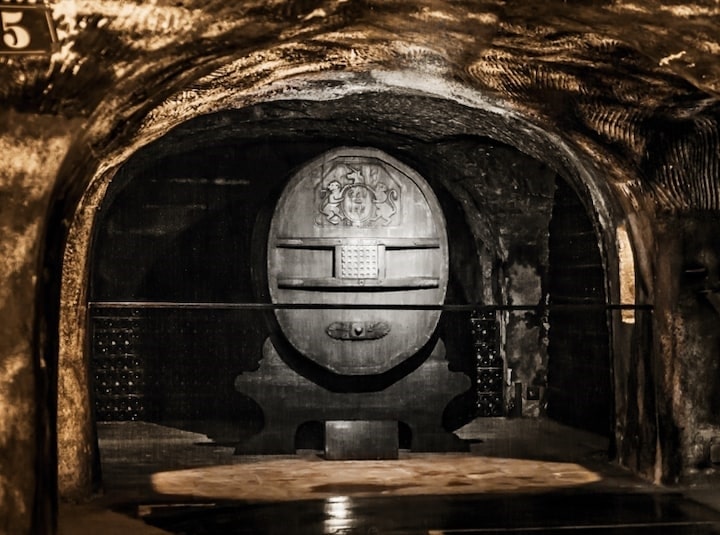
Aging-cellar visits become informative when the producer explains why different casks occupy different roles. Newer wood may contribute more tannin and extraction; older casks may allow slower oxidation with less overt wood flavor. A spirit may move between vessels to manage color, structure and aromatic development. Large vats may be used for marrying blends. Cellar zones can differ in humidity and temperature. None of these choices is automatically superior. The point is to understand the intended trajectory.
Collectors should distinguish the age of a bottle’s youngest component, its average age and any vintage claim. Multi-age blending can be a mark of skill, but the language must be precise. For a vintage Calvados, ask how the year was preserved through cask movements and whether the bottling comes from one cask, several casks or a selected batch.
A well-designed tasting can make maturation visible. The most instructive comparison is not necessarily the estate’s most expensive sequence. It may be a younger and older expression with related fruit and distillation origins, or samples from different cask treatments if the producer permits them. The collector is listening for changes in fresh fruit, cooked fruit, spice, tannin, oxidative notes, texture and length while asking which changes the producer attributes to time, wood or blending.
Do not confuse darkness with age or quality. Color may reflect cask activity and blending; sweetness of aroma may come from ripe fruit, concentration, wood or reduction. The cellar explanation should give enough context to avoid reading the glass through visual prestige alone.
Two Pays d’Auge anchors illustrate different visit strengths
Christian Drouin at Coudray-Rabut and Château du Breuil are useful reference points because each publishes concrete information relevant to a collector’s visit. They should not be treated as the only serious producers in the appellation, nor as a universal first and second choice. They show how estate selection can begin with evidence rather than brand recognition.
Christian Drouin: a strong orchard-to-house-style line of inquiry
Drouin’s own material provides unusually specific orchard context: two high-stem family orchards, roughly 30 cultivars, four functional fruit families and collection of fully ripe apples from the ground beginning in September. This gives an appointment a ready-made technical spine. A collector can ask how those orchards relate to total production, how varieties are assembled into cider, which lots remain distinct and how the house interprets fruit through distillation and maturation.
The Calvados industry’s producer directory for Christian Drouin lists the estate at 1895 Route de Trouville, Coudray-Rabut. At the research check dated 16 September 2026, it showed year-round Monday-to-Saturday hours of 09:00–12:00 and 14:00–18:00. Those hours are operational information, not a guarantee of a technical host, a private discussion or access to every production area. They should be reconfirmed for the intended date, and the content of the appointment should be specified separately.
Drouin is especially compelling when the central question is how a large cultivar palette becomes a consistent house identity. The ideal visit would connect named fruit categories to cider composition, then show where the distillation and cask program preserve or reshape that material. Whether that depth is available on a standard visit, a specialist appointment or only by advance arrangement must be established before leaving Paris.
Château du Breuil: a defined distillery-and-cellar visit framework
Château du Breuil, presented through La Spiriterie Française, publishes a clearly structured visitor offer. At the research check dated 16 September 2026, the estate’s visit page stated that its classic one-hour guided visit included the distillery, an aging cellar and a double tasting. It also warned that guided visits can sell out from April through September and recommended contacting the estate before traveling.
That published scope is useful because it names two production spaces rather than promising only a tasting. It still leaves important questions. Does “distillery” mean an explanation from the visitor route or access to the working floor? Is the still expected to operate on the chosen date? Which cellar is included, who leads the visit, what languages are available and can the tasting be adapted to compare maturation or appellation questions? A classic visit can be a sound introduction while remaining too broad for a collector’s study.
Château du Breuil may suit travelers who value a formal route through built production infrastructure and want a defined visit duration. It becomes more relevant to a specialist brief when the estate confirms a host able to discuss cider sourcing, double distillation and cask management rather than relying on a general historical script.
Choose by the question that must be answered
- Choose an orchard-led appointment when cultivar families, high-stem orchard practice, fruit sourcing and harvest decisions are the core research questions.
- Choose a distillery-and-cellar-led appointment when the priority is to understand equipment, double distillation, cask movement and blending.
- Choose the producer with confirmed access when two estates appear equally strong on paper. A technically suitable host and a precise room list are more valuable than a better-known name with an undefined booking.
- Choose one estate, not two, when a second stop would shorten the orchard, fermentation or cellar conversation at the first.
The central comparison is not “Which producer is best?” It is “Which producer can provide the evidence needed for this particular study on this particular date?” That answer can change with season, staffing and production activity.
Season changes the evidence, not just the landscape
The Pays d’Auge is visually persuasive in every season, but orchard beauty and production visibility do not move together. A collector should select the date according to the stage of work most relevant to the inquiry, then accept that even the right season offers probabilities rather than guarantees.
Spring: orchard structure and blossom, with limited production action
Spring can make orchard form easy to read. Blossom, branch architecture, tree spacing and the relationship between pasture and high-stem fruit become visible. The exact flowering window varies with weather, variety and site, so it should not be promised far in advance. This is a strong period for discussing pollination, cultivar distribution and crop development, but generally a weak reason to expect pressing, active fermentation or distillation.
Summer: fruit development and the busiest visitor period
During summer, fruit is forming and producers can explain anticipated harvest conditions. Cellars remain relevant, yet the public-visit calendar can be under pressure. Château du Breuil’s published warning that guided visits may sell out from April through September is a useful reminder that rural estates are not automatically available because they lie outside Paris. Summer requires earlier booking and a clear distinction between public tour inventory and a specialist appointment.
Harvest: the richest orchard context and the greatest operational variability
From September onward, Drouin’s account places ripe fruit collection in view. Harvest can reveal orchard logistics, fruit condition, receiving, sorting and pressing. It can also restrict access. Staff may be occupied, machinery may be moving, weather may force schedule changes and some areas may be unsafe for visitors. “Visit during harvest” should therefore mean “request the most relevant feasible access during a working period,” not “expect to participate.”
A good harvest appointment confirms what may be visible and what will remain off-limits. It also builds a fallback: if pressing is not occurring, the host can discuss that year’s fruit, show orchard blocks, identify fermentation vessels or compare newly made cider with mature production records.
Post-harvest and cool-season work: fermentation and possible distillation
After fruit collection, the technical focus shifts toward tanks and stills. Fermentation develops on its own schedule, and distillation follows when the cider is ready and the producer’s program allows. This can be the most rewarding period for a visitor interested in transformation rather than scenery, but an operating still must be verified. Maintenance, run timing and safety can alter access even on a date that appears ideal.
Year-round: maturation, blending and documentary study
Casks continue to age regardless of blossom or harvest. A cellar-led study, label discussion and comparative tasting can therefore work throughout the year, subject to opening and staffing. For collectors whose main question concerns age, blending or cask influence, a quieter period may produce a better conversation than the most photogenic season.
The appointment is part of the research method
A “tasting reservation,” a “guided visit” and a “technical appointment” are not interchangeable products. The first may provide pours and retail access. The second may follow a fixed public route. The third is built around a defined question and a host qualified to answer it. A collector traveling from Paris should establish which format is actually being booked.
The most efficient request is concise and specific. State that the purpose is to understand orchard selection, cider fermentation, double distillation and maturation. Then ask what can be confirmed rather than presenting a long wish list as an entitlement.
- Will the visit include an orchard or a mapped explanation of fruit sourcing?
- Can the host discuss cultivar families and the current or most recent harvest?
- Will fermentation tanks or cider records be included?
- Does distillery access mean the working floor, a viewing route or an equipment explanation from outside?
- Is the still expected to operate, with the understanding that production can change?
- Which aging cellar will be visited, and can cask types or transfer practice be explained?
- Can the tasting compare stages of maturation rather than only the standard commercial range?
- Who will host, in which language, and how long is reserved for questions?
Ask for confirmation in writing, especially when the trip depends on a particular room or technical host. A reply that says “full tour and tasting” is still ambiguous. A useful confirmation names the orchard, press or tank area, distillery, cellar and tasting format, while noting any access that remains subject to production conditions.
When a collector’s brief depends on seeing the orchard-to-cellar chain rather than simply sampling pours, producer selection, advance questions and a non-tasting driver should be coordinated as one plan. Orange Donut Tours can shape a private Paris-based touring plan around confirmed technical appointments. Inquire now.
Road scale determines whether one producer or an overnight makes sense
The Pays d’Auge is not a single village that can be covered on foot after a train arrival. From Paris, the day generally follows the A13 corridor toward Normandy and then smaller roads around Pont-l’Évêque and the dispersed orchards and estates of the Pays d’Auge. Traffic, road works, weather and rural last-mile travel can erode the margin between appointments. Two producers may look close on a map while their visit times and access windows make the pairing impractical.
For most collector-grade studies, one deep producer visit is the coherent day-trip model. It allows enough time for the orchard, cider, still, cellar and tasting to connect as one argument. It also leaves room for delays and for a midday pause that does not force the technical discussion to end early. Adding a second estate is worthwhile only when it supplies a genuine contrast—different orchard sourcing, a different scale, another maturation philosophy or a specific appellation comparison.
An overnight becomes justified when the research brief requires two substantial appointments, when harvest activity and distillation are being pursued in separate windows, or when the collector wants a second morning for follow-up tasting and purchases. It can also make sense when the Pays d’Auge study is paired with coastal Normandy, but the Calvados work should retain its own time rather than becoming an hour between unrelated stops.
- One producer in a day: best for a focused question, a long technical appointment and a same-day return to Paris.
- Two producers in a day: viable only with confirmed times, short rural transfer, complementary evidence and disciplined tasting.
- One night in Normandy: preferable for two deep appointments, a harvest-plus-cellar sequence or a schedule that would otherwise depend on a late, fragile return.
Private transport matters here for two concrete reasons. First, it separates tasting from the responsibility of driving. Second, it turns the vehicle into a controlled transfer between a Paris address and rural appointments that may not align with public transport. The value is not ceremonial. It is the ability to keep the producer discussion intact, carry purchases safely, adjust for a delayed finish and avoid asking the person evaluating spirits to navigate the return.
Design the day in the same order as the spirit
The most intelligible visit follows the liquid’s chronology. Begin with appellation and orchard geography. Continue to fruit selection, pressing and cider fermentation. Move to distillation. Then enter the maturation cellar and finish with a comparative tasting. This sequence allows each sensory observation to refer back to a visible decision.
Before arrival
Review the producer’s own account and note which claims are specific enough to test. For Drouin, that might be the high-stem orchards, four fruit families and broad cultivar palette. For Château du Breuil, it might be the promised distillery and aging-cellar components of the visit. Bring a short set of questions tied to those published facts. This is more productive than arriving with an encyclopedic questionnaire unrelated to the estate.
In the orchard or sourcing discussion
Identify the fruit categories, orchard ownership and harvest method. Ask how a difficult year changes the blend. If only one orchard is shown, clarify whether it is representative, experimental, historic or a major supply source. Note what is observed directly and what is described from records.
At the fermentation stage
Ask which tanks contain cider for distillation, how lots are identified and what marks the end of fermentation or maturation. If the tanks are inaccessible, a diagram or production sheet can still establish sequence. The absence of dramatic machinery should not lead this stage to be skipped.
At the still
Trace the first and second distillations and ask how the heart is selected. If production is active, observe without expecting the distiller to interrupt critical work. If production is idle, focus on flow, vessels and records. The useful question is not “Can we see flames and copper?” but “Can we understand how this producer chooses what continues into cask?”
In the cellar and tasting room
Connect cask examples to the tasting order. Ask which samples are designed to demonstrate age, wood, vintage or blend. Spit when necessary, use water and keep notes before moving to the next pour. A smaller number of well-explained samples usually reveals more than a broad range tasted quickly.
Build a tasting that can test the production story
A collector’s tasting should function as a set of comparisons. The producer may not offer every element, but the request can explain the desired logic. One useful progression begins with cider or a discussion of the distillation cider, moves to a young Calvados that retains clear fruit and spirit structure, then compares older or differently matured expressions. A vintage or single-cask sample can be valuable if its relationship to the house blend is explained.
For each sample, record evidence in four layers:
- Fruit: stated orchard or sourcing basis, cultivar families, harvest year if relevant and whether the information is documented or general.
- Fermentation and distillation: cider lot, fermentation approach, still type, double-distillation sequence and any specific cut philosophy disclosed.
- Maturation: minimum or stated age, cask type, cellar or transfer history, blend composition and bottling strength.
- Sensory result: fruit character, fermentation-derived notes, spirit texture, oak influence, oxidative development, balance and finish.
The fourth layer should not be used to invent the first three. A note of baked apple does not prove a particular cultivar. A floral note does not establish a high-stem orchard. Fine tannin does not identify a cask source. Sensory analysis is strongest when it tests a documented production narrative rather than replacing one.
When purchasing, ask whether the tasted bottle is the same batch available for sale, whether a vintage or cask reference appears on the label and how the bottle should be stored for travel. Keep invoices and producer literature with the bottles. Provenance after purchase is less complex than for old wine, but clear documentation still matters to a serious collection.
A field sheet prevents charm from outrunning evidence
Estate hospitality can make details blur together, particularly after several samples. A simple field sheet helps separate observation, producer statement and editorial interpretation. That distinction is essential when comparing estates later in Paris.
- Observed directly: orchard type, fruit on the ground, tanks, still configuration, cask sizes, cellar conditions, bottle labels and the sequence of the visit.
- Stated by the producer: cultivar proportions, sourcing percentages, fermentation duration, cut policy, cask history and blend composition.
- Supported by a record: harvest sheet, tank number, distillation log, barrel mark, vintage documentation or published technical material.
- Inferred by the visitor: likely stylistic effect, comparison with another producer and the coherence between explanation and tasting.
These categories do not imply distrust. They make the visit intellectually honest. A producer may share a practice verbally without opening private records; that remains useful when clearly attributed. An observed cellar may support a maturation discussion without proving that every bottle tasted passed through the exact cask shown. Precision strengthens appreciation because it avoids turning a complex house into a simplified story.
Use the same field sheet at both estates if making a comparison. Standardized headings expose meaningful differences: one producer may be more transparent on orchards, another on fermentation, another on blending. The best visit is not always the one with the longest tour. It is the one whose evidence matches the collector’s priority.
Seven common inferences to avoid
- A beautiful orchard means estate fruit only. It may be important to the house without supplying every bottling. Ask for the sourcing model.
- Harvest season guarantees visible pressing. Fruit arrival and pressing follow weather, ripeness and work schedules. Confirm the likely activity and a fallback.
- A distillery visit means the still will operate. Equipment access and live distillation are separate promises.
- Double distillation creates one recognizable style. Pot stills and two runs define the method, while cuts and handling allow house variation.
- An old château guarantees old stocks. Architecture and liquid inventory are different forms of age. Ask about cask records and bottle composition.
- A long tasting is a deep visit. More pours can reduce attention. A short comparative flight linked to production may be more instructive.
- A public tour can absorb specialist questions without notice. Fixed-route guides may have timing and content constraints. Technical depth should be requested in advance.
How this study differs from Champagne and Paris bottle research
Calvados, Champagne and mature Burgundy all reward provenance thinking, but they organize evidence differently. A Champagne appointment may revolve around village origin, base wines, reserve stocks, dosage, lees aging and the difference between a grower and a grande marque. Travelers considering that parallel can compare producer appointments in Champagne by cuvée, village and pace.
Calvados places more of the interpretive burden on the orchard-cider-still chain. The visitor is not only asking where the fruit grew, but how multiple cider-apple functions were assembled, how a microbial fermentation evolved and how double distillation selected from that cider. The maturation cellar then adds a second long transformation. A tasting that ignores fermentation misses the bridge between landscape and spirit.
Paris-based wine acquisition presents another contrast. When buying older bottles, storage history, fill level, label condition and merchant chain of custody may be more important than visiting the original producer. Collectors can extend the same provenance discipline to mature Burgundy in Paris, but the Calvados day is less about inspecting a finished object and more about observing a living production system.
This is why a Pays d’Auge visit should not be judged against the polished efficiency of a Reims cellar circuit. Rural dispersal, orchard access and seasonal work make it operationally less uniform. That irregularity is not a defect; it is part of the evidence. The planning must account for it rather than smoothing it into a generic tasting excursion.
The one-visit threshold is a mark of depth, not restraint
Collectors often assume that comparative value requires two producers in one day. Comparison is useful, but it can occur through samples, records and focused questioning within a single estate. One house may offer several orchard sources, ages, vintages or cask treatments that reveal more variation than a rushed second stop.
A second producer earns its place when it introduces a deliberate contrast. Examples include an estate-fruit emphasis against a broader sourcing model, a small family cellar against a larger visitor operation, a markedly different cask philosophy or a different appellation logic. The contrast should be named before booking. “We would like to see another distillery” is not yet a research reason.
The overnight threshold is reached when a second appointment deserves a fresh period of attention. One estate in the afternoon and another the next morning allows time to review notes and absorbs harvest delays or a long first conversation. Yet a single excellent appointment and a direct return may still produce the cleaner study.
Back in Paris, resist scheduling an immovable dinner immediately after the rural return. Traffic variability and a producer conversation that runs long can create needless pressure. When an evening reservation matters, choose it with a generous buffer; the guide to planning a Paris fine-dining evening can serve as a separate next step rather than dictating the estate departure minute.
The final test: can every glass be traced backward?
At the end of the visit, take one bottle or sample and try to reconstruct its story in reverse. Which casks and ages formed the blend? How did the spirit move through maturation? What decisions were made during the second distillation? What cider entered the first run? Which fruit categories, orchards or suppliers contributed to that cider? Which parts of the answer were observed, which were documented and which were described by the host?
No producer will reduce a complex blend to a perfectly linear biography, and some information will remain proprietary. The goal is not total disclosure. It is a coherent account with enough specific evidence to understand the house’s choices. A bottle that can be discussed only through age, color and tasting notes has not yet yielded its full provenance.
That is what defines a worthwhile Calvados study from Paris. The appellation supplies the legal grammar: Normandy origin, an apple-led base, double pot-still distillation in the Pays d’Auge and oak maturation. The producer supplies the voice through orchard selection, fermentation practice, cut decisions, cask management and blending. The visit succeeds when those elements can be read as one argument rather than admired as separate rooms.
For a collector, the memorable conclusion is rarely that one estate poured the oldest spirit. It is that the day made transformation visible. The orchard was not scenery, the cider was not a missing chapter, the still was not theatre and the cellar was not simply age made picturesque. Each stage explained the next. That continuity—more than the number of samples or the grandeur of the property—is what allows a Calvados to be understood rather than merely tasted.
If you’re interested in any private tours of Paris, please reach out to us.








 So if you are looking for the absolute best in Paris & surroundings with authentic local fully-licensed native guides whose English you can actually understand and with an exclusive and amazingly fun itinerary