Hampton Court and Kew for a Wheelchair-Using London Group: Surfaces, Transfers and Shared Routes

Updated
Two west-London names, two separate access systems
On a map, Hampton Court Palace and Kew Gardens look like natural partners. Both sit west or south-west of central London, both combine architecture with designed landscape, and both can give a multigenerational family more air than another day of dense central sightseeing. The map hides the operational truth: they are not neighbouring attractions that can be joined by an incidental stroll. Historic Royal Palaces describes a Thames Path walk between Hampton Court and Kew Palace as roughly 11 miles and three to four hours. For this family, that figure is a scale signal, not an accessible transfer recommendation. It shows why a shared day needs a deliberate gate-to-gate movement between two separately managed estates, with the wheelchair, companions, weather and energy accounted for before anyone starts.
The official source is the Hampton Court Palace getting-here page. Its walking route has not been established here as continuously suitable for a particular wheelchair, attendant, battery range or wet-weather condition. A family should therefore treat road or carefully checked public transport as the connection, not assume that the Thames-side setting makes the sites function as one continuous landscape.
The access character also differs. Hampton Court is the more historically constrained environment: uneven floors, cobbles, flagstones, gravel, staff-operated lifts and some rooms that remain restricted. Kew is easier under the wheels on its principal paths, because the Gardens describe themselves as largely flat with tarmac in most places, yet its vastness creates a different problem. A poor gate choice can consume time and energy before the group reaches its first shared anchor. In other words, Hampton Court is primarily a surfaces-and-sequence problem; Kew is primarily a distance-and-gate problem.
This guide assumes a multigenerational family travelling with one wheelchair user and walking companions; that the chair user can remain in the chair during normal touring unless the family explicitly confirms otherwise; and that the aim is shared cultural time rather than exhaustive coverage. Operational details below were checked against official sources dated 26 August 2026. Lifts, building works, gate arrangements, path closures, equipment availability and parking can change, so the closing verification step is part of the plan rather than an administrative afterthought.
The practical answer: one substantial visit and one edited visit
Hampton Court and Kew can form one shared day, but only when the family accepts an asymmetry. One estate should carry the historical or botanical depth; the other should be a selected chapter built around two or three nearby anchors. Trying to tour the main palace routes, several Hampton Court gardens, multiple Kew glasshouses, Kew Palace and the wider arboretum turns the day into a succession of surfaces, lift requests, loading cycles and long path segments. Walking companions may still feel capable, while the wheelchair user has already accumulated vibration, transfers, temperature changes or sustained sitting fatigue.
For most groups, Hampton Court belongs first and Kew second. Hampton Court’s access is more dependent on staff-operated lifts and historic circulation, so it benefits from an early arrival while everyone is fresh. Historic Royal Palaces says the palace is quietest before 11:00 and suggests allowing two to three hours. Kew is more forgiving as a second visit because a gate-specific cluster can be shortened without making the whole stop meaningless. This is an editorial route judgment, not an official itinerary, and it should be reversed when a pre-booked Kew mobility scooter, a fixed horticultural priority or the day’s weather makes Kew the more time-sensitive site.
The family choosing between one garden estate and a paired day may also find the wider comparison of Kew, Hampton Court and a London garden afternoon useful. The present question is narrower: not which place is best in isolation, but whether everybody can remain meaningfully together across both.
Begin with the wheelchair profile, not the attraction list
“Wheelchair accessible” is too broad a category to decide this route. A compact manual chair pushed by a strong companion, a self-propelled manual chair with small front casters, a heavy powered chair, a reclining chair and a mobility scooter encounter the same estate differently. The family needs a working profile before selecting entrances, lifts or split points.
- Chair footprint: record overall length and width, not only seat width. Include footplates, anti-tip bars, bags and any oxygen or medical equipment.
- Total weight: include the user and carried equipment when checking a lift or vehicle ramp capacity.
- Propulsion: identify whether the user self-propels, uses power, or relies on an attendant. Gravel and cobbles can be an endurance issue even when a route contains no step.
- Transfer requirement: state whether the user can transfer into a vehicle seat, whether the chair folds, and whether the user must travel secured in the wheelchair.
- Pressure and posture needs: define how long the user can comfortably remain seated before a repositioning or private care interval is required.
- Toilet requirement: distinguish an ordinary step-free accessible toilet from a Changing Places facility. They are not interchangeable.
- Weather tolerance: consider rain protection, heat in glasshouses, cold exposure in gardens and the effect of wet surfaces on grip and pushing effort.
- Group behaviour: decide whether children or other adults may branch off, who remains with the wheelchair user, and where everyone will rejoin.
This profile prevents a common planning error: using the site’s availability of a borrowed wheelchair or scooter as proof that the day will work. Hampton Court’s wheelchairs cannot be pre-booked and are first come, first served, while its electric buggies are for outdoor use only. Kew has limited wheelchairs at public gates and advance-booked scooters at selected gates, with restrictions in some attractions. Borrowed equipment may help, but it is not a substitute for a chair that fits the user’s posture, controls, pressure management and independence needs.
Hampton Court arrival: the final 500 metres matter
Hampton Court offers several superficially similar arrival descriptions, but they produce different access consequences. The official Hampton Court accessibility page says drivers can enter through the main palace gates and ask the security officer for directions to the on-site car park. It lists ten Blue Badge bays, with two described as the closest to the palace entrance. The separate getting-here page says the car park is limited, first come, first served, and that its bays fit a standard car. A large wheelchair-accessible vehicle should therefore not assume that an on-site space will suit its length, height, side-ramp deployment or rear-ramp clearance.
The distinction between parking and dropping off is equally important. Hampton Court states that taxis may drop off or collect by the Ticket Office. For minibuses and coaches, the named points are Hampton Court Station Coach Park, about 200 metres from the entrance, and Hampton Court Green, about 500 metres away. Those numbers are not trivial. A 200-metre approach can be acceptable in a powered chair and onerous in heavy rain with a manual chair, luggage, children and a road crossing. A 500-metre fallback can consume the effort the family expected to spend inside the gardens.
Rail is possible but should be described precisely. Hampton Court station is step-free, and the palace is across the bridge, described by the palace as about a ten-minute journey. “Step-free station” does not mean an indoor, weather-protected arrival at the palace door. It still includes the bridge approach and an outdoor segment. For a one-site Hampton Court day, that may be entirely reasonable. For a two-estate day, it becomes the first of several transitions and should be counted as such.
A good vehicle plan names four separate points: where the wheelchair user alights, where the vehicle waits, where the group meets it after the visit, and what happens if the on-site car park is full. Without those four answers, “we will drive” is not yet an access plan.
Hampton Court surfaces: step-free does not mean low-resistance
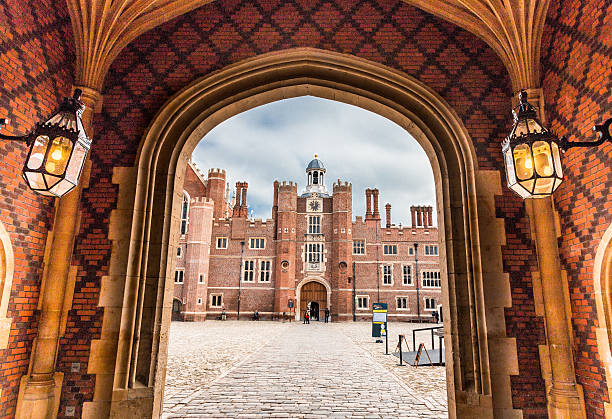
Historic Royal Palaces is unusually direct about the physical character of the site. Its accessibility page says Hampton Court has large amounts of uneven flooring and staircases, with wheelchair access restricted in some areas. It identifies gravel paths, cobbles and flagstones. The downloadable access guide adds that the palace gardens are generally flat but include some steep slopes and drops, with uneven surfaces and gravel throughout; it identifies smoother tarmac in the Wilderness, Rose Garden and Kitchen Garden. This is why a route can be technically step-free yet still demanding under a wheelchair.
For a self-propelling manual wheelchair user, coarse aggregate can increase rolling resistance and make steering corrections constant. For an attendant, it can turn a visually modest courtyard crossing into sustained pushing work. Small front casters may catch or vibrate on joints between stones. A powered chair may handle resistance more easily but still face turning-space, traction and battery consequences. None of these outcomes can be inferred from the word “flat” alone. Gradient, surface texture, crossfall, route width and distance work together.
Hampton Court’s current access guide is especially valuable because it publishes lift dimensions. It lists a primary lift at approximately 190.5 centimetres long by 121.9 centimetres wide, with a stated capacity of 1,000 kilograms, and a smaller secondary lift at approximately 116 centimetres long by 134.6 centimetres wide. These figures should be checked again in the current guide before travel, but they show why chair footprint belongs in the first planning conversation. A family using a long reclining chair or carrying equipment behind the backrest cannot rely on a general statement that a lift exists.
The official step-free interior routes currently include Henry VIII’s Apartments, William III’s Apartments and the Georgian Story via staff-operated lift, plus the ground floor of The Tudor World. The first floor of The Tudor World remains a more constrained case: the palace says staff-operated lift access is available only via four steep steps. That is not an independent step-free route for a wheelchair user who cannot transfer or negotiate steps. The accessible version of the palace is therefore not simply the standard visitor route with a lift inserted; it may involve a different entrance, escort, reverse sequence or omitted level.
This is consistent with the broader conservation reality described by Historic England’s guidance on improving access to historic places: effective access solutions have to respond both to users’ needs and to the significance and vulnerabilities of the historic fabric. That context explains constraints; it does not erase their consequences. The family still needs to know which rooms can be shared and which cannot.
For comparable thinking about London sites where the advertised icon and the accessible route are not identical, see the guide to stair- and step-heavy London icons. Hampton Court differs from a compact monument because its courtyards and gardens add substantial rolling distance after the interior route.
Hampton Court shared anchors and bounded splits
The group should choose named rejoining points before entering a lift-dependent sequence. “Meet in the courtyard” is not enough at a palace with several courtyards, changing circulation and temporary works. Base Court and Fountain Court are useful operational anchors because the palace identifies step-free accessible toilets at both. The access guide further links Base Court with Henry VIII’s Kitchens, Henry VIII’s Apartments and The Tudor World, while Fountain Court is associated with William III’s Apartments, the Georgian Story and the palace gardens. These associations make the two courts intelligible to staff and useful for rejoining, subject to the route in operation that day.
A practical Hampton Court split is short and purpose-led. Walking companions might take a stair-only or faster branch while the wheelchair user follows the staff-assisted lift route, but the split should end at the next named court, not after an open-ended collection of rooms. One person who understands the plan remains with the wheelchair user; another adult leads children or other companions; both parties carry the same written meeting point. The guide or family lead tells a Palace Host that the group intends to reunite there, because construction or one-way circulation may alter the expected exit.
The gardens need the same discipline. The Maze should not be treated as a universal family anchor: the access guide describes its internal paths as only about one metre wide. The Wilderness, Rose Garden and Kitchen Garden are more promising surface choices because the guide identifies smooth tarmac paths there, but “smooth path available” is not a promise that every adjoining garden feature is step-free. A short shared garden segment is safer than sending the wheelchair user toward a distant rejoining point based only on the general map.
Hampton Court also permits re-entry when a visitor shows the admission ticket to a Palace Host. That creates a legitimate bailout option if medication, charging equipment, clothing or a private care item remains in the vehicle. It should not be used casually: returning to the car can add significant distance, and the value depends on where the vehicle is actually parked. Still, it is better to know that re-entry exists than to treat an exit as the end of the visit.
Kew gate selection decides the first and last stretch
Kew has four public gates, and each belongs to a different transport logic. The official Kew getting-here page identifies Victoria Gate as the pedestrian entrance closest to Kew Gardens station, Elizabeth Gate as the coach drop-off and the entrance closest to Kew Bridge station and river services, Brentford Gate as the car-park entrance, and Lion Gate as the pedestrian entrance closest to Richmond station. Those labels are not merely directions. They determine whether the family begins beside the chosen attraction cluster, beside the parked vehicle, or beside a borrowed mobility device.
Brentford Gate is the logical arrival when the vehicle must remain in Kew’s own car park. It places the group near the car park and, according to Kew’s accessibility map, toward the Kew Palace and Children’s Garden side of the estate. It is a poor choice if the family intends only a brief Palm House and Temperate House visit and has no appetite for a long cross-garden route.
Elizabeth Gate has a different value. Kew identifies it for coach drop-off and provides an accessible drop-off area nearby. It gives relatively direct access to the east side of the Gardens, including Kew Palace, the Orangery, the Hive and the Great Broad Walk area. It may suit a vehicle that drops the group and returns later, but the pickup point must be fixed in advance. A vague “meet at Kew” can send the vehicle to Brentford while the family waits at Elizabeth.
Victoria Gate is often the best entrance for a concise glasshouse cluster. Kew’s accessibility map gives average walking times from Victoria Gate of about five minutes to Palm House and about ten minutes to the Temperate House or the Hive. Those are walking estimates, not wheelchair timings, but they reveal relative geography. The same map places accessible facilities and a Changing Places symbol in the Victoria Plaza area, making this gate particularly important when that facility is required. The map should be checked again before travel because facilities and routes can move.
Lion Gate is useful for the Great Pagoda, the southern galleries and the Temperate House side, and it is the closest gate to Richmond station. Yet Kew’s advance-booked mobility scooters are listed at Brentford, Victoria and Elizabeth Gates, not Lion Gate. A family needing a Kew scooter should not arrive at Lion simply because a rail map makes it look convenient.
Kew is largely flat, but it is not uniformly effortless
The official Kew accessibility page states that the Gardens are largely flat, with tarmac paths in most places. Those two qualifiers matter. The linked accessibility map distinguishes fully accessible paths, lawn paths and marked steep paths that are not suitable for wheelchairs. Kew is therefore much more navigable than a landscape dominated by gravel, but it should not be described as a completely level paved circuit.
Distance is the larger friction. The map’s average walking times from Victoria Gate range from five minutes to Palm House to twenty minutes to the Great Pagoda and twenty-five minutes to the Woodland Walk. A wheelchair user may move faster or slower than those estimates depending on power, pushing support, crowds, stops, surface conditions and the chosen path. The figures are still useful because they show that “one more feature” can create a substantial out-and-back. A family pairing Kew with Hampton Court should work in clusters, not trace a loop around the whole estate.
Kew offers limited manual wheelchairs at every public gate without advance booking. It also offers mobility scooters by advance reservation from Brentford, Victoria and Elizabeth Gates and recommends booking at least two weeks ahead; the site notes that scooters are restricted in some parts of the Gardens. This creates three planning consequences. First, availability at the gate should not be the only mobility plan. Second, the collection gate becomes a fixed arrival point. Third, the route must be filtered by the device, because a scooter and a wheelchair do not have identical access inside Kew’s buildings.
The Gardens place accessible toilets within easy reach of main attractions, cafés and gates and mark them on the map. For a paired day, the important move is to identify the next toilet before leaving each anchor, not after the need becomes urgent. Kew’s size means a facility can be “within easy reach” in estate terms while still requiring several minutes of travel.
Kew’s buildings create device-specific branches
Kew’s glasshouses and historic buildings demonstrate why the family must name the device, not merely the disability. The Temperate House and Alpine House are listed as accessible to wheelchairs and mobility scooters. Palm House is accessible to wheelchairs but not to mobility scooters. The Princess of Wales Conservatory admits wheelchairs and mobility scooters, but its upper floor is not accessible to either. A group using a mobility scooter can therefore share a Temperate House visit and may need a bounded split at Palm House.
The galleries add another variation. The Shirley Sherwood Gallery of Botanical Art has a ramp and is described as fully accessible by wheelchair. The Marianne North Gallery is wheelchair accessible via a platform lift near the Temperate House gate. Kew notes restrictions for mobility scooters and buggies in the current gallery layout while welcoming manual and electric wheelchairs. These are the details that turn a general “art stop” into a workable or unworkable branch.
Kew Palace is accessible to wheelchair users with assisted access and a lift, but narrow corridors and doorways require a small wheelchair. Mobility scooters are not permitted in Kew Palace or the Royal Kitchens. That makes Kew Palace a poor spontaneous addition for a family using a large powered chair or scooter unless dimensions and the transfer plan have been checked. A walking companion’s ability to enter does not make it a shared anchor.
The best rejoining rule at Kew is to return to the same exterior entrance used for the split. When one branch enters Palm House and another waits outside with a scooter, agree to meet at the same door rather than at a distant café. When a platform lift is involved at Marianne North Gallery, use the gallery entrance as the reunion point and keep the split to one attraction. Estate landmarks that appear obvious on a map can have several approach paths and may be crowded.
Temperature is another access variable. Glasshouses can be warm and humid relative to the outdoor gardens. That may be welcome in cold rain and uncomfortable for someone managing fatigue, thermoregulation, respiratory equipment or medication. The family should alternate indoor and outdoor anchors rather than stacking every glasshouse simply because they are accessible.
The transfer between estates is part of the visit
A two-site plan often underestimates the transfer because it counts only driving time. The real interval begins when the group stops touring Hampton Court and ends when everybody is through the chosen Kew gate with the right equipment. It can include an accessible toilet stop, return across palace surfaces, locating the vehicle, deploying a ramp or lift, securing the wheelchair, loading bags, navigating traffic, unloading, collecting a pre-booked scooter and orienting to the second map.
For a wheelchair user who remains in the chair, vehicle compatibility is fundamental. The vehicle needs an appropriate ramp or lift, adequate internal height, safe wheelchair restraint and occupant restraint, plus room for companions without placing equipment in the user’s space. For a user who transfers to a seat, the family needs to know who assists, where the transfer occurs, whether a transfer board is used and where the folded chair is secured. These are care and safety questions, not sightseeing details, and they should be settled with the transport provider rather than improvised at the palace gate.
The road route should not be scheduled against an exact minute-by-minute promise. Traffic in west and south-west London can vary, and the correct Kew gate may be more important than the theoretically fastest entrance. A driver sent to Brentford because it is “the car entrance” is not helpful when the family has a scooter reservation at Victoria. Equally, an Elizabeth drop-off is not a complete solution if the vehicle then disappears without a confirmed collection point.
This is where coordinated private service has a material purpose. A guide can finish the Hampton Court interior sequence near the agreed exit, confirm the accessible toilet before departure and keep walking companions from drifting into another garden. A suitable driver can be positioned at the correct collection point and take the group to the Kew gate matched to the second-site cluster. Neither person can make an inaccessible room accessible; their value lies in reducing avoidable separation and repeated transitions.
A shared-day sequence that has a realistic chance of holding together
1. Arrive early at Hampton Court with the exit already agreed
Use the main palace arrival only when the vehicle and parking arrangement have been confirmed. If a taxi or private hire vehicle is dropping off, ask for the Ticket Office point identified by the palace. If a larger vehicle must use the station coach park, account for the 200-metre approach. Before entering, the family lead confirms the chair dimensions, the intended first lift-assisted route, the nearest accessible toilet and the exact place where the vehicle will collect the group.
2. Build the palace around one lift-dependent sequence
Choose one principal upper-level route, not every available apartment. Henry VIII’s Apartments may be the most coherent choice for a first visit; William III’s Apartments or the Georgian Story may better suit a family with a particular historical interest. The operational rule is the same: ask a Palace Host for the lift route at the beginning, learn where it exits and set Base Court or Fountain Court as the next shared point. Add the ground-floor Tudor World only if the group’s energy remains good and the sensory content suits the family.
3. Use a short garden coda rather than a garden expedition
After the palace, select a nearby, surface-aware garden segment. The access guide’s smoother tarmac options in the Wilderness, Rose Garden and Kitchen Garden are more defensible than assuming every formal path is equally comfortable. The family should avoid turning the Maze into a compulsory shared activity, given its narrow internal paths. End the Hampton Court visit while the wheelchair user still has reserve for loading and the second site.
4. Make the transfer a protected interval
Use the accessible toilet before leaving if needed, then move directly to the vehicle. During the ride, the plan should become simpler, not expand. Confirm the Kew gate, the first anchor, the final anchor and the bailout point. Do not add an extra lunch location that requires another unload unless food, medication or care needs make it necessary. A seated interval in the vehicle may help some users and may be uncomfortable for others; the family’s posture and pressure-management plan governs.
5. Enter Kew through the gate that matches the edited cluster
For a concise glasshouse visit, Victoria Gate can support Palm House plus either the Princess of Wales Conservatory or Temperate House, depending on device restrictions and energy. For a Kew Palace and family-oriented cluster with a parked vehicle, Brentford Gate may be more coherent. For a drop-off focused on Kew Palace, the Great Broad Walk and the eastern side, Elizabeth Gate can reduce cross-garden travel. Lion Gate is useful for the southern end but should not be used when a booked Kew scooter must be collected elsewhere.
6. Finish at the gate from which departure is actually possible
A Kew route should be designed backwards from the exit. If the vehicle waits in the Brentford car park, finishing near Victoria Gate creates a long final crossing when fatigue is highest. If the vehicle is returning to Elizabeth Gate, the family should not end at the Great Pagoda. A one-way internal route can work only when the driver is permitted and prepared to collect at a different gate. Otherwise the group needs a compact out-and-back from the same entrance.
Rejoining points should be obvious, named and low-effort
A rejoining point is not simply a landmark everybody has heard of. It needs step-free access, a precise meeting location, enough space to wait, and a route that does not force the wheelchair user to search. At Hampton Court, Base Court and Fountain Court are stronger than an undefined “main courtyard” because they are named in the access materials and have step-free toilets. At Kew, the exterior entrance of a specific glasshouse or gallery is stronger than “by the lake.”
- Use one door: agree on the same entrance or gate, not merely the building name.
- Set a short time window: a ten-minute branch is easier to recover from than an open-ended exploration.
- Keep one informed companion: the wheelchair user should not be left without the person who knows the route, medication, communication or transfer needs.
- Avoid moving targets: cafés can have multiple doors, queues or changing seating; use them only when the exact entrance is clear.
- Tell staff: where lifts or temporary routes are involved, confirm that the expected exit still operates.
Children benefit from the same precision. A child sent through a separate attraction with another adult should know the name of the court, gate or building entrance where the family will meet. The goal is not to eliminate every split; it is to make any split bounded, supported and reversible.
When Kew should come first
Kew-first can be the better order when the family has a pre-booked mobility scooter with a fixed collection gate, when a particular glasshouse or botanical collection is the day’s primary purpose, or when the forecast makes the morning the only comfortable outdoor window. It can also work when the family plans a very short Hampton Court interior visit and has confirmed that the required lift route and arrival window remain available later.
The tradeoff is that Hampton Court becomes the second, less flexible site. Staff-operated lift routes, historic surfaces and closing times leave less room for drift. If the Kew visit expands, Hampton Court cannot always be compressed to a satisfying half-hour. A Kew-first plan therefore needs a strict departure point: one final Kew anchor, one toilet stop, then the transfer. It should not rely on the group voluntarily leaving after “just one more” garden feature.
Public transport, an ordinary car and an adapted vehicle are not equivalent
Public transport can work for either estate in isolation, but the two-site day magnifies every platform, bridge, bus stop and boarding transition. Hampton Court station is step-free, with an outdoor approach across the bridge. At Kew, the nearest station is not automatically the easiest accessible approach. Kew states that Kew Bridge station is about 800 metres from Elizabeth Gate and has no level access. Kew Gardens station is about 500 metres from Victoria Gate, but the westbound platform lacks level access; Kew describes a workaround involving travel to Richmond and returning on the eastbound platform. Richmond station has lift and level access, followed by a bus or a walk to Lion or Victoria Gate. Planned closures and lift status must be checked for the actual date.
An ordinary private car reduces public-transport transitions but creates parking risk. Hampton Court’s on-site car park and Kew’s Brentford car park are both limited and first come, first served. A car also ties the family to the gate beside the parked vehicle unless the driver can relocate. A folding manual chair may fit easily; a rigid powered chair may not. The family should test boot dimensions, lifting requirements and safe loading before the day.
A properly specified wheelchair-accessible vehicle can remove the need for the user to transfer and can connect the correct Hampton Court pickup with the correct Kew gate. Its advantage is not decorative comfort; it is continuity. Yet “wheelchair accessible” must still be interrogated. Ramp angle, lift capacity, door height, internal turning room, securement system and space for companions vary. The user’s chair dimensions and total weight should be supplied in writing, and the provider should confirm whether the user travels in the chair or transfers to a seat.
For a family comparing this west-London pairing with a central London wheelchair day, the Tower, Thames and Greenwich accessibility guide shows a different geometry: more central transport interfaces and river possibilities, but fewer vast garden distances. Neither is universally easier; the friction simply sits in different places.
Weather changes surfaces, effort and the value of the second site
Rain does more than make a garden less pretty. At Hampton Court, wet gravel, cobbles and flagstones can increase pushing effort, vibration and caution. Ramps may require slower approaches, and the outdoor movement between palace areas feels longer. At Kew, principal tarmac paths remain a relative advantage, but wind-driven rain across a large estate can make even a short cluster exposed. Wet clothing also matters during vehicle transfers and when moving into warm glasshouses.
Heat creates a different problem. Long outdoor distances at Kew combine with warm, humid glasshouses. Some wheelchair users have impaired thermoregulation or fatigue that is not visible to companions. The route should include shade, water and a willingness to drop the final glasshouse. Hampton Court’s palace interiors may offer more shelter, but the courtyards and garden connections remain exposed, and low-light interiors can create abrupt visual transitions.
Cold weather may favour a palace-led day, yet a second-site Kew stop still requires movement between buildings. The family should not label Kew an indoor alternative merely because it has glasshouses. Conversely, a bright dry day does not justify adding distant garden features after the wheelchair user has already crossed Hampton Court’s rougher surfaces.
A useful weather rule is to decide the one-site fallback before leaving the accommodation. If rain, heat or wind crosses the family’s agreed threshold, the day becomes Hampton Court only or Kew only. The group should not wait until everyone is wet or depleted to discover that the second estate is optional.
One-site fallbacks that still feel complete
Hampton Court only
Choose Hampton Court alone when Tudor or royal history is the main interest, when the wheelchair user can tolerate the palace’s uneven surfaces but not a second long landscape, or when the family wants one staff-supported interior sequence without another load and unload. Build the day around one upper-level apartment route, the ground-floor Tudor World if suitable, a short garden segment on the smoother paths identified in the access guide, and a seated break. Use the extra time to allow lift coordination and interpretation rather than racing to Kew.
This fallback is weaker when a Changing Places facility is essential, because Hampton Court currently states that it does not have one. It is also weaker when the chair’s dimensions do not fit the lift arrangement or the user is particularly sensitive to cobbles and gravel. Those are route-defining constraints, not inconveniences to be solved by adding more assistance.
Kew only
Choose Kew alone when smoother main paths, a booked mobility scooter, a Changing Places requirement shown on the current accessibility map, or botanical interests matter more than palace interiors. A full Kew day can be organised as two nearby clusters with a substantial rest between them. From Victoria Gate, a glasshouse-led sequence can include Palm House and one additional conservatory, with an optional gallery branch. From Brentford, Kew Palace and the Children’s Garden can form one family-focused cluster; from Elizabeth, Kew Palace, the Great Broad Walk and the Hive form another, subject to current access and device restrictions.
Kew alone is not automatically light. Its scale can produce more total distance than a carefully edited Hampton Court visit. The benefit is choice: the family can shorten the route by turning back to the same gate, select more consistently paved paths and avoid repeated vehicle loading. The best Kew-only plan still excludes several attractions.
A west-London garden afternoon without both estates
If the family wants outdoor time but neither full estate is right, the answer may be a smaller London garden or park closer to the accommodation and other planned sights. That option sacrifices the historical depth of Hampton Court and the botanical breadth of Kew, but it can preserve shared movement when the chair user has already spent several days on London surfaces. The comparison should be made by access profile and desired content, not by the prestige of the name.
Children, older companions and the wheelchair user do not tire in the same way
In a multigenerational family, fatigue will not arrive simultaneously. Children may still have energy for a Maze, play area or distant feature while an older walking companion needs a seat and the wheelchair user needs pressure relief rather than more rolling. The route should therefore include different forms of recovery. Sitting in a wheelchair is not the same as resting; a long vehicle transfer is not automatically restorative; and a companion who has been pushing over gravel may be more fatigued than the person walking beside them.
Assign roles before the first split. One adult is responsible for access communication and remains with the wheelchair user. Another may take children on a bounded branch. A third, if present, handles timing, bags and contact with the vehicle. This prevents the access companion from simultaneously navigating, interpreting, lifting, supervising children and contacting the driver.
For a broader family itinerary in which this west-London day sits among central sights, the comfort-first London-with-kids plan can help distribute high-effort and lower-effort days. The Hampton Court and Kew pairing should not follow another surface-heavy day merely because the calendar has space.
What should be verified before the family commits
The family does not need every operational detail months in advance, but it does need the details that could invalidate the day. Confirm the wheelchair’s dimensions against Hampton Court’s current lift guide; ask whether building works have altered the step-free route or the expected lift exit; check whether the on-site car park can accept the planned vehicle; and record the precise Hampton Court pickup point. Verify the presence and location of any required toilet facility rather than relying on a general accessibility label.
At Kew, confirm the entrance that matches the transport mode, the gate for any booked mobility scooter, the current restrictions for the exact device, and the path cluster around the selected anchors. Recheck the access map for steep-path markings and facilities. For public transport, verify platform access, lifts and planned closures on the day. For a vehicle, confirm the arrival gate and collection gate separately.
The official pages used for this planning are the Hampton Court accessibility and transport pages, Kew’s accessibility and gate and transport pages, and the linked downloadable access maps and guides. Recheck them after any substantive site update and again close to travel, especially where parking, works, lifts or borrowed equipment determine feasibility.
When chair dimensions, staff-assisted palace routes, gate-specific mobility equipment and a coordinated transfer all have to align, tailored planning has a concrete purpose: it keeps the wheelchair user and walking companions in the same story rather than asking one person to absorb every compromise. Review Orange Donut Tours’ private London touring options and Inquire now
If you’re interested in any private tours of London, please reach out to us.















 So if you are looking for the absolute best in London & surroundings with authentic local fully-licensed native guides whose English you can actually understand and with an exclusive and amazingly fun itinerary













