A Dementia-Aware London Museum Day: Orientation, Quiet Exits and Shared Interpretation for a Private Family

Updated
The direct answer: choose the museum by orientation and exit control, not collection size
For many families travelling with a parent who has dementia, the Wallace Collection is the more manageable primary museum for a London day. Its historic-house scale, sequence of distinct rooms, available seating, quieter periods and unticketed main collection make it easier to establish a recognizable arrival, see a short group of objects and leave without turning departure into a failed visit. The National Gallery can be the better choice when a particular painting, artist or familiar Trafalgar Square setting carries real meaning for the family, but it asks more of the route: security, a larger circulation system, more people, numbered rooms and a deliberate exit plan.
This is not a rule about what a person with dementia can or cannot enjoy. People differ, and the useful starting point is the individual’s current preferences, familiar interests, mobility, response to crowds and comfort with unfamiliar buildings. A dementia-aware museum day is therefore not simply a slower ordinary tour. It is a day with fewer unresolved decisions, a visible arrival point, a small cultural purpose, known toilet and seating locations, clearly divided companion roles and an exit that can happen without debate or embarrassment.
The most reliable shape is one museum treated as the cultural centre of the day, with a second museum held only as an optional branch. A family that spends forty-five satisfying minutes with three paintings has had a more serious museum experience than a family that pushes through fifteen rooms because the itinerary said it should. The measure is shared attention, not coverage.
What “dementia-aware” means in a museum setting
A museum becomes difficult long before anyone is physically tired. The pressure often accumulates at decision points: which entrance, which queue, whether a bag must be opened, which lift, which corridor, where the toilet is, whether the family is still following the same plan and how to leave. London’s large cultural buildings add their own visual and social density. An entrance that seems obvious on a map may be one of several doors on the ground. A room number may be useful to one relative and meaningless to another. A quiet bench may be more valuable than a celebrated gallery if reaching it requires three uncertain turns.
The planning principle is to reduce ambiguity while preserving dignity. The Alzheimer’s Society’s dementia-friendly environment checklist emphasizes quiet space, supportive companionship, clear high-contrast signs, signs at key decision points, especially clear toilet and exit signs, recognizable seating and memorable landmarks. Its guidance is written for environments rather than for a particular museum visit, but it gives a sound way to evaluate a route. See the Alzheimer’s Society dementia-friendly environment checklist.
For a family, that translates into practical choices. Use one entrance name throughout the day. Pick one visual landmark at arrival. Keep the first object close enough that the visit begins before orientation work becomes tiring. Identify a seat that is part of the route rather than a rescue measure. Decide who accompanies a toilet visit if help is wanted. Agree that one person can call the exit without needing to justify the decision to the rest of the group.
None of this requires infantilising language or testing memory. The parent remains a participant in a cultural day. The route should offer choices that are easy to answer in the present: “Would you like the portrait room or the armour next?” is more usable than presenting the entire building as an open field. Shared interpretation should invite looking, preference and association without requiring a correct recollection.
The five criteria that change the museum choice
- Arrival legibility: Can the family name and recognize one entrance, understand what happens immediately inside and reunite easily if separated at security or the cloakroom?
- Room scale and landmarks: Does the building offer distinct rooms, visible objects or architectural cues that can serve as anchors, or does it depend mainly on numbers, maps and repeated corridors?
- Seating within the cultural route: Is seating available near the objects the family wants to see, and can a pause occur without leaving the shared experience?
- Toilet and exit control: Are the toilet route and way out understood before they are needed? Can the group leave by the same recognizable point, and is same-day re-entry confirmed rather than assumed?
- Bailout geography: Is there a specific, communicable pickup point outside, with a lawful and realistic vehicle approach, or only a vague instruction such as “meet in front”?
These criteria explain why the Wallace Collection and the National Gallery can produce very different days even though both offer exceptional art and free access to their main collections. The distinction is not “small museum good, large museum bad.” It is how each building converts family attention into movement.
The Wallace Collection: lower-friction orientation in a historic-house setting
The Wallace Collection occupies Hertford House on Manchester Square. For this particular family task, the useful feature is not merely that it is smaller than the National Gallery. It is that the visit can be understood as entering one house, moving through named or visually distinct rooms and returning to a familiar front sequence. That domestic scale can provide stronger landmarks than a long chain of institutionally similar galleries.
The museum’s official access information states that entry to the main collection is free and unticketed, that visitors may come and go during opening hours and that there is no need to queue for entry. It also identifies weekday 10.00–11.00 and 16.00–17.00 as usually the quietest periods, while Saturday 12.00–15.00 is the busiest. These details are operational and should be rechecked close to the visit, but they materially improve planning because a brief exit does not automatically have to become the end of the day. See the Wallace Collection’s official access information.
Arrival has several useful cues. The entrance is step-free, approached by a sloped driveway. Automatic double doors are at the sides of the vestibule, and the Information Desk is on the right. A family can therefore use a simple sequence before leaving the hotel: “Manchester Square, up the slope, through the doors, desk on the right.” That is more durable than “we are going to a museum in Marylebone,” and it gives companions a shared script if the arrival feels unfamiliar.
Inside, the Wallace Collection reports room signage on each door, orientation maps outside the lift on every floor and by the toilets, and Gallery Team staff in each room. Portable folding seats are available from the Landing, with a small number of cushioned benches with backrests in the Hall, on the Landing and in the Great Gallery. Public toilets are on the lower ground floor off Founders’ Court, with the accessible toilet at the end of the toilets corridor. These are not decorative details. They determine whether the family can place a seated pause before fatigue, rehearse the toilet route while everyone is calm and ask for directions without returning to a central desk.
Where the Wallace Collection still needs care
The building is not friction-free. It is a historic interior with changes in visual character, some darker rooms and many objects on open display. The museum notes that the Arms and Armour Galleries are among its quieter spaces but are also darker. That creates a genuine tradeoff: lower sound and footfall may help one visitor, while lower light or the density of weapons and cases may be less comfortable for another. The correct choice depends on the person, not on a universal quiet-room rule.
The restaurant, front hall, shop, exhibition galleries and Oval Drawing Room are identified by the museum as busier areas. A family using the restaurant as the automatic rest point may therefore exchange gallery calm for lunchtime noise. A better plan is to distinguish a gallery seat from a meal. The first is a brief continuation of the visit; the second introduces ordering, waiting, other conversations and a new set of choices. If lunch is important, reserve it as a separate phase rather than using it as the only bailout.
The open-display character also changes companion positioning. Relatives should avoid forming a protective ring around the parent, which can feel conspicuous and can narrow movement near unglazed or unroped objects. One companion beside the person and another slightly behind the group is usually less intrusive than four people giving simultaneous instructions. This is an editorial route judgment, not museum policy.
Families comparing the Wallace Collection with other compact institutions can compare the Wallace Collection with other smaller London museums. The important question remains whether the chosen building offers the right cues for this person, not whether it is small in the abstract.
The National Gallery: stronger iconic anchors, higher coordination demands
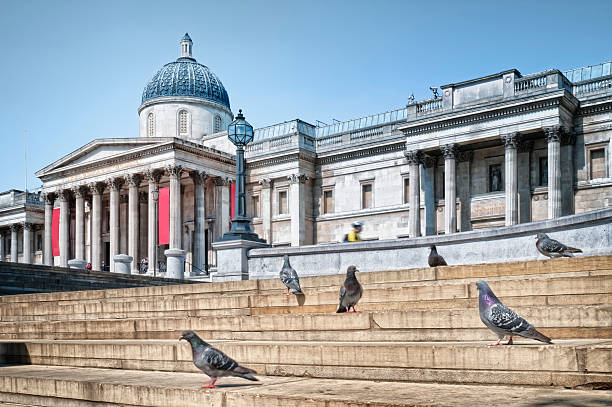
The National Gallery has a different advantage. A familiar painting, a well-known artist or the sight of Trafalgar Square may provide a more meaningful cultural anchor than the relative calm of an unfamiliar house museum. For some families, that recognizability is worth the larger building. The visit should then be designed around one named entrance and a short set of paintings, not around the ambition to “do the National Gallery.”
The Gallery’s visual story identifies the Sainsbury Wing as the main entrance and a step-free route. It explains that visitors pass through security, including an arch and possible bag inspection, before entering. It also notes that wheelchairs and a rollator can be reserved, folding stools are available, gallery staff can help visitors find quieter spaces, the main painting rooms are on Level 2 and rooms are numbered. Reading the National Gallery visual story together before the day can make security and the vertical journey expected rather than surprising.
The Gallery’s broader access page confirms seating in Level 2 painting rooms, near the Getty Entrance and in catering spaces, with folded stools available around the building. It also lists accessible and ambulant toilets near entrances and several accessible toilets across the Sainsbury Wing and main building. See the National Gallery access page. These facilities are substantial, but the family still needs to convert them into a route. “There are seats around the Gallery” is less useful than “after the second painting, we sit in the next room before choosing whether to continue.”
Why the Sainsbury Wing should be the family’s named anchor
“The National Gallery entrance” is too vague. The institution has multiple arrival and departure points, and a person leaving by a different door can emerge into a different street scene. The Sainsbury Wing Entrance is on the north side of Trafalgar Square near Whitcomb Street. The Gallery describes it as level access, convenient for taxis and set-down or pick-up, and the closest entrance to parking bays. See the official Sainsbury Wing Entrance page.
That wording supports a precise family instruction: “Our door is Sainsbury Wing, near Whitcomb Street; our vehicle returns there.” It also lets a driver or coordinator work from the same point rather than interpreting “Trafalgar Square” independently. The vehicle should not be assumed to wait at the door. London stopping restrictions, congestion and changing street conditions make a live confirmation more reliable than a static promise. The useful plan is a nominated pickup point, a second nearby fallback and one person responsible for communicating with the vehicle.
Once inside, keep the Sainsbury Wing as the mental home base even if the painting route moves into the main building. Photograph the entrance name or retain the official image on one companion’s phone. Use room numbers as secondary cues, not the only cues. “The room with the large red wall and the bench” may be more memorable to the family than “Room 32,” while the room number remains useful for staff and the route lead.
Wallace Collection or National Gallery: the practical distinction
Choose the Wallace Collection when the family needs continuity
The Wallace Collection is usually the better fit when predictable arrival, distinct room character, flexible re-entry and a shorter path back to the front matter more than seeing a famous individual painting. It supports a visit that feels complete after one floor or one theme. The family can choose portraits, furniture or arms and armour, then stop without the emotional sense of abandoning a monumental institution halfway through.
Its strongest route advantage is reversibility. Because the main collection is unticketed and the museum states that visitors may come and go during opening hours, an outside pause can remain a pause. That does not guarantee every temporary exhibition has the same rules, and it does not remove the need to check current opening arrangements. It does, however, give relatives a clearer answer to “Can we leave now and decide later?”
Choose the National Gallery when recognition carries the day
The National Gallery is stronger when the family can name a reason to be there: a painter the parent has loved, a work connected to family history, or the pleasure of returning to Trafalgar Square. A known object can compensate for some building complexity because the visit has a visible destination. The route should contain perhaps three to five paintings in a compact zone, with one seated pause and a direct return to the chosen exit.
Do not promise same-day re-entry unless the Gallery confirms it for the relevant visit. The official pages explain booking, entrances and exits but the evidence supplied here does not establish a general re-entry rule. That uncertainty changes the bailout plan. At the National Gallery, crossing the final threshold should be treated as the likely end of the museum phase unless staff has said otherwise. This makes an internal quiet pause more valuable before the family leaves.
Avoid making two museums the baseline
A two-museum day can work, but it should be earned by the morning rather than assumed at breakfast. The transfer from Manchester Square to Trafalgar Square is not just road time. It adds regrouping, coats, a vehicle rendezvous, a second arrival, another entrance sequence and another set of toilets and exits. For a family protecting orientation, that transition may cost more attention than the second collection returns.
Hold the National Gallery as an optional afternoon only if the Wallace Collection visit ends with the parent still engaged, the group remains coordinated and there is a specific painting set worth the transition. Otherwise, retain the cultural success of the first museum. Families building a broader art day can compare larger London museum choices by subject and route demands, but this dementia-aware plan should keep optionality more important than institutional coverage.
Build orientation before the first object
The first fifteen minutes should be designed as part of the museum visit, not as administrative dead time. Arrival orientation has four jobs: establish where the family is, show what will happen next, identify the first seat or toilet decision and preserve one recognizable way out.
Use a three-image arrival sequence
One companion can keep three current images on a phone or a small printed card: the outside entrance, the first interior landmark and the agreed pickup point. The images should be shown only if useful to the parent; they are not a compulsory aid. Their value is that all relatives refer to the same physical cues. At the Wallace Collection, that sequence might be Manchester Square, the sloped drive and the Information Desk on the right. At the National Gallery, it might be the Sainsbury Wing sign, security and the lift route to Level 2.
Do not overload the sequence with a full floorplan unless the parent enjoys maps. A route lead may need the detailed plan, while the shared family explanation remains short: “We go in here, see three paintings upstairs, sit, then come back to this door.” The detailed logistics belong with the companion responsible for them.
Make security part of the story at the National Gallery
Security is easier when it is expected. Before entering, one relative can state plainly that bags may be checked and everyone may pass through an arch. Keep medication, identification and essential items in a bag that one person can open without redistributing belongings at the threshold. This is practical organization, not health advice. The purpose is to prevent the family from fragmenting while coats, bags and instructions compete for attention.
At the Wallace Collection, the absence of a routine admission queue for the main collection reduces one layer, but the family should still pause at the vestibule rather than moving directly into galleries. Point out the desk, confirm who holds the map and state the first room or object set. A calm entry is an orientation act, not lost time.
Give one person the route language
Multiple well-intentioned relatives can create more uncertainty than the building. Choose one route lead to describe the next movement. Other companions can answer questions and offer support, but they do not issue parallel directions. The route lead should use the same nouns throughout: “Sainsbury Wing,” not alternately “main entrance,” “new wing,” “Trafalgar side” and “taxi door.” Consistent language is a form of wayfinding.
Short object sets: cultural depth without gallery sprawl
A short object set is not a diluted tour. It is a curatorial choice. The family selects a small number of works that can sustain looking and conversation, links them through one idea and stops before movement overwhelms meaning. Three objects can carry a serious discussion about portraiture, craftsmanship, power, landscape, faith or collecting.
A Wallace Collection set
The Wallace Collection lends itself to a mixed-material set because paintings, furniture, decorative arts and arms and armour sit within a historic interior. One route could pair a portrait, an intricately made piece of furniture and one armour object around the theme of how status is constructed. Another could stay entirely with paintings if visual continuity matters more than material variety.
The route lead should check the current location of chosen objects before arrival because displays can change. Each object should have one reason for inclusion and one nearby pause. Avoid turning the route into a hunt for ten highlights. In a house museum, the room itself can be one of the “objects”: wallpaper, light, furniture and the relation between works may create a recognizable setting even when a label is not remembered.
A National Gallery set
At the National Gallery, a compact chronological or artist-based set is usually easier than crossing the building for unrelated masterpieces. Choose works in the same zone of Level 2 where possible. The Gallery notes that paintings can move or be loaned and recommends checking the floorplans before a visit to see a known work. A substitute should be agreed in advance so that an absent painting does not turn into a prolonged search.
The interpretive structure can be simple: one painting that feels familiar, one that offers a contrast and one chosen by the parent on the day. That last choice protects participation. The guide or family interpreter can provide context in short layers, stopping when conversation becomes more valuable than additional facts.
Do not make recall the price of participation
A culturally serious conversation does not require a memory test. Avoid questions whose hidden purpose is to check whether the parent remembers a name, date or previous visit. Present-tense prompts keep the artwork central: “Which face draws your attention?” “Does this room feel formal or intimate?” “Would you keep looking here or move to the next one?” Family memories can emerge naturally, but they do not need correction or completion to validate the moment.
This differs from sensory-aware planning for autistic teenagers, where advance predictability, sensory load and the young person’s own communication preferences may produce a different route. Families needing that framework should see the separate sensory-aware planning framework for autistic teenagers. The overlap is careful preparation; the purpose and decision criteria are not interchangeable.
Companion roles: coordinated without becoming conspicuous
A private family often has enough people to help, but more helpers do not automatically produce more ease. The group benefits from roles that are distinct and quiet. They need not be announced formally to the parent or performed rigidly. Their purpose is to prevent four relatives from noticing the same problem and responding at once.
- Route lead: Holds the entrance name, object sequence, toilet route and exit plan. Gives the next movement instruction.
- Interpretive companion: Keeps attention on the art, offers context in short layers and notices when conversation is more rewarding than further movement.
- Support companion: Stays physically close if the parent wants assistance, accompanies a toilet visit if agreed and can remain in a quiet space while others handle logistics.
- Outside coordinator: Manages coats, reservations and vehicle communication. This role can be combined with another in a small family but should not be improvised during an exit.
The group should also agree on a neutral exit phrase. “Let’s take the next part outside” is less loaded than debating whether someone is tired, confused or unable to continue. A bailout is not a verdict on the person or on the day. It is one of the planned outcomes.
This is the point at which private coordination can materially change the cultural experience. A guide who knows the selected objects and one coordinator who manages the entrance, seats and pickup can keep relatives present with the parent instead of splitting attention between maps and messages. The value lies in continuity and role clarity, not in adding ceremonial service. Families considering a tailored day can explore private London touring designed around family coordination. Inquire now
Seating and quiet: build two kinds of pause
A useful plan distinguishes a viewing pause from a withdrawal pause. A viewing pause happens on a gallery seat with the family still looking at art. It maintains the story of the visit. A withdrawal pause reduces conversation, movement and visual input, ideally with one supportive companion. The Alzheimer’s Society guidance supports the value of a quiet space, but the museum route must identify where that could realistically happen.
At the Wallace Collection
Use the known seating locations as anchors. A cushioned bench in the Hall, on the Landing or in the Great Gallery can be written into the route before it is needed. Portable folding seats provide more flexibility, but collecting one is itself a task; assign it to a companion rather than deciding after the group is already tired. The Armouries may offer quieter galleries, according to the museum, yet the darker setting should be considered against the parent’s preferences.
The courtyard restaurant should not be treated as the only quiet fallback because the museum notes that it can be busy and noisy. Outside benches near the front entrance may serve as a more direct air break when weather permits. Because the main collection permits coming and going during opening hours, the family can decide whether to re-enter without making that decision at the moment of departure.
At the National Gallery
Level 2 seating and folded stools allow the family to pause beside paintings, which is especially useful when the selected works are in a compact area. Staff can help identify quieter spaces. Ask early, not only after the need becomes urgent: “We are seeing these three paintings; which nearby room is usually calmer today?” That question gives staff a current operational problem they can solve.
Catering spaces offer seating but can be noisy at lunchtime, and reaching them may involve a floor change. A gallery stool can therefore be a better first pause than a café. Keep one internal quiet option and one exit option. The family should know which is being chosen; “sit for five minutes in the next room” and “leave for the vehicle” are different decisions.
Toilets, exits and re-entry should be decided before urgency
Toilet planning is not a footnote. It changes the order of rooms, companion roles and the point at which the family can still leave gracefully. Ask the parent privately what support, if any, is wanted. Do not assume that a spouse, adult child or guide should enter. The museum’s facilities and the person’s preference must both shape the plan.
Wallace Collection toilet logic
The public toilets are on the lower ground floor off Founders’ Court, and the accessible toilet is at the end of the corridor. The route therefore involves a floor change from many galleries. Rehearse the location near arrival: identify the lift, show the map by the toilets if useful and decide who accompanies the parent. A toilet visit after the last selected object may also be the natural point to end, because the family can then return toward the familiar entrance rather than re-entering the collection.
If a companion needs to assist across genders, the Wallace Collection’s gender-neutral individual cubicles may simplify dignity and coordination. Families needing specific space or equipment should verify directly with the museum rather than infer suitability from a general access description.
National Gallery toilet and exit logic
The National Gallery lists accessible and ambulant toilets near its entrances, with accessible facilities on several levels of the Sainsbury Wing and elsewhere. That abundance is useful only if the family chooses one toilet zone tied to its route. The Sainsbury Wing can function as the common anchor for arrival, facilities and pickup, reducing the number of building concepts the group must hold.
The visual story states that visitors can leave through the Getty exit or Sainsbury Wing, with an additional weekend exit through the Roden Centre for Creative Learning, and that the exits are step-free. More choices are not always better. Unless there is a specific reason to do otherwise, return to the named Sainsbury Wing point. If the family exits elsewhere, the outside coordinator should tell the vehicle before everyone reaches the pavement.
Re-entry should be asked about at the welcome desk if it might matter. The plan should record the answer for that day rather than relying on an old assumption. If re-entry is not clearly confirmed, use an internal pause before crossing the exit.
The Mayfair–Manchester Square–Trafalgar Square movement problem
Affluent multigenerational families often stay in Mayfair, which makes both museums appear close on a London map. The route reality is more complex. The Wallace Collection sits at Manchester Square, north of Oxford Street and near Marylebone; the National Gallery faces Trafalgar Square farther southeast. Moving between them introduces busy central streets, uncertain vehicle timing and a complete change of visual environment.
Walking may be attractive for an able group on a quiet day, but it should not be the assumed transfer when orientation is the primary constraint. The distance is only one variable. Repeated crossings, road noise, shopfronts, crowds and the need to track several relatives can consume the attention saved by avoiding a vehicle. A private vehicle can reduce walking and provide a contained pause, but it also requires a lawful pickup, live communication and tolerance for central traffic.
Use exact pickup language
At the Wallace Collection, “Manchester Square outside the Wallace Collection” is clearer than “Marylebone.” The family should choose a side or landmark with the transport provider and confirm it on the day; the article does not assume a vehicle can stand on the sloped drive or wait outside indefinitely. One companion should be the only person messaging the driver.
At the National Gallery, use “Sainsbury Wing Entrance, north side of Trafalgar Square near Whitcomb Street.” This matches the Gallery’s own pickup guidance and avoids confusion with the Portico, Getty Entrance or the opposite side of the square. A fallback point should be close enough to reach without crossing the square again.
Do not make the vehicle a second itinerary
Transport belongs in this plan because it controls the bailout, not because the day needs a sightseeing drive. The vehicle’s jobs are limited: arrive at the agreed point, accept an early departure, keep essential outerwear or mobility equipment available if appropriate and return the family to a known base. Additional scenic loops, spontaneous shopping stops or a new landmark lecture can undermine the reset that the transfer is meant to provide.
For a wider London itinerary involving older parents, physical access and major sights, plan a wider first trip with older parents and lower physical load. That planning question is related but broader; dementia-aware orientation adds companion and exit-control requirements beyond general mobility.
Three workable day shapes
Shape one: Wallace Collection as the complete cultural day
Arrive during a quieter weekday period if it suits the family’s routine. Use the entrance sequence, stop at the Information Desk, identify the lift and toilet route, then see one compact object set. Include a seated pause before deciding on a second set. Leave through the same front sequence and meet the vehicle at the pre-agreed Manchester Square point.
This shape is strongest when the parent responds well to intimate interiors, decorative arts, portraiture or the sense of visiting a collection in a house. It also offers the most dignified optionality because departure and possible re-entry are clearly supported for the main collection. Lunch can follow elsewhere or at the museum only if the likely noise and waiting suit the family that day.
Shape two: National Gallery with one meaningful painting cluster
Arrive at the Sainsbury Wing with the security sequence already explained. Use the lift to Level 2, see a compact group of paintings and sit in a painting room or on a folded stool. Ask staff early about a nearby quieter space. Return to Sainsbury Wing facilities before leaving, then use the same named entrance for pickup.
This shape is strongest when the family has a clear art reason for choosing the National Gallery. It should not include an obligation to cross the whole collection. Check the location of known works close to the visit and keep one substitute nearby. Treat the exit as final unless re-entry has been confirmed.
Shape three: Wallace first, National Gallery only as a live option
Begin at the Wallace Collection and complete a self-contained visit. At the exit, ask a simple present-tense question: does the parent want another painting stop, a meal or a return to the hotel? The National Gallery proceeds only if the answer and the group’s coordination support it. The vehicle transfer becomes a quiet interval, and the second museum contains no more than a preselected mini-route.
This is not a two-museum target with a cancellation clause. It is one complete museum day with an optional cultural coda. The distinction matters because relatives do not have to persuade anyone to continue merely to preserve the itinerary.
A stage-by-stage bailout plan
Before entry
If the pavement, square or entrance already feels too busy, do not cross the threshold merely to claim the visit. Use the vehicle or a nearby calm base, and decide whether to try the alternative museum, return later or end the cultural phase. The family has not failed; the plan has used its earliest exit.
After security or vestibule orientation
If the National Gallery security sequence fragments the group, regroup before taking the lift. If the Wallace vestibule is busy, pause at the Information Desk or move only to the first known seat. Do not begin interpretation while relatives are still handling bags and directions.
Mid-gallery
Move first to the designated viewing seat. One companion remains with the parent; the route lead quietly checks the fastest path to facilities or exit. The family should avoid a public conference about whether to continue. After the pause, offer two clear options rather than reopening the entire itinerary.
At the toilet decision
A toilet visit can be a transition out of the museum. The outside coordinator contacts the vehicle while the support companion assists if wanted. Coats and belongings should be gathered without asking the parent to wait through a second logistical phase. At the National Gallery, confirm which exit is being used. At the Wallace Collection, decide whether the family is leaving temporarily or ending the visit.
Outside
The pickup point must already exist in everyone’s language. One companion waits with the parent at the most recognizable safe location while another handles the vehicle only if necessary. Avoid moving the whole family repeatedly in response to a driver’s approximate location. The driver should come to the agreed fallback where lawful, not make the family chase a moving car.
What to verify close to the visit
The underlying planning principles are evergreen, but entrance procedures, opening hours, equipment availability, room closures and street access can change. A final check should be brief and specific.
- Wallace Collection: Confirm opening hours, quiet-time guidance, main-collection entry terms, lift operation, current seating arrangements and any temporary exhibition conditions.
- National Gallery: Confirm the recommended arrival slot, Sainsbury Wing access, security procedure, mobility equipment reservation, current floorplan and location of selected paintings.
- Re-entry: Rely on the Wallace Collection’s current come-and-go policy only for the main collection as stated, and ask the National Gallery directly if re-entry is important.
- Facilities: Verify any specific toilet, Changing Places, wheelchair, rollator or assistance requirement with the institution rather than assuming that general access wording answers the family’s exact need.
- Pickup: Confirm the lawful vehicle rendezvous and fallback on the day. Use the museum entrance name and nearby street cue, not a broad district.
- Object locations: Check the selected works shortly before travel and choose nearby substitutes in case of loans, closures or rehanging.
A family should also carry one written summary that any companion can understand: entrance, first object, first seat, toilet zone, exit, pickup point and the name of the person managing each. The summary is for coordination, not for controlling the parent’s experience.
Keep the day culturally ambitious and operationally modest
Dementia-aware planning should not reduce London to waiting rooms and accessible doors. The point is to make serious cultural time possible. A family can still discuss patronage at the Wallace Collection, colour and composition at the National Gallery, the difference between private collecting and a national institution, or the way a room changes the meaning of an object. What changes is the route’s architecture.
The most successful interpretation often has three layers. First, name what is immediately visible. Second, add one piece of historical context. Third, invite a preference or association. Stop there if the conversation is alive. A guide does not need to empty the research file into the room. The family’s shared attention is the intellectual result.
Likewise, the most useful private service is not constant assistance. It is preparation that remains mostly invisible: a verified entrance, a compact object set, a seat already located, a companion role understood and a vehicle that knows the exact exit. Those elements let relatives spend less time negotiating London and more time being together around art.
The final recommendation
Choose the Wallace Collection as the primary plan when the family values a legible historic-house sequence, quieter gallery options, known seating and the freedom to come and go from the main collection. Choose the National Gallery when a familiar masterpiece or Trafalgar Square itself provides the stronger emotional and cultural anchor, and accept the need for tighter entrance, security, room and exit coordination.
In either case, define success before arrival: one recognizable door, one coherent set of objects, one planned seat, one known toilet route and one dignified way out. Keep a second museum optional. Assign companion roles quietly. Use present-tense interpretation rather than recall tests. Confirm operational details and pickup points close to the day.
That combination protects orientation without emptying the visit of meaning. It gives the parent a real place in the family’s cultural life, gives relatives a shared route rather than competing instincts and makes an early exit part of good planning rather than an apology.
If you’re interested in any private tours of London, please reach out to us.
















 So if you are looking for the absolute best in London & surroundings with authentic local fully-licensed native guides whose English you can actually understand and with an exclusive and amazingly fun itinerary













