How to Plan a Curated London Museum Day for a Luxury Stay: British Museum, National Gallery or Churchill War Rooms?

Updated
For most first-time visitors on a luxury London stay, the National Gallery is the best default museum day. It sits on the Trafalgar Square / National Gallery hinge, so you can see major art without handing the whole day over to transfers, and you still have room for lunch, Whitehall, or a polished dinner. The British Museum works best only when you are willing to let Bloomsbury take over the day; starting on the Great Russell Street side and then trying to make it half of an equal-weight cross-town pairing is the move that most often turns a cultural day into a tiring one. The clearest exception is the traveler who truly wants antiquities depth or wartime history depth: in that case, the British Museum or Churchill War Rooms can beat the National Gallery because focus matters more than centrality.
That is the real London thesis here: museum days succeed when the neighborhood geometry matches the collection. Bloomsbury rewards commitment. Trafalgar Square rewards pairing. Westminster rewards focus. If you choose against that grain, the city starts charging you in queues, security resets, pavement time, and attention drain rather than in the obvious headline distances on a map.
If the museum itself is the reason you came, think British Museum first. If the museum is part of a broader elegant day, think National Gallery first. If your party cares more about Churchill, command history, and the feel of wartime decision-making than breadth, Churchill War Rooms becomes the sharper answer. What most first-time visitors should not do is pretend that the British Museum and National Gallery belong in the same day as equal partners.
British Museum, National Gallery or Churchill War Rooms: the three museum-day shapes that actually hold together
The quickest answer is that these are not three interchangeable sights; they create three different day structures.
Best all-around museum day: National Gallery. It is the easiest to shape around a luxury stay because the Trafalgar Square / National Gallery hinge connects naturally to lunch, Whitehall, St James’s, the West End, and hotel returns.
Best single-interior commitment: British Museum. It offers the richest payoff when Bloomsbury is the day’s center of gravity, and the weakest payoff when treated as a warm-up before another heavyweight museum.
Best focused history day: Churchill War Rooms. It is the strongest choice when your day already leans Westminster and your interest is in twentieth-century power, crisis, and atmosphere rather than encyclopedic breadth.
The plan to cut first: trying to make the British Museum and National Gallery equal-weight visits on the same day.
If you want a runner-up rather than a tie, it is the British Museum—but only when you are happy for Bloomsbury to be the whole center of gravity.
That last point is worth making early because it is counterintuitive to ambitious travelers. The two museums are both famous, both culturally important, and both tempting to combine. Yet fame does not make a good pair. One is a sprawling encyclopedic institution that rewards a guided route through scale. The other is a concentrated art experience that rewards selection, pauses, and conversation. Put them together as equals and you do not get a fuller London day. You usually get a more fragmented one.
Bloomsbury only pays off if you commit
The British Museum is at its best when you admit that it is not a side stop.
This is where the non-obvious local cue matters. On paper, Bloomsbury can look close enough to Covent Garden, Soho, and Trafalgar Square that a first-time visitor imagines a smooth cultural sweep. In practice, the British Museum is not just a pin on a map; it is an arrival pattern, an internal route, and a mental gear change. The current official British Museum visit page (https://www.britishmuseum.org/visit) directs visitors through the main entrance on Great Russell Street or the Montague Place entrance, which is exactly why the Great Russell Street side of the British Museum matters so much. If you enter there with a clear route and a plan, the museum can feel energizing. If you drift in as one stop among many, it can feel punishing long before your feet are actually tired.
For a curated London day, the British Museum wins outright when one of three things is true. First, your party is genuinely drawn to antiquities, empire, archaeology, and cross-civilization comparison. Second, you have a guide who can edit the building into a story rather than an accumulation. Third, you are willing to keep the rest of the day lighter: perhaps Bloomsbury, a good lunch, a gentle Covent Garden crossover, and dinner, rather than another major interior. That is why the British Museum is not my default winner for a luxury stay, but it is the most rewarding specialist choice of the three.
Where guided interpretation matters most, the British Museum is the clear leader. Without it, first-time visitors often burn their best energy in the wrong rooms, overstay on objects they do not really understand, and then race through the sections that would have landed emotionally if someone had framed them properly. With it, the museum stops being a warehouse of greatness and becomes a disciplined narrative. That shift is not a nicety. It is the difference between leaving full and leaving dulled.
This is also the museum where “more” is usually the wrong instinct. More rooms, more departments, more civilizations, more photos, more ticking-off: those impulses make the visit feel important while quietly eroding what you remember. A tighter route is not a compromise here. It is the premium version of the experience. A couple interested in Assyrian reliefs, Egyptian sculpture, and the Parthenon galleries can have a magnificent morning or afternoon without pretending the entire institution needs to be conquered.
The British Museum is a weaker choice for travelers who mainly want one beautiful cultural stop before a celebratory lunch or theatre dinner. Bloomsbury is charming, but the museum does not release you back into the city as lightly as the National Gallery does. It asks for more standing, more internal navigation, and more willingness to let the day narrow around it. That can be excellent. It can also be the wrong tone if the day is meant to feel social, flexible, or fashionably open-ended.
The cut-first rule belongs here: if your itinerary is getting crowded, cut the second heavyweight museum before you cut lunch, rest, or evening plans. Most first-time visitors should not try to do the British Museum and National Gallery as equal-weight visits on the same day. The British Museum deserves either top billing or a different day.
For travelers who know this is their museum, the next step is not a bigger transport budget but a better interior. A well-shaped British Museum private tour usually earns more of its cost than adding a car between central neighborhoods that are not actually far apart, because the real friction inside this museum is not the street grid. It is scale.
At the Trafalgar Square / National Gallery hinge, the day stays open
The National Gallery is the best museum choice when you want culture and city life in the same frame.
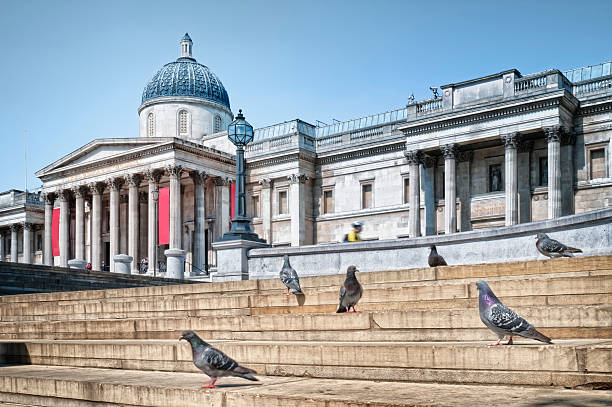
This is where London becomes unusually cooperative. The Trafalgar Square / National Gallery hinge lets you walk out of art and almost immediately back into the visible city: Trafalgar Square itself, Whitehall falling south, Covent Garden to the northeast, St James’s beyond, the West End close enough to feel available. That geographic privilege changes the emotional shape of the day. You do not feel marooned inside a worthy institution. You feel like the museum sits at a civic crossroads that belongs to the rest of your trip.
The current National Gallery plan-your-visit page (https://www.nationalgallery.org.uk/visiting/plan-your-visit) lists the Sainsbury Wing as the main entrance and places it on Trafalgar Square at the corner of Pall Mall and Whitcomb Street. That operational detail matters because it explains why this museum pairs differently from Bloomsbury or Westminster. You are not arriving in an isolated pocket and then working your way back to London. You are arriving in one of the city’s most useful hinges.
For first-time visitors, that hinge has three practical consequences. It simplifies hotel logistics. It makes lunch placement easier. And it leaves the afternoon open to graceful decisions rather than forced ones. You can do a concentrated art visit and still continue south toward Whitehall. You can keep the whole day walkable if the weather is pleasant. You can break for a serious lunch without feeling that you have abandoned the cultural mission. Even your fallback options are better, because a hotel reset from this part of town is less psychologically disruptive than one from Bloomsbury after a major museum push.
The National Gallery also happens to be the museum where editing produces the most elegant result for first-timers. Many visitors are not looking for a survey course in Western painting; they want a highly intelligent ninety minutes to two and a half hours that gives them enough art, enough context, and enough visual pleasure without museum blur. That is exactly why a strong guide is so helpful here. The task is not merely explanation. It is selection, sequencing, and permission not to overdo it.
In other words, the National Gallery’s luxury advantage is not exclusivity. It is recoverability. You can arrive fresh, see something superb, and still feel sociable afterwards. That makes it ideal for couples with dinner plans, multi-generational groups who need fewer abrupt energy cliffs, and first-time visitors who want London to remain a city rather than become a string of interiors.
There is an honest limit, though. If you care little for painting, the National Gallery can become the polite default you chose because it seemed sensible. Sensible is not always memorable. In that case, Churchill War Rooms may give you the stronger emotional return, and the British Museum may give you the stronger intellectual return. The National Gallery wins because it behaves best in a London day, not because every traveler is secretly an art historian.
For travelers who do want this as their anchor, a National Gallery private tour is where the day usually sharpens. It turns the building from “one more important museum” into a coherent encounter with a handful of paintings that you can still remember over dinner.
It also protects the body in a very London-specific way. The city does not punish you here with major climbs, but it does punish false efficiency. A heavy Bloomsbury museum followed by a second heavy stop asks for more standing, more security moments, more coat-and-bag choreography, and more attention resets than people expect. The National Gallery, precisely because of the Trafalgar Square / National Gallery hinge, lets you keep the walking you want and avoid the transitions you do not.
And it protects the mood. A London day that pivots around Trafalgar Square can still feel airy at five o’clock. A London day that bounces from Bloomsbury to another major museum often feels as if it happened mostly in foyers, thresholds, and exit corridors. That difference matters more than almost any brochure adjective.
King Charles Street is what makes Churchill War Rooms work
Churchill War Rooms is the right answer when you want one concentrated interior with Westminster already built into the day.
This is the most focused of the three experiences, and that focus is both its virtue and its limitation. The route itself tells you what kind of museum day you are choosing. From Trafalgar Square or Whitehall, the move toward King Charles Street tightens the city around you. By the time you turn down toward Clive Steps, the atmosphere has shifted from open civic stage to controlled historical threshold. The current official Churchill War Rooms visitor page (https://www.iwm.org.uk/visits/churchill-war-rooms) identifies the site at Clive Steps, King Charles Street and recommends advance booking to keep waits down. That matters because arrival here is not casual. Even before you step inside, the visit feels more bounded, more timed, and more self-contained.
That is why Churchill War Rooms pairs so well with Westminster and so awkwardly with overstuffed ambitions. If your day already includes Whitehall, St James’s Park, Horse Guards, or Westminster Abbey nearby, the War Rooms can feel perfectly judged: one strong interior with a clear emotional arc. If you are treating it as an extra after a full art day or a massive antiquities morning, it can land as one interior too many, especially because its subject matter asks for attention of a different kind.
Where the British Museum rewards breadth and the National Gallery rewards selection, Churchill War Rooms rewards concentration. You go for atmosphere, political stakes, and the intimacy of decision-making spaces. It is often the best choice for history-loving travelers, older children who connect more strongly to twentieth-century narrative than to paintings, and repeat visitors who have already done the obvious museum day and want something more specific.
It is not the default answer for every first trip because it does not give much outward range. If your party wants London “masterpieces,” the War Rooms is too narrow. If your party wants one memorable, intelligent, story-driven interior near Westminster, it can be ideal. That distinction matters because many visitors confuse emotional intensity with breadth. Churchill War Rooms is intense. It is not broad.
This is also the museum where timing discipline matters most. If you arrive late, squeezed between other commitments, the security and timeslot rhythm can make the day feel pinched. If you give it a proper slot and let the surrounding Westminster streets do the framing, it can feel beautifully exact. Think less “add-on” and more “focused chapter.”
Guided interpretation is useful here too, especially for travelers who want the Cabinet War Rooms and Churchill material read against the city outside. A route that starts with Westminster’s political geography and then drops below ground can be far more resonant than simply entering as ticket holders. That is the case for a Churchill War Rooms private tour, which tends to work best when the museum is part of a wider Westminster story rather than an isolated booking.
The honest caution is that Churchill War Rooms is the easiest of the three to overvalue if you are choosing by theme alone. Wartime history sounds inherently gripping, and often it is. But if your group’s real desire is beauty, visual variety, or a spacious sense of occasion, the War Rooms can feel claustrophobic compared with the National Gallery and less grandly expansive than the British Museum. It wins on specificity, not on amplitude.
Should you choose one major museum or two lighter stops in London?
Choose one major museum unless one of the stops is clearly lighter, more edited, and in the same geographic conversation as the rest of the day.
This is the planning question beneath the title, and it matters more than which museum you admire most from afar. On a premium stay, the objective is rarely to maximize ticket scans. It is to maximize the quality of the day. In London, one major museum usually beats two lighter stops when the major museum is the British Museum, when your party includes anyone who tires from long standing, when the day begins after a slow breakfast, or when dinner matters. Two lighter stops can beat one major museum only when they behave as a single neighborhood story rather than as two separate missions.
That is why National Gallery plus Churchill War Rooms can work, while British Museum plus National Gallery usually does not. The first pairing has a logic: art at the Trafalgar Square / National Gallery hinge, then a southward tightening toward Whitehall and King Charles Street. The second pairing looks prestigious, but it asks you to jump from Bloomsbury scale to Trafalgar Square art with too little respect for what the first museum already did to your attention span.
There is also a bodily consequence that affluent travelers sometimes underestimate because London feels flatter than Rome or Lisbon. The strain is not the incline. It is accumulation. You stand more than you think. You queue in small doses. You pass security more than once. You restart your concentration after every pavement decision, taxi stop, Tube platform, cloakroom moment, or bag check. A plan can be physically possible and still be aesthetically wrong because it exhausts the very attention you came to spend.
The city also changes the trip mood faster than people expect. A day that is too dense does not only make you tired; it changes the tone of the evening. Instead of arriving at drinks or dinner feeling expanded by what you saw, you arrive feeling compressed by everything you were trying to fit in. London’s best museum days leave a little air in the schedule. That air is not wasted time. It is the space in which the day starts to feel expensive in the right way.
Use this practical rule set:
- Choose the British Museum alone if antiquities are a true priority, if you value explanation over sheer volume, or if the day’s best finish is Bloomsbury, Soho, or Covent Garden rather than another museum.
- Choose the National Gallery as the main cultural anchor if you want one substantial interior and then freedom: lunch, Whitehall, St James’s, theatre, shopping, or a refined dinner.
- Choose Churchill War Rooms as the main interior or second lighter stop only when Westminster is already the frame and your party is genuinely interested in the subject.
- Cut first: the fantasy that the British Museum and National Gallery should be treated as equal-weight visits on the same day because both are famous.
That last line deserves to stay blunt. Most first-time visitors should not try to do the British Museum and National Gallery as equal-weight visits on the same day. If you insist on seeing both, make one of them deliberately brief and accept that the better experience would usually be to give each its own proper slot.
The same logic applies to families, celebration groups, and travelers with older parents. The group rarely remembers how “complete” the checklist looked. It remembers where the day tightened, where tempers shortened, where someone needed to sit down, or where dinner conversation revived because the schedule had not squeezed out everyone’s patience. One well-judged museum is usually what allows the rest of the day to feel cared for.
Spend on interpretation before you spend on a car
If you are deciding where premium spend earns its keep, put the money inside the museum before you put it on the street.
This is especially true for a Trafalgar Square and Westminster-focused museum day. A chauffeur adds less value than a better-guided interior, especially on a Trafalgar Square and Westminster-focused museum day. Premium spend does not help much when it goes into a car for short central moves that still require curb waits, walking from drop-off points, and repeated security handoffs. It helps far more when it edits the interior experience, protects pacing, and keeps the day from turning into self-directed overconsumption.
That does not mean a car never helps in London. It can be extremely useful on airport days, outer-neighborhood combinations, multi-generational plans with mobility limits, rainy cross-city itineraries, or days that genuinely stitch together places with awkward handoffs. But the museum choice in this article is not really a street-distance problem. It is a concentration problem. That is why the more relevant supporting read is this guide to whether a chauffeured London day is worth it.
Guides materially improve different things in each museum. At the British Museum, they prevent overload and create a route through scale. At the National Gallery, they select intelligently and help you look harder at fewer works. At Churchill War Rooms, they connect the subterranean rooms to the Westminster landscape above them. Those are different benefits, but they all have more effect on the quality of the day than shaving a few minutes off a central transfer that was never the real bottleneck.
For travelers staying in Mayfair, Covent Garden, or around Westminster, this matters because the instinct to buy smoother logistics can point in the wrong direction. The smoother choice is often not more transportation. It is better judgment applied earlier: the right museum, the right duration, the right lunch window, and a guide who knows what to leave out.
That is the planning handoff Orange Donut Tours is built for. If you already know which museum shape fits your trip, the work is in refining it: how deep to go, what to pair, where to leave air, and how to avoid paying for the wrong kind of convenience. If you want that museum day tailored around your hotel, pace, and evening plans, Inquire now. If you are still deciding whether the museum belongs inside a broader custom day, a Tailor-Made London tour is often the cleanest next step.
Choose the museum that leaves room for dinner
The best museum day for a luxury stay is often the one that still feels good at 7 p.m.
This is not a small point. High-end city trips are rarely only about the museum itself; they are about how the museum sits inside the whole day. A British Museum day tends to call for a calmer evening, ideally one that does not ask you to switch conversational gears too abruptly. The National Gallery, because of its centrality and because it rarely has to consume the entire day when curated properly, is the easiest choice if you care about cocktails, theatre, or a serious dinner. Churchill War Rooms can also support a strong evening, but only if the visit has not been crammed into a Westminster marathon.
If you are planning a celebratory table, make that consequence visible early. Do not assume you can brute-force a major museum and still feel polished enough for a late, exacting dinner. Treat Ikoyi menu & reservations as a separate planning decision made in advance, not as something you will casually sort out once the museum day reveals itself. The museum you choose changes not just your timetable but your appetite, your attention, and your willingness to dress the evening properly.
That is one reason the National Gallery wins so often for discerning first-time visitors. It preserves optionality. You can have a real museum experience and still let the evening belong to the city. If your wider trip is also balancing dining decisions, the related London food-and-wine day guide helps with the other side of that equation.
The British Museum is still worth choosing when it is the thing you most care about. It just asks for honesty. Choose it because you want depth, not because you are trying to make the day look culturally maximal. Choose the National Gallery because you want art and city life in one frame. Choose Churchill War Rooms because Westminster history is the story you want the day to tell. Once you make that decision honestly, the rest of the schedule gets easier.
FAQ
Which museum is best for a first-time visitor staying in Mayfair or Covent Garden?
For most first-time visitors staying centrally, the National Gallery is the safest choice because it sits at the Trafalgar Square / National Gallery hinge and is easy to pair with lunch, Whitehall, the West End, or a comfortable hotel return. The British Museum is better only when antiquities are the true priority and you are happy for Bloomsbury to dominate the day.
Can I do the British Museum and National Gallery in one day?
You can, but most first-time visitors should not try to do the British Museum and National Gallery as equal-weight visits on the same day. If you insist on combining them, make one of them deliberately brief and accept that the better experience would usually be to give each its own proper slot.
Is Churchill War Rooms too narrow if I only have one museum day in London?
It can be too narrow if your party wants a broad sense of London’s artistic or historical range. It is the right single museum day only when wartime history, Churchill, and Westminster’s political setting matter more to you than encyclopedic breadth or painting.
Where does a private guide help the most?
The British Museum is where a guide has the biggest effect because the building’s scale makes self-editing difficult. The National Gallery is a close second because the real luxury there is intelligent selection. Churchill War Rooms benefits most when the guide connects the underground rooms to the streets and institutions above ground in Westminster.
Is a chauffeur worth it for a London museum day?
Not usually for a Trafalgar Square and Westminster-focused museum day. In this specific planning problem, a stronger interior guide usually earns more value than a chauffeur because the main friction is not street distance but the way museums consume attention and time. Cars matter more on broader cross-city days than on compact central museum plans.
Which museum day works best with older parents or mixed-energy groups?
The National Gallery is usually the easiest because it can be edited elegantly and sits in a central zone with plenty of graceful exits and pacing options. Churchill War Rooms can also work well for interested adults if the subject lands for the whole group. The British Museum is rewarding, but only if you accept that it needs a disciplined route and more stamina indoors.
Which choice best protects a special dinner or theatre night?
The National Gallery is the best protector of the evening because it rarely needs to swallow the whole day when curated properly. Churchill War Rooms can also work if it is the day’s main interior near Westminster. The British Museum is the riskiest choice for dinner-night polish unless it is the clear emotional priority and the rest of the day is kept intentionally light.
If you’re interested in any private tours of London, please reach out to us.

















 So if you are looking for the absolute best in London & surroundings with authentic local fully-licensed native guides whose English you can actually understand and with an exclusive and amazingly fun itinerary













