Spring Orange Blossom, Autumn Ease or Winter Sun? Choosing the Right Season for a High-End Seville Stay

Updated
Autumn is the clearest default answer for a high-end Seville stay. It is the season that most often lets you see the Real Alcázar and Cathedral properly, move through Santa Cruz without rushing, cross to Triana without turning the middle of the day into damage control, and still arrive at dinner wanting the evening. Choose spring instead only if orange blossom and longer light matter more to you than crowd pressure and stricter booking discipline. Choose winter if you care less about stretching every terrace hour and more about calmer monument days, easier walking, and using Seville as a base for Córdoba or Jerez.
In Seville, the season is not mainly a weather preference; it is a route-design decision. The hinge is the Santa Cruz-to-Triana midday reset. On a map, the old center looks compact enough to improvise. In real city conditions, the day often breaks at the point where a morning around Patio de Banderas and Plaza del Triunfo turns into exposed walking via Avenida de la Constitución, Paseo de Cristóbal Colón, and the Puente de Isabel II toward Triana. That is where spring can stop feeling romantic, autumn earns its reputation, and winter begins to look much better than prestige-season marketing suggests.
That is also why Seville’s prestige season is not automatically its best season for travelers who value pace, privacy, and a usable evening. Spring has the scent, the glow, and the bragging rights. It also has denser lanes, firmer ticket-and-table choreography, and less tolerance for lazy sequencing. If you want your dates designed around how the city actually moves, not around a postcard expectation, start with seasonal Seville tours.
Spring orange blossom, autumn ease, winter sun: the decision matrix
The cleanest way to choose is to rank your trip by four things that matter more than a generic weather summary: exposed walking load, timed-entry pressure, the value of late light at Plaza de España, and whether you want Andalusia spillover beyond Seville itself.
Autumn ease — the default winner. This is the best fit when your stay revolves around the Real Alcázar, the Cathedral, Santa Cruz, Triana, Plaza de España, and one serious evening. It still feels social and open-air, but it is less likely to turn the center of the day into recovery time.
Winter sun — the strongest alternate. This is the best fit when you want lower walking strain, calmer monument rhythm, and more confidence adding Córdoba or Jerez around a Seville base. The tradeoff is shorter late light, so Plaza de España becomes a precise timing play instead of a casual afterthought.
Spring orange blossom — beautiful, but easiest to overvalue. This only wins cleanly when atmosphere itself is a trip priority and you are happy to reserve major sights, premium dinners, and ideal time slots earlier, then protect the middle of the day with much more intention than you first imagined.
- Default answer: autumn.
- Best alternate: winter.
- Most likely to disappoint when overpacked: spring.
There is an operational reason behind that ranking. The official Real Alcázar site (https://alcazarsevilla.org/) shows shorter October-to-March opening hours than April-to-September, while the Cathedral’s official schedules page (https://www.catedraldesevilla.es/en/cultural-visit/schedules-and-rates/) notes that visits can be modified around worship and cultural activity. Those are not fussy details in Seville. They change whether your core sightseeing day can breathe, and whether winter’s shorter daylight is a manageable tradeoff or a planning mistake.
What is the best season to visit Seville for a comfort-led first stay?
Autumn is the best season to visit Seville for a first high-end stay because it preserves the city’s two hardest things to hold at once: a full sightseeing day and an evening that still feels like pleasure rather than repair.
Seville does something very specific to the body. It does not wear you down with gradients the way Lisbon or Granada can. It wears you down with queue drag, reflective stone, shallow shade, stop-start movement through the narrow lanes of Santa Cruz, and repeated exposure between compact pockets of interest. A day that sounds light on paper can involve timed entry at the Real Alcázar, a slow exit back toward Plaza del Triunfo, a Cathedral visit that is longer than casual planners assume, then a river crossing or hotel return just when your concentration is already dropping. Autumn is the season when those frictions still exist without automatically swallowing the second half of the day.
Seville also does something very specific to the mood of a trip. When the middle goes wrong, the evening does not feel elegant; it feels like deferred maintenance. You cancel the stroll, simplify dinner, or treat a rooftop drink as the whole night. Autumn is the season most likely to keep the city feeling additive instead of cumulative. You can take a slower lunch, change for the evening, head out again for late light at Plaza de España or a riverfront walk, and still feel as though the day belongs to one coherent city story.
Spring can absolutely be extraordinary, but it is overvalued by travelers who confuse atmosphere with ease. Orange blossom is a bonus, not a scheduling contract. The scent can sharpen memory and make a Santa Cruz morning feel cinematic, yet it does not shorten lines, widen lanes, or reduce the number of people converging around the same postcard corners. If your goal is to feel Seville at its most sensual, spring can win. If your goal is to move through Seville with the least resistance while keeping premium dining, slower lunches, or a chauffeur-supported evening in play, spring is often the more fragile choice.
Winter is the surprise. It is not the flashy answer, but it is the season that quietly lets many travelers enjoy Seville more completely. The city’s light is clear, the old-town core is easier to absorb at human pace, and the river crossing to Triana or the southward glide to Puerta de Jerez and María Luisa Park feels like a decision rather than an ordeal. Winter loses some loose-ended terrace hours, and the city asks for better clock awareness. What it gives back is steadier energy, easier monument focus, and better odds that a day trip will not flatten the next morning.
So the editorial judgment is firm. If you want one season that usually makes Seville feel both generous and manageable, choose autumn. If your trip is more about atmosphere than ease, choose spring with open eyes. If you prize calm, appetite, and wider itinerary flexibility, winter is the wiser answer than many travelers expect.
Can you pair the Real Alcázar, Cathedral, Santa Cruz, and Triana in one day?
Yes in autumn, conditionally in spring, and in winter only if you stop pretending that every extra detour belongs in the same unrestricted day.
Autumn: the only season where the full quartet usually feels coherent
Autumn is the season in which the Real Alcázar, Cathedral, Santa Cruz, and Triana can most often live inside one elegant day without requiring heroic recovery. The reason is not simply cooler air. It is that the connectors between those zones stay worth taking. You can enter the Real Alcázar in the morning, let Santa Cruz work as the connective tissue rather than a separate “stop,” move to the Cathedral side with patience, take lunch or a short hotel pause, then cross west later in the day and let Triana become the evening district rather than a box to tick.
That sequencing matters. Santa Cruz is not a fourth monument; it is the textured corridor between major anchors. In autumn, you can linger there without the area turning into a heat trap or a crowd maze that destroys momentum. The lane pattern around Calle Mateos Gago, the approaches near the Giralda, and the slow drift back toward Avenida de la Constitución still take time, but they usually do not create the sense that you are fighting the city. By the time you angle toward El Arenal or the river, you still have judgment left.
The full day works best when Triana is treated as the second act, not as a lunchtime dash inserted too early. Cross the river later, let the bridge feel like a transition, and use Triana for a slower browse, drinks, or dinner rather than demanding that it behave like an old-town attraction. This is one reason autumn feels so balanced. It lets neighborhoods keep their intended role. The Cathedral side remains your history-heavy core. Triana becomes the release valve.
Spring: viable only if Triana becomes the evening, not the middle
Spring makes this combined day look easier than it really is. The light is flattering, the orange trees reward even ordinary streets, and the city can feel alive from breakfast onward. The trap is that beauty disguises friction. Once the approaches around Plaza del Triunfo grow thick with foot traffic and timed-entry visitors, the move from the Real Alcázar and Cathedral side into the Santa Cruz lanes becomes slower than first-time travelers expect. Add a late morning that runs long and the Santa Cruz-to-Triana midday reset can stop being a delightful neighborhood contrast and become the hinge that empties the evening.
In spring, the combined day is still possible, but only if you make one correction early: Triana should usually be your later-day district, not your midday objective. Do the monuments first. Let Santa Cruz be the atmospheric connector. Then retreat, lunch well, or take a real pause before crossing west. The travelers who get the best spring days in Seville are rarely the ones doing the most by 14:00. They are the ones protecting what happens after 18:00.
This is where spring’s prestige status can backfire for high-end travelers. Because the city feels special from the moment you step outside, there is a temptation to keep adding. A more sensible plan might be a beautifully handled monument morning, a genuine break, then Triana for dinner and riverfront atmosphere. A worse plan is trying to stack the Real Alcázar, the Cathedral, a serious Santa Cruz wander, Triana, Plaza de España, and a tasting-menu dinner into one scented, photogenic blur. The city does not reward that ambition; it punishes it quietly, later.
There is a second spring complication: the most desirable time slots and premium dinner tables tend to matter more. If your Cathedral entry drifts, lunch stretches, or the hotel pause takes longer, the whole afternoon can compress. That is exactly when affluent travelers start paying extra to fix a sequencing problem that should have been prevented. In spring, private guiding earns its value most clearly by tightening the first half of the day, not by encouraging you to do more. Spring is still wonderful. It is simply the season that exposes soft planning fastest.
Winter: easiest on the legs, stricter on the clock
Winter is often the easiest season in which to combine the Real Alcázar, Cathedral, Santa Cruz, and Triana physically. It is also the season that punishes daydreaming about daylight. Because the official Real Alcázar day is shorter in the October-to-March pattern, you need to start cleanly and stop pretending that every bonus district can remain flexible until late afternoon.
The winter advantage is obvious once you are in motion. The old town is calmer, Santa Cruz feels absorbable instead of performative, and the crossing toward Triana asks less of your body. Many travelers who believe they need a car in other seasons discover that winter lets them walk more happily than expected. But winter wins only when you respect the clock. If you leave the Real Alcázar too late, or treat lunch as endless, you can still end up forcing Triana into a rushed final act.
The fix is simple. In winter, use the shorter day to sharpen hierarchy. Decide whether Triana is your main late-day move or whether Plaza de España is. Decide whether Santa Cruz is a drift or a full exploration. The season is forgiving physically, not endlessly elastic. Once you accept that, winter can feel almost luxurious in its calm.
If the day starts looking too crowded in any season, cut Plaza de España first, not the Real Alcázar and not a well-timed Triana evening. Plaza de España pays back most when it gets the light it deserves. Forced into an already loaded core-monument day, it becomes a long southern swing that often costs more energy than it returns.
For the full sequencing logic of that core day, see this detailed Seville day-planning guide.
When a midday hotel reset or chauffeur matters more than you think
A midday hotel reset is a luxury in winter, a high-value design choice in autumn, and in spring it is often the difference between an elegant Seville day and a spent one.
Travelers regularly underestimate how hard Seville becomes after the old-town morning. Between the Real Alcázar, the Cathedral side, and Santa Cruz, you are operating in dense pedestrian space where timing, shade, and stop-start movement matter more than distance alone. Once you emerge from that zone, the next decisions are rarely neutral. Going back to the hotel, heading south toward Puerta de Jerez and Plaza de España, or crossing west to Triana all involve exposure at the exact point when the body is least grateful for more city.
That is why the Santa Cruz-to-Triana midday reset is such a revealing test. In a cool season, it can feel like a graceful change of scene. In a warm spring spell, or on an autumn day that still carries real heat, the same move can become the moment when shoes, patience, and appetite all start to fail together. It is not just the bridge. It is the whole sequence: the exit drag from the monument area, the riverfront exposure, the psychological sense that the city is suddenly longer than it looked over breakfast.
This is the point at which a hotel reset earns its keep. Not because Seville is impossible without one, but because a real pause can restore the evening to the trip. Change clothes. Sit down somewhere private. Let the day stop climbing. Then go out again with purpose. High-end travelers often treat the reset as something wasteful because they came to be in the city. In Seville, especially in spring, it is frequently the move that allows you to enjoy the city twice in one day instead of burning through it once.
Chauffeur support matters most once you leave the tight monument core. It is especially valuable when your hotel is not tucked directly into the old-town center, when you want to thread Plaza de España into the late afternoon without losing dinner polish, when older parents or children change the walking equation, or when Seville is part of a wider Andalusia trip and Santa Justa station, luggage, or a next-day departure are in play. This is where a car changes the character of the day rather than merely shortening it.
But the threshold moves by season, and this article exists to make that explicit. In winter, many travelers can comfortably walk more of Seville and save the chauffeur spend for arrivals, departures, or day trips. In autumn, a chauffeured transfer or late-day pickup can turn a very good day into a calm one. In spring, the same service may be worth arranging earlier because the city stops feeling small sooner.
Paying for a driver still cannot rescue a badly chosen hot-season midday plan between the Real Alcázar, the Cathedral, and Santa Cruz. The bottleneck there is timed entry, security, queue drag, and exposed walking once you are already on foot. Premium spend does not help once you have committed to an overheated Santa Cruz-to-Triana crossing at the worst point of the day.
That is the counterintuitive correction many high-end travelers need. The car earns its keep after the old-town core, not inside it. If you want that threshold unpacked more fully, read our Seville chauffeur guide. When you already know you want that layer of support built into the day, Luxury Chauffeured Seville Private Tour is the clearest next step.
Plaza de España late light, dinner timing, and the evening you actually get
The Plaza de España late-light payoff is strongest in autumn, most seductive in spring when protected properly, and most strategic in winter because the window arrives earlier than many travelers assume.
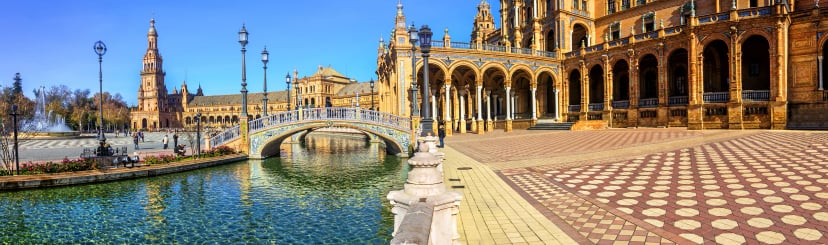
Plaza de España is not just another sight in Seville. It is one of the city’s best mood shifters. Coming there after the denser old-town core changes the trip’s emotional register: broader sky, longer sightlines, water, ceramic detail, and room to exhale. Seville’s official tourism site even recommends going early or at sunset on its Plaza de España page (https://visitasevilla.es/en/plaza-de-espana-2/). That matters because the square gives back most when it is placed as a light-and-space reward, not as an obligation squeezed into the wrong hour.
In autumn, Plaza de España belongs after a pause and before dinner. The city is still warm enough for the square to feel alive, yet usually forgiving enough that the detour south through Puerta de Jerez and into María Luisa Park does not feel like another test. This is the season when Seville can most easily deliver what affluent travelers think they are buying: a layered day with monument depth, neighborhood contrast, and a composed evening.
In spring, Plaza de España is exactly as beautiful as you hope, which is why it so often gets mishandled. Travelers try to force it into an already crowded day because the light lingers and the square photographs so well. The better move is to let it be the main visual reward of the later day. If you protect your energy, spring at Plaza de España can be one of the best hours of the trip. If you arrive after too much sun, too much queueing, and too much insistence on “seeing everything,” the square becomes another place to stand while tired.
Winter changes the square from a lazy bonus to a precise appointment. The light can be lovely, the space often calmer, and the stroll through María Luisa Park can feel wonderfully breathable. But you cannot think of it as an endlessly available pre-dinner add-on. Put it on the clock. Build toward it. Then move on before the day loses shape.
This is also where Seville most obviously affects the mood of the evening. Travelers sometimes speak about “saving energy” as though it were abstract. In Seville, the consequences are immediate. Arrive at dinner with your body still open and the city feels seductive. Arrive mildly overheated, over-walked, and under-rested, and even the best table can feel like something to get through. The evening is not protected by good taste alone. It is protected by the middle of the day.
That is why premium dining belongs in the season conversation. If you are committing to a longer dinner, especially at a restaurant whose menu structure matters, the afternoon should support it. The current menu approach at abantalrestaurante.es/menu (https://abantalrestaurante.es/menu/) is a useful reminder that serious dining in Seville is not always on the Santa Cruz-Triana postcard axis. Abantal sits east of the old core, which means the route before dinner matters. A spring day crammed with old-town walking, a river crossing, and one more scenic stop can leave less appetite than you think. Autumn and winter are much kinder to travelers who want sightseeing and a thoughtful dinner on the same day.
There is another quiet truth here. A beautifully paced Seville evening often starts by leaving something out. Skip the extra viewpoint. Do not force the full loop from the Cathedral side to Triana and then back south again unless the season and your energy genuinely support it. The city is generous when you let one late-day scene dominate. It becomes strangely small and tiring when you keep making it prove how much it can hold.
Córdoba, Jerez, or Ronda: which add-on improves or deteriorates by season?
Autumn and winter expand what Seville can comfortably hold around it. Spring narrows the margin for extras unless you lengthen the stay or willingly sacrifice ease inside Seville itself.
Córdoba: the cleanest extra in cooler seasons
Córdoba is the easiest add-on to justify around a Seville stay when the season keeps both cities usable rather than draining. In autumn and winter, Córdoba often feels like a natural extension of a Seville base because you can give the Mezquita-Catedral its due, handle the old-town walking, and still return without feeling as though you spent the whole day inside the hard middle of Andalusia. In spring, Córdoba can still be magnificent, but it starts to compete more directly with Seville’s own best atmospheric hours.
If your trip is built around first-time Seville itself, winter is the moment when Córdoba often becomes most attractive. The temperature burden drops in both places, the monument rhythm tends to feel clearer, and the next Seville day is less likely to become a recovery day. Autumn is nearly as strong, especially if your stay is long enough to keep Seville from feeling truncated. Spring only wins when you have enough nights that a day outside the city does not cost you the very reason you came.
Jerez: strongest when lunch, sherry, and indoor-outdoor balance matter
Jerez improves as Seville cools. This surprises travelers who instinctively assign it to sunnier windows. For food-and-wine visitors, autumn and winter often make Jerez a better add-on because the day can lean into cellar visits, a serious lunch, or a slower tasting rhythm without the return to Seville feeling spent. You get the pleasure of contrast without paying for it with the next morning’s energy.
Spring is still appealing for Jerez, especially if your trip is oriented around food and sherry rather than Seville’s own monument core. But if the real question is whether to spend your best atmospheric day in Seville or away from it, spring pushes you to choose more sharply. Autumn is more forgiving because Seville itself is easier to re-enter in the evening.
Ronda: the add-on most sensitive to daylight and fatigue
Ronda is the trip whose value changes most obviously with season. It is the add-on that asks for the most schedule appetite, the most tolerance for a longer day, and the most honesty about what happens when you return. Autumn is its cleanest partner because you still have enough light and stable energy for a road-heavy outing without automatically sacrificing the rhythm of the Seville days around it.
Spring can still work well for Ronda if your overall itinerary is longer and Seville is not being squeezed too tightly. But for travelers choosing between a richly lived Seville stay and a more ambitious Andalusia loop, spring is where Ronda most often becomes the trip you admire rather than the one that feels easy. Winter is the season in which Ronda demands the clearest compromise. The city can still be rewarding, but the shorter day makes the outing feel more self-contained and less spillover-friendly.
The cleanest summary is this. If you want Seville plus one additional city that leaves the whole trip feeling coherent, autumn is the strongest default and winter is close behind. If you want Seville plus the most forgiving monument-oriented extra, think Córdoba in winter or autumn. If you want Seville plus a lunch-and-cellar day, Jerez gets stronger as the season cools. If you want Ronda, give it the season with the most balanced daylight and stamina, which usually means autumn first.
For the broader question of which Andalusia add-on best suits a Seville base, use our Seville-as-a-base comparison. Before fixing dates too tightly, it is also worth checking how many nights your trip actually needs in this Seville stay-length guide.
Choose your dates backward from the hardest day, not the prettiest postcard
If the trip lives or dies on a fully satisfying Seville day with the Real Alcázar, Cathedral, Santa Cruz, Triana, and a real evening, choose autumn. If you want the calmest monument rhythm and the easiest case for adding Córdoba or Jerez, choose winter. If orange blossom is emotionally central and you are willing to reserve well, pause properly, and accept more pressure in the core, choose spring.
That is the real planning handoff. In Seville, the season changes not just the temperature but the route, the usefulness of a midday hotel break, the value of chauffeur support, and the odds that a day trip still feels worth it when you get back. If you want help choosing dates around your own pace, hotel position, restaurant priorities, and whether Córdoba, Jerez, or Ronda belong inside the same stay, Inquire now.
FAQ
Is spring the best time to visit Seville for a high-end first trip?
Not automatically. Spring is the most atmospheric choice, but it is not the easiest one. If you want orange blossom, longer light, and a celebratory feel, spring can be worth it. If you care more about smoother monument days, easier pacing, and a better chance of enjoying the evening fully, autumn is usually the stronger answer.
Is winter too quiet or too cool for Seville?
No. Winter is often the most underrated season for Seville because it lowers walking strain and makes the city easier to absorb. The real tradeoff is shorter daylight, not lack of interest. If you plan Plaza de España and your monument hours deliberately, winter can feel more satisfying than a more prestigious season.
Can I really do the Real Alcázar, Cathedral, Santa Cruz, and Triana in one day?
Yes, but the season changes how wise that plan is. Autumn is the easiest season for the full sequence. In spring, it works best when Triana is treated as the later-day district rather than a midday errand. In winter, the walking is easier but the clock matters more, so the day needs firmer priorities.
When does a midday hotel reset become worth the time?
It becomes especially valuable when the day includes a monument-heavy morning and a second-act neighborhood such as Triana or a late-light stop at Plaza de España. In spring, that pause often saves the evening. In autumn, it can upgrade a good day into a calm one. In winter, many travelers can skip it unless the trip also includes older parents, children, or a dressed-up dinner plan.
Does a chauffeur help in every season?
No. A chauffeur helps most once you leave the compact monument core, when the day involves hotel repositioning, Plaza de España, Triana, Santa Justa, luggage, or a dinner address outside the obvious old-town arc. It helps less inside the Real Alcázar-Cathedral-Santa Cruz zone, where the main friction is walking, timing, and entry logistics rather than the absence of a car.
Which add-on works best from Seville in winter: Córdoba, Jerez, or Ronda?
Córdoba is usually the cleanest winter add-on because the cooler season helps both the city itself and the return to Seville. Jerez is also strong if lunch, sherry, and indoor-outdoor balance are the point. Ronda can still be rewarding, but winter makes it the most compromise-heavy choice because daylight becomes a bigger factor.
Should I schedule around orange blossom season?
Only if you can be flexible and are treating it as an atmospheric bonus rather than the entire logic of the trip. Orange blossom can make spring Seville unforgettable, but it should improve a well-built day, not justify an overpacked one. The scent does not remove queue drag, crowd pressure, or the need for a proper midday pause.
What is the most common seasonal planning mistake in Seville?
The most common mistake is assuming that spring beauty makes Seville easier, then forcing too much into the center of the day. The second is underestimating winter by focusing only on shorter light rather than on how much calmer the city can feel. In both cases, the fix is the same: plan the hardest transition first, especially the Santa Cruz-to-Triana midday reset, and build the rest of the day around that reality.
If you’re interested in any private tours of Seville, please reach out to us.





 So if you are looking for the absolute best in Seville & surroundings with authentic local fully-licensed native guides whose English you can actually understand and with an exclusive and amazingly fun itinerary













