Is a Chauffeur-Led Seville Day Worth It for a High-End Andalusia Stay? A Comfort-First Guide to Heat, Midday Resets and Smarter Pickups
Updated
Usually, no: a chauffeur-led Seville day is not the best use of money for the classic old-town loop. Santa Cruz, the Cathedral and the Real Alcázar sit tightly enough inside the historic center that the meaningful part of the day happens on foot, not through a car window. The answer changes when Seville becomes a split day instead of a simple one: a proper midday hotel break, the jump out to Plaza de España, the westward pull into Triana, or a dinner plan that ends somewhere other than the monument core. That is when a car stops feeling decorative and starts earning its place.
The overlooked hinge is the Puerta de Jerez pickup zone. It is a pedestrian square at the seam between the old center and the broader approaches into the city, which is exactly why a day can begin gracefully there and feel clumsy if you insist on being collected from deep inside Santa Cruz. Seville rewards walking until you ask it to become two cities in one day: the intimate city of lanes, patios and monument thresholds, and the wider city of park edges, river crossings, hotel returns and dinner addresses that do not sit neatly inside the same loop.
My firm editorial call is simple. The Santa Cruz to Cathedral compact loop is the Seville day that is over-luxurized by default. Paying for a chauffeur does not materially improve a Seville day built only around Santa Cruz, the Cathedral and the Alcázar. If that is your plan, use a walking-first Seville day guide instead. If your day needs one monument cluster, one real hotel pause and one cross-city move, then a chauffeur-led Seville day starts to make practical sense rather than aspirational sense.
Is a chauffeur-led Seville day worth it if Seville is so walkable?
Yes, but only for certain day shapes. Seville is famously walkable where visitors most want to linger, yet its comfort curve changes once you add heat, a true midday reset, park-and-river geography, or a dinner destination that pulls the evening in another direction.
Santa Cruz + Cathedral + Alcázar compact loop
Best choice: Walk it. A chauffeur adds cost, waiting time and edge-of-zone pickups, but very little lived comfort.
Monuments in the morning + hotel break + old town again
Best choice: Maybe. A car helps when the hotel is outside the monument core, when heat is the main enemy, or when clothing changes and family logistics matter.
Plaza de España + Triana + evening plans
Best choice: Often yes. This is the point where Seville’s compact center stops feeling frictionless for many comfort-first travelers.
City sightseeing + outer-neighborhood lunch, shopping or dinner
Best choice: Usually yes. The value is not spectacle; it is continuity, cooled handoffs and a better-preserved evening.
The decision is less about distance than about rhythm. First-time visitors often overestimate how useful a vehicle is inside the monument core because Seville’s famous names look separate on a list. In reality, the Cathedral, the Archive of the Indies and the Alcázar belong to the same historic center cluster, while Santa Cruz is a dense maze of narrow lanes built to be walked and slowly read. The opposite mistake is just as common: underestimating how much the day lengthens once Plaza de España, a river crossing into Triana, a return to the hotel and a proper dinner are all forced into the same afternoon.
The Seville day that is over-luxurized by default
The pure old-town day works better on foot. That is the clearest answer in this guide, and it matters because a lot of high-end travelers are sold cars in cities where the real upgrade should have been a better guide, better timing or better tickets rather than a vehicle waiting outside the wrong zone.
Think of the classic first-day plan: early entry to the Alcázar, a Cathedral visit, time inside Santa Cruz, perhaps a long lunch, perhaps a pause at a shaded square, and then a gentle drift into the afternoon. The most rewarding parts of that day are the parts where a car simply cannot participate well. From Plaza de Santa Cruz to Callejón del Agua, the point is to drift through the quarter, not keep escaping it. Santa Cruz is not a district you “cover” by driving. It is a district of winding lanes, small passages and short reveal moments: the turn into a quiet square, the sudden feel of shade near a wall, the tiny compressions and openings that make the quarter memorable. Once you are actually in the fabric of Santa Cruz, a chauffeur is not a comfort solution. It is a remote accessory waiting on the perimeter.
That is why the Santa Cruz to Cathedral compact loop proves the rule. Even travelers who usually prefer private transport in London, Paris or a spread-out Andalusian touring day should resist it here. You may still use a car to arrive at the old town from the hotel in the morning, but not as the organizing principle of the day itself. The payoff in Seville’s historic heart comes from continuity: one walkable story, not a string of miniature transfers.
There is also a psychological trap. When guests book a chauffeur for this compact loop, they often feel pressure to justify it. The day becomes over-managed. People start hunting for pickup points after short visits, or trying to “see more” because a car is available. That is exactly backwards in Seville. The right luxury move is usually to slow down and let the city’s compact core work as intended.
If the morning anchor is the Alcázar, keep it that way. Use a strong walking plan or a focused guided entry such as Real Alcázar private tours, then continue the day on foot instead of trying to convert the city into a driving itinerary. The same logic applies to a Cathedral-led morning: if the monument itself is the center of gravity, a specialist experience such as Seville Cathedral private tours does more for the day than a vehicle that mostly waits beyond the pedestrian lanes.
Where premium spend does not help is inside this monument loop. Premium spend does not help inside the Santa Cruz-to-Cathedral compact loop, because the meaningful part of that day is pedestrian and the car can only wait outside it. That sentence is not anti-chauffeur; it is simply pro-Seville. The city’s core was not built to reward constant vehicular intervention, and comfort-first planning should respect the city you are in rather than import another city’s solution.
A non-obvious local consequence sits beneath that judgment. Much of Santa Cruz feels effortless on a map because the distances are short, but the effort comes from interruption rather than mileage. You stop for security, ticket checks, slow-moving clusters, photo pauses, narrow corners, and the tiny decisions that old quarters generate every few minutes. Add a car and you do not remove that friction. You only add another layer: where to meet, how to reach the edge, whether the driver can be where you imagine, and whether the moment really warrants a transfer at all.
For couples on a first visit, this is especially important. Seville’s romance is rarely improved by over-routing. The city feels luxurious when you move through it with confidence and enough slack for a coffee, a glass of something cold, or ten unplanned minutes in a shaded square. It feels oddly transactional when you convert each move into a pickup. For families, the same rule often holds unless the family includes grandparents, very young children in heat, or an afternoon destination outside the compact core. For celebration travelers dressed for a serious evening, the answer may shift later in the day, but not necessarily in the morning.
So the cut-first rule begins here: when the itinerary gets too full, cut the second neighborhood before you cut the integrity of the walking loop. Do not start a compact old-town day on foot, interrupt it with a transfer, and then wonder why Seville feels chopped into pieces. Keep the first half coherent. That alone solves more comfort problems than many travelers expect.
Why the Puerta de Jerez pickup zone matters more than people expect
If you are going to use a vehicle in Seville, the pickup point often matters more than the vehicle category. The Puerta de Jerez pickup zone is valuable because it sits at the hinge between the old center’s pedestrian logic and the broader road network. It is a cleaner handoff than trying to improvise collection from deep inside Santa Cruz or from somewhere vague “near the Cathedral.”
This is the overlooked local hinge that separates a smooth Seville day from an awkward one. Travelers often think the most elegant pickup is the closest possible pickup. In Seville, the smarter pickup is often the easier pickup. Starting or resuming from Puerta de Jerez means you are already at the seam where Avenida de la Constitución, the monument cluster and the broader approaches toward María Luisa Park and the river begin to open out. The day starts smoother because the driver is not fighting the city’s most intimate urban fabric just to satisfy an over-literal address.
That matters most on heat days and on split days. Seville is not a hill city, but it is a city of accumulated exposure. The body tax comes from a different pattern: stone underfoot, slow queue drag, sun in the open areas, and the false promise of a map that makes everything look ten minutes away. A morning in the Alcázar and Cathedral, followed by lunch and then a walk toward the park or back to a hotel, does not usually feel strenuous at 10:00. It feels long at 15:30. That is why the midday hotel break is not an indulgent extra for many travelers; it is the piece that decides whether the evening still feels alive.
A proper midday reset is also where a chauffeur begins to earn its keep. Not because Seville suddenly becomes hard, but because it becomes discontinuous. You have already had one dense walking chapter. You may want showers, cooler clothes, medication, a nap for a child, a rest for an older parent, or simply twenty quiet minutes in a room that is not public. Then you want to re-enter the city with intention rather than inertia. A car turns that pivot into one movement instead of several.
The difference to the trip mood is outsized. Seville has a way of making a day feel shorter than it is when the chapters connect naturally. It can also make a day feel strangely overlong when every chapter has to be restarted. The mood penalty is not the extra ten or fifteen minutes; it is the repeated sense of beginning again. Find a taxi. Explain the stop. Unload. Cool down. Leave again. Decide where to be collected. Do it once and it is fine. Do it three times, and the city loses some of its grace.
This is why I would rather see travelers use one intelligent pickup at the Puerta de Jerez pickup zone than insist on an all-day vehicle for a day that is mostly walkable. Seville does not need continuous chauffeuring nearly as often as it needs good transitions. That is a more honest, and more useful, luxury judgment.
Your hotel location affects this more than many visitors realize. A guest staying inside Santa Cruz may still find the compact loop easiest on foot, because hotel and sights are already threaded through the same district. A guest staying in El Arenal may still walk easily into the monument core but appreciate a later handoff. A guest staying across the river in Triana, or farther out than the center feels on paper, may value the break and re-entry more. That is one reason hotel choice and day design belong in the same conversation, not separate ones; where you stay in Seville quietly changes whether a chauffeur feels redundant or rational.
There is one more honest warning here. A midday car does not rescue a bad morning plan. If you have already overloaded the first half of the day with too much time in line, too little shade and too many “while we are here” additions, even the best pickup will only soften the damage. The luxury move is not to keep adding transport to an overstuffed day; it is to stop forcing the wrong amount into one day in the first place.
When the Plaza de España to Triana shift changes the answer
This is the point where the answer often flips to yes. The Plaza de España to Triana shift is where Seville’s walkable core stops feeling frictionless for many travelers, not because the city suddenly becomes vast, but because the day starts to span different urban experiences with different kinds of walking.
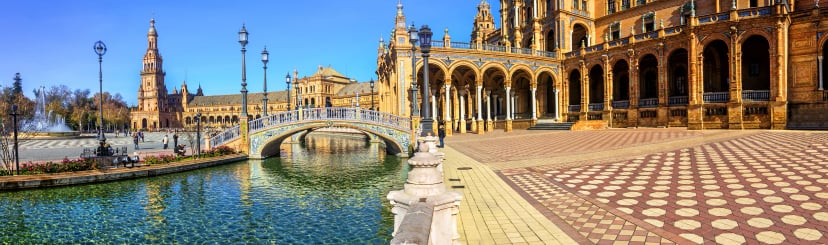
Plaza de España sits in María Luisa Park, and in pure map terms it can look temptingly close to the historic center. In the cool of the morning, and for travelers who genuinely enjoy walking, it can be connected on foot from Santa Cruz or Puerta de Jerez without drama. But the practical consequences matter more than the abstract distance. The old-center walk is full of texture and intermittent shade; the park-and-plaza chapter is broader, brighter and more open. Then Triana asks for another change: a move back toward the river, then across the Guadalquivir by Puente de Isabel II, then into a neighborhood that rewards lingering rather than merely “ticking.” That is a very different day from staying inside the Cathedral-Santa Cruz orbit.
For comfort-first travelers, this is where Seville begins to behave less like one easy loop and more like a set of linked scenes. The issue is not whether the route is technically possible on foot. Almost all of it is. The issue is what that choice does to the body by late afternoon and to the appetite for evening plans afterward. Many first-timers can absolutely walk from Santa Cruz through the Jardines de Murillo and along Paseo de Catalina de Ribera toward the park, then later cross to Triana. The better question is whether they still want to do that after a monument morning, lunch, and perhaps a dinner reservation that asks them to look and feel better than “end-of-day tourist.”
Plaza de España also creates a particular kind of false confidence. Because it is so famous, travelers often imagine it as part of the same automatic city-center stroll as the Cathedral. It is not quite that. It is the first major Seville sight where the city opens its scale. That can be glorious. It can also be the exact moment when the day changes from immersive to effortful if you have not planned your handoffs well.
Triana then adds another practical shift. The neighborhood is best enjoyed slowly: ceramics, side streets, tapas rhythm, the sense of being in a place with its own identity rather than a quick appendage to the center. But the crossing itself matters. The river is not a giant barrier, yet it is enough of a hinge that many travelers feel the difference. Once you are deciding whether to cross to Triana after Plaza de España, and then whether to return to the hotel before dinner or go straight on, you are no longer in “walk a compact old town” territory. You are in “compose a city day” territory. That is where private transport becomes sensible.
If Plaza de España is the afternoon anchor, a focused experience such as Plaza de España private tours can pair well with a later vehicle handoff rather than a full-day chauffeured circuit. If Triana is the second half’s true purpose, a neighborhood-specific plan such as Triana private tours often benefits from arriving fresh rather than worn down by the connective walking that came before it. Again, the upgrade is not speed for its own sake. It is preserving the part of the day that deserves your attention.
This is also where families and multigenerational groups start to diverge from younger independent walkers. Seville’s challenge is often cumulative, not dramatic. Children can be fine in Santa Cruz and then fall apart in the big open spaces. Older parents can manage the morning beautifully and then lose enthusiasm for the river crossing or the extra return leg. A chauffeur day that begins only after lunch can be the right compromise: enough walking to feel the city, enough help to stop the second half from becoming attritional.
My strongest judgment here is this. Do not judge the worth of a chauffeur in Seville by the size of the city; judge it by the number of distinct chapters you are trying to stitch together after lunch. Once those chapters include Plaza de España, Triana and either a hotel reset or a serious evening reservation, the car starts to protect not just energy but coherence.
Where private transport changes the day quality, and where it still does not
Private transport changes Seville day quality when it solves a transition problem, not when it tries to replace walking. That is the central value judgment. The car is worth its cost when it joins together pieces that would otherwise create repeated restarts: monument core to hotel, hotel to park, park to Triana, Triana to dinner, or any version of Seville that mixes the intimate city with the wider one.
It still does not help if you are using it as a status signal for tiny hops. A ten-minute walk you are taking only because the car exists is rarely a luxury win. In Seville, the elegant use of a chauffeur is selective. You walk the parts that should be walked, and you ride the parts that would otherwise flatten the day.
This becomes especially clear around dining. A dinner anchored by Michelin Guide: Cañabota (https://guide.michelin.com/us/en/andalucia/sevilla/restaurant/canabota) can fit neatly into a day that remains largely within the old-town grid, because Cañabota sits on Orfila, still inside central Seville rather than at the far edge of a sightseeing arc. That means a walking-first day can often carry into dinner without forcing a full vehicle strategy. By contrast, an evening shaped around abantalrestaurante.es/menu (https://abantalrestaurante.es/menu/), with its address on Calle Alcalde José de la Bandera, pulls the night in a different direction and makes a proper reset between sightseeing and dinner feel much more persuasive.
Food-and-wine travelers should read this carefully. The real luxury is not “car plus restaurant.” It is choosing whether the restaurant sits naturally at the end of the day you already have, or whether it creates a second Seville after dark. Cañabota on Orfila may reward staying central and light on your feet. Abantal, by address alone, suggests a more deliberate transition. Neither choice is inherently better. The important point is that restaurant geography can quietly decide whether a chauffeur is useful long before the car itself enters the conversation.
Celebration travelers often feel this most sharply. If you are dressing for a birthday dinner, an anniversary or a proposal night, the midday reset is no longer optional nicety. It becomes part of the event. The car then earns its cost because it keeps the day from spilling over onto the evening version of yourselves. That is a different calculation from sightseeing efficiency, and an honest planner should say so.
Small groups have their own version of the same logic. Two fit adults can improvise Seville more easily than four or six people who all want shade, a short pause, a washroom, a bag drop or a reliable arrival before dinner. The more people involved, the less elegant the repeated-taxi solution tends to feel. Private transport can then be less about luxury optics and more about keeping the group in one rhythm.
The city’s effect on the body deserves one blunt paragraph. Seville does not usually defeat people with gradients. It wears them down through accumulation: queueing inside major monuments, stepping over old paving, moving from tight shade to broad exposure, and underestimating the size of open places like Plaza de España because the old-town map looked so manageable. By late afternoon that often shows up not as collapse, but as shortened patience, slower decisions and a rising temptation to skip the evening plan you most cared about.
The city’s effect on the trip mood deserves one too. Seville feels generous and atmospheric when the day holds together as a sequence of scenes. It feels smaller, calmer and more gracious than it really is. The mood drops when the plan becomes logistics-forward: too many pickups, too much backtracking, or the sense that you are always either leaving or arriving. Good private transport can prevent that. Bad private transport planning can actually create it.
So here is the spending judgment in plain language. Paying more changes the trip when it preserves transitions, privacy, temperature, wardrobe changes, group cohesion or evening energy. Paying more does not change the trip when it merely shadows you around a compact pedestrian district that wants to be walked. That is the line. Seville is clear about it if you listen.
A sequence walkthrough that keeps Seville elegant instead of overplanned
The best chauffeur-led Seville day usually starts as a walking day. That is the sequence most travelers miss.
Start with one concentrated monument chapter. Choose the old-town anchor that deserves your best attention while you are still fresh. That might mean the Alcázar and Santa Cruz, or the Cathedral and immediate surroundings, but not a frantic attempt to sweep every named sight before lunch. Walk deliberately. Let the morning have one shape.
Use one intelligent handoff, not constant collection. If the afternoon will widen, aim for the Puerta de Jerez pickup zone rather than trying to be collected from the deepest part of Santa Cruz. This keeps the morning intact and makes the transition cleaner.
Take the midday break seriously. Go back to the hotel if the afternoon includes Plaza de España, Triana or a meaningful evening reservation. Change clothes, cool down, repack, and decide what the second half is actually for. If the day is already feeling crowded, keep the reset and cut the least important add-on instead.
Give the second half one job. This is where Seville days are won or lost. After lunch and a break, choose the afternoon’s real purpose: Plaza de España with time to enjoy it, or Triana with time to linger, or a celebration/dining arc that needs calm arrivals. Do not try to make the second half compete with the first half for monument density.
End with intention. If dinner sits naturally inside the day’s geography, stay out and let the day taper into the evening. If dinner requires a wardrobe reset or a clear directional shift, use the car to mark that change cleanly. The point is not to be driven as much as possible. The point is to arrive at the evening still interested in it.
This is also the place to be honest about wrong fit. Travelers who are energetic walkers, staying inside Santa Cruz, traveling light, and content with a lunch-and-wander day should probably skip the chauffeur entirely within Seville itself. Travelers combining a morning monument chapter with a true hotel pause, Plaza de España, Triana, a celebration dinner, older parents, children or a group dynamic should look at transport much more seriously.
Once your Seville plan needs one walkable core, one cooled reset and one clean afternoon handoff, you are no longer choosing a car for prestige. You are choosing whether the day feels pieced together or properly composed. That is the point where professional planning earns trust. Inquire now
FAQ
Is Seville too walkable to justify a chauffeur?
No. Seville is walkable enough that a chauffeur is unnecessary for the classic monument core, but not so walkable that every combined day stays easy. Once you add a midday hotel return, Plaza de España, Triana or a dinner address outside the compact loop, private transport can become the cleaner choice.
What is the best no-car case in Seville?
The best no-car case is the Santa Cruz to Cathedral compact loop, especially when the Alcázar is part of the same day. That cluster rewards slow walking and punishes over-management more than it rewards a waiting vehicle.
When does a chauffeur become worth it in Seville?
A chauffeur becomes worth it when the day has more than one rhythm: monument morning, hotel break, afternoon expansion, dinner transition, group logistics or heat management. In other words, when Seville stops being one continuous walk and starts becoming a series of chapters.
Why is the Puerta de Jerez pickup zone so useful?
Because it is a cleaner seam between the pedestrian monument core and easier road access. That makes it a better handoff point than improvising pickups from deep inside Santa Cruz, where the romantic part of the day and the drivable part of the day do not line up neatly.
Can you walk from Santa Cruz to Plaza de España and then to Triana?
Yes, many travelers can. The better question is whether you should do that after a monument morning and still expect to feel fresh for the evening. For walkers who enjoy long city days, it is possible. For comfort-first travelers, that sequence is often the point where the day starts to feel longer than it looked on the map.
Does paying more for a car help with heat in Seville?
It helps when it reduces exposure between meaningful parts of the day and allows a true midday reset. It does not help if you are using it for tiny transfers inside the old town where the practical experience remains mostly on foot.
What should I cut first if my Seville day is getting too full?
Cut the least important second-half add-on before you cut the midday break. In Seville, travelers often regret forcing one more district more than they regret seeing slightly less. A calmer second half usually beats a longer one.
Is a chauffeur-led Seville day a good idea for food-and-wine travelers?
Yes, but selectively. It works best when restaurant geography changes the day’s shape, when a serious dinner asks for a reset, or when lunch and dinner pull you into different parts of the city. It is less useful when your whole day and dinner remain inside the same old-town orbit.
If you’re interested in any private tours of Seville, please reach out to us.





 So if you are looking for the absolute best in Seville & surroundings with authentic local fully-licensed native guides whose English you can actually understand and with an exclusive and amazingly fun itinerary













