How 1929 and 1992 Remade Seville: Plaza de España, Cartuja and the River Between Them

Updated
Treat Seville’s 1929 and 1992 exposition landscapes as one full day only if you separate the walking from the transfer: begin at Plaza de España and María Luisa Park, stop trying to collect every 1929 pavilion, then hand the route to a chauffeur for Cartuja and one carefully chosen interior. That works because the 1929 grounds were stitched into the southern city and reward close walking, while the 1992 site is an island-scale campus whose surviving buildings are dispersed and unevenly visitable. The clearest exception is a first-time visitor with only one day: the Alcázar, Cathedral and Santa Cruz should still win. This is a second-visit architecture route, not a substitute for Seville’s historic core.
The deciding hinge is the same kind of small logistical truth as the Santa Justa-to-old-town reset: a short vehicle move determines whether the city reads as one story or two unrelated excursions. The river looks like a convenient line on a map, yet the useful crossings sit far apart, the approaches absorb time, and Cartuja’s entrances are not arranged like a compact monument district. A guide-led morning and a coordinated driver handoff are therefore more valuable here than another pre-booked “priority” entrance. Travelers considering private tours in Seville should think of the guide and vehicle as two different tools, not as an all-day convoy.
Seville’s twentieth-century modernity wore two different costumes. In 1929, progress was staged through brick, tile, gardens and an idealized regional tradition; in 1992, it was staged through bridges, transport infrastructure, international pavilions and a newly accessible island. The river is not empty space between the two fairs: it is the evidence of how Seville changed.
1929 vs 1992 in Seville: the planning matrix
1929: civic theater in regional dress
Purpose: The Ibero-American Exposition projected a renewed cultural and commercial relationship between Spain, Portugal and the Americas while giving Seville a ceremonial new southern face. Its architecture often looked backward in order to argue that the city could move forward without losing its identity.
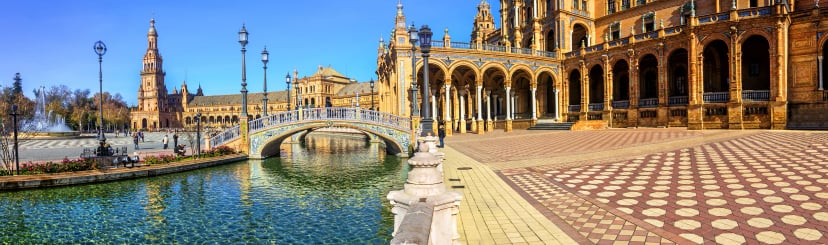
Best way to experience it: On foot, with a guide who can distinguish the fair’s urban plan from picturesque decoration. Plaza de España is the grand statement; María Luisa Park and Plaza de América show how landscape and pavilion architecture made that statement habitable.
Interior verdict: The 1929 story is primarily exterior. Enter one pavilion only when the collection deepens the argument, rather than because a door happens to be open.
1992: a universal fair built around movement
Purpose: Expo ’92 marked five centuries since 1492 under the theme of discovery, but its lasting urban effect was broader: Seville gained new transport links, bridges and a transformed relationship with Isla de la Cartuja. The future was presented through technology, global participation and infrastructure rather than a single regional style.
Best way to experience it: By vehicle between selected stops, then on foot within each stop. Cartuja is not a coherent open-air museum, and many former pavilions have been adapted, restricted, altered or removed.
Interior verdict: The Monastery of Santa María de las Cuevas and the Centro Andaluz de Arte Contemporáneo offer the strongest interior because one site contains monastic, industrial, Expo-era and contemporary layers.
Where the contrast is strongest
1929 gives you continuity: formal avenues, framed views, ceramic craft and a park that softens monumental scale. The fair feels absorbed into Seville.
1992 gives you rupture: broad roads, isolated architectural objects, reused plots and reminders that universal exhibitions are temporary machines. The fair feels like a district still negotiating what it became afterward.
Who gains most from combining them
This is the strongest architecture-and-urban-history day for repeat visitors, design-minded couples, families with older children, and small groups who want a coherent twentieth-century narrative. It is a weaker choice for travelers who mainly want interiors, anyone determined to walk the entire route, and visitors with fewer than five useful hours.
Begin with 1929: Plaza de España is the thesis, not the whole chapter
Start with Plaza de España in the morning, but treat it as an argument to be read rather than a backdrop to be exhausted. Aníbal González designed the complex for the 1929 exposition, using a vast semicircle, bridges, towers, brick, ironwork and ceramic programs to turn national representation into a piece of urban theater. The official Plaza de España visitor page (https://visitasevilla.es/plaza-de-espana-2/) is useful for checking current access conditions, especially when concerts or civic events affect the space, but the planning judgment remains simple: arrive before the square has absorbed the day’s full heat and before photography stops begin controlling your pace.
The overvalued default most readers should reconsider is the boat on the canal. It photographs well and can amuse younger children, but it consumes a disproportionate amount of attention, creates a wait-and-regroup interruption, and contributes almost nothing to understanding how the fair remade Seville. For an architecture-led day, choose the upper and lower viewpoints, two or three province alcoves with personal relevance, and the relationship between the building and the park. Do not spend the morning completing all the ceramic benches as though they were passport stamps.
There is another correction worth making early: María Luisa Park was not created whole-cloth for the exposition. It grew from the former gardens of the Palace of San Telmo, and Jean-Claude Nicolas Forestier’s early twentieth-century redesign supplied the landscape armature into which the fair would later settle. That matters to the traveler because the park is not simply “the next attraction.” It is the mechanism that turns Plaza de España’s monumental scale into a walkable sequence of shade, water, curved paths and smaller rooms. Miss that transition and 1929 becomes a single famous photograph; follow it and the fair becomes a piece of city-making.
A guide should use the square to establish three ideas before moving on. First, regionalism here was modern strategy, not nostalgic retreat: local materials and historical references were used to make an international exposition feel unmistakably Sevillian. Second, the semicircle and processional space were designed for representation, not for the casual social life of a neighborhood plaza. Third, the complex survives so convincingly because later Seville found uses for it; it did not remain a sealed exposition relic.
Allow enough time to cross one bridge, rise to a gallery view if steps are comfortable, and come back to ground level before moving into the park. The bridge stairs, long arcades and sunlit central space can quietly increase the walking load for older parents or travelers managing knee pain. A private guide can compress the explanation and select the most revealing details, but no guide can make the stone and brick stop radiating heat. In warm weather, the correct upgrade is earlier timing and a shorter open-space circuit, not a longer list of architectural details.
Continue through María Luisa Park to Plaza de América
The next sequence should be Plaza de España, the park’s shaded interior, then Plaza de América. This order moves from the exposition’s largest national statement to a more legible ensemble of pavilions, where Mudéjar, Renaissance and Gothic references face one another across a garden square. The contrast is useful because it shows how 1929 packaged Spanish history into distinct architectural languages rather than relying on one consistent style.
For travelers who want the park itself to carry more of the day, the María Luisa Park decision guide explains how to balance the square, the museums and the shaded paths. For this route, however, the park should remain connective tissue. Choose one or two garden rooms, notice how fountains and ceramics moderate the heat visually and physically, then continue south rather than turning every glorieta into a stop.
The strongest 1929 interior for this specific story is usually the Museo de Artes y Costumbres Populares in the Mudéjar Pavilion, provided its current opening status and the day’s schedule align. Its collections of Andalusian material culture, craft and domestic life make the building’s regional language more than surface decoration. Architecture-only travelers can admire the pavilion from outside and keep moving. The Archaeological Museum, housed opposite in the former Fine Arts Pavilion, should never be treated as a guaranteed anchor without confirming its current status; major reform has affected access, and building a premium day around an assumed reopening is poor planning.
The Casa de la Ciencia in the former Peruvian Pavilion can work for families whose interest shifts from architectural history toward science and natural history, but it weakens the clean 1929-versus-1992 comparison if added merely because it is nearby. The same principle applies to the national pavilions extending beyond the park. Peru, Mexico, Colombia, Argentina and others can enrich a specialist route, yet a general architecture day needs one representative facade, not a roll call. Select the pavilion that lies naturally on the exit path or carries personal relevance; cut the rest.
This is where a private guide earns trust by saying no. The 1929 exposition was extensive, and its surviving buildings now hold universities, consulates, cultural institutions and offices. Their present-day uses are part of the story, but they do not all deserve interior time. A traveler should leave the 1929 zone with the fair’s purpose and urban method clear, not with a blurred memory of six historicist facades.
The river is the hinge: where the driver handoff should happen
The best driver handoff is at the western or southern edge of María Luisa Park, usually along a vehicle-friendly stretch such as Paseo de las Delicias, after the 1929 walk is complete. It is better than summoning a car in the middle of the Plaza de España visit, and it is cleaner than pushing everyone into the pedestrian logic of Santa Cruz for lunch before trying to regroup. From the park edge, the route can follow the river north, pause for lunch in Arenal or Triana according to the evening plan, then continue to Cartuja with the same driver.
The exact crossing should be chosen by the first Cartuja stop and live traffic, not by loyalty to one “scenic” bridge. A route approaching the southern and central part of Cartuja may favor Puente del Cristo de la Expiración; a sequence entering farther north may make Barqueta more logical. The guide’s job is to keep the historical thread running while the driver handles the geometry. Torre del Oro, the old port edge, Triana and the newer bridges then become the transition from Seville’s Atlantic memory to its late-twentieth-century reinvention.
Walking the entire distance is the false economy. Seville does not punish this route with steep hills; it punishes it with exposure, long approaches and repeated orientation resets. A traveler who leaves Plaza de América, walks to the river, continues north, chooses the wrong crossing, then searches for the CAAC entrance can arrive at the most intellectually rewarding Cartuja stop already tired of Cartuja. The body feels the accumulated hard paving, reflected sun and bridge approaches before the mind gets the payoff. This is why the transfer matters even for active travelers.
The mood changes just as decisively. The badly sequenced version feels like a long morning of decorative architecture followed by a stranded business park. The well-sequenced version moves from ceremonial confidence, through the working river, into a monastery-factory-museum and the fragments of a universal fair. The first flattens the day; the second makes Seville feel larger, stranger and more modern without sacrificing the evening.
Extra spend earns its cost when it buys coordinated pickup, air-conditioned transfer, flexible bridge choice, a hotel or lunch pause, and a driver who can reposition while the guide remains with the group. It also helps couples celebrating an occasion, multigenerational families and small groups because no one has to negotiate taxis, split vehicles or an uncertain meeting point. The chauffeur-led Seville guide gives the broader citywide logic.
Premium spend does not help inside Plaza de España or among the adjacent María Luisa Park pavilions; a vehicle cannot improve close-looking, and repeated micro-pickups only break the narrative. The premium choice is not “car everywhere.” It is walking where the city is coherent and driving where the twentieth-century city deliberately expanded the scale.
This is the natural point for a planning handoff. Orange Donut Tours can pair an architecture-minded private guide with a chauffeur, choose the park-edge pickup, confirm the day’s viable interiors, and return you to the correct side of the river for dinner or a performance. See tailor-made Seville touring or Inquire now.
Read Cartuja selectively: one interior and a controlled exterior loop
Cartuja is worth the detour when you enter through one place that explains the island’s layers, not when you roam in search of every Expo ’92 survivor. The best first stop is the Monastery of Santa María de las Cuevas, now home to the Centro Andaluz de Arte Contemporáneo. Check the CAAC official site (https://www.caac.es/) for current exhibitions and visitor information, because the temporary program affects how much time the art itself deserves. Even when a particular exhibition is not the main draw, the complex is the strongest historical hinge on the island.
The monastery gives the 1992 landscape a past. Carthusian religious spaces, later industrial interventions from the Pickman ceramics factory, surviving kilns and chimneys, gardens, Expo-era restoration and contemporary installations occupy the same enclosure. That density is precisely what the dispersed fairground outside lacks. A visitor can see how Seville repeatedly repurposed Cartuja before and after the universal exposition, rather than imagining that the island began in 1992.
For architecture and urban-history travelers, allow roughly ninety minutes for the complex, extending the visit only when the exhibition program strongly matches the group’s interests. A focused visit should include the principal monastic spaces, the industrial traces and a selective look at contemporary art. Do not insist on every gallery. The building is the anchor, and the art should deepen rather than obscure the route’s central question: how did Seville turn inherited land into a platform for successive versions of modernity?
The answer differs sharply from 1929. The earlier fair made new architecture look rooted by embedding it in garden design and historical styles. Expo ’92 made the island feel newly connected and internationally current through infrastructure, technological display and architectural variety. Its theme, the Age of Discoveries, tied the fair to the fifth centenary of 1492, but the urban legacy travelers feel today is movement: bridges, roads, a wider metropolitan reach and the incorporation of Cartuja into everyday Seville.
That is also why the 1992 site can disappoint unprepared visitors. A universal exposition is designed for temporary spectacle and immense visitor flows, not for elegant afterlife as a compact heritage quarter. Some pavilions found strong new uses, some changed substantially, some are not routinely open, and others disappeared. Do not plan Cartuja as though every Expo ’92 pavilion were a visitable museum. A responsible guide identifies what can be seen from public space, what has a meaningful current use and what should remain context rather than a stop.
Which Expo ’92 interiors merit time?
First choice: CAAC and the monastery
Choose it for: architecture, layered history, contemporary art and the clearest explanation of Cartuja before and after 1992.
Skip or shorten it when: the group has no appetite for museum space and needs an interactive family experience. Even then, a short exterior and courtyard-focused visit can still carry the historical argument if access permits.
Second choice: the Navigation Pavilion
Choose it for: families, maritime history and travelers who prefer an interpretive exhibition to contemporary art. Its riverfront position also makes the relation between discovery, navigation and the Guadalquivir explicit.
Skip it when: the day already includes one substantial interior or the group is more interested in the architecture of fairs than in interactive content. Confirm current access and exhibition conditions before treating it as fixed.
Exterior-only choice: a short pavilion legacy loop
Choose it for: seeing how varied national and thematic architecture was reused. The former Moroccan Pavilion, today associated with Fundación Tres Culturas, can be a useful example when the route and access conditions suit.
Keep it controlled: twenty to forty minutes of selected exteriors is usually enough. Broad avenues and large plots magnify small detours, and a second “quick look” can turn into another vehicle reset.
For a deeper treatment of the island’s museums, crossings and stop selection, use the Cartuja detour guide. In this two-exposition route, the island should remain the second movement rather than becoming a separate roundup. The goal is not to prove that Expo ’92 has many remnants; it is to understand why its urban logic feels so different from 1929.
The full sequence that makes the contrast land
A well-paced version needs a true day, but it should not feel like a conventional “full-day sightseeing” marathon. Think in movements rather than clocked attractions. The sequence below is deliberately selective and can contract in heat, rain or low museum interest.
- Opening movement at Plaza de España: allow about an hour to read the geometry, ceramics, bridges and relation to the park. Add time only for photography with purpose, not for a canal wait.
- María Luisa Park to Plaza de América: use forty-five to seventy-five minutes, depending on mobility and whether the park itself is a priority. The aim is to feel the transition from spectacle to landscape.
- One 1929 interior or pavilion focus: allow forty-five to sixty minutes if entering the Museo de Artes y Costumbres Populares or another confirmed venue. Architecture-only groups can replace this with a shorter guided exterior comparison.
- Driver handoff and lunch: use the park edge rather than a deep old-town meeting point. Arenal suits travelers returning later to the historic center; Triana can make sense when the evening also remains west of the cathedral district.
- Cartuja anchor interior: give the CAAC and monastery around ninety minutes, with a shorter version for low museum appetite and a longer version only when a temporary exhibition genuinely deserves it.
- Expo ’92 exterior coda: finish with a concise drive-and-walk loop around one or two meaningful remnants, then leave before the district’s scale begins to dilute the argument.
In total, this usually asks for roughly seven useful hours before an evening commitment, not including an unhurried hotel break. Travelers who want a serious lunch should cut one interior rather than compress both. Travelers who want a tasting-menu dinner should return to the hotel with enough time to change and recover; an architecture day loses its sophistication when the final hour becomes a race through traffic.
The five-hour version
With about five hours, keep Plaza de España, a direct park crossing and the CAAC. Skip Plaza de América’s interior, use the driver handoff immediately after the park, and treat lunch as light or later. This is the minimum viable contrast. Any attempt to add the Navigation Pavilion, multiple national pavilions or a river cruise will turn the route into disconnected samples.
The high-heat version
In hot conditions, start with the exposed Plaza de España spaces, move into the park while shade still helps, and let the transfer and lunch occupy the day’s most draining period. Cartuja should begin with the monastery interior rather than a broad exterior drive. The route is viable in warm weather because the two landscapes can be divided by a cooled transfer, but it is not improved by pretending that every open space deserves equal time. For a broader seasonal strategy, consult Seville’s high-heat river strategy.
The mobility-sensitive version
Plaza de España’s arcades and ground-level views can be satisfying without taking every bridge or staircase. In María Luisa Park, choose direct shaded axes rather than decorative loops. At Cartuja, arrange the drop-off around the confirmed entrance and accept that the monastery complex itself still involves distance. A chauffeur reduces the empty walking between districts; it does not remove the need to move within large sites. Travelers using mobility aids should confirm current access details directly with each venue because temporary exhibitions, works and event setups can alter routes.
What to cut first when the day starts to sprawl
The first cut is the canal boat at Plaza de España. The second is a complete circuit of province benches. The third is a second 1929 interior. These cuts preserve the intellectual shape of the morning while releasing time where it matters: the river transition and Cartuja’s layered monastery.
The next cut is any attempt to “see the Expo ’92 pavilions” as a plural objective. Choose one interior and one short exterior loop. The site’s current mixture of offices, cultural uses, leisure facilities and residual fair architecture is historically meaningful, but it is not visitor-friendly in the way a preserved exposition ground might be. More stops do not automatically produce more understanding.
Editorial no: do not force a continuous walk from Plaza de España to Cartuja. The route looks elegant on a simplified map, but the park exit, riverbank, bridge approaches and dispersed island entrances convert visual continuity into dead mileage. Walk a chosen river segment at another time if river atmosphere is the goal. On this day, use the river as historical context and the driver as the practical bridge.
Also resist overloading the evening. Ending at Cartuja can make a Triana performance geographically sensible, but only when the return, dinner and show form one clean arc. Teatro Flamenco Triana (https://www.teatroflamencotriana.com/en/home/) publishes its own current venue and performance information, so confirm directly rather than relying on a static guide. If the hotel and dinner are in the center, Museo del Baile Flamenco or Casa de la Memoria may reduce cross-river movement. Those are evening-geography choices, not prizes to stack after a long museum day.
The same restraint applies to dinner. Check abantalrestaurante.es/menu or ispal.es directly if either restaurant is being considered, then judge whether the current format fits the time and appetite left after touring. A lengthy menu can be a superb evening in its own right, but it does not become better because it follows seven hours of architecture. For many couples, the more polished choice is a lighter dinner after the exposition route and the serious meal on another night.
Who this route rewards—and when it fails
This route rewards travelers who have already seen Seville’s royal and ecclesiastical center and want to understand why the modern city extends where it does. It is especially strong for architects, designers, historians, repeat visitors and curious families with teenagers who can compare two different ideas of spectacle. It also works for celebration travelers who want a day with visual drama but less ticket pressure than an Alcázar-centered plan.
Couples tend to enjoy the shift in mood: formal Plaza de España in the morning, a river-facing lunch, the strange calm of the monastery and the incomplete futurism of Cartuja. Small groups benefit from having one guide hold the narrative while a vehicle prevents the party from breaking into separate taxis. Older parents can enjoy it when the park route is edited and the driver handles the long transfer, but the day still includes substantial standing and museum walking.
It fails for travelers who expect a sequence of lavish interiors. Plaza de España’s best content is spatial and exterior; the 1929 pavilions are selective; Cartuja’s strongest interior mixes historic fabric with contemporary art rather than furnishing a preserved 1992 spectacle. It also fails for visitors who are indifferent to urban history. Without interest in why the city expanded, one exposition square plus one modern district can feel too abstract.
The route also breaks down when attached to arrival day. The Santa Justa-to-old-town reset already consumes attention: luggage, hotel access, room readiness and the transition from station scale to the historic center. Adding Plaza de España and Cartuja afterward mistakes geographical convenience for mental readiness. Use this as a dedicated second or third day, preferably after the Alcázar and Cathedral have established the older city against which both expositions can be read.
Finally, do not choose it simply because Plaza de España is famous. Travelers wanting one easy photograph and a shaded stroll should stay in the 1929 zone and enjoy the park. Cartuja earns the transfer only when the group wants the contrast. That is the firm editorial judgment: Plaza de España alone is a beautiful stop; Plaza de España plus Cartuja is a serious urban-history day.
FAQ
Can Plaza de España and Cartuja be visited in one day?
Yes, provided you walk the compact 1929 landscape and use a vehicle for the transfer to Cartuja. Allow a true full day, choose only one substantial interior in each zone at most, and keep the Expo ’92 exterior loop short.
What is the main difference between Seville’s 1929 and 1992 expositions?
The 1929 exposition used regional architecture, gardens and ceremonial planning to present continuity between Seville, Spain and the Americas. Expo ’92 used international pavilions, technology and major infrastructure to present discovery, global connection and a newly modernized city.
Which interior is most worth entering on this route?
The Monastery of Santa María de las Cuevas and CAAC are the strongest overall interior because they combine monastic history, the Pickman ceramics factory, Expo-era restoration and contemporary art. In the 1929 zone, the Museo de Artes y Costumbres Populares is the most relevant optional interior when open and aligned with the group’s interests.
Is Cartuja worth visiting if I do not like contemporary art?
Yes, if you are interested in architecture, industrial history or urban change. Keep the CAAC visit focused on the monastery, gardens, kilns and chimneys, then add a short Expo ’92 exterior sequence rather than a long gallery visit.
Should I walk or take a car between Plaza de España and Cartuja?
Take a car. Walking adds exposure, bridge approaches and navigation time before you reach Cartuja’s dispersed sites. A coordinated driver handoff preserves energy and makes the river crossing part of the historical narrative rather than a logistical interruption.
How long should I spend at Plaza de España?
About an hour is enough for an architecture-led visit: read the overall geometry, cross one bridge, see selected ceramic alcoves and understand the relationship with María Luisa Park. Add time for photography only when it does not displace Plaza de América or Cartuja.
Are all Expo ’92 pavilions open to visitors?
No. Some have new institutional or commercial uses, some are only meaningful from the exterior, some have changed substantially and others no longer survive. Confirm any desired interior directly and build the day around one reliable anchor rather than a list of pavilions.
Is this route suitable for summer or for older travelers?
It can be, with an early Plaza de España start, a direct shaded park route, an air-conditioned transfer and a selective Cartuja visit. It still involves standing and walking inside large sites, so shorten decorative detours and confirm current accessibility with the venues.
If you’re interested in any private tours of Seville, please reach out to us.





 So if you are looking for the absolute best in Seville & surroundings with authentic local fully-licensed native guides whose English you can actually understand and with an exclusive and amazingly fun itinerary













