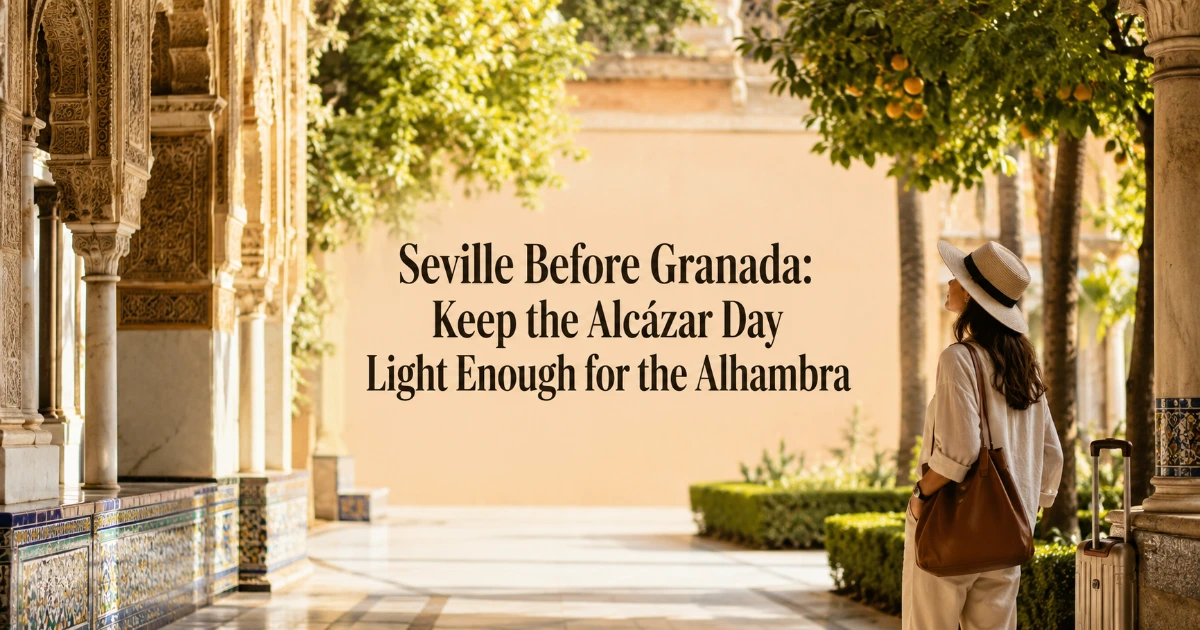
Seville Before Granada: Keep the Alcázar Day Light Enough for the Alhambra
Updated
Keep the Seville monument day focused: Real Alcázar first, a measured Santa Cruz recovery walk after the Alcázar, and no heroic push into Triana, Plaza de España, or a second palace if Granada and the Alhambra follow soon after. This works because Seville’s old core compresses major sites into a small, walk-heavy zone around Puerta del León, Patio de Banderas, the Cathedral, and the narrow lanes off Calle Mateos Gago; the mistake is not distance on a map, but accumulated standing, garden exposure, and late-afternoon decision fatigue. The exception is a traveler who has already seen the Alhambra, is sleeping two relaxed nights in Granada before visiting it, or cares more about Mudéjar palace detail than arriving with a fresh eye for the Nasrid Palaces.
The useful way to plan Seville before Granada is to treat the Alcázar not as a trophy to exhaust, but as a calibration point for the Alhambra. Seville gives you palace craft, gardens, courtyards, dynastic layers, and a city-center walking rhythm; Granada asks for sharper attention, punctual entry to the Nasrid Palaces, hillier movement, and more mental space. This guide answers one narrow question: how much Alcázar day is enough when the Alhambra is still ahead?
For the broader choice of whether Seville deserves two, three, or four days before Córdoba or Granada, use the ODT Seville stay-length guide. Here, the decision is tighter: keep the Real Alcázar meaningful, keep the afternoon from ballooning, and arrive in Granada with the appetite to see the Alhambra properly.
The Seville-before-Granada verdict in one sequence
The best sequence is a morning Real Alcázar visit, a short interpretive exit through Santa Cruz, an easy lunch or hotel pause, and only one light late-day layer if everyone still has capacity. That one layer can be Cathedral context from outside, a shaded old-town walk, or a gentle river-facing evening; it should not become a second monument sprint. The city will tempt you because the Cathedral, Archivo de Indias, Santa Cruz, and Arenal sit close together, but proximity is deceptive when the next major day is the Alhambra.
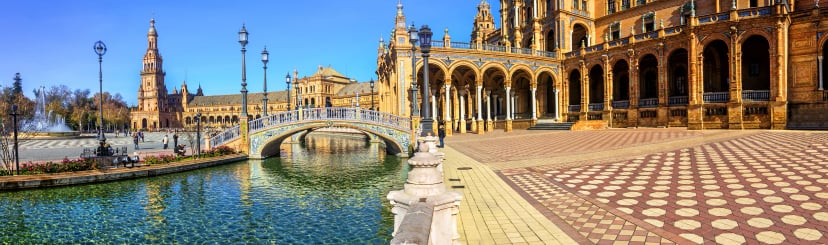
The first correction is counterintuitive: do not make Plaza de España the automatic “easy add-on” after the Alcázar just because it is famous and photogenic. It sits beyond the compact Alcázar-Cathedral-Santa Cruz triangle and often means exposed walking toward Parque de María Luisa at exactly the moment when people need shade, water, and fewer decisions. If the group includes children, older parents, anyone recovering from a long-haul arrival, or travelers with a serious dinner planned, Plaza de España usually belongs on a separate river-and-park slot, not on the Alcázar day before Granada.
The second correction is that Triana is not a recovery walk from the Alcázar. Triana is wonderful when you have appetite for a river crossing, ceramic context, market texture, and an evening built around the neighborhood’s own rhythm. But after the Alcázar, crossing toward Puente de Triana can turn a contained old-town day into a two-bank itinerary, especially if the plan later points toward a flamenco seat, dinner timing, or a hotel return. If Triana matters, place it with intention, not as a filler line after a palace morning.
A private Alcázar plan can go deeper than a standard visit without becoming heavier. The difference is not more rooms at any cost; it is choosing which rooms, patios, garden axes, and historical transitions actually prepare the traveler for Andalusia. When ODT designs a focused Alcázar morning, the Real Alcázar private tour is best used as a paced interpretive visit rather than a maximalist palace inventory.
A decision matrix for the Alcázar day before the Alhambra
Use the day according to what needs protecting for Granada: attention, walking capacity, or evening calm. If you only compare attractions by beauty, everything seems worth adding. If you compare them by what they do to the next 24 to 48 hours, the right cuts become much clearer.
Best default: Real Alcázar plus Santa Cruz, with a lunch pause and an optional light evening. Choose this when the Alhambra follows the next day or the day after, when travelers are first-time visitors, or when the party includes mixed ages. The payoff is cultural depth without turning two palace days into one long blur.
Worth adding only with care: Seville Cathedral and Giralda, if the group has stamina and the day is not hot or transfer-shaped. The Cathedral’s own visitor information describes the Cathedral and Giralda visit as approximately 75 minutes, so it is not a harmless ten-minute add-on; check the official Cathedral schedules and rates page (https://www.catedraldesevilla.es/en/cultural-visit/schedules-and-rates/) when building the day.
Move off the day: Triana, Plaza de España, Casa de Pilatos, Dueñas, Lebrija, or a long shopping route. These are not inferior choices; they are the first casualties when the goal is to keep the Alhambra sharp.
Wrong fit: A full Alcázar, Cathedral, Giralda, Santa Cruz, Plaza de España, Triana, and flamenco stack. That plan can look efficient in a spreadsheet and feel punishing in a real Andalusia sequence.
This matrix is not about lowering ambition. It is about deciding which kind of richness belongs in Seville and which kind of readiness belongs in Granada. The Alhambra is not just another monument slot. The official Alhambra ticketing page emphasizes punctual access to the Nasrid Palaces and ID requirements, which means the Granada day has less forgiveness for late starts, foggy focus, or slow-moving exhaustion than a looser city walk; verify the current rules on the official Alhambra ticketing site (https://tickets.alhambra-patronato.es/en/).
The practical test is simple: after the Seville day, should your group want conversation, dinner, and an early night, or should they need recovery from a day that was too clever? The first outcome helps Granada. The second steals from it. A strong guide earns the fee by helping you leave things out without feeling that the city has been under-seen.
How much Alcázar is enough before the Alhambra?
Enough Alcázar depth means seeing the palace as Seville’s layered political and artistic center without trying to decode every chamber, garden turn, and decorative program before Granada. For a first visit before the Alhambra, the ideal experience usually feels complete rather than exhaustive: the major courtyards, the Mudéjar palace logic, the Christian royal overlay, selected garden movement, and a clear sense of how the complex sits beside the Cathedral and the old Jewish quarter.
The Real Alcázar’s official site is the place to confirm current visit information and ticketing; the site also identifies itself as the official source for the monument, which matters because third-party ticket pages can blur costs, add-ons, and terms. Use the official Real Alcázar website (https://alcazarsevilla.org/) for factual planning, then use editorial judgment to decide how much of the visit belongs in your day. For this specific sequence, depth should come from interpretation, not duration.
A good Alcázar visit before Granada should leave the traveler able to describe three or four ideas clearly: why Seville’s royal palace feels layered rather than stylistically singular, how courtyards and gardens manage light and power, why the palace sits in conversation with the Cathedral and Archivo de Indias, and how Islamic, Christian, and courtly aesthetics overlap without collapsing into one generic “Moorish” label. Once those ideas are alive, adding another hour may bring diminishing returns if the Alhambra is still ahead.
The cut-first rule is firm: if the day is getting heavy, cut the second palace before you cut the Santa Cruz recovery walk after the Alcázar. Casa de Pilatos, Dueñas, and Lebrija can be excellent in a palace-focused Seville trip, but on this sequence they often make the traveler compare tile, courtyard, ceiling, garden, and dynastic detail for too many consecutive hours. That is exactly the kind of overload that makes the Alhambra feel like another item instead of the reason you planned Granada.
There is also a difference between visual appetite and interpretive appetite. Travelers can admire one more patio long after they have stopped absorbing meaning. A private guide should notice when the group is still interested but no longer retaining, then change texture: out through Patio de Banderas, into Santa Cruz, past a quiet corner, toward a drink, shade, or lunch. That is not under-touring. It is protecting the quality of the next monument day.
The route that keeps Seville vivid without draining Granada
The cleanest Alcázar-light route uses the city center’s compactness without abusing it. Start at or near Puerta del León, hold the palace visit to the interpretive essentials, exit toward Patio de Banderas, and then slow down in Santa Cruz rather than immediately chasing another landmark. This route keeps the day physically coherent: palace, district, pause.
The Santa Cruz recovery walk after the Alcázar matters because it changes the body’s rhythm. Inside the Real Alcázar, travelers stand, look up, follow thresholds, adjust to crowds, and move between interiors and gardens. In Santa Cruz, the scale drops. The walk can pass through narrow lanes around Calle Judería or Calle Vida, pause near Plaza de Doña Elvira or Plaza de Santa Cruz, and return toward Calle Mateos Gago without asking the group to cross the city. It is a decompression route, not a sightseeing checklist.
This is where Seville does something specific to the body. The city center is walkable, but the walking is not neutral: stone paving, sun pockets, slow-moving visitor lanes, garden exposure, and repeated standing all add up. The Real Alcázar is not a high-altitude climb, yet a long palace visit followed by the Giralda, then a push to Plaza de España, then a river crossing, can leave feet and attention more depleted than the map suggests. The Alhambra day then inherits that fatigue, especially when Granada adds slopes, timed entry pressure, and longer visual concentration.
Seville also does something specific to the mood of a trip. A contained Alcázar day lets the city feel generous: you saw the palace, understood the center, enjoyed Santa Cruz, and still have a dinner conversation that is not dominated by logistics. An overloaded day flattens the trip; the Cathedral becomes “the next place,” Plaza de España becomes “the photo we still need,” and Triana becomes “the bridge we have to cross.” By the time Granada arrives, the Alhambra may still impress, but the group has lost some of the patience that makes it memorable.
That is why the best Seville-before-Granada day often feels almost modest in outline. It is not modest in content. It simply gives the Alcázar enough room to mean something and Santa Cruz enough time to translate the visit back into the city. For travelers who want a fuller Seville day without the Granada consequence, ODT’s separate guide to planning Alcázar, Cathedral, Santa Cruz and Triana without midday burnout is the better frame.
What to keep out of the same day
Move anything that adds a second zone, a second palace vocabulary, or a second major queue-and-concentration moment out of the Alcázar day when Granada follows soon after. The point is not that these experiences are weak. The point is that they use the same reserves the Alhambra will need: attention to detail, tolerance for standing, and willingness to be guided through layered history.
The first item to move is a second palace. Casa de Pilatos, Palacio de las Dueñas, and the Palacio de la Condesa de Lebrija are most rewarding when they are not squeezed after the Real Alcázar. If you love interiors, courtyards, ceramics, and aristocratic detail, give that theme its own Seville day or half-day. If the itinerary has no room, save the second palace rather than diluting both the Alcázar and the Alhambra.
The second item to move is a long Cathedral-and-Giralda climb when the group already feels close to its limit. The Cathedral belongs naturally beside the Alcázar in a Seville plan, and for many travelers it is essential. But “beside” is not the same as “effortless.” The interior scale, side chapels, visitor flow, and Giralda ascent can push the day from cultural concentration into endurance. If the Cathedral matters, choose it consciously and remove something else, rather than adding it because the door is near.
The third item to move is a food-and-wine itinerary that turns lunch into a second tour. Seville’s tapas rhythm can be a pleasure after the Alcázar, but a tasting route that jumps from Santa Cruz to El Arenal and onward may overwork the afternoon. For food-focused travelers, the better move is one excellent, seated lunch or a restrained evening plan. The day before Granada is not the day to prove how many bars the group can compare.
The fourth item to move is a flamenco plan that makes Triana the third act of a palace day unless the entire evening has been designed around it. Teatro Flamenco Triana sits in the neighborhood by the Guadalquivir and is a legitimate named anchor for a Triana evening; confirm venue details directly with Teatro Flamenco Triana (https://www.teatroflamencotriana.com/en/home/). But if the Alcázar day has already included a long morning, a Cathedral layer, and a late lunch, crossing to Triana for a show may convert a beautiful evening into a return-logistics exercise.
Cutting is not failure. It is the discipline that makes an Andalusia sequence feel designed rather than accumulated. When travelers say they want to “do Seville properly” before Granada, they usually mean they want to understand Seville, not arrive at every photogenic surface. Understanding improves when the day has edges.
When to move Triana or Plaza de España
Move Triana off the Alcázar day when the group would cross the river only because it feels like the next famous neighborhood. Triana is strongest when it has its own reason: ceramics, flamenco context, a riverfront evening, market texture, or a dinner plan that makes the return worthwhile. It is weakest when it is treated as a post-palace add-on after everyone has already spent hours in the Alcázar and Santa Cruz.
The route consequence is concrete. From the Alcázar edge, reaching Triana usually means leaving the Cathedral-Santa Cruz center, moving through Arenal or toward the river, crossing Puente de Isabel II, and then managing the return to the hotel or dinner. That can be elegant in a plan built around the Guadalquivir. It can be irritating if someone thought Triana was simply “nearby.” If the next day involves a transfer to Granada or an Alhambra start, Triana is better placed as a separate evening with a clear beginning and end.
Move Plaza de España off the day when heat, children, older parents, dress shoes, or a late dinner reservation are in play. The plaza is not hard to understand; it is hard to place badly. It sits beautifully with Parque de María Luisa, river views, or a soft second-day route, and it photographs better when the group is not counting steps after a palace morning. If you force it after the Alcázar, you often get the picture but lose the pleasure.
The better placement for Plaza de España is a Guadalquivir-and-park strategy: pair it with the river, Parque de María Luisa, or a calmer chauffeured loop rather than with a palace-intensive morning. That lets the plaza act as a scenic release instead of a late-day obligation. For travelers deciding whether Triana, Plaza de España, or the river deserves its own Seville slot, the ODT Guadalquivir day guide is a more useful next step than trying to wedge all three into the Alcázar day.
The one exception is a traveler staying very close to the park or using a chauffeur-led structure with a deliberate hotel pause. Even then, the plaza should be a short scenic chapter, not a wandering afterthought. Premium logistics can reduce transfer waste, but they cannot make a tired group care more about another stop.
How transfer timing changes the plan
Transfer timing decides how lean the Alcázar day should be. If you leave for Granada the same afternoon, the Alcázar visit needs to be shorter, earlier, and cleaner. If you travel the next morning, you can allow a gentler Seville evening. If you have a full buffer day before the Alhambra, you can keep more Seville texture, but you still should not turn two palace experiences into a marathon.
A same-day transfer to Granada changes everything because luggage, checkout, station or chauffeur timing, and arrival fatigue start competing with sightseeing. Santa Justa station is not in the old-town core, so a plan that ends vaguely in Santa Cruz and then discovers luggage still needs collecting has already lost its polish. With a chauffeur, the day can be smoother, but the pickup point, luggage location, and exit route still need to be designed before the morning starts.
If the transfer is by train, the Alcázar day should avoid late sprawl. The group should know whether luggage is at the hotel, whether the pickup is at the hotel or closer to the monument zone, and how much time has been reserved for the station. A private guide cannot change the train time, but a good plan can prevent the final hour from becoming a rushed walk through the old town followed by an anxious ride to Santa Justa.
If the transfer is chauffeur-led, the temptation is to add more because the car is available. Resist that instinct. A chauffeur helps with hotel pickup, luggage custody, station avoidance, and a controlled departure toward Granada. It does not erase the effect of a long Alcázar visit followed by multiple Seville zones. The best chauffeur use here is not to turn the day into a sightseeing sweep; it is to remove the sloppy edges around luggage, pickup, heat, and departure.
If you sleep in Seville after the Alcázar and transfer the next morning, the evening can be richer, but it still should not be noisy with obligations. A light dinner, a short Arenal or Santa Cruz stroll, or a planned flamenco evening can work if the group has rested. A late Triana night before an early Granada departure may look romantic and feel unkind at breakfast.
If you arrive in Granada the evening before the Alhambra, preserve the arrival. Do not make Granada inherit Seville’s leftovers. The Alhambra asks for punctuality, identity checks, and attention to a monumental complex that is physically and mentally different from Seville. Arriving with some charge left is not a luxury; it is the condition that lets the Granada day feel like the culmination of Andalusia rather than another appointment.
Where private guidance and premium spend do, and do not, change the outcome
Private guidance changes the Alcázar day when it selects, interprets, and edits. It helps travelers understand why one courtyard matters more than another in the sequence, how Seville’s royal palace differs from the Alhambra without turning the comparison into a lecture, and when the group is ready to leave the palace before quality drops. That is real value because it protects both the Seville morning and the Granada visit that follows.
Premium access to the Alcázar does not help if the traveler arrives in Granada already depleted. This is the clearest spend judgment in the article. Paying for smoother entry, private guiding, or a better-planned route can improve comfort and reduce wasted time, but no access category can convert an overstuffed Seville day into a fresh Alhambra morning. The upgrade that earns its cost is not “more Alcázar”; it is a better-shaped Alcázar.
Spend helps with timed logistics. It can mean a guide who meets you at the right edge of the monument zone, a route that avoids needless backtracking, a chauffeur who handles luggage while the group tours, or a planner who refuses to place Triana, Plaza de España, a second palace, and a transfer in the same sentence. For families and multigenerational groups, this can be the difference between a day that feels composed and a day that requires constant negotiation.
Spend does not help when the plan confuses exclusivity with accumulation. A private tour that simply adds more rooms, more sites, and more neighborhood crossings may be less useful than a shorter, sharper morning with an expert who knows when to stop. The high-end version of this day is not the longest version. It is the version with the fewest unplanned penalties.
That is why ODT’s most natural role is not only to guide the Real Alcázar, but to design the Andalusia sequence around it. The Seville day, the transfer to Granada, the Alhambra timing, the dinner plan, the family’s walking tolerance, and the hotel geography all affect one another. When that handoff matters, a tailor-made Seville and Andalusia plan can connect the monument day to the Granada experience rather than treating each city as an isolated booking.
To shape the whole sequence around your dates, hotels, travelers, and Alhambra timing, Inquire now.
A sample Alcázar-light day for different travelers
For couples, the strongest version is palace, Santa Cruz, lunch, hotel pause, and a deliberate evening. The evening might be a short old-town walk, a seated dinner, or a flamenco plan if it has been placed carefully. The mistake is to turn romance into distance: Alcázar, Cathedral climb, Plaza de España, Triana, and late dinner can leave the day with plenty of memories but little ease.
For families, the Alcázar day should create texture changes before resistance appears. Palace interiors and gardens can hold children well when the guide gives them patterns, stories, and movement, but the day should shift quickly into Santa Cruz, shade, food, and a defined endpoint. Plaza de España can be wonderful with kids, yet it is better when the park and plaza are the plan, not the reward for surviving too much palace detail.
For older parents or travelers who dislike heat and standing, the focus should be fewer thresholds and better pauses. The Alcázar can still be the centerpiece, but the day needs benches, shade logic, and a controlled exit. The Santa Cruz recovery walk after the Alcázar should be short, meaningful, and flexible, not a labyrinthine stroll that turns charm into fatigue. If the Cathedral is added, remove something else.
For food-and-wine travelers, keep the tasting impulse disciplined. One good lunch after the Alcázar can carry the day more elegantly than a multi-stop bar route. If sherry, tapas, or Triana market texture matter, place them in a dedicated Seville food slot rather than trying to make the palace day carry culinary ambition as well. The palate, like the eye, can tire before the traveler admits it.
For celebration travelers, the day needs fewer moving parts than the occasion may suggest. A birthday, anniversary, proposal trip, or private family milestone can be diminished by too many transitions. Choose the Alcázar as the cultural anchor, Santa Cruz as the graceful release, and one evening flourish. Do not ask the celebration to compete with luggage timing, river crossings, and an early Granada departure.
For small private groups, the key is not consensus by addition. When six or eight people each name one desired stop, the day becomes a committee itinerary. A guide or planner should identify the shared priority: palace depth, easy walking, a flamenco evening, or a strong dinner. Then the rest of the day should serve that priority. The Alhambra will punish the plan that was built to satisfy every casual suggestion.
The exception: when a deeper Alcázar day is still right
A deeper Alcázar day is right when the traveler has enough buffer before the Alhambra or when Seville’s palace culture is the primary reason for the trip. If you are spending two calm nights in Granada before the Alhambra, or if the Alhambra visit is not scheduled until later in the journey, a fuller Alcázar visit plus Cathedral or a second palace can make sense. The recommendation breaks down when the next city is no longer vulnerable to the Seville day’s fatigue.
It also makes sense for travelers who have already seen the Alhambra and are returning to Andalusia for more specialized study. In that case, the Alcázar can become a deeper comparative visit rather than a prelude. You might examine garden sequence, craft, restoration, court ceremonial space, or Seville’s later royal uses in more detail. The day then belongs to Seville on its own terms.
The deeper version still needs editing. It might pair the Alcázar with the Cathedral and a slow lunch, or with one later palace on a different theme. It should not automatically include every nearby monument. A specialist day can be intense without being sloppy. The difference is that each addition has a reason beyond availability.
The wrong traveler for this article’s lean default is someone who will feel cheated by leaving the Alcázar before every corner has been explored. Some travelers love completion. They want every room available, every garden path, every palace comparison, and a guide who will go as deep as time allows. That is a valid preference. It simply requires a Granada buffer, not an Alhambra morning immediately downstream.
The cleanest editorial judgment remains this: if the Alhambra is the next major emotional and cultural peak, Seville should sharpen the eye, not spend it. Let the Real Alcázar prepare the traveler for Andalusia’s layered court worlds. Do not ask it to consume the same reserves Granada needs.
How this differs from a generic Seville day
A generic Seville day asks, “What can we fit?” This sequence asks, “What should still feel fresh when we reach Granada?” That difference changes the answer. It reduces the number of major interiors, changes where Santa Cruz belongs, moves river and park experiences away from the palace morning, and makes transfer timing part of the monument plan rather than an afterthought.
It also changes how the Cathedral is treated. In a standalone Seville day, the Alcázar and Cathedral are the obvious pair. Before Granada, they are a conditional pair. Add the Cathedral when the group has the stamina, the day is not transfer-shaped, and the visit can be kept crisp. Skip or postpone it when it would push the afternoon into recovery mode. This is not a statement about the Cathedral’s importance; it is a statement about the traveler arriving in Granada with enough attention to use the Alhambra ticket well.
The same is true of Santa Cruz. In a generic plan, Santa Cruz may be described as a neighborhood to see. Here, it has a job. It is the soft transition between palace concentration and the rest of the day. A Santa Cruz recovery walk after the Alcázar lets the guide connect Jewish-quarter history, urban texture, shaded lanes, and Seville’s lived scale without demanding another formal visit. That is why it survives the cut when flashier add-ons do not.
The article’s narrowness is intentional. It does not decide whether Seville needs two, three, or four days. It does not build a Granada itinerary. It does not compare every Andalusia base. It protects one hinge in the trip: the moment when travelers leave Seville’s palace world and need to arrive in Granada ready for the Alhambra.
Planning the Seville-to-Granada handoff
The handoff should be designed before any single tour is booked. Work backward from the Alhambra: date, entry type, timed elements, hotel location, and the group’s tolerance for early starts. Then shape Seville so the Alcázar day supports that plan rather than competing with it. This is especially important for travelers who want private touring across multiple Andalusian cities instead of disconnected half-day bookings.
If Granada follows immediately, choose one of three Seville endings. The first is a quiet old-town evening after the Alcázar, best for travelers who value dinner and rest. The second is a deliberate Triana evening, best when flamenco or river context is the chosen flourish and the next morning is not brutal. The third is an early transfer or station-facing plan, best when the group needs to be settled in Granada before the Alhambra day. Anything beyond those three endings tends to create drift.
For travelers considering a Seville-based day trip to Granada rather than a transfer-and-overnight sequence, the calculus is different and stricter. A Granada day from Seville has to respect Alhambra timing, road or rail logistics, and the fact that Granada’s best palace experience is not improved by a depleted start. ODT’s Granada private tour from Seville can make sense for some travelers, but it should be planned around the Alhambra, not around leftover Seville ambition.
The final planning move is to name what the Seville day is not allowed to do. It is not allowed to become the “everything we might miss” day. It is not allowed to collect Triana, Plaza de España, Cathedral climb, second palace, shopping, and flamenco just because each is individually attractive. It is not allowed to spend the group’s curiosity before the Alhambra asks for it. Once those rules are clear, the day becomes calmer and more premium without needing to announce itself as such.
The best Seville-before-Granada itinerary ends with a traveler who can still look forward. They remember the Real Alcázar, understand why Santa Cruz mattered, enjoy the evening, and reach Granada with interest intact. That is the measure of success.
FAQ
Should I visit the Real Alcázar if I am seeing the Alhambra soon after?
Yes, visit the Real Alcázar, but keep the visit focused. It gives Seville essential context and prepares the eye for Andalusian palace culture, while a controlled route prevents the Alhambra from feeling like a second exhausting palace day.
How long should the Alcázar visit be before Granada?
Plan enough time for the major courtyards, palace logic, selected gardens, and a clear historical explanation, but avoid turning the visit into a completion exercise. The right length is the point at which the group still wants a Santa Cruz walk rather than a hotel rescue.
Should I do the Alcázar and Seville Cathedral on the same day before Granada?
You can, but only if the group has stamina and you remove other add-ons. The Cathedral and Giralda are not a tiny extra; they add standing, scale, and concentration, so they should replace Triana, Plaza de España, or a second palace rather than sit on top of them.
Is Triana a good add-on after the Alcázar?
Triana is a good add-on only when the evening is intentionally built around it. If Granada or the Alhambra follows soon, do not cross the river just to say you saw Triana; place it on a separate evening with a clear show, dinner, ceramic, or riverfront purpose.
When should Plaza de España happen if not after the Alcázar?
Place Plaza de España with Parque de María Luisa, a river-facing day, or a soft second-day route. It usually works better as a scenic release than as a late add-on after a palace morning and Santa Cruz walk.
Does a private guide make the Alcázar day lighter?
Yes, when the guide edits as well as explains. A private guide can choose the most meaningful palace layers, manage the transition into Santa Cruz, and stop before the group spends the attention it needs for Granada.
Should I transfer to Granada on the same day as the Alcázar?
You can transfer the same day, but the Alcázar plan must be lean and luggage-aware. Avoid adding Triana, Plaza de España, or a second palace, and decide in advance whether the day ends at the hotel, Santa Justa station, or a chauffeur pickup point.
What is the biggest mistake before an Alhambra day?
The biggest mistake is treating Seville’s famous sights as harmless because they are close together. The Alcázar, Cathedral, Santa Cruz, Plaza de España, Triana, and a flamenco evening can fit on paper, but the Alhambra pays the price in tired attention.
If you’re interested in any private tours of Seville, please reach out to us.





 So if you are looking for the absolute best in Seville & surroundings with authentic local fully-licensed native guides whose English you can actually understand and with an exclusive and amazingly fun itinerary













