A Private Guadalquivir Day for a High-End Seville Stay: River Views, Triana and Plaza de España Without Heat Drag
Updated
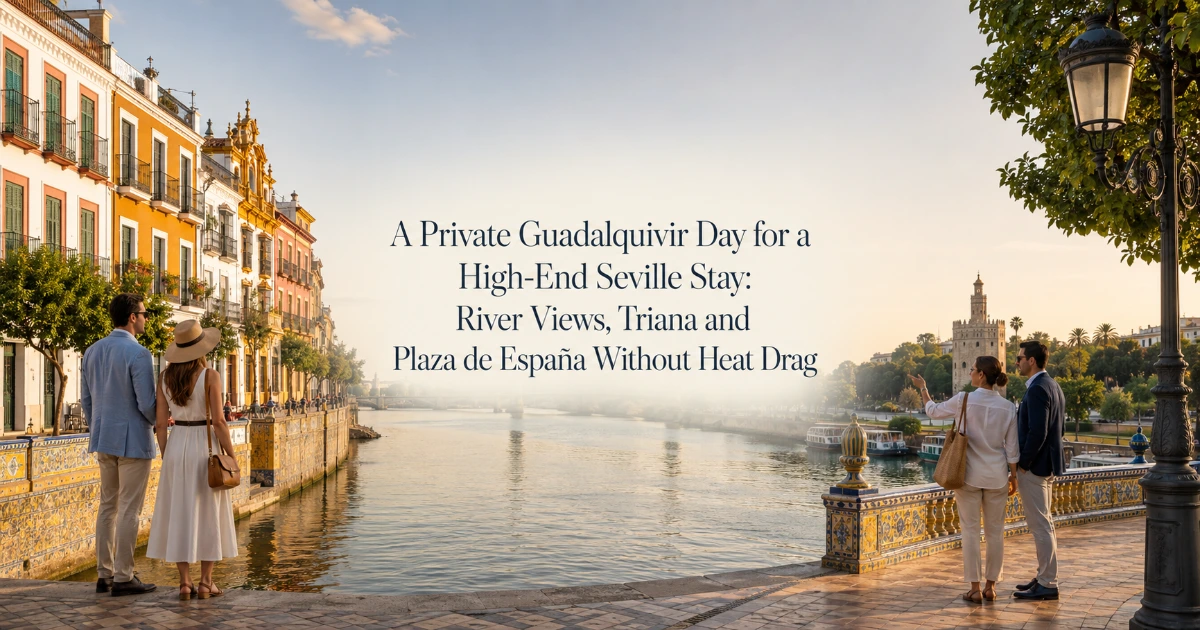
Use the Guadalquivir as the spine of a private Seville day when you want Triana, river views and Plaza de España to feel connected rather than bolted on. In real city conditions, the river corridor helps a guide manage the Santa Justa-to-old-town reset, the choice of bridge into Triana, and a late-day Plaza de España slot without repeatedly pulling your group through exposed old-town lanes. The clearest exception is a one-day, monument-led visit: if the Alcázar and Cathedral are the true priority, let them lead and make the river a short grace note. The Seville-specific thesis is simple: in warm weather, the Guadalquivir is not decoration; it is the routing tool that decides whether Triana and Plaza de España feel elegant or exhausting.
This guide solves one planning question only: when should the river shape a private day that includes Triana and Plaza de España? It is not a broad three-day itinerary, and it is not a cruise sales pitch. The best version usually pairs a guided river orientation, a purposeful Triana stop, a shaded or chauffeured reset, and Plaza de España when the light and body load are kinder. For a route built specifically around the river corridor, see Guadalquivir Private Tours; for a day where the Alcázar, Cathedral and Santa Cruz are still the main event, the cleaner companion plan is private Alcázar, Cathedral, Santa Cruz and Triana day.
How to plan a private Guadalquivir day in Seville without heat drag
The river-led day works best when you make three decisions early: which river crossing carries the story into Triana, when Plaza de España will receive your best energy, and where the reset happens before the return. The counterintuitive correction is that the most photogenic default is often overvalued. Many travelers start in the historic core, walk south to Plaza de España in the middle of the day, then try to pull Triana into the afternoon because it looks nearby on a map. That sequence creates a beautiful list and a tired group. The editorial no is clear: stop forcing Plaza de España at midday after an old-town block just because the map makes it look efficient.
The river-spine matrix
- Best overall sequence: begin with river context near Torre del Oro or Puente de San Telmo, cross into Triana while attention is still fresh, pause or transfer before the most exposed leg, then give Plaza de España a late-day slot.
- Best first-time version: keep the Alcázar and Cathedral out of this day unless you have unusual stamina or a very short monuments visit. The river day should show how Seville opens west toward Triana and south toward Parque de María Luisa, not try to swallow every headline sight.
- Best family or older-parent adjustment: reduce the number of river crossings. One guided crossing into Triana and one chauffeured or river-supported move toward Plaza de España usually feels calmer than walking in and out of every district edge.
- Best celebration version: add a short river cruise, private pause, or polished drink stop only when it gives the day a transition. A longer boat segment can look impressive on paper and still steal time from the neighborhood that makes the river matter.
- First cut when the day is too full: remove the extra old-town loop between Triana and Plaza de España. The route loses less by cutting a duplicate walk than it does by rushing Plaza de España or treating Triana as a five-minute photo stop.
- Where premium spend does not help: premium spend does not help when it is spent on a longer boat segment that replaces Triana context or pushes Plaza de España into the wrong part of the day. It helps far more when it buys judgment, pacing, a well-placed pickup, and a guide who knows when to stop walking.
The practical reason to choose a river spine is that Seville’s most rewarding warm-weather day is rarely the longest straight line. The river lets the day breathe without losing coherence. Puente de Triana gives you the classic arrival into the neighborhood through Plaza del Altozano. Puente de San Telmo gives you a more useful hinge toward the University, Parque de María Luisa and Plaza de España. Torre del Oro is not merely a backdrop; it marks the point where the old port story, the river promenade and the southbound route begin to make sense together.
The sequence that keeps river views, Triana and Plaza de España coherent
The strongest sequence is river first, Triana second, reset third, Plaza de España late enough to avoid the harshest drag. That order keeps the day from becoming a zigzag between postcard sites, and it gives a private guide room to adjust the tempo for heat, children, older parents, photography, lunch, or an evening reservation.
Start with the Santa Justa-to-old-town reset, not a heroic arrival walk
If you are arriving by train, the Santa Justa-to-old-town reset is the quiet hinge that changes the day. Santa Justa sits east of the historic core, and the first decision is whether you spend arrival energy crossing traffic, finding luggage solutions and walking into the city, or whether a guide and driver absorb that friction so the first real moment is already near the river. For high-end travelers, this is not about being unable to walk. It is about refusing to spend the first forty minutes of attention on the least memorable part of the route.
If you are already staying in El Arenal, Santa Cruz, Triana or near Puerta de Jerez, the same idea applies in smaller form. Do not begin with an unfocused wander through lanes that will later need to be crossed again. Start with a clean river edge, a bridge decision, and a clear destination. A guide can use the opening to explain why Triana sits across the water as a separate cultural identity rather than another old-town street, then carry that explanation over the bridge while the body is still receptive.
Use the first bridge as a planning decision, not just a crossing
Puente de Triana and Puente de San Telmo lead to different days. Puente de Triana delivers you into Altozano and the classic Triana feel: river frontage, ceramic memory, market energy, and the sense that you have left the formal old town. It is the better crossing when Triana is the cultural center of the morning. Puente de San Telmo is more useful when the day needs to swing south toward Plaza de España without backtracking, especially if the group will later use a car or shaded pause around Puerta de Jerez, the University edge, or Parque de María Luisa.
This is where a private route beats a fixed walking tour. A couple may want the more atmospheric crossing into Triana and time along Calle Betis before a quiet lunch. A family may need a shorter arc that avoids asking children to cross the river twice. A small group celebrating a birthday may want the guide to hold the river story for the bridge, then shift into a lighter neighborhood rhythm around Altozano. The bridge choice changes what the rest of the day feels like, not just what appears in the photo folder.
Let Triana carry culture before Plaza de España carries spectacle
Triana is strongest when visited before visual fatigue sets in. Give it the part of the day when the group still has curiosity for detail: the riverbank identity, the ceramics legacy, the lived-in difference from Santa Cruz, and the reason Seville’s flamenco story is not confined to evening stages. A good Triana stop does not need to be long, but it does need enough time to avoid becoming a token crossing. For travelers who want that neighborhood to be more than a view from across the water, Triana Quarter Private Tours is the more focused route.
The consequence of placing Triana too late is easy to feel. After a heavy monument morning and an exposed Plaza de España walk, the neighborhood becomes an obligation. People stop noticing the river edge, ceramics references and food cues, and they start asking where the hotel is. When Triana comes earlier, it has the emotional room to do what it does best: make Seville feel less formal, less palace-centered, and more connected to craft, music, river labor and everyday neighborhood life.
Put the reset between Triana and Plaza de España, not after both
The reset belongs before Plaza de España because the plaza is more generous when you arrive with energy. That reset can be a shaded drink, a relaxed lunch, a short boat segment, a chauffeur-supported move, or a return to the hotel to change shoes and lower the temperature of the day. What matters is that the reset is not an apology after the group has already wilted. It is a design choice that makes Plaza de España feel like a finale rather than a final test.
The city does something specific to the body here. Seville’s fatigue is not only distance; it is glare on stone, pauses in exposed spaces, repeated decisions at district edges, and the way heat accumulates while you are standing still. A map may show Triana, Torre del Oro and Plaza de España as manageable. Your legs experience them as river crossing, promenade, road edge, park approach, open plaza and return logistics. When the reset comes in the middle, the day regains texture. When it comes after everything, it is simply recovery.
Give Plaza de España the final generous slot
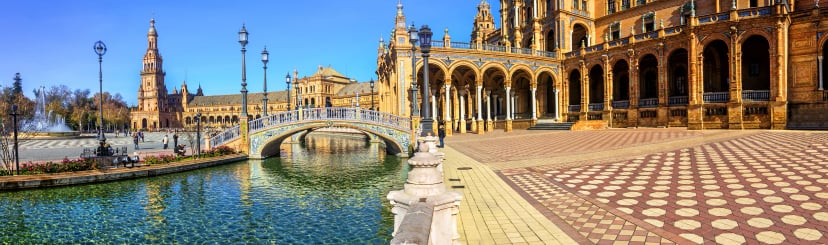
Plaza de España should not be treated as a pass-through on a private Guadalquivir day. It needs enough time for scale, tile detail, the semicircular architecture, and the way Parque de María Luisa softens the approach. The plaza also needs the right mood: people should arrive ready to look, not bargaining with their feet. If your route includes the river and Triana, the plaza is usually better after a reset than before one.
There are exceptions. In cooler months, an earlier Plaza de España can work if the day starts south and Triana becomes an afternoon neighborhood. For travelers staying close to the park, or for guests who care more about photography than ceramics or flamenco context, the plaza can lead. But for a high-end stay built around smoother movement, the more reliable order is river orientation, Triana, reset, Plaza. Dedicated planning around Plaza de España Private Tours is worthwhile when the plaza is not just a photo stop but a key part of the day’s architecture.
Why Triana belongs to the river route, not as a leftover evening stop
Triana belongs in this day because it explains the Guadalquivir from the other side. Without Triana, the river risks becoming scenery; with Triana, the river becomes a border, connector and memory line. That matters for discerning travelers because the neighborhood changes the emotional register of the day. It shifts Seville from courtly monuments and formal avenues into ceramics, river trades, food, music and a community identity that still feels distinct from the old town.
Start with the river-facing edge, not with an isolated fact list. From Calle Betis, the old town looks staged across the water: Torre del Oro, the Cathedral profile beyond, the formal bank opposite. From Plaza del Altozano, the neighborhood pulls inward. That small change of direction is why Triana should not be reduced to a nightlife label. It is a daytime cultural stop first, and it can become an evening performance setting only if the rest of the day leaves enough energy for it.
Flamenco belongs here as context, not as a forced after-dark package. Teatro Flamenco Triana (https://www.teatroflamencotriana.com/en/home/) is useful to name because it anchors performance planning in the neighborhood rather than in a generic “show later” idea; check its official site before pairing it with a route, dinner, or hotel return. Old-town venues can make sense too. Museo del Baile Flamenco (https://museodelbaileflamenco.com/index.php/el-museo/) and Casa de la Memoria (https://www.sevillaflamenco.org/en/casa-de-la-memoria/) are different planning anchors because they pull the evening back toward the historic center. The decision is not which one sounds most famous; it is which one keeps the day from collapsing into late-return fatigue.
For families and multigenerational groups, Triana’s value is also practical. It gives a contrast to monumental interiors without requiring a day trip or a long transfer. The group can move at a conversational pace, take a food or craft pause, and keep the river as a visible reference point. For couples, Triana gives the day intimacy after the broader civic scale of the river and before the theatrical scale of Plaza de España. For small groups, it is where a private guide can keep the story social without losing substance.
The cut-first rule is especially important in Triana. Do not add every ceramic reference, every riverbank photo, a market wander, a long lunch, a cruise and a flamenco show unless this is the only theme of the day. Triana rewards selectivity. One strong crossing, one or two cultural anchors, and one pause usually beat a checklist that leaves everyone watching the clock before Plaza de España.
Plaza de España is the highlight that punishes lazy timing
Plaza de España deserves careful timing because it is both open and absorbing. It is not difficult in the way a hill town is difficult, but it can be draining when approached after too much walking, too little shade, or a rushed transfer from the wrong side of the city. On a Guadalquivir-led day, the plaza should be the controlled flourish, not the reason the rest of the route feels forced.
The usual mistake is to underestimate the transition from the river corridor to the park edge. Puerta de Jerez, the University area, Avenida de Isabel la Católica and Parque de María Luisa can make a beautiful approach, but they are not frictionless when the group is already warm. The open geometry of Plaza de España then asks people to stand, look, cross, compare tile scenes, take photographs and decide how much of the semicircle to cover. None of that sounds hard until it follows a morning of old-town lanes and a river crossing.
There is also a mood consequence. When Plaza de España lands at the wrong moment, it flattens the day because people feel they should be impressed but are too depleted to enjoy scale. When it lands after a proper reset, the day feels shorter than it is. The group reads the plaza as a finale, not a demand. That difference is why timing matters more than squeezing in another nearby sight.
The plaza is also where a private guide’s restraint shows. Not every group needs the same amount of explanation. Some travelers want the architecture and the Ibero-American Exposition context; others need enough framing to understand why the space feels so theatrical, then time to walk, sit, photograph and absorb it. The better plan leaves room for both. A rigid route either over-explains the plaza while guests are hot or under-explains it because the schedule is late. Neither feels premium.
In cooler seasons, or on a day with a relaxed late start, the order can change. Plaza de España can come before Triana if your hotel is nearby, if photography is the central goal, or if the group wants to finish with dinner across the river. But if the main problem is avoiding heat drag while still seeing river views, Triana and Plaza de España in one private day, the plaza usually belongs after the reset, not before it.
Where a river or chauffeur-supported reset reduces heat and backtracking
The reset is worth paying for when it changes the rhythm of the day, not when it merely looks more luxurious. A private river segment can reduce walking load, a driver can prevent a punishing return, and a guide can decide when the group needs shade before anyone has to say so. But the spend has to solve a real Seville problem: heat accumulation, district-edge backtracking, late-return fatigue, or a hotel change before dinner.
A chauffeur-supported move is most useful between mismatched zones: from Triana after lunch toward Puerta de Jerez or the park edge, from Plaza de España back to a hotel in Santa Cruz or El Arenal, or from a riverside pause to an evening venue. It is less useful for tiny hops inside the old town, where the car may add waiting, detours and more friction than it removes. The smarter private day is not car-first. It is car-precise.
For travelers who know they dislike heat or have older parents, children, formal dinner plans, or celebration clothes to protect, a route with Luxury Chauffeured Seville Private Tour support can turn the river corridor into a calmer day. The car should not erase walking; it should remove the least rewarding walking. That distinction matters. You still want the bridge, the neighborhood edge and the plaza approach. You do not need the extra trudge back to the hotel after everyone has already had the best part of the day.
Premium spend does not help if it is used to make the day look grand while ignoring timing. A private boat at the hottest part of the afternoon, a long cruise that leaves Triana underdeveloped, or a driver assigned to every minor move can make the route feel heavier rather than easier. Premium spend earns its cost when it creates a better sequence: the right starting point, the right river crossing, the right pause, the right Plaza de España timing, and the right return.
This is also the natural handoff point for private planning. A guide who knows the river corridor can make Triana, Plaza de España and the hotel return feel like one designed day rather than three separate errands. If you want Orange Donut Tours to shape the route around your hotel, season, group stamina, food plans and river preference, use Tailor-Made Seville Private Tours or Inquire now.
What to cut, keep and upgrade for different high-end travelers
The same river spine can serve couples, families, small groups and food-and-wine travelers, but not with the same inclusions. The right private day is not the one with the most named stops; it is the one that preserves attention for the places that change the feel of Seville.
Traveler-fit decisions
- Couples: keep the route intimate. A river crossing, Triana context, a slow pause and late Plaza de España usually feel more memorable than adding another monument. Upgrade the pause, not the number of stops.
- Families: keep explanations short and spatial. Children usually respond better to crossing the river, seeing the plaza’s scale and having a clear reset than to a dense sequence of cultural references. Cut the duplicate riverbank walk first.
- Older parents: keep the best walking and remove the least rewarding walking. A bridge crossing and Plaza de España approach are worth saving; an exposed return to the hotel after the plaza is often the move to replace with a pickup.
- Small groups: keep the route social. Triana works well when the guide can hold conversation around food, craft and neighborhood identity. Avoid a schedule so tight that the group can never pause together without feeling late.
- Celebration travelers: upgrade the transition. A short river cruise, a polished drink stop, or a clean hotel return before dinner can make the day feel special. Do not upgrade by adding more walking just because everyone is in Seville together.
- Food-and-wine travelers: keep lunch and dinner from competing with the route. If the evening is built around a tasting menu or a reservation you are checking directly at abantalrestaurante.es/menu or ispal.es, make the day lighter and protect the return-to-hotel window. A heavy river day followed by a formal dinner can make both experiences feel less generous.
The best upgrade is usually invisible in the itinerary: fewer low-value transitions. That may mean a driver waits after Plaza de España, the guide chooses San Telmo rather than Triana Bridge for the second movement, or the group takes a short river pause instead of another street crossing. These choices do not sound as glamorous as adding another sight, but they decide whether the day feels composed.
The strongest cut is usually visible: remove one famous thing. If the Alcázar has its own morning, do not repeat monument intensity in this river day. If Plaza de España is the finale, do not add a late museum just because it is nearby. If Triana is the cultural core, do not reduce it to a pre-cruise waiting area. A private day becomes more premium when each inclusion has a job.
A Guadalquivir cruise earns its place only when it solves the route
A Guadalquivir cruise can be excellent in this plan, but only if it solves a routing or mood problem. It should cool the tempo, give the group a seated transition, create a celebration moment, or reduce the sense of backtracking. It should not be treated as the automatic centerpiece of every river day. The river is the spine; the boat is one possible vertebra.
The best cruise slot is often after Triana context or before a hotel reset, depending on the day’s temperature and dinner plans. A short, well-timed segment can make the river feel present without swallowing the schedule. A longer cruise can work for travelers who want a seated, scenic day and are less concerned with Triana depth. But if the brief is river views, Triana and Plaza de España without heat drag, the cruise must protect the sequence rather than dominate it. The specific route can be arranged through Boat Cruise on the Guadalquivir Private Tour when a boat genuinely improves the day.
The not-worth-it scenario is clear. Do not book a river cruise simply because it sounds high-end, then force Triana and Plaza de España around it at the worst times. That creates the exact heat drag the river was supposed to reduce. A private guide should be able to say no to the cruise, shorten it, move it, or replace it with a shaded riverside pause if that makes the day better.
For celebration travelers, the cruise can be the emotional transition between neighborhood and evening. For families, it can provide a seated reset. For older parents, it can reduce walking without removing the sense of place. For food-and-wine travelers, it can work if it does not compress lunch, hotel change and dinner. The cruise belongs when it improves the body rhythm and the mood rhythm at the same time.
Two warm-weather versions that keep the day coherent
A private Guadalquivir day can be built as a four-to-five-hour route or as a fuller day with an evening extension. The right version depends less on status and more on stamina, season, hotel location and how much the group wants Triana to carry the cultural weight.
Compact river spine
- Best for: first-time travelers with another monument day, couples who want a lighter afternoon, families with young children, or guests arriving by train who need a clean Santa Justa-to-old-town reset.
- Shape: river orientation near Torre del Oro or San Telmo, one guided crossing or river-edge walk, focused Triana context, a short pause, then either a chauffeured move or carefully paced walk toward Plaza de España.
- What to skip: a full old-town loop, a long cruise, and any add-on that makes Plaza de España feel like an obligation.
Full river day with evening handoff
- Best for: celebration travelers, multigenerational groups with a driver, food-and-wine travelers with a planned dinner, or visitors who want Triana and the river to be a major theme of the stay.
- Shape: river orientation, deeper Triana, lunch or hotel reset, Plaza de España late, then either a flamenco venue decision or a dinner return that does not require another long walk.
- What to protect: the hotel return. The evening is more enjoyable when people can change, cool down and re-enter the city deliberately rather than dragging from plaza to show to dinner.
The compact version is usually better than travelers expect because it avoids the false prestige of overfilling the day. The full version works when the private guide and logistics support are strong enough to create pauses rather than merely add hours. In both versions, the river earns its role by connecting decisions: where to start, when to cross, when to stop, when to approach Plaza de España, and when to return.
The final planning test is practical. If the day still sounds good after you remove the cruise, it is a strong Guadalquivir plan. If it only sounds good because the cruise makes the itinerary look expensive, it needs revision. If Triana, the river and Plaza de España each have a clear reason to be included, the day will feel specific to Seville rather than interchangeable with any scenic city route.
FAQ
Is the Guadalquivir worth planning a private day around in Seville?
Yes, if the day includes Triana, river views and Plaza de España. The Guadalquivir is worth planning around when it reduces backtracking and gives the route a clear west-to-south logic; it is less worthwhile if it becomes only a generic sightseeing cruise.
Should Triana or Plaza de España come first on a private river day?
Triana usually works better first, followed by a reset and then Plaza de España later. This keeps Triana from becoming an exhausted add-on and gives Plaza de España enough energy, light and attention to feel like a finale.
Is a Guadalquivir cruise worth it for high-end travelers?
A Guadalquivir cruise is worth it when it provides a seated transition, celebration moment, or reduction in walking load. It is not worth it when it replaces Triana context or pushes Plaza de España into a hotter, more tiring part of the day.
How do you avoid heat drag between Triana and Plaza de España?
Use one strong river crossing, avoid duplicate old-town loops, place a pause or hotel reset between Triana and Plaza de España, and consider a precise chauffeur-supported move for the least rewarding transfer or final return.
Can this work as a first day after arriving at Santa Justa?
Yes, especially if the Santa Justa-to-old-town reset is handled cleanly. A guide or driver can move the first real experience to the river edge instead of spending arrival energy on traffic, luggage and orientation friction.
Should I combine this Guadalquivir day with the Alcázar and Cathedral?
Only if the monuments are brief or already familiar. For most first-time visitors, the Alcázar and Cathedral deserve their own focused block, while the river day should concentrate on Triana, the Guadalquivir corridor and Plaza de España.
Where does flamenco fit in a river-led private day?
Flamenco fits best as a contextual evening choice after Triana, not as a nightlife-only label. Choose a Triana venue or an old-town venue based on hotel return, dinner timing and how much walking the group has already done.
Does a chauffeur make a private Guadalquivir day better?
A chauffeur makes the day better when it removes exposed, low-value transfers or protects the return after Plaza de España. It does not improve the day if it is used for every small movement or replaces the bridge and neighborhood moments that make the river route meaningful.
If you’re interested in any private tours of Seville, please reach out to us.





 So if you are looking for the absolute best in Seville & surroundings with authentic local fully-licensed native guides whose English you can actually understand and with an exclusive and amazingly fun itinerary













