Before the Tablao: A Seville Flamenco Sequence Through Archive, Workshop and Live Performance

Updated
The route is a triangle, not a flamenco crawl
Place the day on a map before assigning it a timetable. The first anchor is in Seville’s historic centre at the Museo del Baile Flamenco, where the task is to establish a working vocabulary and a historical frame. The second lies across the Guadalquivir in Triana, where one prearranged guitar-making appointment turns abstract talk about sound into material evidence. The third returns to the centre for a single live performance, ideally in a room whose scale and sightlines allow the earlier study to remain audible and visible.
That geometry matters. A museum, a workshop and a performance are not three interchangeable attractions. They perform different intellectual jobs. The museum should answer what flamenco contains and how its histories have been organised. The workshop should show how a player’s instrument is built to respond. The performance should reveal how singers, guitarists, dancers and supporting musicians negotiate those structures in real time. Reverse the order and the day becomes retrospective explanation. Add a second show and the first performance loses its status as the test of everything learned before it.
For a repeat visitor, this is a stronger use of a Seville day than attaching flamenco to the end of a monument circuit. The Alcázar, Cathedral and Santa Cruz can dominate a first stay; this sequence asks for a different kind of attention. It is closer to a seminar conducted across the city, with the river crossing functioning as a change of scale and medium. Travelers fitting it into a broader stay can use a three-day Seville framework for balancing major monuments with specialist time as the parent plan, then reserve this day for cultural concentration rather than accumulation.
The practical implication is equally important: book the fixed points first. A workshop visit is an appointment, not an assumed walk-in. A performance has a published start time. The museum is the most flexible component, so it should bend around those two commitments. Build in one substantial meal break, one deliberate river crossing and one pre-show decompression period, but do not fill every open interval. Flamenco rewards alertness; the sequence fails when the traveler reaches the live room having spent the afternoon racing between unrelated sights.
In this article, “archive” describes evidence-led interpretation rather than access to private papers or research collections. The Museo del Baile Flamenco states that its development drew on archives, books and consultations with flamencologists, writers, poets and artists, and that its interpretive plan addresses roots, history, styles, masters, elements, schools, periods, costumes and memories. That is the relevant promise: a curated framework for reading the art form, not a private archival appointment. The museum’s own account is available in its published history of the museum’s development.
Begin by learning what each participant is responsible for
A performance becomes legible once the visitor stops treating “flamenco” as a synonym for dancing. Its core relationships are usually described through cante, singing; toque, guitar playing; and baile, dance. Around them sit palmas, handclapping; jaleo, spoken or shouted encouragement; and, in some ensembles, additional percussion or other instruments. Not every performance gives each element equal weight. A singer may carry the emotional and structural centre of one piece, while a dance-led number may foreground footwork, posture and the dialogue between dancer and guitarist.
The first museum task is therefore role recognition. Watch how a singer marks a phrase before a dancer enters. Notice whether the guitarist is accompanying the voice, creating a transition, or taking a solo passage. Listen for palmas as timekeeping rather than decoration. Observe how the ensemble turns toward one another. In a strong performance, the artists are not parallel soloists occupying the same stage; they are continuously giving and receiving information.
Several terms are useful before the evening, provided they are treated as listening aids rather than a glossary to be memorised. A palo is a flamenco form or family of forms, distinguished by combinations of rhythmic structure, melodic character, lyric conventions, origin stories and performance practice. Compás can refer to rhythmic cycle and, more broadly in flamenco speech, to the command of timing that keeps a performance coherent. A falseta is a melodic guitar passage. A llamada is a call or signal that can announce a change, often in dance. An escobilla is a dance passage centred on footwork. A remate is a closing accent or resolution. These structures vary by form and artist, so the point is not to predict a rigid script. It is to recognise that apparent spontaneity is supported by shared conventions.
The word duende requires more caution. It is often used outside Spain as a romantic certificate of authenticity, as though a visitor can grade the depth of a performance by intensity alone. A more useful approach is to ask what produced the intensity: vocal timbre, rhythmic suspension, restraint, the placement of a lyric, the guitarist’s response, the dancer’s control of space, or the concentration of the room. Emotional force is real, but reducing it to an exotic mystery prevents close listening.
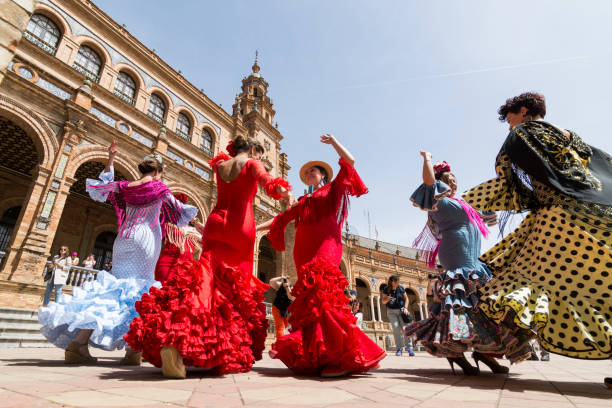
The museum visit should also correct a common visual bias. Flamenco costume can carry historical, social and theatrical meaning, yet no single costume defines the form. A bata de cola, mantón, fan or fitted dress may become an active choreographic object, but their absence does not make a performance less serious. Likewise, rapid footwork is one expressive resource, not the whole art. A still singer, a seated guitarist and restrained palmas can contain more structural tension than a sequence designed around immediate spectacle.
Learn six forms well enough to hear differences, not to identify an examination question
A specialist day benefits from a small set of contrasts. Soleá is often approached as a foundational twelve-beat form with gravity and spaciousness. Seguiriya also uses a twelve-beat framework, but with a different accentual feel and a reputation for emotional severity. Alegrías, associated with Cádiz, can feel brighter and more expansive while retaining considerable rhythmic discipline. Tangos operate in four, with a direct pulse that can make the relationship between groove, lyric and movement easier for a new listener to follow. Bulerías are fast, elastic and socially charged, often used for finales or ensemble exchanges, though not confined to that role. Fandangos encompass multiple regional and personal forms; some are metered, while fandangos naturales may be sung with freer rhythm.
These descriptions are orientation points, not guarantees about the evening programme. A venue may not announce every palo in advance, and performers may shape familiar forms idiosyncratically. The useful pre-show question is not “Can I name this within ten seconds?” but “What is holding the piece together, and who is signalling the next change?” That shift moves attention from labels to relationships.
It also prevents a common error among culturally ambitious travelers: trying to acquire expertise in a morning. The day should create informed receptivity, not simulated mastery. Keep notes to one page. Record a handful of terms, two rhythmic contrasts, one question about the guitar, and one observation about ensemble communication. Those notes become prompts during the workshop and after the performance; a dense transcription of museum panels will not.
Use the museum as a listening laboratory, not a complete history of flamenco
No single museum can settle flamenco’s origins, and a serious visitor should be wary of narratives that make one neighborhood, one community or one date carry the entire story. Flamenco emerged through long interaction among Andalusian social worlds, including Gitano, non-Gitano Andalusian, working-class, urban, rural and theatrical contexts. Its development involved oral transmission, professional stages, cafés cantantes, family lineages, recordings, festivals, conservatory study and international circulation. The history is not less meaningful because it is plural; it is more demanding.
The museum is most productive when treated as an organised set of propositions. Which periods does it distinguish? Which artists are presented as masters, and on what basis? How does it connect private or communal practice with professional performance? Where do costume, photography, film and sound recording change the way flamenco is seen? Which elements are described as inherited, and which as transformed? These questions turn display material into a preparation for live judgment.
Allow enough time to revisit one section after the first pass. On the initial circuit, establish the broad chronology and the principal forms. On the second, choose one strand that will matter later in the day: guitar development, costume as movement technology, the relation between singing and dance, or the role of named schools and lineages. Repetition here is not wasted time. It teaches the eye to discriminate between information that is merely interesting and information that can be tested in performance.
For this sequence, guitar is the most useful strand because it carries directly into a Triana appointment. Before leaving, be able to articulate three questions. What qualities distinguish a flamenco guitar’s intended response from the sound ideal of many classical instruments? How does construction affect attack, sustain and percussive use? How does an accompanist support a singer or dancer without simply becoming quieter? The workshop will not deliver universal answers, but it can show why the questions are materially grounded.
End the museum visit before fatigue makes every panel equivalent. A practical stopping rule is to leave once the traveler can explain the functions of cante, toque, baile and palmas; define palo and compás without overclaiming; identify one historical complication; and carry one focused craft question across the river. Staying another hour to collect isolated facts may reduce, rather than deepen, the evening’s attention.
Cross to Triana for context, but do not ask the neighborhood to certify authenticity
The move from the centre to Triana should be visible on the day’s map. Cross the Guadalquivir and allow the city’s geography to register: the historic core on one bank, a neighborhood with its own craft, labor, ceramic, maritime and flamenco associations on the other. The crossing is valuable because it interrupts the museum’s institutional frame. Flamenco is not only something catalogued in galleries or presented on stages; it is also embedded in urban memory, family histories, workshops, commerce and changing patterns of residence.
Triana’s connection to flamenco is substantial, but it should not be mythologised into a purity test. The neighborhood has been home to important Gitano families and performers, and its name carries enormous symbolic weight in flamenco culture. It has also changed through displacement, redevelopment, tourism and the ordinary turnover of a living city. A doorway, bar or venue does not become artistically profound merely because it is in Triana, and a performance elsewhere in Seville is not automatically less rooted.
This distinction matters for repeat visitors because “authentic Triana” is a powerful sales phrase. It can encourage people to treat local residents as scenery, to search for unadvertised private gatherings, or to assume that informality guarantees artistic quality. The more respectful position is narrower: learn what Triana contributed, notice how the neighborhood’s histories are represented, and judge any current cultural encounter by the artists, conditions and context actually present.
A focused context walk can follow the workshop rather than precede it. Before the appointment, the traveler’s attention should remain available for the maker. Afterwards, a short route through nearby streets can connect craft to neighborhood scale without becoming a generalized sightseeing loop. The purpose is to notice spatial relationships: how close workshops sit to homes and shops, how the river marks the boundary with the centre, and how contemporary commercial life coexists with inherited cultural narratives.
For a deeper treatment of when Triana merits more than a brief evening crossing, use the planning case for giving Triana its own daytime attention. That supporting guide can carry ceramics, market life and wider neighborhood history. On this flamenco day, those subjects should remain secondary. The route is strongest when one appointment anchors the district and keeps the visitor from turning local context into a checklist.
The transition has a cost. It takes time to leave the museum, eat, cross the river, locate a small workshop and arrive without rushing. In hot weather, the physical exposure of the crossing can also reduce concentration. Treat the interval as a real block rather than a decorative stroll inserted between bookings. A car may be sensible for a traveler with limited mobility, a tight appointment window or severe heat, but transport should solve that specific movement problem; it need not shape the whole day. Walking is valuable when conditions are comfortable because the river crossing makes the change of neighborhood intelligible.
Make one guitar workshop appointment do the work of an entire craft chapter
Seville’s official tourism material presents Spanish-guitar makers as part of the city’s living artisan culture and directs visitors toward workshops or specialist shops. It does not, by itself, establish that a particular maker accepts visits, demonstrations or commissions on a given day. That distinction is essential. The official overview is useful evidence of the craft ecosystem; access must still be arranged directly. See the city’s official artisan-shopping overview for the published context.
An official city shopping guide marked as updated in January 2025 lists guitar maker Andrés Domínguez at Calle Procurador 15 in Triana. The listing identifies a real artisan address, but it should not be read as an open-door visiting schedule. The guide can be consulted through the city’s published artisan-shopping PDF. Confirm current contact details, appointment policy and the nature of any visit before building the day around it. Do not assume that a working luthier can pause production, provide a demonstration or host a group without prior agreement.
The best appointment is not a performance by the maker for the visitor. It is a disciplined conversation around an instrument, a bench and a small number of construction choices. Ask in advance what the maker is comfortable showing. Some workshops may be able to discuss woods, bracing, neck geometry, action, finish, repairs or the difference between instruments intended for classical and flamenco use. Others may prefer to focus on completed guitars. Respect the maker’s working environment and avoid turning tools, unfinished instruments or client commissions into photography props.
What to look at on the instrument
Begin with the soundboard. The top is the principal radiating surface, and its thickness, stiffness and internal bracing influence how the instrument responds. A maker may discuss spruce or cedar, though individual practice varies. Look through the sound hole only when invited and ask how the fan bracing has been voiced for that particular guitar. The point is not to extract a secret recipe; it is to understand that responsiveness is designed through relationships among materials, dimensions and maker judgment.
Next, examine the back and sides. Cypress is strongly associated with many flamenco guitars, while other woods are also used. Avoid treating material as destiny. Two instruments made from similar species can respond differently because of construction, age, setup and player technique. Ask the maker how the chosen body materials contribute to weight, projection, tonal separation and the speed of response they seek.
Then look at the setup. Flamenco players often value immediate attack and a tactile relationship with the strings, and many instruments are set with relatively low action. Yet “low” is not an abstract virtue: if the geometry does not suit the player, buzzing and loss of control can result. Ask how the maker balances ease, percussive clarity and clean tone. The answer connects directly to the evening, when rapid rasgueado, thumb work, picado or forceful accompaniment must remain rhythmically articulate.
The golpeador, the protective tapping plate on the soundboard, offers an obvious bridge between craft and performance. It permits percussive strikes while protecting the top, but its presence should not lead the visitor to listen only for golpes. More revealing is the integration of percussive attack with harmony and compás. During the show, notice when the guitarist’s right hand reinforces the dancer’s accents, when it opens space beneath a vocal line, and when a falseta changes the temperature of the room without breaking the form.
Finally, ask about sound ideals in the maker’s own language. Words such as dry, bright, dark, open, quick, deep, separated or sustaining can mean different things to different builders and players. Invite comparison rather than demanding a definition. If two instruments are available and the maker permits them to be played, listen for attack, decay, balance between bass and treble, and the way repeated chords retain or lose clarity. Do not expect a brief demonstration to determine which guitar is “better.” The lesson is that instruments are voiced for particular priorities.
Questions that connect the bench to the stage
- How does the instrument need to respond when accompanying cante? This shifts discussion from solo brilliance to support, breath and phrasing.
- What setup choices help a guitarist articulate compás beside strong footwork? The answer may involve attack, projection, string tension or player preference.
- How does a maker hear the difference between projection and harshness? This prepares the listener to judge presence without equating volume with quality.
- Which repairs or adjustments most change an instrument’s response? This reveals how maintenance and setup continue the making process after construction.
- What does the maker listen for when a guitarist first tries a finished instrument? The response often exposes the practical vocabulary shared between bench and player.
Keep the visit to the agreed duration. A workshop is a place of production, and the appointment should end while the conversation still has focus. One well-prepared hour can transform the evening’s listening; two loosely structured craft stops are more likely to produce repetition and scheduling risk. Do not add a costume atelier, percussion maker and guitar shop merely to make the day look comprehensive. The sequence needs one material encounter, not an artisan inventory.
This is also where specialist private planning can have a material effect. The value lies in identifying an appropriate appointment, establishing what is actually available, briefing the maker on the travelers’ level of interest, and translating technical vocabulary without taking over the conversation. None of that guarantees access to a named artisan or to working artists. It does, however, distinguish a purposeful visit from arriving at an address and hoping a workshop can accommodate an interruption.
Build the afternoon around transitions, not around empty map space
The middle of the day is where ambitious cultural itineraries usually lose coherence. A museum ends earlier than expected, a lunch runs long, the river crossing is hotter than anticipated, or the workshop sits on a street that takes time to locate. The solution is not to remove all uncertainty. It is to place generous seams between the fixed points and to know which component can shrink without damaging the argument of the day.
A workable planning model, assuming a 19:30 performance and a late-morning museum entry, looks like this:
- Late morning: Museo del Baile Flamenco, with the first pass devoted to history and forms and the second to guitar, costume or ensemble roles.
- Early afternoon: a calm meal near the centre or river route, followed by enough unassigned time to cross without watching the clock every five minutes.
- Mid-afternoon: one confirmed Triana workshop appointment, ideally with the visit scope agreed beforehand.
- After the appointment: a short neighborhood context walk and the return toward the performance area.
- Before the show: a seated pause, water and a review of three listening prompts rather than another attraction.
- 19:30–20:30: one live performance, followed by dinner or a direct end to the evening.
This is a sequence model, not a claim about permanent opening hours. Museum admissions, workshop availability and performance schedules must be checked for the chosen date. The fixed time can also move earlier. An 18:00 show may suit summer heat, a lighter dinner or travelers who listen better before a long evening. A later performance can work when the workshop is the day’s principal appointment, but the added open time should not be filled automatically.
The first compressible element is the neighborhood walk. If the appointment runs long, return to the centre without guilt. The second is the meal’s complexity: this is not the day for a lunch whose pacing cannot be controlled. The museum should be shortened only after the visitor has acquired the vocabulary needed for the evening, and the workshop should never be cut so tightly that arrival or departure becomes discourteous.
For broader dinner geography, especially when choosing between eating before and after a show, use this Seville flamenco-night timing guide as the supporting logistics layer. Its role is to solve dining and return questions. This article’s concern is different: preserving enough cognitive space that the live performance remains the culminating act of the day.
Do not schedule a major monument between the workshop and performance. Even when a timed entry appears to fit, it changes the mental register and introduces another queue, security process, interpretive system and walking segment. A small church, market or river view may be acceptable if it is genuinely on the way and requires no commitment, but the stopping rule should be strict: no additional anchor commitment after the workshop.
Choose the evening room for what the day has trained you to notice
A separate decision guide is the right place to compare tablao, peña and theatre formats in detail. Use the full comparison of Seville flamenco formats, sightlines and artistic depth when selecting among venues. For this sequence, the criterion is narrower. Choose one performance whose duration, room and audience conditions allow concentrated listening after the archive and workshop work.
Casa de la Memoria provides a useful example because its published format is unusually compatible with this purpose. The venue lists regular one-hour performances at 18:00–19:00 and 19:30–20:30, with possible additional seasonal times at 16:30, 21:00 and 22:30 subject to availability. These times are operational and can change, so consult the venue’s current information page for the selected date rather than treating this article as a schedule.
The venue also describes an intimate theatre arranged as a widened semicircle around its central patio, with the audience close to the artists. It states that performances use no microphones or amplification and that no bar or dining service crosses the audience during the show. Those conditions matter after a craft-focused afternoon: unamplified sound makes attack, decay, vocal projection, palmas and the guitar’s balance easier to hear as physical events in the room. The published description appears on Casa de la Memoria’s venue-history page.
This does not make the venue universally superior, nor does it imply that every seat or programme is identical. It means the room offers a coherent test environment for the day’s listening framework. A larger theatre may provide broader stage geometry and clearer full-body views. A tablao may offer a different relation between audience, hospitality and performance. A peña may foreground community context but can require more knowledge of programming and access. The choice should follow the traveler’s purpose rather than a hierarchy of supposed purity.
Sightlines: decide what you most need to see
For footwork, the essential condition is an unobstructed view of the floor from the dancer’s ankles downward. A very close seat can heighten physical impact but may compress the overall composition, especially when the dancer moves across the stage or the ensemble sits at the edges. A central seat a little farther back often gives a better account of relationships: who watches whom, how a guitarist cues a transition, when palmas tighten, and how the singer’s posture changes before an entry.
Side angles are not automatically inferior. In a semicircular room they can reveal the exchange between dancer and musicians, and they may give a clearer view of the guitarist’s right hand. The tradeoff is that some body lines or floor patterns can read asymmetrically. Travelers who care most about guitar technique may prefer a position with a direct sightline to both hands; those focused on choreography should prioritise the complete stage plane.
For a guest who is hard of hearing, no-amplification conditions require individualized judgment. Proximity can help with direct sound and visual cues, but room acoustics, hearing devices and the balance of voice, guitar and footwork all matter. The related guide on flamenco sightlines and cultural-day coordination for a hard-of-hearing traveler develops those considerations more fully. The relevant principle here is to choose the seat and room deliberately rather than assuming “front row” solves every sensory need.
Listen for five relationships, not five spectacular moments
- Singer and guitarist: notice whether the guitar anticipates, answers or supports the vocal line, and how much space it leaves around the text.
- Dancer and compás: watch how movement sits inside the rhythmic cycle, especially when tension comes from delaying rather than striking every expected accent.
- Footwork and guitar attack: compare the clarity and decay discussed in the workshop with what survives beside percussive dance.
- Palmas and ensemble control: listen for changes in density and volume that help shape entries, transitions and endings.
- Silence and concentration: notice pauses before applause, the stillness around a lyric, and the moments when restraint carries more force than speed.
Do not spend the show naming every palo in real time. That turns attention inward and can make the visitor miss the ensemble’s communication. Use identification as a hypothesis: perhaps this is soleá because of the twelve-beat feel and the gravity of the phrasing; perhaps the finale moves toward bulerías. Then return to the stage. The most valuable confirmation may come after the piece, in a programme note or conversation, rather than during it.
Performance etiquette is part of the sequence’s integrity. Arrive early enough to settle without disturbing others. Keep phones silent and follow the venue’s current photography rules. Do not record artists without permission. Avoid loud commentary while a piece is unfolding, even when a newly learned term seems exciting. The day has prepared the traveler to notice more; it should also make the traveler less intrusive.
The workshop changes the show only when the listening framework is specific
A craft appointment pays off in performance through a small number of audible consequences. First, the guitar no longer appears as a decorative accompaniment to dance. Its construction and setup become part of how quickly an accent speaks, how clearly chords separate, and how the instrument occupies the room beside voice and footwork. Second, the player’s technique can be heard as a negotiation with the object: the response of the top, the feel of the strings, the percussive possibilities of the golpeador and the balance between force and clarity.
Third, the visitor becomes less likely to confuse volume with authority. An unamplified guitarist may project through precision, timing and tonal focus rather than sheer loudness. A singer may command the room by shaping a phrase against sparse accompaniment. A dancer can create suspense through withheld movement. The workshop has shown that responsiveness depends on controlled relationships; the performance extends that lesson to the ensemble.
Fourth, the day reveals the limits of material explanation. No instrument specification can account for artistic judgment. The same guitar will speak differently under another player, in another room, within another palo. That limit is intellectually productive. It prevents craft knowledge from becoming consumer connoisseurship and returns attention to musicianship, collaboration and live risk.
The guide or specialist accompanying the day should therefore use the pre-show pause to reduce, not increase, the number of prompts. Three are enough: listen to the guitar’s attack beside footwork; watch for a cue that reorganises the ensemble; and notice one passage where restraint changes the room. More instructions can make the audience member anxious about missing evidence. The goal is alert presence, not a scored assessment.
Optional branches should preserve the cumulative logic
The shorter branch: museum, one contextual crossing, one performance
When no suitable workshop appointment can be verified, do not substitute an unannounced visit to a maker. Keep the museum, cross to Triana for a concise neighborhood context walk, and return for the show. Use the museum’s guitar material to establish the craft questions, then listen for the answers provisionally in performance. The day loses tactile depth but retains its order: evidence, place, live test.
This branch also suits travelers who have already visited a luthier elsewhere in Andalusia or who know that technical workshop conversation will exceed their interest. It is better to admit that preference than to treat an artisan’s time as compulsory cultural consumption. Replace the appointment with a longer museum second pass or a seated discussion of recordings and forms, not with another major attraction.
The Triana-centred branch: workshop and performance on the west bank
If the chosen performance is in Triana, the route can remain across the river after the workshop. That reduces a transition and may be advantageous in heat or for limited mobility. The intellectual sequence does not depend on returning to the centre; it depends on choosing a live room that serves the listening task. Teatro Flamenco Triana or another verified programme may fit, but the decision should be based on current artists, room, duration and sightlines rather than the neighborhood name alone.
The tradeoff is that Casa de la Memoria’s specific unamplified, no-service-during-performance conditions may no longer apply. Reassess the listening environment from first principles. Is the guitar amplified? Can the audience see the floor? Does dining continue during the show? How long is the programme? Are seats assigned or chosen on arrival? These are operational questions, not measures of artistic legitimacy, but they materially affect whether the day’s earlier study can be used.
The museum-heavy branch: history for a traveler who already understands guitars
A collector, player or repeat workshop visitor may need less construction explanation and more historical context. In that case, deepen the museum work around schools, periods, costume, named masters and the movement between private, café, theatre and contemporary institutional settings. The afternoon appointment can become a shorter conversation about accompaniment, restoration or contemporary commissions, provided the maker agrees. The performance prompts should then focus on lineage and form rather than basic instrument response.
Even in this branch, avoid claiming that a current artist represents a particular school or lineage unless that information is published or confirmed. Visual resemblance and repertoire choice are not enough. Serious cultural interpretation includes knowing when not to assign a label.
The stopping rule is one performance and one post-show conversation
The day ends after the chosen show. Do not add a second tablao, search for a supposedly more authentic late gathering, or treat a peña as an after-hours upgrade. Multiple performances can be valuable across a longer stay, especially when the formats differ, but placing them back to back collapses distinctions and encourages superficial comparison. The first show deserves time to settle.
A post-show conversation should be brief and evidence-based. Ask which earlier concept became clearer. Did the guitar’s attack match the workshop description? Was a llamada visible? Which artist appeared to control a transition? Did the room help or hinder the singer? Which assumption about costume, speed or emotional intensity changed? These questions preserve memory without forcing consensus.
Then stop analysing. Dinner can follow, but it should not become a seminar in which every gesture is decoded. The purpose of preparation is to enlarge perception, not to eliminate mystery or turn live art into a demonstration. A successful sequence leaves the traveler with sharper questions and a desire to hear another programme on another day.
For a multi-night stay, the next performance should be separated by at least one day and chosen for a different context: perhaps a larger theatre after an intimate room, a dance-led programme after a cante-focused evening, or a peña programme whose public access and schedule have been verified. That creates comparison with memory, not competition within the same exhausted night.
What expert coordination changes
This itinerary becomes meaningfully private when interpretation and access are coordinated around the same artistic question. A specialist guide can establish the museum vocabulary at the travelers’ actual level, keep disputed origin stories in proportion, and carry one technical thread into the workshop. An appointment coordinator can confirm whether a luthier visit is possible, what the maker is prepared to discuss, how many guests can enter, and how long the exchange should last. A performance choice can then be made for room conditions and programme logic rather than brand familiarity alone.
The service value is therefore not a stream of privileged encounters. It is continuity. The museum does not end when the group leaves the building; its questions travel to Triana. The workshop does not become an isolated shopping stop; its material lessons return in the sound of the evening. The guide’s final contribution is restraint: knowing when to stop explaining so the performance can work on the audience directly.
Travelers seeking that archive-to-workshop continuity can place it within a privately guided Seville programme built around specialist interpretation and confirmed appointments. When the evening is meant to reward the day’s earlier study, the inquiry should begin with the desired artistic focus, the travelers’ existing flamenco knowledge, mobility needs and preferred performance time—not with a request to “see everything.” Inquire now
If you’re interested in any private tours of Seville, please reach out to us.




 So if you are looking for the absolute best in Seville & surroundings with authentic local fully-licensed native guides whose English you can actually understand and with an exclusive and amazingly fun itinerary