Before a Flamenco Night in Seville: Triana Context, Dinner Timing and an Easy Return
Updated
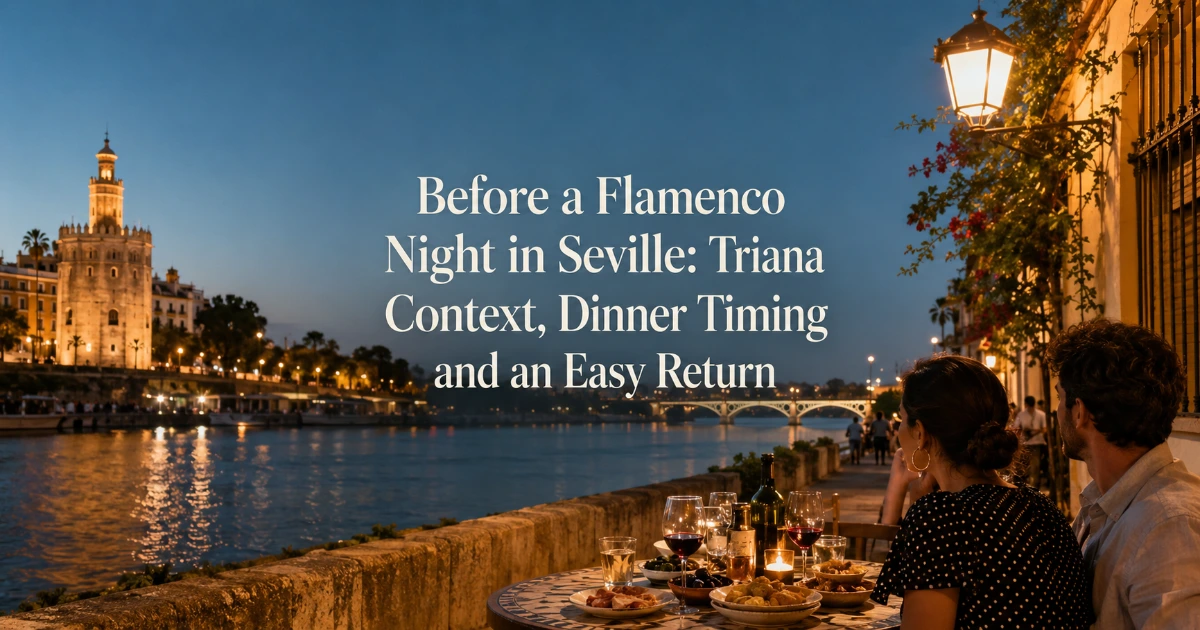
The best way to plan a flamenco night in Seville is to let Triana frame the evening, place dinner either early and light before the show or unhurried afterward, and decide the hotel-return route before you dress for the night. That works in real Seville because the evening is shaped by a river crossing, old-town walking speed, late dining habits and the difference between a meaningful pre-show walk and a decorative wander. The exception is simple: if your show is firmly in Santa Cruz or central El Arenal and your hotel is there too, do not force Triana just for symbolism.
The thesis of this guide is narrow: a flamenco night in Seville feels most polished when the neighborhood context arrives before the performance, not when the performance is treated as an isolated ticket between a rushed restaurant and a vague taxi plan. A short Triana context walk can make the night feel rooted rather than theatrical, especially when it crosses or traces the Guadalquivir with a guide who can connect ceramics, river work, family bars and flamenco memory without stretching the evening into a lecture. For travelers who want that pre-show layer designed privately, the most natural place to start is Triana Quarter Private Tours.
Here is the counterintuitive correction early: the most famous old-town base is not automatically the best flamenco-evening base. Santa Cruz is beautiful and useful for daytime heritage, but its narrow lanes can turn a late return into a small navigation chore, especially after dinner, wine and a show. El Arenal is often smoother for taxis and river-edge movement, while Triana gives the evening better cultural framing when the show or pre-show walk is on that side of the Guadalquivir. Premium show seats do not compensate for a rushed dinner or a poor return route. Spend first on sequence, then on the seat.
The evening should be built as a sequence, not as a ticket plus dinner
A successful flamenco evening in Seville has four parts: the daytime restraint, the pre-show neighborhood frame, the dinner position and the return. Most disappointing plans fail because one of those four is treated as an afterthought. The traveler books the show, then looks for a restaurant, then realizes the group is tired from the Alcázar, Cathedral, Giralda climb, Santa Cruz wandering and a hot walk to the river. By the time the performance begins, the night has already spent its mood.
For couples, the difference is especially visible. The mood-preserving decision is to create one calm transition between daylight touring and the show: a hotel pause, a short guided walk through Triana, a simple glass of wine, or an early dinner that does not feel like a race against curtain time. The mood-killing mistake is to treat flamenco as the final item in a maximum-efficiency sightseeing day. If the afternoon has already included two monument interiors, a long old-town walk and a late lunch that ran heavy, the evening starts with people negotiating tired feet and timing rather than paying attention to the performance.
For families and small groups, the sequence matters for a different reason. A show can hold attention beautifully when everyone arrives settled, fed enough and not overheated. It becomes brittle when the group has been dragged through a long cultural day and then asked to behave elegantly in a compact venue. A private plan can soften this: reduce the daytime route, pick the shortest sensible walking segment, place dinner where the group will not be checking watches, and pre-arrange the return so no one ends the night debating directions on the curb.
The best Seville flamenco evening is rarely the one with the most additions. It is the one with fewer transitions. A Triana context walk, dinner and show can make a complete evening if each element earns its place. A daytime cathedral route, ceramics shopping, river cruise, tapas crawl, flamenco, late dinner and rooftop drink may sound festive on paper, but the city makes you pay for every transfer in heat load, cobbles, waiting time, river crossing and group fatigue.
A practical matrix for Triana, dinner timing and the return
Use this matrix to decide what should lead the evening. The point is not to rank flamenco venues; it is to keep the night coherent around where you are, where the show is, when you eat and how you get back.
- Show in Triana, hotel in Triana or El Arenal: make Triana the frame. Walk the river edge or Altozano area before the show, eat early if your dinner style is light, and return by a short walk or easy taxi. This is the cleanest option for travelers who want the evening to feel local without becoming logistically fussy.
- Show in Triana, hotel in Santa Cruz: Triana still works, but the return must be decided before the night starts. A late walk back through the center can be charming for energetic couples, but it is not the right default for older parents, dressed-up celebration travelers or groups with children.
- Show in Santa Cruz, hotel in Santa Cruz: keep the evening compact and do not force a pre-show detour to Triana. Use Santa Cruz context instead, especially if the day has already been active. A private heritage walk can be shaped through Santa Cruz Private Tours without adding a river crossing.
- Show in El Arenal, hotel in El Arenal or central old town: this can be the easiest comfort-first evening. The cultural frame is less neighborhood-specific than Triana, but the hotel return is often simpler, especially for travelers who dislike late transfers.
- Fine dinner as the anchor: put the show before or after the meal, not in the middle of a tasting-menu rhythm. Formal dining and flamenco both deserve attention. Compressing them together usually weakens both.
- Celebration trip with dressier clothes: favor fewer walking segments, a known curb or driver plan, and dinner near either the show or hotel. The most elegant night is not always the longest walk.
This is why a flamenco night should be planned from the end backward. Ask first: where do we want to be when the show finishes, and how do we want to feel on the way back? Then choose dinner. Then decide whether Triana belongs before the show. That order prevents the most common late-night friction: people loving the performance, then losing the polish of the evening during a tired return through streets that felt picturesque in daylight but less legible after dinner.
Travelers comparing broader Seville bases can use the neighborhood logic in Santa Cruz, El Arenal or Triana for a first stay, but for this particular evening the main rule is narrower: choose the base that reduces after-show decisions. A hotel that is perfect for daytime sightseeing may still require more care at night if the show is across the river.
When Triana should frame the flamenco evening
Triana should frame the evening when the show, dinner or hotel route can naturally connect to the neighborhood without turning the night into a forced pilgrimage. It is most persuasive when your performance is in Triana, when you are curious about flamenco’s neighborhood roots, or when you want the pre-show time to carry meaning rather than function as empty waiting.
The best version is compact. Begin around the river edge, the Puente de Isabel II or the Altozano side of Triana, then let the walk move through ceramics references, old family streets, bars with neighborhood memory and the lived geography of a district that faces Seville across the Guadalquivir rather than dissolving into it. This is not about collecting landmarks. It is about arriving at the show with a mental map: river, bridge, barrio, families, craft, rhythm, public life. When the performance begins, the music feels less like an export and more like something attached to place.
A Triana context walk also corrects a subtle planning error: many visitors think flamenco context belongs inside the show. In practice, a performance is not the ideal moment to pause for explanation. The night gains more if the context is given beforehand, while the group is walking, asking questions and noticing the district. Then the show can remain a show. That is where a private guide earns the cost: not by over-explaining the performance, but by turning the hour before it into orientation rather than filler. To make that handoff feel deliberate, Orange Donut Tours can fold the pre-show walk, dinner spacing and return plan into a tailor-made evening; Inquire now.
Triana should not frame the evening when it adds a transfer without payoff. If your show is in Santa Cruz, your dinner is in the old town, your hotel is also in Santa Cruz and the daytime has already been long, Triana becomes an obligation rather than an advantage. In that case, the better editorial call is to stay central and let the evening breathe. You can still understand flamenco with a well-led conversation and a carefully chosen show; you do not need to cross the Guadalquivir simply to prove cultural seriousness.
Travelers who have already planned a deeper flamenco-focused day may want the broader context in where flamenco belongs in a bespoke Seville stay. This article is more specific: it is about the final pre-show decisions that determine whether the night feels smooth, rushed or overbuilt.
How to plan dinner before a flamenco show in Seville
Dinner should sit either clearly before the show as a lighter, earlier meal, or clearly after the show as the unhurried close to the night. The weakest plan is dinner squeezed immediately before curtain time, especially if the restaurant is not near the venue or the group expects a full Andalusian meal with wine and conversation.
Seville’s dining rhythm rewards leisure. Even when a restaurant can serve you quickly, a premium evening should not require quickness from the meal. If you want dinner before the show, make it intentional: book early, keep the menu moderate, choose a place close to the show or on the direct route, and leave enough space to arrive without rushing. This is especially important in Triana, where a pre-show meal can work beautifully if the route is short, but less well if you are crossing from Santa Cruz at the last minute, finding the restaurant, eating fast and then hurrying back through the neighborhood.
For couples, a light early dinner before flamenco can be the best mood choice when the show is the emotional center of the night. It avoids the post-show hunger problem and lets you arrive settled. But it should not become a disguised tasting menu. If the point of the evening is flamenco, dinner is there to support the show, not compete with it. A small, well-paced meal before the performance usually beats a prestigious, multi-course dinner that forces you to watch the clock.
For food-and-wine travelers, the answer may flip. If dinner is the culinary centerpiece, schedule flamenco before dinner or on a different night. A serious dinner after the show can work if the restaurant timing allows it and the group likes late evenings. But a full fine-dining meal before a show is often the wrong upgrade, because the diner’s attention splits between courses, wine, timing and transit. Paying more for an ambitious dinner does not help if the structure makes everyone restless.
The practical rule is simple. Before the show, choose proximity and restraint. After the show, choose atmosphere and appetite. Around Triana and El Arenal, this often means the dinner decision is also a routing decision: will you end the performance and move toward the hotel, or will you cross the river again for the meal? The second crossing may be lovely for energetic travelers, but it is a decision, not a default.
When you do use an official venue page, use it for narrow operational checks rather than outsourcing the evening plan. For example, confirm the current show information directly with Teatro Flamenco Triana (https://www.teatroflamencotriana.com/en/home/) before locking dinner time around that specific venue. The official page can tell you the show details; it cannot tell you whether your Alcázar morning, lunch, hotel pause, dinner and return will feel like a polished night. That is the planning layer that matters most.
What the daytime should look like before a flamenco night
The daytime should be shortened before a flamenco night when it includes Seville’s major monument core, a hot-season afternoon, or a group that wants dinner and performance to feel like the highlight rather than the final effort. Shorten a daytime Alcázar, Cathedral, Giralda and Santa Cruz plan before a flamenco night; stop forcing a full monument day plus Triana plus late dinner.
This is the cut-first rule: remove the afternoon extension before you remove the evening. The reason is physical, not just aesthetic. Seville asks more from the body than many visitors expect. The old town is walkable, but walkable does not mean weightless. Sun exposure, stone surfaces, narrow-lane navigation, standing inside monuments, bridge crossings over the Guadalquivir and the stop-start rhythm of popular streets all accumulate. By early evening, a traveler may not feel exhausted exactly, but attention is thinner, patience is shorter and the idea of another “short walk” begins to sound less charming.
If the flamenco night matters, keep the daytime to one major anchor and one soft secondary layer. A morning Alcázar with a shaded Santa Cruz thread can work. A Cathedral interior plus a small old-town walk can work. A river-side reset through El Arenal toward the Guadalquivir can work. What fails is the pride of completion: trying to see every central monument, add Triana, eat well and still arrive emotionally available for a performance. The show may still be excellent, but the travelers bring a flattened day into the room.
Heat makes the rule stricter. In warmer months, the late afternoon should often become a hotel pause or low-exposure transfer window rather than another cultural stop. A shower, change of clothes and half-hour of quiet can do more for the evening than one additional palace room. Travelers planning Seville around heat can also read Seville in high heat: morning monuments, midday reset and an evening river strategy, but for this flamenco night the operating principle is clear: protect attention before the performance.
There is also a mood consequence. A flamenco night should not feel like an obligation appended to a conquered itinerary. When the daytime is lighter, the evening feels chosen. Conversation improves. Dinner feels less transactional. The walk to the venue becomes part of the anticipation. When the daytime is overpacked, even a beautiful performance can feel shorter because the group has no spare emotional room for it. Couples notice this most: the night becomes a logistics recovery exercise instead of a shared cultural evening.
The hotel-return route is part of the experience
The hotel-return route should be planned before the show because it determines whether the night ends elegantly or dissolves into small decisions. In Seville, the after-show route is rarely complicated in an absolute sense, but it can be tiring when the group is dressed up, full from dinner, moving late, or crossing from Triana back into the old town.
From Triana, the Puente de Isabel II is the most familiar pedestrian hinge into central Seville, connecting the neighborhood toward the market and old-town side. For some travelers, that crossing after a show is a pleasure: river air, city lights, a short decompression before the hotel. For others, it is the moment the night becomes longer than expected. The difference depends on shoes, age, temperature, wine, group size, and where the hotel actually sits. A hotel in El Arenal may feel close and easy. A hotel deep in Santa Cruz can add a final layer of narrow-lane navigation that was not obvious at booking.
For comfort-first travelers, the most useful question is not “Can we walk back?” It is “Will walking back make the evening better?” If the answer is yes, build the walk into the plan and keep dinner from pushing too late. If the answer is no, arrange the return around a known pickup point or a simple taxi strategy. The Prado de San Sebastián area, Puerta de Jerez side, Plaza de Cuba and central river approaches can all matter as route hinges depending on where the evening begins and ends. The exact plan should be tailored to the venue and hotel, but the principle remains: do not improvise the last transfer after the emotional peak of the night.
Celebration travelers should be even stricter. A birthday, anniversary or multigenerational evening does not improve because everyone proves they can navigate a late walk. It improves when the final movement is calm. If one person in the group is wearing formal shoes, if older parents are present, or if the weather is warm, a shorter return earns its cost. This is where premium spend can help: private planning, a guide handoff, a known pickup, or a chauffeur for the wider evening can change the comfort level. It does not help when it is spent only on a pricier show seat while dinner and return remain badly spaced.
Triana, Santa Cruz or El Arenal before the show?
Triana is best before the show when context is the goal; Santa Cruz is best when compactness and old-town heritage matter more; El Arenal is best when the river edge and return ease need to do more of the work. The right choice depends less on which neighborhood is “best” and more on which one reduces friction for your actual evening.
Triana before the show
Choose Triana when you want the performance to feel attached to a living district. A short walk around Altozano, the bridge approach, ceramics references and the river side can make the evening feel grounded. This is particularly strong when the show is at Teatro Flamenco Triana or another venue on that side of the Guadalquivir, because the context and venue belong to the same geography. It suits couples, culture-focused travelers and small groups who enjoy meaning before spectacle.
Avoid Triana before the show when it would create a three-part zigzag: old-town hotel to Triana, Triana back to central dinner, then another movement to the show or hotel. Triana is not a trophy to attach to every flamenco plan. It is a frame that works when the route allows it.
Santa Cruz before the show
Choose Santa Cruz when your venue and hotel are already central and the daytime has not exhausted the group. Its narrow lanes, Jewish-quarter memory, cathedral edges and quiet patios can create a refined pre-show context, especially for travelers who want Seville’s old-town atmosphere without adding a river crossing. This is also a practical solution for families who need fewer transitions and older travelers who prefer not to stretch the night.
The caution is that Santa Cruz can be deceptively slow. A route that looks short on a map may involve narrow lanes, pauses, people moving at different speeds and the need to reorient. It is a beautiful district for guided context and a mildly frustrating one for hurried self-navigation. If you use it before a show, keep the walk purposeful and do not add a restaurant that requires another cross-town move.
El Arenal before the show
Choose El Arenal when you want a smoother practical evening around the river, central taxis and a less intricate return. It is not the deepest flamenco context, but it can be the strongest comfort choice. The neighborhood sits well between old-town hotels, the Guadalquivir edge and Triana crossings, so it can function as a hinge rather than a destination. For travelers who care about the night feeling easy, that hinge has real value.
The mistake is to undervalue El Arenal because it sounds less culturally dramatic than Triana or Santa Cruz. For a dressed-up group, a late show, or travelers who want dinner to feel relaxed, the best neighborhood is sometimes the one that prevents the evening from fragmenting. If the goal is a polished return, El Arenal may outperform a more romantic-sounding but more awkward route.
Where private planning earns its keep
Private planning earns its keep when the evening has more than one moving part: show location, neighborhood context, dinner, older parents, children, celebration clothes, heat, or a hotel that is not on the same side of the river. It is less about exclusivity and more about not making the traveler solve small problems at the least graceful time.
A guide can turn a pre-show walk into context by choosing what to explain and what to leave alone. Good flamenco framing is not a compressed lecture on every palos, artist and historical debate. It is a calm orientation: why Triana matters, how the Guadalquivir shaped the district, why the bridge crossing changes the city’s feeling, what to notice in the performance, and why some of the most meaningful details are better heard before the first guitar note. That kind of guidance lets the show remain immediate rather than academic.
Private planning also improves the dinner decision. A local editor’s instinct is to ask what the meal is supposed to do. Is it a quiet pre-show foundation? A late celebratory close? A food-and-wine anchor that deserves its own night? The answer changes the route. It can also change what you skip. If dinner is the celebration, do not bury it between a full monument day and a show. If flamenco is the celebration, do not bury the performance after too much food and too much walking.
For bespoke Seville planning, the strongest itinerary is often made by removing one thing. That may mean shortening a monument day, replacing a formal dinner with a lighter pre-show meal, choosing El Arenal over a longer old-town walk, or making the Triana context walk private so it can be exactly long enough and no longer. Orange Donut Tours can design this as part of tailor-made Seville planning, especially when the evening must fit a wider Andalusia stay rather than one isolated night.
A sample polished sequence for a Triana flamenco night
A polished Triana flamenco night usually begins with a lighter daytime, resumes with a hotel pause, moves into a short neighborhood frame, places dinner deliberately, then ends with a chosen return. The sequence below is not a rigid itinerary; it is a planning model that shows the order of decisions.
- Morning: choose one major cultural anchor, not the entire monument core. An Alcázar morning with measured Santa Cruz context can work well. A Cathedral-focused morning can also work. Avoid making the morning a race to “finish Seville.”
- Lunch: keep lunch satisfying but not heavy enough to flatten the afternoon. If the evening includes dinner before the show, lunch should not become the day’s culinary centerpiece.
- Mid-afternoon: pause. In hot weather, this is not optional for travelers who want the evening to feel refined. A hotel reset, change of clothes and quiet hour can outperform another attraction.
- Pre-show: take a focused Triana context walk. Use the bridge, river edge, Altozano and the neighborhood’s craft and flamenco associations to prepare the group without overloading them.
- Dinner: place it either early and close to the venue, or after the show with no rush. Do not squeeze a full dinner immediately before curtain time.
- Show: arrive with enough margin to settle. The performance should not begin with everyone recovering from the route.
- Return: walk only if it adds pleasure. Otherwise, use the simplest return route to the hotel and let the night end cleanly.
For a couple, that sequence creates anticipation. For a family, it reduces negotiation. For a small celebration group, it gives the host fewer things to manage. For food-and-wine travelers, it clarifies whether dinner is supporting the show or deserves its own spotlight. The value is not that every minute is filled. The value is that each movement has a reason.
What to stop over-prioritizing
Stop over-prioritizing the idea that the flamenco evening must include every famous Seville layer. It does not need the longest monument day, the most central restaurant, the most prestigious seat, the furthest after-show drink and a symbolic river crossing if those pieces do not cohere.
The first thing to cut is the daytime overload. The second is the restaurant that looks impressive but sits awkwardly between hotel, show and return. The third is the extra post-show plan that sounds atmospheric in advance and becomes optional the moment the group is tired. A night can still feel special when it is shorter. In fact, it often feels more special because there is enough attention left for the performance.
The overvalued upgrade is a premium seat purchased to rescue a badly planned night. Better seats can improve sightline and comfort depending on the venue, but they cannot restore appetite after a rushed dinner, shorten a poor route, or undo a day spent standing in heat. Pay for better planning before you pay for symbolic upgrades. The city rewards sequencing more than display.
The underused upgrade is context. A private hour before the show can change how the evening lands. It gives the group language for what they are about to see and makes the venue feel less detached from the city. That is especially true in Triana, where the district itself can do part of the interpretive work if the route is chosen well. The walk should be short enough to preserve energy and specific enough to avoid becoming generic sightseeing.
When the recommendation breaks down
This Triana-first recommendation breaks down when the route becomes performative rather than practical. If your hotel, dinner and show are all in Santa Cruz, a Triana detour may weaken the evening. If someone in the group has limited mobility, late-night fatigue, heat sensitivity or dress shoes that make cobbles unpleasant, the plan should reduce walking rather than defend a romantic idea of crossing the city.
It also breaks down when dinner is the true priority. A culinary traveler who has secured a meaningful dinner should not force flamenco into the same narrow slot just because the night seems culturally efficient. Seville has enough depth for both, but not every standout experience needs to be stacked. If dinner is formal, long or wine-led, consider a lighter cultural evening elsewhere in the stay or put flamenco before dinner with a clear appetite plan.
The final wrong fit is the traveler who wants nightlife rather than a cultural evening. This guide is not a late-night bar crawl and does not attempt to turn flamenco into a nightlife category. It is for visitors who want the show to land well: enough context, enough space around dinner and a return that leaves the night feeling finished rather than frayed.
FAQ
Should I go to Triana before a flamenco show in Seville?
Go to Triana before a flamenco show when the venue, dinner or hotel route naturally connects to the neighborhood. It is most worthwhile when the show is in Triana or when a short Triana context walk will help the performance feel rooted rather than isolated.
Is it better to eat dinner before or after flamenco in Seville?
Eat before the show only if dinner is early, light and close to the venue. Eat after the show if you want a more relaxed meal or if food and wine are a major part of the night. Avoid squeezing a full dinner immediately before curtain time.
Is Teatro Flamenco Triana a reason to plan the evening around Triana?
Yes, Teatro Flamenco Triana can make Triana the natural frame for the evening because the venue and neighborhood context sit on the same side of the Guadalquivir. Confirm show details on the official site before fixing dinner time.
Should I shorten my Seville sightseeing day before flamenco?
Yes, shorten the daytime plan if it includes major monuments, heat exposure or a long old-town walk. A flamenco night usually feels better after one major daytime anchor, a pause and a focused evening sequence.
Is Santa Cruz a bad base for a flamenco night?
No, Santa Cruz can be excellent if the show, hotel and dinner are central. It becomes less ideal when you force a late Triana detour or need to navigate deep narrow lanes after a show and dinner.
Is El Arenal a good choice before or after flamenco?
El Arenal is a strong practical choice when you want easier river-edge movement, central taxi access and a cleaner return. It may offer less Triana-specific context, but it can make the evening feel smoother.
Do better seats matter more than dinner timing?
No. Better seats can improve comfort or sightline, but they do not fix a rushed dinner, an overpacked day or a poor hotel-return route. Sequence matters more than symbolic spend.
Can a private guide improve a flamenco evening without joining the show?
Yes. A private guide can be most useful before the show, turning a short Triana or Santa Cruz walk into context and then handing you into the performance with dinner and return logistics already settled.
The final planning call
For a discerning Seville stay, the strongest flamenco night is not the one with the most components. It is the one that gives the performance a neighborhood frame, gives dinner enough breathing room, and gives the return enough certainty that the evening ends with ease. Let Triana lead when it genuinely supports the route. Let Santa Cruz or El Arenal lead when compactness serves the group better. Cut the daytime first, not the evening’s clarity.
That is the difference between booking flamenco and designing a flamenco night. The first buys a ticket. The second shapes how the city, the meal, the route and the performance meet each other.
If you’re interested in any private tours of Seville, please reach out to us.





 So if you are looking for the absolute best in Seville & surroundings with authentic local fully-licensed native guides whose English you can actually understand and with an exclusive and amazingly fun itinerary













