Paris After a Le Bourget Arrival: Luggage Handoffs, Right-Bank Appointments and the First-Commitment Buffer

Updated
Read the transfer as three maps, not one drive
Paris–Le Bourget Airport sits to the northeast of central Paris, while the appointments that most often create pressure for private-aviation arrivals are spread across several different versions of the Right Bank. A meeting near Avenue Montaigne is not the same movement problem as a Place Vendôme appointment, even though both may be described loosely as central or prestigious. The transfer has three distinct maps: the aircraft-to-ground-vehicle handoff at the chosen handler, the northern road approach toward Paris, and the final urban segment from the edge of the city to the exact door. Each map can add uncertainty for a different reason, and a single optimistic drive estimate hides all three.
The planning rule is therefore to work backward from the first commitment’s consequence, not forward from the scheduled landing time. A flexible coffee with a colleague can absorb a delayed release. A specialist viewing, board meeting, auction preview, atelier appointment or class with a late-admission rule cannot. Before travel, recheck the handling arrangement, whether border formalities apply, the luggage release process, the assigned vehicle meeting point and road-access conditions around the destination. Those checks belong in the first-arrival plan because they can change the usable departure time before the driver ever reaches the A1.
Universal Aviation’s January 2026 guide for its own Le Bourget handling operation illustrates why the airside phase deserves separate treatment. It says that an immigration officer is called for arrivals from outside Schengen, gives an average airport exit interval of 10 to 15 minutes, and states that a ramp agent offloads luggage from the aircraft to the passenger or crew ground vehicle. Those are useful process indicators, not a promise for every flight, handler or arrival condition. The exact guide should be reviewed with the operating team rather than converted into a guaranteed transfer time: Universal Aviation Paris–Le Bourget arrival and departure guide.
The usable departure time begins after release, not at wheels-on
Scheduled landing, actual landing, doors open, passenger release, luggage loaded and vehicle movement are separate timestamps. For a low-stakes arrival, the distinction may feel academic. For an executive or collector going directly to a fixed Right-Bank commitment, it determines whether the schedule is defensible. The appointment calendar should never use the flight’s published arrival as though it were the curb-departure time. Even a punctual aircraft can produce a late city arrival if border processing, passenger movement, baggage offload or vehicle access takes longer than assumed.
Start with the aircraft status. A scheduled time can move because of departure delay, slot management, weather, routing or operational decisions. This article does not assign a universal allowance to those variables; the operator and handler have the relevant flight information. What matters for the Paris plan is that the appointment buffer must contain a flight-variance layer rather than quietly presuming zero variance. When the commitment is hard to replace, the coordinator should receive updated estimated landing information and understand the latest time at which the Paris appointment can still be kept.
Next comes release. A Schengen arrival with a small party and simple luggage may move differently from a non-Schengen arrival for which an immigration officer must attend. The Universal Aviation guide’s 10-to-15-minute average is best read as evidence that Le Bourget can be efficient under ordinary conditions, not evidence that every passenger will be in a car within that period. An average does not reveal the upper tail, and the upper tail is what matters when the first commitment has a refusal or forfeiture consequence.
Finally, define the moment that the road clock actually starts. It is not when a driver reports being at the airport, nor when passengers step off the aircraft. It is when the correct passengers, essential hand luggage and the planned checked pieces are in the correct vehicle, the destination has been confirmed, and the vehicle can move. That timestamp should be communicated to the appointment contact when the schedule is tight. It turns a vague message such as “we have landed” into an operationally useful update.
Luggage release is the center of the handoff
Private aviation reduces some terminal friction, but it does not make luggage disappear as a planning variable. The relevant question is not simply how many bags are on board. It is how the bags move from aircraft to vehicle, whether the selected vehicle can accept them without repacking, which pieces must remain with the passenger, and where everything will be secure if the traveler goes directly to an appointment. A collector carrying documents, catalogues, condition reports or high-value personal items has a different chain-of-custody need from a traveler with ordinary cases bound for a hotel.
The Universal Aviation guide says its ramp agent moves luggage from the aircraft directly to the passenger or crew ground vehicle. That direct handoff is operationally valuable because it allows the luggage count and vehicle loading to be completed at the aircraft-side process rather than after a conventional reclaim. It also makes advance vehicle specification important. A saloon chosen for one passenger may be physically unsuitable for several rigid cases, garment bags, presentation materials or specialist equipment. The correction should be made before landing, not on the ramp while an appointment clock is running.
A practical luggage manifest can remain short. It should distinguish pieces that may go to the hotel from pieces that must stay with the traveler, note any oversize or fragile case, and identify which person will verify the final count. Passports, medication, keys, phones, confidential documents and irreplaceable items should not be treated as hotel-bound checked luggage merely for convenience. For valuable objects, the traveler or their professional adviser should determine the appropriate security and insurance protocol; a city guide cannot substitute for those arrangements.
The handoff is complete only when responsibility is explicit. If one vehicle takes passengers and another takes luggage, name who controls each vehicle, who confirms receipt at the hotel, and what happens if the hotel cannot accept the bags at that moment. If everything remains in one vehicle during the appointment, confirm that a responsible person stays with the vehicle or that another secure, pre-agreed arrangement exists. “The driver has the bags” is too imprecise when the car may need to move, wait elsewhere or change access point.
Vehicle staging has to match the handler’s process
Le Bourget is an airport, but a private-aviation arrival is handled through a specific operator or FBO process rather than a single public arrivals hall. The transport brief therefore needs the handler name, the exact passenger handoff point, the lead passenger’s name, the on-site contact and a method for the handler and driver to communicate. An airport address alone is not enough. A driver waiting at the wrong facility can be geographically close and operationally absent.
Vehicle staging should also reflect the planned sequence after departure. A direct run to an 8th-arrondissement office may require one vehicle configuration; a passenger drop followed by an immediate luggage run to a palace hotel may require another. When the party includes assistants, advisers or security personnel, seating and luggage volume should be counted together. The purpose is not to maximize vehicle size for appearance. It is to avoid a last-minute split that leaves the wrong person, document case or bag in the wrong car.
For a fixed appointment, the driver needs more than a venue name. The brief should include the exact entrance, contact telephone number, acceptable drop point, known access instructions, and whether the passenger must pass through reception, security, a courtyard, an elevator or a walk from the curb. The last few hundred meters in Paris can consume the buffer that looked generous on a map. A meeting listed as “Place Vendôme” could be inside a hotel, a maison, an office overlooking the square or a nearby street with a different approach.
Good staging also creates a communication threshold. Decide in advance who will alert the destination if the vehicle has not moved by a certain point, who can authorize a revised route, and who can decide to send luggage separately. That is route coordination in its useful form: a chain of decisions tied to consequences, not continuous commentary from several people giving conflicting instructions.
Build the first-commitment buffer in layers
A defensible buffer is a sum of uncertain stages. It should not be a single extra number added to a navigation estimate. For this kind of arrival, use six layers: flight variance; passenger and border release; luggage offload and loading; road movement; curb-to-room or curb-to-meeting access; and an early-arrival margin appropriate to the appointment’s rules. Some layers may be short on the day. None should be silently set to zero in advance when the cost of being wrong is high.
- Flight variance: the difference between scheduled and actual arrival, informed by the operator rather than a generic allowance.
- Release: the time from doors open to the passenger being free to leave, including any applicable border process.
- Luggage and boarding: offload, count, fit check, seating and destination confirmation.
- Road movement: the live route from Le Bourget through the northern approach and Paris streets.
- Final access: legal stopping, unloading, walking, reception, security and internal circulation.
- Appointment protection: the amount of early arrival required by the consequence of lateness.
Consider a purely illustrative calculation, not a forecast. A 10:00 scheduled landing is followed by a 15-minute flight-variance allowance, 30 minutes for release, 10 minutes for luggage and boarding, 55 minutes for road movement, 15 minutes for the final approach and building entry, and 20 minutes of protected early arrival. The sum is 145 minutes, placing the commitment at 12:25 or later. On a favorable day, the traveler may arrive substantially earlier. On a difficult day, even that window may tighten. The value of the example is the arithmetic: every layer is visible and can be replaced with current information.
Do not construct the total from the best published or remembered value for every stage. The variables can compound: a late arrival can coincide with a border wait, a larger luggage offload and a busy road period. They are not guaranteed to move independently, and the traveler does not receive credit because one stage was faster if another consumes the gain. For a high-consequence commitment, plan against a credible adverse scenario, then use favorable performance as waiting time near the venue rather than permission to shrink the calendar.
It is also useful to calculate a latest vehicle-departure threshold. Work backward from the venue’s cutoff, subtract the current road allowance, final-access allowance and protected early-arrival margin, and identify the latest moment the vehicle can leave Le Bourget without depending on recovery. If passenger release occurs after that threshold, the authorized coordinator should activate the fallback instead of asking the driver to make up time that Paris streets may not offer.
For a lower-consequence meeting, some of the protection layer can be traded for flexibility if the contact agrees to wait or meet at the hotel. For a hard cutoff, the answer may be to move the appointment later rather than keep adding optimism to the arrival plan. A two-hour gap that works only when every stage performs near its average is not a two-hour buffer; it is a chain of favorable assumptions.
The buffer should be recalculated twice. The first calculation is made when the itinerary is built, using known flight origin, party size, luggage profile, destination and appointment rules. The second is made close to arrival, using the latest handling confirmation and live road conditions. The first protects the calendar. The second determines how to execute it.
Classify the appointment by what lateness actually costs
Not every fixed time is equally fixed. The most useful distinction is between a preferred time, a recoverable reservation, and a hard cutoff. A preferred time includes a meeting whose host can wait, a hotel appointment that can shift within the same day, or a private introduction where the participants control the schedule. A recoverable reservation may incur a fee, shorten the experience or require a difficult rebooking. A hard cutoff risks refusal, forfeiture, loss of access or damage to a professional relationship.
The classification should come from the appointment’s written or directly confirmed terms, not from how important the venue feels. A modest-looking specialist meeting can be harder to replace than a famous address. The École Ritz Escoffier provides a concrete Place Vendôme example: its page states that courses are non-cancellable and non-refundable, may be postponed only up to eight days before the scheduled date, and may refuse admission when a participant is more than 15 minutes late. Those terms make an arrival-day class a high-consequence commitment even though the activity itself is not a business meeting. Verify the current conditions on the exact page: École Ritz Escoffier French pastry classics.
For collectors, the same logic applies to private viewings, maison appointments, specialist access and auction-related meetings. The question is whether the relevant expert, room, object or security arrangement is available later. A Place Vendôme appointment may also form one part of a research sequence, so a late first meeting can displace the museum study, archive work or due-diligence slot that follows. That broader sequence is addressed in Place Vendôme appointment planning for collectors.
Once the consequence is known, make one of three decisions: keep the appointment with a protected buffer, move it closer to the arrival geography, or remove it from the arrival day. The third option is often the most professional. It does not mean the transfer is expected to fail; it means the itinerary refuses to make an irreplaceable commitment depend on several independent variables.
Right-Bank geography changes the risk after the A1
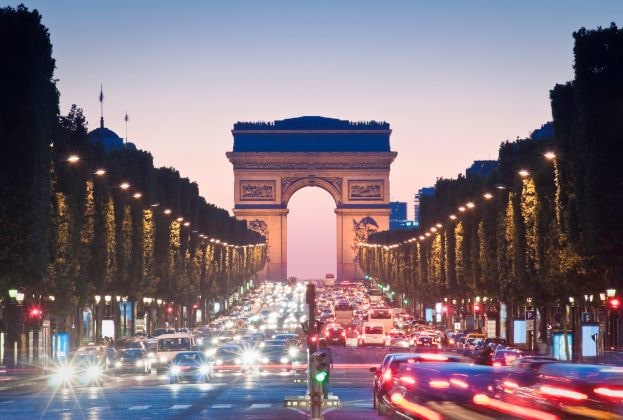
The first road phase from Le Bourget generally brings the vehicle toward the northern edge of Paris, commonly through the A1 and Porte de la Chapelle corridor, but the decisive part of the transfer begins after that approach. The Right Bank is not one compact destination. The 8th arrondissement extends from the Madeleine and Faubourg Saint-Honoré area toward the Champs-Élysées, Avenue Montaigne and the Arc de Triomphe. Place Vendôme sits in the 1st arrondissement. Opera-area addresses may be in the 9th or at the 1st-2nd boundary. Each destination creates a different final street pattern, curb problem and walking requirement.
An 8th-arrondissement meeting near the northern or western side of the district may allow a more direct descent from the northern approaches than a Place Vendôme appointment deeper in central Paris. That does not make it reliably fast. Congestion can migrate between the Boulevard Périphérique, major approaches, boulevards and local streets, while works, demonstrations, security activity and weather can change the usable path. The route should be selected from current conditions, not from a remembered favorite.
Place Vendôme deserves special attention because it lies inside the Paris Centre limited-traffic zone covering the 1st through 4th arrondissements, with stated exclusions around parts of the perimeter. The City of Paris explains that motorized through-traffic is prohibited continuously, while traffic with an origin or destination inside the zone remains permitted; taxis and VTCs are among the listed exemptions from the transit prohibition. The planning consequence is not that Place Vendôme is inaccessible. It is that the driver needs an actual destination and should not treat central Paris as a casual shortcut. The official explanation is here: City of Paris guide to the Paris Centre limited-traffic zone.
The exact hotel base can also change the sensible first commitment. A traveler staying in the 8th may be able to combine luggage receipt and a nearby meeting with less cross-city exposure than someone staying in Saint-Germain. For the broader accommodation tradeoff, see choosing a Paris base by neighborhood. The important point on arrival day is functional geography: where the bags, traveler and appointment need to end up, and whether those three destinations coincide.
When a fixed cutoff cannot absorb uncertainty, coordination becomes the product
There is a point at which a standard pickup is no longer enough. It arrives when the appointment cannot absorb uncertainty in aircraft timing, border release, luggage loading or cross-city movement. At that point, the material service is not a more polished car. It is one coordinated plan linking the handler, vehicle, luggage destination, live route, appointment contact and fallback authority. The benefit is measurable: fewer unowned gaps, faster decisions and a lower chance that the passenger reaches the correct district with the wrong bags or without anyone having warned the venue.
This is also when a separate luggage vehicle, a direct hotel handoff, an arrival-side coordinator or a revised first meeting may be worth arranging. The correct configuration depends on the party, baggage, security requirements and consequence of delay. For help shaping that handoff around a fixed Paris commitment, Inquire now. A relevant supporting service page is Paris airport-arrival coordination, but the decision should still begin with the appointment’s constraints rather than a preset transport package.
Use live road intelligence at three decision points
A navigation estimate at the moment of booking has almost no evidentiary value for a future Le Bourget transfer. What is useful is a monitoring sequence. Check the northern approach before the vehicle is dispatched, check it again when the aircraft’s landing estimate becomes credible, and make the final route decision when passengers and luggage are ready to move. Those checks should look beyond one headline travel time. The relevant questions are whether the A1 approach is flowing, whether the Boulevard Périphérique sector is compromised, and whether the final central streets are affected by an incident or restriction.
Sytadin, operated by the Direction des routes Île-de-France, publishes current and reference travel times for regional road sectors. Its sector page includes the A1 segment from La Courneuve-A86 to Porte de la Chapelle-Boulevard Périphérique, as well as Boulevard Périphérique sectors. That makes it a useful official verification source for the northern road phase, though it cannot predict the complete door-to-door time or every local street condition. Use the page close to movement, not as a static promise: Sytadin travel times by sector.
Route choice is conditional. The A1 toward Porte de la Chapelle is the obvious strategic axis for many central destinations, but an incident may justify a different ring-road or urban approach. Local roads can look attractive when the motorway slows, yet they may add junctions, school traffic, deliveries and unpredictable signals. A driver with current information should choose the route; an itinerary should define the acceptable arrival deadline and fallback trigger. Confusing those roles leads to arguments over streets while the real decision, whether to preserve or release the appointment, goes unmade.
Set one communication threshold before departure from Le Bourget. For example, the coordinator might tell the venue when the vehicle starts moving, then send another update only if the predicted arrival crosses the agreed latest-acceptable time. That reduces noise while preserving professional notice. The venue does not need every fluctuation in the navigation display. It needs a credible arrival estimate and an early warning if the commitment is at risk.
The final two hundred meters can consume the remaining buffer
Central Paris arrival is not complete when the vehicle reaches the neighborhood. A Place Vendôme or 8th-arrondissement address may involve a restricted stopping point, an occupied curb, a security-controlled entrance, a courtyard, an internal reception or a short walk from the legal drop. Rain, multiple bags, formal clothing, mobility needs or confidential materials can make that final segment slower and more consequential. Build it into the plan rather than assuming an instantaneous curb-to-chair transition.
Paris delivery bays illustrate why curb space should not be treated as private waiting space. The City defines these bays as stopping areas, not parking places, for loading or unloading goods or people. It states that the driver must remain near the vehicle, that stops are limited to 30 minutes, and that a European parking disc is mandatory. Permanent and periodic bays have different conditions. These rules do not guarantee that a bay will be free at the required moment, nor do they authorize a vehicle to occupy it while the passenger attends a long appointment. The official guidance is here: City of Paris logistics and delivery-bay rules.
The driver should therefore receive a primary drop point and a secondary legal option. The traveler should know whether an assistant will meet the vehicle, whether the building has a porter or security desk, and which bags leave the car. If the entrance is on a pedestrianized or controlled frontage, the plan should identify the closest appropriate vehicle access rather than promising door service where the street does not allow it.
For an appointment with strict admission, aim to arrive in the district early enough to absorb this last segment. Waiting nearby with the passenger is often safer than using the entire buffer on the motorway and hoping the curb is clear. The early-arrival point should be comfortable, lawful and compatible with the luggage plan. It need not become sightseeing; its purpose is to convert road uncertainty into controlled waiting close to the venue.
Decide whether the traveler and luggage should stay together
Keeping passenger and luggage in one vehicle is operationally simple and preserves a clear chain of custody. It works best when the vehicle can fit everything, the appointment permits a quick curb handoff, and the bags can remain securely attended during the meeting. It becomes weaker when the appointment is long, the vehicle cannot wait nearby, the hotel lies in a different direction, or the contents require a more explicit security arrangement.
Separating the movement can protect the appointment. One vehicle takes the traveler and essential hand items directly to the Right Bank while another transfers checked luggage to the hotel. This can save time only when the split has been arranged before landing, both vehicles are staged correctly, the hotel has confirmed receipt, and responsibility for every bag is documented. An improvised split at the airport can do the opposite: create duplicated calls, uncertain bag counts and a second arrival that no one is ready to receive.
A third model is to make the hotel the first controlled handoff and place the first appointment nearby or later. This is especially sensible when the traveler needs to change, retrieve documents, meet an adviser or confirm the condition of valuable items. It may add a stop, but it can reduce total risk if the hotel is in the 8th and the meeting is nearby. The cost is that the calendar must admit the stop honestly; calling it a five-minute bag drop when reception, unloading and room access are uncertain simply hides another layer.
Do not assume the FBO, hotel, appointment venue or vehicle provider will store unattended luggage. Ask the specific party, obtain a clear acceptance, and record who will sign or message on receipt. For collectors, confidential paperwork and portable valuables should normally remain under the protocol chosen by the owner and their advisers. The logistics plan coordinates movement; it does not determine professional security, customs, insurance or conservation requirements.
Failure modes should already have named responses
A strong arrival plan does not try to predict the one thing that will go wrong. It identifies the small set of failure modes that can break the first commitment and gives each one an owner. The response should be simple enough to use while the aircraft, handler, driver, hotel and venue are all communicating. Long contingency documents are less useful than clear authority and pre-agreed thresholds.
- The aircraft is late: update the usable landing estimate, recalculate the full layered buffer, and release or move the appointment before the venue’s notice window closes.
- Border release takes longer: keep the driver staged, tell the destination that the aircraft has arrived but passengers are not yet released, and do not send a road estimate based on landing alone.
- Luggage does not fit: keep essential items with the traveler, activate the pre-arranged second vehicle or hotel-bound solution, and confirm the final bag count before either vehicle moves.
- A road incident closes the preferred approach: let the driver select the live alternative while the coordinator compares the new arrival estimate with the appointment cutoff.
- The curb or entrance is inaccessible: use the approved secondary drop point, have the venue contact meet the passenger when possible, and preserve enough time for the walk and security process.
- The appointment refuses late admission: stop spending the remaining day trying to recover an impossible entry; activate the alternative agreed with the venue or replace the slot with a low-risk nearby commitment.
- The party splits unexpectedly: assign one lead per vehicle, confirm destinations in writing, and state which person has passports, documents and essential bags.
The most damaging failure is often not the original delay but the late decision. A traveler can lose another hour while several people debate whether the meeting might still be possible. The appointment’s latest-acceptable arrival time should therefore be known before landing. Once the live estimate crosses it, the authorized person acts. That might mean moving the meeting, switching to a video call if the host agrees, going first to the hotel, or preserving a later appointment rather than sacrificing the whole sequence.
There should also be a luggage-security response if the appointment is missed. If the vehicle can no longer wait, bags go to the pre-agreed hotel or other accepted destination with an identified recipient. If no secure receipt has been confirmed, passenger and luggage remain together until one exists. A missed meeting is inconvenient; an unowned luggage handoff can become the larger problem.
A fallback should protect the rest of the Paris sequence
The fallback is not merely “reschedule.” It should preserve the people, objects and later commitments that made the first appointment important. For an executive, that may mean moving a meeting to the hotel, shortening it, or protecting the next fixed event. For a collector, it may mean retaining a specialist consultation while postponing the object viewing, or reversing two nearby appointments if both hosts agree. These are possibilities to confirm with the relevant parties, not assumptions about what they will permit.
Design the fallback around geography. If the vehicle is already approaching the 8th and the Place Vendôme appointment is lost, it may be better to continue to the hotel or a later 8th-arrondissement commitment than to cross the center for a replacement activity. If the traveler is near Place Vendôme, a low-movement substitute should stay nearby. A replacement that sends the car across Paris simply transfers the same risk to the next part of the day.
The fallback should also be low-friction. Avoid adding timed admissions, complex security, a long meal or a museum visit with a distant entrance merely because a calendar gap has appeared. A private meeting room, hotel-based preparation, document review, a short neighborhood orientation or rest may be more useful. The goal is to restore control, not fill every minute. Later, the arrival day can connect to a fuller plan such as building the rest of a three-day Paris stay without forcing the first hours to carry the whole trip.
Write the fallback in one sentence before departure: “If arrival at the venue is predicted after the cutoff, notify the host, send luggage to the confirmed hotel recipient, and take the passenger to the hotel or the next nearby commitment.” The actual sentence will differ, but it should name the trigger, communication, luggage destination and passenger destination. That is enough to prevent a delay from becoming an improvised cross-city tour.
Recheck handling, border and road conditions in a fixed sequence
The evidence for this topic is operational and therefore perishable. A guide can explain the decision method, but the handler, official road sources, City of Paris rules and appointment provider control the live facts. Recheck after any substantive change to the flight, handler, baggage, destination or appointment terms. On the day, verify again rather than relying on a saved screenshot or an estimate from the booking date.
- Twenty-four to forty-eight hours before: confirm the handler, arrival origin, likely border process, passenger count, luggage profile, vehicle capacity, hotel acceptance and appointment cutoff.
- Before departure: confirm the latest flight estimate, the driver’s exact staging instructions, the destination entrance and the person authorized to change the plan.
- When landing becomes credible: check Sytadin and relevant local access information, then compare the resulting road allowance with the appointment threshold.
- After passenger release: count bags, confirm who holds essential items, state the actual vehicle-movement time and send one credible arrival update.
- At the city edge: recheck the final approach and switch to the secondary drop point if the primary access is compromised.
The recheck trigger is especially important for non-Schengen arrivals because the presence and timing of border processing can alter the release phase. It is equally important when Paris has unusual road conditions, demonstrations, security perimeters, major works or severe weather. Do not infer that a private-aviation arrival is insulated from city conditions. It simply reaches a different airport process before entering the same regional road network and dense central streets.
Appointment terms also deserve a fresh check. A venue may change its entrance, identification requirement, late policy or contact person. Send the traveler only the information they need: exact address, entrance, host, cutoff, and what to carry. Keep the longer operational brief with the coordinator. That separation lets the passenger move confidently without asking them to manage the entire transfer.
Give every participant the same one-page handoff brief
The final planning document should be short enough to read on a phone. Include the flight identifier or tail reference used by the operating team, scheduled and latest estimated arrival, handler and exact facility, lead passenger, party size, luggage count and special pieces, vehicle configuration, primary and secondary destinations, appointment contact, latest acceptable arrival, fallback instruction, and the person authorized to make changes. Sensitive information should be shared only with those who need it through an appropriate channel.
The driver version should emphasize staging, luggage fit, route monitoring, destination entrance and secondary drop. The handler version should emphasize passenger release, vehicle identity and luggage handoff. The hotel version should emphasize expected bag arrival, recipient and storage acceptance. The appointment version should receive the passenger name, realistic update points and the agreed late rule. Everyone should use the same destination wording; small naming differences around Place Vendôme, hotel entrances and maison addresses can create avoidable confusion.
For travelers arranging a broader private stay, private Paris tours and tailored planning can serve as the commercial next step after the logistics are defined. The arrival plan should still remain modular. Transport, guiding, hotel coordination and the first appointment may be connected, but each handoff needs a named owner and a fallback that works even if another part changes.
The practical standard is straightforward: the first Paris commitment should inherit certainty from the transfer plan, not uncertainty from the flight. Start with the appointment consequence, separate every clock, keep luggage ownership visible, use live road evidence, and move or remove any engagement that only works under favorable assumptions. A Le Bourget arrival can be efficient. The itinerary becomes reliable when it is designed for the moments when efficiency is not enough.
If you’re interested in any private tours of Paris, please reach out to us.













 So if you are looking for the absolute best in Paris & surroundings with authentic local fully-licensed native guides whose English you can actually understand and with an exclusive and amazingly fun itinerary