Napoleon’s Paris and Malmaison: A Three-Act Sequence of Power, Private Court and Memory

Updated
Can one Napoleonic day explain power without becoming a forced march through dates and trophies?
Paris makes it easy to accumulate Napoleon. His name appears on bridges, streets, façades, paintings, uniforms, tombs and the monumental axis of the city. The harder task is to decide which places actually change the argument. A traveler can spend hours identifying eagles and battle names yet leave with only a larger catalogue. The more revealing day asks three different questions in succession: how did Napoleon project victory in public, how did power operate inside a residence that was also a working political environment, and how did later regimes turn his remains into a national memory?
Those questions produce a three-act sequence: the Arc de Triomphe, the Château de Malmaison, then the Dôme des Invalides and Napoleon’s tomb. The order is not based on whichever monument is closest to the hotel. Nor is it a strict timeline of construction dates. It is a political chronology of claim, practice and afterlife. The Arc presents power at the scale of the capital. Malmaison contracts the field to rooms, habits, papers and court relationships. Invalides expands it again, but now through the decisions of people governing France after Napoleon’s death.
The sequence matters because each site corrects the one before it. The Arc can make the regime seem inevitable and monolithic; Malmaison restores contingency, labor and personality. Malmaison can make the story feel intimate; Invalides shows how intimacy was later absorbed into state ceremony. Seen in reverse, the tomb tends to dominate everything that precedes it. Seen as isolated attractions, the three places become unrelated collections. Seen in this order, they form one biography written in urban space, domestic architecture and commemorative design.
This is also why the day should remain selective. Not every Napoleonic object is equally useful. The governing principle is dependency: keep the objects and spaces that answer the next question, and leave secondary detail behind when it no longer advances the sequence. Travelers who enjoy historical days built around a clear interpretive arc rather than a general checklist may also find the same discipline useful in this Paris Revolution sequence from Palais-Royal to the Conciergerie.
The day’s shape: westward first, then back to the center
The practical route follows the argument with relatively little wasted movement. Begin at the Arc de Triomphe, on the western edge of central Paris. Continue west to Malmaison in Rueil-Malmaison. Return to Paris for Invalides. That creates one suburban transfer rather than two, and it allows the tomb to function as a conclusion rather than an opening image that overwhelms the day.
An illustrative plan is a brief exterior-led Arc visit in the early morning, a late-morning Malmaison visit before its midday closure, a return toward Paris with a restrained lunch, and Invalides in the afternoon. Exact hours should be rebuilt around the date of travel. The Château de Malmaison’s official practical page, verified on 6 October 2026, lists Tuesday closure, a daily museum shutdown from 12:30 to 13:30, seasonal afternoon closing times and last-admission rules. Those details are operational rather than interpretive, and they can change; consult the official Malmaison visitor information again before fixing the day.
The lunch shutdown is not a minor footnote. It determines whether the sequence feels composed or improvised. Arriving at 12:10 with the expectation of a full visit produces either a truncated middle act or an hour of dead time outside the museum. The better pattern is to reach Malmaison with enough margin to complete the principal rooms before 12:30, or to plan deliberately for the 13:30 reopening and accept a later return to Invalides. Because the final site also requires concentration, the morning option is usually the more coherent choice.
Public transport is possible, but it adds dependencies. The official Malmaison page lists Bus 258 from La Défense to the stop called Le Château and also gives an RER-based approach. A traveler starting at the Arc must first connect to the western transport network, then manage the final suburban leg and the return. That can be entirely reasonable for an unhurried day. It is less forgiving when the museum’s midday closure, a rooftop slot at the Arc or a fixed afternoon commitment at Invalides is already in play. The cost is not simply minutes; it is the loss of interpretive continuity while watching connections and last-admission cutoffs.
Act I: the Arc de Triomphe and the public invention of victory
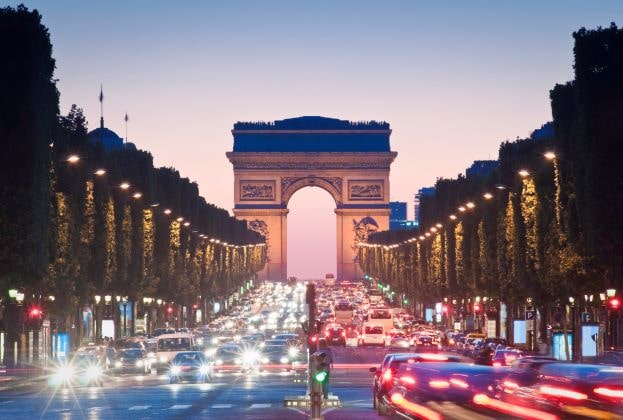
The first act should begin outside, before attention fragments into sculpture, inscriptions and panoramic views. Stand far enough back to read the Arc as a single opening on the historical axis. Its most important feature is not a particular carved figure but the scale of the void itself: a gateway large enough to convert military achievement into an entrance for the ruler and his forces. The monument does not merely report victory. It imagines Paris as the destination and audience of victory.
The official history of the monument explains that Napoleon chose Place de l’Étoile for a single-opening triumphal arch conceived as a gateway to Paris. It also records the revealing solution adopted when the permanent structure was still unfinished: a full-scale temporary arch was erected for the 1810 ceremonial entry of Napoleon and Marie-Louise. The Arc de Triomphe’s official historical account is especially useful here because it shows that spectacle did not wait for stone. The image of completed power could be staged before the monument itself existed.
That temporary structure is the first decisive object of the day, even though it survives only through documentation and reconstruction. It separates political function from architectural permanence. Napoleon needed the gateway for a public act in 1810; the state could supply an illusion of completion because the ceremony mattered more than the material’s durability. The permanent Arc, finished only after the fall of the Empire, then became a vessel for later regimes and later national commemorations. It is therefore both Napoleonic and post-Napoleonic from the beginning.
This is the moment to resist a common interpretive shortcut. The monument’s size can tempt visitors to treat it as a straightforward expression of an all-powerful emperor. Its construction history says something subtler. Imperial power was ambitious enough to claim the urban horizon, but dependent enough on time, labor, money and regime survival that the claim outlasted its author. The gap between the 1810 temporary arch and the later finished monument is not an embarrassment to be rushed past. It is evidence of how political imagery can precede, and even substitute for, completed reality.
The radial setting adds another layer. From the center of the Place Charles-de-Gaulle, avenues radiate outward, making the Arc appear to command movement in every direction. Yet most of that urban geometry belongs to transformations later than Napoleon’s original commission. The correct reading is layered rather than proprietary: Napoleon initiated the monumental claim; nineteenth-century Paris made the setting more powerful than he had known it. A specialist day should identify that distinction rather than attributing every sightline to one ruler.
What deserves attention at the Arc
- The single opening and the axis. Read the Arc first as a political threshold. Ask who is imagined entering, who is watching and how the capital becomes part of the performance.
- The temporary arch of 1810. Use it to understand spectacle as an instrument of government, not merely as decoration.
- The delayed completion. Hold together Napoleon’s commission and the monument’s post-imperial life. The Arc is a claim whose final form was controlled by successors.
- The sculptural and inscribed program. Sample it for the conversion of campaigns into a public canon, but do not attempt to decode every name. A few well-chosen examples are more useful than exhaustive transcription.
The rooftop is optional rather than structurally necessary. It can clarify the monument’s command of western Paris, but the ascent should not consume the margin needed for Malmaison. If access is slow, the exterior still completes the first act. The day’s argument depends on the Arc as gateway and unfinished promise, not on securing every viewpoint.
The first transition: leaving monumental certainty for a working residence
The journey to Malmaison is not dead space. It is the first interpretive transition and should be named as such. At the Arc, power appears impersonal, durable and visible to the whole city. At Malmaison, it becomes contingent on rooms, correspondence, meals, study, friendship, rivalry and administrative work. Moving west out of Paris is therefore a change of scale from national façade to household machinery.
A smooth transfer helps preserve that change of scale. This is one of the few points where private transport can materially alter the intellectual quality of the day. The benefit is not a display of comfort for its own sake. It is control over a narrow arrival window at Malmaison, less cognitive interruption between two dense historical sites, and the ability to leave promptly for Invalides once the middle act is complete. A driver is most useful when paired with a guide who can use the journey to reset the questions rather than filling it with an unrelated biography.
That does not make a car obligatory. It does mean the public-transport version should be planned as a different tempo, with fewer fixed extras. Do not combine an Arc rooftop commitment, a tight Malmaison arrival and a heavily programmed Invalides visit unless there is generous margin. A day can be historically rich or operationally brittle; it should not be both.
On the outward journey, keep one sentence in mind: Malmaison is not an escape from politics. The suburban setting, smaller scale and association with Joséphine can make it feel like a domestic counterweight to imperial Paris. The evidence points instead to a hybrid place where private life, court culture and government work overlapped. That overlap is the reason to travel there.
Act II: Malmaison as private court, administrative workplace and cultivated self-image
Malmaison is the day’s indispensable middle because it changes the meaning of “private.” In modern travel language, a private residence can sound like a retreat from public duty. Under the Consulate and Empire, the boundary was more porous. A residence could be intimate without being apolitical. Decisions, appointments, correspondence and ceremonial relationships followed the ruler and his household. The rooms matter because they show how authority adapted itself to domestic scale.
Begin with the sequence of spaces rather than with a search for the most famous object. Reception rooms establish sociability and display. The council room and library shift the emphasis toward work, reading and decision. Apartments restore personal routine and bodily presence. Joséphine’s rooms introduce another center of agency: not a parallel sovereign, but a court figure whose education, collecting, patronage and social intelligence helped shape what Malmaison represented.
The tent-like language associated with the council room is particularly revealing. Military reference is brought indoors and made architectural. The effect is not that the château becomes a battlefield headquarters in a literal sense. It is that campaign identity is converted into a durable interior vocabulary. Command can be performed in a room through drapery, shape, furniture and controlled access. At the Arc, military glory is scaled to the city; here it is scaled to conversation and decision.
The library performs a different kind of authority. Shelves, desks and ordered knowledge make rule appear disciplined and informed. Whether or not a visitor sees every object in its customary position, the room’s interpretive function remains clear: power is shown as reading, drafting, consulting and directing. This is where a documentary anchor becomes more valuable than a decorative inventory.
A letter written at Malmaison on 7 September 1801 makes the point with unusual precision. In it, Napoleon instructed Interior Minister Jean-Antoine Chaptal to question the prefects about military subsistence, forage, convoys, hospitals, requisitions and reimbursements. The document, preserved in the Napoleonica archive, reveals a ruler attending to the logistical underside of military power from Malmaison. The Arc turns war into victory; the letter turns victory back into grain, horses, transport, hospitals, accounts and provincial administration.
This is one of the strongest transitions in the entire day. A battle name carved on a monument compresses complexity into glory. The Malmaison letter expands it again. Armies require provisioning; central orders depend on prefects; military ambition creates paperwork and claims for reimbursement. The document also prevents the visit from becoming a costume drama. The house was beautiful, but beauty existed beside administrative extraction and the material burdens of war.
Joséphine’s court was also a culture of learning
Joséphine should not enter the narrative only as spouse, style icon or collector of rare things. Her presence at Malmaison adds a second form of political self-fashioning: cultivated knowledge. Historian Charles-Éloi Vial has examined the work of librarian Nicolas Halma, who taught Joséphine history and geography at Malmaison with five manuscript tables mounted on silk, designed to fold out and stored in red morocco boxes. The tables combined chronology and geography with visual material. Vial’s scholarly study of Joséphine’s educational tables supplies a rare, concrete view of learning inside the household.
Those tables should be used carefully. They are evidence of an educational practice associated with Malmaison; they should not be described as guaranteed current displays unless the museum confirms that for the date of visit. Their interpretive value does not depend on being in a case. They show that the private court was a place where historical knowledge could be organized, visualized and performed. The red morocco boxes, silk backing and fold-out format also join scholarship to luxury craftsmanship. Knowledge itself was given courtly material form.
Place that beside the 1801 administrative letter. Napoleon’s document organizes the territory through questions to prefects about supply. Joséphine’s tables organize time and territory through historical and geographical learning. One concerns the state’s capacity to move resources; the other concerns a courtly individual’s capacity to place herself within a larger world. Together they reveal Malmaison as an environment of classification. Power here is not only commanded. It is arranged, taught, filed and made visible.
The rooms should be read as relationships, not isolated décor
A useful Malmaison visit follows relationships between spaces. The council room gains meaning when set against the library: performance of command beside the tools of work. Joséphine’s apartments gain meaning when set against formal reception rooms: personal identity beside courtly role. The smaller scale of the château intensifies these relationships because transitions happen quickly. A visitor can move from public hospitality to decision-making to personal space in minutes.
This compression is precisely what the Arc lacks. Monumental architecture suppresses the ordinary dependencies of rule. Malmaison restores them, but it can also seduce visitors into overcorrecting. Intimacy does not equal innocence. A polished table, a cultivated lesson and an elegant room were parts of a political household connected to war, patronage, office and social hierarchy. The responsible reading holds charm and consequence together.
Nor should every imperial emblem receive equal time. Eagles, monograms, portraits and campaign references can be sampled as a visual language of legitimacy. Once that language is understood, repetition adds little. Give priority to objects or spaces that reveal a mechanism: how a room channels access, how a desk concentrates work, how a document connects the estate to the departments, how a teaching object constructs historical consciousness.
For travelers who respond to houses as evidence rather than as decoration, Malmaison also provides a useful standard for other excursions: a château deserves the journey when the interior changes the argument, not merely when it adds another grand façade. That same principle underlies this sequence for Fontainebleau and Vaux-le-Vicomte, where order also determines what the second residence can explain.
How long the middle act needs
Allow roughly ninety minutes to two hours for a focused visit, depending on room access, temporary displays and the group’s depth of interest. Less than an hour risks reducing the château to décor. Much more than two hours can consume the attention needed for Invalides unless Malmaison is the principal purpose of the day. The right duration is reached when the group can answer three questions: where was authority staged, where was work done, and how did Joséphine’s cultivated court widen the meaning of the residence?
Once those answers are secure, leave. The temptation to complete every label is especially costly here because the return to Paris is still ahead. The middle act should be complete, not exhaustive.
The second transition: from lived power to power recalled
The return from Malmaison to Invalides changes the subject from a living household to a posthumous political project. This is more than a move from suburb to center. It crosses from evidence created during Napoleon’s rule to architecture reorganized by later France in order to receive his memory.
A concise lunch belongs in this transition, not as a separate destination. The day is already dense, and a long meal can break the thread between the estate and the tomb. Choose a location that supports the return route rather than pulling the group toward another quarter. Travelers building a longer stay can place the richer dining experience elsewhere in the itinerary; this guide to shaping three, four or five days in Paris can help protect a specialist history day from carrying too many unrelated ambitions.
During the transfer, revisit the evidence rather than adding new biography. The Arc showed a gateway staged before its permanent completion. Malmaison showed the material and intellectual work behind authority. Invalides will ask who controlled Napoleon’s image after he could no longer control it himself. That question prepares the eye for the Dôme.
Act III: Les Invalides and the state construction of Napoleon’s afterlife
At Invalides, begin with the building before the sarcophagus. The Dôme already possessed a military and religious history before Napoleon’s remains arrived. Napoleon himself used it in 1800 as a pantheon of military glories. Decades later, Louis-Philippe’s government ordered the return of Napoleon’s remains from Saint Helena in 1840, and architect Louis Visconti transformed the interior by excavating beneath the dome to create the monumental tomb setting. The Musée de l’Armée’s official account of the Dôme and tomb makes clear that the place is both Napoleonic initiative and post-Napoleonic reconstruction.
This dual authorship is the key to the final act. Napoleon contributed to the Dôme’s military meaning, but he did not design the tomb through which most visitors now encounter him. The return of the remains and the architectural reworking belonged to a later monarchy seeking its own relationship with revolutionary and imperial France. The tomb therefore tells us as much about the politics of the 1840s and subsequent commemoration as it does about Napoleon’s wishes.
The spatial choreography reinforces that distinction. Visitors encounter the tomb through a controlled sequence of approach, overview and descent. The open circular arrangement allows the monument to be seen from above while also drawing people downward into a closer orbit. This is not merely a container for remains. It is an architecture of attention. The body is placed at the center, but the visitor’s movement is designed by later hands.
That downward gaze is one of the day’s most important visual experiences. At the Arc, the eye is sent outward along the city’s avenues. At Malmaison, it moves laterally through rooms and relationships. At Invalides, it is directed inward and down toward a monumental center. The three sites choreograph three political positions: power entering the capital, power circulating through a household, and memory fixed beneath a national dome.
The tomb should not be mistaken for a neutral ending
A tomb can feel conclusive because it gathers a life into one place. Here, that feeling is itself historical evidence. The return from Saint Helena was a political act, and the tomb’s scale converts a contested ruler into a figure around whom national history can be staged. It does not erase conflict; it monumentalizes a version of continuity.
The correct question is not simply whether Napoleon deserved such a monument. That moral and political debate is larger than one visit and cannot be resolved by grandeur. A more precise question is: what did later France need Napoleon to become in this space? Military hero, lawgiver, sovereign, national ancestor, warning, object of reconciliation? The Dôme accommodates several answers at once, which is why it has remained powerful.
The surrounding military context matters. Invalides is not an isolated mausoleum built solely for one man. The institution’s broader history, collections and commemorative functions place Napoleon among longer traditions of French military service and state memory. That setting can either contextualize him or enlarge him, depending on how the visit is handled. A guide should keep returning to authorship: which layer belongs to Napoleon’s own rule, which to Louis-Philippe’s decision to repatriate the remains, which to Visconti’s architectural intervention, and which to later national commemoration?
What deserves attention at Invalides
- The Dôme as inherited space. Recognize that Napoleon entered an existing military and sacred setting rather than creating a blank stage.
- The 1800 pantheon project. This establishes Napoleon’s own use of the building for military glory before his personal tomb was imagined there.
- The 1840 return of the remains. Treat repatriation as a decision by a later regime with its own political needs.
- Visconti’s excavation and spatial design. The architecture makes the visitor look, circle and descend. That choreography is part of the historical argument.
- A small number of collection objects, if time allows. Choose items that connect the lived regime to the commemorative one. Do not dilute the final act with an indiscriminate sweep through every campaign gallery.
For many history travelers, the permanent collections at the Musée de l’Armée are deeply rewarding. They are also the point at which the day can lose its shape. If the group has already spent two concentrated hours at Malmaison, choose a compact set of galleries or objects linked to the questions carried forward from the château. The tomb must remain the conclusion, not one stop among twenty.
The object hierarchy: six anchors are enough
A specialist itinerary becomes stronger when it names what not to pursue. The following six anchors can carry the whole day even when temporary displays change or one room is unavailable.
- The Arc’s single opening. It turns military movement into a public entrance and makes the capital the audience of victory.
- The 1810 temporary arch. It proves that the political image of completion could matter before permanent completion.
- Malmaison’s council room and library as a pair. They show command performed and administration sustained at domestic scale.
- The 1801 letter to Chaptal. It reconnects imperial glory to provisioning, convoys, hospitals, requisitions and local administration.
- Joséphine’s fold-out educational tables. They show history and geography being materialized as courtly learning, even when the original objects are not on current view.
- The excavated tomb space at Invalides. It reveals the later state physically remaking an inherited building to house Napoleon’s memory.
These anchors are deliberately uneven. Two are monumental spaces, two are documents or documentary objects, one is a pair of rooms, and one is a later architectural intervention. That variety prevents the day from becoming a parade of relics. It also allows evidence to survive changes in display. A room may close, a manuscript may not be exhibited and weather may make the Arc rooftop impractical, but the argument can still hold.
Secondary material should be chosen for support. A portrait can clarify self-presentation. A uniform can restore bodily scale. A campaign map can connect logistics to territory. Decorative motifs can show the repetition of imperial language. None should displace the six anchors unless it provides a stronger answer to the day’s three questions.
Optional branches when the full sequence is not available
The city-only branch
If Malmaison is closed, if the date falls on a Tuesday, or if the group cannot tolerate the suburban transfer, do not pretend that two central monuments offer the same story. Build a different, honest sequence: Arc de Triomphe, selected First Empire material within the Musée de l’Armée, then the Dôme and tomb. The argument becomes public victory, the military-administrative regime and posthumous memory. It loses the private-court dimension, Joséphine’s educational world and the evidence of government operating inside a residence.
This city-only version works best as a half-day or a deliberately lighter full day. At the Arc, establish the staged gateway and delayed completion. At the museum, select only objects that reveal organization, command and the material life of the army. Finish beneath the Dôme with the later politics of repatriation. The branch remains coherent because the middle section explains how military power functioned, but it should be described as an alternative thesis, not a substitute Malmaison.
The shorter branch
When only three to four hours are available, use the Arc and Invalides alone. This creates a sharp comparison between power projected and power remembered. It is intellectually clean but intentionally incomplete. The absent question is how authority operated in lived, interpersonal space. State that absence rather than filling it with hurried anecdotes during the drive.
The Malmaison-first exception
Starting at Malmaison can be justified when its opening window is the non-negotiable constraint, especially on short winter days or when a special access condition requires the earliest slot. In that case, use the transfer back to Paris to establish the Arc as a projected gateway and visit it after the château, then continue to Invalides. The interpretation changes slightly: private machinery precedes public image. This can be illuminating, but the Arc no longer performs the opening act described here. The revised order should be acknowledged, not disguised.
Do not start at Invalides unless the tomb is the sole priority. Its visual and emotional weight makes later rooms at Malmaison feel like appendices. For a three-act day, memory belongs last.
Transition costs that should shape the decision
The route contains three kinds of cost: time, attention and uncertainty. Time is obvious: Malmaison sits outside central Paris, and traffic or connections can vary. Attention is subtler: changing modes, checking stops and watching a closure window consume mental energy that would otherwise support interpretation. Uncertainty arises from operational details such as last admission, room access and seasonal hours.
A well-built day reduces all three without trying to eliminate them. It gives the Arc a firm departure time. It treats Malmaison’s 12:30 to 13:30 closure as a structural constraint. It keeps lunch simple. It avoids adding a major museum before or after Invalides. It also accepts that an ascent, a gallery or a particular object may need to be dropped.
Private transport has its strongest case when the group values a historian-led sequence and the Malmaison window is narrow. The material outcome is not merely a smoother ride. It is the preservation of the argument across dispersed sites: departure from the Arc before the visit expands, timely arrival at the château, and a controlled return to Invalides while the middle act is still intellectually present. For travelers who want that coordination, private Paris touring with a route built around the historical sequence is more relevant than adding generic sightseeing between the three anchors.
Public transport remains a sound choice when the day has no evening pressure and the group is comfortable with transfers. In that version, remove the Arc rooftop unless its timing is secure, carry only a light lunch plan, and allow a larger buffer before Invalides. The itinerary should become simpler as transport becomes more variable.
The stopping rule: end when the three questions have been answered
The day is complete when the group can state, in its own words, how the three places differ. The Arc converts victory into a gateway for the capital. Malmaison reveals power as household, work, education and administration. Invalides shows later France converting Napoleon into monumental memory. Once those distinctions are clear, another imperial object is more likely to blur the argument than deepen it.
That is the stopping rule at each stage as well. Leave the Arc when its void, temporary predecessor and delayed completion are understood. Leave Malmaison when the relationship between court life and government work is legible. Leave Invalides after the group has separated Napoleon’s own use of the Dôme from the later return of his remains and Visconti’s transformation of the space.
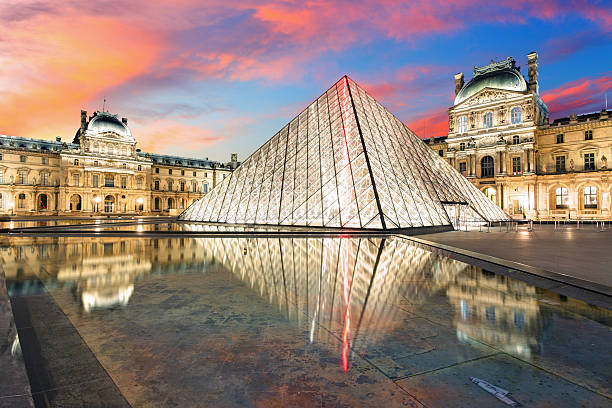
Do not append the Louvre simply because it is famous, or the Eiffel Tower because it is nearby enough to imagine fitting in. Those places can belong to the trip, but they answer different questions. A focused historical day earns its coherence by refusing the extra monument that contributes only prestige. It also leaves room for conversation afterward, which is often when the distinctions between the three acts become most useful.
Decision recap: when this sequence is worth the suburban journey
Choose the full Arc–Malmaison–Invalides sequence when the purpose is to understand how Napoleonic power was fashioned across public spectacle, private court life and later national memory. Keep the Arc exterior-led and selective. Give Malmaison the protected middle window it requires. Treat the 1801 letter and Joséphine’s educational tables as evidence that the château was a place of administration and cultivated self-construction, not a decorative pause. End at Invalides, where the later return of the remains and the architecture of the tomb expose memory as a political project.
Choose the city-only branch when Malmaison’s closure, mobility demands or transfer time would make the middle act rushed. Accept that the thesis changes. Choose the two-site branch when time is short and the comparison between public image and posthumous memory is enough. In every version, stop before accumulation overtakes interpretation.
The private-service case is narrow but real: a historian-led day with coordinated movement is valuable when the reader wants the order, timing and suburban transfer to preserve the argument rather than merely collect monuments. That is the natural moment to commission a bespoke sequence around the group’s pace, access needs and date-specific openings. Inquire now
If you’re interested in any private tours of Paris, please reach out to us.



 So if you are looking for the absolute best in Paris & surroundings with authentic local fully-licensed native guides whose English you can actually understand and with an exclusive and amazingly fun itinerary













